Lake Macquarie Council not happy with NSW’s restrictions on wind farms
Concerns over wind farm guidelines, ABC News, Newcastle, March 28, 2012 Lake Macquarie Council will write to the state Planning Department outlining its concerns over the Government’s Draft Wind Farm Guidelines. The Planning Minister Brad Hazzard has described the draft document as the “toughest wind farm guidelines in Australia and possibly the world”.
But the guidelines have been criticised by environmentalists and renewable energy lobbyists as unnecessarily restrictive. Greens Councillor Hannah Gissane agrees. “We’ve endorsed a submission to the draft guidelines exhibition which would pick apart the bits and pieces of it that make the process too onerous,” she said.
“We’ve also endorsed wind farms as a key mechanism in achieving 20 per cent renewable energy by 2020. “And that any guidelines should be part of a strategic facilitative approach to renewable energy.”
Councillor Gissane says the guidelines are too tough and criticism of wind turbines is not warranted.
“Our beautiful Lake Macquarie has ash dams, has coal-fired power stations, has coal mines, has subsidence all from non-renewable energy sources,” she said.
“I’d like to see future for the city where the glint of a solar panel and the whirl of a wind turbine were actually features of the city.” http://www.abc.net.au/news/2012-03-28/concerns-over-wind-farm-guidelines/3916620/?site=newcastle
National Party M.P. John Cobb urged to support new $10 billion renewable energy fund

 Participants are calling on member for Calare John Cobb to get behind the renewable energy fund.
Groups shine light on solar energy http://www.centralwesterndaily.com.au/news/local/news/general/groups-shine-light-on-solar-energy/2490146.aspx. Central Western Daily, BY TRACEY PRISK 16 Mar, 2012 ORANGE Climate Action Now and the Environmentally Concerned Citizens of Orange joined forces on the weekend to support a national push for the formation of a $10 billion clean energy fund. Continue reading
New South Wales Liberal Premier pleased about Clean Energy Finance Corporation for Sydney
 NSW wins multi-billion dollar clean energy deal http://www.news.com.au/national/nsw-wins-multi-billion-clean-energy-deal-despite-opposition/story-e6frfkw9-1226291960573 By Malcolm Farr, National Political Editor news.com.au, arch 07, 2012
Sydney to host Clean Energy Finance Corporation
Premier O’Farrell happy despite opposition to clean energy fund
“This is good news whichever way you look at it”
NSW Premier Barry O’Farrell is torn between opposing the Federal Government’s carbon pricing and his pride in Sydney’s selection as host of a multi-billion dollar clean energy fund. Continue reading
Let’s not forget that other cancer causer – UV radiation
 Students in NSW not sun safe, Sky News, http://www.skynews.com.au/health/article.aspx?id=725215&vId= March 4, 2012 New research shows students in NSW have amongst the poorest sun protection in Australia. The state came second last in a nationwide review of the sun protection policies in government schools by the New South Wales Cancer Council.
It’s now calling for an urgent overhaul of the state’s outdated sun policy so students receive the same sun protection measures as schools in other parts of Australia. Skin cancer prevention manager Vanessa Rock says state schools in NSW were failing to implement basic sun protection measures.
As part of the survey, each state and territory was marked on a list of key sun protection requirements, such as wearing a sun safe hat and using SPF 30+ sunscreen. Queensland, the NT, Victoria and ACT all scored top marks while Tasmania, which has much lower levels of UV radiation, came in at the bottom of the list.
Models banned from tanning, SMH 1 March 12, “….Sue Heward, SunSmart’s manager, calling on Victoria to follow the NSW Government’s decision last month to ban solariums by 2015. ”Not only is solarium use harmful to your health but it can prematurely age the skin making it coarse, pigmented, leathery and wrinkled. It is suggested that 80 per cent of wrinkles are due to overexposure to UV radiation from either the sun or solariums.”
The thinking goes that if the fashion industry sets an example that a tan is not stylish then young women, who are particularly resistant to health warnings, might be persuaded of the dangers of tanning….
.. It has been estimated that each year in Australia, 281 new melanoma cases, 43 melanoma-related deaths, and 2572 new cases of squamous cell carcinoma can be attributed to solarium use.
http://www.smh.com.au/lifestyle/beauty/blogs/beauty-beat/models-banned-from-tanning-20120301-1u4ff.html#ixzz1oYa4mwyR
Australian Nuclear Science and Technology Organisation (ANSTO) pushing for nuclear power for New South Wales
 A NSW power trip, Climate Spectator, Keith Orchison, 6 Mar 12, “.. the NSW Legislative Assembly public accounts committee, chaired by Sydney North Shore MP Jonathan O’Dea, which has been given the task by the O’Farrell government of examining the economics of power generation.
…One answer, says the Australian Nuclear Science & Technology Organisation in a submission to the parliamentary committee, is to consider diversifying the NSW power system, adding renewables, fossil-fuelled plants with carbon capture and storage and reactors to the mix.
Energy security for NSW, says ANSTO, will be at risk without active consideration of nuclear energy, given that the future cost of carbon isn’t known and wind and what-not is intermittent. Given the availability and price challenges gas generation faces, it suggests the stability of nuclear power pricing should make it attractive…..” http://www.climatespectator.com.au/commentary/nsw-power-trip
NSW Wales government will dump radioactive waste at Kemps Creek
 LETTER CONFIRMS O’FARRELL WILL DUMP RADIOACTIVE WASTE AT KEMP’S CREEK (NSW), Beyond Nuclear, 5 March 12, The O’Farrell Government has turned its back on the people of western Sydney – and confirmed it will break its election promise and dump tonnes of radioactive dirt from Hunters Hill in Kemps Creek. This is in addition to radioactive material from the former uranium smelter at Hunters Hill already being sent to the Lidcombe waste facility. In a February 7 letter to Liverpool City Council, the O’Farrell Government confirmed: The material to be removed from the Hunters Hill site is predominantly clean soil interspersed with traces of low level radioactive contamination, the SITA facility at Kemps Creek is the only facility in NSW licensed to accept this class of waste.
New South Wales Renewable Energy Guidelines aim to prevent small scale wind energy!
 “The Guidelines place incredibly strenuous conditions on the development of wind farms that are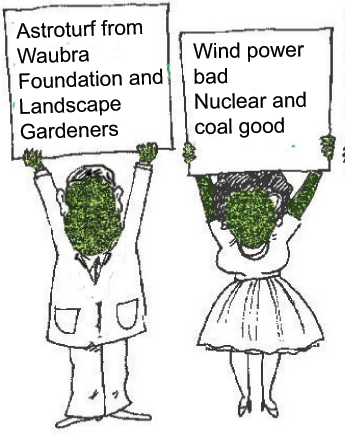
not faced by any other kind of development.
“They appear to have been produced to appease the small anti-wind farm lobby rather than achieving outcomes for the whole community,”
NSW wind farm guidelines shaft clean energy, Green Left, February 16, 2012 The draft planning guidelines for wind farms in NSW, which are now open for public comment, have been labelled inconsistent, too restrictive and politically motivated by environment group Friends of the Earth.
“These guidelines talk about NSW planning to help Australia meet its the 20% by 2020 Renewable Energy Target, but at the same time could pose severe restrictions on the options available to achieve that,” said Ben Courtice, renewable energy campaigner for Friends of the Earth.
“The Guidelines refer to a NSW Renewable Energy Action Plan to be released in 2012, but pre-empt any such planning by placing a severe restriction on wind farms. The guidelines admit that wind energy is the cheapest form of renewable energy.” Continue reading
Look out, New South Wales, the uranium economic downward plunge beckons!
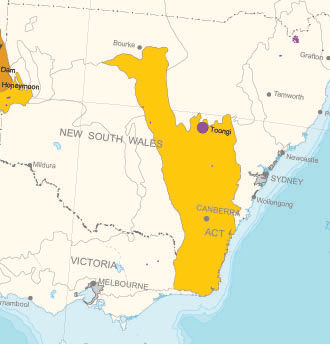
Look out – New South Wales residents! You thought coal seam gas exploration was a threat? And it probably is.
But now, your government, in its unwisdom, is going to allow uranium exploration.
The yellow area shows the area of uranium mineralisation in New South Wales.
Very handy, I suppose, to where some of Ziggy Switkowski’s 50 nuclear reactors will supposedly be positioned.
South Australia is going to go down the economic drain, for its drive for all things nuclear. Meanwhile, what with Paladin Uranium looking like going broke, and the nuclear industry winding down, – Does New South Wales want to join this plunge? – Christina Macpherson
GOVERNMENT TAKES STEP TOWARDS URANIUM MINING Lee Jeloscek, 7 News Sydney February 14, A map drawn up by the government and reported on by 7News shows a large swath of land from north western town of Bourke stretching down past Canberra to the Victorian border could be explored for the resource. http://au.news.yahoo.com/nsw/latest/a/-/newshome/12905605/government-takes-step-towards-uranium-mining/

NSW people don’t want the uranium industry
Opposition lashes O’Farrell’s plan to overturn NSW ban on uranium exploration, THE AUSTRALIAN, AAP, February 15, 2012 THE NSW opposition has criticised a plan to overturn the state’s decades-old ban on uranium exploration….. Opposition Leader John Robertson said voters don’t support the industry. “The people of NSW didn’t vote for it and they don’t want it,” he said in a statement. “Only months ago the Premier categorically ruled out uranium mining and exploration in NSW – now it is on for young and old.”
Greenpeace campaigner Julien Vincent called the expected announcement an “insult”….. “Next month we are marking the first anniversary of nuclear disaster in Fukushima, which is one of the best reasons for not going nuclear,” he added.
Australian Greens nuclear affairs spokesperson Senator Scott Ludlam added: “Australian uranium was used in every reactor at Fukushima. “Why would the O’Farrell government want New South Wales to be complicit in the next disaster?”
 Uranium mining is banned in Queensland but allowed in Western Australia and South Australia.
… Just days before that vote Australian Workers’ Union secretary Paul Howes called on states that don’t allow uranium mining to overturn their bans. http://www.theaustralian.com.au/national-affairs/opposition-lashes-ofarrells-plan-to-overturn-nsw-ban-on-uranium-exploration/story-fn59niix-122
Australian research: solar heat + power, plus energy efficiency
 Australian Made Solar Roofing Panels Provide Heat And Power by Energy Matters, 14 Feb 2012, In an effort to bring Australia in line with an international zero-emissions building code, researchers from the University of New South Wales (UNSW) are working on a system to better harness the power of solar energy to generate electricity and heating for homes.
A prototype rooftop solar power system developed by UNSW’s School of Photovoltaic and Renewable Engineering (SPREE) that combines photovoltaics with thermal technology has demonstrated the ability to produce warm air throughout winter.
Unlike conventional PV systems with solar cells mounted on top of the roof of a house, the UNSW technology is designed to be integrated into roofing panels, allowing excess heat generated by the panels – which would otherwise be wasted – to warm the home.
 The research is part of a series of ‘carbon-positive’ products that will be tested and further developed by the Cooperative Research Centre (CRC) for Low-Carbon Living at UNSW later this year; aimed at bringing Australia in line with Europe and the UK, which plan to introduce a zero-carbon building code in 2016. Professor Deo Prasad, head of the CRC, says when it comes to lowering Australia’s carbon footprint, the biggest savings can be made in energy efficient buildings.
“The built environment is responsible for 40 per cent of energy use and Australia’s homes account for 16.5 per cent of our emissions in electricity use alone, without accounting for energy embodied during the production and disposal of building materials.”….. http://www.energymatters.com.au/index.php?main_page=news_article&article_id=3049
Australian farmers missing opportunity to profit by farming energy
 Farmers squeezed out of energy boon, MATTHEW CAWOOD, Stock and Land 04 Feb, 2012 LANDHOLDERS should be capitalising on seismic changes in how we generate energy, says Matthew Wright, but instead they are being
pushed aside.
Mr Wright, executive director of Beyond Zero Emissions, thinks the thrust of current government policy will be to deny many landholders the ability to profit from wind generation, while compromising the enterprises of other landholders who host coal seam gas (CSG) operations without sharing in CSG profits.
Beyond Zero Emissions, a non-profit organisation, has the goal of moving Australia “from a 19th century fossil fuel based economy to a 21st century renewable powered clean tech economy”.
Wind turbines are “about as benign as it gets” for power generation, Mr Wright said, adding CSG is a “fairly destructive option for resource exploitation”.
Continue reading
Renewable Energy Project for Wagga
Energy plant back on the agenda Daily Advertiser, 02 Feb, 2012 THE development of a proposed $13 million renewable energy plant in Wagga looks to be back on the agenda after the company behind the project received $800,000 to put towards new business ventures.
Representatives from the Adelaide-based company, Syngas, arrived in Wagga on Tuesday to continue the negotiations which began in April last year. Plans were first announced then for a power plant that would use green waste from Wagga’s kerbside collections to generate electricity.
Last September Syngas managing director Merrill Gray said the plant would be established on a 16,000 square metre block at the Bomen Industrial Park, with an underground cable connecting the power plant to neighbouring abattoir Tey’s Australia. The renewable energy generated by the plant would then be sent through
the cable, circumventing the grid….. http://www.dailyadvertiser.com.au/news/local/news/general/energy-plant-back-on-the-agenda/2441039.aspx
Dubious claims that wind farms make people sick
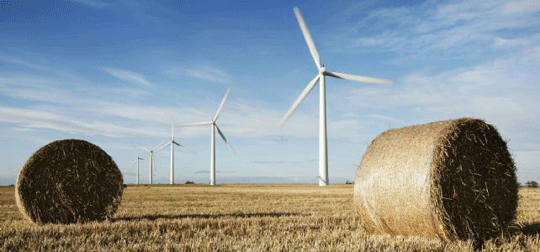
Science on wind turbine illness dubious, say experts. SMH, Ben Cubby, January 24, 2012 FEARS that wind turbines make people sick are ”not scientifically valid”, and the arguments mounted by anti-wind farm campaigners are unconvincing, according to confidential briefings given to the state government by NSW Health.
Documents obtained under freedom-of-information laws show that health officials repeatedly warned ministers last year that there was no evidence for ”wind turbine syndrome”, a collection of ailments including sleeplessness, headaches and high blood pressure that some people believe are caused by the noise of spinning blades.
But the department’s advice contrasts with the view of the Planning Minister, Brad Hazzard, who was responsible for draft guidelines, released in December, that significantly tighten the approvals process……
One study by Nina Pierpont, which is central to the claims that wind turbines make people ill, was dismissed as ”not of sufficient scientific rigour” by NSW Health. ”This ‘study’ is not a rigorous epidemiological study; it is a case series of 10 families drawn from a wide range of locations,” according to the ministerial briefing on July 5 last year. ”This work has not been properly peer reviewed. Nor has it been published in the peer-reviewed literature. The findings are not scientifically valid, with major methodological flaws stemming from the poor design of the study.”
The documents, obtained under FOI laws by the environment group Friends of the Earth, say existing studies had been examined and no known causal link could be established. The assessment undermines the claims of an anti-wind farm group, the Waubra Foundation, which had been lobbying the government for a moratorium on new wind farms.
“The documents from NSW Health confirm our belief that the foundation has been ‘cherry picking’ data that supports its allegations about ‘wind turbine syndrome’ by talking with people who believe they have … symptoms,” said a Friends of the Earth spokesman, Cam Walker. ”This becomes a self-fulfilling prophesy and is not the basis of good science … Yet, as has been noted by a growing number of medical authorities, there is no credible evidence of a causal link between turbines and ill health.”……
A landowner near Lake George, Marcia Osborne, said her family had had no medical problems or trouble sleeping from the seven or eight turbines close by. ”Quite the opposite really, they’ve done nothing but help us,” she said.
”We are farmers … things were pretty tough [during the drought] … When they asked us if they could put a wind farm on the place it was like a gift from God. We used to curse the wind, now we get paid for the wind.”
The guidelines are on exhibition until March 14. http://www.smh.com.au/environment/energy-smart/science-on-wind-turbine-illness-dubious-say-experts-20120123-1qe98.html#ixzz1kPuwgvpd
Anti business policies of Liberal governments in Victoria and New South Wales – war on renewable energy
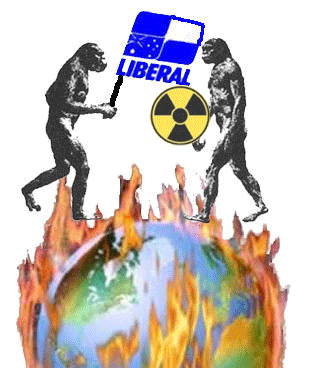 Now, however, backed by the fossil fuel industry, the campaign against solar and wind power in Australia has exposed many of the very anti-business policies of the Coalition. With dropping costs and increasing reliability for renewable energy, conservatives have had to turn to ‘community concerns’ to wage their attacks. These concerns are based around a very tiny, loud minority, and apparently don’t exist for the coal or coal seam gas industry. They also go against strong evidence that show that renewable energy is extremely popular.
There is no doubt that the renewable energy industry will continue to grow throughout the world. Wind and solar are booming and will soon be cheaper than current fossil fuels.
 The war against renewable energy The Drum, Simon Copland, 19 Jan 12, It’s an odd scenario when the Coalition becomes the main opponents to a new, profitable business. Long seen as the small government, pro-business party, the Coalition has engrained itself in the business community and business interests.
Yet, with the election of the Victorian and New South Wales Liberal Governments, it has become increasingly apparent that the Liberal’s pro-business pedigree is only extended to certain business operations – normally the dirtiest ones to boost.
It all started with new regulations in Victoria in 2011. Passed through both houses of the Victorian Parliament in 2010, these rules set strict new regulations on the development of wind farms in the state. Based on the idea of ‘community concerns’ about wind development, the regulations state that any person who lives within 2km of a proposed wind turbine will now have the ability to veto the project, with very little discourse for wind operators. The bill has the potential to cost Victoria $3 billion in wind investment and means that it would now be easier to get approval for a coal power plant in Victoria than a wind farm.
Despite outcry from the Victorian environmental and business community, on the eve of Christmas the New South Wales Coalition Government followed its Victorian counterparts inadopting similar regulations. The New South Wales Government boasted that these were the “toughest wind farm guidelines in Australia and possibly the world”. As Barry O’Farrell said, if he had his way, there would be no more wind farms ever approved in New South Wales. Continue reading
Community solar energy for Australia – Mallacoota shows the way
 While these types of schemes are still relatively uncommon in Australia, a popular method of using the power of collaboration to install solar here is the solar buyers group. Consisting of people within a local area, these groups use their collective clout to secure better pricing for installing solar panels on their own rooftops…
In an initiative led by local resident Jim Sakkas, the community banded together to form a solar buyers group and since that time, close to one hundred solar power systems have been installed in Mallacoota by national solar solutions provider Energy Matters under the model.
A Co-operative Approach To Going Solar, by Energy Matters, 6 Jan 12, A growing number of people are starting renewable energy schemes in their communities through co-operatives and other forms of collaboration. A recent report from Co-operatives UK and The Co-operative Group states 43 communities are in the process of or already producing renewable energy by investing money to install solar panels, large wind turbines or hydro-electric power in their area.
£16 million has been invested by over 7,000 people in these schemes, which include a £2 million wind farm and a 98kW solar photovoltaic installation on the roof of a brewery.
The report says green economy co-operatives are the most rapidly growing part of the UK co-op sector, jumping 24% since 2008. In addition to these co-operatives’ efforts seeing clean, renewable energy being supplied to their communities, there is also a financial return to participants through the sale of electricity produced.
The co-operative approach covered in the report basically works like this: Continue reading
1 This month
7 April – WEBINAR – Australia and the Doomsday Clock – Preventing nuclear war through NoFirstUse and other policies
Online | Tuesday April 7, 4:00-5:30pm, Australian Eastern Time / 8:00-9:30am Central Europe Time
– Access the registration link
15 April – Zoom –Nuclear Power is Not the Solution
Apr 15, 2026 01:00 AM in Canberra, Melbourne, Sydney

Join the International Physicians for the Prevention of Nuclear War (IPPNW) on Tuesday, April 14th for a timely webinar exploring the risks associated with nuclear power and challenging the myth that it offers a simple, safe, carbon-free solution to the climate crisis

21 April Webinar: No Nuclear Weapons in Australia
Start: 2026-04-21 18:00:00 UTC Canberra, Melbourne, Sydney (GMT+10:00)
End: 2026-04-21 19:30:00 UTC Canberra, Melbourne, Sydney (GMT+10:00)
Event Type: Virtual
A virtual link will be communicated before the event.
Host Contact Info: australia@icanw.org

of the week – Australians for War Powers Reform (AWPR)
To see nuclear-related stories in greater depth and intensity
 Antinuclear