


Antinuclear

Australian news, and some related international items

  • Home
  • 1 This month
  • Disclaimer
  • Kimba waste dump Submissions

‘under cover of coronavirus’ New South Wales govt approves US company to mine coal beneath a Sydney drinking water dam

‘Scandalous’: US giant approved to mine beneath Sydney drinking water reservoir ‘under cover of coronavirus’ 9 News, By Bella Peacock • Digital Producer,  May 9, 2020  [ Investigative journalism   Excellent photos and diagrams ]A controversial plan for a US company to mine coal beneath a Sydney drinking water dam has been approved by the New South Wales state government while focus was on COVID-19.

Woronora reservoir, an hour’s drive south of the CBD, is part of a system which supplies water to more than 3.4 million people in Greater Sydney.

The approval will allow Peabody Energy to send long wall mining machines 450 metres below the earth’s surface to crawl along coal seams directly below the dam.

Dr Kerryn Phelps says the fact the decision was made “under the cover of coronavirus” is “unfathomable”.

NSW has spent 12 of the last 20 years in drought, with record low rainfall plunging much of the state into severe water shortage last year.

“We know about the potential for catastrophe,” Dr Phelps told 9News.com.au.

“We just cannot let this [decision] go unchallenged.”

The former president of the Australian Medical Association may seem an odd figure to lead opposition to a mining project, but Dr Phelps takes what she calls a broad view on health.

She grew up on Sydney’s North Shore when koalas still lived in family backyards and has witnessed firsthand the affects human populations have on the natural world. She has also seen, as a doctor, how the degradation of the nature impacts human health.

In her role as City of Sydney councillor, Dr Phelps introduced a motion to the council calling on the NSW Minister for Planning and Public Spaces, Rob Stokes, to reverse the approval.

“We can’t simply risk the water supply in one part of Sydney, without considering the repercussions for the rest of the state and country,” Dr Phelps said.

“We have to make a stand now. If not now, then when?”

Chain reaction

On the evening of April 6 this year, the City of Sydney council almost unanimously passed Dr Phelp’s motion calling for the approval to be reversed, prompting mayor Clover Moore to send Mr Stokes a strongly worded internal letter. In it, she described the minister’s decision as “scandalous”.

Sutherland Labour Party councillor Ray Plibersek says the move also led Sutherland Shire Council to pass a similar motion urging the decision be reconsidered.

“We’re very concerned,” Cr Plibersek told 9News.com.au. 

“There’s been evidence of damage to the water table… and despite assurances from mining companies, there is a threat to a crucial resource – water.”

Sutherland Shire and Wollongong, which both have more than 200,000 residents, share the Woronora special catchment area, the rivers and rivulets passing from one jurisdiction to the next. They share the water within it too – the reservoir supplies 100 per cent of the drinking water……….. https://www.9news.com.au/national/coal-mine-under-greater-sydneys-woronora-drinking-water-reservoir-approved-during-coronavirus-pandemic/d3e51de8-f370-4fcf-b4f8-7f62be1c24c7


May 11, 2020 Posted by Christina Macpherson | environment, New South Wales, politics | Leave a comment

Bushfire Survivors for Climate Action taking legal action against NSW Environment Protection Authority

‘Kick them into action’: Fire group takes EPA to court over climate, SMH, By Peter Hannam, April 20, 2020  Lisa Roberts spent 25 years building a native plant business that was as sustainable as they come, with off-grid solar power and water harvesting, only to see it go up in flames in the recent bushfires.Her home and nursery in Wandella in southern NSW reduced to rubble, Ms Roberts fled to Canberra, powerless to act as fires threatened another venture in nearby Pialligo. Living in the smoke-choked capital also damaged her vocal cords, which have still not recovered.

“A part of me totally rages at the world for its totally inadequate response to climate change,” Ms Roberts said. “Everybody’s safety is at risk.”

That anger is being now channelled into a legal challenge against the NSW Environment Protection Authority. Bushfire Survivors for Climate Action, of which Ms Roberts is a member, began the suit last week with the NSW Environmental Defenders Office “to kick [the EPA] into action”, she said.

EDO chief executive David Morris said the case, in the Land and Environment Court, would seek to force the EPA, which does not have a climate policy, to use its powers to keep communities safe from the increasingly severe impacts of a warming world.

Mr Morris said the EPA was chosen as a test case among similar agencies nationally in part because of a section of the Protection of the Environment Operations Act 1997.

That section requires the agency to “develop environmental quality objectives, guidelines and policies to ensure environment protection”.

“It’s an opportunity for the EPA to recognise they have a legal obligation to take action,” he said. “They should have a policy and a plan to address the greatest threat to the environment.”…….. https://www.smh.com.au/environment/climate-change/kick-them-into-action-fire-group-takes-epa-to-court-over-climate-20200418-p54kzl.html

April 20, 2020 Posted by Christina Macpherson | climate change - global warming, legal, New South Wales | Leave a comment

Outlandish claims made by Byron Shire Councillors, (Greens!!) promoting mobile Small Nuclear Reactors

What a strange article!   The claims made about these “mobile small nuclear reactors” are completely fanciful. These reactors do not exist, are just in the planning stage for use by U.S. military.  Even more fanciful , the article’s claim – “the pilot scheme, which will attract multi-million dollar grants.”.   Just where are these grants to come from?   The cash-strapped Australian government?  The Russians? The Americans? The Chinese?  This entire magical unicorn the Small Nuclear Reactor business is quite unable to attract investors. It’s only hope is to be funded by the tax-payer.  I note these unnamed Green proponents talk about “spreading the risk fairly among the population” – and still think it’s just fine.  So they understand that there’s a risk of dangerous radiation – a very strange attitude for a supposedly environmental group. 

What could go wrong?  https://www.echo.net.au/2020/04/what-could-go-wrong/    April 1, 2020 | by Echonetdaily, Mobile 100MW nuclear power plants have been proposed by the NSW National Party.

The latest miniaturisation technology that has seen electronic circuitry reduced from physical nodes to nanoscale impulses in quantum space has had astounding impacts on the relatively macroscale equipment needed to generate nuclear power. Such equipment has become so small it is now possible to build bus-sized nuclear reactors that can be deployed, as needed, to address gaps in the power grid.

Byron’s Greens councillors have indicated support for the proposal, and hope to involve the Shire in the early stages of the pilot scheme, which will attract multi-million dollar grants. A spokesperson for the local Greens said nuclear plants are not only less polluting than coal fired power stations, but being mobile means they spread the risk fairly among the population.

State and federal Greens later issued a statement disassociating themselves, ‘as always’, from Byron Shire councillors.

April 2, 2020 Posted by Christina Macpherson | New South Wales, politics, technology | Leave a comment

A nuclear power station is inappropriate for the Central Coast


A nuclear power station is inappropriate for the Central Coast,  https://coastcommunitynews.com.au/central-coast/news/2020/03/a-nuclear-power-station-is-inappropriate-for-the-central-coast/   Chris Castellari, Avoca Beach  MARCH 22, 2020

 Just a few points as to why a nuclear power station is inappropriate for the Central Coast.

Nuclear power stations can’t be built under existing law in any Australian state or territory.
They are a more expensive source of power than renewable energy such as solar or wind.
They present significant challenges in terms of the storage and transport of nuclear waste.
Nuclear power stations also present significant health and environmental risks (Fukushima, Chernobyl, Three Mile Island).
They are expensive, around $40B, and take a decade to build.
By comparison, wind and solar farms take just one to three years.
Nuclear power stations also require massive quantities of water to operate and are inappropriate for a dry continent like Australia.
These are the facts but I’m sure the nuclear industry will continue to lobby for this ridiculous solution to our energy needs.

March 23, 2020 Posted by Christina Macpherson | New South Wales, opposition to nuclear | Leave a comment

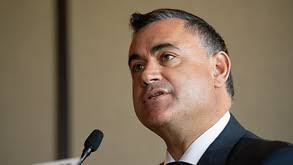
After backlash from colleagues, NSW Deputy Premier John Barilaro backs down from nuclear power support

Barilaro retreats on Nationals support for One Nation nuclear bill,  https://www.smh.com.au/politics/nsw/barilaro-retreats-on-nationals-support-for-one-nation-nuclear-bill-20200317-p54avo.html, By Lisa Visentin,March 17, 2020 Deputy Premier John Barilaro has walked back his party’s support for a One Nation bill to allow nuclear power in NSW, as the issue threatened to split the Coalition.Mr Barilaro, a long-time advocate of nuclear energy, alarmed some Coalition MPs when he declared two weeks ago that the National Party would support Mark Latham’s bill to overturn a ban on uranium mining.

But the Nationals’ leader changed his tune on Tuesday, telling a budget estimates hearing the matter would first need to be considered by the party room as well as the cabinet.

Mr Barilaro made the unilateral call to back Mr Latham’s bill during an interview on Sky News on March 3 before consulting his party room, triggering concern among some National MPs and angering some of his Liberal cabinet colleagues. 

“I’ve since then had to pull that back to the point where I’ll have to go through the National party room, the parliamentary team, before we get to that position,” Mr Barilaro told the hearing.

“What I’m committing to is advocating for a policy that the party stands for and let’s see what happens when we get to the floor of Parliament.”

However, Mr Barilaro reiterated his strong personal support for nuclear energy, in particular “small nuclear reactors”, which he dubbed “the iphone of reactors”.

In a terse exchange, Labor MLC Adam Searle asked Mr Barilaro whether he was aware small nuclear reactors “don’t exist anywhere in the world at the moment”.

Mr Barilaro responded that he was “advocating for a technology that we know is on the horizon,” saying the Russians “would probably have small modular reactors on the market in the next two to three years.”

When quizzed about whether he’d discussed with his Coalition colleagues where in NSW the reactors could be located, Mr Barilaro floated the option of his own electorate of Monaro, on the state’s southern border.

“I haven’t even ruled it out of my own electorate. There you go. There’s your press release for today. Can’t wait to see it,” he said.

Mr Barilaro has previously grounded his support for Mr Latham’s bill as being consistent with the National Party’s policy position to “support nuclear energy in Australia as part of the energy mix for the future”, adopted at last year’s state conference.

He confronted an immediate backlash from within the cabinet, which had yet to consider the issue, with at least four senior ministers saying they would not support his push to back the bill. One minister told the Herald they were prepared to quit cabinet rather than support it.

The split followed a parliamentary inquiry into Mr Latham’s bill, chaired by Liberal MLC Taylor Martin, which concluded the government should support it.

The inquiry’s report stated: “the committee could find no compelling justifications from an environmental or human safety point of view which would warrant the blanket exclusion of nuclear energy.”

The two Labor MPs on the inquiry – John Graham and Mick Veitch – opposed the findings in a dissenting statement which reaffirmed Labor’s “longstanding and unequivocal platform position in relation to nuclear exploration, extraction and export.”

Mr Latham was also on the inquiry, which was comprised of eight MLCS, including three Liberals, two Labor, and one member apiece from the Nationals and the Shooters, Fishers and Farmers party.

March 19, 2020 Posted by Christina Macpherson | New South Wales, politics | Leave a comment

New South Wales National MPs embrace nuclear industry, other MPs are shocked

Is it time to go nuclear?  https://www.echo.net.au/2020/03/is-it-time-to-go-nuclear/, 13 Mar 20 The announcement by National Party leader John Barilaro last week that his party would support the development of nuclear power in NSW came as a surprise to many considering the long lead times for nuclear power development and the abundance of solar and wind power that is ready to be quickly developed.

One Nation’s Mark Latham brought the Uranium Mining and Nuclear Facilities (Prohibitions) Repeal Bill 2019 to parliamentary debate on June 6, 2019 and it’s now working its way towards a vote.

However, local Lismore MP Janelle Saffin has urged North Coast residents to help her kill off the Nationals’ plans to build nuclear power plants in places like Tweed Heads and Coffs Harbour with the same determination shown to defeat Coal Seam Gas (CSG) mining.

Ballina Greens MP Tamara Smith points out that ‘While Europe is rapidly phasing out nuclear energy the dinosaurs in the National Party in NSW want to lift the ban and distract us all in an anti-nuclear debate’.

‘The coal barons and their favourite political party are counting on us to repeat the same mistake we made with climate change. We battled to convince the dinosaurs of climate science that was well and truly settled and we lost the war on vested interests in fossil fuel for over a decade.’

Ms Saffin said Mr Barilaro had announced his nuclear policy support on the run on Sky News, blindsiding Premier Berejeklian, who during Question Time on Wednesday (March 4) could not state her government’s true position on nuclear power.

Ms Saffin accused Deputy Premier and Nationals leader John Barilaro of dangerous behaviour in supporting One Nation Leader Mark Latham’s bill in the Upper House lifting the ban on uranium mining and nuclear energy in New South Wales.

‘By joining forces with Mark Latham, and his former visit overseas to gather information and support for his nuclear cause, John Barilaro has well and truly opened the door to nuclear power plants in coastal communities on the North Coast.

‘The Nats are embracing nuclear power – they keep marching us backwards and have no plans for water protection, no plans for cheap energy that they bang on about, and no plans for country New South Wales,’ she said.

Local National MP responds

Member for Tweed Geoff Provest has responded to questions from Echonetdaily stating that, ‘I have previously stated I am against nuclear power in the Tweed and I have heard nothing during this most recent discussion to change my mind.’ [Ed. note – does he mean that nuclear power is OK everywhere else in Australia?]

Member for Page, Kevin Hogan (Nationals) and National Party MLC, Ben Franklin have not responded to questions regarding their support for nuclear power development.

Federal investigation

Last year the Federal government House of Reps held an inquiry into the pre-requisites for nuclear power in Australia.

‘The release of the report has clearly been done in such a way as to attract the absolute minimum of attention. Its media profile up to now has been zero. That is likely because were it better known, it would have been panned by NGOs Australia-wide,’ said long time anti-nuclear campaigner John Hallam.

‘It’s clear from the recent Federal inquiry, that there is no case whatsoever for a pronuclear about-face in favour of reactors or uranium mining in NSW,’ he said.

‘Ten years ago, the argument would have been that nuclear power was/is uneconomic and potentially dangerous, and that it is uneconomic precisely because it is potentially dangerous. The argument now would be exactly the same, with the added one that in order to be of any relevance to combatting the climate emergency, a source of power must be cheap, problem-free and quickly and easily deployable and nuclear power is the opposite of all those things.

‘Nuclear power, far from solving the climate emergency, diverts needed resources from the real solutions – the deployment of cheap and quickly deployable renewables.

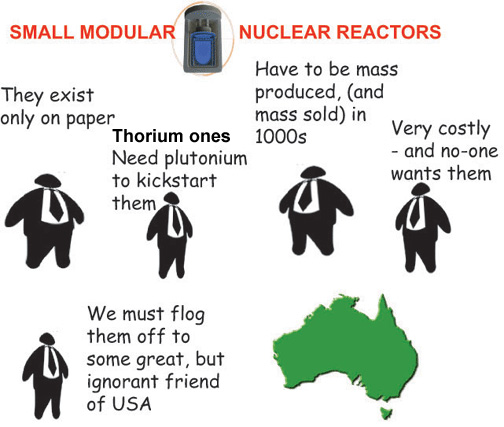
‘Small modular reactors look wonderful on paper but no one has actually succeeded in building even one that works satisfactorily and can be mass-produced, let alone the hundreds that would be needed.’

Local Greens MP Tamara Smith told Echonetdaily that her party requested to be included on the committee looking into nuclear but were ignored. Committee members include two Liberal party MPs, two Labor MPs, a One Nation MP, a Shooters Fishers and Farmers MP and a Nationals MP.

March 14, 2020 Posted by Christina Macpherson | New South Wales, politics | Leave a comment

Nuclear lobbyists have got into the ears of NSW’ National Party

Editorial – Nuclear afterglow  https://www.echo.net.au/2020/03/nuclear-afterglow/ Nuclear waste. Hans Lovejoy, editor, 13 Mar 2020

While there will surely be an afterglow of good will towards local National Party MLC Ben Franklin for securing the Shire $25m in road and infrastructure funding, it should be pointed out where his government is taking us when it comes to the energy sector.

Mr Franklin’s leader, John Barilaro, is a complete bozo.

For many informed voters, that’s not news.

Barilaro’s been a long-time supporter of nuclear power, and last week he reportedly supported One Nation’s attempts to create that industry and lift the uranium mining ban, all without consulting his own party. Seriously.

The Echo is still waiting on a reply from Mr Franklin on his attitude to the ‘nuclear option’, and whether Barilaro did not consult his party, as reported by SMH.

When asked if he supported repealing the uranium mining ban and creating a nuclear industry, Nationals Tweed MP Geoff Provest told The Echo, ‘I have previously stated I am against nuclear power in the Tweed, and I have heard nothing during this most recent discussion to change my mind.’

Notice how Provest only said he opposes nuclear in the Tweed? The rest of the state is presumably okay.

One Nation’s Mark Latham brought the Uranium Mining and Nuclear Facilities (Prohibitions) Repeal Bill 2019 to parliamentary debate on June 6, 2019 and it’s now working its way towards a vote.

Local Greens MP Tamara Smith told The Echo that her party asked to be on the committee that is looking into this – they were denied. Instead it’s stacked with MPs sympathetic to the industry.

Latham’s parliamentary speech, in support of nuclear, admits it takes a decade to establish, but points to Finland’s nuclear industry as why it should occur here.

It’s a speech that you would expect from One Nation – there’s no economic modelling presented to support the viability of nuclear, for example.

Instead, Latham uses his time trying to paint those opposed to nuclear power in Australia as fearmongers, while disparaging renewable energy.

There’s plenty of info available as to the insanity of nuclear – www.climatecouncil.org.au says it simply: ‘Australia is one of the sunniest and windiest countries in the world, with enough renewable energy resources to power our country 500 times over. When compared with low risk, clean, reliable and affordable renewable energy and storage technology in Australia, nuclear power makes no sense.

‘Nuclear cannot compete on a cost basis with wind and solar, which are the cheapest forms of new generation’.

Clearly nuclear lobbyists are in the ear of Barilaro the Bozo.

Have they also got into the ear of the local Nationals MLC Ben Franklin? It may not matter – Franklin is obliged to vote for whatever idiotic laws his party supports.

March 14, 2020 Posted by Christina Macpherson | New South Wales, politics | Leave a comment

Labor MP Yasmin Catley stands up for New South Wales nuclear ban laws

Nuclear power debate resurrected,  https://coastcommunitynews.com.au/central-coast/news/2020/03/nuclear-power-debate-resurrected/  MARCH 13, 2020

Member for Swansea, Yasmin Catley, has vowed to fight moves to repeal legislation banning uranium mining in NSW, which she says is the first step towards nuclear power plants in the State, with three Central Coast sites likely contenders.

An Upper House inquiry into the Uranium Mining and Nuclear Facilities (Prohibitions) Repeal Bill 2019 has recommended repealing the original bill in its entirety.

Although this would make it legal to mine for uranium within NSW boundaries for the first time since 1987, the prohibition on nuclear facilities would remain in place as a result of prohibitions enacted in federal legislation.

But Catley said that Deputy Premier, John Barilaro, had made it clear that he supports the building of new nuclear power stations.

“While there is also federal legislation in this space, it is clear that the Deputy Premier sees the removal of the current ban on uranium mining and nuclear power in NSW as the first step towards that objective,” she said.

“Potential nuclear power station sites were identified at Eraring, Vales Point and Munmorah in 2018, but nuclear is not the answer to the problem of climate change.

“Nuclear is too expensive and too dangerous.

“The future lies in large scale renewable energy projects that bring together wind, solar and other renewable technologies to meet our needs.

“Wind power made reliable with storage, and peaking gas support, costs as low as $52MWh while nuclear energy in nations with established industries costs between $169MWh and $270MWh.

“New nuclear facilities will cost between $195 and $344 per MWh.
“This would see NSW households pay potentially six times as much for electricity.

“Already on the Central Coast we have Vales Point rolling out clean technology like solar.

“The government should be supporting the expansion of this sector and the jobs that come with it, rather than turning regional and coastal communities into nuclear power plant wastelands.”

But MLC Taylor Martin, who chaired the inquiry into repealing the prohibition bill, said bans on uranium mining and nuclear energy reflected the “outdated fears of the 1980s”.

“The safety of nuclear technology has advanced in leaps and bounds since the state prohibition commenced,” Martin said.

On the balance of evidence gathered for this inquiry, nuclear power in its emerging small scale applications, is a compelling technology where energy policy settings seek to decarbonise emissions while delivering secure, reliable and affordable energy to the NSW grid.

“Despite the share of wind and solar in the NSW electricity generation mix tripling in the past five years, just over seven per cent of the state’s electricity currently comes from these sources.

“It is clear that wind and solar firmed with gas, batteries and pumped hydro would not be an adequate solution to meet the state’s future needs for affordable and reliable electricity following the decommissioning of our ageing coal fired generation assets.

“There is an imperative for legislators and governments to be genuinely technology neutral and not lock out appropriate, low emission alternatives to replace these ageing assets.”

Martin said there were “no compelling justifications” from an environmental or human safety point of view which would warrant the blanket exclusion of nuclear energy from serious policy consideration in NSW.

“The outdated arguments for prohibiting nuclear on the basis of safety are increasingly difficult to defend,” he said.

March 14, 2020 Posted by Christina Macpherson | New South Wales, politics | Leave a comment

Melinda Pavey National Party MP wants Small Nuclear Reactors for the Riverina

Melinda Pavey says public perception of nuclear energy is changing  https://www.nambuccaguardian.com.au/story/6677322/paving-the-way-for-nuclear-energy-production-in-oxley/  Ute Schulenberg  13 Mar 20,

Melinda Pavey says she would “love to see regional communities engaged in the discussion of all the opportunities zero emission [?] nuclear energy can offer”.

The Member for Oxley’s comments are in the context of the Upper House Parliamentary Inquiry into the mining of uranium in NSW and nuclear energy, led by Liberal MP Taylor Martin, which has recommended the law prohibiting uranium mining and nuclear facilities should be repealed.

The inquiry was established as a result of a bill put forward by One Nation MP Mark Latham.

While it is only the start of a fresh conversation about nuclear energy, Mrs Pavey said the public perception of zero emission nuclear energy was changing.

“Small modular reactors (SMRs)* are new technology and should be discussed as be part of an energy source and climate change,” Mrs Pavey said.

“SMRs will create new industries, more jobs and a reliable source of baseload power.”

Nationals leader and Deputy Premier John Barilaro has long-supported nuclear energy and said the Nationals would support a bill, as will the Shooters and Fishers.

The parliamentary inquiry will deliver its findings in September.

The process for nuclear energy is both a State and Federal process and both levels of government would have to overturn the various legislative bans currently in place prior to any changes being made.

* Small modular reactors (SMRs) are a type of nuclear fission reactor which are smaller than conventional reactors, and manufactured at a plant and brought to a site to be assembled. They require less on-site construction and supposedly increased containment efficiency. They do not require a coast locations as is the case with traditional nuclear energy sites.

March 14, 2020 Posted by Christina Macpherson | New South Wales, politics | Leave a comment

Call to Premier Gladys Berejiklian to stand up for a nuclear-free New South Wales

Premier must stand up to Barilaro on nuclear power,  https://www.smh.com.au/politics/nsw/premier-must-stand-up-to-barilaro-on-nuclear-power-20200310-p548k3.html  10 Mar, 20,    Deputy Premier John Barilaro has issued another ultimatum to the NSW government, this time over his obsession with starting a nuclear industry, but it is high time Premier Gladys Berejiklian called his bluff. Mr Barilaro is demanding that cabinet endorse a report by an upper house parliamentary committee backed by One Nation which recommends lifting the ban on uranium mining and nuclear power generation that has been in place since 1986. If cabinet refuses, he is threatening that he and perhaps the whole National Party will go their own way and vote in favour of a bill to that effect.

The Herald reported on Monday that some cabinet ministers who oppose nuclear power are threatening to respond by quitting if Ms Berejiklian caves in. The question of whether NSW can or should develop a nuclear industry is complicated. In theory, mining uranium could earn money and nuclear power generation could help reduce emissions. In fact, both face huge practical problems.
Of course, the Northern Territory and South Australia already mine uranium. But there is little reason for NSW to follow them now because, quite apart from concerns over waste storage, safety and proliferation, the business case is very weak. As the upper house report says, the state does not have any proven commercial deposits of uranium and, since the Fukushima disaster in Japan, the global market for uranium has been depressed. The conservative government in Western Australia ended its ban on uranium mining in 2010 but no new mines have opened.

Similarly, the prospects are also poor for nuclear power generation here any time soon. Nuclear reactors are very expensive and would take decades to build. By most reckonings, they cannot compete on cost with renewables – backed up by battery storage – or pumped hydro. Private companies will not build them without subsidies from taxpayers.

Given those practical issues, it is hard to understand why Mr Barilaro has joined One Nation’s crusade for nuclear power. Cynics would argue that his main goal is shielding the coal industry by delaying other more immediate and practical forms of action to reduce carbon emissions. And for Mr Barilaro, it might be a political winner. He might steal One Nation’s thunder and win the support of older regional voters and radio shock jocks who have a vendetta against those they see as renewables-loving green hippies.
But Mr Barilaro’s nuclear adventure risks doing damage to the government including a repeat of what happened to the Howard government in 2007 when it campaigned on nuclear power. The ALP pointed out that because plants require enormous amounts of water, they would have to be located on the coast. That went down like a lead balloon with voters and that was before Fukushima.
With a two-seat majority, Ms Berejiklian is more than usually dependent on her Coalition partner. Over the past year, Mr Barilaro has been able to extract some questionable concessions from her on water policy and regional jobs in the energy sector.

But she must not allow policy on such an important issue to be driven by a minority of Nationals MPs and the whims of One Nation backbenchers. As Premier, it should be Ms Berejiklian who sets the priorities of the state’s energy policy.

This is a good chance for Ms Berejiklian to stamp her authority on the government. Mr Barilaro has backed down in the past. He knows how much he and his party need to be in government. His bark is often worse than his bite.

March 12, 2020 Posted by Christina Macpherson | New South Wales, politics | Leave a comment

Fact-checking the false nuclear claims of NSW Deputy Premier John Barilaro

NSW Deputy Premier John Barilaro’s nuclear falsehoods https://nuclear.foe.org.au/barilaro/Correcting the nuclear falsehoods of NSW Deputy Premier and Nationals leader John Barilaro. Mr. Barilaro has been repeatedly provided with factual information so there is no excuse for his ignorance., March 2020, Jim Green, FoE Australia national nuclear campaigner, jim.green@foe.org.au

Mr. Barilaro: Nuclear power is “probably the cheapest cost to the average Australian household”.
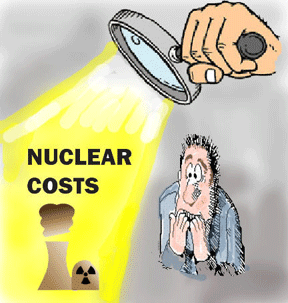
Facts:

* Nationals Senator Matt Canavan acknowledges that nuclear power is “very expensive”.

* Industry insiders and lobbyists freely acknowledge that nuclear power is suffering from an economic crisis that could prove to be terminal.

* Nuclear power is in decline worldwide and a growing number of countries are phasing out nuclear power including Germany, Switzerland, Spain, Belgium, Taiwan and South Korea.

* Laws banning nuclear power has saved Australia from the huge costs associated with failed and failing reactor projects in Europe and North America, such as the twin-reactor project in South Carolina that was abandoned in 2017 after the expenditure of at least A$13.4 billion, bankrupting Westinghouse. That expensive fiasco could so easily have been replicated in NSW if not for the prudent legal ban.

* There are many other examples of shocking nuclear costs and cost overruns, including:

‒ The cost of the two reactors under construction in the US state of Georgia has doubled and now stands at A$20.4‒22.6 billion per reactor.

‒ The cost of the only reactor under construction in France has nearly quadrupled and now stands at A$20.0 billion. It is 10 years behind schedule.

‒ The cost of the only reactor under construction in Finland has nearly quadrupled and now stands at A$17.7 billion. It is 10 years behind schedule.

‒ The cost of the four reactors under construction in the United Arab Emirates has increased from A$7.5 billion per reactor to A$10‒12 billion per reactor.

‒ The cost of the only two reactors under construction in the UK has increased to A$25.9 billion per reactor. A decade ago, the estimated cost was just A$4 billion. The UK National Audit Office estimates that taxpayer subsidies for the project will amount to A$58 billion.

Mr. Barilaro: “As I write this piece, a further 50 nuclear reactors are being built globally (450 reactors currently operate in 31 counties) including in Finland, France, the UK, China and Canada.”
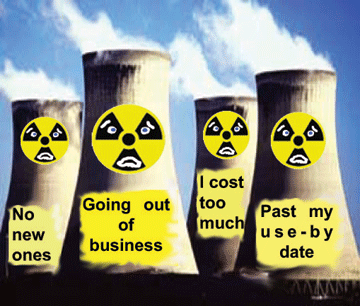
Facts:

* The number of power reactors under construction has fallen steadily from 68 in 2013 to 49 as of Feb. 2020.

* As noted above, reactors under construction in Finland, France and the UK have been subject to catastrophic cost overruns.

* There has only been one reactor construction start in China in the past three years. The number of reactors under construction in China has fallen from 20 in 2017 to 10 now. Renewables generate twice as much electricity in China as nuclear power.

* No reactors are being built in Canada.

Mr. Barilaro on small modular reactors (SMRs): “Given their size and efficiency, their waste is minimal (new advancements in technology continues to address the waste issue)”.

Facts:
* SMRs would produce more nuclear waste per unit of energy produced compared to large reactors.

* A 2016 European Commission document states: “Due to the loss of economies of scale, the decommissioning and waste management unit costs of SMR will probably be higher than those of a large reactor (some analyses state that between two and three times higher).”

* Mr. Barilaro’s “new advancements” (‘Generation IV’ concepts) have failed spectacularly and have clearly worsened nuclear waste management problems (see p.42-43 of our joint submission to the NSW inquiry).

Mr. Barilaro: “The compact nature of SMRs means they need close to only 5 per cent of the nuclear fuel required for large conventional reactors.”

Fact: As the South Australian Nuclear Fuel Cycle Royal Commission report noted: “SMRs have lower thermal efficiency than large reactors, which generally translates to higher fuel consumption and spent fuel volumes over the life of a reactor.”
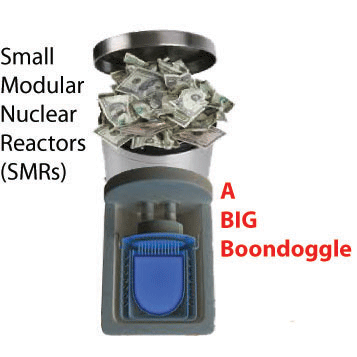
Mr. Barilaro: SMRs are “becoming very affordable”.

Facts:

* Every independent economic assessment finds that electricity from SMRs will be more expensive than that from large reactors.

* SMRs will inevitably suffer from diseconomies of scale: a 250 MW SMR will generate 25% as much power as a 1,000 MW reactor  but it will require more than 25% of the material inputs and staffing, and a number of other costs including waste management and decommissioning will be proportionally higher.

* A December 2019 report by CSIRO and the Australian Energy Market Operator concluded that wind and solar power, including two to six hours of storage, is two to three times cheaper than power from small reactors per unit of energy produced. Nuclear lobbyists dispute the construction costs that underpin this estimate but, in fact, they are a neat fit with real-world construction costs (as opposed to self-serving industry speculation). Indeed the CSIRO/AEMO estimate is lower than the average cost of small-reactor projects in China, Russia and Argentina.

* SMRs in China, Russia and Argentina are, respectively, 2, 4 and 23 times over-budget. None could be described as “very affordable”.

Mr. Barilaro: SMRs “are now on the horizon”.

Facts:

* A handful of SMRs are under construction (half of them to power fossil fuel mining operations in the Arctic, the South China Sea and elsewhere).

* Private sector investment has been pitiful and the main game is to find governments reckless enough to bet billions of taxpayer dollars on high-risk projects. SMRs under construction are all being built by government agencies.

* The prevailing scepticism is evident in a 2017 Lloyd’s Register report based on the insights of almost 600 professionals and experts from utilities, distributors, operators and equipment manufacturers. They predict that SMRs have a “low likelihood of eventual take-up, and will have a minimal impact when they do arrive”.

* Likewise, a 2014 report produced by Nuclear Energy Insider, drawing on interviews with more than 50 “leading specialists and decision makers”, noted a “pervasive sense of pessimism” regarding SMRs.

Mr. Barilaro: SMRs are “not as water hungry as traditional nuclear power plants, because they use air or sand to cool the core.”

Facts:

* SMRs will likely use as much water per unit of energy produced compared to large reactors ‒ possibly more due to lower thermal efficiencies. Nuclear power, large or small, is incredibly thirsty: a typical large reactor consumes 35‒65 million litres of water per day. Gas cooling creates its own set of problems and inefficiencies, leading to higher costs ‒ that is why a very large majority of reactors are water-cooled.

* Sand to cool a reactor core? Perhaps he means sodium ‒ which has caused a number of fires in fast neutron reactors. Sand has only been used as a desperate measure in the event of major accidents, e.g. Chernobyl. Continue reading →

March 12, 2020 Posted by Christina Macpherson | New South Wales, spinbuster | Leave a comment

Climate change fuelled Australia’s devastating Black Summer – Climate Council Report

Summer of crisis https://apo.org.au/node/277911, 11 MAR 2020, Lesley Hughes, Will Steffen, Greg Mullins, Annika Dean, Ella Weisbrot, Martin Rice

Climate Council of Australia   Australia’s Black Summer of 2019-20 was characterised by catastrophic bushfires. The bushfire season started in winter and was the worst on record for New South Wales in terms of its intensity, the area burned, and the number of properties lost. It was also the worst season on record for properties lost in Queensland.

This report focuses on New South Wales and the Australian Capital Territory, because the effects of the bushfires were most severe in these areas, but we acknowledge that the bushfires affected Victoria, Queensland, South Australia, Western Australia and Tasmania.

Key findings:

Climate change fuelled Australia’s devastating Black Summer

  • Extremely hot, dry conditions, underpinned by years of reduced rainfall and a severe drought, set the scene for this summer’s unprecedented fires.
  • Cool season rainfall has declined in southeast Australia over the last two to three decades, while temperature records have been broken over and over. 2019 was Australia’s hottest, driest year on record. 2018-2019 was southeast Australia’s driest two-year period on record.
  • The Australian fire season has lengthened in NSW, decreasing the ability of land managers to conduct hazard reduction burns and increasing the number of fire danger days.

Australia’s Black Summer was unprecedented in scale and harm. The bushfire season was the worst on record for New South Wales in terms of the scale of the bushfires, the number of properties lost and the amount of area burned.

The bushfires are estimated to have spewed between 650 million and 1.2 billion tonnes of carbon dioxide into the atmosphere. That is equivalent to the annual emissions from commercial aircraft worldwide and is far higher than Australia’s annual emissions of around 531 million tonnes.

  • Climate change events are becoming increasingly economically devastating.
  • The tourism sector alone is set to lose at least $4.5 billion because of the bushfires. It is estimated that there was a 10-20 percent drop in international visitors booking holidays to Australia.
  • The bushfire smoke that blanketed Sydney is estimated to have cost the city $12-50 million per day.
  • More than 23,000 bushfire related insurance claims were lodged across New South Wales, Queensland, South Australia and Victoria between November and February, totalling an estimated value of $1.9 billion.

The summer of 2019-20 saw unprecedented climate impacts fuelled by the burning of coal, oil and gas.

  • The hot, dry conditions that fuelled these fires will continue to worsen without substantial, concerted action to rapidly phase out coal, oil and gas.
  • Australia urgently needs a plan to cut our domestic greenhouse gas emissions to net zero and to phase out fossil fuel exports because we are one of the world’s largest polluters.
  • Taking action now will provide a chance to stabilise, then eventually reduce disaster risks for future generations.
  • Clearly, what Australia does matters and the longer we delay, the harder the problem will be to solve. We simply cannot leave this mess for our children to try to fix.

March 12, 2020 Posted by Christina Macpherson | ACT, New South Wales | Leave a comment

NSW Environment Minister Matt Kean contradicts the Coalition party line – wants climate action and NO nuclear

It’s time to win climate wars, Kean says  https://www.canberratimes.com.au/story/6674567/its-time-to-win-climate-wars-kean-says/?cs=14231, Jodie Stephens, 11 Mar 20,   

Outspoken NSW Environment Minister Matt Kean says it’s time to “win the climate wars” and for the political right to show better leadership on the issue.

In the wake of a devastating bushfire season, Mr Kean wants an end to “futile arguments” about whether climate change exists.

He told an Affinity Intercultural Foundation event on Wednesday people had weaponised climate change for too long and to the country’s detriment.

He stressed reducing emissions didn’t need to come at the expense of the economy.  “That’s something that has been absent from the debate for a long time. The economics have changed dramatically,” Mr Kean said at the Sydney event.

“Right now, it presents an enormous economic opportunity for our nation that’d be too good to miss.”

Mr Kean said renewables backed up by pumped hydro offered the cheapest way to deliver electricity, adding, “It’s not nuclear, it’s not coal, it’s not gas.”

He said the global push to reduce emissions would require trillions of dollars of investment in low-emissions technology and he wanted a big slice of that money coming into NSW.

“There’s no country on the planet better placed to take advantage of a low-carbon world than Australia,” he said.

“We’ve got masses of land, we’ve got some of the best wind and solar sources anywhere on the planet.”

Criticised earlier this year for linking bushfires to climate change, Mr Kean said at the time federal cabinet ministers wanted stronger action.

Prime Minister Scott Morrison responded by claiming most of his colleagues didn’t know who Mr Kean was and that he “doesn’t know what he’s talking about”.

Mr Kean on Wednesday said he was glad he raised the issue because it demonstrated “that the sensible people in this discussion need to stand up”.

“The centre of Australian politics has vacated the field when it comes to climate change for too long,” he said.

He said the right of Australian politics hadn’t been showing the leadership they should have for a long time.

“It’s time for that to change.

“As someone on the right of Australian politics, the reason I’m there is because I believe in the power of markets. I’m a capitalist.”

Mr Kean told the event he intended to win the nuclear debate, after Deputy Premier John Barilaro said the Nationals would support a bill to repeal state bans on uranium mining and nuclear facilities.

“For the people arguing for nuclear, you’re actually arguing for more expensive electricity which is less safe and dirtier. I don’t think that’s a good argument,” he said.

March 12, 2020 Posted by Christina Macpherson | climate change - global warming, New South Wales, politics | Leave a comment

Liberal-National Coalition in nuclear disarray

Barilaro’s nuclear push bitterly dividing Coalition,  https://www.smh.com.au/politics/nsw/barilaro-s-nuclear-push-bitterly-dividing-coalition-20200308-p547zm.html  Alexandra Smith, March 9, 2020 Deputy Premier John Barilaro’s support for a One Nation bill to allow nuclear power in NSW is bitterly dividing the Coalition, with a senior Liberal minister prepared to quit cabinet over the issue.In the latest split over environment policy in the Berejiklian government, several Liberal ministers say they will refuse to support Mark Latham’s private members’ bill when it comes before cabinet.

Mr Barilaro’s position is also causing division in his National Party, with some of the party’s coastal MPs concerned that his position would put their seats at risk.

The Nationals’ leader last week declared his party would support Mr Latham’s bill when it comes back before the upper house for a vote this month.

The bill would allow the bans on uranium mining and nuclear power to be lifted but it has not yet been considered by the Liberal or National party rooms or cabinet.

It follows a parliamentary inquiry report, which said the government should support the bill.

But the issue has caused such anger within Liberal ranks that one senior minister told the Herald they would quit cabinet before supporting Mr Latham’s bill.

A senior Liberal minister said: “I did not get into Parliament to support a One Nation bill”, while another minister said: “Crossbenchers don’t set the government’s agenda”.

“It’s amazing that John Barilaro listens to the views of One Nation over his colleagues,” a fourth senior minister said.

Last week, Local Government Minister and Liberal MP Shelley Hancock told Parliament she would not support a nuclear reactor in her electorate.

But Mr Barilaro shot back and said the Liberals repeatedly say they “support technology agnostic energy policy” but then refuse to have a discussion about the role of nuclear.

“Forget about this being a crossbench bill, I would take this to my party room and then put up my own bill if I need to,” Mr Barilaro said.

March 8, 2020 Posted by Christina Macpherson | New South Wales, politics | 2 Comments

New South Wales South Coast to become a nuclear wasteland? That’s the plan of the National Party

Nationals to support nuclear power; Far South Coast flagged as possible location  https://www.begadistrictnews.com.au/story/6665667/nationals-to-support-nuclear-power-far-south-coast-flagged-as-possible-location/, Albert McKnight  6 Mar 20, 

The Nationals will support a bill to allow nuclear power in NSW, while separately the Far South Coast has been flagged as a possible location for a nuclear power plant.

When speaking to Sky News earlier this week, Deputy Premier John Barilaro confirmed The Nationals would support a bill proposed by One Nation on the matter, and said the state would not achieve its 2050 net zero emissions target without nuclear energy.

“While we exclude certain technologies when it comes to the energy mix for the future, I think we’re making it very hard for ourselves,” he told Sky News.

Mr Barilaro has been vocal about the nuclear power issue for years, last year saying it was “guaranteed baseload energy with zero emissions, no fossil fuels and probably the cheapest cost to the average Australian household”.

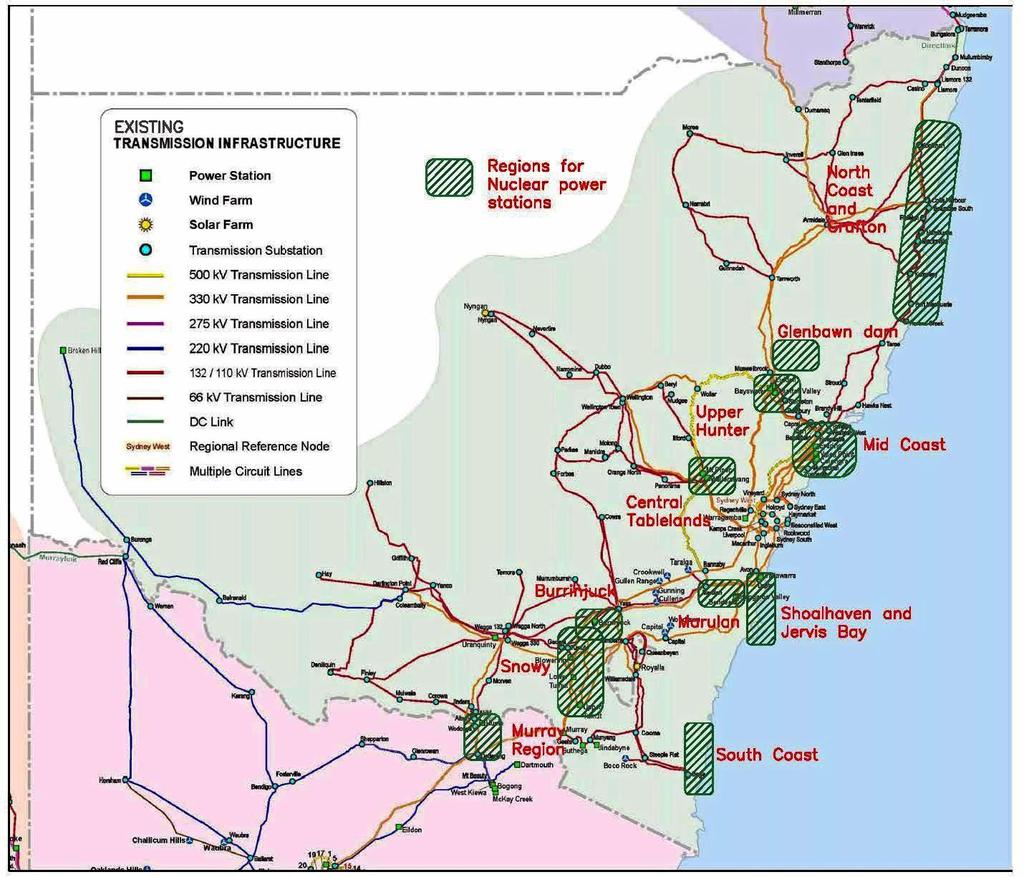
In a study by Nuclear for Climate Australia published on its website, the area between Bermagui and Merimbula is among 18 proposed areas of interest in NSW for a nuclear power station.

Under its proposal it states the South Coast has potential if included with other power plants that could be built at East Gippsland, the Snowy Mountains or Jervis Bay.

While it states the coast has many sites with “good access to once-through sea water cooling” – running a large amount of water through a power plant’s condensers then discharging it into a waterway with only a small amount of evaporation – an extensive grid upgrade would be required for a 2.2GW plant.

Shadow Minister for Climate Change and Energy Adam Searle confirmed a McKay Labor Government would maintain a ban on uranium exploration, extraction and export.

“Nuclear is the most expensive form of power and its waste is a disaster for the environment,” he said.

“Regional and coastal communities now face the grim prospect of becoming a nuclear power plant wasteland, as a result of Mr Barilaro leading this government by the nose.”

Shadow Minister for the Illawarra and South Coast Ryan Park said coastal communities would never embrace nuclear energy.

“This has clearly divided the Liberal-National Government,” he said.

“[Member for South Coast] Shelley Hancock has already said she would not support nuclear plants on the South Coast.”

He said Member for Bega Andrew Constance should do the same. Mr Constance has been approached for comment.

One Nation’s Mark Latham introduced the bill to lift the ban on nuclear power and uranium mining in NSW, saying it would “create jobs, investment” and “undertake the long-term planning needed to keep the lights on”.

Does NSW need nuclear power? Write a letter to the editor 


March 7, 2020 Posted by Christina Macpherson | New South Wales, politics | Leave a comment

« Previous Entries     Next Entries »

1 This month

of the week – Disrupting War & Militarism in Oceania. Active solidarity. Radical practice.

  • Pages

    • 1 This month
    • Disclaimer
    • Kimba waste dump Submissions
      • NUCLEAR ROYAL COMMISSION
      • Submissions on Radioactive Waste Code 2018
      • SUBMISSIONS TO SENATE INQUIRY 18
    • – Alternative media
    • – marketing nuclear power
    • business and costs
    • – Spinbuster 2011
    • Nuclear and Uranium Spinbuster – theme for June 2013
    • economics
    • health
    • radiation – ionising
    • safety
    • Aborigines
    • Audiovisual
    • Autralia’s Anti Nuclear Movement – Successes
    • climate change – global warming
    • energy
    • environment
    • Fukushima Facts
    • future Australia
    • HEALTH and ENVIRONMENT – post Fukushma
    • media Australia
    • Peace movement
    • politics
    • religion – Australia
    • religion and ethics
    • Religion and Ethics
    • secrets and lies
    • Spinbuster
    • spinbuster
    • wastes
    • ethics and nuclear power – Australia
    • nuclear medicine
    • politics – election 2010
    • secrecy – Australia
    • SUBMISSIONS to 2019 INQUIRIES
    • weapons and war
  • Follow Antinuclear on WordPress.com
  • Follow Antinuclear on WordPress.com
  • Blogroll

    • Anti-Nuclear and Clean Energy Campaign
    • Beyond Nuclear
    • Exposing the truth about thorium nuclear propaganda
    • NUCLEAR INFORMATION
    • nuclear news Australia
    • nuclear-news
  • Categories

    • 1
    • ACTION
    • Audiovisual
    • AUSTRALIA – NATIONAL
      • ACT
      • INTERNATIONAL
      • New South Wales
      • Northern Territory
      • Queensland
      • South Australia
        • NUCLEAR ROYAL COMMISSION 2016
          • Nuclear Citizens Jury
          • Submissions to Royal Commission S.A.
            • significant submissions to 6 May
      • Tasmania
      • Victoria
      • Western Australia
    • Christina reviews
    • Christina themes
    • Fukushima
    • Fukushima 2022
    • General News
    • Japan
    • Olympic Dam
    • Opposition to nuclear
    • reference
    • religion and ethics
    • Resources
    • TOPICS
      • aboriginal issues
      • art and culture
      • business
        • employment
        • marketing for nuclear
      • civil liberties
      • climate change – global warming
      • culture
      • energy
        • efficiency
        • solar
        • storage
        • wind
      • environment
      • health
      • history
      • legal
      • media
      • opposition to nuclear
      • people
      • personal stories
      • politics
        • election 2013
        • election 2016
        • election 2019
        • Submissions Federal 19
      • politics international
      • religion and ethics
      • safety
        • – incidents
      • secrets and lies
      • spinbuster
        • Education
      • technology
        • rare earths
        • thorium
      • uranium
      • wastes
        • Federal nuclear waste dump
      • weapons and war
    • water
    • Weekly Newsletter
    • Wikileaks
    • women

Site info

Antinuclear
Create a free website or blog at WordPress.com.
Privacy & Cookies: This site uses cookies. By continuing to use this website, you agree to their use.
To find out more, including how to control cookies, see here: Cookie Policy
  • Subscribe Subscribed
    • Antinuclear
    • Join 883 other subscribers
    • Already have a WordPress.com account? Log in now.
    • Antinuclear
    • Subscribe Subscribed
    • Sign up
    • Log in
    • Report this content
    • View site in Reader
    • Manage subscriptions
    • Collapse this bar
 

Loading Comments...