ERA desperately trying to restore confidence in uranium investors for Ranger mine
ERA digs deep in search of a future BARRY FITZGERALD THE AUSTRALIAN APRIL 10, 2014
“…..Chief executive Andrea Sutton told ERA’s annual meeting in Darwin yesterday that the environmental impact statement would be submitted in the second half of this year. The company is targeting first production late next year and has a $120 million exploration decline and a $57m prefeasibility study into the development running concurrently. Uranium production at Ranger from stockpiled ore is suspended following the collapse of a leach tank in the processing plant in December.
The collapse released a slurry of ore and acid which was captured by the site’s containment system, with ERA saying that no material escaped into Kakadu.
The AGM was told that ERA’s board had approved a work plan to bring the processing plant to readiness for a restart. But a final clearance is required from the NT and federal governments.
Ms Sutton was not able to put a timeline on when that might happen, raising the prospect that ERA will have to secure uranium from other sources. The meeting was told that the quantities involved would depend on the timing of operations being restarted.
The company said it understood the “importance of restoring confidence in the safety and environmental performance of the Ranger mine”. http://www.theaustralian.com.au/business/era-digs-deep-in-search-of-a-future/story-e6frg8zx-1226879305475#
Plan for underground mine at Ranger is high risk and low return
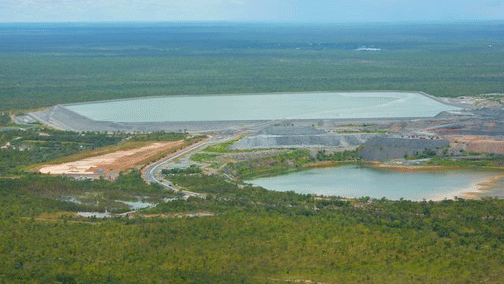 ERA told: Clean up Ranger uranium mine site and clear out rather than shifting underground, 9 April 14
http://www.abc.net.au/news/2014-04-09/era-urged-to-clean-up-ranger-uranium-mine-site-and-clear-out/5377698?section=ntPublic health experts have joined traditional owners and environmentalists in calling for Energy Resources of Australia (ERA) to focus on land rehabilitation rather than expansion of its Ranger uranium mine in the Northern Territory.
The company’s latest report shows that despite operations being suspended at the site since a toxic leak last year, plans to mine uranium underground continue.
ERA is holding its annual general meeting in Darwin today.
NT branch secretary of the Public Health Association of Australia, Dr Michael Fonda, says underground uranium mining poses serious health risks. One of the main things that is concerning us is that they [miners] are going to be exposed to dangerous levels of radon gas,” he said. Dr Fonda says ERA has a troubling safety record and it cannot be trusted to ensure safe work practices for the underground uranium mining.
“What is being planned for the R3 Deep’s expansion is for very large extraction fans to take much of that radon [gas] out of the mine,” he said.”I am concerned, and the Public Health Association is concerned, that will not be enough.”
Australian Conservation Foundation (ACF) national nuclear campaigner Dave Sweeney says ERA should focus on land rehabilitation in the final years of its mining lease. “Realise this is high risk and low return,” he said.
“Instead of accepting the inevitable and cleaning up and exiting, and having a staged and a costed and managed rehabilitation of the Ranger site, ERA is increasingly desperate and is chasing the illusion of dollars by going underground with the Ranger 3-Deep project.”Mr Sweeney says ERA and its parent company Rio Tinto should realise the planned underground mine is high risk and low return.
Indigenous traditional owners have expressed concerns that ERA will not have enough money to follow through on rehabilitation plans for the mine, which is near Jabiru and inside the boundaries of Kakadu National Park.
The end of an era for Energy Resources of Australia’s uranium mining in Kakadu
 The ERA of uranium mining is over http://www.onlineopinion.com.au/view.asp?article=16200, Dave Sweeney 9 April 14, In the early hours of Saturday December 7th 2013 the evacuation order was given in the processing area of Energy Resources of Australia’s troubled Ranger uranium mine in Kakadu.
Minutes later came the unforgiving sound of peeling metal followed by a surge of over one million litres of highly acidic uranium slurry from the buckled and broken number one leach tank. The toxic tide swept over the concrete bunds meant to contain any spills and moved uncontrolled through the night and the site.
Four months later and ERA remains under pressure, under performing and under scrutiny. Mineral processing remains suspended at Ranger pending the findings of a federal government review of the tank collapse and this week the ERA board and management will face sceptical shareholders and no doubt plenty of critical questions at the company’s annual meeting in Darwin. Continue reading
Public Health Association concerned about health dangers of planned Ranger uranium mine expansion
 Proposed Ranger 3 Deeps expansion too risky says PHAA , 7 April 14, The Northern Territory Branch of the Public Health Association of Australia (PHAA NT) is today launching its submission to the Social Impact Assessment process for the proposed ‘Ranger 3 Deeps’ (R3D) underground expansion at the Ranger uranium mine. This comes ahead of a public forum about the future of Ranger in Darwin titled “Reconsidering Ranger”.
The PHAA NT submission focusses on the health and safety impacts for the local population, mine workers and the environment as well as the impacts the exported uranium is having overseas.
“There have been over 200 significant safety incidents at Ranger in its 30 years of operation, including the December 2013 spillage of more than 1 million litres of radioactive and acidic slurry from a storage tank,” said Dr Michael Fonda, PHAA NT Branch Secretary.
“It is of great concern that Energy Resources Australia intends to use the same ageing processing equipment for its proposed R3D expansion,” Dr Fonda said.
PHAA NT is concerned about the health impacts underground mine workers will face from radon exposure.
“Radon inhalation is a particularly dangerous form of radiation exposure and PHAA NT wants reassurances that the R3D design would meet world’s best practice standards. Evidence has emerged linking Ranger to adverse impacts on the surrounding population and environment,” said Dr Fonda.
A 2006 Australian Institute of Aboriginal and Torres Strait Islander Studies report investigating cancer rates in the local population found that the number of actual cases of cancer was 90% higher than expected.
“The research findings to date are very alarming. We believe it is unsafe and unethical to approve this underground expansion before further studies into the health effects in the region have been carried out,” he added.
In the wake of the 2011 Fukushima reactor disaster, which was fuelled in part by Australian uranium, the United Nations called for an urgent review into the health and environmental impacts of uranium mining in Australia. “This review still has not been initiated by the Australian Government. We believe Australia needs an inquiry into its entire nuclear industry before proceeding with any further expansions and PHAA have repeatedly called for this,” Dr Fonda said.
Dr Fonda will be talking about these issues along with other speakers at the “Reconsidering Ranger” public forum being held at the Hilton Hotel in Darwin on Tuesday 8 April 2014. Entry is free and doors open at 6:30pm.
For further information/comment:
Dr Michael Fonda, NT Branch Secretary, Public Health Association of Australia 0429 435 595
This media release – and the related submission – will be available on the PHAA website at: www.phaa.net.au
Three respected Aborigines resign from Country Liberal Party
 Bush Aborigines are fed up AMOS AIKMAN THE AUSTRALIAN APRIL 04, 2014
TENSION between Aborigines who have remained poor while Darwin has been transformed from a disaster zone after Cyclone Tracy to a “Gateway to Asia” city now has finally burst through the seams, ripping apart the Northern Territory government.
The imminent departure from the ruling Country Liberal Party of three traditional, culturally respected indigenous members not only plunges the government into crisis but could create a watershed for indigenous representation in Australia. Aboriginal votes that enabled the CLP to win power failed to deliver a government in which a majority of Aboriginal members could influence policymaking, resources allocation and the public service to anywhere near their — or, it appears, their constituents’ — satisfaction……….
Since the start of self-government in 1978, the Territory has been a mendicant state administering large amounts of federal funds for the notional benefit of Aborigines. However, a parade of reports has revealed that much of the money is skimmed off before it reaches the ground and, despite the substantial spending, living standards and health outcomes have barely improved in 30 years.
Some indicators, particularly those for children, are going backwards.
Successive governments have tried to contain the competing interests of remote and urban voting constituencies. The division is a socioeconomic one that falls uncomfortably along racial lines. In effect, these two constituencies are hankering for the same government resources rather than, as might be the case elsewhere, partnering in the economy……
Chief Minister Adam Giles was installed in March last year with the help of so-called “bush members”, who hoped the change would bring stability………
Anderson, in particular, objected to Giles axing the indigenous advancement department she had been in charge of, and scrapping a committee established by Mills to bring feedback from the bush directly to the cabinet table.
Giles sacked her from his ministry in September, in a move some now view as counterproductive. Gradually it became clear that, by ousting Mills, Giles and his allies had sundered the CLP in much the same way Julia Gillard did Labor when she replaced Kevin Rudd……….
Giles has focused his attention, at times forcefully, on laying the groundwork for major private-sector investment. While this may be an admirable long-term goal, it has distracted from the small-scale change and consultative policymaking bush residents voted for.
The result has been a chorus of questions about whether Aboriginal people will be drivers or passengers in development of their own land — the sort of concerns that fostered the Aboriginal land rights movement. This has clearly been a problem for Kurrupuwu, Anderson and Lee.
“Our concerns for a long period of time has been that we haven’t delivered for the bush,” Anderson told the ABC recently………
The risk for the federal government is self-evident. While the nation debates controversial racial discrimination legislation, and edges towards a referendum on constitutional recognition of indigenous people, politicians exchange racial epithets and ugly allegations in the Territory……… http://www.theaustralian.com.au/news/features/bush-aborigines-are-fed-up/story-e6frg6z6-1226873925714#
US Pentagon’s military city in Australia – Darwin
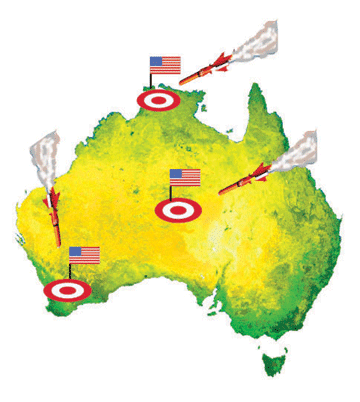 Darwin: Australia’s most militarised city, and a lily pad for the Pentagon Australians know the isolated and exotic city of Darwin through stories about cyclones, crocodiles and Aboriginal art, but it really is a cleverly camouflaged garrison town Tess Lea theguardian.com, Monday 31 March 2014 In his recent book Anzac’s Long Shadow: The Cost of our National Obsession, former ADF soldier James Brown correlates deep Australian ignorance about our contemporary military with our increasingly fantastical commemoration of the Anzac legend. Bedazzled by myths of Gallipoli, Australians neglect more pressing defence policy concerns.
It’s a compelling thesis, and one that closely parallels the situation in one of Australia’s most militarised city,  Darwin.
Australians prefer to see the isolated and exotic city of Darwin through stories about cyclones, crocodiles, Aboriginal art, spicy market food and unlimited road speeds; a place that lets you go to the supermarket in bare feet and look normal. This way, we don’t have to notice the most significant militarisation effort in Australia’s post-war history, which is happening under our noses. The militarisation of the north is unknown to most of us and thanks to this ignorance, the new Cold War brewing in the Asia Pacific region, and Darwin’s place in it, is rarely being debated………
In allowing Australia’s foreign policy interests to be played out of sight, out of mind, in a town that also hides its own nature from itself, we avoid debating difficult questions. What does being a subordinate ally to a military force clinging to its global primacy commit us to? What are our liabilities and responsibilities? At what point do Australian sovereign interests diverge from America’s security objectives? And what are we prepared to do about it? http://www.theguardian.com/commentisfree/2014/mar/31/darwin-a-complicated-but-dazzling-history
Call to Northern Territory’s Country Liberal Party to oppose radioactive waste dump plan
 CLP needs to stand up for the Territory over Canberra’s radioactive waste plan. 13 Mar 14, National and Territory environment groups have called on Chief Minister Adam Giles to send a clear message to Canberra to end plans for a radioactive waste dump in the NT.
The call comes on the second anniversary of former federal Labor Minister Martin Ferguson pushing ahead with controversial federal laws for a radioactive waste dump at Muckaty, north of Tennant Creek.
“Radioactive waste is long lived, hazardous and serious stuff but sadly the Muckaty plan is based more on broken promises and dodgy political expedience than credible science or proper process,” said Australian Conservation Foundation campaigner Dave Sweeney.
“The approach taken by successive federal governments has not been inclusive, scientific or robust and is not consistent with either international industry best practise or Australia’s obligations”.
The Muckaty plan is strongly contested by many Traditional Owners, environment, public health and trade union groups and is the focus of current Federal Court legal action due to go to trial in June 2014.
“For over two decades there has been a push by Canberra for a remote waste dump – first defeated by a strong community campaign in South Australia, and now their sites are firmly set on the NT. This has occurred without a scrap of evidence or success to support such a plan, and in the absence of community consent or a social license,” said ECNT campaigner Lauren Mellor.
“The Territory community and environment deserves better than Canberra playing short term politics with a long term problem.”
“It is time for the Chief Minister to send a clear message to Canberra.Territorians don’t want, and won’t cop, a cynical and dodgy dump plan. We want a genuine examination of how to responsibly manage Australia’s radioactive waste”.
For comment: Dave Sweeney, ACF, 0408 317 812 Lauren Mellor, ECNT, 0413 534 125
Northern Territory is no place for Sydney’s radioactive waste
The NT is no place for Sydney’s radioactive waste: Time for evidence, not expedience, Natalie Wasley, 28 Feb 14, A plan by the NSW Government to move large volumes of radioactive waste from suburban Sydney to a proposed but non-existent dump site at Muckaty north of Tennant Creek highlights the confused and short-term thinking surrounding radioactive waste management in Australia, according to national radioactive waste watchdog the Beyond Nuclear Initiative.
BNI has condemned the suggestion by NSW Finance Minister Andrew Constance that radioactive soil from Hunter’s Hill should be transported to the proposed national radioactive waste dump at Muckaty. “The NSW Liberals’ first plan to transport contaminated soil to politically vulnerable areas of Western Sydney was strongly challenged by the community, local councils and trade unions,” said BNI coordinator Natalie Wasley.
“The latest plan – calculated to move the waste out of the sight and mind of residents in the affluent suburb of Hunter’s Hill – shows extreme contempt for Muckaty Traditional Owners who have been campaigning for almost seven years against the NT dump plan.”
“A strong alliance between Traditional Owners, health and environment groups, trade unions and social justice organisations has stymied and delayed the Muckaty plan. The Muckaty site nomination is the subject of Federal Court action set for trial in June. Any attempts to move radioactive waste there from NSW would be actively challenged by the local community and their growing national network of supporters.”
“Mr Constance’s ‘viable option’ of a 3500km road trip for 5000 tonnes of waste is a long way from international standards that call for community participation in decision making on radioactive waste storage. Transporting radioactive materials long distances presents an unacceptable risk to transport and emergency workers as well as communities along the route.”
“The NSW government clearly does not have a strategy for responsible waste management beyond attempts to find a disenfranchised community to dump it on.”
“Instead of short term dump and run politics we urgently need an independent national commission into advancing responsible radioactive waste management. Minister Constance’s proposal highlights the pressing need for this inquiry to go ahead while the Muckaty site nomination is contested in court. Instead of political plans and toxic trucks we need a genuine and evidence based assessment.”
ERA uranium company’s losses, and closed operations due to radioactive spill
ERA narrows loss to A$136m, says toxic spill probe continuing Mining Weekly By: Esmarie Swanepoel 31st January 2014 “…..During the year, revenue from sales decreased 10%, to A$355.8-million, while revenue from continuing operations was down 12% on the previous financial year to A$370-million…..
ERA produced some 2 960 t of uranium oxide in the year under review, which was 20% less than that produced in 2012, as lower mill rates affected output. The suspension of processing operations following the failure of a leach tank in December also negatively affected operations, ERA said.
Processing operations at the Ranger mine, in the Northern Territory, remain suspended pending the completion of a full investigation and regulatory approvals to restart.
ERA was conducting an independent investigation that would run in parallel with the government investigation.http://www.miningweekly.com/article/era-narrows-loss-to-a136m-says-toxic-spill-probe-continuing-2014-01-31
Aboriginal Land Rights activists targeted by ASIO and NT cops
 ASIO and NT cops spied on, meddled with careers of Territorians BY ALISON BEVEGE NT NEWS JANUARY 21, 2014 AUSTRALIA’S secret service spied on Territorians – including the NT News editor – files released under the Archives Act show……
Those targeted had spoken out against the Vietnam War, campaigned for Aboriginal land rights or opposed Indonesia’s brutal invasion and occupation of East Timor.
Their partners, friends and colleagues were followed, their phones tapped and mail was intercepted…….http://www.dailytelegraph.com.au/news/asio-and-nt-cops-spied-on-meddled-with-careers-of-territorians/story-fnk1w5xx-1226806880023
Following tank rupture, outlook dim for ERA’s Ranger uranium project
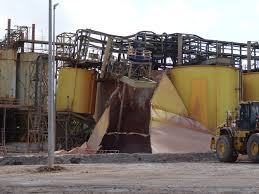 Leach tank failure impacts ERA’s uranium production results, Mining Australia,10 January, 2014 Vicky Validakis Production at ERA’s uranium mine took a 60 per cent hit in the December quarter after a leach tank rupture forced operations to close at the site.
While a slight fall in production was expected after the completion of mining in the high-grade open-cut Ranger pit, matters worsened for the miner when a leach tank at the site’s processing plant ruptured and collapsed, causing an acidic radioactive slurry spill.
The incident forced the shutdown of operations and a massive clean-up at the site, with the Federal Government announcing the mine will not be able to restart production operations without regulatory approval and the go ahead from a joint operation taskforce.
Processing operations remain suspended while clean-up and recovery operations at the Ranger processing plant are ongoing.
In an ASX announcement the Rio Tinto-owned ERA revealed uranium production for the December quarter was 503 tonnes, down 17 per cent on the preceding September quarter and 59 per cent down on the previous corresponding period.
The fall cut annual output by 20 per cent to 2960 tonnes……..approval may be difficult to come by with the Mirrar people previously stating that a number of safety incidents at the site had caused distrust.
In early November a mine left the site’s controlled areas sparking fears of contamination, while later that month four uranium storage barrels were discovered in bushland near Darwin.
“Day by day, litre by litre, incident by incident, they’re losing whatever trust traditional owners have in them,” Mirrar spokesperson Justin O’Brien said. http://www.miningaustralia.com.au/news/leach-tank-failure-impacts-era-s-uranium-productio
Uranium company ERA’s “horror year” continues
 Production slump caps a horror year for ERA BARRY FITZGERALD THE AUSTRALIAN JANUARY 10, 2014 RIO Tinto’s listed uranium subsidiary Energy Resources of Australia (ERA) has finished off a horror year by reporting a near 60 per cent slump in December quarter production from its Ranger mine in the Northern Territory.
A severe production fall was expected because of the absence of high-grade material following the cessation of mining operations in the open-cut at Ranger. But things got worse on December 7 when a leach tank at the processing operations collapsed, forcing a shutdown for clean-up and a wait for regulatory approval to restart processing operations. … (registered readers only) HTTP://WWW.THEAUSTRALIAN.COM.AU/BUSINESS/MINING-ENERGY/PRODUCTION-SLUMP-CAPS-A-HORROR-YEAR-FOR-ERA/STORY-E6FRG9DF-1226798542510#
Unsettling truths about Australia’s uranium and nuclear history
a few unsettling home truths about Australia, as a far-flung outpost of what the writer B. Wongar has called the ‘Nuclear Empire’.
the plunder of native land for its enormous reserves of uranium has entrenched the country’s problematic engagement in world nuclearism and undermined its international credentials as a leading proponent of nuclear non-proliferation.
 Anzac, New Mexico: Placing Australia in the Nuclear Empire, Meanjin, Robin Gerster, Dec 13 It is a lament that many Australian readers will recognise: an indigenous narrator is telling the story of colonial dispossession, from the time of white settlement to the rampant mining activity of today, expressing his helplessness in the face of an implacable force that reinscribes the very landscape it has taken over, mapped and mined………….
In August 1945, unable to boast a military role in such a king-hit to its hated enemy Japan, Australia sought another way to take a small slice of the wretched glory. Two days after the Hiroshima bombing, the claim was circulated that ‘Little Boy’ was fuelled by Australian uranium: ‘Uranium from S.A. source’, ran a story on page one of the Sydney Morning Herald. But the text itself says nothing more than the fact that uranium is vital to nuclear fission, that it had been mined at Mt Painter in South Australia, and (portentously) that supplies of the element had been ‘flown out’ from the mine’s newly constructed aerodrome. The Herald soon retracted the story, quoting Prime Minister Ben Chifley to the effect that ‘though Australia attempted to secure uranium for the atomic bomb, the production stage was never undertaken’. This was a minor humiliation in the scheme of things, but a reminder that Australia’s part in these epochal events was essentially peripheral. Undeterred, a Courier-Mail correspondent on 9 August, the day of reckoning for Nagasaki, claimed that Australia ‘gained prestige’ from the advent of the atomic bomb merely by being one of the world’s leading sources of the element.
Call to reform APY Lands executive board
Former judge urges a clean-up of APY Lands board , REBECCA PUDDY. THE AUSTRALIAN, DECEMBER 23, 2013 SOUTH Australia’s remote Aboriginal lands could be set on the path towards economic development by reforming the state’s Aboriginal land rights act.
Retired Supreme Court judge Robyn Layton has provided interim recommendations into the reform of the Anangu Pitjantjatjara Yankunytjatjara Land Rights Act to the state government, calling for gender equality and a clean-up of the APY Lands executive board.
Ms Layton told The Australian yesterday she believed reform of the lands’ governing council would pave the way towards economic development.– ……
Ms Layton’s recommendations to government also would pave the way for equal gender representation on the APY executive.
Men and women living on the lands were united in their desire for equal gender representation on the board.
The Land Rights Act was anchored in a system that focused primarily on the leadership of male elders and traditional owners, Ms Layton said.
Modernising the act to include a minimum representation of women in leadership positions would take account of the greater role women were playing within Aboriginal communities.
“Women have taken a far more important role within communities because they have been the power where men have fallen away, ……http://www.theaustralian.com.au/national-affairs/policy/former-judge-urges-a-clean-up-of-apy-lands-board/story-fn9hm1pm-1226788507581#
Increased risk of radiation pollution from uranium mining in Kakadu
the Ranger mine is more than 30 years old and we are increasingly seeing metal fatigue and accidents, such as the one we saw so spectacularly 10 days ago.
 Kakadu mine: risk of uranium leakage could be greater than thought
Study shows the radioactive particles can escape into the environment, raising alarms about the national park Oliver Milman theguardian.com, Wednesday 18 December 2013 The risk of uranium leakage from filtration systems used by facilities such as the Ranger mine in Kakadu could be greater than is currently acknowledged, with new research showing that the hazardous substance is far more mobile than previously thought.
A study published in Nature Communications found that seemingly immobile uranium“piggybacked” onto iron and organic material and flowed into a stream that joined a wetland in France.
The Australian Conservation Foundation said the findings were “alarming” given the proximity of the Ranger mine to the World Heritage-listed wetlands of Kakadu national park in the Northern Territory. The ACF said the new European research called into question mine operator Energy Resources of Australia’s practice of using a wetland filtration system to ensure uranium doesn’t escape into the environment. A community of Mirarr people live about 10km from the Ranger mine. Continue reading
1 This month
7 April – WEBINAR – Australia and the Doomsday Clock – Preventing nuclear war through NoFirstUse and other policies
Online | Tuesday April 7, 4:00-5:30pm, Australian Eastern Time / 8:00-9:30am Central Europe Time
– Access the registration link
15 April – Zoom –Nuclear Power is Not the Solution
Apr 15, 2026 01:00 AM in Canberra, Melbourne, Sydney

Join the International Physicians for the Prevention of Nuclear War (IPPNW) on Tuesday, April 14th for a timely webinar exploring the risks associated with nuclear power and challenging the myth that it offers a simple, safe, carbon-free solution to the climate crisis

21 April Webinar: No Nuclear Weapons in Australia
Start: 2026-04-21 18:00:00 UTC Canberra, Melbourne, Sydney (GMT+10:00)
End: 2026-04-21 19:30:00 UTC Canberra, Melbourne, Sydney (GMT+10:00)
Event Type: Virtual
A virtual link will be communicated before the event.
Host Contact Info: australia@icanw.org

of the week – Australians for War Powers Reform (AWPR)
To see nuclear-related stories in greater depth and intensity
 Antinuclear