ERA looks at funding options for Ranger
https://www.australianmining.com.au/news/era-looks-at-funding-options-for-ranger/?fbclid=IwAR0d8ZOC6Sw7adxsNmSSEDnOWzZ319hiuqJB4clv0bQtKX5INnhiTtalqeY June 27, 2022 Ray Chan Energy Resources of Australia (ERA) is reviewing all available options to ensure that the forecast increase in the cost of rehabilitation of its Ranger uranium mine in the Northern Territory will be adequately funded.
In January 2021, ERA – in which Rio Tinto holds 86.3 per cent shares – ceased all mining and processing activities at Ranger after 40 years of operation. It was Australia’s longest continually operating uranium oxide producer.
ERA said it was committed to delivering a positive legacy for Traditional Owners and for all Australians for the future, with its closure plan outlining the path for progressive rehabilitation, which began in 1981, with final rehabilitation to be completed by January 2026.
But given ERA’s current cash on hand position, it said an urgent interim funding solution was required.
The company is engaging with its substantial shareholders in relation to a potential interim entitlement offer to raise ongoing funding for the rehabilitation of the project, the size, price and structure of which are still to be determined.
The operations of ERA are located on Aboriginal land and surrounded by, but separate from, Kakadu National Park. ERA respectfully acknowledges the Mirarr, Traditional Custodians of the land on which the Ranger project area is situated.
During its lifetime, Ranger produced in excess of 132,000 tonnes of uranium oxide.
Remembering the success of the nuclear-free movement at Muckaty in Australia’s Northern Territory
The Commons Social Change Library Nuclear Fuel Cycle watch Jim Green, 24 FEb 22, https://www.facebook.com/groups/1021186047913052
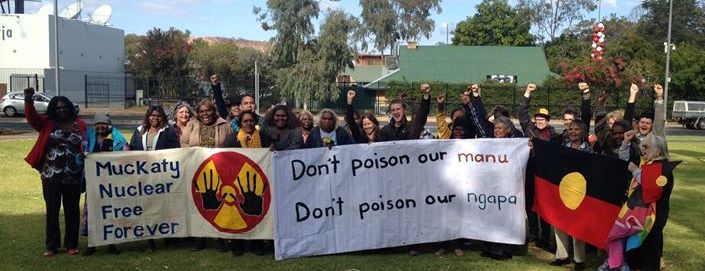
To mark the first anniversary of the official announcement of Muckaty in the Northern Territory as the site for a proposed national radioactive waste dump, members of Friends of the Earth ACE (Anti-nuclear and Clean Energy) Collective toured part of the ALP Energy and Resources Minister Martin Ferguson’s Batman electorate in search of an alternative dumping ground.
This was one of many protests against the project and it would take another three years of concerted campaigning by the Muckaty community and supporters to overturn the government’s decision. For his part Ferguson rapidly transitioned from mining minister to mining lobbyist, taking up a role as the chair of peak group the Australian Petroleum Production and Exploration Association within six months of retirement from parliament.
To learn more about creative activism visit- https://commonslibrary.org/creative-activism-101-an…/
Australians should remember our past and continuing uranium/nuclear environmental disasters
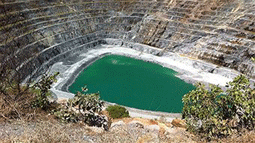
Australia has a nuclear past, we just like to forget it, St George and Sutherland Shire Leader, Chris McLennan, 29 Oct 21, No sooner did Australia announce it was going to buy a nuclear submarine fleet, there was talk of nuclear power plants as well.
Am I the only one who fears they unknowingly contracted COVID-19 or some other nasty and it has somehow warped their mind?
Nuclear this and nuclear that – everyone needs to have a nice lie down.
Australia has a poor record when it comes to nuclear power………….
One of the biggest fans of nuclear power in this country is a Senator from the Northern Territory, a veterinarian in her former life, Sam McMahon.
As someone from the Territory, she should know better
I’ll explain why in a bit.
One of the biggest fans of nuclear power in this country is a Senator from the Northern Territory, a veterinarian in her former life, Sam McMahon.
As someone from the Territory, she should know better. There are quite a few thumping great holes in the ground in her patch which need mending first.
It’s one of our dark secrets and remains one of the biggest environmental disasters in Australian history…..
Australia’s first large scale uranium mine was dug at Rum Jungle on behalf of our “Allies” in the UK and USA to fuel their nuclear weapon programs in the 1950s….
The NT Government has recently lodged plans for another go at the rehabilitation of the old mine which is today filled with water.
If it goes ahead, this will be the second go.
The mine was the first large industrial enterprise undertaken in the NT……
At Rum Jungle, a total of 863,000 tonnes of uranium ore was mined in a project under the ownership of the Commonwealth Government through the Australian Atomic Energy Commission.
The 200 hectare site closed in 1971 and was abandoned.
About $20 million was later spent trying to clean up the NT site, but the pollution continues and may continue for thousands of years.
Large volumes of radioactive mine waste (tailings) are still on the site. In 2003, an investigation of the tailings piles found that capping which was supposed to help contain this radioactive waste for at least 100 years, had failed in less than 20 years.
The latest rehabilitation efforts at Rum Jungle from 1983 to 1986 cost $18.6 million. Although at the time of the 1980s works the objectives were deemed to have been achieved, more recent studies have documented the gradual deterioration of the original rehabilitation works.
The NT and Federal Government agree there needs to be an improved rehabilitation strategy for the site.
These latest plans say the clean up would take at least five years.
No estimate was given for how much it would cost or who is going to pay for it.
The soil is contaminated, as is the groundwater and there is still waste rock needing disposal on the site.
In short, it’s a mess…….
There’s Ranger.
There is still no logical explanation as to how a big uranium mine could be allowed in the middle of perhaps Australia’s most famous national park, Kakadu, but it was.
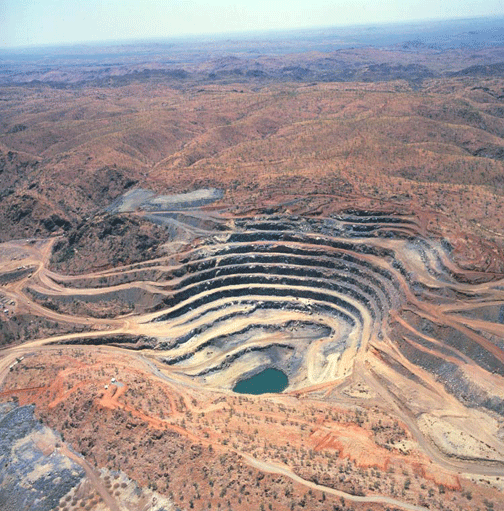
Ranger has recently been closed and the site is somehow to be rehabilitated after more than 130,000 tonnes of uranium oxide was pulled from the place over the past three decades.
Energy Resources Australia, a subsidiary of Rio Tinto, says it has spent more than $642 million in the past eight years on rehabilitation of the mountains of tailings complicated by a lake created from a vast flooded pit.
Their work is only a few years from being finished.
Only time will tell if that scar ever heals…………. https://www.theleader.com.au/story/7485098/australia-has-a-nuclear-past-we-just-like-to-forget-it/?cs=9676
‘It makes us sick’: remote NT community wants answers about uranium in its water supply
‘It makes us sick’: remote NT community wants answers about uranium in its water supply, Laramba’s Indigenous residents fear they are at risk of long-term illness and say they need to know who is responsible for fixing the problem, Guardian, by Royce Kurmelovs and Isabella Moore, Mon 18 Oct 2021,
Jack Cool is looking to hitch a lift out of town.
The 71-year-old former stockman has lived in Laramba, a remote Indigenous community in the Northern Territory, for most of his life
Since his partner, Jennifer, 57, and his youngest daughter, Petrina, 35, started kidney dialysis at the end of last year, he has been trying to make the two-and-a-half hour trip south into Alice Springs whenever he can.
Cool, who also takes medication for kidney issues, says he doesn’t know why this has happened to his family but he thinks it has something to do with the water.
“When we drink the water it makes us sick,” he says.
Problems with Laramba’s water supply have been known since at least 2008 but the scale of the issue was not revealed until 2018, when testing by the government-owned utility company Power and Water Corporation (PWC) found drinking water in the community of 350 people was contaminated with concentrations of uranium at 0.046mg/L.
That is nearly three times the limit of 0.017mg/L recommended in the Australian drinking water guidelines published by the National Health and Medical Research Council.
Follow-up testing in 2020 found the problem was getting worse as uranium concentrations – which occur naturally in the area – had risen to 0.052mg/L, and the water also contained contaminants such as nitrate and silica.
A stream of conflicting advice
Prof Paul Lawton, a kidney specialist with the Menzies School of Health Research who has been working in the Territory since 1999, says there is no good evidence to say for sure whether the water at Laramba is safe to drink…….
Assoc Prof Tilman Ruff from the Nossal Institute for Global Health at the University of Melbourne says uranium contamination also delivers “relatively low but relatively frequent doses” of radiation
“The overall consequences from a radioactive point of view is that this will widely dispose in the body and organs, and will contribute to a long-term risk of cancer,” Ruff says.
Because children are particularly vulnerable, with girls 40% more likely than boys to be affected over their lifetime, Ruff says there is “no good amount of radiation”.
Though there are still many unknowns, authorities elsewhere have addressed similar situations by acting with caution. In Eton, Queensland, a bore supplying the community was turned off when concerning concentrations of uranium were found in the water supply……….
A permanent holding pattern’
Laramba is just one of many among the 72 remote Indigenous communities in the Territory whose water is contaminated with bacteria or heavy metals.
This year the NT government promised $28m over four years to find “tailored” solutions for 10 towns, including Laramba, after a campaign by four land councils for laws to guarantee safe drinking water across the territory.
Asked what was being done to fix the problem, a spokesperson for PWC directed Guardian Australia to sections of the company’s latest drinking water quality report that discuss pilot programs for “new and emerging” technologies to “potentially” clean water of uranium and other heavy metals……….
What little information that is available has filtered through in the media or highly technical language that many people, for whom English is a second language, can’t understand.
In the meantime both men say several people, including some in their own families, have been diagnosed with kidney problems or cancer.
“We have to drink, so we are drinking it,” Hagan says. “We don’t know anything about $28m. We’re still here drinking the same water. Nothing’s changed.”
The co-director of the Environment Centre NT, Kirsty Howey, says communities such as Laramba have been left in a “permanent holding pattern” and the lack of engagement is a “feature of a flawed system”.
Boiling point
Andy Attack, a non-Indigenous man who runs the Laramba general store, says in the three years he has lived there he has noticed a change in the community.
“People here are just so respectful and polite and calm,” he says. “The water is something that makes them really angry, and they don’t like being angry. It’s not nice seeing them like that.”
Attack says the first thing he was told when he moved to Laramba was not to drink the water. He installed reverse osmosis filters normally used in hospitals, which cost $130 a year to maintain, on the taps in his house.
Those who can’t afford such sums must either rely on rainwater or buy expensive 10L casks. ……….https://www.theguardian.com/australia-news/2021/oct/18/uranium-in-the-water-remote-nt-community-wants-answers-about-safety
Uranium mining and high cancer rates in Aboriginals around Ranger mine
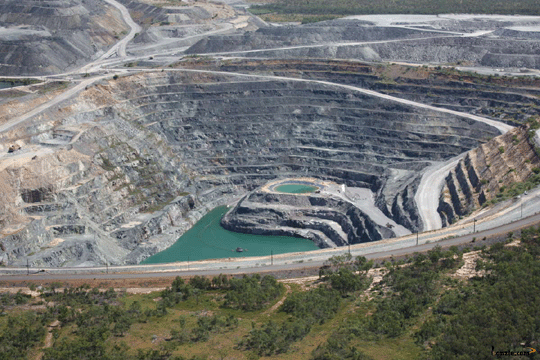
Kakadu mining and radiation, The Saturday Paper 14 Aug 21, Max Opray Carved out of the pristine surroundings of Kakadu National Park in the Northern Territory, the Ranger uranium mine has long been a site of deep controversy.
The mine may have been decommissioned in January, but concerns remain about its legacy, as the Mirarr traditional owners suffer through a mysterious health crisis.
The stillbirth rate among Aboriginal people living near the mine is more than twice as high as among Indigenous Australians elsewhere in the Top End, and rates of cancer are almost 50 per cent higher.
A six-year Northern Territory investigation into the issue failed to identify the cause, noting only that risk factors relating to diet, smoking and alcohol consumption were higher in the local population than in other Aboriginal populations.
The investigation was conducted by staff at the Population and Digital Health Branch of the Northern Territory Department of Health and overseen by an independent reviewer in cancer, epidemiologist professor Bruce Armstrong.
The report, published in November 2020, concluded ionising radiation from uranium mining was unlikely to be linked but did not categorically rule it out.
However, a Flinders University Centre for Remote Health analysis of the government investigation, published in the Medical Journal of Australia this month, found that the parameters of the inquiry were too narrow.
“Cancer is a complex condition,” Dr Rosalie Schultz, author of the analysis, tells The Saturday Paper. “A study like this can’t find a definitive cause.”
The Alice Springs GP was concerned that the main outtake of the report was that Aboriginal people should smoke and drink less.
“Statistically, it didn’t look like smoking and drinking caused the excess cancer rate,” she says. “It’s almost like blaming people rather than looking into the reasons – why is it people are smoking and drinking more in that area in particular, for instance?”
With more than 200 documented leaks, spills and other incidents associated with the mine, Schultz argues the impact of Ranger was multifaceted, including social consequences not considered by the investigation. “Things like destruction of waterbirds and creeks, the worry of that when you get your food and livelihood from the land,” she says.
A senate estimates committee heard in 2009 that 100,000 litres of contaminated water a day was leaking from the mine’s tailings dam into rock fissures beneath Kakadu.
In another breach in 2004, dozens of mine employees were found to have showered in and consumed water containing 400 times the legal limit of uranium.
In response to the release of the Territory government report, Reuben Cooper, chair of the Red Lily Health Board Aboriginal Corporation, welcomed messages “to encourage reduction in smoking and alcohol consumption” but said the findings offered an incomplete picture.
“This investigation does not discuss the reasons for higher rates of smoking and alcohol consumption in the Gunbalanya–Kakadu region,” he said, “which could include factors such as cultural dislocation, stress and royalty payments. Nor does it discuss the potential social impacts that the uranium mining industry has had on the population in the region.”
Schultz’s analysis expands further on these points, noting how unevenly distributed royalty money can increase inequality and the ways in which locals were deprived of a sense of agency and authority.
“The inquiry didn’t look at other knowledge, such as the Dreaming stories about sickness country,” Schultz says.
Centuries before Western science understood the dangers of radioactive substances, Aboriginal people were avoiding the uranium-rich sites near Kakadu, which were considered inappropriate places to camp.
The Dreaming stories of the Jawoyn people warn against disturbing stones or drinking water in what they called “sickness country” south of Ranger, beneath which Bula the creator is said to lie dormant.
In and around the Ranger site itself, the Dreaming stories of the Mirarr warn of sacred sites that are dangerous to disturb……………..
With no data available about individual exposure to ionising radiation, the report authors concluded this was unlikely to have been a contributing factor based on measurement of environmental radiation levels, consumption of bush tucker, and airborne exposure to radon gas.
Justin O’Brien, chief executive of the Gundjeihmi Aboriginal Corporation, which represents the Mirarr people, says the “shocking paucity of data” extends to all aspects of the health and social impacts of the mine. “It’s a very limited data set, so no wonder the findings are inconclusive,” he says………..
With the mine decommissioned in January this year, O’Brien is concerned about whether operators Energy Resources of Australia, a subsidiary of Rio Tinto, will properly rehabilitate the Ranger site, warning that radioactive waste from uranium mining can remain hazardous for tens of thousands of years.
“This is just the first chapter of the legacy of this mine, and the world is watching Rio Tinto,” he says. “The mining company has been given five years to complete all the rehabilitation work – this is patently insufficient.”…………
For Schultz’s part, the monitoring of Ranger failed even in the context of Western science. “They didn’t do what was recommended to consider local perspectives and concerns,” she says. “It was a top-down epidemiological approach, where if you can exclude ionising radiation, the mine is off the hook. It feels like the science is taking a narrower approach now – we used to have researchers embedded in communities. Forty years later … we just look at five data points and that’s it.” https://www.thesaturdaypaper.com.au/life/health/2021/08/14/kakadu-mining-and-radiation/162886320012251#mtr
Higher cancer and stillbirth rates in Aboriginal people living near the Ranger uranium mine
Aboriginal people near the Ranger uranium mine suffered more stillbirths and cancer. We don’t know why, The Conversation, Rosalie Schultz, Adjunct Senior Lecturer, College of Medicine and Public Health Centre for Remote Health, Flinders University, August 2, 2021 This article mentions stillbirth deaths in Aboriginal communities.
The Ranger uranium mine, surrounded by Kakadu National Park in the Northern Territory, operated for 40 years until it closed in 2021. During this time, Aboriginal people in the region experienced stillbirth rates double those of Aboriginal people elsewhere in the Top End, and cancer rates almost 50% higher.
But a NT government investigation couldn’t explain why. And as I write today in the Medical Journal of Australia, we’re still no wiser.
We owe it to Aboriginal people living near mines to understand and overcome what’s making them sick. We need to do this in partnership with Aboriginal community-controlled health organisations. This may require research that goes beyond a biomedical focus to consider the web of socio-cultural and political factors contributing to Aboriginal well-being and sickness.
Investigating the health impacts
Uranium was mined at Ranger from 1981 until 2012. Processing of stockpiled ore continued until 2021. This is despite community opposition when the mine was proposed and during its operation.
Over the life of the mine, there have been more than 200 documented incidents. Diesel and acid spills have contaminated creeks and drinking water.
The Gundjeihmi Aboriginal Corporation represents the Mirarr people of the region. For decades it has expressed grave concerns about continuing incidents and the lack of an effective government response.
When Ranger’s operators proposed expanding the mine in 2014, opponents pointed to suggestions of higher rates of stillbirth and cancer among Aboriginal people living nearby.
The NT health department then set up an investigation. Investigators began by identifying all Aboriginal people who had spent more than half their lives near the mine between 1991 and 2014. These people were compared with all other Aboriginal people in the Top End.
The investigators considered the worst-case scenario would be if Aboriginal people were exposed to radiation from the mine contaminating bush food, water or air, and this exposure increased stillbirth and cancer rates.
Investigators also looked at smoking tobacco, drinking alcohol and poor diet as possible contributing causes.
Here’s what they found
Investigators found the rate of stillbirth was 2.17 times higher among Aboriginal women near the mine. Radiation can lead to stillbirth by causing congenital malformations, and some other risk factors for stillbirth appeared more common amongst women near the mine. However the investigation found neither radiation nor other risk factors explained the higher rate of stillbirth.
The rate of cancer overall was 1.48 times higher among Aboriginal people near the mine than elsewhere in the Top End. No rates of single cancers were significantly higher…………. https://theconversation.com/aboriginal-people-near-the-ranger-uranium-mine-suffered-more-stillbirths-and-cancer-we-dont-know-why-164862
Historic handback of Kakadu town to Mirarr traditional owners,
Historic handback of Kakadu town to Mirarr traditional owners, The Age By Miki PerkinJune 26, 2021, For four decades the Mirarr people, led by senior traditional owner Yvonne Margarula, have been calling for the town of Jabiru, inside World Heritage-listed Kakadu National Park, to be returned to its rightful custodians.
At a handback ceremony on Saturday, their decades-long fight for recognition of their traditional ownership over Jabiru culminated in the grant of freehold title over the town, the first of its kind in Australia.
At a handback ceremony on Saturday, their decades-long fight for recognition of their traditional ownership over Jabiru culminated in the grant of freehold title over the town, the first of its kind in Australia.
The fight for land rights in the region began in 1978, when Jabiru was built on Crown Land without the involvement of traditional owners to service the controversial Ranger uranium mine.
Ranger began operations in 1980, and was run by Energy Resources Australia, which is majority-owned by Rio Tinto.
Initially, there were plans to bulldoze the Jabiru town once the mining lease expired, but the Northern Territory government and the Gundjeihmi Aboriginal Corporation, which represents Mirarr people, have developed an ambitious plan to transform it into a tourism hub for Kakadu, and a regional centre.
The Commonwealth has promised $276 million towards the revitalisation of the town, which includes a new international airport, a five-star eco-tourism lodge, and better access to Kakadu’s natural attractions, but there have been criticisms at the speed of progress.
Justin O’Brien, the chief executive of Gundjeihmi Aboriginal Corporation said the lease handover was a historic milestone in the transition from a mining economy to tourism but the town’s future challenges should not be underestimated.
Energy Resources Australia had failed to engage in a timely way on the town’s transition, Mr O’Brien said, with former mining employee houses not ready for use, and at least 70 ERA houses vacant…….
Processing of ore at the uranium mine finished in January and the mine’s vast pits will be filled in over the next five years, but there are concerns about the rehabilitation process.
Australian Conservation Foundation nuclear campaigner Dave Sweeney welcomed the tenure change but said there were profound challenges ahead for the costly and complex mine rehabilitation, which is set to be completed by 2026.
“There has been 40 years of industrial activity involving heavy metals and radioactive materials in a wet-dry tropical place, surrounded by a World-Heritage listed area,” Mr Sweeney said. “To bring that up to a standard where it could be reincorporated into the surrounding area is a very, very high bar.”
In a statement, Energy Resources Australia extended its congratulations to Mirarr traditional owners and said that after 40 years of production its priority was to successfully rehabilitate Ranger to a standard that could be incorporated into Kakadu National Park.
In the mid-1990s, Ms Margarula and other Mirarr people mounted a high-profile campaign to oppose the Jabiluka uranium mine. Elders also lodged the Jabiru native title claim which was decided by the Federal Court in 2016 after one of Australia’s longest-running native title matters. The court granted native title to the Mirarr.
In 2017, researchers published their findings about a wealth of artefacts on Mirarr country which indicated humans reached Australia at least 65,000 years ago — up to 18,000 years earlier than archaeologists previously thought. https://www.theage.com.au/environment/sustainability/historic-handback-of-kakadu-town-to-mirarr-traditional-owners-20210625-p584c7.html
With uranium mining closed, Kakadu ‘stagnates” during long wait for proposed federal funding.
| Fears Kakadu is ‘probably going to stagnate’ during the long wait for promised federal funding, ABC By Roxanne Fitzgerald 11 Apr 21, The federal government has been urged to fast-track an investment worth more than $200 million it promised two years ago to revitalise the world heritage-listed Kakadu National Park. Key points: Kakadu National Park has been waiting two years for a pivotal federal investmentPoliticians and traditional owners fear Kakadu will ‘stagnate’ without it A Senior Advisory Group has been established to examine the management of the park. The Australian government has allocated only $5.4 million so far to transition Jabiru — the community in the centre of the park — from a mining town into a world-class tourism hub. Outlined in 2019 federal budget papers, the $216.2 million was also meant to fund road upgrades, a new park visitor centre and more than $50 million in tourism infrastructure over a 10-year timeframe.The federal government’s promised spending has now grown to $276 million. Parks Australia has blamed the COVID-19 pandemic and consultations with traditional owners for delays in approving funding………….. . https://www.abc.net.au/news/2021-04-11/nt-calls-for-kakadu-investment-to-be-fast-tracked/100054140 |
The remediation of Ranger uranium mine: will it really restore the environment?
Traditional owners were given land rights in return for their support for the Ranger mine, and Kakadu National Park was born. ……. the land will finally be returned to the traditional owners… the question is, in what state? ……… we could find the site an eroding heap of substandard scrub.
As part of cleaning up the mine site, contaminated buildings and equipment will be buried in one of the mine’s enormous pits.
We’ve been told that burying the equipment and the contaminated material in the mine site is out of step with global best practice in the mining industry.
|
Kakadu in crisis, ABC 22 Feb 2021, Crisis in Kakadu: The turmoil threatening Australia’s biggest national park
“It’s gone downhill. No one basically trusts anybody, no one respects each other anymore. That’s how bad it is here.” Traditional owner Kakadu is one of the great natural wonders of the world. The stunning landscape, teeming with wildlife, is a major tourist destination with scores of Instagram friendly sites. For tourism operators it is an iconic symbol of what Australia has to offer. “It’s one of the most special places in Australia. It’s for so long been one of the reasons why people visit Australia and for Australians, one of their must do life experiences.” Tourism industry representative Despite its beauty, there is trouble inside Australia’s biggest national park. This World Heritage listed site is in crisis. “It’s an absolute mess because the institutions responsible for fixing it up aren’t doing their job.” Traditional owner On Monday Four Corners investigates accusations of mismanagement and neglect which have fuelled a bitter dispute between the park’s traditional owners and the authority that runs the park. |
Australia a renewables leader – or the Saudi Arabia of nuclear energy”

Northern Territory Senator Dr Sam McMahon says she is “delighted” her push for nuclear has been backed, after the Nationals announced new amendments to a bill in favour of nuclear energy and carbon capture and storage.
Nationals Senators, led by Matt Canavan and Bridget McKenzie have announced a raft of amendments to the Clean Energy Finance Corporation (CEFC) bill to invest in nuclear power.
Senator McMahon says the drafted legislation supports her long-established calls to unlock nuclear energy…..
The Northern Territory, with our abundance of Uranium and potential nuclear fuel Thorium, should be the Saudi Arabia of nuclear energy.
But political activist group Get Up’s national director Paul Oosting says that as Australia forges ahead with solutions to the climate crisis, such as solar technology, the push for nuclear could delay climate action.
“Nuclear power is dangerous, unnecessary and colossally expensive. It would take more than a decade to build a nuclear reactor in Australia and cost billions. It’s the ultimate climate action delay tactic,” Mr Oosting said.
“Australia has an opportunity to position itself as a world leader in renewables. It’s critical this pivotal moment in our history not be squandered on obsolete and failing technologies that will lock in irreparable climate damage.”
Mr Oosting said he was concerned the clean energy corporation could become a “slush fund” for the coal, gas, and nuclear industry, and cautioned politicians from backing the bill.
“When Taylor’s Bill comes before Parliament, politicians who accept the seriousness of the climate crisis we face – of all parties and none – must act to ensure coal, gas, and nuclear are excluded from any definition of ‘low emissions technology’, the return-on-investment requirement is kept, and the independence of the CEFC board is maintained,” he said………….he said…………. https://www.hepburnadvocate.com.au/story/7134825/the-nt-should-be-the-saudi-arabia-of-nuclear-energy-senator-mcmahon/
Mediation continuing over rehabilitation of Range uranium mine
Mediation continues behind closed doors, but the case is a clear reminder that commitments are not set in stone and that clean-up funding for even the most environmentally destructive projects is not guaranteed.
While national and/or state law jurisdictions regulate specific requirements for closure and associated financial assurance, which also determine the period of rehabilitation, it is essential that members of the mining community are aware of applicable law and regulation in all jurisdictions of operation……….
“In the context of price volatility, investment shifts and now Covid-19, many major companies have been mothballing operations and selling mines to juniors, smaller and/or less resourced companies around the world. The most notable may be Blair Athol coal mine in Queensland, sold for $1 in 2016.”
The socio-economic and financial arrangements for closure agreements are especially important in order to avoid dumping the costs on taxpayers and society .
How long should a miner commit to oversight? https://www.mining-technology.com/news/mining-rio-tinto/ Yoana Cholteeva11 February 2021
A subsidiary of Rio Tinto is currently in mediation with the Australian Government over continuing commitments to scientific monitoring of the Ranger mine. We examine the dispute and take a look at some positive examples of land remediation.
Land rehabilitation as part of mining oversight is an essential process where the land in a mining area is returned to some degree of its former state. Recently, a new dispute over the rehabilitation of the Ranger Uranium Mine in the Northern Territory of Australia, owned by a Rio Tinto subsidiary, once again reignited the debate over how long a miner should maintain oversight once operations have stopped.
Rio Tinto’s oversight dilemma
Solar, storage to take over from Ranger uranium mine
|
Solar, storage to take over from Australian uranium mine https://www.pv-magazine.com/2021/02/17/solar-storage-to-take-over-from-australian-uranium-mine/https://www.pv-magazine.com/2021/02/17/solar-storage-to-take-over-from-australian-uranium-mine/https://www.pv-magazine.com/2021/02/17/solar-storage-to-take-over-from-australian-uranium-mine/
The Ranger Uranium Mine ceased production in Australia’s Kakadu National Park in January, following years of financial losses. Now, as part of a multimillion dollar rejuvenation of the park, there are plans to develop a solar and battery storage hybrid project near the town of Jabiru. FEBRUARY 17, 2021 BLAKE MATICH From pv magazine Australia Distributed energy producer EDL will build, own and operate a hybrid microgrid in the remote mining town of Jabiru, in Australia’s Northern Territory. Working with the Northern Territory government, EDL’s Jabiru Hybrid Renewable Project will help the community transition from its recent history as a uranium mining town to a new future as a tourist destination in the heart of the World Heritage-listed Kakadu National Park. Jabiru is held in native title by the Mirarr people. The town, as it is recognized today, has only existed since 1982, when it was established as a living community for the nearby Ranger Uranium Mine. The project, which integrates 3.9 MW of solar generation and a 3 MW/5 MWh battery with 4.5 MW of diesel generation, is in line with broader efforts to rejuvenate Kakadu. It will also be EDL’s 100th site since it began 30 years ago with the development of the Pine Creek Power Station on the other side of the national park. “Once completed, our hybrid renewable power station will provide Jabiru with at least 50% renewable energy over the long term, without compromising power quality or reliability,” said EDL CEO James Harman. The Ranger Uranium Mine is owned by Energy Resources Australia, a subsidiary of Rio Tinto. It was once one of the most productive uranium mines in the world. However, the mine ceased production on Jan. 8, after years of losses primarily attributed to the market slump following the 2011 Fukushima nuclear disaster. According to the Katherine Times, Kakadu is set to undergo a $276 million upgrade as part of a plan to rejuvenate tourism to the home of the world’s oldest living culture. Federal Environment Minister Sussan Ley told the newspaper that “the park’s traditional owners want to see culturally appropriate tourism grow and we will work with them to achieve that outcome.” EDL will begin construction on the project in the months ahead. It expects the hybrid system to be generating energy by early 2022. |
|
Clean-up plan for Ranger uranium mine is ”woefully inadequate”
Gundjeihmi and ERA enter negotiations to extend Ranger Uranium Mine rehabilitation
By https://www.abc.net.au/news/2021-01-09/gundjeihmi-era-negotiate-ranger-uranium-mine-rehabilitation/13043076 Matt Garrick
An Aboriginal group in Kakadu National Park says the rehabilitation plan for a decommissioned uranium mine is “woefully inadequate”, and is calling for a 26-year extension to the process.
Key points:
- Mining at the Ranger Uranium Mine wound up yesterday after more than 40 years
- Traditional owners in Kakadu are now calling for an extension of the project’s rehabilitation phase
- The company that runs the mine has signalled its support for the move
Production at the Ranger Uranium Mine, on the outskirts of the national park, drew to a close yesterday after more than 40 years of operation.
Gundjeihmi Aboriginal Corporation, which represents Mirarr traditional owners, has used the closure to demand owner Energy Resources Australia (ERA) rehabilitate the site beyond its current lease expiry in 2026.
Within that timeframe, the company is required to restore the site to its previous pristine state.
“That’s not long enough,” the corporation’s CEO, Justin O’Brien, said.
“We are now awaiting a drafting from the Commonwealth Government for amendments to the Atomic Energy Act such that you can actually put in place an extension to the rehabilitation period.”
Mr O’Brien said traditional owners were pushing for the rehabilitation period to be extended by an additional 26 years, which would carry the process through until 2052.
He said ERA and its parent company, Rio Tinto, had signalled their support for an extended term of rehabilitation — but the timeframe and details of that extension are still being negotiated.
In a statement, the company said it was committed to “achieving all documented rehabilitation outcomes in its Mine Closure Plan (MCP) by January 2026”.
It confirmed negotiations were underway with traditional owners to “determine an appropriate mechanism” to extend the company’s tenure at the Ranger site, which would allow it to continue rehabilitation beyond 2026.
Environmental group the Australian Conservation Foundation yesterday welcomed the end of production at the site, the last active uranium mine in the Northern Territory.
The foundation’s Dave Sweeney, who is an anti-nuclear campaigner, said he was supportive of the push to extend the rehabilitation period.
“The company should not be approaching clean-up asking itself what it can do in five years,” he said.
“It should be approaching clean-up asking ‘What is the best possible way to reduce and address the damage that has happened?’
“What’s the best outcome — not the best outcome we can do in five years.”
The wind-down of production at the mine is expected to prompt an exodus from the nearby town of Jabiru, where ERA holds the lease for about 300 houses.
One hundred and twenty-five ERA staff were made redundant this week.
End of an ERA: four decades of radioactive risk come to an end at Kakadu
Over 40 years of high-impact uranium mining and processing at Energy Resources of Australia’s (ERA) Ranger mine in Kakadu ends today.
Australia’s longest-running uranium operation was licensed to operate until January 8, 2021.
“This is a very good day for Kakadu, the Northern Territory and Australia,” Australian Conservation Foundation nuclear campaigner Dave Sweeney said.
“The Ranger mine has generated controversy, headlines and heartache for four decades. The focus must now be on ERA and parent company Rio Tinto doing comprehensive and credible site rehabilitation and supporting the transition to a post-mining regional economy.
“Today we should also acknowledge the sustained efforts of the Mirarr Traditional Owners and the Gundjeihmi Aboriginal Corporation to protect their country and culture from the impacts of mining.
“The Mirarr opposed the Ranger mine 40 years ago, led a successful campaign to stop ERA developing a further mine at nearby Jabiluka 20 years ago, and are now driving the re-shaping of a culture- and conservation-based local economy.
“Plans for cleaning up the site of the Ranger mine are being hampered by an unrealistic rehabilitation time frame, funding uncertainty, and fears about a tailings dam leaking toxic contaminants into the surrounding national park.
“Closing Ranger, protecting Kakadu, a recent report co-authored by ACF, also found data deficiencies and technical issues, particularly around groundwater and tailings management.
“Australia has a long history of sub-standard mine rehabilitation in both the uranium and wider mining sectors. A far better approach and outcome is needed at Ranger. This work is a key test of the commitment of ERA and Rio Tinto, as well as the NT and federal governments.”
Ranger Danger: Rio Tinto Faces Its Nuclear Test in Kakadu Uranium
|
Ranger Danger: Rio Tinto Faces Its Nuclear Test in Kakadu Uranium Mine, https://sei.sydney.edu.au/opinion/ranger-danger-rio-tinto-faces-its-nuclear-test-in-kakadu-uranium-mine/ Rebecca Lawrence and Dave Sweeney report on growing concerns over the potential failures of the rehabilitation plan for the Ranger mine in Kakadu National Park. By Rebecca Lawrence, Senior Research Fellow, Sydney Environment Institute and Dave Sweeney, Australian Conservation Foundation, 16 December 2020 In the 1950’s uranium mining began in the Alligator Rivers and Kakadu regions in the Top End of the Northern Territory. Since then, the Kakadu uranium story has generated heartache and headlines but it is set to soon come to an end with the closure of the Ranger uranium mine in early January 2021. The story is now moving from one of contest over the impacts of mining to one of concern around the adequacy of rehabilitation. Australia has a notorious record when it comes to mine rehabilitation. Many mines are simply abandoned, and those that are rehabilitated often fail, which means complex and on-going monitoring and management is usually required. In many cases, mining companies and their shareholders are long-gone and it is usually Indigenous communities who are forced to live with toxic legacies and left to fight for governments to finance the clean-up with tax-payer money.
Yet, there are alarming signs we may be headed that way. Significant and crucial knowledge gaps remain around the closure and rehabilitation of the Ranger mine. Despite the looming closure date, mine operator Energy Resources Australia (ERA) is still unable to answer many key questions. For example, ERA has still not completed modelling of the pathways and volumes Another key omission in the mine closure plan is the absence of any substantive social impact research. There is no attention paid to how Aboriginal people have been impacted by uranium mining in Kakadu, or any assessment of how they may be impacted the mine closure. This omission constitutes a profound social injustice and is demonstrably inconsistent with both international best practise and contemporary community expectation. ERA is part of the global Rio Tinto group. Rio, who own 86% of ERA, has been called out for its destruction of ancient Aboriginal heritage and sites at Juukan Gorge in the Pilbara region of West Australia. As the main shareholder in ERA at Ranger, there is a real risk that Rio will also fail at Ranger if they don’t get the rehabilitation right and put in place secure financing for perpetual care and maintenance of the Ranger site post-closure. There is a requirement that the company must isolate large volumes of radioactive mining tailings for 10,000 years, but how can that be done without any funds earmarked for monitoring or post-closure management? The Commonwealth government was the key driver behind opening the Ranger Uranium mine in the early 1980s and yet as closure approaches, they are virtually absent. There is no clear regulatory process for how rehabilitation and post-closure monitoring will be financed or enforced. A successful rehabilitation is dependent upon the Commonwealth Government keeping ERA and Rio Tinto accountable and honest. Despite reassuring rhetoric no mining company will do that on their own – for too many the triple bottom line remains measured in pounds, dollars and euros. The Commonwealth Government needs to step up and ensure that the Kakadu environment and its people are protected and that a dual World heritage listed region is given the attention and focus it deserves and needs. A further key constraint on the likely success of the clean up and closure of Ranger is the unrealistic timeframe that has been mandated for rehabilitation. Ranger is the longest running uranium mine in Australia. It was imposed against the explicit opposition of the region’s Mirarr Traditional Owners and for forty years has conducted deeply contested operations in a monsoonal tropical environment. And not just any tropical environment – the mine is an industrial zone surrounded by Australia’s largest national park – Kakadu. Kakadu National Park is a dual World heritage listed area that is recognised for both its cultural and natural values and properties. The Ranger site is required to be rehabilitated to a standard where it could be incorporated into this unique environment. This is a very high bar to clear and Rio Tinto currently have a very short run-up. The rehabilitation period extends only from January 2021 to January 2026. Five years is simply not enough time to make meaningful and lasting repair to a heavily impacted landscape. As a result, the rehabilitation approach is being increasingly driven by short-cuts and bad decisions, rather than taking the time needed to get it right. The Mirarr people and an increasing number of civil society and wider stakeholders and commentators are urging both the Commonwealth and the company to extend this set period of works to better reflect the complexity of the rehabilitation challenge and to increase the likelihood of a successful result. The closure and clean up of Ranger is a critical test of the commitment, competence and credibility of Rio Tinto and the Commonwealth. Both parties have a responsibility to address decades of environmental damage and community disruption. Without more clarity, funding, time and transparency the future of Kakadu cannot be assured. And this is too high a price to pay. There are many eyes from across Australia and around the world that are focussed on the Ranger rehabilitation and near enough is not good enough. The challenge is clear and considerable – and now it needs to be met. Rebecca Lawrence and Dave Sweeney are part of an expert group who have authored the report, Closing Ranger, protecting Kakadu, released by the Sydney Environment Institute, the Australian Conservation Foundation, the Mineral Policy Institute and the Environment Centre NT. Access the report here. |
|
1 This month
7 April – WEBINAR – Australia and the Doomsday Clock – Preventing nuclear war through NoFirstUse and other policies
Online | Tuesday April 7, 4:00-5:30pm, Australian Eastern Time / 8:00-9:30am Central Europe Time
– Access the registration link
15 April – Zoom –Nuclear Power is Not the Solution
Apr 15, 2026 01:00 AM in Canberra, Melbourne, Sydney

Join the International Physicians for the Prevention of Nuclear War (IPPNW) on Tuesday, April 14th for a timely webinar exploring the risks associated with nuclear power and challenging the myth that it offers a simple, safe, carbon-free solution to the climate crisis

21 April Webinar: No Nuclear Weapons in Australia
Start: 2026-04-21 18:00:00 UTC Canberra, Melbourne, Sydney (GMT+10:00)
End: 2026-04-21 19:30:00 UTC Canberra, Melbourne, Sydney (GMT+10:00)
Event Type: Virtual
A virtual link will be communicated before the event.
Host Contact Info: australia@icanw.org

of the week – Australians for War Powers Reform (AWPR)
To see nuclear-related stories in greater depth and intensity
 Antinuclear