Traditional land owners want troubled ERA uranium mining to shut down by 2021 (or earlier)
 traditional owners of the land want ERA to stick to the 2021 deadline.
“It’s never crossed our mind that they would mine beyond 2021,”
Rio Tinto may decide to walk away from the project at its mandated deadline. “They will be acutely aware that they will be judged long into the future on how they exit Kakadu,” Sweeney says.
Debate warming up over Ranger mine future, The West Neda Vanovac, AAPSeptember 19, 2013, The operators of the Ranger uranium mine in the Northern Territory have unveiled a new water processing machine they say will give it a future beyond 2021.
But not everyone’s happy……. Traditional owners and environmental groups want to see ERA exit in 2021. Continue reading
Uranium mining might commence again at Ranger, Northern Territory
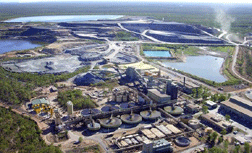 NT uranium mine gets future beyond 2021, Yahoo 7 Finance, 19 Sept 13 The Northern Territory’s Ranger uranium mine has unveiled a new water processing machine it says will prolong its future beyond a planned 2021 closure. Mining has been completed at the site, which is located within but is not a part of the world heritage-listed Kakadu National Park. It’s operated by Energy Resources Australia (ERA), which is owned by Rio Tinto.
The $220 million brine concentrator unveiled on Thursday will improve the mine’s ability to treat water and progressively rehabilitate the site, which must be completed by 2026, when it must be of a standard to be reintegrated into Kakadu.
Previous attempts to treat water properly were either too small for requirements or unsuccessful, CEO Rob Atkinson said………
Although the Ranger mine is now only processing stockpiled ore as its open pits are slowly being backfilled, exploration for a possible underground mine is underway at a neighbouring site called Ranger 3 Deeps.
If feasible, mining could begin in 2015 but would only be able to operate for five years under the current lease agreement.
Mr Atkinson said it was too early to be talking about future negotiations with stakeholders such as the Jabiru community and the Mirarr people, the transitional owners of the land….. http://au.finance.yahoo.com/news/nt-uranium-mine-gets-future-052217361.html
New equipment: old problems – ERA’s Kakadu uranium plans in focus
Environment Centre NT, 17 Sept 13, Uranium miner Energy Resources of Australia will unveil its new brine concentrator – a long overdue piece of infrastructure that seeks to address both chronic water management problems and contaminated process water – at its aging Ranger uranium mine in Kakadu on Thursday.
The Ranger mine has been plagued with water and waste management problems that have caused extended shutdowns and deep concerns about impact on the World Heritage Kakadu National Park. “The new infrastructure is a long overdue and welcome initiative,” said Lauren Mellor, Nuclear Free NT Campaigner with the Environment Centre NT.
“The delay in commissioning this key piece of equipment is a poor reflection on ERA’s commitment to rehabilitation, given the company’s long history of water mismanagement. That ERA has been allowed to continue mining and expanding its waste water inventory, now estimated at eleven gigalitres, without having an effective waste water management plan or the ability to treat process water shows a disturbing lack of regulatory rigour.” Continue reading
National pressure growing in Australia against Muckaty radioactive waste plan
 Dump under the pump: Pressure grows against Muckaty radioactive waste plan. Territory trade unions, medicos and environmentalists have been joined by their national counterparts in a call to end a planned radioactive waste dump in the NT.The groups have placed an advertisement (attached) in the Tennant and District Times today to highlight their concerns over federal plans to dump radioactive waste on Aboriginal land at Muckaty, north of Tennant Creek and their commitment to continuing campaigning on the dump plan after this Saturday’s federal election.
In Northern Territory electorate, Greens, Labor and Coalition candidates all oppose nuclear waste dump

 Solomon candidates against nuclear dump Bigpond News, August 30, 2013 Labor, the coalition and the Australian Greens rarely agree on anything, but the three candidates for Solomon are united in their opposition of a proposed nuclear waste dump in the Northern Territory.
At a community forum hosted by the ABC in Darwin on Friday, the candidates also debated marriage equality, voluntary euthanasia, housing affordability, hospitals, and schools funding.
Country Liberal Party incumbent Natasha Griggs, who holds the seat by a thin 1.7 per cent margin, said she crossed the floor on the nuclear issue to stand up for Territorians.
Greens candidate Todd Williams said: ‘The NT is viewed as easy and open and that can be foisted upon to store nuclear waste … against the wishes of traditional owners.’…….. http://bigpondnews.com/articles/Election-2013/2013/08/30/Solomon_candidates_against_nuclear_dump_901529.html
June 2014 date for Muckaty nuclear waste dump plan court hearing
 Date set for court fight over Muckaty nuclear waste dump http://www.abc.net.au/news/2013-08-26/court-date-set-for-nuclear-waste-dump-fight/4912730 26 Aug 2013, A date has been set in the Federal Court case of Aboriginal traditional owners fighting plans to use their land as a nuclear waste dump.
The site on Muckaty Station near Tennant Creek in the Northern Territory is the Federal Government’s preferred site for Australia’s first radioactive waste facility. Beyond Nuclear Initiative spokeswoman Natalie Wasley says the month-long trial has been listed for June 2014.
“After eight years that’s a big relief for traditional owners and the community who have had this nuclear cloud hanging over their heads,” she said.
She says submissions being made this week will determine whether pre-trial evidence needs to be taken. Ms Wasley says those involved are hoping the trial would be held near the proposed site.
“It’s very important for people that they give the best evidence possible, and of course that it’s close to the site that’s being discussed,” she said.
Shabby history of destruction of Aboriginal culture and land ownership
Rudd and Abbott charge the north Eureka Street Dean Ashenden | 19 August 2013 “……..Credit for getting this history under way goes to the pastoral grandees of the colony of South Australia. In the 1860s they funded an obsessive-compulsive alcoholic Scotsman to find out what lay between their northern border and the far coast, and how it could be got. John McDouall Stuart’s six expeditions found little to encourage them, but lust trumped reason, and South Australia set itself to be the first colony in history to found a colony. The two would fuse, in time, to become the Great Central State.
Dreams of imperial glory and speculative fortunes turned almost immediately into a long-running mixture of farce and nightmare. Eventually South Australia got lucky. In 1911 it managed to palm off its colony onto the newly-constituted Commonwealth of Australia. Astonishingly, the Commonwealth even agreed to pay serious money for it, nearly four million pounds, plus another 2.2 million for a railway line that had not even reached South Australia’s northern border, let alone made any money.
Believing, as had the South Australians before them, that there must be a way to turn space into land, the Commonwealth did what South Australia had done, with the same result. An official inquiry report in 1937 was scathing. It found that in the 25 years since the takeover the federal government had spent more than 15 million pounds and was heading further into the red. The previous year’s production had brought in 100 000 pounds less than the Government’s outlay for the year of 600,000 pounds.
But the inquirers nonetheless found that it can be done, if it’s done right. It prescribed the familiar medicine: ports, roads, bridges, railways, ports, industry development boards, the lot.
Much of what the inquiry wanted soon came to pass, but not in result of its proposals. In 1939, war saw tens of thousands of troops stream north to build roads, airfields, a port and other infrastructure. For the first time the white population exceeded the black.
Soon motor vehicles, aircraft, air conditioning and buckets of public money transformed the look and feel of the Territory, but ‘development’ remained elusive. In the Territory, and more particularly in neighbouring tropical Queensland and Western Australia, mining was the only big earner, not necessarily to the advantage of government revenues.
The kind of on-the-ground industries apparently envisaged by Rudd and Abbott — horticulture and agriculture particularly — were confined to coastal enclaves or to the margins of viability. Much of the north proved too hot, too wet, too dry, too far from markets, too barren or too pestilential, with the happy consequence that the frontier failed to do its grim work.
Instead of a near-obliteration of Aboriginal populations of the kind seen on the eastern and southern seaboards, northern Australia witnessed a slow-motion saga of sporadic violence and accommodation, of advance and retreat. Neither side ever looked liked winning, and neither ever looked like giving up.
In the aftermath of the Coniston massacres of 1928 both sides abandoned violence for other means, and since then both have used the law, politics, money and public opinion in hundreds of struggles over land and ‘culture’, some famous or notorious, most not, one side straining to gain ground, the other to resist and to recover.
That 160-year struggle now seems to be reaching a new stage. We like to think that the devastation of one population and culture by another is all in the past, but the apparent failure of Rudd and Abbott to notice that northern Australia is shared country suggests that there might be more to come.http://www.eurekastreet.com.au/article.aspx?aeid=37087#.UhP0g9Jwo6I
Low demand, low prices, poor outlook, as Ranger uranium mine loses $54 million
ERA boss steps down amid bleak short-term outlook The Motley Fool by Owen Raskiewicz, Thursday, August 1, 2013 Energy Resources Australia (ASX: ERA) chief executive, Rob Atkinson, has quit his position after nearly five years at the helm of the Rio Tinto (ASX: RIO) subsidiary.
ERA has struggled with massively reduced demand and prices for the past seven years. In the wake of the Fukushima nuclear disaster in
Japan, the spot price of uranium hit a low of slightly less than $US 40 per pound, its lowest point in seven-and-a-half years but it’s not
getting better…….
The one positive ERA shareholders can take away from a difficult short-term outlook is the knowledge that few new producers will come online in the near future. There was no dividend declared by ERA…
Boss of ERA bales out as Ranger uranium mine loss reported
 ERA reports Ranger uranium loss of $21m and boss ABC News, By Rick Hind 1 August 13 The company that runs the Ranger uranium mine in the Northern Territory has announced a $54 million loss and the departure of its chief executive.
In its half-yearly results, Energy Resources of Australia (ERA) said losses booked up included $21 million spent on an underground exploration decline.
It said chief executive Rob Atkinson will move to Rio Tinto after five years running ERA.
ERA is majority owned by Rio Tinto….. The underground exploration decline is part of establishing the viability of future operations.
Draft EIS guidelines for the underground mining proposal are in the hands of the Northern Territory Environmental Protection Authority.
The Federal Government is expected to release environmental guidelines for the proposed expansion within weeks….. http://www.abc.net.au/news/2013-08-01/era-ranger-uranium-loss-report-ceo-goes-to-rio-tinto/4858824
Muckaty nuclear waste dump on Aboriginal land – a misguided plan
 Plan to use Aboriginal land as a nuclear waste dump is flawed and misguided
Radioactive waste management is difficult, but secretive deals made without Aboriginal Traditional Owners’ full consent are even more worrying. A transparent debate is needed. Dave Sweeney theguardian.com, 31 July 2013 This week, federal resource minister Gary Gray is talking radioactive waste with Aboriginal people in remote central Australia. Six years ago an Aboriginal clan group, the Northern Land Council (NLC) and the then Howard government signed a secret deal to develop Australia’s first purpose-built national radioactive waste dump at Muckaty, north of Tennant Creek in the Northern Territory.
The commercial-in-confidence plan saw the clan group “volunteer” an area of the shared Muckaty Land Trust for the burial and above ground storage of radioactive waste in return for federal payments, promises and a “package of benefits” worth around $12m.
The deal was not known about or supported by the rest of the Muckaty Traditional Owners and remains the source of bitter contest, deep opposition and a Federal Court challenge. Now Gray is back to talk with the NLC about a second site nomination on Muckaty. Unfortunately the new plan appears to follow the old pattern of secrecy, exclusion and contest. Continue reading
Aboriginals and Environmentalists combine to save Arnhem Land from unchecked resource development
Aboriginal-green link to fight gas projects BY:AMOS AIKMAN , THE AUSTRALIAN, July 19, 2013 ENVIRONMENTAL groups are seeking to capitalise on the beauty of Arnhem Land and the plight of its indigenous people to build support for campaigns against resource development and a northern food bowl.Five indigenous people from the remote community of Maningrida will hold a protest in Sydney’s Martin Place today, objecting to petroleum-licence exploration applications covering about 1500km of coastline.
Their $8000 travel bill was paid by The Wilderness Society, the Australian Marine Conservation Society and Environment Centre NT, which are co-sponsoring the event.
Anti-coal-seam and shale gas group Lock the Gate Alliance and a coalition of anti-nuclear protesters are also involved.
A traditional owner from the nearby Blythe River area, Eddie Mason, said he was worried about the safety of his country and about songlines and sacred sites beneath the sea. Indigenous landowners cannot veto exploration or mining in open water. “That’s our main food source, our supermarket,” Mr Mason said.
He accused Palter Petroleum, which has applied for the Arnhem Land exploration licences, of failing to consult properly with indigenous people, who he said should have veto rights over territorial waters.
Gavan McFadzean, The Wilderness Society’s northern Australia campaign manager, said his organisation was keen to use iconic sites in the Kimberley, Arnhem Land and Cape York Peninsula to develop a national campaign around the dangers of resource extraction and northern food bowl development.
He said the prospect of a future Abbott-led Coalition government was a particular threat.
Lock The Gate Alliance spokesman Drew Hutton said his organisation was also increasing its work in the Top End.
Mr Hutton predicted that Aboriginal land would be the next battlefront after farmland in the war to control unconventional gas developments.http://www.theaustralian.com.au/national-affairs/indigenous/aboriginal-green-link-to-fight-gas-projects/story-fn9hm1pm-1226681650900
Aborigines’ 8 year battle against nuclear waste dumping
“We’ve been arguing for a long time that the Northern Territory was targeted because it was a politically weaker jurisdiction.
“Obviously it was easier for the Commonwealth to override any local opposition to the plan, which is what they’ve done.
“We want the Territorian Senators to actually stand up for the interests of the community, and not just roll over and say that we’ll accept Canberra’s waste dump plan.”
Dust-up over nuclear waste dump hits eight years http://www.abc.net.au/news/2013-07-15/opposition-grinds-on-over-muckaty-nuclear-waste-dump-plans/4820806 Jul 15, 2013 A Northern Territory traditional owner has vowed to keep fighting federal government plans for a radioactive waste dump on her land.
Dianne Stokes is in Melbourne today for a scheduled Federal Court directions hearing on the Muckaty waste dump.
Today also marks eight years since the Federal Government announced a plan to dump nuclear waste in the Territory. Continue reading
ERA’s new uranium plan for Ranger mine sheds doubt on proper future cleanup
Ranger uranium mine expansion plan faces scrutinyhttp://www.abc.net.au/news/2013-07-09/environment-centre-nt-on-ranger-uranium-mine-eis-undergounding/4808406 By Kristy O’Brien Jul 9, 2013 The Northern Territory Environment Centre says it is assessing draft environmental guidelines for the expansion of the Ranger uranium mine.
The draft EIS guidelines from the Northern Territory Environment Protection Authority aim to minimise the effects on the surrounding Kakadu National Park of a move from open-cut to underground mining.
The Environment Centre’s Lauren Mellor says the group is opposed to the expansion but is happy to see increased scrutiny of the project.
“What has been proposed here is underground mining, which is something that has never been done before at the Ranger site,” she said. “This is being proposed at a time when the company should be ramping down operations in preparation for rehabilitation, not ramping them up.”
Mine operator Energy Resources of Australia (ERA) says underground mining would extend the life of the operation. Ms Mellor says her group will assess the EIS guidelines to ensure they are appropriate.
“They [ERA] have got a legal obligation to cease mining and mineral processing by 2021 on the site,” she said. “What they are proposing here is to increase contamination, increase tailings and waste at the site, which means rehabilitation is more than likely to be delayed,” she said.
Uranium company cuts back its NT and Queensland operations as uranium price plummets
Deep Yellow slashes jobs, cuts pay, Minng.com, 5 July, 2013 Vicky Validakis Uranium exploration company Deep Yellow has cut jobs and reduced salaries by five per cent as it ramps up steps to reduce overhead costs, blaming the move on the weakness in the uranium sector.
The company announced board fees and executive salaries would be reduced by five per cent for at least six months, with salary scales to remain fixed at 2013 rates.
The company also said its Perth office had reduced staff to just three, comprising the managing director, financial controller and office manager.
Deep Yellow is said it is also planning to move to a smaller office by the end of the year.
The latest pay cuts follow a ten per cent reduction in base salary and fees and group-wide salary freezes in July 2012…… Deep Yellow’s chairman Mervyn Greene said the steps to reduce overheads costs was due to ongoing volatility in financial markets and a weakness in the uranium market…… In Australia the company owns the Napperby Uranium project in the Northern Territory as well as exploration tenements in Queensland. http://www.miningaustralia.com.au/news/deep-yellow-slashes-jobs-cuts-pay
Australia’s “Northern Territory Intervention” trashed the reputation of Aboriginals on behalf of mining industries
 Government had made it clear that it wished to re-engage itself more directly in the control of community land through leasing options as well as to open up Aboriginal land for development and mining purposes.
The plan was to empty the homelands, and this has not changed. However, it was recognised that achieving this would be politically fraught – it would need to be accomplished in a manner that would not off-side mainstream Australia. Removing Aboriginal people from their land and taking control over their communities would need to be presented in a way that Australians would believe it to be to Aboriginal advantage, whatever the tactics.
So began the campaign to discredit the people and to publicly stigmatise Aboriginal men of the Northern Territory
And even in 2009 when the CEO of the Australian Crime Commission, John Lawler, reported that his investigation had shown there were no organised paedophile rings operating in the NT, no formal apology was ever made to the Aboriginal men and their families who were brutally shamed by the false claims.
 Sixth Anniversary of the Northern Territory Intervention – Striking the Wrong Note Lateral Love Australia‘concerned Australians’ Michele Harris, 21 June 13 Aboriginal advocate Olga Havnen, in her Lowitja O’Donoghue oration has asked a critical question. She asks what has been the psychological impact of the Intervention on Aboriginal people of the Northern Territory. It is surprising that so little attention has been given to this critical, yet in some ways tenuous, link before now.
Even before the Intervention began in June 2007, government had long planned a new approach to the ‘management’ of Aboriginal people in the Northern Territory. It was no longer part of government thinking that self-determination and Aboriginal control over land could be allowed to continue. These were the Whitlam notions of 1975 and they were no longer acceptable.
Early inklings of change occurred in 2004 with the management of grants being transferred from communities to Government’s newly established Indigenous Co-ordination Centres. More ominous were the Amendments of 2006 to the Aboriginal Land Rights Act and the memoranda of agreements that followed. Government had made it clear that it wished to re-engage itself more directly in the control of community land through leasing options as well as to open up Aboriginal land for development and mining purposes. Continue reading
1 This month

of the week – Australians for War Powers Reform (AWPR)
To see nuclear-related stories in greater depth and intensity
 Antinuclear