Jeffrey Lee saved Koongarra land from uranium mining
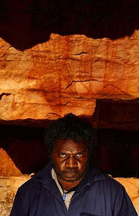 Kakadu victory as uranium mining battle ends http://au.finance.yahoo.com/news/kakadu-victory-uranium-mining-battle-051337975.html By Emma Masters | ABC 30 May 12, – Kakadu National Park in the Northern Territory is set to be expanded, with the inclusion of land previously earmarked for uranium mining. The Northern Land Council (NLC) has agreed for a 1,200 hectare parcel of land containing rich reserves of uranium to be incorporated in to the park.
It is considered the final step in a long battle that Aboriginal traditional owner Jeffrey Lee has waged to protect his land from mining.
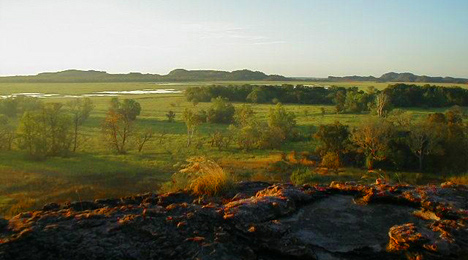
The uranium-rich mining lease Koongarra was excised from Kakadu when the conservation area was established in the late 1970s. The lease is held by French company Areva, which wanted to mine the area for uranium.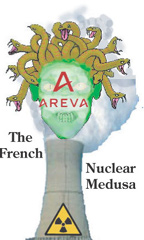
Two years ago, Mr Lee, the sole traditional owner of the land, called on the Federal Government to incorporate it in to Kakadu. The Government accepted the offer and referred the matter to the NLC. The NLC conducted consultations and its full council has agreed to endorse Mr Lee’s wishes.
The council and land trust will now move to enter an agreement with national parks to incorporate Koongarra into Kakadu. It is not known if Areva will attempt to take any action over the decisions. The existing Ranger uranium mine is located within the boundaries of Kakadu, about 180 kilometres south-east of Darwin.
Images of Manuwangku – a community fights against nuclear waste dumping
The words of Dr Nelson that the place constitutes ”the middle of nowhere” echo the old doctrine of terra nullius. If land is bare, then it is open. The land was not bare at Captain Cook’s discovery of Australia, it was not bare at the start of British colonisation, and it isn’t bare now.
Photographer Jagath Dheerasekara reminds us of this in a recent exhibition at Customs House in Sydney, curated by Sandy Edwards.
 A community maintains its spirit in confronting ignorance, SMH, Erin Stewart May 31, 2012
Images of Manuwangku show the human face of the waste dump plan. IN 2005, then education minister Dr Brendan Nelson told Australians there would be no harm in putting a nuclear waste plant ”in the middle of nowhere”.
In 2007, the exact ”middle of nowhere” was identified as Muckaty, or Manuwangku, as the Aboriginal owners of this remote Northern Territory community call it. Despite local fear, dismay, and rejection of the proposal to dump nuclear waste there, the battle is ongoing. The residents fear for the future.
This Sunday it will be 20 years since the High Court’s landmark Mabo decision, which led to the passing of the Native Title Act. Moreover, Article 29 of the United Nations Declaration on the Rights of Indigenous Peoples holds that ”no storage or disposal of hazardous materials shall take place in the lands or territories of indigenous
peoples without their free, prior and informed consent”.
A Federal Court case continues over whether adequate consultation was conducted by the Northern Land Council prior to nominating the site. Regardless of common law, statute and international law that protects indigenous land rights, Manuwangku is still under threat. Continue reading
Labor Member of Parliament joins Northern Territory protest against nuclear waste dump plan
March marks five years of nuclear waste push http://www.abc.net.au/news/2012-05-25/tennant-creek-nucelar-waste-dum-protest-muckaty/4033982?section=ntBy Allyson Horn, May 25, 2012 A protest has marked the fifth anniversary of the proposal to build a nuclear waste facility at Muckaty Station. More than a hundred people have taken part in a protest against a
proposed nuclear waste facility in the Northern Territory.
Muckaty Station, about 130 kilometres north, of Tennant Creek is the site being considered for Australia’s first nuclear waste dump. Protesters marched along Tennant Creek’s main street, chanting “no dump at Muckaty, don’t waste the Territory”.
It has been five years since the site at Muckaty was first nominated for the facility but protesters say some of traditional owners of the land still have not been consulted about it.
Local MLA Gerry McCarthy stood alongside protesters and reaffirmed his commitment to fight against the dump. He says he would take part in a blockade to stop construction of the facility, if it comes to that.
Diane Numbin Stokes is a traditional owner from Tennant Creek and a custodian of the land area that includes Muckaty station. She says the land being set aside for the nuclear waste dump is an Aboriginal men’s site, but this does not mean the women can’t voice their concerns. “We don’t want the waste to come to that land,” she said.
A Federal Court challenge against the nomination of the site is yet to be settled.
Labor and Liberal Party leaders for Barkly, NT, both oppose Muckaty nuclear waste dump

 Barkly candidates united against Muckaty, ABC Alice Springs By Emma Sleath (Cross Media Reporter), 24 May 12 They’re on opposite sides of the political divide but Member for Barkly, Gerry McCarthy and Country Liberal Party candidate Bec Healy stand united on Muckaty.
The CLP’s candidate for the Barkly, Bec Healy says she does not want to see the proposed nuclear waste facility at Muckaty Station go ahead. “I know some of the traditional owners out at Muckaty…and you have to be sensitive with how people live, that’s their life and I’m willing to support them,” she says.
The Federal Government put forward the proposal to build a radioactive waste management facility at Muckaty Station in 2008. The station is located 120kms north of Tennant Creek and leased from Indigenous landholders.
Ms Healy stands united with current Labor Member for Barkly, Gerry McCarthy who maintains his strong opposition to the proposal.
“This is prime cattle country, this is important Indigenous land, this is a very important part of the Territory’s future, it doesn’t need to be contaminated with nuclear material,” he says.
Both candidates stand against their own parties federally on the issue……
Last week the Australian Council of Trade Unions (ACTU) announced their opposition to the Muckaty proposal, saying that they will actively support any trade unions ‘refusing to cooperate with the implementation of the policy.’…..
“Why put it over the top of our water table?” says local business owner Wayne Walsh
“I don’t think they realise that we’ve got so much water underneath up here…one mistake and the whole territory’s dead, all the water’s gone.”…….. http://www.abc.net.au/local/stories/2012/05/24/3510368.htm
Musicians in the struggle for Aboriginals’ justice against Australia’s nuclear industry
The band also show their passionate connections to country in the song “Story”, whose deep story belies its brief lyrics. “Behind the lyrics lie one of the darkest stories of modern Australian history,” says Basil. “The dispossession of desert people by our country’s involvement in the atomic bomb-making industry.
“In the ’50s and ’60s, two groups of desert people living thousands and thousands of kilometres apart were taken out of their homelands. The song’s lyrics name those places. “In the north, Pintubi people were taken to Papunya. Blue-streak rockets fired from Woomera landed on their country. “In the south, Maralinga pe
Anti-nuclear brothers are radio activists, Green Left , May 21, 2012,By Mat Ward Nuclear Kop The Super Raelene Brothers www.superraelenebrothers.com.au
Anti-nuclear activist band The Super Raelene Brothers first made it into the pages of Green Left Weekly in 1995. But the duo, who have just dropped their latest atomic-bomb-atomising EP, Nuclear Kop, were making m usic way before then….. We create songs that celebrate what we see and where we are. We also build songs that voice concern about what is happening or not happening in our local community.”
Those concerns have led them to release songs such as “‘Wiya Angela-Pamela”, which went to number 1 on Triple J’s Unearthed charts in 2010, and a cover of Redgum’s 1980 classic “Nuclear Cop” ― both available as free downloads on their website . Continue reading
Mega Uranium’s Ben Lomond project, dangers to water supply, and Bob Katter
Jim Green, 14 May 12, The Ben Lomond uranium (and molybdenum) deposit is located 50 kms west of Townsville. It is owned by Mega Uranium, which purchased it in 2005
As at May 2012, Mega Uranium was undertaking prefeasibility studies with a view to determining the project economics, the preferred mining and processing options and the key steps in mine development. The recently-elected Liberal National Party state government has thus far maintained previous government policy of banning uranium mining, but Mega Uranium is betting on a change of policy.
Far-right pro-uranium federal MP Bob Katter had this to say in Parliament on 1 November 2005:
“ there is a limit to the dangers we will accept. In the case of Ben Lomond, the company said that there had been no spill. The government agency—the forebears of what we now call the Environmental Protection Agency—also said that there had been no spill. That was for the first three or four weeks. When further evidence was disclosed, they said, firstly, that there had been a spill but the level of radiation was not dangerous and, secondly, that it had not reached the water system from which 210,000 people drank.
For the next two or three weeks they held out with that story. Further evidence was produced in which they admitted that it had been a dangerous level. Yes, it was about 10,000 times higher than what the health agencies in Australia regarded as an acceptable level. After six weeks, we got rid of lie number 2. I think it was at about week 8 or week 12 when, as a state member of parliament, I insisted upon going up to the site. Just before I went up to the site, the company admitted—remember, it was not just the company but also the agency set up by the government to protect us who were telling lies—that the spill had reached the creek which ran into the Burdekin River, which provided the drinking water for 210,000 people. We had been told three sets of lies over a period of three months.
So I say to the people of the Northern Territory: make sure that ordinary people have some sort of oversighting mechanism. Do not leave it up to the government or its officials. They will dance to the tune played by whatever piper is in charge money-wise or politically. They will not answer to the tune of protecting the people. That has been my experience.”
Draconian Aboriginal Intervention laws meeting with powerful community opposition
From the bush to Bankstown, communities prepare to fight ‘Stronger Futures’ welfare laws Green Left, May 10, 2012 The Stop the Intervention Collective Sydney released the statement below on May 9.
Remote NT communities are joining with the south-western Sydney suburb of Bankstown in a pledge to challenge the implementation of ‘Stronger Futures’ legislation which is set to be debated in the Senate.
“Stronger Futures” will extend draconian NT intervention powers for a further 10 years. The laws also facilitate the national expansion of income management, pioneered under the NT intervention, beginning with Bankstown and four other “trial sites” across Australia.
“Stronger Futures” has faced fierce opposition from Aboriginal communities, churches and peak organisations. More than 36,000 people have signed the online “Stand for Freedom” campaign calling for withdrawal of the legislation.
In a historic statement from Arnhem Land last week, Yolŋu Elders pledged to refuse to negotiate any leases, including mining exploration leases, while the government pushed ahead with “Stronger Futures”.
In Bankstown, the Say No to Government Income Management Campaign Coalition, with strong roots in the community sector, Aboriginal and migrant communities, is organising a major seminar on May 26 to discuss strategies for stopping the implementation of income management…… Paddy Gibson from the Stop the Intervention Collective Sydney has just returned from a research trip to the Northern Territory.
He said: “The NT intervention was designed to deny any control or opportunity to Aboriginal people in remote communities and force a migration into town and larger settlements. Every time I visit these communities the situation has deteriorated further. People are completely disenfranchised, there is next to no employment and in places even basic amenities like sewage are collapsing.
“Scratch the surface of the government’s ‘Stronger Futures’ budget announcements for the NT and you find even less funding for homeland services than the current levels which keep people living in third world conditions.
“The decision not to fund a waged employment program to replace CDEP, once 7500 strong in the NT, is a death sentence for many communities. Meanwhile funding for bureaucracies to punish and control Aboriginal people through the income management and prison systems are spiraling out of control.”…. http://www.greenleft.org.au/node/50971
Australian government Intervention laws against Aborigines contravene human rights
The government has wilful deafness on such a fundamental issue, even after critical reports on the intervention by the United Nations High Commissioner for Human Rights and the Special Rapporteur for Indigenous Peoples.
 Intervention laws face human rights hurdle BY: PATRICIA KARVELAS The Australian May 04, 2012 THE National Congress of Australia’s First Peoples has threatened to use “domestic and international human rights forums” to humiliate the Gillard government over the next stage of its radical intervention into Aboriginal communities in the Northern Territory. Continue reading
Australia’s renewed Intervention laws meet strong opposition from Aboriginal elders
NT elders fight Stronger Futures law plans, THE AUSTRALIAN AAP , May 02, 2012 ABORIGINAL leaders from Arnhem Land communities have threatened a revolt against the Federal Government’s Stronger Futures laws by refusing to participate in land lease negotiations or give the nod to mining exploration licences. Continue reading
ERA to close Ranger uranium mine, in context of 90% share price fall
 Doncha love the headline from this Sydney Morning Herald article about the uranium company Energy Resources of Australia? Anyone would think that the company had wonderful prospects. But read the lines (you don’t need to read between the lines) – and you see the true picture – colossal share price loss, closure of the Ranger open pit mine, and a laughable future prospect for their plan for an underground uranium mine.
From a share price of $18.22 in May 2009, the stock lost more than 90 per cent of its value to be languishing at $1.15 earlier this year, with the company’s future being seriously questioned.
 Kakadu’s miner for all seasons SMH, Peter Ker April 28, 2012 After three decades as a major uranium producer in Australia’s top end, Atkinson’s company Energy Resources of Australia is about to fill in its massive open pit and return the landscape to something resembling the nearby Kakadu National Park.
In a reversal of the typical path taken by mining companies, ERA is about to go from producer to explorer, gambling its future on the viability of a deposit deep beneath its existing operations….
… ERA has spent the past 30 years digging uranium from a small province surrounded on all sides by Kakadu National Park. The company operates here at the grace of the indigenous community, which has long been reluctant to see any more of its land developed for mining. Continue reading
U.S. marines unwelcome in Okinawa, moving to Australia
US to move 9,000 Marines out of Okinawa, By Reuters, 27 April 12, WASHINGTON — The United States and Japan announced on Thursday a revised agreement on streamlining the U.S. military presence on Okinawa that will shift 9,000 Marines from that southern Japanese island to Guam and other Asia-Pacific sites. The new plan, unveiled days before Japanese Prime Minister Yoshihiko Noda visits President Barack Obama, helps the allies work around the still unresolved, core dispute over moving the Futenma air base from a crowded part of Okinawa to a new site that had vexed relations for years.
Under the agreement, 9,000 U.S. Marines will relocate off Okinawa: 5,000 to Guam and the rest to other locations such as Hawaii and Australia, U.S. officials said……
Friction over U.S. bases intensified after the 1995 gang rape of a Japanese schoolgirl by U.S. servicemen. The case sparked widespread protests by Okinawans, who had long resented the American presence due
to crime, noise and deadly accidents. There are about 47,000 U.S. troops in Japan under a 1960 bilateral
security treaty. Okinawa, occupied by the United States from 1945-72, accounts for less than 1 percent of Japan’s total land, but hosts three-quarters of the U.S. military facilities in the country in terms of land area…..
http://worldnews.msnbc.msn.com/_news/2012/04/26/11418757-us-to-move-9000-marines-out-of-okinawa
It looks as if the Northern Territory govt will allow uranium mining in water catchment area!
 Exploration in dam catchment http://www.ntnews.com.au/article/2012/04/18/299461_ntnews.html NIGEL ADLAM | April 18th, 2012 TEN mining exploration licences have been granted in the water catchment for a possible new dam. Resources Minister Kon Vatskalis denied any of the licences had been issued specifically for uranium. “Rather the authorisation allows the holder to undertake exploration within a specific area,” he said.
The licences are in the catchment for Warrai Dam, 8km upstream from Adelaide River township, 100km south of Darwin.
Power and Water Corporation boss Andrew Macrides said the $500 million dam may not have to be built for at least 20 years – and possibly not at all.
ERA talking about closure costs for Ranger uranium mine (have they budgeted enough?)
 Era adds A$251m to Ranger closure plan By: Esmarie Swanepoel, Mining Weekly, 11th April 2012 PERTH – The CEO of uranium miner Energy Resources of Australia (Era), Rob Atkinson on Wednesday told shareholders that the company had increased the provision for the closure of its Ranger mine, in the Northern Territory, from A$314-million to A$565-million, following a desktop review.
At the company’s annual general meeting, Atkinson said that the miner would continue investigating its closure plan during the remainder of 2012…… He noted that the revised plan would support a review of the rehabilitation cost estimate, later this year.
Gloomy uranium prices. Ranger mine likely to quietly shut down
 Spot Uranium Grafting, 9 News Finance, 13 April 12, “………Activity in general remains sluggish, and while two transactions were reported last week in the term market they were both pretty small by term market standards…
..Energy Resources of Australia managed a 5% price increase over the quarter but remains in the 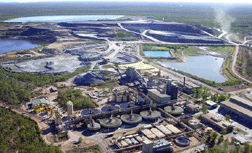 balance. The company has elected to spend $120m to explore the underground potential at its premier Ranger mine in the northern territory, known as the Ranger Deeps project.
If ERA decides the Deeps is not a commercially viable proposition, Ranger is destined to quietly shut down. Merrills suggests known reserves are unlikely to last beyond this year and stockpiles would be gone in 3-4 years.
Meanwhile, Merrills has ceased coverage of Extract Resources post takeover and its impending de-listing this week.
The broker has also taken the opportunity to review its uranium price forecasts to account for weaker Japanese demand now apparent one year after Fukushima. The analysts’ 2012 spot price forecast falls to US$56.25/lb from US$58.50/lb and 2013 to US$67.50/lb from US$70.00/lb. Merrills’ long term price drops to US$63.00/lb from US$65.00/lb. …
http://finance.ninemsn.com.au/newscolumnists/greg/8449091/spot-uranium-grafting
Energy Resources of Australia – no decision on new uranium mining until 2014
ERA to wait two years on new uranium, Northern Territory News, ALISON BEVEGE | April 12th, 2012 A DECISION won’t be made on mining an estimated 34,000 tonnes of uranium at a new Territory resource until 2014, uranium miner Energy Resources of Australia has said.
Shareholders caught a ray of hope at ERA’s annual general meeting at SkyCity Casino yesterday after a gloomy 2011 where the company lost $154 million and halted dividends….. The company will begin extensive mapping of the new find this year with construction to begin on a $120 million exploration decline on May 1.
Mr Atkinson said no decision on mining it would be considered for two years. “2014 is to be the year of decisions,” he said….. http://www.ntnews.com.au/article/2012/04/12/298551_ntnews.html
1 This month
7 April – WEBINAR – Australia and the Doomsday Clock – Preventing nuclear war through NoFirstUse and other policies
Online | Tuesday April 7, 4:00-5:30pm, Australian Eastern Time / 8:00-9:30am Central Europe Time
– Access the registration link
15 April – Zoom –Nuclear Power is Not the Solution
Apr 15, 2026 01:00 AM in Canberra, Melbourne, Sydney

Join the International Physicians for the Prevention of Nuclear War (IPPNW) on Tuesday, April 14th for a timely webinar exploring the risks associated with nuclear power and challenging the myth that it offers a simple, safe, carbon-free solution to the climate crisis

21 April Webinar: No Nuclear Weapons in Australia
Start: 2026-04-21 18:00:00 UTC Canberra, Melbourne, Sydney (GMT+10:00)
End: 2026-04-21 19:30:00 UTC Canberra, Melbourne, Sydney (GMT+10:00)
Event Type: Virtual
A virtual link will be communicated before the event.
Host Contact Info: australia@icanw.org

of the week – Australians for War Powers Reform (AWPR)
To see nuclear-related stories in greater depth and intensity
 Antinuclear