Kimba Nuclear Waste Dump Bill yet again postponed in the Australian Senate
 Kazzi Jai No nuclear waste dump anywhere in South Australia 6 Feb 21,
 High Court ruling a helpful precedent for opponents of Kimba nuclear dump

Peter Remta. 4 Feb 21, The High Court’s decision in the New Acland Coal Mine case (1) delivered by Justice James Edelman on Wednesday and based on the principle of “apprehended bias” should give great heart to all the community members in Kimba opposing the government’s proposed nuclear waste facility.
The background of the appeal is that a Queensland community group known as Oakey Coal Action Alliance and representing more than 60 local residents and landholders who opposed the proposed expansion of the New Acland Coal Mine on the basis that it would destroy otherwise productive agricultural land appealed to the High Court to stop the expansion.
In its unanimous decision delivered by Justice Edelman the High Court ruled that due to the way the original hearings had been conducted leading to previous decisions made by earlier courts favouring the coal mine expansion had been affected by apprehended bias with the result that the Action Alliance had not “had its day in court” and that it had not had the opportunity to present all of its arguments.
The rationale of the decision based on the principle of “apprehended bias” as stated by Justice Edelman in delivering the Court’s decision was that
“these matters are insufficient to justify the highly exceptional course of this court refusing a rehearing for a party whose hearing was decided other than independently and impartially. Indeed, it cannot be said that Oakey Coal Action has “had its day in court” or had lost all of its grounds before an independent and impartial tribunal”.
The Action Alliance had been represented by the Environmental Defenders Office on the appeal to the High Court and the Kimba community members opposing the nuclear waste facility should immediately seek the assistance of the Public Defender on the basis of that appeal.
(1). Oakey Coal Action Alliance Inv v. New Acland Coal Pty Ltd & Ors
High Court Case No.B34/2020
This description of the appeal is partly based on the report in RenewEconomy by Michael Mazengarb on 3 February 2021
https://reneweconomy.com.au/author/ michael-mazengarb/
Additional reading:
The litigation against the New Acland Coal Mine involved a major and lengthy hearing in the Land Court of Queensland, followed by judicial review, a subsequent appeal and High Court challenge the history of which is extremely well described on the website of Environmental Law Australia .
This website is a free public service provided by Dr Chris McGrath, LLB (Hons), BSc, LLM, PhD, a barrister in Queensland practising in environmental law and an Adjunct Associate Professor in the School of Earth and Environmental Sciences at the University of Queensland.
Australian government will probably ignore most recommendations in the environmental report
Jim Green and Mia Pepper (WA) 3 Feb 21, – on the nuclear issues in the final Environmental Protection & Biodiversity Conservation review Samuel report, which finds that the Act is not doing its job and the environment is in big trouble (as we all know).
”Nuclear Actions” in the final report on environment laws in Australia
 In this week’s news, the final report on environment laws in Australia has been made and in summary, recommends that “nuclear actions” remain a Matter of National Environmental Significance (MNES). This means all proposals that are a “nuclear action” eg uranium mining, need to be assessed and approved in accordance with national environmental laws (EPBC Act). Initially “nuclear actions” will have to be assessed and approved based on “the whole of environment” impact – this means they would require a full environmental assessment.
Final Report on environment laws https://dont-nuke-the-climate.org.au/environment-laws-australian-nuclear/, February 2, 2021 The final report on environment laws in Australia has been made public this week.
In Summary, the Final Report:
- recommends that “nuclear actions” remain a Matter of National Environmental Significance (MNES) this means all proposals that are a “nuclear action” eg uranium mining, need to be assessed and approved in accordance with national environmental laws (The EPBC Act).
-
- recommends that State and Territory Governments be accredited to assess and approve projects in-line with the EPBC Act and with “National Environment Standards.” National Environmental Standards do not yet exist but would be legally enforceable standards. In the case of nuclear it is likely that National Environmental Standards would be derived from national and international standards on the nuclear industry. o Nuclear projects, including uranium mines would then be assessed and approved by state and territory governments, not the federal government.
- recommends a second phase of reform that “the EPBC Act and the regulatory arrangements of the Australian Radiation Protection and Nuclear Safety Agency (ARPANSA) should be aligned, to support the implementation of best-practice international approaches based on risk of harm to the environment, including the community.”
-
- describes the section 140A prohibition on some nuclear actions (like nuclear power and reprocessing) reflects a policy choice and that to change this would also be a ‘policy’ or political decision – but notes that legislative changes would be required. Important to note that there is emphasis on elected parliamentarians making policy choices, a subtle hint on the lack of a mandate to lift the prohibition.
Initially “nuclear actions” will have to be assessed and approved based on “the whole of environment” impact – this means they would require a full environmental assessment. It is unclear if this would be retained under the proposal to make ARPANSA the regulator and with National Environmental Standards for nuclear actions or whether assessments and approvals would only be required for aspects of a project that involve radiation.
Australian uranium mining company threatens Spanish government with legal action
Miner threatens Spain over uranium ban, Cosmo Sanderson, 01 February 2021
Resource Minister Pitt should withdraw the Bill as the process for a Kimba nuclear waste dump has failed
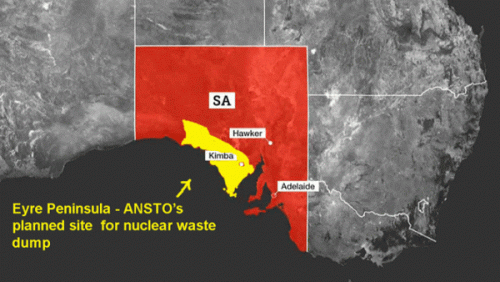
George Gear , 30 Jan 21, Reports have said that there is a possibility of a federal election this year. This means clearing the decks of issues that have the potential to embarrass the government or be a distraction.
One of these is the radioactive waste site at Kimba in SA.
The selection process for the radioactive waste facility project has now been going on for over 4 years.
The government’s bill to site the facility in Kimba will not pass the senate.
The proposed Kimba facility will not get a license to operate a radioactive waste facility as it does not meet
International Atomic Energy Agency standards of burial below ground. Australia is a founding member of the
IAEA. Their standards are our standards.
The minister will not declare Kimba because of the litigation that would follow will add years to the project. The
Barngarla traditional owners have been sidelined from the decision and will litigate. They have the resources to
do it with assets of $300M according to their Adelaide lawyers.
This will still be an issue at the next election unless it is settled. It is a major factor in SA where the government
has marginal seats. Press reports have opposition to the plan in SA at 70%.
Minister Pitt, in February, should announce that he respects the fact that the senate will not pass his bill and he
has decided to withdraw it. The cross bench have actually given the government a “get out of jail free” card. The
senate is now in control of the issue. I say that the government should take back control in the way I have
suggested.
At the same time he announces that negotiations with another nominee in the self selection process has begun.
Leonora did nominate in the process. No names at this point……..
The trouble with the process to date is that it hasn’t followed the science. The PM and Premiers did this with the
Corona Virus. The outcome is positive and they were all rewarded. The waste facility is not being ruled by science
which says that the waste has to be buried underground “at depths of twenty to hundreds of metres.” This
standard has been established by scientists.
The starting point should have been talking to the regulator to confirm the standards need to get a licence to
store the waste. This still hasn’t been done and has been left to the end of the process. Imagine if the bill had
passed the senate and the proposed facility on application to the regulator ARPANSA was refused a license. The
press would have had a field day at the governments expense.
The Australian government’s Radioactive Waste Bill does not meet required IAEA standards
 Peter Remta, 30 Jan 21, National Radioactive Waste Management Amendment (Site Specification, Community Fund and Other Measures) Bill
2020 I understand that Minister Pitt has brought on the bill for debate in the Senate on Thursday 4 February 2021 as he has been threatening the opposing senators that if the bill fails to pass it will become a trigger for the federal government to call early election by means of a double dissolution.
establishment of the facility at Napandee which will only show up the inefficient and disingenuous conduct of the government and its agencies such as ANSTO and even ARPANSA.
*****
Below is the email message I sent out yesterday which includes in red my suggested draft for an amendment to the Labor
Party’s proposed amendment to the bill The effect of this draft is to require such strict compliance with the codes and standards prescribed by the International Atomic Energy Agency that would be possible for the government to continue with establishing the facility
*****
3A Section 4Insert:
Joint Convention means the Joint Convention on the Safety of Spent Fuel Management and on the Safety of Radioactive Waste Management, done at Vienna on 5 September 1997, as amended and in force for Australia from at any time and includes without limitation the Safety Standards established or adopted by the International Atomic Energy Agency which provide the fundamental principles,requirements and recommendations to ensure nuclear safety for the purposes of among other things giving full effect to the Joint Convention.
Kimba nuclear waste dump issue is in limbo in the Australian Senate

Julian Assange nominated by French parliamentarians for Nobel Peace Prize
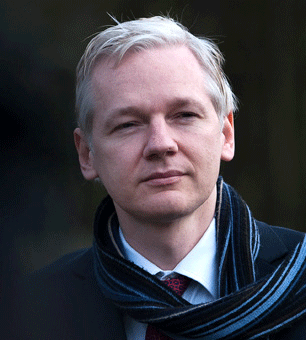 A Nobel Peace Prize for Julian Assange! https://melenchon.fr/2021/01/28/un-prix-nobel-de-la-paix-pour-julien-assange/ Thursday 28 January 2021, I decided to nominate journalist Julian Assange for the Nobel Peace Prize, as I have the power to do as a parliamentarian. Julian Assange is a hero of freedom. The WikiLeaks initiative has raised awareness of war crimes and serious human rights abuses. It is right that the peoples of the world express their gratitude to him. A Nobel Peace Prize for Julian Assange! https://melenchon.fr/2021/01/28/un-prix-nobel-de-la-paix-pour-julien-assange/ Thursday 28 January 2021, I decided to nominate journalist Julian Assange for the Nobel Peace Prize, as I have the power to do as a parliamentarian. Julian Assange is a hero of freedom. The WikiLeaks initiative has raised awareness of war crimes and serious human rights abuses. It is right that the peoples of the world express their gratitude to him.
On January 4, 2021, British justice refused his extradition to the United States, but maintained his imprisonment. More than ever, Julian Assange needs the protection of the peoples of the world. Granting him the Nobel Peace Prize would allow that.
|
|
|
Australian Labor Party’s removal of Mark Butler as Shadow Environment Minister – an ominous sign for the nuclear-free movement
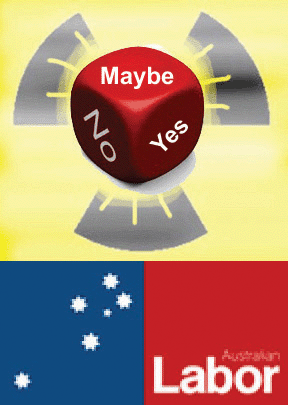 Noel Wauchope 30 Jan 21, Anthony Albanese’s removal of Mark Butler as Shadow Environment Minister is an ominous sign – for the environment, the climate, and for a nuclear-free Australia. Having followed the Labor Party’s efforts (or lack thereof) on nuclear issues, over several years, I am not optimistic. When I wrote individually to each ALP politician, a few years back, I got standard answers from all, just quoting Labor policy, but not answering my question. Only Mark Butler and Sam Dastyari gave me straight answers, affirming their personal anti nuclear opinion. Labor has a sad history of caving in on uranium/nuclear issues.
As new climate spokesman, Chris Bowen has good climate change and environment credentials, and good ideas on connecting clean energy technologies with employment opportunities. BUT, this appointment looks like a Labor swing to the Right, and appeasing the fossil fuel fans (and ? the nuclear fans)
Labor leader Anthony Albanese used to be a strong anti-nuclear force in Labor. The former leader, Bill Shorten, was ever ready to make a deal with the nuclear lobby, if he thought that would help him win. But – what has happened to Albo lately ?
Butler dumped as Labor’s climate opposition collapses at a truly pivotal moment

Labor to dump Mark Butler as its opposition to Morrison’s inadequate climate and energy policies evaporates. Renew Economy, 28 Jan 21,
It’s odd how climate news tend to rhyme and counter itself across the world in perfect unison. Joe Biden has just announced a huge raft of major new climate policies, after coming to power off a campaign that focused heavily on climate. It’s a big moment, and it’s being received well by both the American energy industries and by the progressive activists that helped shape Biden’s policies.
Back in Australia, the news that opposition climate spokesman Mark Butler is losing the climate change portfolio to a member of the party’s right wing was leaked to media. What a contrast. As the federal government sinks even deeper into a climate and energy funk, the opposition marks this major global climate moment by sacking one of their best.
The total absence of any countering force to pressure a government that’s become stunningly and openly destructive on climate is a dark moment for Australia, and it’s worth exploring how we got here.
Missed opportunities are the norm
If you trace back through every big climate and energy moment of the past two years (and before that, too), the Labor party has failed catastrophically to summon any might or certainty or even bare sufficiency in their opposition to the federal government’s fossil expansion fantasies.
The climate-intensified bushfires were mostly ignored and there has been near zero debate about where COVID19 recovery cash flows.
In December last year, a crucial moment for Australia’s climate came and went. In the lead up to the moment when Australia’s government had to submit an ‘update’ to its 2030 Paris Agreement targets (known as ‘Nationally Determined Contributions, or NDCs), the Prime Minister and ‘Energy and Emissions Reductions Minister’ Angus Taylor were badly exposed.
Scott Morrison claimed to have been invited to an event held by the United Kingdom government – another climate summit talk-fest type thing. Turns out that Australia never made it onto the list; purely because Morrison’s government had steadfastly refused to upgrade their 2030 NDC from something weak, old and insufficient to something newer and better aligned with the country’s potential for climate action and level of ambition. Morrison was furious: he’d saved up a big announcement to promise not to cheat on those already-weak 2030 targets (a shift made possible only because renewable energy has outperformed expectations, and because a deadly disease dented emissions) – where was his congratulations?
2030 is what counts. The world’s performance this decade will largely decide whether net zero by 2050 is a pipe-dream or possible. And in the last months of 2020, Australia federal opposition, the Labor Party, had a brilliant opportunity to pressure the government into upgrading their 2030 climate ambitions to something more aligned with what’s required to keep the planet to 1.5C of warming (around 66% is a good indicator; a new ‘Climate Targets Panel’ announced today, suggests somewhere above 50% for 2C and 75% for 1.5C).
Of course, that didn’t happen. The absolute peak of opposition was leader Anthony Albanese labelling the rescinding of the Kyoto trick ‘pathetic‘. The reason why? Labor has itself not established what a 2030 target should be; they haven’t even set an interim pre-2050 target for emissions reductions.
There’s a popular conception that Labor’s 45% 2030 target, which it took to the 2019 federal election, was a major part in their loss. That’s generally justified on an ‘election review‘ that blamed opposition to the Adani coal mine for their loss; along with too-ambitious climate policies. “Labor should recognise coal mining will be an Australian industry into the foreseeable future and develop regional jobs plans based on the competitive strengths of different regions” said the review. It was co-chaired by Dr Craig Emerson, who recently wrote in the AFR that ending fossil fuel extraction is akin to an act of white supremacy. Albanese now reminds voters that Australia will be digging up and selling coal in 2050; the year the world ought to be mostly free from all emissions.
Of course, it only ‘cost’ Labor in 2019 due to a mixture of half-heartedness from Labor right leader Bill Shorten, severe misreporting of climate policy from media outlets (“What about the costings!!”) and the government’s relentless and ludicrous scare campaign around zero emissions transport. The alternative – of doing climate advocacy in an effective way, immune to those immature attacks – wasn’t even considered in that review.
The internal fight was won by the fossil industry
Mark Butler was one of the remaining forces for stronger climate action within the Australian Labor party is Mark Butler. He’d come into conflict with the party’s most aggressive advocate of higher emissions, Joel Fitzgibbon, who represents a coal-mining area in New South Wales. Whatever slight momentum existed within the party for climate ambition seems now to have been sidelined.
The alternative vision offered up by Labor – modelled on Ross Garnaut’s ‘superpower’, in which Australia becomes enriched through the export of zero carbon energy – is grand but still vague. There is little detail on the short term benefits that strong climate action would bring. There’s no commonly stated policy about a just transition for fossil workers, as that would entail admitting the likelihood that the industry’s on the way down – unthinkable for an unashamedly pro-fossil-mining party.
Butler is tipped to be replaced by Chris Bowen, a member of Labor’s right faction. Bowen’s Twitter history features no mention of wind, solar, coal, oil or gas, and the majority of climate mentions are criticisms of Liberal backbencher Craig Kelly. Bowen reassured voters prior to the 2019 election that he would not ban the Adani coal mine, but has also signalled potential enthusiasm about some parts of the US Democrat’s ‘Green new deal’ policy package. Bowen also led a push to make climate change a health priority, just prior to the onset of Australia’s Black Summer. bushfire season. It may not be all bad, but whether it translates into sufficient ambition seems highly questionable.
Albanese’s reshuffle was welcomed by Joel Fitzgibbon. “Fitzgibbon, who stood down from the resources portfolio after his clashes with Mr Butler at the end of last year, welcomed the news about the reshuffle but signalled he wanted a change on policy as well”.
It’s a weird request, given there is literally no policy to change, save for reaching ‘net zero’ domestic emissions in 2050 while still pumping out fossil fuels to the world. Presumably what Fitzgibbon is requesting is creating new policy, doing things like using government power to build new fossil fuel power stations, subsidising fossil mining operations even more, and changing regulations to roadblock renewables, EVs and other forms of decarbonisation. Capitulating to pro-fossil forces means that miles will be taken, after inches are given. Time will tell what this new-found position entails, but chances are that it won’t be good.
A new opportunity to waste again
This is all happening in the context of two global shifts.
First, the US Democrats won against an extremely popular authoritarian figure (for both the presidency and control of the Senate) by making climate action – and in particular, justice-driven climate action – a central focus. Today, Biden has made climate a central focus, announcing a wide range of additional initiatives that focus on communities of colour in the US. Biden just announced a plan to replace the government’s fleet of 650,000 vehicles with all-electric alternatives, cancelled the Keystone XL oil pipeline from Canada and has rejoined the Paris agreement. Of course, Biden has his own Fitzgibbon to contend with, but it hasn’t resulted in a reshaping of the party around total silence on climate.
It’s a winning formula: at least try to do what’s needed on climate, rather than hand-wringing about potential attacks from the opposition – which will always be in bad faith, and will always happen to matter the level of ambition. Make it about people – about jobs, and benefits and air and cities and land. Make it real. That seems to work.
Second, a major global climate conference will be held in November this year, in the UK. If you think the snub from the UK last year was bad, wait until you see what happens after another full year of fossil fuel advocacy and government support from Morrison and Taylor. The lead up and duration of this massive global climate event ought to be a red hot, near-perfect time to establish a clear alternative to the government’s stonewalling.
The final year of this stretch of government seems like it’ll end up the same as the first two: Morrison and Taylor worsen climate harm, while the opposition fails to oppose.
We can say with total confidence that if the Labor party had already created and popularised a climate plan that targets today’s ills, like the need for cleaner cities, more accessible transport, cheaper power and more varied and secure work, they’d be soaring in the polls even despite COVID19.
Of course doing this would paint a target on their back – but literally anything would invite bad-faith attacks from the government and the media. The best option in the face of those attacks is to build a plan so strong that it can withstand attacks, not to abandon climate policies altogether. The current approach means the party is hurtling towards an election loss, up against one of the most stunningly clumsy, pro-fossil governments in the world. https://reneweconomy.com.au/butler-dumped-as-labors-climate-opposition-collapses-at-a-truly-pivotal-moment/
Joel Fitzgibbon Demands Labor’s Climate Change Policy Be Solely Based On Keeping Him In A Job
Joel Fitzgibbon Demands Labor’s Climate Change Policy Be Solely Based On Keeping Him In A Job Betoota Advocate, WENDELL HUSSEY | Cadet | CONTACT, 28 Jan 21, As storms begin to brew in regards to Anthony Albanese’s leadership, Joel Fitzgibbon has today hit the media junket with another big demand.
This time, the Member for Hunter has called for the Labor Party to give up on trying to combat climate change and instead focus upon developing a policy solely based on keeping his parliamentary salary rolling in.
The man involved in every single federal Labor leadership spill since 2006 because the party never seems to be heading in the direction he wants, says ‘Labor needs to return to its roots.’
But, by roots, he doesn’t mean trying to develop policy that improves the lives of his predominantly working-class constituents in a long term sense, he means dropping all climate targets and continuing to try and cosy up to the dying coal industry despite the fact even giant profit-driven banks and investment funds are saying it’s not economically viable going forward…. https://www.betootaadvocate.com/entertainment/joel-fitzgibbon-demands-labors-climate-change-policy-be-solely-based-on-keeping-him-in-a-job/
Murdoch’s Australia Day award — brought to you by miners and bankers
 Murdoch’s Australia Day award — brought to you by miners and bankers
Those who promote and profit from fossil fuels have appropriated the phoney awards handed out by the obscure Australia Day Foundation. https://www.crikey.com.au/2021/01/27/rupert-murdoch-australia-day-foundation/– DAVID HARDAKER, JAN 27, 2021
On the face of it it looks to be an extraordinary decision: a prestigious honour bestowed on the media mogul whose recent hits in the United States include helping fan an insurrection against democracy via Fox News and in Australia leading the way on climate change denialism in cahoots with the Morrison government it supports.
The foundation and its awards are backed by a group of international conglomerates including mining giants BHP, Rio Tinto, Woodside and Anglo-American. Australia’s big banks, the National Australia Bank and Westpac, are also in on the act. Another leading name is CQS, the wealthy London hedge fund founded by Australian business figure Sir Michael Hintze.
Hintze is not well known in Australia, but he is at the centre of a powerful network of business and conservative UK and Australian politicians. As we reported last year he has been a force behind the climate-sceptic Global Warming Policy Foundation which has given voice to the views of Tony Abbott and Cardinal George Pell.
Nominally a business outfit, the foundation also blurs the lines with government. It is sponsored by Austrade and uses Australia House, home to the Australian High Commission, in London to hand out its “Australia Day” awards to UK and Australian figures of its choosing.
This year it gave its honorary Australian of the Year in the UK award to Conservative British MP Liz Truss who promoted the cause of Abbott as a trade adviser to the UK government. Past recipients have included Prime Minister Boris Johnson.
Hintze is not well known in Australia, but he is at the centre of a powerful network of business and conservative UK and Australian politicians. As we reported last year he has been a force behind the climate-sceptic Global Warming Policy Foundation which has given voice to the views of Tony Abbott and Cardinal George Pell.
Nominally a business outfit, the foundation also blurs the lines with government. It is sponsored by Austrade and uses Australia House, home to the Australian High Commission, in London to hand out its “Australia Day” awards to UK and Australian figures of its choosing.
This year it gave its honorary Australian of the Year in the UK award to Conservative British MP Liz Truss who promoted the cause of Abbott as a trade adviser to the UK government. Past recipients have included Prime Minister Boris Johnson.
Hintze is not well known in Australia, but he is at the centre of a powerful network of business and conservative UK and Australian politicians. As we reported last year he has been a force behind the climate-sceptic Global Warming Policy Foundation which has given voice to the views of Tony Abbott and Cardinal George Pell.
Nominally a business outfit, the foundation also blurs the lines with government. It is sponsored by Austrade and uses Australia House, home to the Australian High Commission, in London to hand out its “Australia Day” awards to UK and Australian figures of its choosing.
This year it gave its honorary Australian of the Year in the UK award to Conservative British MP Liz Truss who promoted the cause of Abbott as a trade adviser to the UK government. Past recipients have included Prime Minister Boris Johnson.
Will Australia join the global nuclear lobby’s propaganda onslaught?
‘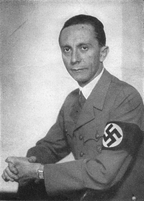 ‘If you tell a lie big enough and keep repeating it, people will eventually come to believe it. A lie told once remains a lie but a lie told a thousand times becomes the truth ” – Joseph Goebbels
With the sudden mysterious departure of Australia’s high priest of nuclear spin, Dr Adi Paterson, and the flummoxed and failing government push for a Kimba nuclear waste dump, – the nuclear lobby in Australia seems paralysed at present.
But the world-wide nuclear industry is anything but paralysed, and, while everyone is agonising, (justifiably), over the pandemic, it is gearing up for a big publicity spin. So I’m guress that it won’t be long before a new nuclear champion takes up the nuclearv religion role in Australia..
 This month, I’ve concentrated my efforts on the ground-breaking and historic UN Treaty for the Prohibition of Nuclear Weapons coming into force. Of course, the nuclear weapons states will try to destroy that Treaty. Failing destruction, they will aim for pooh poohing and rubbishing that Treaty. Finally they’ll go for a favourite strategy – ignoring it, and hoping that the world will just forget about it.
I don’t think that the world will forget about it. The challenge will be to help those workers and communities that depend on nuclear-weapons-making to be helped out of that toxic situation, and into life-sustaining work and activities.
MEANWHILE, as media and science correctly focus on the global coronavirus pandemic, the issue of nuclear power has pretty much disappeared from view. Nothing is happening?
Today, the nuclear weapons industry is pretty much the only reason for”peaceful” nuclear power. ”Peaceful nukes” provide the trained experts, the technology development necessary for the weapons industry. If governments and universities can be persuaded to back commercial nuclear energy, this solves a lot of probems. Especially, it helps the blur the picture onthe astronomic costs of nuclear weapons, as quite a lot of costs are covered by ”peaceful” nuclear development.
There’s another pressing reason to keep nuclear power going. It’s the horrible and never-ending cost of shutting down reactors and dealing with their toxic wastes. How much cheaper to just relicense the for 100 years? That way, the present responsible officials will all be gone, and they don’t have to worry about that problem. Heck – they’ve handed it over to our great-grandchildre, What a fine idea! NOT!!
Against this background, the nuclear lobby is girding its loins for the public perception battle.
Armed with lies – that nuclear fixes climate – that it’s cheap, is clean, works great with renewables, essential for society – blah blah, the nuclear lobby is preparing its onslaught. They generally try pretty hard to ignore matters like comparative costs, and wastes problems. But they can just lie again, if put on the spot about such problems.
Just a few quotatios from World Nuclear News :-
The barrier to nuclear is perception“
”addressing perceptions of its alleged drawbacks”
Bilbao y León – “the nuclear industry has responsibly managed all its used nuclear fuel and waste “from day one”.
“We know where every ounce of used nuclear fuel and nuclear waste is because we have been managing it throughout the history of the nuclear industry. “We know where every ounce of used nuclear fuel and nuclear waste is because we have been managing it throughout the history of the nuclear industry“. ……. https://www.world-nuclear-news.org/Articles/The-barrier-to-nuclear-is-perception,-says-
“The real challenges to nuclear are external” – ”small modular reactors ..cheaper, safer, better, and going to provide more discreet financial solutions”
The government nuclear regulatory authorities are, unfortunately, usually well onside with the industry – in what is known as “regulatory capture”. Again, from World Nuclear News –
”The hurdles advanced nuclear developers face‘ – ””We, as the regulator, are working on building public trust, confidence and social acceptance in these new technologies.’‘
Joseph Goebbels would be proud of the skills of Sama Bilbao y Leon, Director General of the World Nuclear Association. She’s great with language (as the global nuclear lobby has realised, in appointing her, and several other women to top promotional positions”
Australian Capital Territory politicians join calls for Australia to sign nuclear ban treaty
|
ACT politicians join calls for Australia to sign nuclear ban treaty https://www.canberratimes.com.au/story/7097235/act-politicians-join-calls-for-australia-to-sign-nuclear-ban-treaty/, Jasper Lindell 24 Jan 21,
ACT politicians have renewed their calls for the federal government to join a United Nations treaty banning the use of nuclear weapons, which came into force on Friday. Politicians and members of the international diplomatic corps gathered on Saturday at the Canberra Rotary peace bell in Nara Peace Park to mark the entry-into-force of the treaty. Greens member for Ginninderra Jo Clay said Australia’s continued relationship with uranium mining and the creation of nuclear weapons was unacceptable.
“With climate change upon us, the ACT Greens believe that there has never been a more urgent time for Australia to join its 86 international counterparts and show its commitment to a more peaceful and sustainable future for all of us,” Ms Clay said in a statement. All Greens members of the Legislative Assembly have signed the International Campaign to Abolish Nuclear Weapons’ parliamentary pledge.
Some Labor members, including Chief Minister Andrew Barr and Deputy Chief Minister Yvette Berry, have signed the pledge. Federal member for Canberra Alicia Payne has also signed. The Australian government has not signed the treaty, which compels signatories to stop developing, testing, producing or stockpiling nuclear weapons. Signatories are also banned from threatening to use the weapons. Fifty countries ratified the treaty in October, which was condemned by the United States. Red Cross International humanitarian law adviser Tara Gutman welcomed the treaty, saying the law was the cornerstone of a world free of nuclear weapons. “There has been no humanitarian response developed that is remotely capable of being applied to a nuclear weapon attack. We simply will not be there to assist victims,” she said. “These weapons are an inhumane response to any military threat … They decimate populations, cause untold and needless suffering, and their environmental impact would accelerate climate change making some areas of the planet uninhabitable. |
|
1 This month
17 October, Free Public Talk on Nuclear Issues in South Australia
David Noonan will speak on public interest concerns over the new Roxby Downs Indenture Act 2026 on BHP copper-uranium mining and ore processing in SA, and on how AUKUS may face SA with a High-Level nuclear waste agenda.
Dr Jim Green will discuss international developments in the field of nuclear power including ‘small modular reactors’ and Generation 4 ‘advanced’ nuclear reactor concepts.


Help Aunty Sue Protect Her Land and Sacred Sites From Destructive Rocket Testing.
.

Australians deserve the truth
about
AUKUS – https://aukuspublicinquiry.com/

PETITION – To: Prime Minister Anthony Albanese and the Australian Labor Government

of the week – Australians for War Powers Reform (AWPR)
To see nuclear-related stories in greater depth and intensity

