Nuclear waste dump plans scrapped for South Australia
By Andrew Brown August 10 2023 –
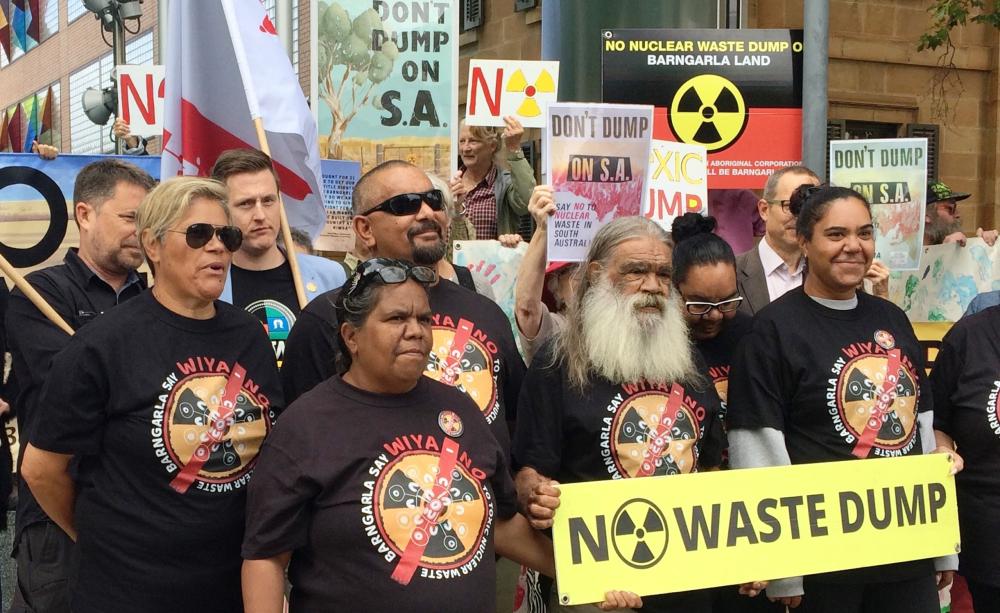
Plans for a nuclear waste dump in regional South Australia have been scrapped by the federal government following a court decision blocking its construction.
The waste facility was earmarked to be built on land at Napandee near the town of Kimba in the Eyre Peninsula by the previous coalition government in 2021.
The decision was challenged in the Federal Court by traditional owners, the Barngarla people, who said the decision was made without them being consulted.
The court ruled in July the facility could not be built.
Resources Minister Madeleine King told federal parliament the government would look for a new location for the nuclear waste storage.
“I’m deeply sorry for the uncertainty the process has created for the Kimba community, for my own department, for the Australian Radioactive Waste Agency workers and for the workers involved in the project,” she said.
“I also acknowledge the profound distress this process has caused the Barngarla people.”
Ms King said any work near Kimba had stopped after the court’s decision.
She said the government would not appeal against the court decision.
“We have to get this right. This is long lasting, multi-generational government policy for the disposal of waste that can take thousands of years to decay,” she said.
“We must consult widely and bring stakeholders including First Nations people along with us. We remain bipartisan in our approach.”…………………………………………………………….. https://www.canberratimes.com.au/story/8303272/nuclear-waste-dump-plans-scrapped-for-south-australia/
Yes in my backyard: Nationals happy to go nuclear

SMH, yMike Foley and James Massola, August 10, 2023
Nationals leader David Littleproud has declared he is open to having a nuclear power plant in his Queensland electorate, as the Coalition pushes a new plan to convert Australia’s existing fleet of coal plants to the controversial source of electricity generation.
Coalition energy spokesman Ted O’Brien said on Wednesday nuclear energy was a crucial emissions-reduction technology. He called for a national discussion about ending Australia’s moratorium, and argued that existing coal plants could be supplanted with the developing nuclear technology of small modular reactors.
Federal parliament banned nuclear power in 1998, and the moratorium has remained in place with bipartisan support.
“I would support a process to explore small-scale modular reactor technology in my electorate with appropriate consultation and education of the community if a moratorium was removed,” Littleproud said.
The Maranoa MP, whose electorate sprawls across western Queensland, was joined by two Nationals colleagues in supporting nuclear in their patch.
Michelle Landry, who represents Capricornia in Queensland, said she would support a coal-to-nuclear transition in her electorate at a “coal-fired power station that is no longer being used”.
Former leader Barnaby Joyce, whose electorate of New England in northern NSW does not have coal plants, emphatically backed developing the technology in his electorate.
O’Brien, however, would not be drawn on his position on a nuclear power plant in his Sunshine Coast electorate of Fairfax. He said a selection of nuclear locations could be addressed if the moratorium was lifted.
“If we end up with a clean energy policy that includes zero-emissions nuclear energy, a cheap NIMBY [not-in-my-backyard] campaign will inevitably come and we’ll deal with those sort of childish debates then,” O’Brien said.
O’Brien said small modular reactors would be key to a nuclear energy policy………………………
CSIRO and the Australian Energy Market Operator’s GenCost report into the cost of electricity generation based on technology type found that an energy grid running on 90 per cent renewables, including transmission lines and back-up battery or gas power, would cost between $70 to $100 a megawatt hour in 2030.
Small modular reactors would cost between $200 and $350 a megawatt hour, were that technology available by 2030.
Former chief scientist of Australia Alan Finkel, writing in the Financial Review this week, said it was unlikely small modular reactors could be deployed before 2040 in Australia, which meant “we must continue our investment in renewables”.
Climate Change and Energy Minister Chris Bowen has rejected the deployment of nuclear power and on Wednesday reiterated the Albanese government’s goal to cut power bills by supplying 82 per cent of electricity through renewable energy by 2030.
“We look forward to the costings and the locations of the nuclear power stations when [O’Brien] releases them. I’ve been a bit confused about why a party claiming to be economically rational would propose the most expensive form of energy as a way to reduce prices,” Bowen told parliament.
On Wednesday, Bowen announced energy rule changes to force companies building transmission lines to engage in earlier and more frequent “genuine” community consultation. The move is designed to reduce community opposition, which is now the main obstacle to the government’s goal to decarbonise the electricity grid.
Opposition Leader Peter Dutton has backed the coal-to-nuclear plan and Canning MP Andrew Hastie said small modular reactors should be considered as replacement for coal plants given “we already have four to five small modular reactors on order” to power Australia’s next generation of nuclear submarines.
When asked if he backed nuclear in his northern NSW electorate, Joyce said: “Not only would I be happy to have a small modular reactor in New England, but I suggested the policy to accompany it.”…………………………………….https://www.smh.com.au/politics/federal/yes-in-my-backyard-nationals-happy-to-go-nuclear-20230809-p5dv43.html
Government abandons plan to dump nuclear waste near Kimba, sparking new hunt for dump site
ABC , By political reporter Matthew Doran, 10 Aug 23
Key points:
- The planned nuclear waste site near Kimba, SA, has been formally abandoned
- The Federal Court ruled against Coalition plans to dump nuclear waste there
- The Opposition claims it is a massive setback
…………………………………………………………. In parliament, Federal Resources Minister Madeleine King said the government respected the court decision.
“The Albanese Labor government does not intend to pursue Napandee as a potential site for the facility, nor is the government pursuing the previously shortlisted Lyndhurst and Wallerberdina sites,” Ms King said.
She revealed all work on the Napandee site had ceased.
“Any activities that have already been conducted were non-permanent and will be reversed or remediated,” Ms King said.
“The site is currently being supervised to ensure it remains safe and cultural heritage is protected while we work through dispossession of the land.”
The Coalition immediately took aim at the announcement, accusing Labor of a “legacy failure” and “abandoning years of work”………………………………………………………………………………………………….
Nuclear storage site still needed
Ms King said Australia needed a nuclear storage facility, but argued it could not be at the Napandee site.
……………………………….. “The site of Australia’s only nuclear reactor at Lucas Heights can safely store waste on site for some time, but we must ensure this waste has an appropriate disposal pathway.”
She argued the government remained committed to finding a solution. https://www.abc.net.au/news/2023-08-10/kimba-nuclear-dumping-plan-abandoned/102711320
Reducing the risks of nuclear war — the role of health professionals
By – Kamran Abbasi, Parveen Ali, Virginia Barbour, Kirsten Bibbins‐Domingo, Marcel GM Olde Rikkert, Andy Haines, Ira Helfand, Richard C Horton, Bob Mash, Arun Mitra, Carlos A Monteiro, Elena N Naumova, Eric J Rubin, Tilman A Ruff, Peush Sahni, James Tumwine, Paul Yonga and Chris Zielinski
Med J Aust || doi: 10.5694/mja2.52054, 7 August 2023
In January 2023, the Science and Security Board of the Bulletin of the Atomic Scientists moved the hands of the Doomsday Clock forward to 90 s before midnight, reflecting the growing risk of nuclear war.1 In August 2022, the UN Secretary‐General António Guterres warned that the world is now in “a time of nuclear danger not seen since the height of the Cold War”.2 The danger has been underlined by growing tensions between many nuclear armed states.1,3 As editors of health and medical journals worldwide, we call on health professionals to alert the public and our leaders to this major danger to public health and the essential life support systems of the planet — and urge action to prevent it.
Current nuclear arms control and non‐proliferation efforts are inadequate to protect the world’s population against the threat of nuclear war by design, error, or miscalculation. The Treaty on the Non‐Proliferation of Nuclear Weapons (NPT) commits each of the 190 participating nations “to pursue negotiations in good faith on effective measures relating to cessation of the nuclear arms race at an early date and to nuclear disarmament, and on a treaty on general and complete disarmament under strict and effective international control”.4 …………………………………………
Any use of nuclear weapons would be catastrophic for humanity. Even a “limited” nuclear war involving only 250 of the 13 000 nuclear weapons in the world could kill 120 million people outright and cause global climate disruption leading to a nuclear famine, putting 2 billion people at risk.7,8 A large‐scale nuclear war between the USA and Russia could kill 200 million people or more in the near term, and potentially cause a global “nuclear winter” that could kill 5–6 billion people, threatening the survival of humanity.7,8. Once a nuclear weapon is detonated, escalation to all‐out nuclear war could occur rapidly. The prevention of any use of nuclear weapons is therefore an urgent public health priority and fundamental steps must also be taken to address the root cause of the problem — by abolishing nuclear weapons.
The health community has had a crucial role in efforts to reduce the risk of nuclear war and must continue to do so in the future.9 In the 1980s the efforts of health professionals, led by the International Physicians for the Prevention of Nuclear War (IPPNW), helped to end the Cold War arms race by educating policy makers and the public on both sides of the Iron Curtain about the medical consequences of nuclear war. This was recognised when the 1985 Nobel Peace Prize was awarded to the IPPNW (http://www.ippnw.org).10
In 2007, the IPPNW launched the International Campaign to Abolish Nuclear Weapons, which grew into a global civil society campaign with hundreds of partner organisations. A pathway to nuclear abolition was created with the adoption of the Treaty on the Prohibition of Nuclear Weapons in 2017, for which the International Campaign to Abolish Nuclear Weapons was awarded the 2017 Nobel Peace Prize……………………………………………………………..
We now call on health professional associations to inform their members worldwide about the threat to human survival and to join with the IPPNW to support efforts to reduce the near‐term risks of nuclear war, including three immediate steps on the part of nuclear‐armed states and their allies: first, adopt a no first use policy;12 second, take their nuclear weapons off hair‐trigger alert; and, third, urge all states involved in current conflicts to pledge publicly and unequivocally that they will not use nuclear weapons in these conflicts. We further ask them to work for a definitive end to the nuclear threat by supporting the urgent commencement of negotiations among the nuclear‐armed states for a verifiable, timebound agreement to eliminate their nuclear weapons in accordance with commitments in the NPT, opening the way for all nations to join the Treaty on the Prohibition of Nuclear Weapons…………….. more https://www.mja.com.au/journal/2023/219/5/reducing-risks-nuclear-war-role-health-professionals
Building for War: The US Imperium’s Top End Spend

August 5, 2023, Dr Binoy Kampmark, https://theaimn.com/building-for-war-the-us-imperiums-top-end-spend/
The AUSMIN 2023 talks held between the US Secretaries of State and Defense and their Australian counterparts, confirmed the increasing, unaccountable militarisation of the Australian north and its preparation for a future conflict with Beijing. Details were skimpy, the rhetoric aspirational. But the Australian performance from Defence Minister Richard Marles, and Foreign Minister Penny Wong, was crawling, lamentable, even outrageous. State Secretary Antony Blinken and Defense Secretary Lloyd Austin III could only look on with sheer wonder at their prostrate hosts.
Money, much of it from the US military budget, is being poured into upgrading, expanding and redeveloping Royal Australian Air Force (RAAF) bases in the Northern Territory city of Darwin, and Tindal, situated 320km south-east of Darwin, the intended to “address functional deficiencies and capacity constraints in existing facilities and infrastructure.” Two new locations are also being proposed at RAAF Bases Scherger and RAAF Curtin, aided by site surveys.
The AUSMIN joint statement, while revealing nothing in terms of operational details or costs, proved heavy with talk about “the ambitious trajectory of Enhanced Force Posture Cooperation across land, maritime, and air domains, as well as Combined Logistics, Sustainment and Maintenance Enterprise (CoLSME).” Additionally, there would be “Enhanced Air Cooperation” with a rotating “US Navy Maritime Patrol and Reconnaissance Aircraft in Australia to enhance regional maritime domain awareness, with an ambition of inviting likeminded partners to participate in the future.”
Further details have come to light about the money being spent by the Pentagon on facilities in Darwin. The unromantically titled FY22 MCAF Project PAF160700 Squadron Operations Facility at the RAAF Darwin base “includes the construction (design-bid-build) of a United States Air Force squadron facility at the … (RAAF) in Darwin, Australia.” The project is deemed necessary to add space “for aircrew flight equipment, maintenance and care, mission planning, intelligence, crew briefings, crew readiness, and incidental related work.” Some of the systems are mundane but deemed important for an expanded facility, including ventilating and air conditioning, water heating, plumbing, utility energy meters and sub-meters and a building automation system (HVAC Control system).
Correspondents from the Australian Broadcasting have gone further into the squadron operations facility, consulting US budget filings and tender documents to reveal cost assessments of $26 million (A$40 million). A further parking apron at RAAF Darwin is also featured in the planning, estimated to cost somewhere in the order of $258 billion. This will further supplement plans to establish the East Arm fuel storage facility for the US Air Force located 15 kilometres from Darwin that should be able to, on completion by September this year, store 300 million litres of military jet fuel intended to support US military activity in the Northern Territory and Indo-Pacific region.
According to the tender documents, the squadron operations facility also had a broader, more strategic significance: “to support strategic operations and to run multiple 15-day training exercises during the NT dry season for deployed B-52 squadrons.” The RAAF Tindal facility’s redevelopment, slated to conclude in 2026, is also intended to accommodate six B-52 bombers. Given their nuclear capability, residents in the NT should feel a suitable degree of terror.
Michael Shoebridge, founder and director of Strategic Analysis Australia, is none too pleased by this state of affairs. He is unhappy by Canberra’s reticence on US-Australian military arrangements, and none too keen on a debate that is only being informed by US-based sources. “A public debate needs to be enabled by information and you can’t have a complete picture without knowing where the money is being spent.”
While it is hard to disagree with that tack, Shoebridge’s outfit, in line with such think tanks as the Australian Strategic Policy Institute, is not against turning Australia into a frontline fortress state ready for war. What he, and his colleagues take issue with, is the overwhelmingly dominant role the US is playing in the venture. Those in Washington, Shoebridge argues, seem to “understand the urgency we don’t seem to.” Rather than questioning Australia’s need for a larger, more threatening military capability to fight phantoms and confected foreign adversaries, he accepts the premise, wholeheartedly. Canberra, in short, should muck in more, pull its weight, and drum up Australian personnel for the killing.
Anthony Bergin, a senior fellow of Strategic Analysis Australia, teases out the idea of such mucking in, suggesting a familiar formula. He insists that, in order to improve “our national security, we should be looking at options short of conscription which wouldn’t be as hard to sell to the Australian people.” He thought the timing perfect for such a move. “There’s now a latent appetite for our political leaders to introduce measures to bolster national resilience.”
This silly reading only makes sense on the assumption that the Australian public has been softened sufficiently by such hysterical affronts to sensibility as the Red Alert campaign waged in the Fairfax Press.
Options to add padding to Australia’s military preparedness include doubling or tripling school cadets and cadet programs of the “outdoor bound” type based in the regions. But more important would be the creation of a “national militia training scheme”. Bergin is, however, displeased by the difficulty of finding “volunteers of any kind”, a strange comment given the huge, unpaid volunteer army that governs the delivery of numerous services in Australia, from charities to firefighting.
Alison Broinowski, herself formerly of the Australian diplomatic corps, safely concludes that the current moves constitute “another step in the same direction – a step that the government has been taking a series of for years; accepting whatever the United States government wants to place on Australian soil.” More’s the pity that most details are to come from Washington sources, indicating, with irrefutable finality, Canberra’s abject subordination to the US imperium and its refusal to admit that fact.
Parramatta Labor Party’s FEC unanimous anti-AUKUS motion
Antonina Gentile 4 Aug 23
The ALP’s FEC of the entire Parramatta electorate tonight voted unanimously against aukus. This makes it the second FEC in NSW, the other being Sydney. Thus noone can try to attack the campaign as an inner urban phenomenon anymore.
This will certainly give AA and the Executive something to lose some sleep over. They are confident that they will win the National Conference vote, but they have a widespread party membership in movement and these are far less pleased than they thought.
If the “aukestra” outside Conference is impressive, parliamentary delegates will now more than ever need to take note and, if lobbied by their constituencies and organisations such as those on this list, some could start finding their tongues…
Nuclear issues turn Radio-Active dial up
Georgia Curry, August 5, 2023, https://canberraweekly.com.au/nuclear-issues-turn-radio-active-dial-up/
With Hiroshima Day this Sunday, 6 August, (and Nagasaki Day on 9 August) plus the cinema release of Oppenheimer, there’s no better time to highlight Australia’s longest running show about nuclear issues – Radio Active.
Canberra’s oldest community radio station, 2XXFM 98.3, airs the program every Sunday morning and, sadly, nuclear issues are just as topical now as they were when the show started in 1976.
According to the Doomsday Clock, which was created by the Bulletin of the Atomic Scientists (founded in 1945 by Albert Einstein and University of Chicago scientists who helped develop the first atomic weapons), it is 90 seconds to midnight.
The Doomsday Clock is set every year and has become a universally recognised indicator of the world’s vulnerability to global catastrophe caused by man-made technologies.
This ticking clock feeds the longevity of Radio-Active. Canberra’s 2XXFM is one of 20 community radio stations broadcasting the show around Australia for the past 47 years.
The show is produced at Melbourne’s community radio station 3CR by producer Michaela Stubbs.
“All of the show’s presenters are activists, which is probably why the show has gone on for so long because we have quite a big movement that is multi-generational and we’re really passionate about the issues,” Michaela says. “My mum was part of the peace and nuclear disarmament movement in the ‘80s so I had an awareness of Hiroshima Day.”
Michael has a vast archive of tapes to draw from and recently aired a show about “Down Winders”, people affected by the Trinity nuclear test site in New Mexico, USA, the site of the first detonation of a nuclear weapon.
“That was such an important story,” Michaela says. “They are the voices that don’t get heard.”
There are also old cassettes of protests such as Australia’s Jabiluka blockades in the ‘70s against the Jabiluka uranium mine in the Northern Territory.
Michaela recently interviewed an Indigenous woman whose family was affected by the British Government atomic tests at Emu Field, South Australia. This occurred 70 years ago this October and her family is still seeking reparations.
“We have always had a strong focus on amplifying the voices of people who are directly impacted by nuclear development,” Michaela says.
Australia’s longest running show on nuclear issues also focuses on peace and sustainability. Radio-Active is broadcast on Canberra community radio 2XXFM 98.3 every Sunday, 7.30am-8am.
USA flexes its belligerent muscles in Western Australia, showing off its nuclear submarines

US military shows off nuclear capable submarine in Western Australia By 9News Staff Aug 4, 2023 https://www.9news.com.au/national/us-military-shows-off-nuclear-capable-submarine-in-western-australia/9b152141-2e3f-4a2a-a73f-37b7a02738cb
The United States military is flexing its nuclear fleet of submarines in Western Australia.
The arrival of the USS North Carolina is the first visit since a landmark defence deal was signed earlier this year.
Australia is buying eight of the nuclear-powered Virginia class submarines in a deal costing $368 billion.
Australia’s Ambassador to the US Kevin Rudd was on Garden Island touring the 110-metre vessel which can go three months underwater.
WA will permanently house nuclear subs from next decade.
HMAS Stirling is set for an upgrade as thousands more submariners file through Perth.
The public is not allowed to know how long the North Carolina will be docked in Perth – that information is classified even from Australia’s defence minister.
However, there have been reassurances the AUKUS deal is watertight regardless of who is in the White House.
Advisor to the US secretary of defence Abe Denmark said there has been broad bipartisan support.
Rudd described the move as an opportunity to step up the capabilities of the Royal Australian Navy and the sovereign capabilities of Australia “in a highly uncertain period strategically”.
AUKUS, Australia and the drive to war
By John Minns, Aug 2, 2023 https://johnmenadue.com/aukus-australia-and-the-drive-to-war/
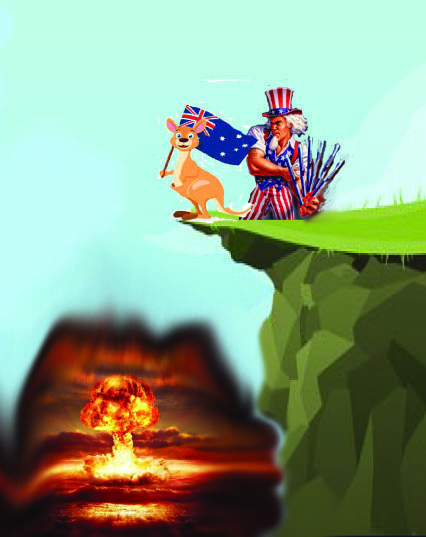
My fear is not that AUKUS SSNs, if they arrive, will be late, ineffective, and obsolete. My fear is that they will arrive and will be effective and even lethal. Because, if that is the case, they will play a part in the drive to a potentially devastating war with China that would be a disaster for the entire world.
This was a speech given at an anti-AUKUS protest at the ANU on 28 July 2023
Friends, I have been proud to have been part of a number of protests against the AUKUS alliance and the nuclear submarine deal that is part of it. However, to be truthful, I haven’t always completely agreed with everything that has been said at them.
I heard at one of the protests a speaker opposing the subs deal because they might never arrive, or might be delivered very late, or that, by then, they would be ineffective and obsolete. Apart from the enormous cost, my concern is not that they will be late or obsolete. My fear is that they will arrive and will be effective and even lethal. Because, if that is the case, they will play a part in the drive to a potentially devastating war with China that would be a disaster for the entire world.
In a war with China – what would victory look like? It would certainly not end, like the Second World War, with allied troops occupying Germany and Japan. Even to imagine Australian, British and US troops patrolling the streets of Shanghai is to realise what a ludicrous prospect that is. China – a vast and nuclear-armed country – is not going to be physically occupied.
Would victory mean that China’s dynamic economy would no longer stock the shelves of Kmart and the like around the world and that it would revert to a poor semi-agricultural country. Hardly – unless it is turned into a nuclear wasteland – it will clearly go on to be the largest economy in the world.
Would victory be the successful defence of Taiwan. Well, China has claimed Taiwan since 1949. But it has made no attempt to invade it. In any case, are we prepared to go to war to defend the independence of a place whose independence we don’t recognise and don’t support. It makes no sense.
Would victory mean that China is prevented from interfering in the affairs of other countries – something which every large or wealthy power does – including Australia in the Asia-Pacific. I study Latin America and, when US politicians talk about China’s interference in the domestic affairs of others, I hear, somewhere in my head, roars of bitterly ironic laughter from all over Latin America. Because the US has interfered in the affairs of every country in Latin America and the Caribbean – instigating coups, supporting military dictatorships, blockading harbours, embargoing trade and even military invasion. And it has done so for the last two hundred years – ever since President James Munro in 1823 proclaimed the doctrine that only the US had the right to interfere in the region.
Would victory mean that so-called Chinese military expansionism is halted. Well, it’s true that China has set up military bases on a number of artificial islands. But the US has around 750 foreign military bases in more than 80 countries. To my knowledge, China has one – in Djibouti. If bases and the ability to project military force is the problem, then China is not the main culprit.
Also, the US spends more on its military than the next 10 countries combined and most of them are US allies.
The chances of being killed by the US military are enormously higher than by any other country. A recent research project from Brown University in the US showed that, since 2001, about 900,000 people have been killed directly by the US military – nearly half of those were civilians. On top of that, what the project calls “the reverberating effects” of US military action – such as famine, destruction of sanitation, health care and other infrastructure has led to several times as many civilian deaths as caused directly.
Would victory in a war with China mean the successful defence of our trade routes and shipping lanes. Where do our trade routes and shipping lanes lead? Largely to China! So, would we fight China to defend our trade with China?
Another thing I’ve heard said that I disagree with is that the AUKUS deal might drag Australia into a war with China. Australia is not being dragged anywhere. The Australian government is eagerly jumping into this alliance – with eyes wide open – rather than being forced into something not of its own making.
There has never been a war conducted by our great and powerful friends that Australia has not been eager to join – whether to the Maori Wars in New Zealand, to Sudan and to South Africa in the 19th century, to the First and Second World Wars, to Korea, Malaysia, Vietnam, Afghanistan and Iraq – twice. We should not be protesting calling for Australia’s independence – it is independent – we should be calling for it to use that independence to help halt the drive to war – rather than to enthusiastically join it.
I’ve heard some on the other side of this argument repeat the old cliché – “if you want peace, prepare for war”. It sounds good – a nice juxtaposition of opposites etc. But it is logical and historical rubbish. It is essentially the argument of the National Rifle Association of America. The NRA says that to be safe, we need to have everyone armed. Security comes from allowing all to buy AR-15 assault rifles. We know how that has worked out in practice. Preparing for war to ensure peace is the same argument on an international scale.
When we look at the great periods of arms build-up, we see that they led to war rather than peace. It was the case with the arms build-up – especially the naval build-up – before World War One, with rearmament in the 1930s, with the Cold War arms economy which was accompanied by very hot and devastating wars – in Vietnam and Korea for example – which were among the most destructive on a per capita basis in modern history..
The world today contains great possibilities. We have the resources and the human ingenuity to deal with some of our real problems – like housing, poverty, health, education, climate. Some of that ingenuity is right here at the ANU. Let us set that ingenuity to the task of solving the real problems which affect our lives and our society rather than to the exacting but grisly science of blowing human bodies apart.
Military Initiative by Australia, the United Kingdom and the United States (AUKUS) is Another Major Step in Prospective War on China

Covert Action Magazine, By Murray Horton, June 29, 2023
Peace groups in all three nations need to rally against provocative alliance that is a pivotal component of war planning.
The AUKUS pact (military initiative among Australia, the UK and U.S.) came out of nowhere in 2021 when Australia broke a $A90 billion contract to buy French submarines.
Instead, it signed up with the U.S and UK to form AUKUS, which will build eight nuclear-powered (but not nuclear-armed) submarines for Australia.
The first get-together of AUKUS leaders did not go well for Australia, when President Biden could not remember the name of its then-Prime Minister, Scott Morrison.
Morrison went behind the backs of the French in order to do a deal, instead, with the U.S. and UK. It led to the most extraordinary diplomatic bust up between those countries—France recalled its ambassadors from both Australia and the U.S. (it is America’s oldest ally, dating back to the American Revolution); President Macron called Morrison a “liar.” When Morrison was voted out a few months later, France’s outgoing foreign minister said: “I can’t stop myself from saying that the defeat of Morrison suits me very well.”…………………………………………………
In May 2022 Scott Morrison’s government was resoundingly voted out of office, but Anthony Albanese’s Labor government wholeheartedly carried on with his Tory predecessor’s foreign policy, including being committed to AUKUS. The last time that an Australian Labor government offered a markedly different foreign policy was the 1972-75 government led by Gough Whitlam, which was overthrown in a CIA-backed coup.[1]
Both Whitlam and Albanese had themselves sworn in as Prime Minister immediately after their respective election wins, but the contrast could not be starker. Whitlam wanted to get go forward with his radically different foreign policy; Albanese wanted to immediately scurry off to Tokyo to meet Joe Biden and reassure him of Australia’s continued loyalty as a good and obedient servant.
The Australian Labor Party has not questioned the American alliance since Whitlam.
The year 2022 came and went but two of the original three AUKUS leaders—Scott Morrison and Boris Johnson—were kicked out of office and AUKUS carried on, building up to its big launch in March 2023, which was hosted by President Biden, alongside Prime Ministers Sunak and Albanese, in front of a massive U.S. nuclear submarine at a San Diego Navy base. Australia will build eight nuclear-powered subs in Adelaide; they will have a British design but American technology.
Eyewatering Cost
The cost is truly eye-watering—anywhere between $A268 billion and $A368b, by 2055. Yes, that’s right—those eight subs will not be ready for more than 30 years.
The first of these eight subs is unlikely to be ready until the 2040s so, to fill that gap, Australia will buy three existing U.S. subs from the early 2030s, at a cost of up to $A58b, with an option to buy two more. There has been zero official discussion about the multitude of things that are likely to change over the next 30 years, militarily, let alone in the wider global society. Think about what has changed in the last 30 years. I would put money on these monstrosities being obsolete long before they are built.
But the politicians and military leaders who commissioned them will be long gone, leaving future taxpayers to shoulder the costs—and the highly likely adverse consequences of such a major push toward war with China. Because that is what AUKUS and its nuclear submarines, and all others, following military technology developments, are aimed at. It has nothing to do with defending Australia, and everything to do with projecting power far from home. That is the point of nuclear-powered subs—they do not need to return to home port to refuel……………………………………………………………………………………………………….
Breakneck Militarization
AUKUS is only part, albeit a very big part, of Australia’s breakneck militarization. “Flying under the radar of last week’s AUKUS submarine announcement was the revelation that the United States had agreed to sell Australia up to 220 Tomahawk cruise missiles.”
“This follows Australia’s purchase in January [2023] of ‘high mobility artillery rocket systems,’ known as HIMARS, which have been used by Ukraine on the battlefield in response to Russia’s invasion. And in 2020, the US approved the sale of up to 200 long-range anti-shipping missiles (LRASM) to Australia.”…………………………………………………………………………………………………………………….
Shortly after Albanese was elected as prime minister in May 2022, he initiated the Defence Strategic Review. It was classified but a redacted version was publicly released in April 2023. It was billed as Australia’s biggest defence overhaul since World War II. “Australia has said the acquisition of nuclear-powered submarines, long-range strike capabilities and its northern bases will be among the country’s six priority areas after a major review of its defence strategy found the armed forces were not ‘fully fit for purpose.’”………………………………………………………………………………………………………………………………………………………………….. more https://covertactionmagazine.com/2023/06/29/military-initiative-by-australia-the-united-kingdom-and-the-united-states-aukus-is-another-major-step-in-prospective-war-on-china/?mc_cid=f5762ce44c&mc_eid=65917fb94b
U.S. aggression against China ignores lessons of Hiroshima

The USA and Australia as its right-hand man in the region has worked to make the idea of war a realistic option. The truth has been distorted in order to sell the idea that it is necessary to stop China. Stop it from doing what? No rational argument has yet been made that can convince any thinking person that China is a threat. The U.S. sees things differently.
And yet China threatens no one. It has no history of expansionism or incursionary activity, effectively has no overseas bases, and its fleet and army are China-based. At the same time, we have the USA and its 800-plus bases, its ring of missiles off China’s shores and its history of blatant aggression, meddling in the affairs of states and regime change.
By William Briggs | 3 August 2023, https://independentaustralia.net/politics/politics-display/us-aggression-against-china-ignores-lessons-of-hiroshima,17773
In its determination to become the superior military power, the U.S. is ignoring historical actions that many consider war crimes, writes Dr William Briggs.
SEVENTY-EIGHT years ago, the United States chose to destroy the cities of Hiroshima and Nagasaki. It was and remains unjustifiable and ought to be regarded as a war crime. The war was all but over. The targets were almost exclusively civilian.
The purpose of the atomic devastation was to signal to the world that a new order was being born. We now know that order as the international rules-based order. We know who sets the rules and what happens if those rules are not obeyed.
Since establishing its new order, the USA and its allies have made the world an intensely more dangerous place to live. War with China is openly discussed. Today, the doomsday clock has its hands set at just 90 seconds to midnight. Never, since the Bulletin of Atomic Scientists put the clock in place, has the world been so close to destruction.
The sword that hangs over us has a double-edged blade. We face both the threat of nuclear destruction and a devastating climate crisis. The two – war and climate – cannot be separated. War, be it conventional or nuclear, will only make the climate crisis immeasurably worse. We are facing an existential crisis on two fronts.
While the planet burns, governments talk about reducing emissions, but emissions from the military are simply not included in the figures. The U.S. military is the single biggest emitter in America. If the U.S. military was a separate country, then it would be among the worst polluters on the planet. The link between the death of the planet by climate change and by military adventures is clear for all to see. The fault lies with those who profit from war and climate destruction and those who allegedly govern us.
Governments of whatever shade have, generation after generation, driven us to war. Lives of soldiers and civilians have been sacrificed, infrastructure wantonly destroyed and vast sums of money that could solve all of humanity’s problems have been wasted. They have been getting away with murder for an awfully long time.
Millions have died in conflict since the end of the war and millions more have been displaced by wars and now by climate destruction.
Today, people ask if war with China is inevitable and whether such a war might involve nuclear weapons. In 2020, the International Committee of the Red Cross polled millennials across 16 countries. Eighty per cent saw a real possibility of a catastrophic war in their lifetime. Fifty-four per cent believe that it will be a nuclear war.
How can this be?
Wars can only be imagined, let alone fought, if they have a degree of “popular” support. Support gives legitimacy. Support is built using a propagandised media that acts in the service of the state that has determined that war is an acceptable option. The motivation for war is almost always economic. It can include a desire to maintain and to secure hegemony, to win political outcomes and to maintain power and prestige. For all these reasons, the U.S. has determined that China is the enemy.
Our leaders accept the U.S. argument without question. Critical thought is made more difficult when enormously influential groups like the Australian Strategic Policy Institute (ASPI) come into play. ASPI receives about a third of its funding from the Government and the rest from the international arms industry. ASPI’s job is to advise the Government about military threats and miraculously, China is confirmed to be the enemy.
And yet China threatens no one. It has no history of expansionism or incursionary activity, effectively has no overseas bases, and its fleet and army are China-based. At the same time, we have the USA and its 800-plus bases, its ring of missiles off China’s shores and its history of blatant aggression, meddling in the affairs of states and regime change.
The road to war with China is not all that new. Since President Obama, there has been a push from the U.S. to “contain” China. This containment was designed to be both economic and military. For every action, however, there has been a reaction. Each push has been met with a reciprocal pushback and gives license for America and its allies to respond to an “assertive” China.
It is in this light that AUKUS assumes special importance. So, too, do declarations of missile production in Australia and a move to what is becoming a war economy. Few can now doubt that there is a push, a drive to war. War plans are openly discussed. It is all on show and the thinking of the Pentagon is there for all to see. U.S. generals make insane and obscene statements but are neither relieved of duty, much less locked away.
To illustrate this point, we have General Mike Minahan, head of the United States Air Force’s Air Mobility Command who recently sent a message to the world. It is blunt, threatening and sinister: ‘My gut tells me we will fight in 2025.’
The General sent his message as a memorandum to the leadership of the 110,000-strong USAF, with the unambiguous title, ‘February 2023 Orders in Preparation for — The Next Fight’.
The chief of the U.S. Marine Corps, Commandant David Berger, was in Australia a few months back. His take on things is that “we can’t slow down, we can’t back off, we can’t get comfortable with where we are”. The message is clear.
If there is a war against China, then it will be the U.S. who will start it. It will push until it gets what it wants. That wish is to hold back, contain or seriously weaken its designated rival and adversary by whatever means it feels appropriate. That includes the use of force. If it is war and it becomes a nuclear conflict, which it might well, then it will be the USA who will be the initiator. This is not being fanciful. China, just as the Soviet Union in the Cold War, has pledged a no-first-use doctrine. The USA refuses to do the same.
The USA and Australia as its right-hand man in the region has worked to make the idea of war a realistic option. The truth has been distorted in order to sell the idea that it is necessary to stop China. Stop it from doing what? No rational argument has yet been made that can convince any thinking person that China is a threat. The U.S. sees things differently.
For America, the threat is about either China as an economic power that will displace it, that China is a socialist threat, or that China is a powerful economy that is possibly moving towards establishing a socialist economy and social system. Any of these scenarios is enough to make the Americans reach for their guns.
What would the world look like if war comes and if it ends up as a nuclear conflict? This does not necessarily mean a repeat of the imagery of mushroom clouds and Hiroshima silhouettes, although that may well be the case. The war would more likely be fought with tactical and “low-yield” nuclear weapons. These are already being produced in industrial numbers and being fitted to U.S. ships and missiles, including Tomahawk cruise missiles.
Significantly, Australia has placed an order for 220 of these missiles. They will fit snugly on the AUKUS submarines and any other ordinance that our masters see fit and can be fitted with nuclear warheads at a moment’s notice.
Missile installations have been strengthened across the region. Nuclear capable missiles are within a few minutes flying time of major Chinese cities. Japan, South Korea, Guam, the Philippines, Australia and importantly Taiwan are all part of the encirclement. Then there is the permanent deployment of 60% of the total U.S. Navy and Air Force, in close proximity to China.
It’s an obvious point but China simply does not threaten mainland USA. New York or San Francisco are not in danger from imminent missile attacks from Chinese offshore bases and installations. Could there be a scenario that might see the U.S. use these missiles to destroy civilian targets in China? Ask the citizens of Hiroshima or Nagasaki.
Australian MPs Blast Blinken Over Assange

The MPs called the U.S. secretary of state’s remarks that Julian Assange threatened U.S. national security “nonsense” and said the U.S. is only bent on revenge, reports Joe Lauria.
SCHEERPOST, By Joe Lauria / Consortium News August 2, 2023
Three Australian members of Parliament have dismissed U.S. Secretary of State Antony Blinken’s strong statement in support of prosecuting imprisoned WikiLeaks publisher Julian Assange as “nonsense.”
Independent MP Andrew Wilkie told The Guardian‘s Australian edition that Assange was “not the villain … and if the US wasn’t obsessed with revenge it would drop the extradition charge as soon as possible.”
“Antony Blinken’s allegation that Julian Assange risked very serious harm to US national security is patent nonsense,” Wilkie said.
“Mr Blinken would be well aware of the inquiries in both the US and Australia which found that the relevant WikiLeaks disclosures did not result in harm to anyone,” said Wilkie. “The only deadly behaviour was by US forces … exposed by WikiLeaks, like the Apache crew who gunned down Iraqi civilians and Reuters journalists” in the infamous Collateral Murder video.
Speaking at a press conference with Australian Foreign Minister Penny Wong in Brisbane on Saturday, Blinken said he understood Australians’ concerns about their imprisoned citizen, but took a hard line against any move to end his persecution. Blinken said:
“…………………………………………………….Mr Assange was charged with very serious criminal conduct in the United States in connection with his alleged role in one of the largest compromises of classified information in the history of our country.
The actions that he is alleged to have committed risked very serious harm to our national security, to the benefit of our adversaries, and put named human sources at grave risk of physical harm, grave risk of detention…………”
As was shown conclusively by defense witnesses in his September 2020 extradition hearing in London, Assange worked assiduously to redact names of U.S. informants before WikiLeaks publications on Iraq and Afghanistan in 2010. U.S. Gen. Robert Carr testified at the court martial of WikiLeaks‘ source, Chelsea Manning, that no one was harmed by the material’s publication.
Instead, Assange faces 175 years in a U.S. dungeon on charges of violating the Espionage Act, not for stealing U.S. classified material, but for the First Amendment-protected publication of it.
The Meaning of ‘National Security’
WikiLeaks has indeed threatened “national security” if the “nation” is defined as merely its rulers. If “national security” however is meant to be the security of the entire nation, then Blinken’s obsession with continuing the war in Ukraine with the risk of nuclear conflict is truly a threat to the nation’s security.
Liberal MP Bridget Archer, another co-chair of the pro-Assange parliamentary group, said: “He continues to suffer mentally and physically, as does his family, and the government should redouble their efforts to secure his release and return to Australia.”
………………………..Labor MP Julian Hill, also part of the Bring Julian Assange Home Parliamentary Group last week called on Assange to take a plea deal, which should not reflect badly on him. In the meantime, Hill said improving prison conditions “should not be difficult to do even while argument continues about resolution of this matter.”
A recent opinion poll shows that 79 percent of Australians want Assange released and bought home. https://scheerpost.com/2023/08/02/australian-mps-blast-blinken-over-assange/—
The Day Australian Sovereignty Died
Australian Independent Media, August 2, 2023, by: Dr Binoy Kampmark
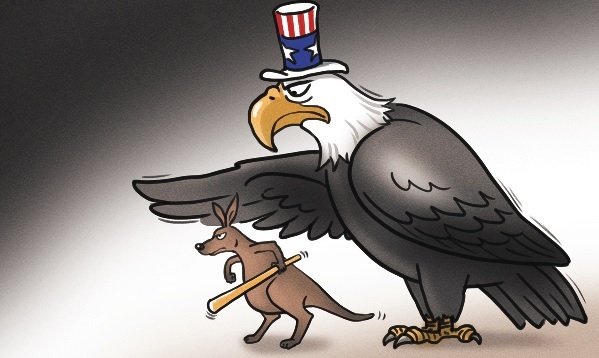
If a date might be found when Australian sovereignty was extinguished by the emissaries of the US imperium, July 29, 2023 will be as good as any. Not that they aren’t other candidates, foremost among them being the announcement of the AUKUS agreement between Australia, UK and the US in September 2021. They all point to a surrender, a handing over, of a territory to another’s military and intelligence community, an abject, oily capitulation that would normally qualify as treasonous.
The treason becomes all the more indigestible for its inevitable result: Australian territory is being shaped, readied, and purposed for war under the auspices of closer defence ties with an old ally. The security rentiers, the servitors, the paid-up pundits all see this as a splendid thing. War, or at least its preparations, can offer wonderful returns.
The US Secretary of Defense, Lloyd Austin III, was particularly delighted, though watchful of his hosts. His remit was clear: detect any wobbliness, call out any indecision. But there was nothing to be worried about. His Australian hosts, for instance, proved accommodating and crawling.
Australian Defence Minister Richard Marles, for instance, standing alongside Austin, US Secretary of State Antony Blinken and Australian Foreign Minister, Penny Wong, declared that there was “a commitment to increase American force posture in respect of our northern bases, in respect to our maritime patrols and our reconnaissance aircraft; further force posture initiatives involving US Army watercraft; and in respect of logistics and stores, which have been very central to Exercise Talisman Sabre.” To the untutored eye, Marles might have simply been another Pentagon spokesman of middle-rank…………….
Australian real estate would be given over to greater “space cooperation”, alongside creating “a guided weapons and explosive ordnance enterprise in this country, and doing so in a way where we hope to see manufacturing of missiles commence in Australia in two years’ time as part of a collective industrial base between the two countries.” Chillingly, Marles went on to reiterate what has become something of a favourite in his middle-management lexicon. The efforts to fiddle the export-defense export control legislation by the Biden administration would create “a more seamless defence industrial base between our countries.” Seamless, here, is the thick nail in the coffin of sovereignty.
Moves are also underway to engage in redevelopment of bases in northern Australia, in anticipation of the increased, ongoing US military presence. The RAAF Base Tindal, located 320km south-east of Darwin in the Northern Territory, is the subject of considerable investment “to address functional deficiencies and capacity constraints in existing facilities and infrastructure.” The AUSMIN talks further revealed that scoping upgrades would take place at two new locations: RAAF Bases Scherger and RAAF Curtin.
Australia’s Defence Intelligence Organisation will also be colonised by what is being termed a “Combined Intelligence Centre – Australia” by 2024. This is purportedly intended to “enhance long-standing intelligence cooperation” while essentially subordinating Australian intelligence operations to their US overlords. Marles saw the arrangement as part of a drive towards “seamless” (that hideous word again) intelligence ties between Canberra and Washington. “This is a unit which is going to produce intelligence for both of our defence forces … and I think that’s important.”
……….. Under the Albanese government we have reverted completely to our worst selves on defence. We’re going to do almost nothing consequential over the next 10 years other than get the Americans to do more on our land.” ……… Australia might be at war with China under US-direction before a decade is up, vassalized warriors eager to kill and be killed. https://theaimn.com/the-day-australian-sovereignty-died/
Australia Agrees To Build US Missiles; US Dismisses Australian Concerns About Assange
The reason Blinken keeps repeating the word “risk” here is because the Pentagon already publicly acknowledged in 2013 that nobody was actually harmed by the 2010 Manning leaks that Assange is being charged with publishing, so all US officials can do is make the unfalsifiable assertion that they could have potentially been harmed had things happened completely differently in some hypothetical alternate timeline.
CAITLIN JOHNSTONE, JUL 30, 2023, https://www.caitlinjohnst.one/p/australia-agrees-to-build-us-missiles?utm_source=post-email-title&publication_id=82124&post_id=135542172&isFreemail=true&utm_medium=email
Two different news stories about US-Australian relations have broken at around the same time, and together they sum up the story of US-Australian relations as a whole. In one we learn that Australia has agreed to manufacture missiles for the United States, and in the other we learn that Washington has told Australia to go suck eggs about its concerns regarding the US persecution of Australian journalist Julian Assange.
The relationship between Australia and the United States is all the more clearly illustrated by the way they are being reported by Australia’s embarrassingly sycophantic mainstream press.
In a Sydney Morning Herald article published Friday titled “‘Hugely significant’: Australia to manufacture and export missiles to US,” the US-educated war propagandist Matthew Knott exuberantly reports on the latest development on Australia’s total absorption into the American war machine.
“Australia is set to begin manufacturing its own missiles within two years under an ambitious plan that will allow the country to supply guided weapons to the United States and possibly export them to other nations,” Knott reports,” adding that the “joint missile manufacturing effort is being driven by the war in Ukraine, which has highlighted a troubling lack of ammunition stocks in Western nations including the US.”
Knott — perhaps best-known for being publicly told to “hang your head in shame” and “drum yourself out of Australian journalism” by former prime minister Paul Keating over his virulent war propaganda on China — gushes enthusiastically about the wonderful opportunities this southward expansion of the military-industrial complex will offer Australians.
“As well as creating local jobs, a domestic missile manufacturing industry will make Australia less reliant on imports and provide a trusted additional source of munitions for the US,” Knott writes ecstatically in what has somehow been presented by The Sydney Morning Herald as a hard news story and not an opinion piece.
An article published the next day, also in The Sydney Morning Herald and also by Matthew Knott, is titled “Assange ‘endangered lives’: Top official urges Australia to understand US concerns”.
It’s not unusual to see this type of propagandistic headline designed to convey a specific message above Knott’s reporting on this subject; in 2019 he authored a piece which was given the bogus title “‘A monster not a journalist’: Mueller report shows Assange lied about Russian hacking”.
“The United States’ top foreign policy official has urged Australians to understand American concerns about Julian Assange’s publishing of leaked classified information, saying the WikiLeaks founder is alleged to have endangered lives and put US national security at risk,” Knott writes. “In the sharpest and most detailed remarks from a Biden administration official about the matter, US Secretary of State Antony Blinken said Assange had been involved in one of the largest breaches of classified information in American history and had been charged with serious criminal conduct in the US.”
Blinken’s remarks came during a press conference for the Australia–US Ministerial Consultations (AUSMIN) forum on Saturday, in response to a question asked by Knott himself.
Here are Blinken’s comments in full:
“Look, as a general matter policy, we don’t really comment on extradition matters, extradition proceedings. And so, I really would refer you to our Department of Justice for any questions about the status of the criminal case, whether it’s with regard to Mr Assange or the other person in question. And I really do understand and can certainly confirm what Penny said about the fact that this matter was raised with us as it has been in the past. And I understand the sensitivities, I understand the concerns and views of Australians. I think it’s very important that our friends here understand our concerns about this matter. And what our Department of Justice has already said repeatedly, publicly, is this, Mr Assange was charged with very serious criminal conduct in the United States in connection with his alleged role in one of the largest compromises of classified information in the history of our country. The actions that he is alleged to have committed risked very serious harm to our national security, to the benefit of our adversaries and put named human sources at grave risk, grave risk of physical harm, grave risk of detention. So, I say that only because, just as we understand sensitivities here, it’s important that our friends understand sensitivities in the United States.”
The reason Blinken keeps repeating the word “risk” here is because the Pentagon already publicly acknowledged in 2013 that nobody was actually harmed by the 2010 Manning leaks that Assange is being charged with publishing, so all US officials can do is make the unfalsifiable assertion that they could have potentially been harmed had things happened completely differently in some hypothetical alternate timeline.
In reality, Assange is being persecuted by the United States for no other reason than the crime of good journalism. His reporting exposed US war crimes, and the US wishes to set a legal precedent that allows for anyone who reveals such criminality to be imprisoned in the United States — not just the whistleblowers who bring forth that information, but publishers who circulate it. This is why even mainstream press outlets and human rights organizations unequivocally oppose his extradition; because it would be a devastating blow to worldwide press freedoms on what is arguably the single most important issue that journalists can possibly report on.
So here is Australia signing up to become the Pentagon’s weapons supplier to the south — on top of already functioning as a total US military/intelligence asset which is preparing to back Washington in a war with China, and on top of being so fully prostrated before the empire that we’re not even allowed to know if American nuclear weapons are in our own country — being publicly hand-waved away by Washington’s top diplomat for expressing concern about a historic legal case in which an Australian citizen is being persecuted by the world’s most powerful government for being a good journalist.
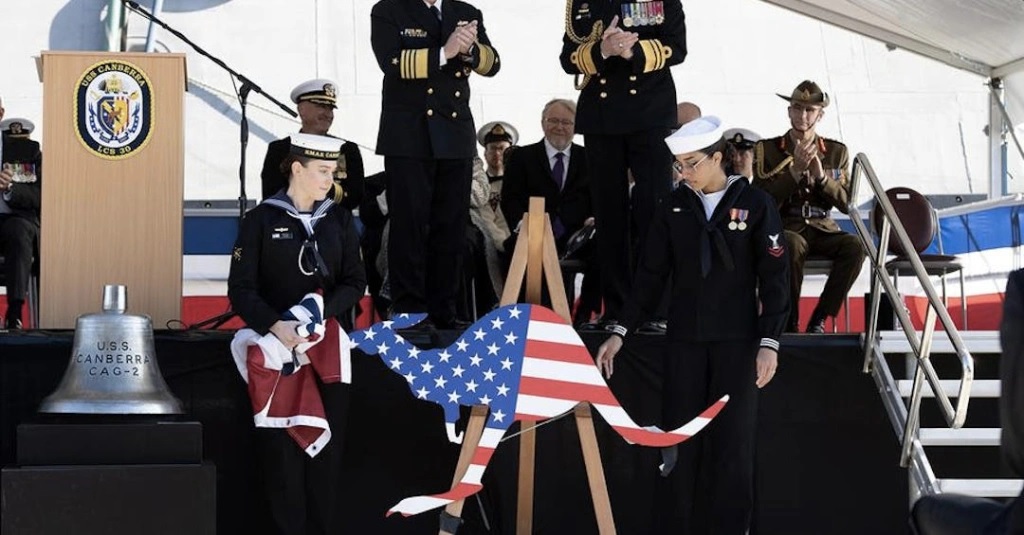
You could not ask for a clearer illustration of the so-called “alliance” between Australia and the United States. It’s easy to see that this is not an equal partnership between two sovereign nations, but a relationship of total domination and subservience. I was only half-joking when I wrote the other day that our national symbol should be the star-spangled kangaroo.
Australia is not a real country. It’s a US military base with marsupials.
Australian National Sovereignty and Economic Welfare in Peril? Feedback from the AUSMIN Meeting in Brisbane

Behind the scenes intrigues by defence chiefs and intel services through their media releases are a quite inadequate substitute for these democratic consultations.
Hopes of US co-operation in releasing Julian Assange who is languishing in Belmarsh Prison in London while awaiting extradition to the USA to face charges for breaches of the US Espionage Act were dashed at the recent AUSMIN Meeting.
July 30, 2023. by: The AIM Network, By Denis Bright
Decades ago – in 1951 – the ANZUS Pact promised ongoing consultations about strategic policies within the US Global Alliance. Now, from the elite surroundings of Queensland’s Government House in Brisbane, media statements from AUSMIN have taken everyone back to school days. Our elected leaders are now the principals in a frightening new age in which preparation for war is a key element in foreign and strategic policies (Joint Statement from AUSMIN 29 July 2023):
Minister for Foreign Affairs Penny Wong and Deputy Prime Minister and Minister for Defence Richard Marles hosted the U.S. Secretary of State Antony J. Blinken and Secretary of Defense Lloyd J. Austin III on 29 July in Brisbane to advance the Australia-U.S. Alliance and their cooperation in the Indo-Pacific and globally. Building on the high tempo of engagement between leaders and ministers, including the meeting between Prime Minister Albanese and President Biden in May 2023, the Ministers and Secretaries (the principals) determined that the Alliance has never been stronger. Based on a bond of shared values, it remains a partnership of strategic interest – premised on a common determination to preserve stability, prosperity, and peace.
For our visiting US Principals, it seems that peace will be delivered by exporting cluster bombs to extend the war in Europe.
National sovereignty is always imperiled by unnecessary secrecy like the Treaty of London (1915) which moved Italy from neutrality to becoming a participant in the Great War (1914-18) at the instigation of the British Government.
Extracts from the Treaty of London 1915
ARTICLE 2. On her part, Italy undertakes to use her entire resources for the purpose of waging war jointly with France, Great Britain, and Russia against all their enemies…………………………….
ARTICLE 16. The present arrangement shall be held secret.
It would have been better for Italy if a brave Julian Assange from the era told the Italian people about the secret strategic deals with Britain in 1915. Italy’s involvement in the Great War brought family tragedies, mass immigration, financial ruin and the rise of fascism in its wake.
The current militarization of the global economy by potential friend and foe alike will ultimately be ended by accidental conflict or economic recession from burnt out commitments and distortion of investment flows globally. Going too far by Australian leaders risks schism in the Labor Movement as in the Great War or tensions within the Labor Party during the Cold War in the 1950s and more recently when New Zealand withdrew from the ANZUS Pact over visits by naval vessels that were either nuclear powered or carrying nuclear weapons or both in the 1980s.
If there is a chink in the armour of public support for Australia’s defence commitments to the US Global Alliance, it lies in medium and long-term concerns about the costs of the AUKUS defence commitments which are apparent in the Lowy Institute’s 2023 Polling.
It would have been better for Italy if a brave Julian Assange from the era told the Italian people about the secret strategic deals with Britain in 1915. Italy’s involvement in the Great War brought family tragedies, mass immigration, financial ruin and the rise of fascism in its wake.
The current militarization of the global economy by potential friend and foe alike will ultimately be ended by accidental conflict or economic recession from burnt out commitments and distortion of investment flows globally. Going too far by Australian leaders risks schism in the Labor Movement as in the Great War or tensions within the Labor Party during the Cold War in the 1950s and more recently when New Zealand withdrew from the ANZUS Pact over visits by naval vessels that were either nuclear powered or carrying nuclear weapons or both in the 1980s.
If there is a chink in the armour of public support for Australia’s defence commitments to the US Global Alliance, it lies in medium and long-term concerns about the costs of the AUKUS defence commitments which are apparent in the Lowy Institute’s 2023 Polling.
The financial costs of the submarine deal is the real chink in favourable Australian public opinion towards more participation in the US Global Alliance.
Despite the outpouring of patriotic rhetoric at the launching event in Mobile, Alabama, Austal Limited Australia had not finalized its Australian taxation commitments from an annual revenue of $579.4 million in 2020-21 by 2 November 2022. The tax owing under review by the ATO was a paltry $28 million due to legalized tax minimization by the company’s accountants. Austal’s explanation of these processes is well covered in the 2022 Annual Report from Austal Australia which can easily be perused by interested readers.
Orders for AUKUS vessels and commitments to the QUAD Defence Arrangements will provide windfall revenue for the military and industrial complexes of Britain and the USA for a generation ahead until 2050. In the traditions of the original ANZUS Defence Alliance of 1951, our bipartisan strategic commitments were always consistent with adherence to the UN Charter and to open discussion of defence arrangements.
Behind the scenes intrigues by defence chiefs and intel services through their media releases are a quite inadequate substitute for these democratic consultations.
Hopes of US co-operation in releasing Julian Assange who is languishing in Belmarsh Prison in London while awaiting extradition to the USA to face charges for breaches of the US Espionage Act were dashed at the recent AUSMIN Meeting. Defence analyst Chelsea Manning who actually released the Pentagon documents to Julian Assange for publication had his charges commuted by President Obama in 2017.
These documents are largely in the public domain through sites like ChatGPT which can retrieve the gist of most items released but without adequate referencing by the AI robots at Opensystems in San Francisco. Readers can avail themselves of the resources of ChatGPT in the absence of full and frank media releases from Australian government strategic agencies.
Environmental risks of nuclear-powered ship visits to Australian ports also add to the policy dilemmas facing Australians.
It was the Morrison Government which welcomed the ageing French nuclear powered submarine to HMAS Sterling near Perth in late 2020 en route to naval manoeuvres near Guam and likely stealth operations in the South China Sea to test China’s maritime intelligence. Such manoeuvres in troubled waters are hazardous operations. This epic seven-month voyage to the Indo-Pacific Basin was well covered in this YouTube video.
The New York Times (31 March 1994) and other global media outlets of the nuclear accident involving the nuclear-powered submarine off Toulon. ChatGPT has a blind spot about the reporting of this incident from media monitoring:
Ten sailors died today in an accident aboard a French nuclear-propelled submarine that was taking part in naval exercises in the Mediterranean off Toulon, the Defense Ministry announced.
A ministry spokesman said that the Émeraude, a 2,400-ton Rubis-class attack submarine, did not carry nuclear missiles and that its 48-megawatt nuclear reactor was not damaged in the accident, which occurred when a burst pipe released high pressure steam into a turbine compartment.
“The steam is certainly not radioactive,” Rear Adm. Philippe Roy said at a news conference in the southern port city of Toulon this evening.
Hours after the accident, the navy recalled three other nuclear-propelled submarines — two from the Mediterranean and one from the Atlantic — pending an investigation. “We are recalling them because we are asking questions about what happened,” Admiral Roy said.
Since I covered this topic the WA State Police Minister’s Office has kindly provided details of protocols operating for the containment of accidents involving nuclear powered ship visits which possibly carry nuclear weapons under Don’t Ask Won’t Tell Protocols operating within the US Global Alliance……………………………………………………………………………….
Nuclear powered vessels from countries in the US Global Alliance have been visiting Australian ports since 1960. The details of these visits can be monitored on the web sites of the Australian Radiation Protection and Nuclear Safety Agency and the Departments of Defence itself in both Australian and the USA.
Specialist staff within DFAT will of course have access to some classified documents generated by the US Department of Defense and its related intel networks. To guard against the emergence of any new generation of Australians wishing to follow in the traditions of Chelsea Manning of Oklahoma, it is my understanding from personal communications from just one staff member on my reporting rounds for AIM Network that personal phones and communication systems are all monitored by local intel services and probably by overseas agencies as well.
Whilst ChatGPT is tightening up on the topics on which it is able to release information, it can still provide a wealth of anecdotal information to assist in the reporting of hearsay on strategic and intelligence matters. Reporters can work on this anecdotal information by perusing reliable documents in the public domain such as annual reports of companies within the global military industrial complexes.
Like the manufacturers of lethal weapons during the Great War, not all corporate data can be withheld from potential investors and curious members of the general public. Corporations here and overseas will make windfall profits from defence contracts. ChatGPT could offer these details of key defence companies operating in Australia:
- Thales Australia: Thales is a major defense contractor with operations in various sectors, including aerospace, defense, security, and transportation. They have a significant presence in Australia and are involved in projects such as armoured vehicles, naval systems, and communications.
- Austal: Austal is an Australian shipbuilding company known for designing and manufacturing high-speed aluminum vessels for defense and commercial purposes.
- BAE Systems Australia: BAE Systems is a global defense company with a significant presence in Australia, involved in areas such as maritime, aerospace, and land systems.
- Rheinmetall Defence Australia: Rheinmetall is a German defense company with operations in Australia, focusing on armored vehicles and defense technology.
- ASC (Australian Submarine Corporation): ASC is a government-owned company that specializes in submarine maintenance, sustainment, and upgrades.
US Companies operating in Australia who are likely to gain from international strategic tensions include:
- Lockheed Martin Australia: Lockheed Martin is a prominent U.S. defense contractor, and its Australian subsidiary, Lockheed Martin Australia, operates in the country. They are involved in various defense projects, including aerospace, cybersecurity, and naval systems.
- Boeing Defence Australia (BDA): Boeing, a major U.S. defense and aerospace company, has a subsidiary known as Boeing Defence Australia. BDA is actively engaged in providing defense products, services, and solutions in Australia, including aviation and intelligence systems.
- Northrop Grumman Australia: Northrop Grumman, another U.S. defense company, has a presence in Australia through its subsidiary Northrop Grumman Australia. They focus on delivering advanced defense and security technologies and systems.
- General Dynamics Land Systems – Australia (GDLS-A): General Dynamics is a U.S. defense contractor, and its Australian subsidiary GDLS-A is involved in the design, engineering, and support of military land systems.
- Raytheon Australia: Raytheon, a major U.S. defense and technology company, has a presence in Australia through its subsidiary Raytheon Australia. They are active in areas such as defense systems, cybersecurity, and intelligence.
Inquisitive readers can easily check which prominent Australian family is a big shareholder in Austal Limited which manufactured the USS Canberra in Mobile, Alabama prior to its commissioning in Sydney on 22 July 2023. With so many millions to spare, this family is a prominent investor in the Ukrainian Development Fund with just a small holding of US $500 million.
More than a century ago during the Great War (1914-18) peace initiatives were by-passed because both sides of the conflict in Europe hope for strategic advantages from continuing the fighting. These peace initiatives involved the Vatican under Pope Benedict XV and ultimately diplomatic engagement between the warring parties in 1916-17.
More than a century later, Pope Francis has authorized his peace envoy in Cardinal Matteo Zuppi of Bologna to visit Washington, Kiev, Moscow and Beijing to sound out the possibilities for an end to the current conflicts with colleagues from the Vatican secretariat of state. As in the Great War, initial efforts are on behalf of the civilian victims of warfare. These efforts became mainstream in the Great War as noted by Philip Zelikow in his book for the US Woodrow Wilson Institute.
he Road Less Travelled: The Secret Battle to End the Great War, 1916-1917
For more than five months, from August 1916 to the end of January 1917, leaders from the United States, Britain, and Germany held secret peace negotiations in an attempt to end the Great War. They did so far out of public sight – one reason why their effort, which came astonishingly close to ending the war and saving millions of lives, is little understood today. In The Road Less Travelled.
As Australia is not a current non-permanent member of the UN Security Council, our immediate efforts for some token welfare support for the victims of war can be made through the efforts of NZ’s UN Ambassador Carolyn Schwalger (NZ Department of Foreign Affairs and Trade). NZ is still officially outside the US Global Alliance but is kept well in the loop by the Australian Government.
Supporting governments which are involved in the use of cluster bombs to counter Russian aggression against Ukraine is dramatically at odds with the values of the broader Labor Movement and this opposition should be taken up by delegates from the progressive wings of the Labor Party within the National Conference. Supporters of lobbyists from the commercial military industrial complexes across the US Global Alliance have no affinity with Labor Values and should be exposed by committed delegates who believe in peace and disarmament.
https://theaimn.com/australian-national-sovereignty-and-economic-welfare-in-peril-feedback-from-the-ausmin-meeting-in-brisbane/more https://theaimn.com/australian-national-sovereignty-and-economic-welfare-in-peril-feedback-from-the-ausmin-meeting-in-brisbane/
1 This month

of the week – Australians for War Powers Reform (AWPR)
To see nuclear-related stories in greater depth and intensity
 Antinuclear