Shock Jock Alan Jones takes time off insulting women, to praise thorium nuclear power
Thorium ‘more environmentally friendly and safer’ than nuclear https://www.news.com.au/video/id-5348771529001-6074698767001/thorium-more-environmentally-friendly-and-safer-than-nuclear August 20th 2019
Sky News host Alan Jones explains the element thorium, which is “seen by many as more environmentally friendly” than nuclear as an energy source. Mr Jones said thorium-based reactors are safer too because the reaction can easily be stopped and produce less waste that is radioactive. “It’s three times as abundant as uranium, we’re told, and there’s enough thorium in the United States alone to power America at its current energy level for a thousand years,” he said. The broadcaster noted that rolling blackouts for smelters and manufacturers has created a “crisis” for the energy market and suggested thorium as a possible answer.
Australia’s Deputy Prime Minister Michael McCormack is an international embarrassment
Key points:
- Pacific countries want Australia to do more about climate change as they face rising sea levels
- Nationals leader Michael McCormack said last week they would survive because they “pick our fruit”
- He has has offered an apology for the comment “if any insult was taken”
Mr McCormack made the comments last Friday as he sought to dismiss criticism levelled at Prime Minister Scott Morrison following the Pacific Islands Forum (PIF), at which leaders claimed Australia was ignoring the threat climate change posed to the survival of vulnerable low-lying island nations.
[I] get a little bit annoyed when we have people in those sorts of countries pointing the finger at Australia and say we should be shutting down all our resources sector so that they will continue to survive,” he said.
“They will continue to survive, there’s no question they will continue to survive, and they will continue to survive with large aid assistance from Australia.
“They will continue to survive because many of their workers come here and pick our fruit.”
On Thursday he apologised…….
‘Appropriate from a drunk in a bar, not from a leader’
The PIF meeting in Tuvalu saw Mr Morrison pressure fellow leaders to water down the PIF’s final declaration, removing references to cutting carbon emissions by phasing out coal.
Former president of Kiribati Anote Tong said he could not understand how Mr McCormack thought it was a smart comment to make.
“If you’re drunk, and in a bar, it would be an appropriate place and time to make the comment. But if you’re speaking as a leader, really it is not appropriate,” he said.
Tuvalu Prime Minister Enele Sopoaga, who hosted the Pacific Islands Forum, said the comments made Pacific Islanders sound like “paupers” who were begging for Australian support. https://www.abc.net.au/news/2019-08-22/mccormack-apology-pick-our-fruit/11438312
Bass Coast Shire Council declares Climate Emergency
 Climate change is an emergency, Mirage News, 23 Aug 19
Bass Coast Shire Councillors have resolved that climate change poses a serious threat and should be treated as an emergency.
A motion was carried at last Wednesday’s Ordinary Council Meeting and will see Council develop a Bass Coast Climate Change Action Plan 2020-30, to set out how Bass Coast Shire can more effectively contribute to climate change mitigation and be more resilient and well adapted to the effects of a changing climate.
It will also include a target of zero net emissions by 2030 across Council operations as well as the wider community.
Bass Coast Mayor, Cr Brett Tessari, said while Council’s Natural Environment Strategy, adopted in 2016, recognises climate change, this declaration goes one step further….. https://www.miragenews.com/climate-change-is-an-emergency/
Nuclear submissions: people are “doubling up”? Sending the same submissions to 2 different Inquiries
 Well – I am not able to read any submissions to FEDERAL. Inquiry into the prerequisites for nuclear energy in Australia . But I have read all the 11 submissions so far published to New South Wales Inquiry into Uranium Mining and Nuclear Facilities (Prohibitions) Repeal Bill 2019. https://www.parliament.nsw.gov.au/committees/inquiries/Pages/inquiry-details.aspx?pk=2525&fbclid=IwAR2JjKI28uB4TZIJ38uZRlnQTmCQ3e7QyXk0 . They mostly pretty much read as if they were about setting up nuclear power in Austra ply using the same story to send to the Federal Inquiry. So there’s a hint – a way to save time?
Another hint – some writers are using some or all of their own previous submissions to the 2016 South Australian Nuclear Fuel Cycle Royal Commission.
In the next days and weeks Antinuclear. net will analyse submissions, as they appear on government websites.
About the CURRENT NUCLEAR SUBMISSIONS
 It’s hard to grasp it all, with 4 nuclear Parliamentary submissions going on at the same time, and with short deadlines.
I am attempting to make sense of it all, starting with the Federal one FEDERAL. Inquiry into the prerequisites for nuclear energy in Australia (Submissions close 16 September 2019 https://www.aph.gov.au/Parliamentary_Business/Committees/House/Environment_and_Energy/Nuclearenergy?fbclid=IwAR0Sw4LB2qdcxSI6U6l67lI7Mwz9IEWw7_0RIq3mtN-nfpkfBn4z2VkQGog
A submission can be sent in hard copy by post, or online. It’s quite a performance to send a submission online, but well worth doing. One can refer to any or all of the Terms of Reference.
a. waste management, transport and storage,
b. health and safety,
c. environmental impacts,
d. energy affordability and reliability,
e. economic feasibility,
f. community engagement,
g. workforce capability,
h. security implications,
i. national consensus, and
j. any other relevant matter
Best to write your own submission, but there is also the option of using Friends of the Earth’s pro forma submission.
The Committee of Inquiry may publish submissions, but people (and nuclear companies) can ask for their submissions to be confidential.
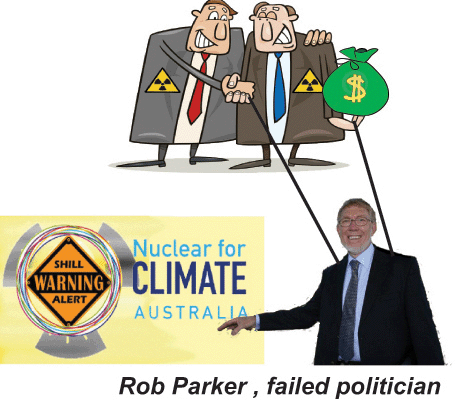
Reaction against Robert Parker’s nuclear reactor plan for Ipswich, Queensland
|
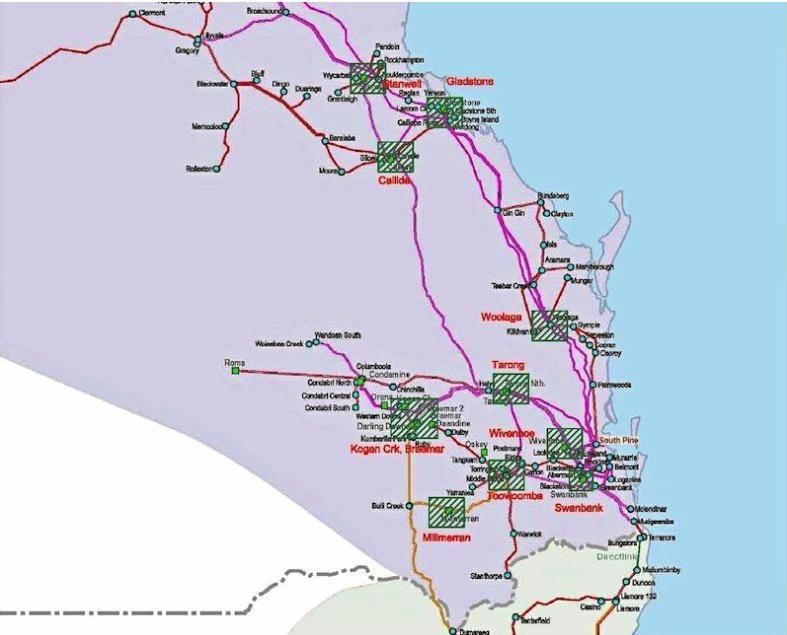
Nuclear for Ipswich to combat growing carbon emissions, Navarone Farrell, Queensland Times, August 21, 2019 SWANBANK is one of 10 sites in Queensland touted for a nuclear power station after talks at a lobby group summit.
Ipswich Residents Against Toxic Environments president Jim Dodrill said moving towards nuclear energy based on the premise of carbon footprint reduction “was nonsense”. “We’re absolutely opposed to (nuclear). It doesn’t make any sense economically, it doesn’t make any sense environmentally and it certainly doesn’t make any sense in the long term in regards to the waste from that form of power generation,” he said. “People do try to confuse the issue in relation to (nuclear’s) carbon footprint. The carbon footprint of nuclear is very, very high – not in the direct generation of power, but in the indirect. “You’re talking about moving the fuel over great distances, you’re talking about a lot of storage and the logistics of the fuel and the waste and the set up of that kind of generator. “It would be, in the long-term, no better than burning coal.” Mr Dodrill said moving towards another form of non-renewable energy would be a step backwards and that the rest of the world has moved on from nuclear. “It would make no sense for somewhere like Ipswich – or any city anywhere in Australia – to move into a type of power generation that’s (becoming defunct),” he said. “It’s nonsense altogether… (this agenda) is obviously being pushed by a particular sector of the far right in Australian politics.” Bundamba Labor MP Jo-Ann Miller, a fierce opponent of any more “stinks and smells” energy in Ipswich, ridiculed the idea. “Australia cannot even work out what it needs to do in relation to the nuclear plant in Sydney,” she said. “It’s certainly is at no stage of looking at nuclear-based power. Our city for many, many years has been a nuclear-free zone and that’s the way it should stay. “We do not want incinerators and we do not want nuclear power plants in our back yards, it’s a no-go.”… “How dare they consider Swanbank and my electorate without even having a conversation with the local people, and I can assure them that our locals would be very much against it,” she said. https://www.weeklytimesnow.com.au/news/regional/nuclear-for-ipswich-to-combat-growing-carbon-emissions/news-story/61af3052d10672573bb761eed16af606 |
|
|
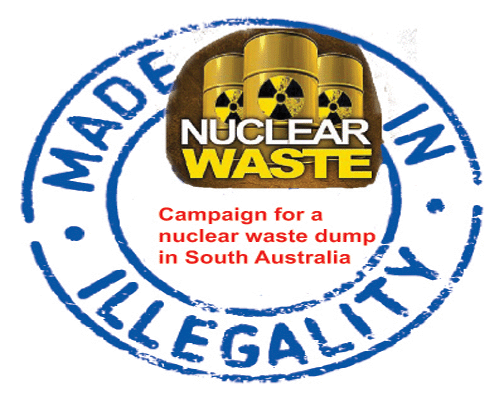
South Australian law – no public money towards nuclear waste dumping facility
NUCLEAR WASTE STORAGE FACILITY (PROHIBITION) ACT 2000 – SECT 13
13—No public money to be used to encourage or finance construction or operation of nuclear waste storage facility
(1) Despite any other Act or law to the contrary, no public money may be appropriated, expended or advanced to any person for the purpose of encouraging or financing any activity associated with the construction or operation of a nuclear waste storage facility in this State.
(2) Subsection (1) does not prohibit the appropriation, expenditure or advancement to a person of public money for the purpose of financing the maintenance or sharing of information or to enable the State to engage with other jurisdictions.
The Kimba nuclear waste dump ballot – breaching South Australian law?
ENuFF[SA], 21 Aug 19, Today Kimba Council announced a date for a community ballot on the radioactive suppository ~ October 3rd.
http://www.kimba.sa.gov.au/page.aspx?u=408&c=10102
The legality of conducting such a ballot needs to be tested in the courts, since s.13 of the Radioactive Waste Storage Facility (Prohibition) Act SA 2000 prohibits public monies being spent “…. encouraging or financing any activity associated with the construction or operation of a nuclear waste storage facility in this State.”
http://classic.austlii.edu.au/au/legis/sa/consol_act/nwsfa2000430/s13.html
This concerns & will affect ALL South Australians, not just Kimba. We should start a fund for a court injunction based upon s.13 “… any activity …” of the Radioactive Waste Facility [Prohibition] Act ~ & then engage Maurice Blackburn Lawyers [eg] to mount a case against the ballot.
Council announces dates for Kimba radioactive waste ballot
 Council announces dates for Kimba radioactive waste ballot, Kimba District Council, 21 Aug 19, The Kimba community will have its say on the of the Commonwealth Government’s proposed National Radioactive Waste Management Facility at one of two nominated sites in the district from October 3.
The District Council of Kimba today announced the dates for the long-awaited ballot, which has been delayed for more than 12 months due to litigation.
While the favourable judgment received by Council in the Federal Court of Australia on 12 July has been appealed, Mayor Dean Johnson said that there was no legal impediment to the ballot proceeding to determine the level of community support as part of the overall site selection process.
“Council’s position has always been to facilitate the ballot on behalf of the Minister for Resources and Northern Australia so our community could have its voice heard, and we reaffirmed that position at our ordinary meeting last week,” he explained.
“We were advised this morning that the Minister no longer requests that the Kimba and Hawker ballots to be run concurrently, so Council has commenced planning with a view to ballot papers being posted out on 3 October.”
The ballot will be run in a manner identical to that scheduled to be held in 2018, and applications from eligible ratepayers and residents for inclusion on the voters roll will be open for a period of three weeks from 23 August 2019 until midday on 13 September 2019…..http://www.kimba.sa.gov.au/page.aspx?u=408&c=10102&fbclid=IwAR1y2ZfiGYV6gFpnvtTkWYWNs1_LcelO3cQ1iLG3RaC22tVRoHy0NHQ2igg
Secrecy in Sinister Matt Canavan’s meeting with nuclear waste dump organisations in Hawker, South Australia
|
Last week the Barndioota Consultative Committee (BCC) held its first meeting in over a year since the process was stalled by a federal court injunction lodged by the Barngarla Determination Aboriginal Corporation. The scheduled meeting had preemptively caused a stir when a new code conduct restricted observers from note taking or recording the meeting without prior agreement from the department, independent convener and all representative members of the committee.
The issue was resolved and protocol was amended to allow note-taking, provided privacy of the speaker was respected. However a closed meeting scheduled between the Minister for Resources Matt Canavan, the Economic Working Group and the BCC has reignited accusations of secrecy.
Mr Canavan is scheduled to meet with the groups behind closed doors during a visit to Hawker this week, before opening the session up to the public…… https://www.transcontinental.com.au/story/6335519/community-tensions-simmer-over-waste-dump-closed-meeting-plans/?fbclid=IwAR0c6Dzo8ZuCMX78A29wUaFmSvsigcZR8AViGXSBE0ykoru3YU4WkEofEnM |
|

Some caustic comments on Minister Canavan’s closed nuclear waste dump meeting in Hawker S.A.
These comments refer to both the article above and to the one discussed at https://antinuclear.net/2019/08/17/nuclear-waste-kimba-committee-even-discussed-transitioning-out-of-the-site-selection-process/

Raised eyebrows amongst anti-nuclear campaigners ….only? How about maybe the rest of the communities as well??
Also, last time I looked Kimba and Hawker were not islands!! Nope – they are DEFINITELY part of South Australia too!!! And ALL of South Australia will be affected by this National Nuclear Dump!
This is MEANT TO BE “AN OPEN AND TRANSPARENT PROCESS” so we have been told….When will we HAVE THAT???
Shan’t hold my breath!!…….DISGRACEFUL!!
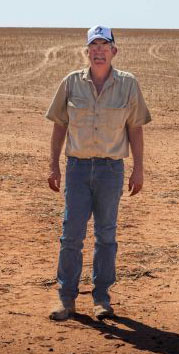 Noel Wauchope Jeff Baldock’s Kimba property is allegedly the frontrunner for a future nuclear waste dump. No wonder this man is prominent at this meeting, happy with the progress and his financial prospects. Better than farming, hey?
Doug Potts The man who offered land owns both sites. I’m not sure if it’s free hold or lease. But why are they pushing, showing, brainwashing for these site especially when one is in a known sciesmic active area with floods as well. Also a West Australian site has said yes we would like this no interest is shown. Sadly the whole thing stinks like yesterday’s nappies!
Sinister for Resources, Matt Canavan, avoids Quorn community in his nuclear waste dump promotion visit
 Katrina Bohr, no nuclear waste dump anywhere in south australia, 20 Aug 19,
Have heard it through the Grapevine, we are expecting theMinister’s presence. Hawker and Kimba, the apple of his eye. Quorn has a voting population far greater than Hawker, yet we are overlooked. A 30 min. meeting on Wednesday at 12:30 with the Flinders Ranges Council in Quorn, is the limit of the Minister’s ‘time’ here. https://www.facebook.com/groups/941313402573199/
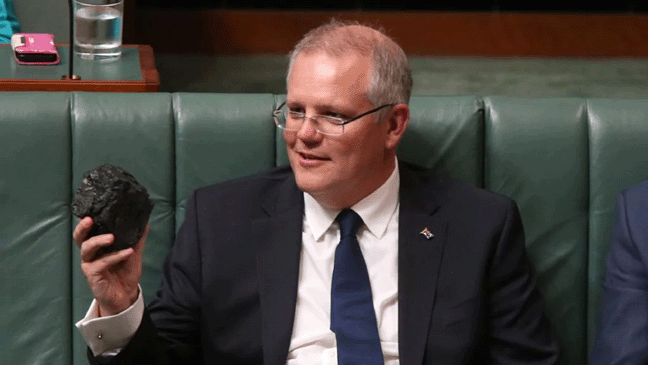
Australia losing credibility with Pacific nations, as Morrison supports coal, not climate action
|
Australia’s climate change stance damaging relationship with Pacific islands, former Kiribati president warns, ABC News, By political reporter Matthew Doran , 19 Aug 19. Pacific nations may view Australia as the “worst of two evils” when compared to China, after it undermined a deal on climate change, according to the former president of one of the region’s smallest nations.
Key points:
Prime Minister Scott Morrison and the Coalition have been broadly criticised for forcing leaders at last week’s Pacific Islands Forum (PIF) in Tuvalu to water down language on cutting carbon emissions and phasing out the use of coal. China’s rising influence in the Pacific is of concern to Australia, which has “stepped up” its presence in the region through aid and development funding. But Anote Tong, who from 2003 to 2016 served as president of Kiribati — a series of islands atolls in the Pacific which is home to more than 100,000 people — said the renewed interest from Canberra could be dismissed, as island nations expressed their disgust at the nation’s lack of leadership on climate change. “It’s really about the lesser of the two evils, I guess,” he told RN Breakfast…. https://www.abc.net.au/news/2019-08-19/australia-climate-change-inaction-damaging-pacific-relationship/11426390 |
|
Climate change is altering ocean waves, as well as causing sea level rise

|
Climate change may change the way ocean waves impact 50% of the world’s coastlines The Conversation, Principal Research Scientist, Oceans and Atmosphere, CSIRO, Kernot Professor of Engineering, University of Melbourne, PhD Candidate, Griffith University, Professor, Kyoto University, August 20, 2019 The rise in sea levels is not the only way climate change will affect the coasts. Our research, published today in Nature Climate Change, found a warming planet will also alter ocean waves along more than 50% of the world’s coastlines.
If the climate warms by more than 2℃ beyond pre-industrial levels, southern Australia is likely to see longer, more southerly waves that could alter the stability of the coastline. Scientists look at the way waves have shaped our coasts – forming beaches, spits, lagoons and sea caves – to work out how the coast looked in the past. This is our guide to understanding past sea levels. But often this research assumes that while sea levels might change, wave conditions have stayed the same. This same assumption is used when considering how climate change will influence future coastlines – future sea-level rise is considered, but the effect of future change on waves, which shape the coastline, is overlooked. Changing wavesWaves are generated by surface winds. Our changing climate will drive changes in wind patterns around the globe (and in turn alter rain patterns, for example by changing El Niño and La Niña patterns). Similarly, these changes in winds will alter global ocean wave conditions. Further to these “weather-driven” changes in waves, sea level rise can change how waves travel from deep to shallow water, as can other changes in coastal depths, such as affected reef systems. Recent research analysed 33 years of wind and wave records from satellite measurements, and found average wind speeds have risen by 1.5 metres per second, and wave heights are up by 30cm – an 8% and 5% increase, respectively, over this relatively short historical record. These changes were most pronounced in the Southern Ocean, which is important as waves generated in the Southern Ocean travel into all ocean basins as long swells, as far north as the latitude of San Francisco. Sea level rise is only half the story.…. https://theconversation.com/climate-change-may-change-the-way-ocean-waves-impact-50-of-the-worlds-coastlines-121239 |
DELAY is the most salient reason why Small Modular Nuclear Reactors can’t work in Australia
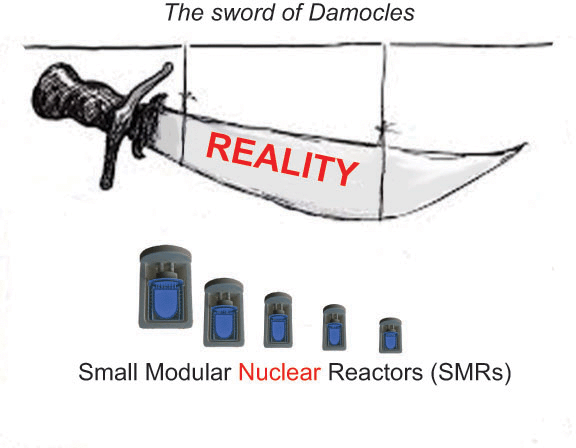
7 reasons why Small Modular Nuclear Reactors are a bad idea for Australia, more https://independentaustralia.net/environment/environment-display/seven-reasons-why-small-modular-nuclear-reactors-are-a-bad-idea-for-australia,13010
International news reports that, in a failed missile test in Russia, a small nuclear reactor blew up, killing five nuclear scientists, and releasing a radiation spike.
In Australian news, with considerably less media coverage, Parliament announced an Inquiry into nuclear energy for Australia, with an emphasis on Small Modular Reactors (SMRs). Submissions are due by September 16.
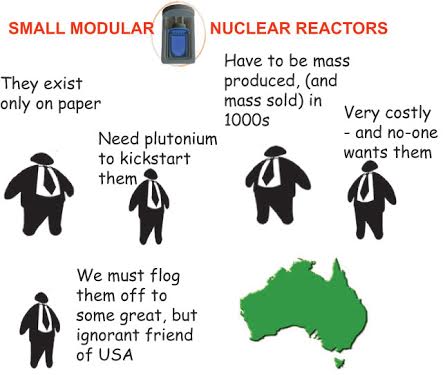 A bit of background. The U.S. government and the U.S. nuclear industry are very keen to develop and export small modular nuclear reactors for two main reasons, both explained in the Proceedings of the National Academy of Sciences, 2018 Firstly, with the decline of large nuclear reactors, there is a need to maintain the technology and the expertise, trained staff, necessary to support the nuclear weapons industry. Secondly, the only hope for commercial viability of small nuclear reactors is in exporting them – the domestic market is too small. So – Australia is seen as a desirable market.
The USA motivation for exporting these so far non-existent prefabricated reactors is clear. The motivation of their Australian promoters is not so clear.
These are the main reasons why it would be a bad idea for Australia to import small modular nuclear reactors.
-
 COST.Researchers from Carnegie Mellon University’s Department of Engineering and Public Policy concluded that the SMR industry would not be viable unless the industry received “several hundred billion dollars of direct and indirect subsidies” over the next several decades. For a company to invest in a factory to manufacture reactors, they’d need to be sure of a real market for them – Australia would have to commit to a strong investment up front.
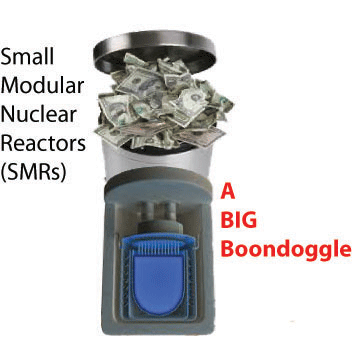
The diseconomics of scale make SMRs more expensive than large reactors. A 250 MW SMR will generate 25 percent as much power as a 1,000 MW reactor, but it will require more than 25 percent of the material inputs and staffing, and a number of other costs including waste management and decommissioning will be proportionally higher.
A study by WSP / Parsons Brinckerhoff, commissioned by the 2015/16 South Australian Nuclear Fuel Cycle Royal Commission, estimated costs of A$180‒184/MWh (US$127‒130) for large pressurised water reactors and boiling water reactors, compared to A$198‒225 (US$140‒159) for SMRs.
To have any hope of being economically viable, SMRs would have to be mass produced and deployed, and here is a “Catch-22″ problem The economics of mass production of SMRs cannot be proven until hundreds of units are in operation. But that can’t happen unless there are hundreds of orders, and there will be few takers unless the price can be brought down. Huge government subsidy is therefore required
-
 Safety problems. Small nuclear reactors still have the same kinds of safety needsas large ones have. The heat generated by the reactor core must be removed both under normal and accident conditions, to keep the fuel from overheating, becoming damaged, and releasing radioactivity. The passive natural circulation coolingcould be effective under many conditions, but not under all accident conditions. For instance, for the NuScale design a large earthquake could send concrete debris into the pool, obstructing circulation of water or air. Where there are a number of units, accidents affecting more than one small unit may cause complications that could overwhelm the capacity to cope with multiple failures.

Because SMRs have weaker containment systems than current reactors, there would be greater damage if a hydrogen explosion occurred. A secondary containment structure would prevent large-scale releases of radioactivity in case of a severe accident. But that would make individual SMR units unaffordable. The result? Companies like NuScale now move to projects called “Medium” nuclear reactors – with 12 units under a single containment structure. Not really small anymore.
Underground siting is touted as a safety solution, to avoid aircraft attacks and earthquakes. But that increases the risks from flooding. In the event of an accident emergency crews could have greater difficulty accessing underground reactors.
 Security
Proponents of SMRs argue that they can be deployed safely both as a fleet of units close to cities, or as individual units in remote locations. In all cases, they’d have to operate under a global regulatory framework, which is going to mean expensive security arrangements and a level of security staffing. ‘Economies of scale’ don’t necessarily work, when it comes to staffing small reactors. SMRs will, anyway, need a larger number of workers to generate a kilowatt of electricity than large reactors need. In the case of security staffing, this becomes important both in a densely populated area, and in an isolated one.
-
 Weapons Proliferation.

The latest news on the Russian explosion is a dramatic illustration of the connection between SMRs and weapons development.
But not such a surprise. SMRs have always had this connection, beginning in the nuclear weapons industry, in powering U.S. nuclear submarines. They were used in UK to produce plutonium for nuclear weapons. Today, the U.S. Department of Energy plans to use SMRs as part of “dual use” facilities, civilian and military. SMRs contain radioactive materials, produce radioactive wastes – could be taken, used part of the production of a “dirty bomb” The Pentagon’s Project Dilithium’s small reactors may run on Highly Enriched Uranium (HEU) , nuclear weapons fuel – increasing these risks.
It is now openly recognised that the nuclear weapons industry needs the technology development and the skilled staff that are provided by the “peaceful” nuclear industry. The connection is real, but it’s blurred. The nuclear industry needs the “respectability” that is conferred by new nuclear, with its claims of “safe, clean, climate-solving” energy.
- Wastes.
 SMRs are designed to produce less radioactive trash than current reactors. But they still produce long-lasting nuclear wastes, and in fact, for SMRs this is an even more complex problem. Australia already has the problem of spent nuclear fuel waste, accumulating in one place – from the nuclear reactor at Lucas Heights. With SMRs adopted, the waste would be located in many sites, with each location having the problem of transport to a disposal facility. Final decommissioning of all these reactors would compound this problem. In the case of underground reactors, there’d be further difficulties with waste retrieval, and site rehabilitation.
6. Location.
I have touched on this, in the paragraphs on safety, security, and waste problems. The nuclear enthusiasts are excited about the prospects for small reactors in remote places. After all, aren’t some isolated communities already having success with small, distributed solar and wind energy? It all sounds great. But it isn’t.
With Australia’s great distances, it would be difficult to monitor and ensure the security of such a potentially dangerous system, of many small reactors scattered about on this continent. Nuclear is an industry that is already struggling to attract qualified staff, with a large percentage of skilled workers nearing retirement. The logistics of operating these reactors, meeting regulatory and inspection requirements, maintaining security staff would make the whole thing not just prohibitively expensive, but completely impractical.
- Delay.
For Australia, this has to be the most salient point of all. Economist John Quiggin has pointed out that Australia’s nuclear fans are enthusing about small modular nuclear reactors, but with no clarity on which, of the many types now designed, would be right for Australia. NuScale’s model, funded by the U.S. government, is the only one at present with commercial prospects, so Quiggin has examined its history of delays. But Quiggin found that NuScale is not actually going to build the factory: it is going to assemble the reactor parts, these having been made by another firm, – and which firm is not clear. Quiggin concludes:
Australia’s proposed nuclear strategy rests on a non-existent plant to be manufactured by a company that apparently knows nothing about it.
As there’s no market for small nuclear reactors, companies have not invested much money to commercialise them. Westinghouse Electric Company tried for years to get government funding for its SMR plan, then gave up, and switched to other projects. Danny Roderick, then president and CEO of Westinghouse, announced:
The problem I have with SMRs is not the technology, it’s not the deployment ‒ it’s that there’s no customers. … The worst thing to do is get ahead of the market.
Russia’s programme has been delayed by more than a decade and the estimated costs have ballooned.
South Korea decided on SMRs, but then pulled out, presumably for economic reasons.
China is building one demonstration SMR, but has dropped plans to build 18 more, due to diseconomics of the scheme.
There’s a lot of chatter in the international media, about all the countries that are interested, or even have signed memoranda of understanding about buying SMRs, but still with no plans for actual purchase or construction.
Is Australia going to be the guinea pig for NuScale’s Small and Medium Reactor scheme? If so,when? The hurdles to overcome would be mind-boggling. The start would have to be the repeal of Australia’s laws – the Environment Protection and Biodiversity Conservation (EPBC) Act 1999 Section 140A and Australian Radiation Protection and Nuclear Safety Act 1998. Then comes the overcoming of States’ laws, much political argy-bargy, working out regulatory frameworks, import and transport of nuclear materials, – finding locations for siting reactors, – Aboriginal issues-community consent, waste locations. And what would it all cost?
And, in the meantime, energy efficiency developments, renewable energy progress, storage systems – will keep happening, getting cheaper, and making nuclear power obsolete.
1 This month


Help Aunty Sue Protect Her Land and Sacred Sites From Destructive Rocket Testing.
.

Australians deserve the truth
about
AUKUS – https://aukuspublicinquiry.com/

PETITION – To: Prime Minister Anthony Albanese and the Australian Labor Government

of the week – Australians for War Powers Reform (AWPR)
To see nuclear-related stories in greater depth and intensity

