They’ve also gone quiet on the prospect of more advanced “Generation IV” reactors. Again that’s unsurprising. Most of the leading research projects in this field have been
abandoned or
deferred past 2030, even for prototypes.
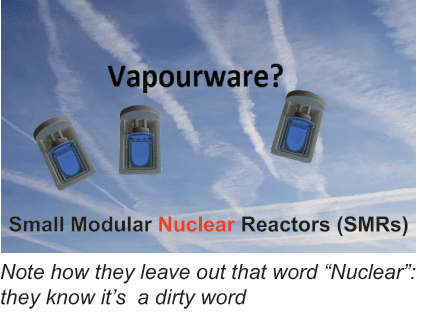
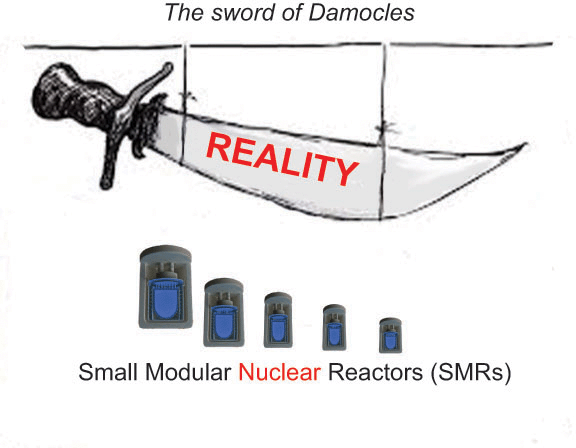
The great hope now is for Small Modular Reactors, which will, it is hoped, be assembled on site from parts built in factories. The idea is that the savings in construction will offset the loss of the scale economies inherent in having a larger reactor (arising ultimately from the fact that the volume of a sphere grows faster than its surface area).
Lots of SMR ideas have been proposed, but the only one with any serious prospect of entering commercial use is that proposed by NuScale, with funding from the US Department of Energy. NuScale has recently claimed that it should have its first reactor (consisting of 12 modules) in operation by 2027.
A couple of observations on this. First, when the project was funded back in 2014
the proposed start date was 2023. So, in the course of five years, the target time to completion has been reduced from nine years to eight. That suggests the 2027 target is pretty optimistic.
Second, NuScale isn’t actually going to build the factory that is the key selling point of the SMR idea. The press release says that the parts will be made by BWX, formerly Babcock and Wilcox (who abandoned their own SMR proposal around the time NuScale got funded).
So, is BWX going to build a factory, or is this going to be a bespoke job using existing plants (presumably much more expensive). I went to their website to find out. But far from getting a clear answer, I could find no mention at all of a deal with NuScale, or of any recent activity around SMRs.
So, there you have it. Australia’s proposed nuclear strategy rests on a non-existent plant to be manufactured by a company that apparently knows nothing about it.
August 10, 2019
Posted by Christina Macpherson |
AUSTRALIA - NATIONAL, spinbuster, technology |
Leave a comment
 Ruth Tulloch Fight To Stop Nuclear Waste In The Flinders Ranges, 10 Aug 19 These committees were originally set up as a way of “consulting with the community”. They haven’t been allowed to discuss much (if any thing) with the community and any one who wants to go and sit in on a meeting has to ‘ask’ (beg, be vetted) for an invite. These are supposed to be public meetings and as such should be run like a public meeting ie. local council….where any one is entitled to go and sit in at any time. https://www.facebook.com/groups/941313402573199/
August 10, 2019
Posted by Christina Macpherson |
AUSTRALIA - NATIONAL, Federal nuclear waste dump |
Leave a comment
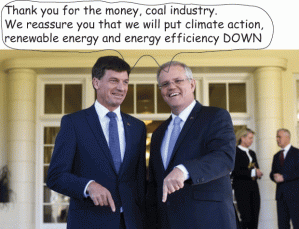 Australian government brushes off UN’s urgent climate warning, SBS News 9 Aug 19 Humanity faces increasingly painful trade-offs between food security and rising temperatures within decades unless emissions are curbed and unsustainable farming and deforestation halted, according to a landmark climate assessment.
The federal emissions reduction minister has defended Australia’s land management practices after a new United Nations climate change report called for changes in the way the world produces and consumes food.
The UN’s Intergovernmental Panel on Climate Change warned efforts to limit global warming while feeding a booming population could be wrecked without swift and sweeping changes to how we use the land we live off.
The report on land use and climate change highlighted the need to protect remaining tropical forests as a bulkhead against future warming. It offered a sobering take on the hope that reforestation and bio-fuel schemes alone can offset mankind’s environmental damage, underlining that reducing emissions will be central to averting disaster.
“Land is a source of emissions as well as a sink,” IPCC chair Hoesung Lee told AFP.
“Obviously you want to reduce emissions from land as much as possible. But that has a lot to do with what’s happening to the other side of the equation: greenhouse gas emissions, mainly from the energy sector.”
But Emissions Reduction Minister Angus Taylor said Australia is already absorbing emissions from land management. “This is a very, very important success story in Australia. Farmers, in particular, haven’t been given the credit they deserve for the role, the enormous role, they’ve played on this front,” he told ABC News on Friday.
But the minister brushed off concerns about the role meat-heavy diets play in climate change, suggesting the report was “forcing” people to become vegan……..
Land is intimately linked to climate. With its forests, plants, and soil it sucks up and stores around one-third of all man-made emissions. Intensive exploitation of these resources also produces huge amounts of planet-warming CO2, methane and nitrous oxide, while agriculture guzzles up 70 percent of Earth’s freshwater supply.
National Farmers Federation president Fiona Simson said the food warning should send “a shiver down your spine”…….
As the global population balloons towards 10 billion by mid-century, how land is managed by governments, industry and farmers will play a key role in limiting or accelerating the worst excesses of climate change.
Farmers for Climate Action want the federal government to implement a national strategy on climate change and agriculture, and to speed up the transition to clean energy.
“With NSW marking one year since it was 100 per cent drought-declared … and farmers across the country hurting from droughts, heatwaves and other extreme weather events, it is clear that climate change is already hurting Australian agriculture,” the group said in a statement……https://www.sbs.com.au/news/australian-government-brushes-off-un-s-urgent-climate-warning
August 10, 2019
Posted by Christina Macpherson |
AUSTRALIA - NATIONAL, climate change - global warming, politics |
Leave a comment
 Nuclear waste: residents near proposed dump told to sign draconian code of conduct, https://www.theguardian.com/australia-news/2019/aug/08/nuclear-waste-residents-near-proposed-dump-told-to-sign-draconian-code-of-conduct?CMP=soc_567&fbclid=IwAR3a-X8NHLloKNUaCpkAblZb7yhKDmDkiIkFgP9cVGiv232hfZec0-w_Xfk
Code bans residents from taking notes or recording any part of meetings without prior agreement, Calla Wahlquist @callapilla 8 Aug 2019 Residents in small South Australian communities shortlisted for a proposed nuclear waste storage facility have been told if they want to attend community consultation meetings they have to sign a code of conduct that bans them from taking notes.
The shortlist for the proposed dump has been narrowed down to Lyndhurst or Napandee, in the Kimba shire area on the Eyre Peninsula, and Wallerberdina Station, which is near Barndioota in the southern Flinders Ranges.
If approved, it would be a permanent storage facility for low-level nuclear waste and provide temporary storage for intermediate level waste, including waste temporarily stored near the research reactor at Lucas Heights in Sydney.
The process has been stalled for more than 12 months because of a federal court challenge by Barngarla traditional owners, who hold native title over land adjacent to the two proposed Eyre Peninsula sites.
Barngarla Determination Aboriginal Corporation last month lost a federal court case arguing that a decision not to include native title holders in a local government poll gauging community support for the dump was in breach of the Racial Discrimination Act, but have appealed that decision to the full court.
A majority of Adnyamathanha traditional owners have also said they’re “totally opposed” to the facility being built at Barndioota.
Meetings of two local consultative committees, appointed by the federal industry department’s National Radioactive Waste Management Facility Taskforce (NRWMFT) as its main platform for ongoing community consultation, were put on hold while the court case was underway but have been scheduled to resume next week.
But locals have complained that a new code of conduct for people wishing to observe the Barndioota and Kimba consultative committee meetings is unnecessarily restrictive and makes it harder for the community to obtain up-to-date information and voice their concerns.
The code, seen by Guardian Australia, states that “observers” must be approved and cannot “take any notes, or record any part of the meeting … except with the prior agreement of the department, the independent convenor and all representative members of the committee”.
It also says they cannot “repeat or share the individual ideas or views of [committee] members,” and can’t repeat confidential information or try to interject in committee discussions.
“This agreement does not prevent you from discussing information shared during a BCC meeting unless it has been identified as confidential or sensitive,” it says. “The [convenor] may ask you to leave the meeting if you do not comply with this Code of Conduct.”
Farmer Dean Hooper, who has applied to attend the Barndioota meeting, said that restrictions on repeating confidential information and behaving respectfully were reasonable but other conditions placed on attending were “bullshit”.
“They are trying to keep it low and quiet and get this dump to happen as easily and quickly and quietly as possible,” he said.
Hooper opposes the dump and is a member of the Flinders local action group.
The NRWMFT said that the code of conduct concerned behavioural standards and that information in the meeting was not confidential, unless stated otherwise, and that the minutes of all meetings had been published online.
Committee members have also been restricted from discussing meetings with the media. Susan Andersson, a GP from Hawker who sits on the Bandioota committee, said the contract extension that committee members signed in March was “more restrictive” than the original contract and represented an apparent desire by the department to control public information.
NRWMFT general manager Sam Chard said the facility “will only proceed near a community that broadly supports it and which could provide an ongoing workforce”.
In a statement on Wednesday, she said that ballots of residents and ratepayers, like that attempted by Kimba before the federal court challenge, “remain one method that we intend to use to help inform if that necessary broad community support exists”.
People living outside the local government areas can make a submission.
August 8, 2019
Posted by Christina Macpherson |
AUSTRALIA - NATIONAL, civil liberties, Federal nuclear waste dump |
Leave a comment
 One month for nuclear inquiry submissions, 9 News, Aug 7, 2019 Australians have until next month to make a submission to the federal government’s inquiry into the feasibility of using nuclear energy as a local power source.
Submissions are open until September 16, with the hope of finalising the report by the end of the year……
“This inquiry will provide the opportunity to establish whether nuclear energy would be feasible and suitable for Australia in the future, taking into account both expert opinions and community views.”
The committee will consider waste management, health and safety, environmental impacts, affordability and reliability, economic feasibility and workforce capability.
August 8, 2019
Posted by Christina Macpherson |
AUSTRALIA - NATIONAL, politics |
Leave a comment
we’ve been able to show (many published studies now) that 100 per cent renewable systems are technically achievable, cost-effective (possibly cheaper than maintaining a fossil fuel system, depending on cost assumptions) and reliable, without having to resort to nuclear power.
Strategic placement of wind and solar plants to take advantage of synoptic weather patterns, combined with pumped hydro energy storage, will require significant investment, and more importantly, intelligent long-term energy and climate policy.
Should Australia be investing in nuclear energy? https://lens.monash.edu/@technology/2019/08/07/1376072/should-australia-be-investing-in-nuclear-energy The Australian government is launching an inquiry into the possibility of building a nuclear power industry in Australia. Some will see this as a good thing – another low-carbon tool in the toolbox that we need to combat climate change; others will see it as a dangerous path to go down with the (difficult to quantify) risks of a nuclear accident and issues around dealing with radioactive waste.
There are questions about how long it might take to get a nuclear power station planned, built and operational (maybe as long as 20 years), not to mention that a change of legislation is required before a nuclear plant can even begin to be built. And then there’s the question of cost. Continue reading →
August 8, 2019
Posted by Christina Macpherson |
AUSTRALIA - NATIONAL, energy |
Leave a comment
Nuclear reactors called SMRs are being touted as possible energy source for Australia, ABC News By political reporter Jackson Gothe-Snape 7 Aug 19, Energy Minister Angus Taylor has ordered a parliamentary inquiry into nuclear energy.
Key points:
- Small modular reactors (SMRs) will be investigated in a parliamentary inquiry
- These are designed to be built in factories then shipped to a location for operation
- Some expect SMRs will become popular in coming decades, but none are currently operational
“This will be the first inquiry into the use of nuclear power in Australia in more than a decade and is designed to consider the economic, environmental and safety implications of nuclear power,” he wrote this week.
 The inquiry follows campaigns from Coalition senators James McGrath and Keith Pitt, New South Wales Nationals leader John Barilaro, and the Minerals Council to re-examine the nuclear option.
The Government continues to grapple with the pressures of energy prices, reducing carbon emissions and ensuring reliability.
Investigating nuclear is controversial however, given both major parties agree to a ban on nuclear energy in Australia and the Fukushima nuclear disaster occurred in Japan less than a decade ago.
The biggest change in the nuclear sector since the last federal government review is the emergence of “small modular reactors” (SMRs). This technology was specifically referenced in Mr Taylor’s request for an inquiry.
Benefits of SMRs…..
South Australia’s 2016 royal commission into the nuclear fuel cycle sets out their key benefit: cost.
Developers of SMRs “are aiming to lower the typical construction costs associated with nuclear plants through serial fabrication at an off-site facility, with components brought together at the operational site for final assembly”.
Much like Ikea’s economies of scale, the more reactors are built, the cheaper each new one becomes. And multiple reactors can be deployed together on the same site if more energy is needed.
Mobility, safety and … uncertainty
There are other theoretical benefits too.
Because they are built at a factory and then shipped to a location, SMRs could be appropriate for a remote, energy-intensive factory or off-grid settlement needing power.
A similar idea is currently being pursued by Russia, which will soon tow a new floating nuclear power station to its remote far east.
But SMRs won’t look like a Soviet cruise ship. If they ever get built, they will be transportable on road by trucks.
Traditional nuclear power stations are located near rivers, lakes or the coast because they need large volumes of water.
SMRs promise to use less water, which would open up more remote sites.
And they are also designed to be “passively” safe — that is, they promise not to require an operator or backup water or energy to avoid meltdown.
The mooted benefits of SMRs sound promising, but none have been deployed so far.
In fact, they have been discussed for years with only slow progress. NuScale, a prominent SMR company owned by global engineering giant Fluor, is more than a decade old.
Construction on an SMR in China is reportedly set to commence in 2019, while approvals for the first test SMR are currently being worked through in the US and Canada. These may take several more years.
Cost criticism
South Australia’s royal commission found small modular reactors could be an option in future, but flagged there was a risk of cost blowouts associated with unproven technologies.
Despite the theoretical benefits of SMRs, Malcolm Turnbull — a proponent of pumped hydro project Snowy Hydro 2.0 when he was prime minister — argued this week that nuclear options were more expensive than what else is available right now.
“The cheapest form of new generation is renewables plus storage,” he posted on Twitter. …..
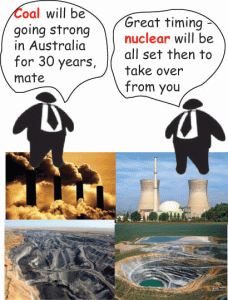 Individuals associated with the push for small modular reactors in Australia are closely associated with coal generation.
The NSW Nationals leader John Barilaro attended a 2018 SMR conference in the US with Tony Irwin, a director of SMR Nuclear Technology.
The company’s website states it was “established to advise on and facilitate the siting, development and operation of safe nuclear power generation technologies”.
Another director of that company is Trevor St Baker from Delta Electricity, the company that operates Vales Point on the NSW Central Coast.
A submission from SMR Nuclear Technology to a current uranium inquiry in New South Wales sets out how nuclear may replace coal.
“It should be acknowledged at the outset that there may be an important continuing role for gas-fired and coal-fired power generation,” it states……..
‘Untapped potential’ of uranium
 Kevin Scarce, the man who led South Australia’s royal commission, said there was an opportunity to mine more uranium and convert it into a fuel source, “but at the moment that part of global supply is oversupplied”.
“Realistically, in the next 10 to 15 years there doesn’t appear to be much of a market unless nuclear starts to become more seen in the rest of the world.”…
The Minerals Council has long argued for Australia’s ban on nuclear energy to end.
It also wants uranium mining removed from the definition of a “nuclear action” in the Environment Protection and Biodiversity Conservation Act.
“These activities are not nuclear actions. They are mining activities,” a Minerals Council policy document states.
“Uranium projects should not automatically trigger a duplicative federal environmental approval process, and the costs and delays that come with that, for no environmental benefit.”
A joint media release this week from Treasurer Josh Frydenberg and Assistant Minister to the Prime Minister Ben Morton announced a Productivity Commission review into resources sector regulation.
It also flagged that “improving the efficiency of environmental approvals would reduce the regulatory burden on business”.https://www.abc.net.au/news/2019-08-07/small-modular-reactors-nuclear-explained/11386856
August 8, 2019
Posted by Christina Macpherson |
AUSTRALIA - NATIONAL, spinbuster |
Leave a comment

|
Pro-nuclear former Gilmore candidate Warren Mundine weighs in on federal inquiry into nuclear energy, South Coast Register, , 7Aug 19
Former Liberal candidate for Gilmore Warren Mundine has called for “sensible debate” on nuclear power and for the ban to be lifted.
Mr Mundine said he was supportive of nuclear energy as it was the only source of energy that “doesn’t produce CO2 and works 24/7″……
“We had a similar debate in South Australia several years ago… they had a community consultation process and in the end it was decided not to move forward. …
The comments come in light of Federal Energy Minister Angus Taylor’s decision to request a parliamentary enquiry into nuclear power.
A ban on nuclear energy has been in place in Australia since 1998, the legislation prohibits anyone from operating a nuclear power plant or enrichment facility.
Gilmore MP Fiona Phillips was staunch in her opposition to nuclear power during the last federal election and addressed the issue again in her maiden speech to Parliament last Tuesday.
“Accidents happen, natural disasters happen, the risk it poses to human health are profound, let alone the risks to the reputations of our primary producers, hospitality and tourism industries that thrive on our environment,” she told the lower house.
“We will fight this every day … I will never accept a nuclear power plant being built in our community.”….
Mr Mundine, who was former national president of the Australian Labor Party, said he believed some Labor MPs supported nuclear but were afraid to speak out on the topic…. https://www.southcoastregister.com.au/story/6315093/mundine-wants-sensible-debate-on-nuclear-power-and-ban-lifted/
|
|
August 8, 2019
Posted by Christina Macpherson |
AUSTRALIA - NATIONAL, politics |
Leave a comment
|
 Question marks around new nuclear reactors, news.com.au, 7Aug 19NBN boss Ziggy Switkowski, who led a Howard government review into nuclear power, admits there’s still question marks around small modular reactors. Question marks around new nuclear reactors, news.com.au, 7Aug 19NBN boss Ziggy Switkowski, who led a Howard government review into nuclear power, admits there’s still question marks around small modular reactors.
……. The top bureaucrat who led a Howard government review into nuclear power concedes there’s still question marks around emerging technologies of the energy source.
Ziggy Switkowski led a review in 2006, which found Australia would need about 25 reactors to supply one-third of the nation’s electricity supply by 2050.
…….Dr Switkowski says the smaller reactors are still being developed, with the US, China, Russia and India considering them.
The small modular reactors could be stored underground and cooled down by gas rather than water, he added.
“There are some very appealing features in the designs of these new reactors, but until you’ve got a fleet of them somewhere where there’s been some history of operation … there still are question marks around them,” he told ABC’s Radio National on Tuesday.
Dr Switkowski, who now heads NBN Co, also concedes the “road ahead is almost impossible” without bipartisan support for nuclear power as it would take about 15 years to get up and running.
This covers multiple election cycles, meaning a change in government would put a roadblock to any developments.
Labor opposes removing the moratorium against nuclear, with leader Anthony Albanese describing the inquiry as a “frolic”.
Solar and wind power paired with battery storage is the cheapest form of power, Dr Switkowski added.
The Standing Committee on the Environment and Energy is expected to launch the inquiry this week.https://www.news.com.au/national/breaking-news/question-marks-around-new-nuclear-reactors/news-story/baf246562ad2345aff661e9ee212140f
|
|
August 8, 2019
Posted by Christina Macpherson |
AUSTRALIA - NATIONAL, technology |
Leave a comment
I guess we’ve got enough nuclear targets for now, anyway
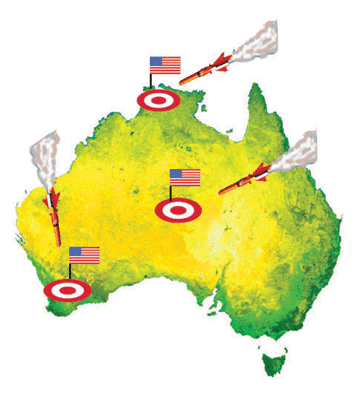
‘Draw a line under it’: PM rules out US missile base in Australia, The Age By Stephanie Peatling, August 5, 2019 Prime Minister Scott Morrison has ruled out the construction of US missile bases in Australia, saying no such request was made at high-level defence and diplomatic talks between the two countries over the weekend.US and Australian officials appeared to leave open the option of a missile base being built in northern Australia as part of a move to counteract an increasingly assertive Chinese presence in the South Pacific at the conclusion of the talks in Sydney on Sunday…….
Defence Minister Linda Reynolds also emphatically ruled out any formal request by the United States. …..
Any use of Australian soil as a launch site for intermediate-range missiles would anger Beijing, given that could bring Chinese military installations in the South China sea within range.
US Defence Secretary Mark Esper had earlier canvassed placing conventional intermediate-range missiles “in Asia”, following the collapse last week of the US-Russian Intermediate-Range Nuclear Forces treaty, which aimed to limit development of such weapons.
Asked whether Australia might now also be under consideration for basing a conventional version of the weapons, with ranges of 500 to 5500 kilometres, Dr Esper did not give a direct answer…..
But Australia remains open to a US invitation to join a coalition of countries to protect oil tankers and cargo ships from attack by Iran in the Straits of Hormuz……. https://www.theage.com.au/politics/federal/no-request-has-been-made-linda-reynolds-rules-out-us-missile-base-in-australia-20190805-p52du1.html
August 6, 2019
Posted by Christina Macpherson |
AUSTRALIA - NATIONAL, politics international, weapons and war |
Leave a comment
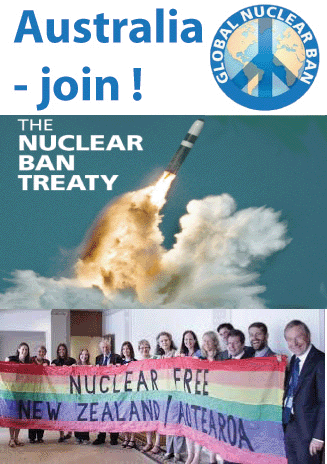 Michael Kirby urges Australia to sign up to nuclear weapon ban treaty, https://www.theguardian.com/world/2019/aug/05/michael-kirby-urges-australia-to-sign-up-to-nuclear-weapon-ban-treaty
Former high court judge says it’s a fluke the world has avoided nuclear disasters since the second world war and weapons remain a peril
The former high court judge Michael Kirby believes it was a fluke that the world has avoided further nuclear weapons disasters since the second world war and has urged Australia to sign up to a weapon ban treaty.
Kirby will launch a report in Sydney this week from the International Campaign to Abolish Nuclear Weapons, which calls for Australia to get on board.
Ican, which was founded in Melbourne, won the 2017 Nobel peace prize for leading the campaign for a global ban on nuclear weapons that resulted in a United Nations treaty being adopted in July 2017.
Kirby seized on the 74th anniversaries this week of the US detonating two nuclear bombs over the Japanese cities of Hiroshima and Nagasaki.
“That the world has survived seven decades since Hiroshima is more by good luck than effective management and there is no guarantee that it will continue to do so in an environment of proliferating nuclear weapons,” he said.
He acknowledged the nuclear weapons ban treaty was not perfect but “doing nothing is a far greater weakness”.
“Failing to address the challenges of nuclear weapons to humanity, the safety of the planet and the biosphere, highlights the global community’s failure to respond appropriately and effectively to the existential peril of nuclear weapons,” he said.
The nine nuclear powers, including the US, oppose the weapons ban treaty, arguing it could undermine nuclear deterrence.
More than 120 countries voted for the UN treaty and so far 70 have formally signed up and 24 have ratified the agreement. The treaty comes into force once 50 countries have ratified, which is expected in 2020.
Australia is not on the list. The federal government argues the ban treaty would not eliminate a single nuclear weapon. While Australia doesn’t have any nuclear weapons, it relies on “umbrella protection” under the US alliance.
can co-founder Dr Tilman Ruff said it is possible for Australia to keep its security pact with the US but sign the nuclear weapons treaty.
He pointed out 11 of 17 of the US’s regional allies have voted for the treaty’s adoption and three have signed up, including New Zealand.
“For none of those has there been any disruption or fuss with their ongoing military cooperation with the US,” Ruff said.
Ruff said if Australia was to sign up it would have to reconsider any nuclear weapons link to operations at joint facilities such as the satellite surveillance base Pine Gap in central Australia.
The report suggests the relay ground station at Pine Gap’s western compound would have to be closed or the US would have to separate out defensive functions from nuclear war-fighting.
It’s one of multiple redundant channels,” he said. “It’s clear that function of Pine Gap could easily be removed. Clearly this would need to be a negotiation, it would likely involve processes that would take a couple of years but we think that it’s eminently doable,” he said.
The federal Labor conference last December adopted as party policy a binding resolution to sign and ratify the UN treaty to outlaw nuclear weapons.
Anthony Albanese, who prosecuted that case at the conference, has as party leader reaffirmed his commitment.
“I’m a big supporter of nuclear disarmament. It is something that I’ve supported my entire political life,” Albanese told the ABC Insiders program on Sunday.
“We want to be a part of bringing the world with us. The fact is that over a period of time, issues like landmines and chemical weapons and other weapons have been outlawed, but nuclear weapons, the most catastrophic and damaging that can exist, still remain.”
In government ranks only Liberal MP Warren Entsch and Nationals MP Ken O’Dowd have publicly backed Australia joining the weapon ban treaty. Meanwhile, Australian foreign affairs minister Marise Payne and defence minister Linda Reynolds met with US secretary of state Mike Pompeo and defence secretary Mark Esper in Sydney on Sunday for annual talks.
Epser flagged on Saturday he supported placing ground-launched, intermediate-range missiles in the Asia-Pacific region in the short term.
Asked if northern Australia could be a potential site, he declined to speculate, saying the US deployed systems globally with friends and allies with consent and respect for sovereignty.
“We make decisions based on mutual benefit to each of the countries,” he said.
The US scrapped a nuclear arms pact with Russia on Friday. Both countries have pointed fingers at each other for violating the 1988 intermediate-range nuclear forces treaty.
August 6, 2019
Posted by Christina Macpherson |
AUSTRALIA - NATIONAL, politics international, weapons and war |
Leave a comment

Apparently, in order to placate Barnaby Joyce and others, there will be a Parliamentary inquiry into nuclear power. I was thinking of putting a boring submission restating all the reasons why nuclear power will never happen in Australia, but that seemed pretty pointless.
Given that the entire exercise is founded in fantasy, I’m thinking it would be better to suspend disbelief and ask what we need if nuclear power is to have a chance here. The answer is in two parts:
- Repeal the existing ban on nuclear power
- Impose a carbon price high enough to make new nuclear power cheaper than existing coal (and, ideally gas) fired power stations
My initial estimate, based on the Hinkley C contract in the UK (price of $A160/MWh) is that the required price is at least $100/tonne of CO2. Rough aritmetic follows: Black coal emits about 1 tonne/MWh, and costs around $40/MWh to generate, so it would be slightly cheaper in the short run. Similarly for brown coal, which has higher emissions, but is cheaper to run.. But at those prices, it would be uneconomic to do the repairs necessary to keep existing coal-fired plants in operation past, say, 2030.
If such a policy were adopted, perhaps to be phased in over a decade or so, the immediate impact would be a massive expansion of renewables and big incentives for energy efficiency. But, if the arguments of nuclear fans about the need for baseload energy turn out to be right, there would be some room for nuclear to enter the mix after about 2040.
Of course, nothing remotely like this will happen. It’s rather more likely that Barnaby and the committee will discover a working technology for cold fusion, based on harnessing unicorns.
August 6, 2019
Posted by Christina Macpherson |
AUSTRALIA - NATIONAL, politics |
Leave a comment
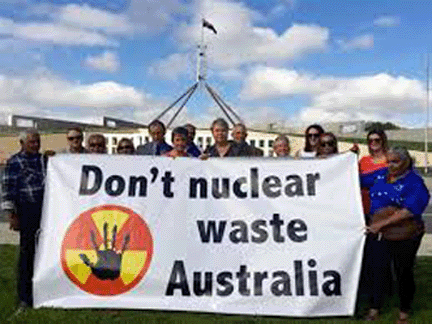
Paul Richards While nuclear power in Australia has a somewhat shaky business case, a much stronger argument can be made for the back end of the nuclear fuel cycle: storing nuclear waste’ Heiko Timmers Associate Professor of Physics, UNSW
A case can be made, that’s true.
However, the nuclear industry never talks about the whole nuclear fuel cycle. Furthermore, no one in the nuclear estate has proved they can look after unspent nuclear fuel, and contaminated material for the time needed without an indefinite supply of sovereign wealth.
What you are proposing is that Australia enters the sales channels of waste storage, for the profit of a very limited few in the nuclear estate. An unrealistic proposal, as no other nation has been able to solve this back door nuclear waste issue that even the IAEA admits, there is no economically viable solution for.
Unlike all the other sales channels in this nuclear estate, waste storage in terms of cost is indefinite, and on that basis, the cost is then based on our sovereign wealth. In other words, an indefinite cost to our Australian taxpayer’s.
The key takeaway is;
there is no way that nuclear waste storage as a business is economically viable, as the nuclear war hawks propose, it will be a cost to Australia indefinitely.
However, introducing nuclear waste storage as a sales channel for the nuclear estate changes our Federal Legislation of nuclear non-proliferation and that is the ‘Trojan Horse’ being wheeled out yet again. In yet another amoral attempt at introducing;
• nuclear energy,
• waste, and
• weapons,
despite developed nuclear nations phasing out nuclear fuel as obsolete, because the energy system is unviable economically and environmentally.
August 6, 2019
Posted by Christina Macpherson |
AUSTRALIA - NATIONAL, politics, spinbuster |
Leave a comment
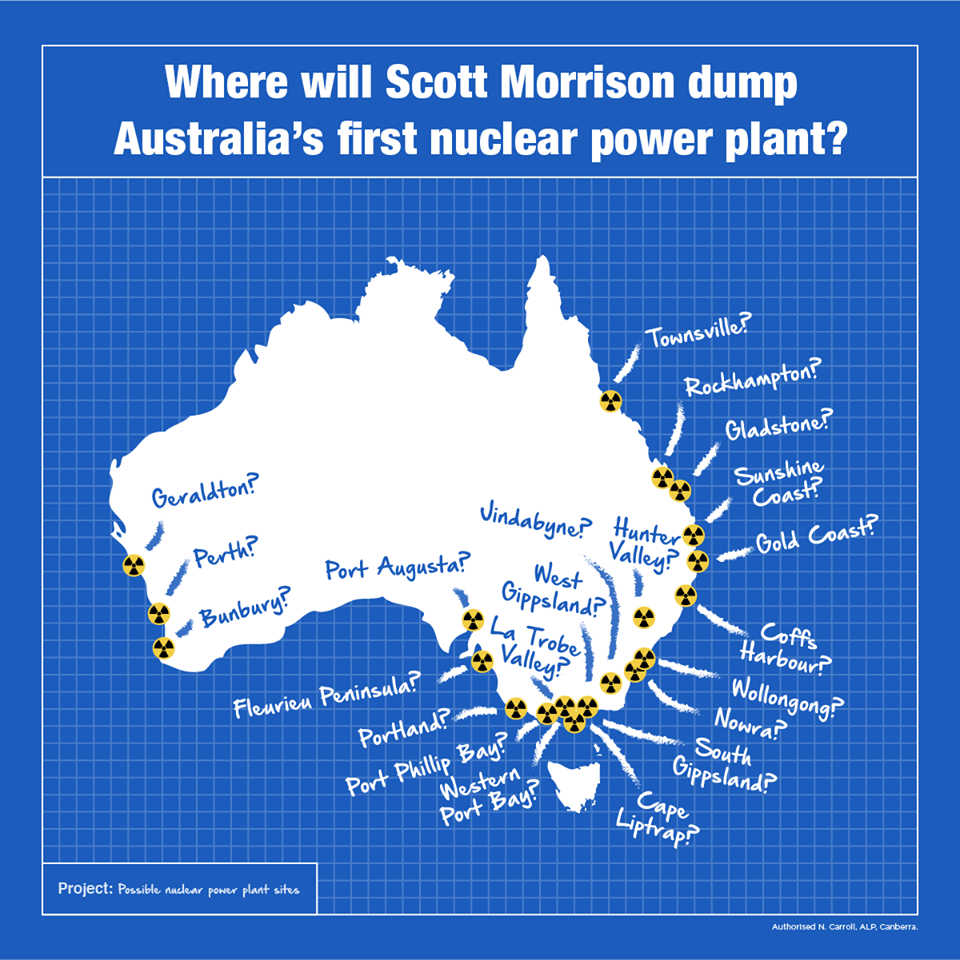 Labor fires warning shot on nuclear power, https://www.9news.com.au/national/labor-fires-warning-shot-on-nuclear-power/072b8a0a-e2a6-421e-a83c-a1c358424be1, By AAP
Aug 4, 2019 Labor has demanded the federal government outline potential locations for nuclear power plants after establishing a parliamentary inquiry into an Australian industry.
Energy Minister Angus Taylor has requested the Standing Committee on the Environment and Energy to investigate nuclear as a power source for Australia.
Opposition Leader Anthony Albanese suggested the inquiry showed the government was softening its position on lifting the ban on nuclear power.
“What the government has to come up with is exactly where is it considering putting nuclear power plants around our coastlines or next to the rivers?” he told the ABC’s Insiders program on Sunday.
Conservative Liberal and Nationals MPs have been pushing for the inquiry, arguing nuclear could be a way to drive power prices down and cut emissions.
But Mr Albanese said the issue had been examined many times before, with studies showing it would be three times more expensive than wind or solar when connected to other systems.
He said construction of nuclear plants had emissions-intensive construction and used large volumes of water, meaning they had to be near rivers or the coast.
We know, of course, from incidents like Chernobyl and Fukushima that it’s very dangerous,” the Labor leader said.
Mr Albanese said the government was in its third term and still didn’t have an energy policy.
“Now they’re off on this frolick, giving a parliamentary committee the scope to run around the country and consider matters that have been considered by the experts before,” he said.
August 6, 2019
Posted by Christina Macpherson |
AUSTRALIA - NATIONAL, politics |
Leave a comment