Australian media’s alarm over Chinese spy ship highlights stark double-standard
Pearls and Irritations, By Brian Toohey, Jul 31, 2023
The mainstream media has once more tried to generate alarm about the presence of two relatively innocuous Chinese electronic spy ships in international waters during the latest biennial Talisman Sabre military exercise spread across the Australian mainland and offshore oceans. It involves 30,000 troops from 13 countries. Although the Indian prime minister Narendra Modi had publicly assured his Australian counterpart Anthony Albanese that his country would attend, India did not turn up.
The unnamed enemy is China. A London based journalist reported from Townsville that the latest exercise was occurring against a “changing security landscape in which China grows evermore belligerent”. Apparently, he didn’t see any need to give evidence for this dubious claim. The defence minister, Richard Marles said Talisman Sabre provided an opportunity to practice “high-end” warfare. Just how participants such as PNG, Tonga and Fiji can do this is not clear. In a war, their role would be to let the US operate from their territory.
During the last exercise, the ABC’s national television news each night ran a video of the spy ships across the top of the screen. It hasn’t gone that far this time, but has given extensive coverage to the spy ships without explaining what harm they might be doing.
The participants don’t seem alarmed. During the last exercise, an ABC journalist asked an American soldier on an amphibious ship if he was worried about the presence of Chinese spy ships. He replied, “No, we do it to them and they do it to us”. An Australian military spokesman said this time that it had taken the appropriate precautions to ensure the spy ships don’t cause any harm. A core reason is that all signals traffic is encrypted. The reality is that the US and its allies conduct electronic intelligence gathering on a much greater scale than China can. The Pine Gap satellite ground station in central Australia, for example, generates billions of pieces of intelligence every day. This did not stop the ABC defence correspondent Andrew Green commenting on the activities of one Chinese spy ship, “If knowledge is power, China has just become more powerful”.
The RAAF’s P8A Poseidon electronic spy planes pose an aggressive threat to China by dropping sonar buoys in the South China Sea where its submarines are based on Hainan island close to the mainland. The small buoys contain an underwater microphone to pick up the sounds from submarines and relay the data to the spy planes conducting surveillance for potential military use.
Australia’s behaviour in the South China Sea is the same as if Chinese planes dropped sonar buoys outside the Fremantle base for Australian and US submarines. But the Chinese planes don’t do this. …………………………………………………………………………………
Certainly, Australian media would consider it provocative if China developed a long-range air capability and dropped sonar buoys off the submarine base at Fremantle. Albanese portrays the co-operation between the US and Australia to conduct potentially aggressive military activities in the South China Sea as part of the struggle between autocracies and democracy. Unfortunately, the draconian nature of some of Australia’s national security laws, deprive Australia of the right to call itself a liberal democracy.
Similar problems arise with Albanese’s iron grip on the Labor party’s federal conference in Brisbane on August 17-19. Although he describes Labor as a democratic party, he has effectively banned any parliamentarians attending the conference from supporting motions in favour of scrapping the AUKUS pact or the acquisition of nuclear submarines. Albanese has also banned any parliamentarian from supporting the existing conference policy of making it a priority to recognise of Palestine as a state. https://johnmenadue.com/australian-medias-alarm-over-chinese-spy-ship-highlights-stark-double-standard/
Readers disgusted with pro militarism report on Australia getting a “missiles industry”.
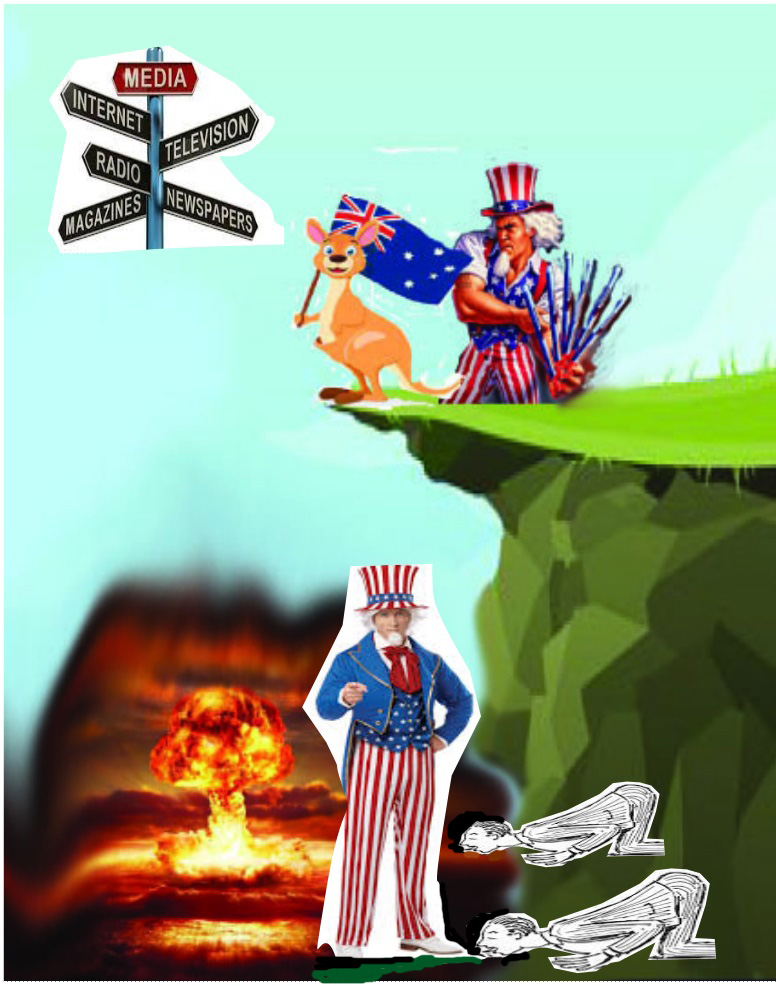
‘Hugely significant’: Australia to manufacture and export missiles to US’ (SMH)
‘Australia to manufacture and export missiles to US and others’ (9 News)
‘US to help Australia develop guided missiles by 2025’ (Aljazeera)

Above are just a few of the rapturous headlines in the print media. Then the joyous Australian TV and radio media – orgasmic delight at Australia’s new subservience to USA militarism.
BUT – by today – 204 comments on thed Sydney Morning Herald’s delighted article by Matthew Knott. July 28, 2023. Yes quite a few comments rejoicing in the prospect of the missiles industry . BUT the overwhelming majority of commentators were disgusted. Below are some of the comments.
Australia will be the front line in a US war with China
And make Australia a target for attacks un-necessarily ? Australia should NOT be drawn into any activity that is war-like in nature. We are a peaceful country that should not be militarily engaged in other nations issues. Sure we can have a voice BUT NOT ACT MILITARILY .. If the Americans want to stick their nose in other nation’s affairs, so be it .. Don’t drag us in militarily !!!
We voted Labor and they are throwing any semblance of autonomy we had away.Terrible idea !We can’t make Under Pants, Socks, Kettles, Washing Machines, Dustpans.
The Syrian war and Ukraine wars have generated 10 million refugees who have fled into the rest of Europe. The South China Sea has 200 million people living within 10 km of the coastline. Australians were easily convinced to turn back the boats and create a cruel offshore detention program all for the expediency of the LNP’s re election. The obsession with contributing to the US led arms race and the insistence of provoking a war over Taiwan will inevitably lead to our shiny new missiles and military arsenal being used as an expediency to turn back the thousands of boats
Just how (and why) are we finding the capacity to make death ?
More military lunacy.
We can’t make Under Pants, Socks, Kettles, Washing Machines, Dustpans.
Just how (and why) are we finding the capacity to make death ?
We can’t make Under Pants, Socks, Kettles, Washing Machines, Dustpans.
Just how (and why) are we finding the capacity to make death ?As Fraser said, we should have got out of Anzus at the end of the Cold War. Seems now we’re more captured by the US’s foreign policy agenda than ever before.
For Labor it’s clearly about the domestic optics. They want to be seen as the tough guy on military and defence matters, so long that being the Coalition’s political play.
Because of Morrison, and no Choice. We ended up with ALBO the United States Cheerleader.
Albo will NOT
provide leadership and he will not provide intellectual input in the following areas;
•‘Made a public call for building an autonomous Australia in a persistent attempt to shake off Australia’s shackles and prove that it is not the vassal of The United States.
•that Australia should be one pole of multipolarity with its own independent position to serve its own interests, and cannot be a vassal of other forces,
•When dealing with its relations with the US, it is hoped that Australia can truly safeguard its own core interests and get rid of the shackles the US has placed on it in the fields of economy, trade, ideology and even security,
Finally he has no idea on how to make Australia a world class manufacturing hub as declared in his election policy speech.
I’d much rather see Australia manufacturing things like solar panels and wind turbines and exporting them to the rest of the world to help tackle the growing threat of global climate change. Instead we focus on weapons and the machinery of war. Strange priorities from a Labor government…..disappointing really!
Big cheers for this ‘Hugely significant’!!! We finally became like North Korea, soon we will be able to replace New Year celebrations with real deadly missiles.
With the added bonus for politicians: whenever they make a mess they just fire missiles to distract the electorates … and at the same time it would be ‘Hugely Great’. The Rednecks and war mongers will be cheering all the way … it’s win win… well done Albo
We are being conned.
Can we go back to making cars. At least they were useful.
Missiles are for war.
Unless we agree to annilate all Mankind we are walking down the wrong path.
In a car you can go somewhere.
And so the violence industry marches on. By setting such an example is it little wonder there is so much killing & maiming in the world today?
So now new funding just extending the Morrison/Dutton Missile manufacturing policy announced in 2021?
Will it be like the F18 program all over again – assembling kits from the US? How much will the taxpayer subsidise the program?
So we’ve been sold out to the military industrial complex and will become fully integrated into the US War machine as the US makes its last ditch attempt to maintain its global hegemony and it control over the pacific region.
We are being marched into WWIII by the crazy neo cons in the USA and we are too blind to see it, chanting USA, USA, USA as we are led like lambs to the slaughter.
Unbelievable.
How are we a ‘peaceful country’ – name a war we HAVEN’T been involved in! We’re sycophants, hiding under the US’s skirt.
After being a gigantic quarry for so many years, our new major export industry will be providing weapons of war.
This is shameful. Surely we have the intelligence and foresight to do better than this.
Unbelievable.
After being a gigantic quarry for so many years, our new major export industry will be providing weapons of war.
This is shameful. Surely we have the intelligence and foresight to do better than this.
This is a step up from days of Lithgow Small-Arms .303s and these days, our Bushmasters. We’ll just be making them here to another nation’s specs & IP, all for the promise of jobs.
Blinken & Bush: “We have no greater friend, no greater partner, no greater ally than Australia.
A charm offensive that Albanese must take heed.
We import foods & goods from our neighbours for survival only for them to be killed by our missiles. How gross!
While the US and Australia are incessantly focusing on arms and the military in the Pacific, China’s hospital ship, the Peace Ark is in Tonga and will depart Nuku’alofa on 4 August 2023. It will also visit Kiribati, Vanuatu, Solomons Islands and Timor-Leste during its mission. The ‘Peace Ark’, on her third goodwill visit to Tonga on a humanitarian medical mission from 28 July to 4 August 2023.
So which country is doing more for the people in the Pacific?
American owned, designed, parts supplied. We are just like a 3rd world country assembling stuff, all profits going offshore with no tax paid. What a waste………… And paying for the privilege
And another target added to the growing number of American bases.
..and what about all the bs about becoming self-sustaining after the pandemic when we saw how reliant we are on imports? Or this is suddenly irrelevant? They need a Royal Commission into the capabilities of Australia when another and worse pandemic hits. Oh, I can write the summary now “We will be stuffed – starvation, no drugs, no products”. But yes, focus on warheads. Made with Australian metal I hope? Stick some kangaroo prints on it so when it is dug out of children we can be proud.
Yes, “assembled ‘Down Under’ from imported components subject to our strict specifications so you can rest assured that when you get hit by a genuine ‘Aussie’ missile it’s gonna hurt”…………….. Exactly! How gullible we are to trust the Americans? It’s unbelievable!
Now imagine if an LNP government announced we were making killing things for Uncle Sam. You’d never hear the end of it. Oh the hypocrisy.
Nice not, when we have industry again it is all about weapons and destruction.
What have we become? So we are not making products that will make our life easier and more comfortable? We are not making tools and machines to facilitate our normal daily activities? We are no building metro lines to reduce commute times? We are not making electric vehicles to reduce carbon emissions? Yet we are going to making missiles for wars that will kill human beings. What a weird sense of priority we’ve got ???
Lloyd Austin moved from the board of Raytheon to Secretary of Defence. Is it any wonder we are now getting sucked into arms manufacturing a cycle of endless wars, which is a bona fide policy of the US. We need to be much more discerning than “all the way with Uncle Sam” this is a very poor sign of our priorities, and the “jobs and growth” mantra has been taken from the liberal playbook to justify this stupid and dangerous choice.
So the plan is to continue a longstanding trend to make us even more financially and militarily dependent on foreigners right?
“Sydneysiders are aghast at the level of gun violence breaking out. On to happier news, Australia is going to create its very own missile manufacturing plants”.RESPECT8
We’re being used again, it won’t be to our advantage everything the US does is for theirs.
We are their lapdog.
The anti-China brigade in Canberra is pushing hard to get Labor to think China wants to go to war & so we have to be closely allied with the US.
NO it is the USA that always wants to go to war – look how many we’ve followed them into and look at China, only min-wars or skirmishes on their borders, never ever far afield.
I think this idea stinks.
ALP – American Lapdog Party
What is hugely significant is Albo’s lost his marbles.
No way. To restore our manufacturing capacity, I’d rather prefer we start making electric vehicles and solar panels, not missiles.
We’re becoming completely dependant upon the American military machine. AUKUS are about all our government seems to care about anymore. Meanwhile… over 1 million young people are living in poverty and koalas are going extinct. It’s all about priorities and it’s 100% obvious what and who our leaders are working for and it ain’t the people or the country. With friends like Labor, who needs Liberals?
Who cares what Simon Birmingham thinks, or says.
He represents a government that made defence decisions that were more photo-op than substance; cancelled the SEA1000 project that put us squarely into the ship-building “Valley of Death” that the COALition hyperventilated over; failed abysmally in both defence and foreign policy, all the while telling us what absolute standouts they were in government.
It was the COALition that left us with this mess called AUKUS.
I can’t see us receiving nuclear-powered submarines, despite the efforts to push through with AUKUS. At some point, the taxpayers of Australia will simply say “enough!” The options being offered are far too expensive.
“US defence contracting giants Lockheed Martin and Raytheon have been selected by the government as preferred partners for its guided weapons and explosive ordnance enterprise“. The Hawkei is made by Prime contractors including Thales Australia (French) Boeing (US) Plasan (Israel). The Virginia submarines are designed and built by US General Dynamics Electric Boat (EB) and Huntington Ingalls Industries. Virtually all military equipment purchased or being built in Australia by foreign, usually US companies. Australia is feeding overseas military complexes, not developing anything new.
A gigantic error from the government here. The only priorities here are for shareholders of Raytheon and Lockheed Martin. The US are always looking for the next endless war. History repeating itself over and over. We will be used as pawns between the US and China.
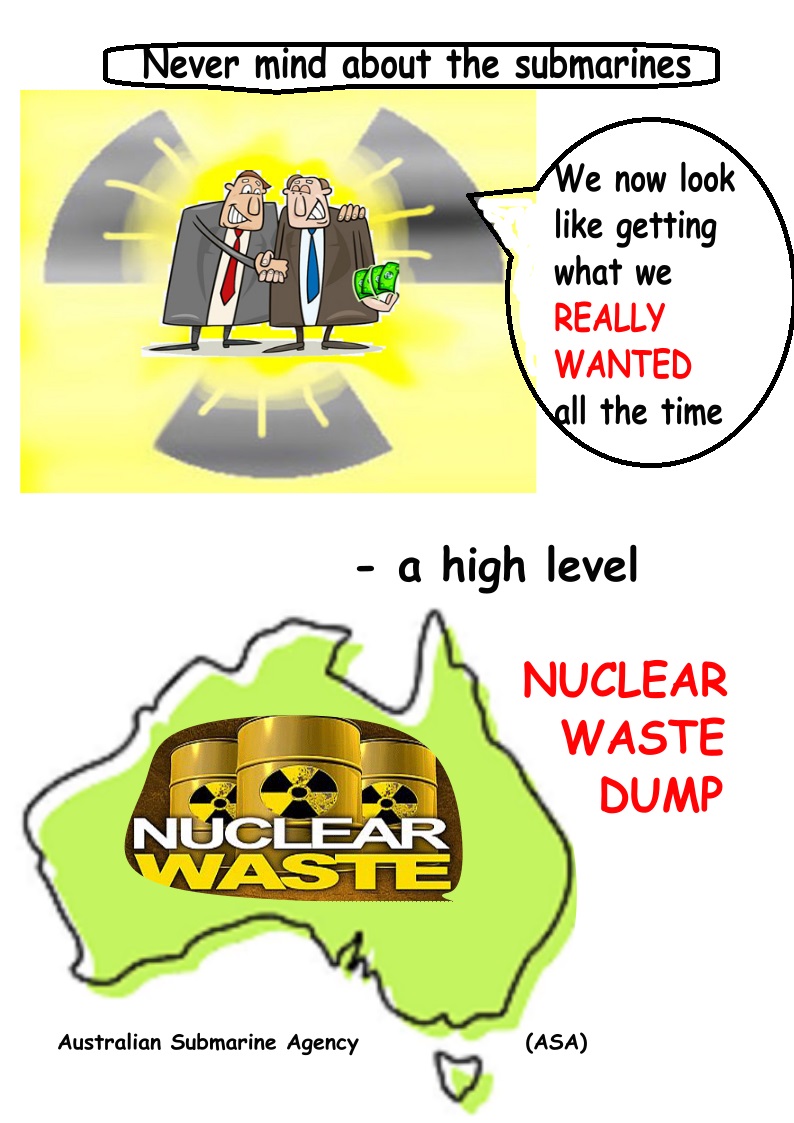
Australia – an international nuclear wasteland?
By Richard Broinowski, Jul 29, 2023 https://www.europeanleadershipnetwork.org/commentary/to-avoid-nuclear-instability-a-moratorium-on-integrating-ai-into-nuclear-decision-making-is-urgently-needed-the-npt-prepcom-can-serve-as-a-springboard/
The spectre of an international nuclear waste dump in Australia hangs over AUKUS and what this secretive agreement commits Australia to. Does it oblige us simply to dispose of spent nuclear reactors from our submarines if and when we get them? Or is there a hidden agenda whereby we also take the expired nuclear reactors from US and British submarines? If so, could it lead to Australia becoming a dump for high-level waste from civil nuclear reactors around the world?
Crikey.com is the latest to set speculative hares running. On 26 July it published an article by David Hardaker claiming the Albanese government had struck a secret deal under AUKUS to build a high-grade nuclear waste facility in Australia. Crikey claimed the deal has echoes that resound from 26 years ago.

Indeed it does. In December 1998, a proposal was made by Jim Voss, an American nuclear evangelist, who through his company Pangea proposed constructing an international nuclear waste repository on Billa Kalina, a pastoral lease near Roxby Downs in South Australia. Roxby Downs is a town built to service the giant BHP uranium, gold, copper and silver mine at Olympic Dam. Water for the town and the mine comes from Australia’s Great Artesian Basin.
As I wrote in Fact or Fission – the truth about Australia’s nuclear ambitions (Scribe 2003 and 2022), Voss’s proposal was leaked to the public by Friends of the Earth. Pangea was flying a kite on behalf of Anglo-American and possibly other nuclear interests. It made the unassailable observation that there is a real risk of nuclear weapons proliferation through the theft of plutonium or highly enriched uranium from nuclear power programs. Voss proposed a nuclear waste dump in Western Australia to take about a quarter of the high-level waste from the 445 commercial power reactors in 30 countries around the globe.
This, he claimed, would achieve several things – support international efforts to reduce nuclear weapons proliferation, further the objectives of nuclear disarmament, strengthen Australia’s relations with the United States, protect the global environment, and support the International Atomic Energy Agency (IAEA) and the United Nations. How all this would happen he didn’t say.

Such a repository has also been a gleam in the eyes of the Australian nuclear lobby and several politicians for many years. In 2006, John Howard’s Nuclear Review sought to expand Australia’s nuclear footprint by making nuclear power ‘a practical option’ in Australia’s electricity production. He also envisioned an international nuclear waste dump somewhere in the Outback. In 2014, former Prime Minister Bob Hawke, supported by then South Australian Premier Adam Giles, proposed to put a high-level nuclear waste depository at Muckaty Station north of Tennant Creek in South Australia. Hawke said the money earned would be of immense value to indigenous communities.

Prime Minister Tony Abbott had similar aspirations. So did Malcolm Turnbull, who in 2015 suggested that Australia should not just export uranium oxide (U3O8), but enrich it, process it into fuel rods, retain Australian ownership by leasing the rods abroad, and take them back as spent fuel for permanent disposal in Australia. That way, he said, Australia retained ownership of the uranium, preventing it from being diverted into clandestine weapons programs.
None of these proposals resulted in practical action. Except for qualified acceptance of the export of Australian yellowcake under safeguards to approved civil nuclear energy companies, the Australian public maintained an aversion to all things nuclear. The earlier careless disposal of nuclear tailings at Radium Hill, the contemptuous and ineffective clean-up of highly toxic plutonium in the aftermath of Britain’s nuclear tests at Emu Field and Maralinga in the 1950s, and French nuclear tests in the Pacific in the 1990s, all consolidated Australians’ aversion.
Following negative public reactions to his proposal, Voss quietly closed his Pangea office In January 2002 and retreated to Europe. But several years later, he was given renewed hope.
In 2016, the South Australian Nuclear Fuel Cycle Royal Commission under former South Australian governor Kevin Scarce concluded that although nuclear energy in Australia would not be economically viable for the immediate future, research should continue regarding the feasibility of an international spent fuel repository.
Voss returned to Australia in 2022, and took over the optimistically-named Ultra Safe Nuclear Corporation in Melbourne. Safe disposal of nuclear waste remained on his agenda. According to Crikey, Voss reckons very deep boreholes of around three to five kilometres could safely incarcerate spent fuel from the reactors of Australia’s nuclear-powered submarines for thousands of years.
Could such a storage facility attract US or British attention? Could their governments pressure Australia to take their own submarine spent fuel reactors as well as those of Australia?
They have strong motives to do so. Around 90 British spent fuel submarine reactors are said to be lying around Devonport Docks in Plymouth and the Rosyth dock in Fife, safeguarded only at huge expense. The US Navy has many more in open trenches at the Hanford Nuclear Reservation in Washington State. There are plans to process and store their transuranic elements somewhere permanently, but the Yukka Mountain Deep Geological repository in Nevada was de-funded in 2010, and has been subject to complex political manoeuvring ever since.
Given Albanese’s and Marles’ supine acceptance of US conditions to keep the reactors from our own submarines after their service lives, they could also easily be leant on to take US and UK used submarine reactors as well.
Could this in turn lead to Voss’s grand vision of Australia becoming a spent fuel repository for the international nuclear industry? Since we cannot even decide on the location of a repository for low-level nuclear waste from hospitals and materials testing laboratories, let alone places for intermediate and high-level waste, such an expansion seems a pipe dream. But we must not under-estimate the persistence of the Australian nuclear industry or its backers in Federal and State parliaments and in the Murdoch press.
Australia’s nuclear waste

finding a national waste repository is not urgent because it has been stored this way for 60 years.
it’s not even clear if centralising the waste is the best option. ..there’s an implicit risk in transporting the waste from the various sites to a new site, and there should be a safety comparison with leaving it where it is.
Courts have quashed a decision to store water in Kimbra, meaning there is still no centralised repository in the country
Guardian. Tory Shepherd, Sat 29 Jul 2023
More than 20 tonnes of reprocessed nuclear fuel will stay at Australia’s only reactor in southern Sydney, while nuclear waste will remain scattered in “cupboards and filing cabinets” around the country, after the federal court blocked plans for a long-term storage site in outback South Australia.
The site in Kimba was selected more than 40 years after Australia started planning for a centralised repository. But this month, that decision was quashed by the courts.
There is currently no live national facility option, and the waste pile is growing.
Successive governments and agencies have said there are more than 100 sites that are storing nuclear waste littered across the land, in hospital basements and universities, on defence and mining sites and in research laboratories.
There’s no definitive list, because of a licensing split between the federal and state governments, but the vast majority is produced and stored at the Australian Nuclear Science and Technology Organisation (Ansto) facility in Lucas Heights.
A national inventory published last year found Australia’s 2,061 cubic metres of intermediate-level waste (ILW) will more than double to 4,377 cubic metres in the next 50 years.
………….The inventory predicted that the 2,490 cubic metres of low-level waste will more than quadruple to 13,287 within the next five decades. LLW includes gloves, paper, gowns and other ephemera used in nuclear medicine. Much of it can be left to “delay and decay”, and can be disposed of as regular rubbish.
Ansto’s waste makes up about 93% of the LLW, and about 96.5% of the ILW.
Ansto is also responsible for the spent fuel rods from its Opal research reactor at Lucas Heights, in Sydney’s south, which are sent to France, the UK or the US for reprocessing.
Last year, the UK shipped two tonnes of ILW to be stored at Sydney’s Lucas Heights facility until it could be transported to a national facility – it was part of a waste-swap deal after Australia sent spent fuel rods from Opal predecessor to be recycled.
In 2015, 25 tonnes of radioactive waste from France was returned to Australia after reprocessing – that too will be housed at Lucas Heights until a dump is selected and built. Since then, Australia has sent more spent fuel rods to France to have the uranium and plutonium extracted, but their return has not been announced, and it’s not clear what will happen with such deals now that Kimba option is off the table.
The current government policy is to build a National Radioactive Waste Management Facility (NRWMF) to dispose of LLW permanently, and ILW temporarily while a permanent dump is built.

The traditional owners of the land around Kimba, the Barngarla people, took the government to court, and won – former resources minister Keith Pitt’s declaration of the site was cast aside because of his “apprehended bias” and “pre-judgement”.
Now, the process is on hold as the government considers the judgement, and as the case continues with final details to be ironed out.
Top nuclear waste expert, emeritus professor Ian Lowe, says waste is kept in “cupboards and filing cabinets in universities and hospitals”…………“It’s clearly not optimal … the reason it hasn’t been a problem is there’s not actually anything very nasty you can do with low level waste. It’s not very radioactive,” Lowe says.
Ansto says such waste needs “minimal shielding”, while some major hospitals use “delay tanks” and other facilities use drums.
So, Lowe says, finding a national waste repository is not urgent because it has been stored this way for 60 years.
Lowe, who is from Griffith University, says it’s not even clear if centralising the waste is the best option. He says there’s an implicit risk in transporting the waste from the various sites to a new site, and there should be a safety comparison with leaving it where it is.
“I haven’t even seen a crude, back of the envelope calculation,” he says.
With the intermediate level waste, which is “much nastier stuff”, he says he “couldn’t see the point of moving it from temporary storage at Lucas Heights to temporary storage at Kimba while we work out a permanent solution”.
The Australian Conservation Foundation (ACF) and the Greens are pushing for it to remain at Lucas Heights for now.
The ACF’s Dave Sweeney says the waste at Lucas Heights is secure, and that keeping it there could be a “circuit breaker” after years of political wrangling. He accepts that Lucas Heights is not set up to permanently dispose of the waste, but points out that the Australian Radiation Protection and Nuclear Safety Agency has said it is safe there.
And, he says, much of the LLW currently being managed in hospitals was never going to get to Kimba anyway. On top of all that, Kimba was only ever going to hold ILW temporarily until a permanent facility was built.
“We need to actually take a breath and get very serious, systematic and credible about how we advance radioactive waste management,” he says.
“[This shows] the need for and a clear ability to deliver a circuit breaker and inject some responsibility, credibility and respect into this process.”
A spokesperson for resources minister, Madeleine King, said it would be inappropriate to comment on the future of a NRWMF while the Barngarla case is still before the court. The government has lodged a submission to the federal court and could appeal the decision……………………………………
Lowe says only Finland and Sweden have managed to solve the issue with long-term waste storage, and they did it by finding communities who are keen to have the waste in return for investment.
He says permanent disposal of all types of waste will need somewhere geologically stable. “That probably means remote parts of SA, WA, NT, but there’s any number of parts of Australia. “The point is finding a community that’s happy to have it there.” https://www.theguardian.com/environment/2023/jul/29/nuclear-waste-australia-how-much-why-kimba-lucas-heights
If Albanese’s such a buddy of Biden’s, why is Assange still in jail?
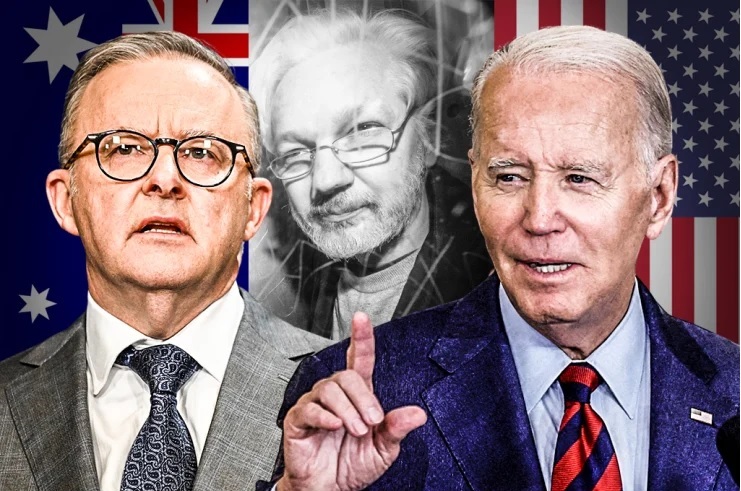
An initial refusal from Biden is only an invitation to ask a second time, in a firmer voice
Bob Carr Bob Carr was NSW’s longest-serving premier and is a former Australian foreign affairs minister. 27 jul 23, https://www.theage.com.au/politics/federal/if-albanese-s-such-a-buddy-of-biden-s-why-is-assange-still-in-jail-20230721-p5dqci.html
Julian Assange is in his fourth year in Britain’s Belmarsh prison. If the current appeal fails, he will be shackled and driven off in a prison van and flown across the Atlantic on a CIA aircraft for a long trial. He faces likely life imprisonment in a federal jail, perhaps in Oklahoma.
In 2021, then opposition leader Anthony Albanese said, “Enough is enough. I don’t have sympathy for many of his actions, but essentially, I can’t see what is served by keeping him incarcerated.”
As prime minister, Albanese said he had already made his position clear to the Biden administration. “We are working through diplomatic channels,” he said, “but we’re making very clear what our position is on Mr Assange’s case.”
So we can assume that at one of his seven meetings with US President Joe Biden he has raised Assange, even on the fringes of the Quad or at one of two NATO summits. Or perhaps in San Diego when they launched AUKUS, under which Australia will make the largest transfer of wealth ever made outside this country. This $368 billion is a whopping subsidy to American naval shipyards and to the troubled, chronically tardy British naval builder BAE Systems.
But it clinches Australia’s reputation as a deliriously loyal, entirely gullible US ally. It gives President Biden the justification for telling Republicans or Clinton loyalists in his own party that he had no alternative but to end the pursuit of Assange. “Those Aussies insisted on it. They’re doing us all these favours … we can’t say no.”
In addition to the grandiose AUKUS deal, Biden could list other decisions by the Albanese government that render Australia a military stronghold to help US regional dominance while materially weakening our own security.
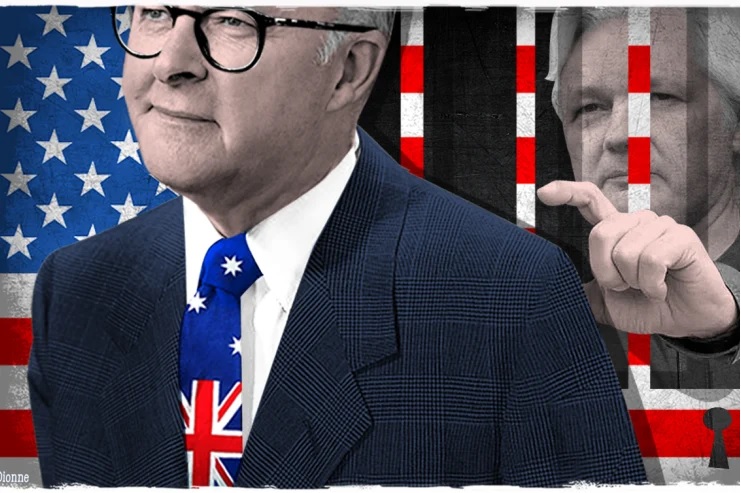
Candid words, but they aren’t mine. They belong to Sam Roggeveen of the Lowy Institute in this month’s edition of Australian Foreign Affairs. In a seminally important piece of analysis, Roggeveen nominated Australia’s decision to fully service six American B52 bombers at RAAF Tindal, in the Northern Territory, as belonging on that list. It is assumed these are aimed at China’s nuclear infrastructure such as missile silos. “It is hard to overstate the sensitivity involved in threatening another nation’s nuclear forces,” Roggeveen writes.
In his article, he reminds us we’ve also agreed to host four US nuclear subs on our west coast at something to be called “Submarine Rotational Force-West”. Their mission would be destroying Chinese warships or enforcing a blockade of Chinese ports.
The east coast submarine base, planned most likely for Port Kembla, will also directly support US military operations. It’s another nuclear target. As Roggeveen says, all these locations raise Australia’s profile in the eyes of the Chinese military planners designing their response in the event of war with the US.
In this context, I can’t believe the US president is not on the point of agreeing to the prime minister’s request to drop charges against Assange.
Apart from the titanic strategic favours, two killer facts help our case. One, former US president Barack Obama commuted the sentence of Chelsea Manning, who had supplied Assange with the information he published. The Yank is free, the Aussie still pursued.
Two, the crimes Manning and Assange exposed involved US troops on a helicopter gunning down unarmed civilians in Baghdad. They are directly comparable to the alleged Australian battlefield murders in Afghanistan we are currently prosecuting.
An initial refusal from Biden is only an invitation to ask a second time, in a firmer voice.
It’s possible to imagine an Australian PM – Fraser, Hawke, Keating, Howard or Rudd – being appropriately forceful with a US president. There would be an inflection point in their exchange – prime minister to president – when the glint-eyed Australian says, “Mr President, it’s gone on too long. Both sides of our politics are united. Your old boss commuted Chelsea Manning, an American, in the same case.”
A pause. A beat. Then the killer summation. “Mr President, I speak for Australia.”
Surely this counts.
I don’t believe the president can shake his head and say, “nope”, given all we have gifted – the potent symbolism of B52s, nuclear subs and bases on the east and west coast. It would look like we have sunk into the role of US territory, as much a dependency as Guam or Puerto Rico.
US counter-intelligence conceded during court proceedings there is no evidence of a life being lost because of Assange’s revelations. Our Defence Department reached the same view.
If Assange walks out the gates of Belmarsh into the arms of his wife and children it will show we are worth a crumb or two off the table of the imperium. If it’s a van to the airport, then making ourselves a more likely target has conferred no standing at all. We are a client state, almost officially.
AUKUS nuclear dump deal decades in the making by nuclear evangelists with prescience.
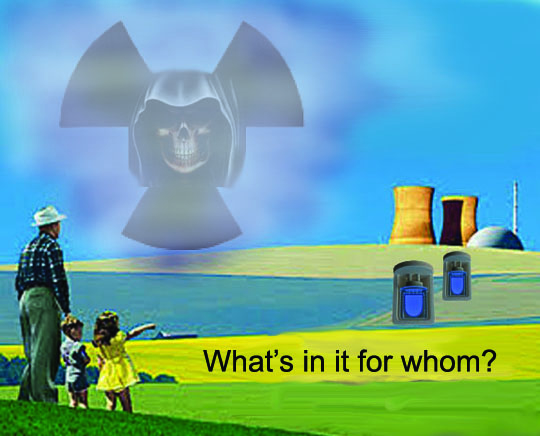
David Hardaker 26 July 23 https://www.msn.com/en-au/news/australia/aukus-nuclear-dump-deal-decades-in-the-making-by-players-with-prescience/ar-AA1elV6p
he story of the long, slow journey to a nuclear waste dump being built in Australia as required by the AUKUS agreement is probably best told through one Jim Voss, a nuclear evangelist from America who has been part of the Australian scene for at least a quarter of a century.
Part of a push which began in 1997, he’s one of a handful of international figures who’ve never gone away. Now, arguably, that push has won the day courtesy of a secret deal struck by the Australian government.
Voss’ most recent appearance was at a parliamentary committee hearing into nuclear legislation on May 15. Courtesy of the government’s AUKUS agreement he was now, finally, able to make a link between the benefits of small modular nuclear reactors — the sort sold by his company — and the nuclear-powered submarines Australia has committed to.
It all went to show, as Voss put it, that “a nuclear culture will be essential for this nation in the future”.
Voss could afford to be just a little triumphant that Canberra day. The inspirational words “If at first you don’t succeed then try, try and try again” could well have been written just for him.
Apart from sheer doggedness, the Voss story tells us much about the close connections between the military and commercial worlds when it comes to nuclear energy, as well as the powerful roles played by the UK and the US governments in seeking a solution for a terrible problem they share: how to permanently store nuclear waste. Australia, it emerges, has been a long-term target.
It was only when Scott Morrison came along — later backed by Prime Minister Anthony Albanese — that all that work paid off, with the bonus that it was all done in secret.
Pangea 1997
Voss first came to public attention in Australia courtesy of a Four Corners investigation in the late 1990s. Voss was then general manager of a company called Pangea which was attempting to realise the idea of building a nuclear waste dump in Australia, catering to an international need for a permanent solution for disposing of radioactive waste. The company considered that outback parts of Western Australia met the checklist for safety, remoteness and geological stability.
Voss was joined by a Pangea scientist, Charles McCombie, who would also go on to become a mainstay of international efforts to have a nuclear waste dump built in Australia.
Other now-familiar connections emerged at this time. Pangea, backed by a multimillion-dollar marketing and lobbying budget, brought on board then-rising star of conservative political polling, Mark Textor. Textor was soon to establish the powerful Crosby-Textor (ClT) group with then Liberal Party director, Lynton Crosby. Textor was reportedly paid some $250,000 for his work. (As we revealed in May, ClT’s American arm acts as a lobbyist for the giant US defence company General Dynamic, which builds the US Navy’s nuclear-powered submarines and is set to play a key role in the AUKUS program. It already hosts a growing Australian workforce at its Connecticut shipyards.)
In America, Pangea had signed up a former US nuclear submarine commander, Ralph Stoll, who helped lobby members of the US Congress to back Pangea’s plans for an Australian dump. Not that the US needed much persuading. Back in 1999, Four Corners reported that Pangea’s case found favour with US security and defence officials when it shifted its focus from a commercial venture to play to America’s strategic preoccupation with growing stockpiles of nuclear warheads.
Former US defence official Jan Lodal who had been responsible for running nuclear policy for the Pentagon put it this way:
There are thousands and thousands of tonnes of [nuclear waste] and thousands of tonnes more coming online each year, so to speak, as well as many thousands of tonnes that are derivative from former nuclear weapons programs. And these have to be stored safely and securely for thousands of years, and the world simply doesn’t have a solution to this. And as long as this waste is stored in an imperfect fashion, in which it is now — virtually everywhere — it represents something of a threat.
The Pangea company drew on American expertise but it was essentially a front for the UK government. It was 80% owned by British Nuclear Fuels Limited (BNFL), which in turn was wholly owned by the British government. BNFL and the UK had the same problem as the US: it held the largest stockpile of high-level radioactive waste in the world (after America) kept in canisters cooling beneath the water at its Sellafield facility in the north of England.


CrikeyFollow
AUKUS nuclear dump deal decades in the making by players with prescience
Story by David Hardaker • Yesterday 8:01 pm

(IMAGE: GETTY IMAGES)© Provided by Crikey
The story of the long, slow journey to a nuclear waste dump being built in Australia as required by the AUKUS agreement is probably best told through one Jim Voss, a nuclear evangelist from America who has been part of the Australian scene for at least a quarter of a century.
Part of a push which began in 1997, he’s one of a handful of international figures who’ve never gone away. Now, arguably, that push has won the day courtesy of a secret deal struck by the Australian government.
Why Seniors with private health cover are losing money
Voss’ most recent appearance was at a parliamentary committee hearing into nuclear legislation on May 15. Courtesy of the government’s AUKUS agreement he was now, finally, able to make a link between the benefits of small modular nuclear reactors — the sort sold by his company — and the nuclear-powered submarines Australia has committed to.
It all went to show, as Voss put it, that “a nuclear culture will be essential for this nation in the future”.
Voss could afford to be just a little triumphant that Canberra day. The inspirational words “If at first you don’t succeed then try, try and try again” could well have been written just for him.
Apart from sheer doggedness, the Voss story tells us much about the close connections between the military and commercial worlds when it comes to nuclear energy, as well as the powerful roles played by the UK and the US governments in seeking a solution for a terrible problem they share: how to permanently store nuclear waste. Australia, it emerges, has been a long-term target.
It was only when Scott Morrison came along — later backed by Prime Minister Anthony Albanese — that all that work paid off, with the bonus that it was all done in secret.
Pangea 1997
Voss first came to public attention in Australia courtesy of a Four Corners investigation in the late 1990s. Voss was then general manager of a company called Pangea which was attempting to realise the idea of building a nuclear waste dump in Australia, catering to an international need for a permanent solution for disposing of radioactive waste. The company considered that outback parts of Western Australia met the checklist for safety, remoteness and geological stability.
Voss was joined by a Pangea scientist, Charles McCombie, who would also go on to become a mainstay of international efforts to have a nuclear waste dump built in Australia.
Other now-familiar connections emerged at this time. Pangea, backed by a multimillion-dollar marketing and lobbying budget, brought on board then-rising star of conservative political polling, Mark Textor. Textor was soon to establish the powerful Crosby-Textor (ClT) group with then Liberal Party director, Lynton Crosby. Textor was reportedly paid some $250,000 for his work. (As we revealed in May, ClT’s American arm acts as a lobbyist for the giant US defence company General Dynamic, which builds the US Navy’s nuclear-powered submarines and is set to play a key role in the AUKUS program. It already hosts a growing Australian workforce at its Connecticut shipyards.)
In America, Pangea had signed up a former US nuclear submarine commander, Ralph Stoll, who helped lobby members of the US Congress to back Pangea’s plans for an Australian dump. Not that the US needed much persuading. Back in 1999, Four Corners reported that Pangea’s case found favour with US security and defence officials when it shifted its focus from a commercial venture to play to America’s strategic preoccupation with growing stockpiles of nuclear warheads.
Former US defence official Jan Lodal who had been responsible for running nuclear policy for the Pentagon put it this way:
There are thousands and thousands of tonnes of [nuclear waste] and thousands of tonnes more coming online each year, so to speak, as well as many thousands of tonnes that are derivative from former nuclear weapons programs. And these have to be stored safely and securely for thousands of years, and the world simply doesn’t have a solution to this. And as long as this waste is stored in an imperfect fashion, in which it is now — virtually everywhere — it represents something of a threat.
The Pangea company drew on American expertise but it was essentially a front for the UK government. It was 80% owned by British Nuclear Fuels Limited (BNFL), which in turn was wholly owned by the British government. BNFL and the UK had the same problem as the US: it held the largest stockpile of high-level radioactive waste in the world (after America) kept in canisters cooling beneath the water at its Sellafield facility in the north of England.
Pangea collapses but the dream lives on
Pangea’s best laid, secret plans came unstuck when the British arm of Friends of the Earth came into possession of a corporate Pangea video which the company had produced for the launch of its Australian venture.
The leaking of the video triggered a federal parliamentary backlash, including from the Howard government’s resources minister Senator Nick Minchin, who denounced the idea of Australia being an international waste dump.
Yet Pangea left a legacy to be reckoned with. It had hit on messaging designed to allay community concerns about safety. One line distilled its argument to house the world’s nuclear waste in remote Australia: “There’s no safer place in the world to make the world a safer place.”
Some influential political voices warned this would not be the end of the matter. Australian Democrats senator Meg Lees told Parliament: “Let us look a couple of years down the track. Knowing the pressure that is coming from Britain, combined with pressure from state governments such as Western Australia, I think we may then have a whole different ball game.”
Then federal MP and former WA Labor premier Dr Carmen Lawrence said: “[Pangea] are serious; they are well-funded. They’re people who’ve worked around the mining industry for a very long time. And I think it would be foolish of anybody — government or people such as me opposed to what they’re proposing — to underestimate their long-term commitment to this proposal.”
Speaking to Four Corners from his office in Seattle, Pangea’s chairman (the late) David Pentz had the most prophetic of words:
The idea of an international repository and the benefits it will bring the world is real. We think we have begun to see how we could put the genie back into the bottle, and you know ideas of this size don’t go away.
Never say never
The big idea never went away. Nor did Jim Voss. Among his voluminous collection of writings and presentations, he has covered some eye-catching topics.
He was joint author of the tantalisingly titled “From subs to mines: what would it take for Australia to develop a nuclear-powered submarine capability?” Written in 2013 — a full decade ago — the paper uncannily anticipated the future.
It canvassed issues relating to “procuring, leasing or assembling a complete military off-the-shelf (MOTS) nuclear-powered submarine in Australia”. This happens to be exactly the AUKUS approach which would see the US provide three of its used nuclear submarines to the Australian Navy to bridge Australia’s capability gap.
The paper continued: “This scenario would likely require Australia to develop a nuclear-powered submarine operations, maintenance, refuelling, waste management and possibly decommissioning capability, without presenting Australia with the considerable upfront challenges of developing a nuclear reactor and fuel enrichment supply chain.”
It also raised the possibility that “procurement, leasing or development of nuclear-powered submarine capabilities in Australia” would potentially open the way to “expansion into other aspects of the high-value nuclear energy supply chain, and provide opportunities for increased nuclear power plant deployment capabilities in the future, for instance, with small modular reactors (SMRs)”.
Voss’s Pangea colleague McCombie also stayed close to the action. As Pangea dissolved, McCombie became part of another international not-for-profit organisation called Arius (Association for Regional and International Underground Storage).
2015, and South Australia calls
The big idea of Australia as the site of an international radioactive waste dump came roaring back into contention in 2015. The South Australian government established the Nuclear Fuel Cycle Royal Commission, chaired not by a judicial figure, as custom has it, but by a retired rear admiral of the Australian Navy, Kevin Scarce, the former governor of South Australia.
A wait worth the while
More than 20 years on and with Australia part of the nuclear submarine club with the US and the UK, Voss is back in town, having taken on the reins of the Melbourne office of the exquisitely named and American-headquartered Ultra Safe Nuclear corporation.
Ultra Safe Nuclear is in the business of selling small modular nuclear reactors. Voss shifted into the managing director’s role in late 2020, about nine months before Morrison announced the AUKUS deal. Given his writings of 2013 which explored the business consequences of Australia acquiring nuclear subs, it appears to be a case of a destiny fulfilled. So how does he feel now about Australia’s nuclear embrace and its pledge to — finally — build a nuclear waste facility?
As a seasoned pro, Voss knows better than to be triumphant. This is not a win for him. It is more an opportunity for Australia:
Australia crossed the Rubicon of needing long-term deep disposal in 1958 [when the Lucas Heights nuclear reactor was established]. Starting at that point, Australia is generating long-lived alpha-bearing waste, in other words, waste with plutonium contaminant in it.”
The waste from Lucas Heights is generally regarded as much lower level than the high-grade waste from nuclear submarines, though Voss says it will also require “a deep disposal solution”. He maintains both can be dealt with by a technique called “very deep borehole disposal”. This is three- to five-kilometres deep at a location where the geography and the physics allowed it to be “absolutely secure for the aeons”.
But what about the 100-tonne spent nuclear reactor of a nuclear sub?
“You’re not putting the entire reactor down,” he says. “You’re putting the most highly radioactive alpha-bearing parts of the reactor down such a hole. So the deep borehole solution is quite amenable to the most highly active waste from a fleet of submarines.”
Australia’s eight submarines would need around six boreholes, he suggests, each costing around $200 million to construct. A snip at $1.2 billion.
But what if the deal to bury Australia’s AUKUS waste is just the start? After all, the cost of a nuclear dump is directly related to the amount of material to be buried. He says:
I would say that I do not personally believe that any part of AUKUS is the thin end of the wedge to an international repository. Two reasons. One is I’ve never heard anybody in any corner suggest that linkage. The second is there is a tried and true premise that a country that generates highly active waste is responsible for its management.
But with the UK and the US still seeking a permanent solution for highly active waste, does he agree it’s not a big step to take the waste of the AUKUS allies? “It would not be a huge leap,” he says. “But again, I cannot see the tea leaves politically lining up to support that path.”
Asked to reflect now on warnings from politicians and others 25 years ago that ultimately Australia may host international nuclear waste, Voss agrees that in some respects those words were prophetic: “Yes, I completely agree. With the problems we face today we are always searching for solutions. And sometimes older solutions have a place where they didn’t 25 years ago.
“But I want to emphasise that nobody that I am aware of in Australia, or frankly in the world, is working on an international disposal solution for all parties for highly active waste.”
Voss says Pangea’s failure was due not to government but to the fact that the social licence or community acceptance to operate a nuclear waste facility was lacking. For the record, he has not seen Textor since Pangea days.
The post AUKUS nuclear dump deal decades in the making by players with prescience appeared first on Crikey.
Aboriginal Australians defeat nuclear dump
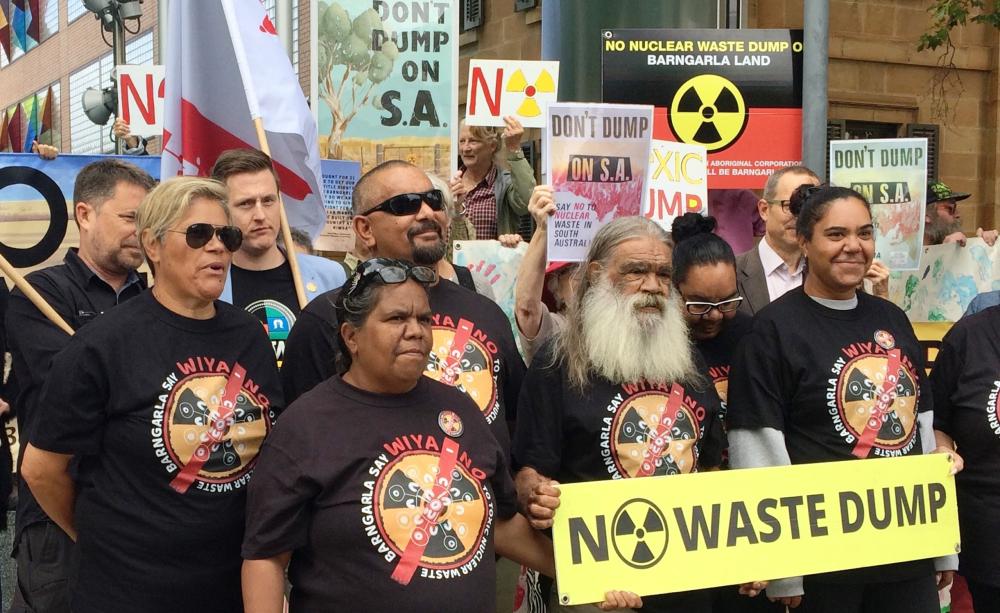
Dr Jim Green 26th July 2023 https://theecologist.org/2023/jul/26/aboriginal-australians-defeat-nuclear-dump
Historic win as South Australian Aboriginal traditional owners defeat nuclear dump plan.
Bipartisan efforts by successive federal governments to impose a national nuclear waste dump on the land of Barngarla Aboriginal traditional owners in South Australia (SA) have been upended by a federal court decision in favour of the Barngarla people.
Australians will have their say in a referendum about whether to change their constitution to recognise the First Nations of Australia by establishing an Aboriginal and Torres Strait Islander Voice later this year.
READ: Radioactive waste and the nuclear war on Australia’s Aboriginal people
The Voice would be an independent and permanent advisory body giving advice to the Australian parliament and government on matters that affect the lives of first nations peoples.
Ignored
Sadly, the federal Labor government has at the same time continued with the plan of the previous regime to establish a national nuclear waste dump near Kimba in South Australia – despite the unanimous opposition of the Barngarla traditional owners.
This plan has now come a-cropper. The Barngarla traditional owners sought to revoke the nomination of the dump site and the federal court this month agreed, arguing that the nomination of the dump site was infected by “apprehended bias” and “pre-judgement”.
The government might yet appeal the decision. However it seems likely that the plan for a nuclear dump on Barngarla country will instead be abandoned.
Aunty Dawn Taylor, a Barngarla elder, said: “I am so happy for the women’s sites and dreaming on our country that are not in the firing line of a waste dump. I fought for all this time for my grandparents and for my future generations as well.”
Jason Bilney, chairperson of the Barngarla Determination Aboriginal Corporation, said: “The Barngarla fought for 21 years for Native Title rights over our lands, including Kimba, and we weren’t going to stop fighting for this. We have always opposed a nuclear waste dump on our country and today is a big win for our community and elders.”
The Kimba site has been targeted for a dump since 2015. In 2021, the conservative Coalition government formally nominated the Kimba dump site, and the Labor government has continued with the plan since winning the May 2022 election.
Violation
Barngarla traditional owners were excluded from a so-called ‘community ballot’ by the Coalition government. An independent and professional ballot of Barngarla traditional owners found absolutely no support for the proposed dump ‒ but it was ignored.
The federal parliament’s joint committee on human rights unanimously concluded in an April 2020 report that the government was violating the human rights of Barngarla people. Even the Coalition members of the committee endorsed the report.
But the Coalition government continued to ignore the human rights of the Barngarla people. The Coalition government also tried to pass legislation which would deny Barngarla traditional owners the right to challenge the nomination of the Kimba dump site in the courts. However the draft legislation was blocked by Labor, minor parties and independent senators.
It was expected ‒ or at least hoped ‒ that the incoming Labor government would abandon the controversial dump proposal after the May 2022 election. But Labor only went as far as pointing out that Barngarla traditional owners could challenge the dump plan in the courts.
The Barngarla Determination Aboriginal Corporation was forced to launch a legal challenge against the previous government’s nomination of the Kimba dump site – and the Labor government fought the case.
Battle
There are at least two problems with Labor’s position. Firstly, the government has vastly greater resources to contest a legal challenge. Indeed, the government has spent A$13 million (£6.8 million) fighting Barngarla traditional owners in the federal court.
Barngarla traditional owners have spent significantly less than A$500,000 – needless to say, they have many pressing demands on their limited resources. There is no other example in recent Australian history of this level of legal attack on an Aboriginal group.
Secondly, the relevant laws are stacked against the interests of traditional owners. In 2007, the conservative Coalition government passed legislation ‒ the Commonwealth Radioactive Waste Management Act ‒ allowing the imposition of a nuclear waste dump on Aboriginal land with no consultation, and no consent from traditional owners.
At the time, Labor parliamentarians described the legislation as “extreme”, “arrogant”, “draconian”, “sordid”, and “profoundly shameful”.
But when the Labor government returned to the legislation in 2012 ‒ and renamed it the National Radioactive Waste Management Act ‒ the amendments were superficial and still allowed for the imposition of a nuclear waste dump with no consultation or consent from Traditional Owners.
Immoral
Regardless of the federal court’s decision, the plan to impose a nuclear dump despite the unanimous opposition of Barngarla traditional owners is immoral. It contradicts the spirit of the Voice to Parliament currently being championed by the Labor government.
Jayne Stinson, chair of the South Australian parliament’s environment, resources and development committee, said: “In this day and age, when we’re talking about ‘voice, treaty and truth‘, we can’t just turn around and say, ‘Oh well, those are our values but in this particular instance, we’re going to ignore the voice of Aboriginal people’.
“I think that’s just preposterous and it’s inconsistent with what most South Australians would think.”
The plan to dump on Barngarla country makes a mockery of Labor’s professed support for the United Nations’ Declaration on the Rights of Indigenous Peoples, which states that “no storage or disposal of hazardous materials shall take place in the lands or territories of indigenous peoples without their free, prior and informed consent”.
There is no informed consent from Barngarla traditional owners: there is informed unanimous opposition.
‘Dreadful’
Dr Susan Close, now the Labor deputy premier of South Australia, has consistently opposed the dump. She said in 2019 that it was a “dreadful process from start to finish” that led to the nomination of the proposed Kimba dump site and that SA Labor is “utterly opposed” to the “appalling” process which led to Kimba being targeted.
Dr Close noted in a 2020 statement, titled ‘Kimba site selection process flawed, waste dump plans must be scrapped’, that SA Labor “has committed to traditional owners having a right of veto over any nuclear waste sites, yet the federal government has shown no respect to the local Aboriginal people.”
She has called for her federal Labor colleagues to abandon the Kimba dump proposal once and for all in the wake of the recent federal court decision.
In February 2008, Labor prime minister Kevin Rudd highlighted the life-story of Lorna Fejo ‒ a member of the stolen generation ‒ in the historic National Apology to Aboriginal People in Parliament House.
At the same time, the Rudd government was attempting to impose a nuclear waste dump on Fejo’s country in the Northern Territory. Lorna said: “I’m really sad. The thing is ‒ when are we going to have a fair go? Australia is supposed to be the land of the fair go. I’ve been stolen from my mother and now they’re stealing my land off me.”
Resistance
Federal Labor’s “nuclear racism” is disgraceful and it diminishes all Australians. And Labor’s nuclear racism is always supported by the conservative Coalition parties, who are still today arguing for a ‘no’ vote in the upcoming referendum on a Voice to Parliament.
But nuclear racism has always met with resistance. Remarkably, community campaigns led by Aboriginal people have stopped five nuclear dump proposals since the turn of the century.
Plans for a national nuclear waste dump in SA have been defeated in 2004, 2019 and 2023 (touch wood), a planned national nuclear dump in the Northern Territory was defeated in 2014, and a plan to turn SA into the world’s high-level nuclear waste dump was defeated in 2016.
Three of the five successful campaigns involved legal challenges that made it much more difficult for governments to override community resistance.
The federal Labor government should abandon the Kimba dump site and apologise for attempting to foist a dump on Barngarla country despite the unanimous opposition of traditional owners.
Veto
The federal Labor government should also adopt SA Labor’s policy that traditional owners should have a right of veto over any proposed nuclear dumps.
That would give traditional owners across the country some confidence that their voice will be heard as the government progresses plans to store and dispose of waste arising from nuclear-powered submarines in the coming decades.
Finally, Labor must commit to amend the shameful and racist National Radioactive Waste Management Act.
This Author
Dr Jim Green is the national nuclear campaigner with Friends of the Earth Australia.
More information:
Radioactive waste and the nuclear war on Australia’s Aboriginal people
Barngarla: Help us Have a Say on Kimba (facebook)
Friends of the Earth nuclear-free campaign
No Radioactive Waste Facility for Kimba District (facebook)
Key British Assange supporter says Wikileaks founder could cut deal to secure freedom
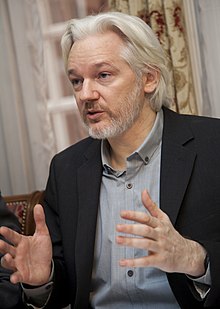
The Age, By Latika Bourke, July 26, 2023
London: One of federal parliament’s leading supporters of Julian Assange says the WikiLeaks founder could cut a deal with prosecutors and plead guilty to “whatever nonsense” necessary to secure his release from prison.
Labor MP Julian Hill, the member for Bruce, tried unsuccessfully to visit Assange in Belmarsh prison, where he has been held since 2019, during a private trip to Europe recently.
Prime Minister Anthony Albanese has directly lobbied US President Joe Biden for the Queenslander’s release but has so far failed to secure it, and has hinted that Assange may have to accept a plea deal.
“The reality is that Australia cannot force the United States to [release Assange], and if they refuse, then no Australian should judge Mr Assange if he chooses to just cut a deal and end this matter,” said Hill.
“His health is deteriorating and if the US refuses to do the right thing and drop the charges then no one would think less of him for crossing his fingers and toes, pleading guilty to whatever nonsense he has to and getting the hell out of there.”
Hill, a member of a cross-party group of MPs who support Assange’s release, also hit out at supporters who he sees as fixated on having Assange suffer as a martyr and continue to languish in prison as he faces extradition to the United States.
“It worries me greatly that there are some Assange supporters who would rather he be a martyr than a free man, but ultimately it’s important for everyone to respect what Julian himself chooses to do,” he said.
His wife Stella Assange has repeatedly warned his health has deteriorated badly due to his incarceration over the last four years…………………………………….
Stella Assange has not said if her husband will accept any plea deal, urging instead that the Biden administration force the US Department of Justice to drop the case, which began under the former Trump administration……………….
Hill said there was only one priority as the case continued to drag on and that was “bringing him home safely to be with his family”.
“I’m not privy to the negotiations that may be occurring but frankly the parliamentarians would back him to the hilt in cutting a deal if that’s what he chose,” he said.
“That’s a message that I wanted to convey personally and hear from him what he wants.”
The Australian High Commission in London tried to help Hill visit Assange on July 1, but the request was denied at the last minute by prison authorities.
“It was incredibly frustrating and disappointing that the Belmarsh Prison authorities failed to approve Mr Assange’s request for me to visit him,” Hill said. “The required paperwork was completed by Julian multiple times.
“However it mysteriously got lost and mislaid until the day before the scheduled visit when they said it was too short notice. It’s up to them to explain whether it’s a conspiracy or a stuff up, but it’s profoundly disappointing to the cross-parliamentary group.”
Jenny Louis, the governor of Belmarsh Prison, was contacted for comment. https://www.theage.com.au/world/europe/key-assange-supporter-says-wikileaks-founder-could-cut-deal-to-secure-freedom-20230725-p5dr7n.html
The Star-Spangled Kangaroo
CAITLIN JOHNSTONE, JUL 27, 2023 https://www.caitlinjohnst.one/p/the-star-spangled-kangaroo?utm_source=post-email-title&publication_id=82124&post_id=135485598&isFreemail=true&utm_medium=email
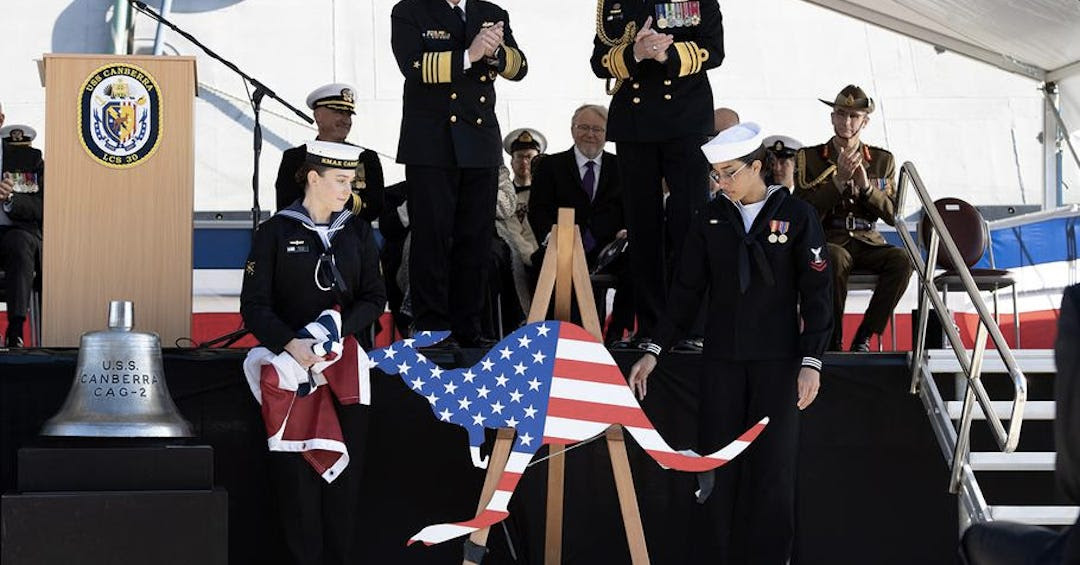
A new US warship has been ushered into service in Sydney. The ship is called the USS Canberra to honor the military union of the United States and Australia, and, if that’s still too subtle for you, it has a literal star-spangled kangaroo affixed to its side.
That’s right: the first US warship ever commissioned in a foreign port has been emblazoned with a kangaroo covered in the stars and stripes of the United States flag. An Australian officer will reportedly always be part of the staff of the ship, to further symbolize the holy matrimony between Australia and the US war machine.
“I can think of no better symbol of this shared future than the USS Canberra,” gushed US ambassador to Australia Caroline Kennedy. “Built by American workers at an Australian company in Mobile, Alabama, her crew will always include a Royal Australian Navy sailor, and from today forward, she will proudly display a star-spangled kangaroo.”
And you know what? She’s right. Not because of her giddy joy over the complete absorption of Australia into the US military apparatus of course — that’s a horrifying nightmare which is increasingly putting this nation on track toward a frontline role in Washington’s war plans against China. But she’s right that the star-spangled kangaroo and the ship which carries it is a perfect symbol for the way these two nations have become inseparably intertwined.
In fact, I’d take it a step further. I’d say the star-spangled kangaroo should be the new symbol for our entire nation.
I mean, we might as well, right? Australia is not a sovereign nation in any meaningful way; we’re functionally a US military/intelligence asset, and according to our defence minister Richard Marles our own military is being moved “beyond interoperability to interchangeability” with the US war machine so they can “operate seamlessly together, at speed.”
The US imprisons Australian journalist Julian Assange for exposing US war crimes like he’s the personal property of the Pentagon, and when the US doesn’t like our Prime Minister because he’s too keen on Australian independence or perceived as too friendly with China, they simply replace him with another one.
We even found out recently that Australians are not permitted to know if the US is bringing nuclear weapons into this country. That is a secret the US keeps from all of us, and our government respects their privacy on the matter.
So I think the star-spangled kangaroo is an entirely appropriate symbol for this country. Put it on our flag. Put it on our money. Put it on all our warships and planes, and on every military uniform. When you walk into an Australian government building, Yankarooey (or whatever stupid Aussie nickname we make up for the thing to mask our own cognitive dissonance) should be the first thing everyone sees.
Undignified? Certainly. Humiliating? Absolutely. An admission that Australia is not a real nation? Of course. But at least it would be honest. If we’re going to act like Washington’s subservient basement gimp, we may as well dress the part.
Seven deadly sins in the Defence industry

In the light of such revelations, and of the fact that nuclear-propelled submarines are really suitable only for deep sea operations, not littoral defence, Richard Marles’s obduracy in continuing to pursue Virginia-Class Attack submarines is astonishing.
It is also about whether the Australian tax payer will be ripped off in the process of acquiring them.
By Richard Broinowski Jul 27, 2023 https://johnmenadue.com/seven-deadly-sins-in-the-defence-industry/
If previous defence acquisitions are any guide, the enormous cost of nuclear-powered submarines for the Royal Australian Navy will almost certainly escalate well beyond the estimated but un-itemised initial price of $A368 billion. The record of corruption of the two US submarine builders suggests that the project will also probably suffer from mismanagement. The final bill is likely to be astronomical.
In my article ‘AUKUS exposes Australia’s incoherent defence policy’, (Pearls and Irritations 14 February 2022), I mentioned the findings of Fred Bennett, Chief of Capital Procurement in the Australian Department of Defence from 1984 to 1988. Bennett listed what he called the seven deadly sins of defence procurement projects – novelty, uncertainty, complexity, interdependence, resource limitations, creative destruction and political constraints. (Security Challenges Vol 6 No 3 Spring 2010).
Bennett claimed that all have been present to a greater or lesser degree in most acquisition projects, and none can be entirely evaded or eliminated. The record over several decades, both in Australia and Britain supports his view.
The Australian Jindalee over the horizon radar system suffered similar delays. The Lockheed Martin F-35 joint strike fighter, designed as a low-cost, lightweight high-performance stealth aircraft, is none of these things, and its project director was sacked in 2010 for cost overruns, schedule delays and a troubling performance record. The BAE Hunter class frigate program has been plagued by design changes which made the ships heavier and slower than intended.
Trying to adhere to a prime contract comprising 22,000 pages with 600 sub contracts, the Collins class submarine all but lost its way in a forest of complexity. This was exacerbated when Wormald, the lead corporation in the submarine consortium changed hands. The head of Wormald was also chair of the Australian Submarine Corporation. The ASC lost its CEO and a period of chaos followed.
But it is not just Bennett’s seven deadly sins we have to worry about with regard to the acquisition of US nuclear powered submarines. Nor is it just about confusion about their primary role, and whether they will be the best possible platform available to realise it. It is also about whether the Australian tax payer will be ripped off in the process of acquiring them.
There are precedents. ……………………………………………………………………………………………………………………………
In the light of such revelations, and of the fact that nuclear-propelled submarines are really suitable only for deep sea operations, not littoral defence, Richard Marles’s obduracy in continuing to pursue Virginia-Class Attack submarines is astonishing. Much cheaper conventional submarines with air-independent propulsion (AIP) are available from Sweden, Germany, Korea or Japan. They are quieter than nuclear submarines, have the capacity to lurk undetected for 30 days or more, are almost as fast, and are very unlikely to suffer the kind of cost blow-outs we are likely to face in nuclear-powered Virginias. We could also get them sooner.
The pro-nuclear lobby in Australia is excited by the prospect that possession of nuclear-powered submarines will lead to the capacity to develop a complete nuclear industry in Australia. This is a pipe dream. Operating experience with ANSTO’s one small Argentinian-designed research reactor at Lucas Heights does not enhance our capacity to enrich uranium, fabricate fuel rods, construct power reactors, or permanently dispose of nuclear waste. Few if any local councils would welcome construction of power reactors in their backyards. Australia still has no designated burial place for low-level medical nuclear waste. A growing number of high-level highly toxic spent fuel rods remain unprocessed at Lucas Heights. Uranium and plutonium residue from rods that have been processed overseas remain in temporary storage.
One can only hope that it is not too late to abandon the purchase of Virginia submarines in favour of much cheaper non-nuclear boats with AIP.
[problems in defence procurement, submarines, corruption, AUKUS, faulty steel plate, nuclear propulsion versus AIP]
New Zealand’s anti-nuclear stance means it won’t play a role in Australia’s submarine plans
New Zealand’s commitment to remaining nuclear-free means it won’t play a role in Australia’s defense plans to acquire nuclear-powered submarines, the leaders from both countries said Wednesday
ABC News, By NICK PERRY Associated Press, July 26, 2023
WELLINGTON, New Zealand — New Zealand’s longstanding commitment to remaining nuclear-free means it won’t play a role in Australia‘s plans to acquire nuclear-powered submarines, the leaders from both countries said after meeting Wednesday…………………………………………………………. more https://abcnews.go.com/International/wireStory/new-zealands-anti-nuclear-stance-means-play-role-101659242
US, Australia Launch Largest-Ever Joint Military Exercise
This year’s Talisman Sabre exercise involved 11 other nations and over 30,000 military personnelby Dave DeCamp Posted on https://news.antiwar.com/2023/07/23/us-australia-launch-largest-ever-joint-military-exercise/
The US and Australia on Friday launched the largest-ever iteration of their Talisman Sabre exercise as the US is increasingly focused on building alliances in the Asia Pacific against China.
The Talisman Sabre started in 2005 as a biennial exercise between the US and Australia. This year’s iteration involves participants from 11 other countries and over 30,000 military personnel.
US Navy Secretary Carlos Del Toro spoke at the opening ceremony on Friday and said the massive drills served as a warning to China. “The most important message that China can take from this exercise and anything that our allies and partners do together is that we are extremely tied by the core values that exist among our many nations together,” he said at a naval base in Sydney.
In a symbolic gesture to demonstrate the growing military ties between the US and Australia, the US on Saturday commissioned a naval vessel in Sydney, the USS Canberra, an Independence-class littoral combat ship. It marked the first time the US ever commissioned a US Navy ship was commissioned in a foreign port.
Del Toro has previously said that the US Navy envisions turning Australia into a full-service submarine hub for the US and its allies in the region under the AUKUS military pact that was signed between the US, Britain, and Australia in 2021 that will result in Canberra acquiring nuclear-powered submarines.
The US and Australia were joined in the Talisman Sabre exercises by militaries from Fiji, France, Indonesia, Japan, South Korea, New Zealand, Papua New Guinea, Tonga, Britain, Canada, and Germany. Personnel from the Philippines, Singapore, and Thailand are attending as observers.
The exercises involve live-fire drills and will conclude on August 4. A Chinese naval vessel was spotted surveilling the drills, which Australian military officials said have happened since 2017.
Congressional Concerns: Stalling Nuclear Submarines for Australia

Australian Independent Media July 23, 2023, Dr Binoy Kampmark
Any security arrangement with too many variables and multiple contingencies, risks stuttering and keeling over. Critical delays might be suffered, attributable to a number of factors beyond the parties concerned. Disputes and disagreements may surface. Such an arrangement is AUKUS, where the number of cooks risk spoiling any meal they promise to cook.
The main dish here comprises the nuclear-powered submarines that are meant to make their way to Australian shores, both in terms of purchase and construction. It marks what the US, UK and Australia describe as the first pillar of the agreement. Ostensibly, they are intended for the island continent’s self-defence, declared as wholesomely and even desperately necessary in these dangerous times. Factually, they are intended as expensive toys for willing vassals, possibly operated by Australian personnel, at the beckon call of US naval and military forces, monitoring Chinese forces and any mischief they might cause.
While the agreement envisages the creation of specific AUKUS submarines using a British design, supplemented by US technology and Australian logistics, up to three Virginia Class (SSN-774) submarines are intended as an initial transfer. The decision to do so, however, ultimately resides in Congress. As delighted and willing as President Joe Biden might well be to part with such hulks, representatives in Washington are not all in accord.
Signs that not all lawmakers were keen on the arrangement were already being expressed in December 2022. In a letter to Biden authored by Democratic Senator Jack Reed and outgoing Republican Senator James Inhofe, concerns were expressed “about the state of the US submarine industrial base as well as its ability to support the desired AUKUS SSN [nuclear sub] end state.” Current conditions, the senators went on to describe, required “a sober assessment of the facts to avoid stressing the US submarine industrial base to the breaking point.”
On May 22, a Congressional Research Service report outlined some of the issues facing US politicians regarding the procurement of the Virginia (SSN-774) submarine for the Australian Navy……………………………
The report has proven prescient enough. Republicans on the Senate Armed Services Committee have realised that stalling aspects of AUKUS might prove useful, if it entails increasing military spending beyond levels set by the current debt-limit deal………………………………………
Then came another problem: almost 40% of the US attack submarines would be incapable of deployment due to maintenance delays………………………….
The terms, for Wicker, are stark. “To keep the commitment under AUKUS, and not reduce our own fleet, the US would have to produce between 2.3 and 2.5 attack submarines a year.”…………………………………………..
Such manoeuvring has caught the Democrats off guard……………………………………………..
As US lawmakers wrestle over funds and the need to increase submarine production, the Australian side of the bargain looks flimsy, weak, and dispensable. With cap waiting to be filled, Canberra’s undistinguished begging is qualified by what, exactly, will be provided. What the US president promises, Congress taketh. Wise heads might see this as a chance to disentangle, extricate, and cancel an agreement monumentally absurd, costly and filled with folly. It might even go some way to preserve peace rather than stimulate Indo-Pacific militarism. https://theaimn.com/congressional-concerns-stalling-nuclear-submarines-for-australia/
Dutton’s Nuclear Folly: Small Modular Reactors a political mirage

by Rex Patrick | Jul 23, 2023 https://michaelwest.com.au/duttons-nuclear-folly-small-modular-reactors-a-political-mirage/
As Peter Dutton talks up nuclear power, it is not surprising to see Andrew Liveris shifting his pitch from a ‘gas led recovery’ to a call for Small Modular Reactors (SMRs) to be considered for the 2032 Brisbane Olympics. Dutton is engaged in politics, Liveris in fantasy. Rex Patrick reports on the nuclear distraction.
What’s a Small Modular Reactor?
Small modular reactors (SMRs) are nuclear powered reactors with an electrical power output of less than 300 megawatts (MW).
There’s potential for these reactors to be mass produced and deployed at significantly lower costs to traditional nuclear reactors to replace coal and gas fired power plants with low carbon, base-load, synchronous power generation.
But for a sunburnt country with an abundance of space, they will never compete with solar and wind, supplemented by base-load technologies such as batteries, hydro, pumped-hydro and molten salt.
A Liveris’ Fantasy
Liveris’s 2032 suggestion was beyond belief.
Russia has packaged two low powered nuclear ice breaker reactors in a floating barge to claim a first SMR. China has a demonstration SMR in Shidaowan. Apart from that, they don’t exist.
The US is aiming to have its first SMR generating power in 2029. Its proponent, NuScale Power, has assigned a memorandum of understanding with Polish mining firm, KGHM, to deploy a plant to support its copper and silver production in Poland.
While there are over 70 SMR designs being developed across 18 countries, few are even close to being commercially mass produced.
Australia has had some involvement in SMRs through ANSTO, the operator of the Australia’s only 20 MW nuclear reactor used for nuclear medicine, research, scientific and industrial purposes.
Since late 2020 ANSTO has been participating in a three year International Atomic Energy Agency’s co-ordinated research project on the economic appraisal of SMRs. It has assembled a team of its own and other Australian experts to analyse the economics of the technology.
They have also supported a University of Queensland PhD candidate to model the deployment of SMRs across the Australian National Energy Market. The student is due to conclude his PhD work in a few month’s time.
Eight days after Minister Chris Bowen was sworn in he sought an ANSTO briefing on SMRs.
The Politics of Dutton
While ANSTO has been at work, CSIRO has also been working with the Australian Energy Market Operator to work out the Levelised Cost Of Electricity (LCOE) for each technology.
For 2030, wind and solar are sitting on or around $50/MWh while SMRs are somewhere between $150 and $300/MWh
For 2050, wind and solar are sitting on or below $50/MWh while SMRs are somewhere between $125 and $150/MWh.
Peter Dutton is not one to let facts get in the way of a political position.
Turnbull foiled, Teals fuelled
Across 2017 and 2018 Prime Minister Malcolm Turnbull was working up a National Energy Guarantee (NEG) policy to deliver energy to Australia which balanced out cost, reliability and emissions cleanliness. It was policy designed by engineers and economists.
Dutton moved to exploit deep seated division in the Liberal National Party (LNP).
He wasn’t interested in climate change. He wasn’t interested in good policy. He was interested in himself. He used NEG to challenge Turnbull’s leadership and, while he failed, he managed to kill off the policy. A second challenge saw Scott Morrison sworn is as Prime Minister and the NEG abandoned.
Dutton was the person responsible for a moment in time that created opportunity for the Teals, who went on to displace a number of LNP members in the 2022 election.
A lack of vision
Dutton promoting nuclear will appeal to the LNP base. To the informed, he won’t appeal to those concerned about cost of living and, yet again, he’s certainly not offering leadership and vision.
Yes, there is a case for a mix of wind, solar and nuclear (in place of gas and coal), but it is not a case that’s filled with vision. A better future for Australia is one that seeks to capitalise on abundant space and renewables; a mix of wind, solar, batteries, hydro, pumped-hydro, batteries, molten-salt and other technologies.
That’s what Malcolm Turnbull was trying to do with NEG and Snowy Hydro 2.0. Sadly, Snowy Hydro 2.0 is a project that’s turning out to be a good idea poorly executed.
Originally envisaged to cost $2b, new estimates have its final costs sitting at $10b. A value for money re-assessment must occur, with one alternate pumped-hydro solution being Tasmanian with a second cable being funded to clean electrons across the Bass Strait?
Fusion power
Solutions are available as we wait for fusion energy to arrive.
Fusion received international attention in late 2022 when a US based group made more energy that was put into a fusion reaction, showing proof of concept.
It’ a long way off, a source that won’t be fielded until beyond 2050, but something we should be aiming for.
Wasted opportunity
We don’t pass our planet on to our children and grandchildren; it’s actually on loan from them. It should be treated accordingly.
We should cast our mind forward to 2070, when the world has fully embraced base-load renewables and fusion.
A young man named Dutton will be asking himself ‘what exactly was my great-grandfather thinking”, as he grapples with the still controversial and unsolved problem of dealing with high level nuclear waste from AUKUS submarines and a foray into SMRs.
The answer to the young man’s question will be, “folly”.
AUKUS’ nuclear waste dump is the secret no-one talks about. So what’ll it cost?
The $360 billion cost of AUKUS might be startling, but on top of that is another undiscussed figure: the cost of building storage for nuclear waste.
Crikey, DAVID HARDAKER, JUL 24, 2023
In late 2021, it came as a shock when Australia woke up to find that its government, under then-prime minister Scott Morrison, had secretly agreed to join the nuclear submarine club with old friends, the US and the UK.
The secret within that secret was that Australia would be responsible for the radioactive waste generated by its involvement in the AUKUS program. For the first time, Australia had signed up to construct a storage facility for high-grade nuclear waste, robust enough to last 1000 years.
Australia had never done it. Nor the US. Nor the UK. Was the iron-clad commitment to building a waste dump part of the deal struck by Morrison when he announced the AUKUS partnership? If so, he didn’t mention it at the time. Nor was it mentioned by US President Joe Biden, UK Prime Minister Rishi Sunak or Australian Prime Minister Anthony Albanese at the official AUKUS announcement in San Diego in March…………. (subscribers only) more https://www.crikey.com.au/2023/07/24/aukus-nuclear-waste-dump-cost-australia/
1 This month

of the week – Australians for War Powers Reform (AWPR)
To see nuclear-related stories in greater depth and intensity
 Antinuclear