Union push to union trustees to formally exclude nuclear energy from industry super investments
ETU pushes union trustees to block nuclear AFR, 10 July 19 The Electrical Trades Union is leading a push for union trustees to formally commit to excluding nuclear energy from industry super investments in favour of bolstering renewables. ETU national secretary Allen Hicks will propose an anti-nuclear investment motion at the Australian Council of Trade Union’s national executive later this year and use the ACTU’s Super Trustees Forum to “build and leverage support among my union director colleagues on this”.
“I want to pass a motion committing union directors in the industry super sector to focus on backing investment in renewable tech,” he will tell the union’s national conference on Wednesday afternoon.
“To focus on backing that investment instead of propping up the misguided imaginings of those who long for an Australian nuclear sector.”
The motion follows the ETU’s attack last week on an energy paper released by industry fund peak body Industry Super Australia (ISA), chaired by former ACTU secretary Greg Combet…….
Mr Hicks will attack the paper as a “disgrace” in his speech and question industry funds diverting money to ISA to produce it.
“It’s a disgrace that this body – this body that unions created – could be used as part of a push to expose workers and their communities to the catastrophic dangers that nuclear power plants present,” the speech says.
He will advocate industry super funds commit to a “war-like mobilisation” to battle climate change and “become the ultimate weapon in Australia’s fight for a clean, renewable energy sector”.
“The retirement savings of Australian workers could be deployed to invest in smart, new, renewable technology – including battery tech – that could set us on the path to zero carbon emissions.”
The ETU’s anti-nuclear position is supported by the $50 billion building industry super fund Cbus, which includes the CFMEU on its board of trustees………
Mr Hicks will argue the economics around nuclear power don’t stack up due to the costs and time taken for construction.
“But even if they did, our union would oppose it,” he will say, arguing nuclear puts workers in unsafe conditions.
“No responsible Australian trade union … no organisation that claims to represent the interests of Australian workers … could possibly endorse putting Australians into that line of potential fire.”…..
Energy Super, whose board includes ETU representatives, stressed it was “focused on maximising members’ hard-earned retirement savings”.
“We have a transparent investment process which considers many factors including environmental, social and governance criteria to ensure the sustainability of the fund over the longer term,” chief executive Robyn Petrou said.
“We are increasing our investments in renewables, such as wind farms and solar energy.” https://www.afr.com/leadership/workplace/etu-pushes-union-trustees-to-block-nuclear-20190710-p525sj
A counterview to Hugh White’s book in favour of nuclear weapons for Australia
Australia, nuclear weapons and America’s umbrella business The Strategist , 9 Jul 2019, Rod Lyon Hugh White’s new book, How to defend Australia, has stirred up a hornet’s nest on the topic of potential nuclear proliferation. In one sense, that’s a surprise, since anyone who’s read the relevant chapter knows that it’s book-ended by carefully crafted paragraphs which state explicitly that White ‘neither predicts nor advocates’ Australia’s development of an indigenous nuclear arsenal.
But in between those paragraphs White explores the history of Australian interest in a national nuclear weapons program, underlines the dwindling credibility of US nuclear assurances to allies, canvasses a possible nuclear doctrine for Australia, and recommends a force structure—more submarines—suitable to what he sees as our new straitened strategic circumstances. If he’s not advocating a nuclear arsenal, why is he telling us so much about what it ought to look like?
Let’s start with the possibility of Australian nuclear proliferation up front. As I wrote recently for a chapter in After American primacy, there are five barriers to Australian proliferation: ideational, political, diplomatic, technological and strategic. Briefly, crossing the nuclear Rubicon would require:
- Australians to think differently about nuclear weapons—as direct contributors to our defence rather than as abstract contributors to global stability
- a bipartisan political consensus to support proliferation, during both development and deployment of a nuclear arsenal
- a shift in Australia’s diplomatic footprint, to build a case for our leaving the Non-Proliferation Treaty, and abrogating the Treaty of Rarotonga, while still being able to retail a coherent story of arms control and nuclear order
- serious investment in the technologies and skill-sets required to construct and deploy, safely and securely, both nuclear warheads and appropriate delivery vehicles
- and a strategy which gives meaning to our arsenal and an explanation of our thinking to our neighbours and our major ally.

New South Wales Deputy Premier John Barilaro sucked in by slick propaganda from “New Nuclear” lobby
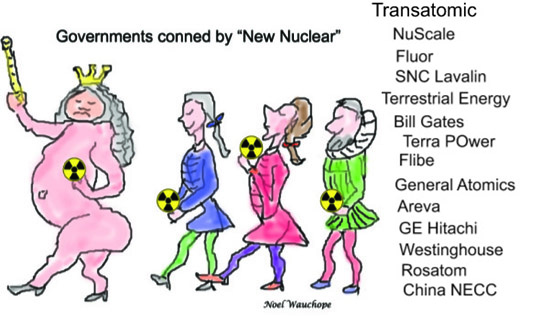
The NSW Deputy Premier has thrown his support behind the push for a Senate inquiry into the benefits of a nuclear power industry in Australia.
Nuclear energy is a controversial solution to Australia’s deepening energy crisis but it still remains illegal in Australia.
Queensland National Keith Pitt and Liberal Senator James McGrath have also backed a parliamentary inquiry into nuclear power.
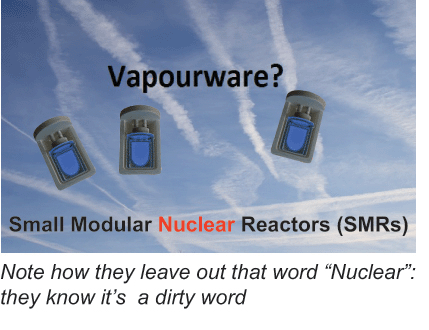 NSW Deputy Premier John Barilaro tells Merrick Watts Australia needs to welcome nuclear energy into the conversation.
“Chernobyl or Fukushima… that technology is your granddad’s technology.
“What is on the horizon, small modular reactors, gives us a chance to really look at this through a different lens.”
The unwisdom of Australia mindlessly following USA into a war against Iran
 We must think very carefully before committing to war in the Gulf, The Age, By Hossein Esmaeili, July 8, 2019 Conflict between the United States and Iran is deepening and the two states are marching towards war. The Persian Gulf, where a third of the world’s natural gas and a fifth of the world’s oil is sourced, may soon see another large scale and probably long-lasting international conflict………
Australia has no legal obligations under the ANZUS Treaty, or any other international agreement, to join the US in another possibly long, chaotic and devastating regional conflict. Indeed, under the Charter of the United Nations, to which both Australia and the US are parties, the use of force is prohibited unless authorised by the Security Council of the United Nations.
the European Union is backing measures, provided by France, United Kingdom and Germany, known as Instruments In Support of Trade Exchange (INSTEX), to facilitate trade between the EU and Iran to partially get around the US sanctions, in order to save the 2015 nuclear deal, to maintain dialogue with Iran and to prevent an international military crisis.
Australia would be much wiser to join the EU’s INSTEX and engage in dialogue with Iran……..
Should Morrison decide to enter into a conflict in one of the most volatile regions of the world, he will not have the decision-making power to end it. He would do well not to drive Australia into such a war, instead, given Australia’s international reputation, he should help European countries, the world community and the United Nations to avoid a useless armed conflict, which will not benefit any country.
Hossein Esmaeili is an associate professor of international law at Flinders University. https://www.theage.com.au/world/middle-east/we-must-think-very-carefully-before-committing-to-war-in-the-gulf-20190708-p52566.html
Is Napandee, (Jeff Baldock’s property) near Kimba the govt’s chosen site for expanded nuclear waste dump?
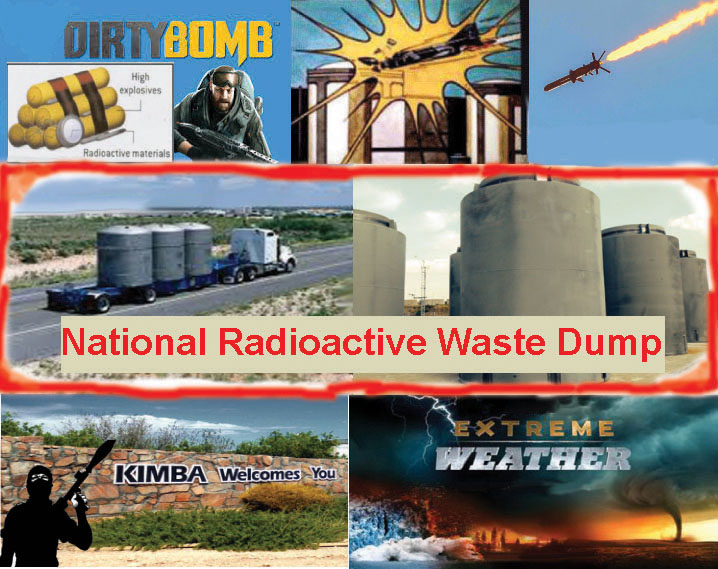
Federal Government denies claims it has a preferred site for radioactive waste storage in South Australia, Advertiser, 8 July 19,
A Kimba property is allegedly the frontrunner for a future nuclear waste dump, a source claims – but it’s disputed by the Federal Government which says no favoured site has been picked.
The Federal Government says it is yet to select a favoured site for its proposed radioactive waste facility, rebuffing claims that a Kimba property is the frontrunner.
A spokesman for the Department of Industry, Innovation and Science also says the Government is not bound to wait until a court case on the issue is finalised before selecting the best place for the contentious development.
A source close to the project has claimed the waste storage site is now likely to be at least 60 per cent bigger than previously envisaged.
The Government is considering three sites for the radioactive waste facility – two near Kimba and one near Hawker.
A Kimba-based consultative committee is due to meet next month to discuss the project.
The source believes Napandee – a property 25km northwest of Kimba – is the Government’s preferred site and next month’s meeting will discuss revised requirements for the proposed waste site.
“There’s a rumour getting around town that Napandee is the one they’ve chosen and it seems to align with this revelation over the last week that they suddenly have to increase the size of the land from 100ha to 160ha or 170ha,” the source said.
“Whoever gets the site is going to get 70 per cent more money because it’s a bigger parcel.
“They’ve always said that there would be cropping and agricultural trials at the (land) that’s not being used for the buildings. Apparently now the safety regulator has said that is not going to happen.”
Various stakeholders The Advertiser spoke to believed there would be little progress on the project until after a legal challenge was complete.
The Barngarla Determination Aboriginal Corporation took Kimba Council to court in January over its plan run a community ballot to determine the level of support for the dump, arguing it was discriminatory.
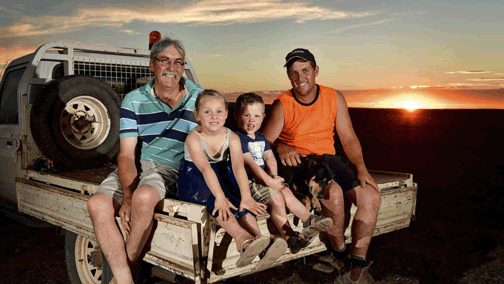 Napandee owner Jeff Baldock said the Kimba community was awaiting the court ruling.
“There’s not much happening – obviously things are still ticking along quietly in case it happens,” Mr Baldock said. (Baldock and family at left)
Once a court decision was made “we can get our vote and get on with it”, he said.
Kimba chief executive Deb Larwood said the community was “in a holding pattern” until the case was finalised.
A spokesman for the Department of Industry, Innovation and Science said community ballots were suspended last year because of the court challenge, but the department was also aware “the community would like to see a decision as soon as possible”.
The Government was not required to wait until the court process was complete.
“The National Radioactive Waste Management Act 2012 provides the (Resources) Minister (Matt Canavan) with discretion to make decisions in relation to nominations and site selection,” he said.
“That said, it has been stated consistently that if there is no broad support for the facility then it will not be imposed on a community.”
The Government had no strict definition of “broad support” for the proposed site, which would measure at least 100ha.
That would be determined by a range of factors, including submissions, feedback from the community in meetings, conversations with neighbours and “the results of any ballot if one proceeds”.
The spokesman said it had been agreed the site could include “community-led agricultural research and development” but the exact nature of this was yet to be determined.
New South Wales National Party formally adopts pro nuclear policy
 NSW Nationals formally support nuclear power stations, The Northern Daily Leader, Jamieson Murphy 8July19
THE NSW Nationals have formally made supporting nuclear power a part of its policy platform, following a grassroots push from within the party.
At the recent annual conference in Inverell, a motion to “support the use of nuclear power in Australia” was put forward by both the Orange and Narrabri Nationals branches, and passed unanimously.
“If they’re not going to let us have a new coal-fire power station, we have to look at nuclear power,” Mr Scilley said. “Renewables work when the winds blows and the sun shines, but they’ve got no back up. We need to cover base-load power.”
Mr Scilley said it was up to the regions to lead the controversial debate.
“People out in the country are more practical – people in the city don’t realise where their food comes from or what it takes to produce it,” he said “The government needs a push in the right direction. The biggest problem is minority groups get too much of a say.” Mr Scilley believes the majority of Australians would support nuclear power “if it meant a lot cheaper power”.
New England Nationals chair Russell Webb was singing off the same hymn sheet…..
“I think if we take emotions out of it and face the topic realistically, we can see that this nation has some fantastic resources, ones that can supply either fuel for coal-fire power stations or nuclear power.” Mr Webb said it was “foolish” for Australia to think of an energy future without a secure base-load supply. Nuclear power stations, which are used across the world, are one great solution for that,” he said.
NSW Nationals leader and Deputy Premier John Barilaro recently said Tamworth or Armidale could be the site of a new nuclear power station. Mr Barilaro said modern nuclear power technology means small scale plants could be established in parts of regional Australia. “If you want to get away from coal, well nuclear energy, there’s a real chance for it because of the new technology, the new small modular reactors that are now on the horizon,” Mr Barilaro said.
The Deputy Premier said these were not as water hungry as traditional nuclear power plants, because they use air or sand to cool the core…….. https://www.northerndailyleader.com.au/story/6262310/nats-go-nuclear-and-formally-support-controversial-energy-source/
Why Australia should absolutely not contemplate getting nuclear weapons
Australia could equally consider acquiring nerve gas or biological weapons as a “deterrent”, but the notion is unthinkable. The acquisition of nuclear weapons, which are far more destructive, should be equally so.
Professor White’s advice to keep the nuclear weapons option open should be rejected outright. It is a recipe for nuclear weapons proliferation, and a world armed to the teeth with self-destructive capacity. We survived the Cold War but might not be so lucky again. Nuclear weapons must be abolished, and the discussion in Australia should be about rapidly getting on board with global efforts to achieve this critical goal.
Signing the Treaty on the Prohibition of Nuclear Weapons would be a good start.
 Our own nuclear weapons? That’s the exact opposite of what we should do https://www.canberratimes.com.au/story/6261965/our-own-nuclear-weapons-thats-the-exact-opposite-of-what-we-should-do/, Sue Wareham 8 Jul 19
Have the Nukunu Aboriginal people been consulted about proposed Wallerberdina nuclear waste suppository?
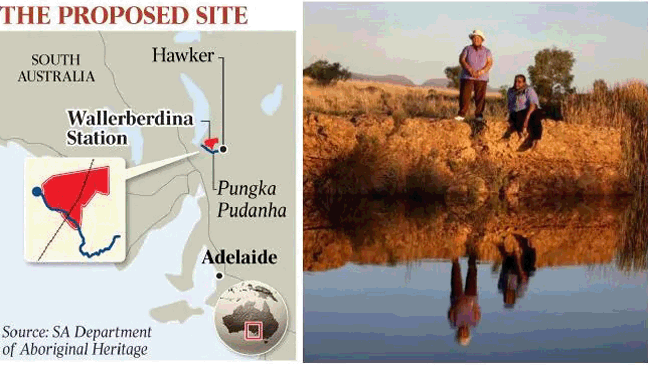
On June 21 2019, the Nukunu Native Title Claim achieved Consent Determination. Their traditional country includes Quorn &, according to the Federal Court Map, extends north up to Wallerberdina.
Well within a 50k radius of the proposed national suppository; & also includes much of the Flinders Ranges District Council precinct. Therefore entitled for consultation.
HAVE THE NUKUNU BEEN CONTACTED BY DIIS & INCLUDED WITHIN THE SO-CALLED ‘NRWMF COMMUNITY CONSENT ASSESSMENT PROCESS’? Procedural fairness requires such…..
ENuFF[SA] Office Admin https://www.facebook.com/sanuclearfree/
Uranium contamination in groundwater in an Adelaide suburb
|
Uranium among contaminants sparking proposed bore water ban in Thebarton, ABC News By Eugene Boisvert, 5 July 19 About 1,500 Adelaide residents and businesses have been told not to use groundwater because of contamination from uranium and degreasing chemicals.
Key points:
The Environment Protection Authority (EPA) is proposing a permanent groundwater ban for the area, which includes most of Thebarton and a small part of Mile End, just west of Adelaide’s CBD. The authority has also found contamination from degreasing chemicals tetrachloroethene (PCE) and trichloroethene (TCE) that were used in the area. Similar groundwater bans are in place in Adelaide suburbs including Edwardstown, Clovelly Park, ……. https://www.abc.net.au/news/2019-07-04/uranium-among-contaminants-leading-to-thebarton-bore-water-ban/11277300 |
|
The raid on journalist’s home by armed federal police
AFP emails shed new light on media investigations, show officers were armed during raids, SMH, By Kylar Loussikian and Bevan Shields, July 5, 2019 The Australian Federal Police initially classified its investigation into a high-profile national security leak as “routine” and of “low value”, according to a cache of documents that also reveals police were armed when they launched two recent raids on the media.
Emails obtained by The Sydney Morning Herald and The Age under freedom of information laws also offer fresh evidence that Annika Smethurst, a senior member of the Canberra press gallery, could be prosecuted for publishing secret government information.
The AFP is expected to be called before a parliamentary inquiry to explain the chain of events leading to raids in early June on Smethurst’s Canberra home and the Sydney headquarters of the ABC over separate stories based on sensitive and secret government information.
The search warrants sparked a major debate over press freedom, with media chiefs lobbying the Morrison government over recent days for swift legal changes to better protect whistleblowers and journalists………
Other documents reveal officers were armed when they entered Smethurst’s home as well as the ABC’s headquarters in inner Sydney. ……
Nine chief executive Hugh Marks, ABC managing director David Anderson and News Corp corporate affairs director Campbell Reid met with the Attorney-General at Parliament this week but were not given a guarantee that the journalists would be spared prosecution……https://www.smh.com.au/politics/federal/afp-emails-shed-new-light-on-media-investigations-show-officers-were-armed-during-raids-20190705-p524kc.html
Australian unions reject Industry Super’s backing of the nuclear industry
 Unions revolt over Industry Super’s nuclear backing, Financial Review, David Marin-Guzman 3 July 19 The Electrical Trades Union has condemned a report from Industry Super Australia that backed nuclear energy as an option to confront the energy crisis, sparking a split between unions and industry funds’ own peak body.
ETU national secretary Allen Hicks said industry fund participants were not consulted on the ISA energy paper released last week and called on unions to condemn the paper’s recommendations, which he said promoted a “highly risky investment with deadly consequences”.
While the paper titled Modernising Electricty Sectors stressed it was not “pro nuclear” it said nuclear must be considered as part of the energy investment mix and questioned the capabilities of battery and renewable options.
“The ETU has very strong concerns about this ISA report that broadly spruiks nuclear power while using flawed assumptions and poor modelling to write down the capacity of renewables and battery technology,” Mr Hicks said.
“This report has been developed without consulting key industry stakeholders or actual members of ISA that we have been in contact with.”
The comments mark a significant push-back against the industry fund peak body, which is chaired by former Australian Council of Trade Unions chief Greg Combet.
The ETU has representatives on industry funds Cbus and Energy Super and its anti-nuclear position is shared by the maritime union, which opposes shipping nuclear material into ports.
Cbus, whose board members include building unions such as the CFMEU, joined the ETU in disagreeing with the ISA paper’s position.
“The ISA paper raises a number of interesting points for discussion. However, from an investment perspective Cbus doesn’t see nuclear as a part of Australia’s energy mix and we are actively pursuing other energy opportunities,” a spokesman for the fund said.
Mr Hicks said he supported ISA taking the lead on energy investment due to government inaction. But he argued it should focus on maximising returns, not promoting an industry that “would put at risk the very people who industry super represents – union members”.
The ETU has opposed nuclear power and uranium mining since the Second World War due to perceived risks to workers and the public.
Mr Hicks said members had “witnessed first-hand the death and destruction that comes with this form of power” and “more recent disasters in Fukushima and Chernobyl only reinforce this view”.
“That’s why it’s so vexing that industry funds our members pay their retirement savings into would offer any support to a report giving the nod to nuclear.”
………. ETU national industry co-ordinator Matthew Murphy claimed the ISA report “fluffed up” the benefits of nuclear power while including flawed assumptions on renewables “that had no basis in reality”.
“This report is biased toward nuclear power and against renewables and that clearly bears out in shoddy maths and assumptions like ‘a battery will only run for one hour’ or that the island nation of Australia is not suitable for offshore wind and tidal power,” he said.
Mr Murphy said the “most glaring” statement in the paper was that 100 to 150 nuclear power plants was enough to power half the country.
“Unlike the numbers in the report, we can’t pluck nuclear reactors out of thin air. And there is likely to be huge public opposition from the 150 towns where these deadly power plants would be built.” https://www.afr.com/leadership/workplace/unions-revolt-over-industry-super-s-nuclear-backing-20190702-p5239a
News Corpse comes out with a weird pro nuclear ramble
 (salient bits of the long, rather weird ramble)
……….The view globally is that nuclear power provides the best emissions-free hedge against a failure of renewables to satisfy more than about one-third of a nation’s energy requirements.
Ed. the view globally – whose view exactly?
The Prime Minister is being urged to give his blessing to a review of the potential for nuclear energy in Australia.
Queensland MPs Keith Pitt and James McGrath have proposed terms of reference for an inquiry that will review advances in nuclear energy including small nuclear reactors and thorium.
The NSW parliament will conduct its own review.
One Nation MLC Mark Latham has legislation before parliament to legalise uranium mining and nuclear facilities.
“The climate change challenge is real but a renewables fetish can’t solve it,” he says.
NSW Deputy Premier John Barilaro has called for a national vote to end the ban and says the northern cities of Tamworth or Armidale could be the site of a new nuclear power station.
Scott Morrison says he won’t oppose nuclear if the economics stack up but no one is offering to build a reactor in Australia.
Advocates of the nuclear option are playing a long-term game.
In April, OECD Nuclear Energy Agency director general William Magwood made his first official visit to Australia. He met the energy ministry, the Australian Safeguards and Non-proliferation Office, the Australian Radiation Protection and Nuclear Safety Agency, the Australian Nuclear Science and Technology Organisation and the Energy Policy Institute of Australia……
Magwood’s discussions highlighted uranium resource issues but also focused on NEA analyses related to the decarbonisation of electricity systems and radioactive waste management.
While Australia has no plans to build nuclear plants, in 2016 the country joined the Generation IV International Forum, for which the Nuclear Energy Agency acts as technical secretariat.
Ed note: Let us not forget that nuclear industry law-unto-himself Dr Adi Paterson signed Australia up to this with no Parliamentary discussion and no government authorisation . A month later a senate committee ratified this – still no parliamentary discussion, despite the fact that Australa has laws against constructing nuclear reactors.
Magwood’s talks with Australian authorities included the latest research and development on advanced nuclear systems………
One of the themes of the discussion paper is that mainstream thinking on the energy market may be misleading in many areas…….Ultimately, there is the prospect that some wind and solar projects themselves may become stranded assets.
The problems of intermittency are at the heart of global concerns. Federal Energy Minister Angus Taylor is trying to address the issue with a reliability obligation for generators………
nuclear has advantages that intermittent sources of energy cannot provide.
And a recent OECD report assesses the levelised cost using a 3 per cent interest rate at $US100 per megawatt hour for commercial solar, $US70 per megawatt hour for onshore wind and $US50 a megawatt for nuclear………..
Ed. note. Really – source?
Australia lagging
It was noted that Australia is one of the few First World economies without nuclear power and experience in managing a nuclear plant…….
Ed note. Along with Austria, Denmark, Greece, Ireland, Italy, Latvia, Liechtenstein, Luxembourg, Malaysia, Malta, New Zealand, Norway, Philippines, and Portugal. Belgium, Germany, Spain and Switzerland are phasing-out nuclear power
Not considering nuclear puts Australia in the minority of First World economies. It is also lagging several Second and Third World economies in our region and elsewhere such as Argentina, Mexico, Bangladesh and Turkey and geographical neighbours such as Indonesia and Vietnam…….
Based on the Tesla battery in Adelaide, achieving 1½ days’ energy storage would cost $6.5 trillion, enough to build about 1000 nuclear reactors.
For household batteries, it would cost about $US7000 per household every 10 years to provide back-up for 36 hours……..
One important step would be to build some capacity to operate a nuclear facility.
This would provide insurance against failure in alternative options or rapid change in technology.
It says a single reactor would be a relatively small investment.
Ed note: really? https://www.theaustralian.com.au/inquirer/report-argues-for-the-nuclear-energy-option/news-story/f3faf4befb3d68cedc01c6735d467976
Former Environment Minister rejected department advice and approved uranium mine day before election called
The admission is contained in a statement of reasons signed by the minister before she approved the Yeelirrie uranium mine, 500km north of Kalgoorlie, the day before the federal election was called in April.
The document also shows the environment and energy department recommended conditions that would require the developer, Cameco, to ensure the project would not result in the extinction of up to 11 stygofauna, which are tiny groundwater species.
But Price instead adopted a weaker set of conditions aimed at reducing the risk to groundwater species but which the department said contained “significant uncertainties” as to whether or not they would be successful.
Price acknowledged the department had recommended tougher conditions but said in the statement that if they were imposed there was “a real chance that the project would not go ahead”.
“In making this recommendation, the department considered only the environmental outcomes, and did not weigh the environmental risks against the social and economic benefits of the project,” she said.
“Rather, as the department’s briefing noted, this balancing exercise was for me to do”.
Price wrote that she “accepted that there was a risk” that species could be lost but that the department’s advice was this was not “inevitable” if the project went ahead.
The statement of reasons also notes that the project could lead to the wipeout of the entire western population of a species of saltbush, known as the Atriplex yeelirrie.
The saltbush has just two distinct populations, the western and eastern population, both of which are found on Yeelirrie station.
The statement of reasons says the western population occurs entirely within the proposed area for the mine and there is a risk the development would clear all of it.
The Australian Conservation Foundation, which requested Price’s statement of reasons, described the document as “an extraordinary piece of decision making”.
A new book argues that Australia will need nuclear weapons

Nuclear arsenal must be on Australia’s agenda, argues defence expert, SMH, By Harriet Alexander, July 1, 2019 Australia can no longer rely on the United States to protect it in Asia and should consider developing its own nuclear weapons for the event that China becomes hostile, former defence strategist and security analyst Hugh White argues in a controversial new book.
Professor White argues in How to Defend Australia the assumption that the United States would protect the nation against any attack by a major power, which has underpinned Australian defence policy since the Cold War, is no longer true as China emerges as the dominant power in Asia.
For Australia to be self-reliant, it would need to boost defence spending from 2 per cent to 3.5 per cent of GDP – or $30 billion – and consider the “difficult and uncomfortable” question of developing its own nuclear capability, said Professor White, a professor in strategic studies at the Australian National University……..
Although most think tanks and strategic policy institutes in the United States continued to assert that dominance in Asia was a strategic priority, America’s global leadership has not figured as a priority for President Donald Trump nor for the contenders to the Democrat nomination, Professor White said. ……
Professor White said Australia should only consider defensive weapons such as submarine-launched ballistic missiles.
“We need to be extremely careful about how we talk about this and very conscious of the extraordinary cost to us of acquiring nuclear weapons,” Professor White said.
“It would make us less secure in some ways, that’s why in some ways I think it’s appalling.”
The last prime minister to canvass the development of nuclear weapons in Australia was Robert Menzies in the 1960s.
Professor White, a former deputy secretary for strategy and intelligence with the Department of Defence, was dismissed as alarmist when he first foreshadowed in 2010 the demise of American influence in Asia. But the Lowy Institute’s international security program director Sam Roggeveen said he had since been proved correct.
Mr Roggeveen said the regional complications of Australia developing nuclear weapons would be huge, with Indonesia probably having to follow suit, but the logic was inescapable.
“If we ever completely decouple from the [US] alliance then it’s hard to see how we could essentially maintain our independence against China’s coercion if we didn’t have nuclear weapons,” Mr Roggeveen said.
The bipartisan political consensus on Australian defence policy is opposed to the development of nuclear weapons, and the domestic shipbuilding program would leave Australia “hopelessly vulnerable” if it ever came to a fight with China, Mr Roggeveen said.
“According to White, we are locking in a defence force for a generation that will be totally unsuited to the world we are entering,” he wrote in a book review for The Interpreter. “That’s the scandal.”
The Minister for Defence, Linda Reynolds, said: “Australia stands by its Non-Proliferation Treaty pledge, as a non-nuclear weapon state, not to acquire or develop nuclear weapons.”
La Trobe Asia executive director Euan Graham said the US alliance was more resilient than Professor White described and China had shown no signs of aggression, but he agreed Australia should think about developing its nuclear capability.
“We’re talking about 15 to 20 years acquisition timeframe and the security environment that we’re facing will almost certainly be more severe then that it is now,” Dr Graham said.
“I think Australia has to be thinking about what will be be required to move to a nuclear weapon posture because that can’t happen overnight.” https://www.smh.com.au/politics/federal/nuclear-arsenal-must-be-on-australia-s-agenda-argues-defence-expert-20190701-p52306.html
South Australia the leader in energy efficiency
 South Australia leads push for energy efficiency, India Murphy,
  ,
,
1 This month
.

Australians deserve the truth
about
AUKUS – https://aukuspublicinquiry.com/

PETITION – To: Prime Minister Anthony Albanese and the Australian Labor Government

of the week – Australians for War Powers Reform (AWPR)
To see nuclear-related stories in greater depth and intensity

