The global nuclear lobby co-opts academia- now they’ve got University of Tasmania

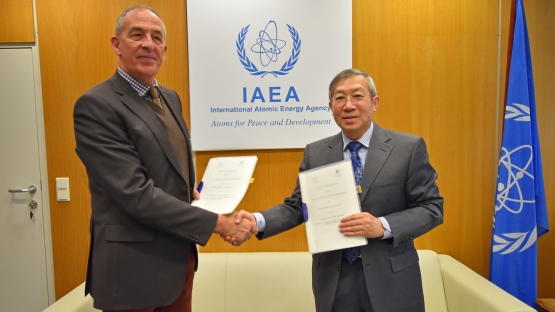 IAEA and University of Tasmania Sign Practical Arrangements Agreement to Enhance Cooperation in Human Health, Agriculture, Environment and Marine Sciences , On 12 December, the IAEA and the University of Tasmania (UTAS) signed a Practical Arrangement which provides a framework for closer collaboration in the areas of health, agriculture and the marine environment. The agreement – the first signed between the two organizations – covers the period of 2018 to 2021.
Pangea, reborn as ARIUS, waiting in the wings for the Australian govt to privatise a nuclear waste dump
 Kazzi Jai Fight To Stop Nuclear Waste In The Flinders Ranges, PANGEA was leaked to the Australian Media in 1998. Although it has since changed its name to ARIUS in 2012, it still remains active, as shown clearly by the Royal Commission into the Nuclear Fuel Cycle recently, and the very heavy push for an International Nuclear Dump by invested interests.
But South Australia said NO MEANS NO!
There is no doubt in my mind that this is the ENDGAME.
The fact that this current proposal by the Federal Government does not address the Intermediate Waste final disposal AND that the Intermediate Waste will be part of the dump – as “temporary storage” has all of the hallmarks of a Claytons INTERNATIONAL NUCLEAR DUMP. …..All it needs is a stroke of a pen, PRIVATIZATION, and WHAM, BAM – THERE YOU GO! https://www.facebook.com/groups/344452605899556/

STAND UP TO NUCLEAR WASTE DUMP BULLIES
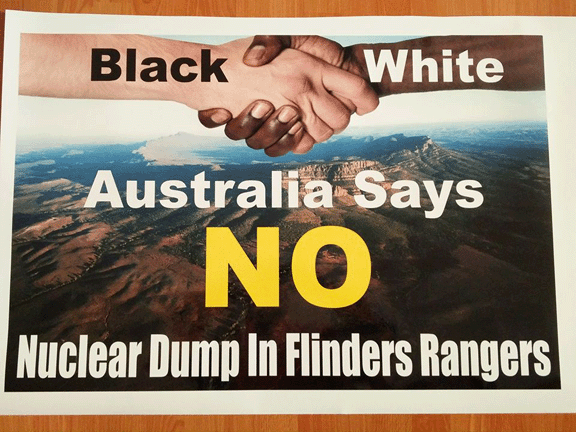
The Federal Liberal Govnt Nuclear Waste Dump Process is subjecting people to intimidation, insults, threats and bullying.
The Federal Liberal Govnt process has been appalling and is feeding the bad behaviour of pro nuclear waste dump bullies.
The Federal Liberal Govnt nuclear waste dump process has fractured the communities in the Flinders Ranges and Kimba regions (near the proposed nuclear waste dump sites) and has encouraged intimidation, insults, threats and bullying.
Pro nuclear waste dump bullies have also come to my facebook page and insulted me and insulted my facebook friends because we express views they disagree with.
Pro nuclear waste dump bullies can insult me as much as they like, but it wont change the Facts :
A Radioactive Nuclear Waste Dump facility study in 2005 conducted by URS Australia for the EPA (SA) and SA Govnt, found the Flinders Ranges and Eyre Peninsula regions unsuitable for a low level Radioactive Nuclear Waste dump, let alone intermediate level nuclear waste – which the Federal Liberal government have obviously ignored.
The Flinders Ranges proposed nuclear waste dumpsite near Hawker, is on a floodplain, 5.5kms from the nearest ranges, 6.5 kms from extensive natural springs and 3 kms from Hookina Creek.
The Flinders Ranges and Outback contributed $425 million in tourism to South Australia in 2017 and projected $452 million in 2020 (SATC regional profile). How will establishing a nuclear waste dump in the Flinders Ranges affect tourism??? – Will the one off payment of 30 million carrots (20 million carrots to become available after the dump is established) compensate for lost tourism numbers and revenue???
The Flinders Ranges proposed nuclear waste dump site is in a seismically active region, on a floodplain, that flows into Lake Torrens – remnants of past major flooding and seismic activity are obvious.
The Eyre Peninsula proposed nuclear waste dump sites, near Kimba, are on farmland and next to Lake Giles Conservation park.
The Eyre Peninsula farming region contributes a third of all the grain grown in South Australia, worth $1.7 – $2 billion annually to South Australia – why would you even contemplate establishing a nuclear waste dump on farmland ??? – and if there is a nuclear waste accident – what then ???
Recent ABC News : “Lucas Heights facility fails modern nuclear safety standard, independent review finds”. ANSTO (Australian Nuclear Science and Technology Org), the organisation that manages the Lucas Heights Nuclear Reactor facility near Sydney, the same organization that will manage the National Nuclear Waste Dump facility, was found to have a culture of “make do and mend”.
The Federal Liberal govnt propose to transport radioactive nuclear waste thousands of kms, from all over Australia, to a national nuclear waste dump in South Australia. Not only will South Australians and all future generations be burdened with the nuclear waste dump for eternity, so will communities along the transport route. And just like 99% of South Australians, those communities along the transport route will have no say. Spencer Gulf cities will become nuclear waste dump transport central, with radioactive nuclear waste being transported several times a week (for the first 4 years) to the proposed nuclear waste dump, through Spencer Gulf ports, roads and rail.
There was nothing scientific about the way the proposed sites were chosen – land owners were asked to nominate their properties for a nuclear waste dump and get paid 4 times what the property owners say the property is worth – and no need to consult with neighbours or the community. And the cattle property owner at the proposed site in the Flinders Ranges (long term lease) is an ex Federal Liberal president (doesn’t live at the property), who chaired a failed attempt in the 90’s to establish a nuclear waste dump in South Australia.
Even after 30 years, high-level nuclear waste is still 10,000 times more radioactive than uranium ore and will take 10 million years to get to the same radioactivity as uranium ore.
No Respect – No Trust : How can we trust a Federal Govnt that keeps on stabbing their leaders (prime ministers) in the back????
Why on earth would the Federal Liberal govnt want to dump nuclear waste (intermediate-level and low-level) in the Flinders Ranges, on a floodplain, in a seismically active region, bordered by natural springs, in an iconic tourism destination, or on Eyre Peninsula farmland, near Kimba and next to Lake Gilles Conservation Park?????
Each state should establish their own low-level Nuclear Waste Dump and the intermediate-level and high-level radioactive nuclear waste produced at the Lucas Heights Nuclear Reactor should stay on the grounds at Lucas Heights until a permanent solution can be found. https://www.facebook.com/groups/1021186047913052/
TEACHER ATTEMPTS TO DERAIL PATH TO ECOCIDE TO ENSURE FUTURE FOR STUDENTS
 Frontline Action on Coal , 8 Jan 19 Frontline Action on Coal , 8 Jan 19
Early this morning, 37 year old teacher Jesse Secomb brought coal trains to a halt in protest of the proposed Adani Carmichael coal mine. Securing himself to a concrete barrel located on the railway tracks, Jesse has blockaded the transport of coal into Abbott Point Coal Terminal situated just outside of Bowen in Queensland. Jesse’s protest marks the first of its kind against Adani for 2019, following a magnitude of demonstrations in previous years as part of a nationwide movement against the mine after growing concern on the impacts the proposed mine will have on the environment and climate. Jesse stated that concerns about recent planned work by Adani on the mine inspired him to take urgent action. After declaring that work on the mine would start by Christmas, Adani has yet again failed to meet a self imposed deadline, instead blaming the QLD Governement after a recent request to review and resubmit their groundwater management plan after concerns were raised. When asked why action was needed, Jesse said “Working as a teacher, you really grow to care for your students and want to support them in realising their hopes and dreams. But what’s the good of dreaming about the future, if the future of the planet is in crisis? If the Adani mine goes ahead it will pump an extra 705 million tons of deadly carbon into the air, making it almost impossible to make the necessary changes over the next 12 years to avert a climate catastrophe.” He refers to the recent IPCC report by the worlds leading climate scientists which states that we only have 12 years to act on climate change and keep global warming within 1.5C, avoiding extreme heat, droughts, floods and poverty. Despite recent claims by resources minister Matt Canavan that communities of “David’s” were facing huge battles with Goliath’s of green activists, many of those protesting the mine are every day Australian’s who don’t want to see the even more Australians suffer from further drought, fires and heat as a result of inaction on climate change. |
Adani tries to bankrupt Wangan and Jagalingou man, Adrian Burragubba, I
 It’s the multi-billion dollar mega-mine set for Queensland. But one man is trying to stop it going ahead. And he isn’t going away. news.com.au Adrian Burragubba has been a thorn in Adani’s side for years and now the mining giant has had enough.
 Last month Adani filed an order seeking to bankrupt the Wangan and Jagalingou man by demanding payment of more than $600,000 in legal costs.
The extreme action follows numerous failed court actions that Mr Burragubba has been party to since 2015 to stop Adani’s coal mine in Queensland’s Galilee Basin from going ahead.
Mr Burragubba is part of the W&J People, who have a native title claim over about 30,000sq km of land in central Queensland, west of Rockhampton, including the townships of Clermont, Alpha, Rubyvale and Capella.
He’s a vocal member of the W&J Family Council disputing the validity of the indigenous land use agreement (ILUA) which Adani has secured from the traditional owners of the land.
The W&J had been negotiating with Adani since 2011 but were unable to reach an agreement so the company applied to the National Native Title Tribunal to grant them two mining leases.
The tribunal can order that mining leases be granted even if an agreement with traditional owners has not been reached.
In October 2013, the Queensland Government gave notice it intended to grant the leases and a six-month negotiation process started between the mining company and native title holders.
Australia’s first Indigenous silk Tony McAvoy has previously criticised the native title system because the tribunal rarely rejects applications for mining leases.
Mr McAvoy is a W&J traditional owner and he said Aboriginal people were being coerced into agreements with mining companies because if an agreement was not reached, they lost their opportunity to negotiate compensation or royalties.
“If we don’t agree, the native title tribunal will let it go through, and we will lose our land and won’t be compensated either. That’s the position we’re in,” Mr McAvoy told The Guardian.
…….At the meeting, which Mr Burragubba has claimed is not valid, there were 294 votes to approve the agreement and only one against.
But Mr Burragubba said the company failed to explain that once native title is relinquished it cannot be reclaimed.
“Our position has always been the same — that there has never been any free or informed consent with any agreement with Adani,” Mr Burragubba said in August.
However, legal action challenging the registration of the land use agreement was dismissed on August 17, 2018.
The decision was delivered after the Federal Government passed legislation to override a separate Federal Court ruling that all members of a native title group had to approve of an agreement for it to be valid.
The law change was important for Adani because its agreement did not get approval from all 12 families represented.
At that point, state and federal governments had already granted Adani all necessary state and federal approvals, although it still needs to submit groundwater and other plans.
But Mr Burragubba has refused to give up.
Another appeal was filed on September 7 and is due to be heard in May.
Adani tried to stop the most recent action, which was originally scheduled for February, by asking the court to force W&J representatives to pay $160,000 in security costs or have their appeal dismissed.
Adani’s lawyers said it had tried to recoup payment of $637,000 in legal fees from previous cases and had been unsuccessful. While the court agreed to the payment, it reduced the amount to $50,000 that must be paid by the end of January.
The decision was a blow to Adani, partly because its move also saw the court case delayed further and it will be heard in May instead.
After weathering years of legal actions from the W&J Family Council and other environmental activist groups, Adani appears to have had enough and is playing hardball. https://www.news.com.au/finance/business/mining/adani-tries-to-bankrupt-wangan-and-jagalingou-man-adrian-burragubba/news-story/46aefeeca5f02c61f73b3840cfdddad1?fbclid=IwAR1NuyfNRGivxa72zmUl0lBVb91I074dPmTeHqGzIfA6If0_ukjHTkVqepQ
Caloundra, South East Queensland an ionising radiation hotspot
Australia records 6,543,223 c.p.m. radiation counts 1-5-2019
Paul WaldonFight To Stop Nuclear Waste Dump In Flinders Ranges SA 7 Jan 19 – Caloundra, a hot spot.
This is no less than three times that I know of, where this town of more than 42,000 people have been hit with a radioactive cloud, however this time its at a whopping 6,543,223 cpm.
ARPANSA failed to give me an explanation with the previous contamination. Did the media report on it, I don’t know.
I don’t know the cause, but when they can’t control nuclear, they try their best to control the media.Fight To Stop Nuclear Waste Dump In Flinders Ranges SA https://www.facebook.com/groups/373984659617522/
Nuclear arms race danger is increasing – Australia endorses it
 Nuclear arms race risk grows, amid US and Russia tensions, Newcastle Herald , Damon Cronshaw , JANUARY 7 2019, The risk of a new nuclear arms race appears to have significantly increased through “fractured relations between the US and Russia”, a University of Newcastle academic says.
The Trump administration’s stated intention to develop a new generation of American nuclear weapons was “highly inflammatory”, said Associate Professor Amy Maguire, a senior lecturer in international law at the university.
She also considered the intention to be “disingenuous”.
“The US continually enhances its nuclear capability – it is not as though the US has had warehouses full of old bombs gathering dust for decades and now they are starting afresh,” she said.
Nevertheless, she said the global stockpile of nuclear weapons had been reduced significantly to 14,700. The Cold War arms race led to a stockpile of an estimated 70,000 weapons.
“However, arms control agreements that have been key to achieving this reduction are increasingly under pressure,” she said.
She said the US and Russia had repeatedly accused each other of violating various arms control treaties.
“In October this year, President Trump announced that the US will withdraw from the Treaty on the Elimination of Intermediate-Range and Shorter-Range Missiles [commonly known as the INF treaty].”
The US said Russia had violated the treaty by developing a new cruise missile. The US was also concerned about having no response to Chinese missiles. China is not part of the treaty.
“If Russia’s doing it and if China’s doing it and we’re adhering to the agreement, that’s unacceptable,” Mr Trump said in October.
Former Soviet president Mikhail Gorbachev cited withdrawal from the INF treaty and the Iran nuclear deal as evidence that the US had declared a new nuclear arms race.
“This is of particular concern given the massive and growing rate of military spending globally,” Associate Professor Maguire said.
She said Australia’s refusal to endorse the Treaty on the Prohibition of Nuclear Weapons “indicates how we see ourselves in relation to the world’s nuclear powers, none of which has endorsed the prohibition treaty”.
“Australia is one of 30 states that are regarded as nuclear weapons-endorsing states. This bloc of states rely on what they regard as the nuclear protection of allies.
“Australia’s government argues that a ‘building blocks’ approach to disarmament is preferable to the prohibition required by the treaty.”
But by refusing to participate in the drafting of the prohibition treaty, she said Australia “missed an opportunity to contribute positively to nuclear disarmament”. “The treaty is far from perfect, not least because it does not include the nine nuclear-armed states. Had countries like Australia participated in the drafting more productively, a different agreement could perhaps have been reached,” she said.
“Such an agreement might, for example, have allowed for a phase in which weapons stockpiles were reduced prior to full elimination and prohibition.”………. https://www.theherald.com.au/story/5833974/the-revived-menace-of-nuclear-arms-a-newcastle-researchers-take/?cs=12
Despite Tony Abbott, renewable energy investment has been promoted by Labor and the crossbench
Senate crossbench gave renewables $23bn boost by thwarting Abbott’s plan https://www.theguardian.com/environment/2019/jan/06/senate-crossbench-gave-renewables-23bn-boost-by-thwarting-abbotts-plan, Paul Karp@Paul_Karp Sun 6 Jan 2019
Decisions by Labor and crossbench to save clean energy agencies encouraged investment, report says The Senate’s decisions to stop Tony Abbott abolishing clean energy agencies helped create renewable energy projects worth $23.4bn, a new report says.
 The Australia Institute says decisions taken by Labor and the crossbench between 2013 and 2015 to
 save the Clean Energy Finance Corporation and Australian Renewable Energy Agency (Arena) have now secured $7.8bn in public funding and investment for clean energy.
Together with the renewable energy target – which was retained but reduced to 33,000GWh by 2020 – these measures will cut greenhouse gases by 334m tonnes over their lifetime, compared with 192m tonnes through the Coalition’s emissions reduction fund.
The Australia Institute released the Saved by the Bench report alongside polling that showed Australians supported the Senate’s role as a check on government power but were split on whether it blocked government legislation too often. Continue reading
Victoria’s bushfires could burn for weeks
 Bushfires across Victoria could burn for weeks, The Age, By Rachael Dexter, Liam Mannix, Rachel Wells & Simone Fox Koob, 5 January 2019, Firefighters will use a brief reprieve from the hot weather to try to get on top of a major bushfire in Gippsland – before temperatures start to rise again.
The bushfire at Rosedale, suspected to be deliberately lit, ripped through more than 10,000 hectares of scrub and forest before it was brought under control about 2.30am Saturday.
After a cool change following one of the hottest days in years on Friday, the mercury is forecast to rise to 31 degrees on Tuesday. Another cool front will bring relief Wednesday and Thursday with temperatures of 23 and 25 degrees.
But the fire, which is burning through a state park and pine plantation, could take weeks to extinguish. Gippsland will get a week of cool weather, before the temperature starts to get into the 30s next weekend. Firefighters hope to have it well under control by then. ……..
The Rosedale fire was the largest of more than 200 that burnt across Victoria on Friday, as high temperatures and fast winds combined to apply a blowtorch to the state. Melbourne recorded its hottest day in five years with a top temperature of 42.6 degrees…….. https://www.theage.com.au/national/victoria/bushfires-across-victoria-could-burn-for-weeks-20190105-p50prw.html
Dept of Industry (DIIS) “rules out” Woomera as nuclear waste storage site, despite much waste already there

Woomera not in contention for nuclear storage facility, The Transcontinental, Marco Balsamo, 3 Jan 19
The Department of Industry, Innovation and Science (DIIS) has dismissed any possibility of reconsidering the Woomera Protected Area (WPA) as a site for the national radioactive waste management facility.
With ongoing operations at the site conducted by the Department of Defence, DIIS described a nuclear waste facility as an “incompatible land use”.
Commonwealth Scientific and Industrial Research Organisation (CSIRO) stores 10,000 drums of low and intermediate level waste in a hangar at Evetts Field, 1.3 kilometres from the Woomera Range head.
Defence also stores 35 cubic metres of intermediate level waste in a bunker 5km down range.
However, a DIIS spokesperson said the 122,000-square kilometre military testing range was not suitable…….
Two sites in Kimba and one near Hawker have been nominated to host the potential facility, but the selection process has been delayed, as the Federal Court is set to hear the Barngarla Determination Aboriginal Corporation v District Council of Kimba case this month. …..
Traditional owners lodged an Australian Human Rights Commission (AHRC) complaint in December 2018, alleging a fundamentally flawed process in the consideration of the site near Hawker.
Adnyamathanha Traditional Lands Association CEO Vince Coulthard said the group remains strongly opposed to any nomination of its land for a future radioactive waste dump site. https://www.transcontinental.com.au/story/5834606/no-nuclear-waste-facility-in-woomera/?fbclid=IwAR1b9w9pAAjSSQ9GNu9X1oPJtafBftRX54llcy0sGDC0qnrobsFX6eI3xas
Australia’s wide swathe of mid-40 degree heat breaks records, and there’s more to come
 National records melt in ‘prolonged spell of heat’ with more to come, Brisbane Times Peter Hannam, 4 January 2019 A huge swathe of Australia baked in mid-40 degree heat on Friday, with more records likely to be broken at the tail-end of a heatwave that set a slew of national highs last month.
The mercury was tipped to reach at least 45 degrees over a region stretching from northern Western Australia into Victoria and the NSW Riverina.
Melbourne exceeded its predicted top of 42 degrees, reaching 42.6 degrees. Avalon, to the city’s west, reached 45.8 degrees before a cool change knocked that down to under 25 degrees in less than an hour.
Walpeup in the state’s north touched 46.6 degrees – not far shy of Victoria’s January record of 47.2 degrees set in 1939 – while across the border in South Australia, Marree got to 47.2 degrees…….
Mean temperatures for 2018 were the third-warmest on record, with the bureau due to release its year-end report in coming days.
All but one of the country’s top 10 hottest years have occurred since 2005, a result “in line with long-term trends resulting from anthropogenic climate change”, the bureau said in a preliminary summary on 2018’s national weather. https://www.brisbanetimes.com.au/environment/weather/national-records-melt-in-prolonged-spell-of-heat-with-more-to-come-20190104-p50pkf.html
Adani’s attack on Aboriginal leader morally reprehensible
Traditional Owners support leader, Adrian Burragubba
Adani’s bankruptcy petition is corporate bullying, abuse of process
W&J call on Qld Government to investigate Adani’s sham dealings
Adani are out to punish the Traditional Owner leading the fight against their Carmichael Mine and the opening up of the Galilee Basin. In a show of abject moral failure and corporate bullying, Adani has instituted bankruptcy proceedings against W&J leader and spokesperson Adrian Burragubba, simply for retribution, said W&J Traditional Owners Family Council chairperson Linda Bobongie.
“Our people will stand with Mr Burragubba at this trying time. He is a courageous leader who has put our people, country and cultural heritage before his own and his families personal needs. He speaks for many of the rightful Traditional Owners of Wangan and Jagalingou Country and we will not be frightened by Adani’s latest abuse of power.
We have enormous support for our Federal Court appeal against Adani’s rent-a-crowd ILUA. Over 128,000 people have signed our petition and millions of Australians who oppose the Carmichael Mine continue to back our campaign because they also care about Aboriginal rights in this country.
We will prosecute Adani to the limit and make sure they wear their illegitimate claims as a burden upon their brief corporate history in Australia. But we cannot rely on the legal system alone for justice.
We call on the Queensland Government to urgently inquire into the corruption of process that led to the disputed land deal. We demand that the Queensland Government refrain from any action to support Adani and from extinguishing our native title while investigating this grave injustice.
Queensland Labor has said they recognise that the registration of the Adani ILUA is contested and they acknowledge and respect our right to have our complaints considered and determined by a court. They should underwrite this process to ensure that Adani cannot bankrupt any of the appellants before the matter is heard, and they make proper inquiries of their own.
Adani are trying to prevent justice and hide behind a veil of supposed charity. Nothing could be more sickening than to have this corporate bully lecture us about our own people. They never have the courage to front up. It’s always done through anonymous media spokespeople or high priced lawyers.
We demand to know the Adani bosses who initiated this action. Was it Lucas Dow, the new CEO of Adani Mining, or was it Jeyakumar Janakaraj, CEO & Country Head Australia, or was it Gautam Adani himself who authorised this shameless attack on our people?
We are seeking the assistance of the UN Special Rapporteurs for Indigenous Peoples Rights and for Human Rights Defenders. The heads of corporations like Adani have a responsibility to respect human rights that are protected under international law. These responsibilities exist independently of a country’s abilities or willingness to fulfil its own obligations with respect to the rights of Indigenous peoples. We expect Adani’s bosses to answer for their actions.
Adani has no moral claim over us, and no legitimate claim for money. Their deceit is practiced. From the hollow protest about a vote of 294 – 1, as though this is believable, and Traditional Owners property rights and human rights can be wiped out forever by a one-off stacked meeting; to employing or contracting with people who oversaw the collapse of our $1m trust fund, such as Ms Irene Simpson and Mr Patrick Malone, directors of Cato Galilee, which entered into an unauthorised Memorandum of Understanding with Adani; to the PR exercises on jobs and partnership with ‘fake W&J people’. (Tony Johnson who appears in this Adani video is from the Gooreng Gooreng Nation on the Port Curtis Coast).
Adani claims to have a valid ILUA with the W&J people yet have failed to engage the authorised native title party at any time in more than two years, and have not paid $1.3m they are obligated to under the terms of their own contract.
Adani would bankrupt our people, prop up those who would breach our trust, and withhold what they owe just to score a cheap political point.
Our people will continue to seek justice in the face of this profound inequity. We will call on all First Nations people, and members of the Australian and international communities for support. And we will challenge the decision of Justice Reeves because we know the Adani ILUA is a gross distortion of the will of the W&J People”, Ms Bobongie concluded.
| Source Document: wanganjagalingou.com.au/adanis-attack-on-aboriginal-leader-morally-reprehensible/ |
Over 20 years of Australian governments failure to act on climate change
 Climate warnings ignored
Twenty years on, only the names have changed, The Age 1 January 2019 The annual release of the federal Cabinet papers is usually a chance to reflect on issues long since settled. … the release today by the National Archives of Australia of the papers from John Howard’s cabinet deliberations of 1996 and 1997.
The most obvious is climate change and finding a way to reduce Australia’s greenhouse gas emissions.
The Cabinet papers reveal how the Howard government clearly rejected the advice of its most senior ministries that the most effective and efficient method to deal with the issue was via a price signal with an emissions trading scheme.
Howard government started the hypocrisy on climate change
Howard government told without a carbon price, emissions would rise, The Age, By Shane Wright, 1 January 2019 The Howard government was urged more than 20 years ago to consider an emissions trading scheme, while its signature plans to deal with Australia’s greenhouse gas emissions were considered by its own departments to be merely aimed at deflecting global criticism.
As the Morrison government continues to fight a debilitating internal battle over how to deal with climate change, previously secret papers from the 1990s reveal a suite of major government departments said the most effective and efficient way to deal with greenhouse gases was to impose a carbon price.
Cabinet papers from 1996 and 1997 released on Tuesday by the National Archives reveal the beginnings of the Howard government’s drawn-out response to the threat posed by rising greenhouse gas emissions and the way some of those issues are still playing out in the Morrison government.
Ahead of the expected adoption of the Kyoto Protocol in December 1997, there were deep concerns within the government about how it may affect Australia with its large coal exports, heavy dependence on coal-fired power stations and increasing LNG production.
Government departments headed by Prime Minister and Cabinet, Treasury and Foreign Affairs fleshed out the details of a series of proposals backed by the government in September 1997 in a bid to deal with Australia’s emissions.
The co-ordinating document produced by the departments, which were aiming to finalise a package discussed at cabinet earlier in the month, made clear the bureaucracy did not believe the government’s plans would go nearly far enough in cutting emissions but may be sufficient to deflect international criticism.
“None of the packages presented here would achieve the stabilisation of emissions at 1990 levels,” they said.
“Rather, they are aimed at deflecting criticism that Australia is not fully committed to reducing its emissions.”
The departments costed a series of proposals which would ultimately become part of the government’s official response to climate change…….
But the departments, which acknowledged the government’s opposition to a price signal, said these would ultimately be expensive initiatives which would not deliver a real impact on the nation’s overall emissions profile.
“The most effective way to reduce emissions would be to combine significant price signals (either general or sectoral increases in taxes on greenhouse producing activities), information so firms and individuals can reduce greenhouse production, opportunities to invest in carbon sinks and some degree of compulsion to address areas where markets cannot be made to work effectively,” they said…….
While a small number of Coalition MPs have backed subsidies for new coal-fired power stations, the cabinet documents from 1997 canvassed ways to use emission standards to effectively end brown coal-fired stations and encourage more gas into the system.
Last month, official figures showed Australia’s greenhouse gas emissions increasing to their highest level since 2011. Projections suggest Australia will fall well short of its stated aim of reducing emissions by between 26 and 28 per cent by 2030. https://www.theage.com.au/politics/federal/howard-government-told-without-a-carbon-price-emissions-would-rise-20181227-p50og9.html
Dave Sweeney reflects on the achievements of Australia’s nuclear-free movement in 2018
 The days roll on and 2018 is about to be in the past tense.
As ever the year saw highs, lows and flatlines. It also saw sustained and successful resistance to the nuclear industry in Australia.
This note is a snapshot, not a definitive list, but I wanted to capture some of our collective efforts and achievements so in a quiet moment we can reflect and recharge – and know that we are making a real difference.
Thanks and solidarity to all – and best wishes for a good break and time with people and in places that freshen the spirit. I look forward to working with you all in season 2019.
Uranium: Less is being ripped and shipped
- Kakadu: the clean-up of the Ranger site is underway – Mirarr native title of the region was formally recognised – Rio Tinto have accepted their responsibility to clean up – there was a calendar and a series of events around the country to mark twenty years since the Jabiluka blockade
- uranium remains stalled and actively contested in WA: 2018 saw a decade since then Premier Barnett announced a fast tracked uranium sector that would be “iron ore on steroids” – there are no mines but there is a major legal challenge to the Yeelirrie project, procedural challenge to Mulga Rock and community resistance to the four proposed projects with actions at AgMs, project critiques, Walkatjurra Walkabout and more
- Qld Labor reaffirmed its opposition to uranium mining at its state conference
Radioactive waste: Under pressure and delayed
the federal plan for a national waste facility in regional SA is highly contested, behind schedule and increasingly uncertain
- the issue was pushed ahead of the state election and SA Labor has subsequently adopted a good policy position
- there is growing civil society awareness and engagement with the issue – especially through our trade union partners
- the Barngarla people were formally awarded native title over the Kimba sites in June and have taken legal action over deficiencies in the Feds consultation processes
- Adnyamathanha resistance to the proposed Flinders Ranges site is strong and they have lodged a complaint on the plan with the Australian Human Rights Commission
- community resistance at both sites is sustained and strong with high levels of engagement and regular actions, events and media profile
- Federal Labor policy has a long way to go but at its national conference in December Labor moved from a policy position dominated by sites and place to one of standards and process
- Standing Strong – the story of the successful community fight against the earlier plan for an international radioactive waste dump in SA was launched and learned from
- there was early and strong opposition to chatter around other potential radioactive waste sites – especially at Brewarrina (NSW) and Leonora (WA)
Nuclear weapons: the cold war is reheating and support for a weapons ban grows
ICAN – the International Campaign to Abolish Nuclear Weapons – has continued to build on its 2017 Nobel Peace Prize profile
- there was sustained outreach and awareness initiatives, including a bike ride from Melbourne to Canberra
- there is growing international support for the Treaty on the Prohibition of Nuclear Weapons with more nations signing and ratifying the ban
- federal Labor committed to sign and ratify the ban treaty at its national conference in Adelaide in December – a major step forward
- the Peace Boat visited Australian waters and cities in January/February and the Black Mist, Burnt Country Maralinga exhibition continued touring
Broader nuclear free efforts
ANFA – the Australian Nuclear Free Alliance – had a good gathering in the Adelaide Hills in October and there was clear recognition of the role of First Nation people in the atomic resistance with awards to crew in WA, Aunty Sue in SA and Jeffrey Lee gaining the German based Nuclear Free Future award in the global Resistance category
- anniversaries were marked with actions, events and reflection – including Fukushima, Chernobyl, Hiroshima and Maralinga
- people engaged in state and federal processes including Senate Estimates, Senate Inquiries into radioactive waste siting and mine rehabilitation, ARPANSA Codes of Practice and more
- folks engaged with ALP state and federal conferences, the ACTU Congress, many union forums, SoS, the Sustainable Living Festival and more
- we remained connected and updated via the efforts of Christina Macpherson, Maelor at ACF, Jim Green at WISE, KA at CCWA and Walkatjurra, WGAR news, 3CR’s Radioactive Show, Understory and more
Looking ahead to 2019 – Another big year ahead folks – and one where we consolidate, defend and grow
- Challenges include:
- the forever struggle of resourcing and capacity
- pro-nuke voices pushing small modular reactors (SMRs) and seeking to overturn the ban on domestic nuclear power
- Mineral Council of Australia and others seeking the removal of uranium mining as a ‘trigger’ action in the federal EPBC Act
- We need to:
- better braid the uranium story and struggle into the wider dirty energy-fracking- fossil fuel narrative
- keep Rio Tinto and the regulators focussed and genuine re the best possible rehab outcomes at Ranger and keep the door shut to the uranium sector in WA
- support affected communities facing radioactive waste dump plans and push federal Labor to adopt a different approach
- pressure and support federal Labor to follow through on its commitment to sign and ratify the nuclear weapons ban
- make Australian uranium companies operating overseas – often in jurisdictions with low governance – accountable for their impacts
1 This month
25 October – Film –Britain’s Nuclear Bomb Scandal: Our Story – part of the Adelaide Film Festival,
Screening and Conversation
A screening of Britain’s Nuclear Bomb Scandal: Our Story (2024) followed by a talk with 2026 Bettison and James Awardee and Tradtional Owner Karina Lester in conversation with Simone Tur.
When: Sun 25 Oct, 12:00pm-Screening, 1:15pm-Talk
Where: The Mercury
Free admission, register below by clicking on BUY TICKETS and select free event tickets, at end of web page:
https://www.adelaidefilmfestival.org/program/2026/britains-nuclear-bomb-scandal-our-story
.

Australians deserve the truth
about
AUKUS – https://aukuspublicinquiry.com/

PETITION – To: Prime Minister Anthony Albanese and the Australian Labor Government

of the week – Australians for War Powers Reform (AWPR)
To see nuclear-related stories in greater depth and intensity

