Antinuclear

Australian news, and some related international items

Government and media silence on the bushfire danger to Lucas Heights nuclear reactor

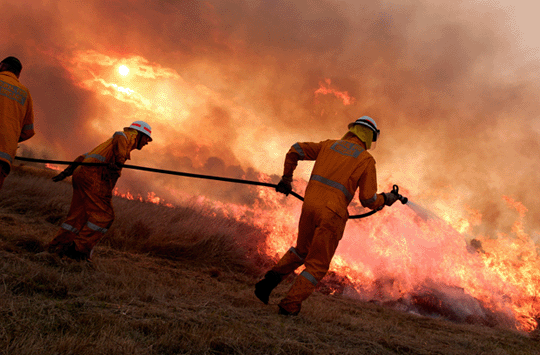
Lucas Heights nuclear reactor: The untold threat of the Sydney bushfires. 

Emergency warning issued as out-of-control bushfire rages across Sydney

As fires raged in Sydney, there has not been a peep out of the mainstream media about the fire hazard to Lucas Heights nuclear complex. Noel Wauchope reports. 

THE LATEST news on the bushfires raging in Sydney’s south-west is that the firefighters are “cautiously optimistic” and that emergency warning advice has been downgraded to “watch and act”.

However, the fire continues to burn in an easterly direction towards Barden Ridge and weather conditions are still dodgy, as Sydney’s record-breaking heatwave looks like coming to an end.

It’s been an anxious time — the fire has burned over 2,400 hectares. On Sunday (15 April), more than 500 firefighters in almost 100 fire trucks, along with 15 aircraft, battled the blaze throughout the day. Residents were told that it was too late to leave their homes. Heat from the bushfires was impacting the high voltage lines. There is very little rain forecast over the next few days.

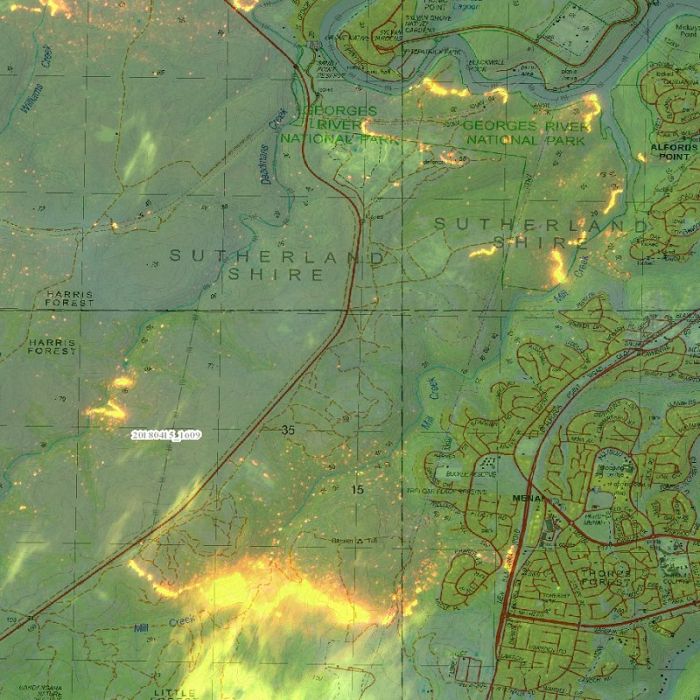
So, it has all been a worry. But you wouldn’t know, would you, that the fire is so close to the Lucas Heights nuclear complex? The latest maps shown on The Guardian and NSW Rural Fire Service websites don’t really show how close this fire is getting to Lucas Heights. I have previously written about the safety hazards of Lucas Heights, with its reactor, cooling pond and accumulation of nuclear wastes — the amount of which is not publicly available.

The fires have reached about four kilometres from Lucas Heights. Embers carried by wind can form spot fires well ahead of the firefront — even up to 20 kilometres away. In the dense and rugged bushland, with predicted west to north-west winds up to 30 kilometres per hour – not forgetting that bushfires create their own weather systems – is not that hazardous to the nuclear complex?

But we don’t hear a word about this. What makes the silence easier, is that the residential area previously part of Lucas Heights was renamed Barden Ridge in 1996 to increase the real estate value of the area, as it would no longer be instantly associated with the High Flux Australian Reactor (HIFAR) — and now the Opal nuclear reactor.

Of course, now, because of the name change, there’s no public awareness that Australia’s nuclear reactor is anywhere near the fires. You can bet that the government wants to keep us all in blissful ignorance.

What we do know, is that fires are certainly a hazard to nuclear sites and there is the possibility of radiation release across a wide area, if fire invades a nuclear complex, with the fuel rods in cooling pools at great risk. When fires do happen near a nuclear site, there may be a security panic going on but that is not communicated to the public.

Whenever there have been wildfires threatening nuclear sites – in Russia, Europe or the U.S. – the pattern is to downplay, to not mention, the nuclear danger. The publicity pattern is always to ignore the radiation hazard.

For example during the recent Californian wildfires:

“It’s being fought by security site fire crews, with help from a helicopter able to detect any aerial release of radiation.”

As though any amount of monitoring is going to help or that any data would be publicly shared. Not a peep about the radiation numbers during the fires in and around Los Alamos, even though they were “monitoring” it.

And in the case of this fire in Russia, the emergency minister threatened to “deal with” those who spread radiation “rumours”:

For the current Sydney bushfires, it seems as though there will have been a lucky escape for the communities, despite the fact that two giant aircraft, the DC10 Nancybird and the C130 Hercules “Thor” — normally used for aerial water bombing — were not available to help fight the Sydney fire, having been sent back to the U.S., because by March, the fire risk is supposed to be over.

It will have been a much luckier escape that they realised if the nuclear complex remains unscathed — this time!

April 16, 2018 Posted by | AUSTRALIA - NATIONAL, media, safety | Leave a comment

ANSTO closes the Lucas Heights nuclear complex to all but the most essential staff

Lucas Heights nuclear organisation closed on Monday https://www.theleader.com.au/story/5343505/ansto-closed-to-all-non-essential-staff/
While there was no risk to ANSTO as a result of fires near the precinct, the organisation decided to close the campus to all non-essential staff tomorrow to help minimise traffic impacts in the area.
 The Australian Nuclear Science and Technology Organisation (ANSTO) at Lucas Heights will be closed on Monday to all non-essential staff.

ANSTO released a statement late today saying there was no risk to ANSTO as a result of fires near the precinct  but the organisation decided to help minimise traffic impacts in the area.

“ANSTO infrastructure including the OPAL reactor is protected by numerous fire safety systems, policies, plans and arrangements to ensure there is never any risk to operations or safety,” the statement said.

“The OPAL reactor is at power and operating normally.

 “Some 1,200 people work at the Lucas Heights campus. Based on current advice, and to minimise local road and traffic impacts, we have advised ANSTO staff who are not performing essential services to work from home.

“All contractors, tenants and construction workers on our building projects are advised not to attend our campus tomorrow; and the childcare centre has been closed.

“As a precautionary measure, the ANSTO Operations Centre was activated yesterday, and continues to monitor the situation.

“ANSTO would like to take the opportunity to thank the emergency services and support staff who are continuing to assist on this matter.”

April 16, 2018 Posted by | AUSTRALIA - NATIONAL, safety | Leave a comment

If a nuclear bomb were to be dropped on Sydney

New study reveals catastrophic death toll from a nuclear attack
WHAT would happen if a nuclear bomb went off in your backyard? A chilling new study estimates the death toll from an attack on Australia.Tom Livingstone, news.com.au, APRIL 15, 2018

“……Scientists from Virginia Polytechnic Institute and State University have created simulations of a potential outcome if an attack did occur, and found the best course of action for people was to take shelter first and then take steps to escape afterwards.

Those who tried to seek out family members and “aid and assist” others were more likely to die.

In the study, it showed some people would look out for family, while others wold panic and run blindly away.

When humans carried out “shelter-seeking, evacuation, healthcare-seeking, and worry combined,” they were more likely to survive.

The simulation, which was first revealed by Science Magazine, shows that venturing away from a safe place leaves civilians subjected to a higher dose of radiation, which would likely prove fatal.

With President Trump’s consistent tweets threatening action against Russia and North Korea in a game of who has the bigger artillery, a dystopian future seems more and more possible.

Last month researchers created an interactive map that revealed the terrifying scope of a nuclear blast for any given area.

The map shows the extent of the fireball, radiation, shockwave, and heat spawned by different weapons, from the 15 KT ‘Little Boy’ dropped on Hiroshima to the largest weapon in the USSR’s arsenal, the 50,000 KT Tsar Bomba.

For example, if North Korea dropped the Hwasong-14, a 150 KT yield nuclear weapon on Sydney’s CBD, there would be more than 77,000 fatalities and 156,000 injured. The radiation from the blast would exceed 12 square kilometres and go further depending on wind patterns.

If Vladimir Putin dropped a 50,000 KT Tsar Bomba (Reportedly the biggest in his arsenal) on Sydney, there would be 1,513,303 fatalities, 1,111,725 injuries and radiation exceeding 80 square kilometres.

If the Aussies pissed off the US and Trump attacked us, it would most likely be with the 300KT W-87, which would kill an estimated 114,374 Sydneysiders, injure more than 227,000 and cause radiation exceeding 15 square kilometres on initial impact.

While scary to think about, it’s an important thing to get your head around in Trump’s 2018. Without coming off as alarmist we should understand the exact magnitude of a nuclear blast and how damaging it can potentially be.

http://www.news.com.au/technology/science/new-study-reveals-catastrophic-death-toll-from-a-nuclear-attack/news-story/0f50696ee563b5f9e977f30b4cb42494

April 16, 2018 Posted by | New South Wales, weapons and war | Leave a comment

Could Lucas Heights nuclear complex be threatened by current bushfires?

Unusually for a suburb, Lucas Heights does not contain a residential area. The residential area previously part of Lucas Heights was renamed Barden Ridge in 1996 to increase the real estate value of the area, as it would no longer be instantly associated with the HIFAR nuclear reactor.  [and now the Opal nuclear reactor]

Residents warned not to leave, Sydney fire worsens  SMH, By Jacob Saulwick, 

Fire authorities have issued an emergency warning for some suburbs in south-west Sydney, telling residents to seek shelter.

At about midday on Sunday, residents in Voyager Point, Pleasure Point and Sandy Point were advised not to leave their properties and to protect themselves from the heat of an out-of-control fire.

Residents in Alfords Point, Menai and West Barden Ridge were advised to shelter in place as the bush fire approached.

“It is too late to leave,” the Rural Fire Service said in a statement.

“Firefighters are in these areas and are in place to undertake property protection as required,” the RFS said……

Electricity company Ausgrid, meanwhile, said there might be short interruptions to power supply.

Heat from the bushfires was affecting Transgrid’s high-voltage power lines, Ausgrid said, causing voltage dips. Rail services across Sydney were disrupted on Sunday morning……

Electricity company Ausgrid, meanwhile, said there might be short interruptions to power supply.

Heat from the bushfires was affecting Transgrid’s high-voltage power lines, Ausgrid said, causing voltage dips. Rail services across Sydney were disrupted on Sunday morning……..https://www.smh.com.au/national/nsw/residents-warned-not-to-leave-sydney-fire-worsens-20180415-p4z9os.html

April 15, 2018 Posted by | New South Wales, safety | Leave a comment

Kimba Postal Ballot – BUT the National Radioactive Waste Management Facility  Taskforce NOT truthfully informing people

Federal Science Minister Canavan this week announced a postal ballot August 20 of the so-called ‘local communities’ – Kimba & Wallerberdina – for the purpose of gaining consent towards furthering the NRWMF Site Selection process.

Informed consent requires both these electorates (& the wider Australian society) be fully appraised of all facets integral to any nuke dump.

Such would include these minimal requirements:
1.   Adequate time to digest & follow up the outcomes from the current Senate Select Committee Inquiry into the NRWMF Community Engagement Process.

2.   A complete knowledge of the actual nature, containment types, timings, duration & volumes of material destined for the facility – including a full & competent inventory of radioactive waste legacy holdings. For example: HIFAR decommissioned; ILW from all sources; CSIRO & DoD Woomera; DSTO Edinburgh; & SAGovt Radium Hill, amongst others.

Without such widespread understanding, any Poll result would lack competency, demonstrate a failure of administrative process & further exacerbate the existing community divisions created by the NRWMF Project deficient governance.

So far, the National Radioactive Waste Management Facility  Taskforce has focused almost exclusively upon ANSTO radiopharma production gloves & gowns @ Lucas Heights.

THE TASKFORCE NEEDS TO PRO-ACTIVELY FULLY APPRAISE EVERYONE BEFORE ANY CASTING OF BALLOTS

ENuFF[SA]
Office Admin
https://www.facebook.com/sanuclearfree/

April 14, 2018 Posted by | AUSTRALIA - NATIONAL, Federal nuclear waste dump, politics | Leave a comment

Janet Tiller: deep concern at plan for radioactive trash dump on agricultural land- submission to Senate

Senate Inquiry Submission into the Nuclear Waste Site Selection Process , Janet Tiller                 I am deeply concerned and  upset that the Federal Government are considering Kimba as potential site for a Radioactive Waste Facility. Kimba has been a farming community since the land was starting to be cleared in the late 1800’s. We produce mainly Wheat, Meat and Wool and I am afraid if the Radioactive waste is stored anywhere in our community it could adversely affect the prices for our land and the Wheat, Meat and Wool (they can be very fickle industries).

I would also like to know what is the true definition of broad community support. We were advised it was 65 percent then after the vote to determine those for and against the facility, Matt Canavan the Minister for Industry, Innovation and Science decided it would be 57 percent. Why? The vote was only for Kimba residents, farm owners and people that owned property in the community. The Dump could adversely affect more than just Kimba it could affect the whole of Eyre Peninsula with its “ Clean Green” image, a Radioactive Waste Facility won’t exactly fit in there.

A committee of 16 has been formed and their aim is to decide where the $2 million (now we are in the 2nd stage of the process) will be spent in the community. The committee was selected from applicants and said to be chosen from a broad selection of the community from Farming, Business, some for the RWF and some against. There are only 4 people on that committee of 16 that were against the dump, they won’t have a very strong voice will they? I look forward to your reply.

April 14, 2018 Posted by | AUSTRALIA - NATIONAL, Federal nuclear waste dump, politics | Leave a comment

Costly and top secret transport of nuclear waste from Lucas Heights to port, then to France

Tight security for shipment of nuclear waste from Lucas Heights to France, THE AUSTRALIAN, SIAN POWELL, 12 APR 18 

A top-secret security operation to send spent radioactive fuel rods from Australia’s nuclear reactor to France for reprocessing is planned for the coming months.

Potentially involving hundreds of state and federal police, the details of the transport operation will remain confidential until after the shipment arrives at La Hague, in northwest France.

Unused uranium and plutonium will then be removed from the fuel rods, and the residual waste eventually returned to Australia for storage. About 500kg of unused low-enriched uranium and 4.5kg of unused plutonium will be recovered from the rods…

The Australian Nuclear Science and Technology Organisation at Lucas Heights in Sydney’s south has confirmed the shipment will be trucked to a port for transport to La Hague midway through this year.

The route, the port, the time and the ship, as well as the numbers of ­security personnel, will remain confidential until after the mission is completed.

The last shipment of spent rods was sent to the US in 2009, and both Port Kembla and Port Botany have been used as shipment ports in the past.

When reprocessed nuclear waste was returned to Australia in 2015 for storage at Lucas Heights, more than 500 police were ­deployed to guard the shipment, and it is expected at least that number will guard the radioactive cargo destined for France.

The radioactive spent fuel rods will be packed into an undisclosed number of ­immensely tough lead and stainless steel transport casks for the journey to France.

“These casks are purpose-­engineered to safely transport this type of material without risk to people or the environment,” said the manager of the multipurpose OPAL Reactor at Lucas Heights, Dave Vittorio. “Even a jet plane strike could not penetrate them.”

The total cost of the project is $45 million, including the contract with France, equipment, staff costs, and incidentals.

…… Australia, like other nations, pays to use the La Hague facility’s infrastructure and expertise. The shipment will be the 10th export of spent nuclear fuel ­assemblies used in the OPAL ­reactor’s first 10 years of operation. ….https://www.theaustralian.com.au/news/health-science/tight-security-for-shipment-of-nuclear-waste-from-lucas-heights-to-france/news-story/5549c370206c15aa1bc1a4b2367d6552

April 14, 2018 Posted by | AUSTRALIA - NATIONAL, safety, secrets and lies | Leave a comment

Nuclear Promotional Activities planned :Australia’s Department of Industry, Innovation and Science

Department of Industry, Innovation and Science Bruce Wilson,  9 April 2018.  The department has compiled the attached table of planned activities with indicative dates.

As explained in the department’s submission, provided on 3 April 2018, the process is beingundertaken closely with the communities. Accordingly, the milestones and precise dates of  activities will depend on community feedback and will be determined with community representatives. The timing of certain decisions within government are also the prerogative of the Executive and could be subject to change. For this reason, we have included a highlevel timeline of activities, with broad date ranges, to allow flexibility to respond to the needs of communities and executive government processes.

Table: Planned community consultation and activities and indicative dates to April 2019

Activity Topic Indicative timing

Information RWMF Governance Framework released Ql/2018

Consultation Kimba Economic Working Group established Ql/2018

Engagement- Quom-Work Experience Program – ANSTO Ql/2018

Consultation Barndioota Consultative Committee meets Ql/2018

Consultation Kimba Consultative Committee meets Ql/2018

Information Wallerberdina Aboriginal Heritage Ql/2018

Information Monthly newsletters – Wallerberdina and Kimba Ql/2018

Consultation Barndioota Consultative Committee meets Q2/2018

Consultation Kimba Consultative Committee meets Q2/2018

Consultation Barndioota Economic Working Group meets Q2/2018

Consultation Kimba Economic Working Group meets Q2/2018

Consultation ANSTO visits and consults Hawker and Kimba Q2/2018

Event Hawker Community Industry Expo Q2/2018

Event NRWMF Agriculture meeting Q2/2018

Information Monthly newsletters – Wallerberdina and Kimba Q2/2018

Information NRWMF Agriculture information Q2/2018

Information NRWMF Waste Acceptance Criteria Q2/2018

Information NRWMF Safety and Security Q2/2018

Information NRWMF Transport Q2/2018

Information NRWMF Site Suitability Assessment Q2/2018

Information NRWMF Facility design Q2/2018

Information NRWMF Infrastructure and enabling services Q2/2018

Information NRMWF Operation and jobs information Q272018

Consultation Barndioota Consultative Committee meets Q3/2018

Consultation Kimba Consultative Committee meets Q3/2018

Consultation Barndioota Economic Working Group meets Q3/2018

Consultation Kimba Economic Working Group meets Q3/2018

Information Senate Inquiry hands down report 14 August 2018

Event Communities vote Q3/2018

Site selection Community sentiment assessment 0.3/2018

Site selection Site Selection report Q3/2018

Site selection Minister gives notice of intent on preferred site Q4/2018

industry.gov.au

Industry House – 10 Binara Street, Canberra City, ACT 2601

GPO Box 2013 Canberra ACT 2601 ABN: 74 599 608 295

2

Site selection 60 Day consultation commences Q4/2018

Site selection Minister declares a site Q4/2018

Site selection Minister acquires the land Q4/2018

Milestone Detailed Business Case finalised Q4/2018

Consultation Regional Consultative Committee established Q1/2019

Milestone Public Works Committee Q1/2019

Consultation Environment Protection Biodiversity Conservation Q1/2019

approvals process

Consultation Australian Radiation Protection and Nuclear Safety Q1/2019

Agency approvals process

industry.    https://www.aph.gov.au/Parliamentary_Business/Committees/Senate/Economics/Wastemanagementfacility/Additional_Documents

April 14, 2018 Posted by | AUSTRALIA - NATIONAL, Federal nuclear waste dump | 1 Comment

Kimba Economic Working Group on nuclear waste dump set up by Dept of Industry Innovation and Science

 National Radioactive Waste Management Facility 
12 APRIL 2018  A new group in the South Australian community of Kimba will be charged with investigating all economic opportunities and issues associated with a proposed National Radioactive Waste Management Facility.

Minister for Resources and Northern Australia Matt Canavan today announced the members of the Kimba Economic Working Group, established as part of the Phase Two consultation process that is currently underway in the area.

“Together, the Phase Two community consultation and results of technical studies will help inform a decision on whether the Facility is located at one of the two volunteered sites in Kimba,” Minister Canavan said.

“Eight people from the Kimba area have been appointed as members, including farmers, Councillors and business owners, and people for, against and neutral on the proposal.

“David Schmidt, long-time Kimba resident and active local community member, has been named as the Group’s Chair.”

………The Kimba Group mirrors successfully established group around the Wallerberdina Station site, which is already developing a range of ideas on how local business could benefit from a Facility.The Kimba Economic Working Group will meet on about a monthly basis for the duration of the Phase Two consultation process.

Members of the Kimba Economic Working Group are:

April 14, 2018 Posted by | AUSTRALIA - NATIONAL, Federal nuclear waste dump | Leave a comment

Accelerating rate of heat increasing in oceans, especially around Australia

‘Concerning’: Marine heatwaves increasing, especially near Australia, https://www.smh.com.au/environment/climate-change/marine-heatwaves-australia-tasman-sea-climate-20180410-p4z8qq.html, By Peter Hannam, 

Marine heatwaves are increasing in their frequency and duration at an accelerating rate in many parts of the world, especially around Australia, a team of international scientists has found.

The number of oceanic heatwave days a year has increased by 54 per cent in the past century globally, the researchers determined, using data of sea-surface temperatures from long-established sites and satellites.

“We have seen an increasing trend in the frequency and duration [of marine heatwaves], and that trend has accelerated in the past 30 years or so,” said Lisa Alexander, associate professor at University of NSW’s Climate Change Research Centre, and an author of the paper published in Nature Communications on Wednesday.

Rather than a precursor, the number of heatwave days may even be an underestimate of what is to come as the planet warms, Professor Alexander said. “We could see it accelerated even more, given what we’ve seen recently,” she said.

Episodes of extreme heat over land have been studied more closely than those beneath the waves. Oceans, though, not only absorb about 93 per cent of the additional heat being trapped by rising greenhouse gas levels, they are also the main driver of the Earth’s climate.

Thank goodness we have the oceans as this massive sink [for both heat and carbon dioxide] but they are also changing too, and we tend to forget that,” said Sarah Perkins-Kirkpatrick, an author of the paper and also a researcher at the UNSW CCRC.

Dr Perkins-Kirkpatrick likened the oceans to the tropics, where temperatures typically move within a narrow band. Even moderate increases can have big impacts on humans and ecosystems alike.

The paper, which defined heatwaves as at least five consecutive days with sea-surface temperatures in the top 10 per cent of warmth over a 30-year period, found such events were on the increase in most parts of the world.

Global hot spots

Australia was home, along with the north Pacific and north Atlantic, of some of the global ocean hot spots.

While coral bleaching from extended heat over the Great Barrier Reef and elsewhere in recent years had drawn international attention, many other regions had seen “substantial ecological and economic impacts”, as fishing and tourism industries they support were hit, the paper said.

For instance, an extreme event off the Western Australia coast in 2011 led to large-scale effects in the Ningaloo region. Kelp forests south of Ningaloo were hammered and are yet to recover.

“You only need to have that one event to have this complete shift in the ecological environments,” Dr Perkins-Kirkpatrick said, noting such changes have tended to be less dramatic on land.

“Will it ever change back? Have we reached the point of no return for certain marine environments?” she said. “There are a lot of unknowns there, but it’s quite concerning.”

Coral bleaching events have garnered much of the attention but many other marine species, including kelp forests off Tasmania, can be vulnerable to changing conditions.

“[Corals] are the sort of poster child for ecological change, and other systems aren’t maybe as pretty to look at,” Professor Alexander said. “But [others] are equally as important in the ecosystems and food chains”.

Tasman Sea heat

The westward boundaries of the continents tend to be where oceans are warming fastest, including off the east Australian coast.

The Tasman Sea had experienced an increase in heatwave events even before this past summer’s record burst, that fell outside the researchers’ period of study.

In a special climate statement released last month by the Bureau of Meteorology and New Zealand’s National Institute of Water and Atmospheric Research, the agencies found the south Tasman Sea recorded sea-surface anomalies of as much as 2.12 degrees last December and 1.96 degrees in January.

Those readings were compared with a 1981-2010 baseline – and broke the record for those months by about a degree – an unusual departure from the norm for ocean readings.

April 13, 2018 Posted by | AUSTRALIA - NATIONAL, climate change - global warming, environment | Leave a comment

Lucas Heights’ dangerous nuclear wastes

Nuclear waste from Australia’s only reactor ready to be dumped http://www.abc.net.au/news/2018-04-12/nuclear-waste-from-australias-only-reactor-needs-to-be-removed/9643428 By Michelle Brown  

April 12, 2018 Posted by | AUSTRALIA - NATIONAL, safety, wastes | Leave a comment

Top secret transport of nuclear waste – via Port Kembla?

Port Kembla a possibility for secret nuclear shipment   https://www.illawarramercury.com.au/story/5338205/port-kembla-a-possibility-for-secret-nuclear-shipment/ Glen Humphries 12 Apr 18 

April 12, 2018 Posted by | AUSTRALIA - NATIONAL, wastes | Leave a comment

Katrina Bohr: Submission to Senate- community views, indigenous support – and what about climate extremes?

Above – ferociousness of historical flooding near the rail lines in the proposed Barndioota area for the site. 
Katrina Bohr – Submission to SENATE INQUIRY into the site selection process for the National Radioactive Waste Management Facility , (NRWMF) Barndioota.
My name is Katrina Bohr. I have been a resident of South Australia for 32 years, having lived in regional South Australia for the last 22 years. Nuclear waste and the historical outcomes of radioactive damage has been an ongoing concern of mine for almost 50 years.

In the initial stages of the announcement for site selection at Barndioota, when Josh Frydenberg was Minister for Resources and Energy, a statement was issued from the Government.

‘The Australian Government will also take into account the views of others (outside community zones) as part of the commitment to broad consultation.’

The proposal for low and intermediate waste to be stored in South Australia affects not only myself, but also future generations. Unlike some respondents, I do not live in the Hawker region. Therefore, my views are not driven by benefits, but rather genuine concerns for peoples’ health, our environment, and our local Indigenous communities.

 B) How the need for ‘broad community support’ has played and will continue to play a part in the process, including:

i)                    The definition of ‘broad community support’
I believe the definition of ‘broad community support’ is defined as support given by the majority. Broad support should be determined when the consultation process has been conducted thoroughly and with all persons of interest. The consultation process should offer full disclosure for the proposed site selection process.

ii)                  How ‘broad community support’ has been or will be determined for each process advancement stage
Determining Broad Community support at this stage has involved a number of methods.

              Surveys, Public Meetings, face to face meetings, a continual presence of Australian Nuclear and Science and Technology Organisation (ANSTO) employees, members of  the Australian Radiation Protection and Nuclear Science Agency (APRANSA) and a Heritage Assessment process.

              Rowan Ramsey’s June/July 2016 Grey Newsletter states that all all the feedback, including district surveys were considered by the  Minister to evaluate whether there was a realistic chance of ‘developing’ broad support. The word ‘developing’ almost implies an action to develop rather than consult.

             My understanding of on-going broad community support is for updated and collated material to be honest and transparent, and that all perspectives be disclosed. 

 C) How any need for Indigenous support has played and will continue to play a part in the process, including how Indigenous support has been or will be determined for each process advantage stage;

There are local indigenous people who believe that they should have been consulted from the outset. This is due to Yappala Station (next door to the proposed site) having already been classed as a protected area. Yappala Station is heritage listed as an Indigenous protected area due to its cultural and environmental significance.

A South Australian Department of State Development spokesperson confirmed that there are three Aboriginal sites that fall within the Barndioota-nominated area. Two of the sites are cultural and the third is archaeological (NITV Posted 2016).

The local indigenous people needed to be involved in all aspects of the site selection process. From heritage assessment to cultural importance. Dreamtime stories and Songlines.

Traditional land owner and Elder Eunice Marsh speaks of their love for the land as love for family. Hookina Springs and the surrounding area is significant to the Adnyamathanha women.

When the Adnyamthanha Traditional Lands Association met at the end of March 2018, the vote for the NRWMF was overwhelmingly against.

  E) Whether wider (Eyre-Peninsula or State-wide) community views should be taken into consideration and, if so, how this is occurring or should be occurring;

I believe that wider community views should be considered as the nuclear waste, and in particular, the intermediate waste from Lucas Heights in NSW will be transported through a number of corridors. Therefore, wider community consultation should be considered. 

Matt Canavan makes reference to a ‘wide’ consultation process to determine whether the site is suitable’-Transcontinental newspaper 22/11/2016.

As far as I am aware, there has been no wider community consultation to date. Wider community consultation could be conducted through relevant forums, surveys and information mail outs.

 F) Any other related matters

 In the fairness of disclosure, I have referred to the Australian Government Department of Business

                           Initial Business Case (revised) 2014 Page 29

                          ‘The Capital cost estimates for the project options are based on delivery

                           of given designs at a site in Central Australia’

The Business Case also refers to a Timeline where ANSTO is due to run out of space for low and intermediate storage. This is by 2018.

When in Parliament, Grant Chapman chaired the select committee that recommended the country’s low level nuclear waste be stored in a single facility-The Guardian 29/4/16.

Grant Chapman is part owner of the proposed site at Barndioota, and has made it quite public that he believed his land would be an ideal site for a NRWMF.

He served on three committees including Uranium mining and milling to Radioactive Waste from March 1995 to May 1997. The other from August 2000 to May 2001. Acting as Chair in the first two committees, where in !996 a decision was made to pursue a NRWMF.        There is evidence that there may have been a determination over the years by the Australian Government to establish the site at Barndioota.

Images: I am sending three images displaying the ferociousness of historical flooding near the rail lines in the proposed area for the site.

April 11, 2018 Posted by | AUSTRALIA - NATIONAL, Federal nuclear waste dump | Leave a comment

Holly Whittenbury on Nuclear dump siting- Aboriginal issues, tourism impact, conflict of interest issues

Senate Inquiry Submission into the Nuclear Waste Site Selection Process Holly Whittenbury

My name is Holly Whittenbury and I come from the southern Flinders Ranges. I have grown up there, spending the first 18 years of my life in Peterborough, not too far from Hawker, one of the selected dump sites. I presently study Environmental Science and plan to return to the area to assist in conservation efforts of the southern Flinders Ranges. I foresee myself being apart of the Flinders Ranges for my entire life ahead; although I do not live within the area presently, the issues within the ranges concern me wherever I am. I disagree with key aspects of the selection process for the nuclear waste dump site for the following reasons

  •   how the need for „broad community support‟ has played and will continue to play a part in the process, including: i) the definition of „broad community support‟ ii) how „broad community support‟ has been or will be determined for each
  • whether wider (Eyre Peninsular or state-wide) community views should be taken into consideration and, if so, how this is occurring or should be occurring;

Contrary to other pro-nuclear waste dump submissions, broad community support should include not just the residents within the Hawker township, but the wider surrounding area of Hawker, the state and the country.

The nearby Adnyamathanha Indigenous groups value the entire site proposed for the nuclear waste dump. Unlike Hawker residents, their spiritual home is not separated by nearly 40 kilometres. They are present in spirit and also physically through land rights beside and within the dump site location. The story-line of the Adnyamathanha people stretches 70 kilometres across the state along the ranges, their sacred birthing and healing site, Hookina Springs, lies within Grant Chapman‟s property of which they have rightful access to.

Whilst Hawker residents are separated, both physically and mentally from the proposed nuclear waste dump site, with Chapman himself declaring it is virtually wasteland, the whole area, but especially this site, is as sacred to the Adnyamathanha people as Mecca is to Muslims. To ignore or prioritise one community opinion over another is to degrade one community in favour of another. To degrade the local indigenous peoples views (who are closer in proximity to the site) in favour of the Hawker residents is to prioritise predominantly European society living in the township in European lifestyles with European law and worldviews. To claim that Indigenous consent has been gained despite the overt disagreement from the Adnyamathanha people over the waste dump site and their driving of protests which blocked the streets of Adelaide on North Terrace, is wilful ignorance in favour of nuclear fuel cycle industry and residents of non-Indigenous background. Here is a quote from Indigenous leader and outspoken critic of the waste dump, Enice Marsh, to demonstrate the obviously lack of consent and lack of consultation with the indigenous people:

“If we’re going to have that poison stuff here, even if it’s a low-level situation, it’s just absolute madness to put something like this near somewhere that’s so special,” she said.

“It’s everything; it’s a type of importance that you would never be able to describe.”

“The connection to this land for Adnyamathanha people is their culture, their customs; it’s their identity.” http://www.abc.net.au/news/2016-02-24/traditional-owners-flinders-ranges-fears-on-nuclearwaste-dump/7195030

In addition, criticism of the dump site has been given loudly by Adnyamathanha Traditional Lands Association chair Vince Coulthard:

“The Flinders Ranges is an iconic area that people come from all over the world to visit. I’m saddened to hear that the government wants to spoil this beautiful, pristine area with a devastating piece of junk. We certainly understand that there has to be somewhere they can store it, but you don’t take a pristine area and destroy that. We ask that the state government stand with the Adnyamathanha community to stop this waste dump.” https://www.greenleft.org.au/content/south-australians-say-no-nuclear-waste

 Broad community support should also be sought state-wide; it is a state issue. The waste will either be trucked across the country through small towns or a port will be built to transport the waste first by ocean, then by rail or trucks on road. Despite the majority of the South Australian population living in Adelaide, The Flinders Ranges is an iconic totem of our state and dear to countless people, regardless of their place of residence. As stated, I am no longer living precisely within the Flinders Ranges area, yet my future depends on the area. I will return and my family still resides in Peterborough as they have done so since we first settled in Cavanaugh, north west of Dawson. My grandfather drove cattle and sheep through Horrocks Pass, just south of Hawker and the dump site, prior to the highway‟s construction. The land will always be important to many of us not necessarily physically present; broad community support needs to include those outside of the Hawker township.

  • the financial compensation offered to applicants for the acquisition of land under the Nominations of Land Guidelines;

In addition, the impact of the nuclear waste site on tourism within the Flinders Ranges should be evaluated independently and form part of state and national consensus. Presently, the Flinders Ranges is the third most popular visitor attraction (574,000 domestic visitors, 2.6 million visitor nights). It contributed 45% of tourism revenue in 2016 and employs 3,000 people directly and indirectly in the region. It therefore contributes significantly to the state economy and therefore likely affects the majority of the state‟s population in some way, even indirectly. Any reduction in this contribution to state economy (which is markedly more than what a nuclear waste dump would contribute) affects the entire state economically and has indirect consequences to many other businesses of towns surrounding Hawker in particular. My town, Peterborough, depends on tourism. It has been the town‟s only industry since the shut down of the railway industry decades ago, which saw the population of the town halve. The town depends on thriving tourism, largely bustling through its main street towards the Flinders Ranges. On weekends, in particular, the main street is full of caravans and off-road camper vehicles headed to the state icon north. The most successful businesses within the town are tourism based; hotels, motels, caravan parks, petrol stations, delis and the newsagency selling souvenirs touting the town as the „Gateway to the Flinders Ranges‟. How many other towns (Orroroo, Wirrabara, Melrose, Quorn, Yunta, Port Pirie, Port Augusta, Jamestown and Terowie), would be severely affected by the site selection of the nuclear waste dump? All of these businesses would be affected; therefore, these people deserve a say in the site selection. It is impossible to say how far out a reduction of tourism within the Flinders Ranges would reach. Therefore, the entire state (and nation) deserves a say and their voices heard in regards to seeking consent on the site selection.

https://www.theflindersnews.com.au/story/4568617/ranges-tourism-boom/

  • whether and/or how the Government‟s „community benefit program‟ payments affect broad community and Indigenous community sentiment;

The payment of Hawker residents with a $10 million bribe does affect surrounding populations, including the Indigenous, significantly. The process of offering money to compensate or persuade a supposedly impoverished town (Hawker) to give consent despite Indigenous views disadvantages anyone who is not indoctrinated into Neo-Liberal values of European-based society. It is an inherently and blatantly biased process, given Hawker has been bribed with something that is only worthy in exchange for land of which others have spiritual and physical connection with and with something that could never be valuable in Indigenous culture. The thinking of the Hawker residents is truly unclear and motivated by financial support for their town. It is reprehensible that anyone, including the residents who have already made submissions, suggest that only their opinion counts in the selection and consent process of a nuclear waste dump. This will house the nation‟s (and perhaps eventually, the world‟s) nuclear waste. Their opinion is the most blighted and misguided of all individuals, given their own declared poverty and the bribe (“compensation”) offered to them. Here is a quote exemplifying this by Hawker Community Development board member Ian Carpenter:

“Like any small country council, we struggle for money to put into infrastructure and schools and nursing facilities,” he said.

“Admittedly, it’s not going to employ 100 people, but if it employs 20 in our area and creates traineeships for our people, then I think it’s a great idea.” traineeships for our people, then I think it’s a great idea.”

http://www.abc.net.au/news/2016-02-24/traditional-owners-flinders-ranges-fears-on-nuclearwaste-dump/7195030

Employing 20 people through the nuclear waste dump is NOT a good enough reason to omit the voices of the other > 1 million people within the state of South Australia. Our voices count also and are arguably more objective than the Hawker residents.

Nationally, opinions on the waste dump should also be heard. The waste will come from all over the country, from medical and other sources. The need to remove that waste, the transport of such waste and its eventual storage and where it is stored (hence the site selection process) should be considerate to all individuals‟ perspectives on the matter

. · how any need for Indigenous support has played and will continue to play a part in the process, including how Indigenous support has been or will be determined for each process advancement stage;

  • any other related matters;

Indigenous support for the site should be overwhelmingly present if a site is selected to go ahead.

To have one, single person, who chaired a committee to establish a waste dump industry in SA in 1995, nominate his property as a potential site, is clearly a conflict of interest and completely bypasses the obtaining of any other consent from surrounding communities. It is reflective of the NeoLiberal system that Australia is presently under. We care more about cash, ‘industry’, tax cuts for major companies and figures at the end of spreadsheets than making real, responsible decisions and respecting the oldest living culture on this planet. The indigenous people of the area have described their stress at knowing their home and sacred site has been nominated as a nuclear waste dump for the nation.

The nomination by Grant Chapman with complete disregard for the rare freshwater spring, biodiversity, cultural storyline and indigenous community living beside his nominated property is nothing short of a continuation of forceful Colonialism. It is an Administrative Rationality which decides what is „good‟ for everyone else, despite never really placing itself in the shoes of its constituents, especially the Adnyamathanha people. His excuse was that the nearby town of Hawker is appreciative of the $10 million bribe that will go along with the nuclear waste site. In other words, the largely non-Aboriginal community’s consent, obtained through bribes that are only valuable in a society indoctrinated into Neo-Liberal, penny-counting thinking, can override Indigenous views. It is representative of our current priorising of European, Neo-Liberal thinking over Indigenous land values. It is unacceptable that, in a country which avidly nags its citizens to be more accepting of other cultures and demonstrate our so called ‘multiculturalism’, that it does not extend this to Indigenous welfare and their views on land management. They have stated their lack of consent loud and clear. Clearly, the nearby Indigenous custodians are suffering and outraged over the site selection. The nomination of the waste dump beside the beautiful Hookina Springs really is just another slap in the face to the very culture that we should actually be listening to as a nation.

April 11, 2018 Posted by | AUSTRALIA - NATIONAL, Federal nuclear waste dump | Leave a comment

South Australia’s Liberal Premier “open to nuclear power”

Marshall still open to nuclear power, IN Daily, 11 April 19  Premier Steven Marshall says establishing a nuclear generation industry in South Australia is not on his “short-term” radar but it could “come back onto the agenda further down the track” as he considers “every option to ensure we have lower energy prices”.

Marshall today embarked on his third regional tour since seizing office at last month’s election, visiting the South-East seat of Mount Gambier where Liberal-turned-Independent MP Troy Bell is a firm advocate for nuclear power.

Marshall and Bell broke bread this morning, their second face-to-face meeting since election day.

Bell quit the party after being charged with dishonesty offences following an ICAC investigation. He is pleading not guilty in an ongoing court case.

Marshall told InDaily he was “looking forward to a close working relationship with all the crossbenchers”, and that Bell was “the duly elected member for Mount Gambier and as such I’ll be treating him with respect”.

“I’ve always worked with Troy Bell… it’s quite obvious we share a lot of common aspirations for the people of the South-East,” he said.

One of those aspirations could yet be the establishment of a nuclear generator after Marshall last year flagged his interest in considering the industry, despite Royal Commissioner Kevin Scarce rejecting it as a commercially viable option “in the foreseeable future”.

“There will be a time when it may become viable, and desperate times call for desperate solutions – and we are in a desperate situation,” Marshall told media in February 2017.

Bell, who spearheaded the Liberals’ South-East fracking moratorium before he left the party-room, is a strong advocate for nuclear power and told InDaily he was “absolutely happy to lead the discussion” about establishing a local industry.

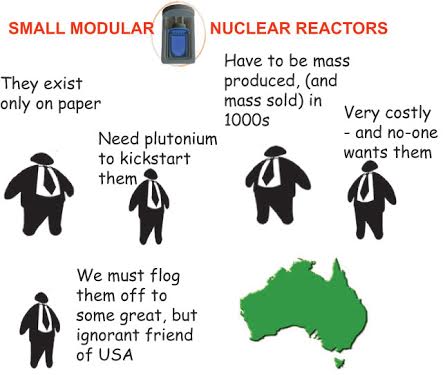
Asked if he would advocate for a nuclear generator in the South-East, he said: “A small modular one – yes definitely.”…..

Bell said he was “very interested” in the nuclear option, insisting that “with modern technology and advancements there’s more discussions that need to be had in that space”.

“The problem is nobody wants it in their backyard,” he said.

……….Marshall told InDaily today nuclear power was “not on the short-term agenda of the Government”.

“We’ve got a very robust plan for energy [and] we’re already well on the [record] for saying we want to be neutral on that issue,” he said……https://indaily.com.au/news/local/2018/04/11/marshall-still-open-nuclear-power/

April 11, 2018 Posted by | politics, South Australia | Leave a comment