The Conversation, Ian Lowe, Emeritus Professor, School of Science, Griffith University, March 15, 2023
.”……………. nuclear submarines mean nuclear waste. And for decades, Australia has failed to find a suitable place for the long-term storage of our small quantities of low and intermediate level nuclear waste from medical isotopes and the Lucas Heights research reactor.
With this deal, we have committed ourselves to managing highly radioactive reactor waste when these submarines are decommissioned – and guarding it, given the fuel for these submarines is weapons-grade uranium.
Where will it be stored? The government says it will be on defence land, making the most likely site Woomera in South Australia.
What nuclear waste will we have to deal with?
Under this deal, Australia will not manufacture nuclear reactors. The US and later the UK will give Australia “complete, welded power units” which do not require refuelling over the lifetime of the submarine.
In this, we’re following the US model, where each submarine is powered by a reactor with fuel built in. When nuclear subs are decommissioned, the reactor is pulled out as a complete unit and treated as waste.
An official fact sheet about this deal states Australia “has committed to managing all radioactive waste generated through its nuclear-powered submarine program, including spent nuclear fuel, in Australia”.
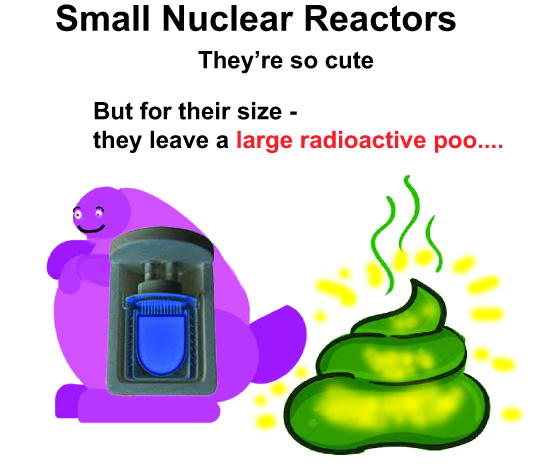
What does this waste look like? When Virginia-class submarines are decommissioned, you have to pull out the “small” reactor and dispose of it. Small, in this context, is relative. It’s small compared to nuclear power plants. But it weighs over 100 tonnes, and contains around 200 kilograms of highly enriched uranium, which is nuclear weapons-grade material.
So, when our first three subs are at the end of their lives – which, according to defence minister Richard Marles, will be in about 30 years time – we will have 600kg of so-called “spent fuel” and potentially tonnes of irradiated material from the reactor and its protective walls. Because the fuel is weapons-grade material, it will need military-scale security.
Australia has no long-term storage facility
There’s one line in the fact sheet which stands out. The UK and US “will assist Australia in developing this capability, leveraging Australia’s decades of safely and securely managing radioactive waste domestically”.
This statement glosses over the tense history of our efforts to manage our much less dangerous radioactive waste.
For decades, the Australian government has been trying to find a single site for disposal of low-level radioactive waste. …………………………………..
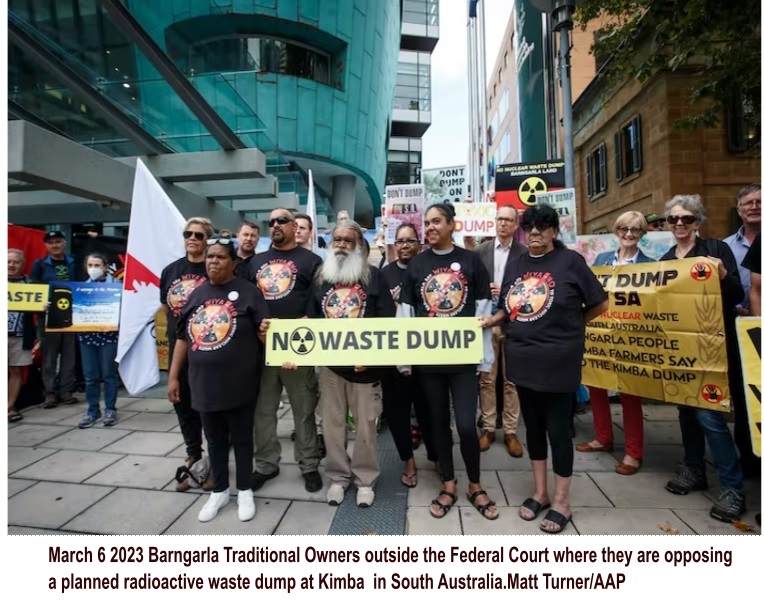
The most recent plans to locate a dump at Kimba, on South Australia’s Eyre Peninsula is still bogged down in the legal system due to opposition by local communities and First Nations groups.
And we’re still dithering about what to do with the intermediate level waste produced by the OPAL research reactor at Lucas Heights in Sydney. At present, spent fuel is sent to France for reprocessing while nuclear waste is now being returned to Australia, where it is held in a temporary store near the reactor.
This waste needs to be permanently isolated from ecosystems and human society, given it will take tens of thousands of years for the radiation to decay to safe levels.
Our allies have not figured out long-term waste storage either
But while Sweden and Finland are building secure storage systems in stable rock layers 500 metres underground, neither the UK nor the US have moved beyond temporary storage.
UK efforts to manage waste from decommissioned nuclear submarines is still at the community consultation stage. At present, high-level waste from sub reactors is removed and taken to Sellafield, a long-established nuclear site near the border with Scotland. But each submarine still holds around one tonne of intermediate level waste, which, according to the UK government, has to be temporarily stored until a long-term underground storage facility is built some time after 2040.
In the US, spent fuel and intermediate waste from nuclear submarines is still in temporary storage. ………. nuclear waste from their military and civilian reactors is just piling up with no long-term solution in sight. Successive administrations have kicked the can down the road, assuring the public a permanent geological disposal site will be developed some time in the future.
This should be concerning. To manage the waste from our proposed nuclear submarines properly, we’ll have to develop systems and sites which do not currently exist in Australia.
In 2016, South Australia’s Royal Commission on nuclear fuel suggested Australia’s geological stability and large areas of unpopulated land would position us well to act as a permanent place to store the world’s nuclear waste.
This hasn’t come to pass in any form. An almost intractable problem is that any proposed site will be on the traditional land of a First Nations group. Every site suggested to date has been opposed by its Traditional Owners.
What if we send the high-level waste overseas for processing and bring it back as less dangerous intermediate waste? It’s possible, given it’s what we already do with waste from the OPAL reactor. But that still leaves us with the same problem: where do you permanently store this waste. That’s one we haven’t solved in the 70 years since Australia first entered the nuclear age with our original HIFAR reactor at Lucas Heights. https://theconversation.com/australia-hasnt-figured-out-low-level-nuclear-waste-storage-yet-let-alone-high-level-waste-from-submarines-201781
The Monthly, By Rachel Withers 15 Mar 23, As is often the case in politics, the ABC comedy Utopiaskewered the situation years ago. In an episode in which the government decided to spend a mind-boggling amount on defence, the gathered strategists would not specify why, and agreed only to nod along when Tony deduced that China was the target, our trade routes were what needed protecting, and that China was our largest trading partner.
“So under this scenario, we’re spending close to $30 billion a year to protect our trade with China… from China,” Tony surmised. In the case of the AUKUS deal, it’s quite clear that China is who we are looking to counter. But it’s still not entirely clear why we are sinking $368 billion into submarines that will, as The Betoota Advocatequips, “halt China’s invasion by 14 hours”. Is it really in Australia’s strategic interests to be poking the dragon, permanently aligning ourselves with the US against a power we could never actually defend ourselves against? Is China really enough of a threat to us that we need to spend $368 billion? Are these wildly expensive nuclear subs necessary, or prudent? Shouldn’t we, I dunno, talk about this a little more before signing away our collective future?
Doubts are continuing to swirl around AUKUS, not least because, as the ABC’s Matt Bevan observes, Australia is “buying stuff to protect us from China, using essentially all the money we get from exporting stuff to China” (“to protect ourselves from missiles made from our raw materials,” added Alan Kohler)……………………………..
Turnbull wasn’t the only former PM refusing to be swept up in the excitement. Former Labor leader and major AUKUS critic Paul Keating did not hold back at the National Press Club today, labelling it the “worst international decision” by his party since Billy Hughes tried to introduce conscription, with several kicks at Penny Wong and Richard Marles, and some vicious comments about the UK and US leaders for good measure.
………………………….. Other experts, meanwhile, have blasted the fact that the AUKUS deal directly benefits the US and the UK governments while Australia takes the main strategic risk; others reckon that our massive subs outlay would be better spent closer to home. “A more sensible approach might be for the AUKUS partners to negotiate with China on an arms control agreement to cap the number of regional nuclear submarines and avoid a hugely expensive arms race for all concerned,” wrote Clive Williams, a former military intelligence officer in the army and a visiting fellow at the ANU’s Strategic and Defence Studies Centre. It’s not that far off The Shovel’s suggestion, which is that we “just pay China $300 billion not to invade”, saving $68 billion.
A $200billion nuclear submarine deal could cost the average Australian taxpayer about $13,000. This is effectively the equivalent of every Australian buying a new small car – an astonishing outlay on just a handful of boats. But experts say the deal – despite the extraordinary price tag – could be worth every cent.
Prime Minister Anthony Albanese has just committed Australia to spending $368 billion on somewhere between three and five second-hand US Virginia Class submarines, and a follow on build of eight next generation British AUKUS nuclear submarines. It’s a strategic blunder, writes former submariner Rex Patrick, and it’s not even going to happen the way the PM has suggested.
I just want a Ferrari. All my mates tell me they’re great cars. Never mind that, financially, I’m already struggling to keep up with the house repayments and, over time, the wife and kids are going to have to miss out on some of life’s niceties and even essentials; no orthodontic treatment to straighten my daughter’s teeth, no tutor to assist my son through extension maths and the wife won’t be able to afford to go back to uni to get her masters.
But I’ll look good cruising down Jetty Road at Glenelg in my shiny red machine. Now, just between you and me, the Ferrari’s not so good for going off-road or towing the family caravan, but hey, otherwise it is a great car.
Nuclear capability
Coming back from my Ferrari dream, it’s true that nuclear submarines are good. I know, because I’ve spent time at sea on them.
There’s nothing like taking the submarine down to 200 metres and turning up the power on the reactor to get to 30 knots, and then staying there, knowing you have almost unlimited power. It allows you to deploy great distances, arriving quickly. That’s important for the power projecting nations that sit as permanent members of the United Nations Security Council; China, France, Russia, the UK and the US all have nuclear submarines.
Our first priority is supposed to be defence of Australia, and our Defence Force should be configured for that, first and foremost. Even those who think we must automatically join the US in a war against China need to understand US strategy and what Australia’s role would likely be.
China depends on imports for 72% of its oil consumption, and the overwhelming majority of China’s oil imports must pass through maritime chokepoints over which the United States has significant influence. China’s dependency is complicated by the fact an overwhelming portion of its energy imports come from its west. 43% of its oil is sourced in the Persian Gulf, 25% from the Gulf of Aden and Africa and 9% from the Americas, with the overwhelming majority of that passing through the Malacca Straits. Security of supply would be a significant weak point in any conflict China finds itself involved in with the US.
In time of conflict the United States Navy, perhaps in conjunction with European or other regional coalition partners, could secure the Straits of Hormuz. India, part of the Quad, could assist with operations from the Persian Gulf through to the Andaman Seas.
Indonesia, Malaysia and, particularly, Singapore would exercise control over the Malacca Straits with Indonesia and Australia jointly responsible for shutting down Chinese oil carriage through Sunda and Lombok (and up through Makassar Straits). With these routes controlled, the only remaining option for China would be to re-direct shipping around Southern Australia.
Australian submarines are not needed in the South China Sea. The US will rely on Japan’s 20 submarines, South Korea’s 23, and Vietnam’s six, and Malaysia’s two and Singapore’s six. Our submarines have a role to play in shutting down the Sunda and Lombok Straits, or Chinese ships passing through Australian waters. This is a role that can be carried out by far less expensive conventional submarines.
The pros and cons of going nuclear
Of course, it’s true to say that it’s handy to have a reactor when you are detected by enemy anti-submarine forces. Speed can be a very useful asset.
The flip side is that smaller conventional submarines are better performers in littoral waters where they can silently lie in wait, lay mines or covertly deploy Special Forces.
Unsustainable price
The purported cost of this program is “up to” $368 billion dollars. That’s an incredible amount of money to spend, and particularly on a single capability.
Australia has $970 billion dollars in gross debt. It will rise to a trillion dollars next financial year. Albanese says that out Defence budget will increase to 2.5% of GDP. That’s an extra $10 billion per annum, on top of a structural deficit of $50 billion a year, already rising to $70 billion.
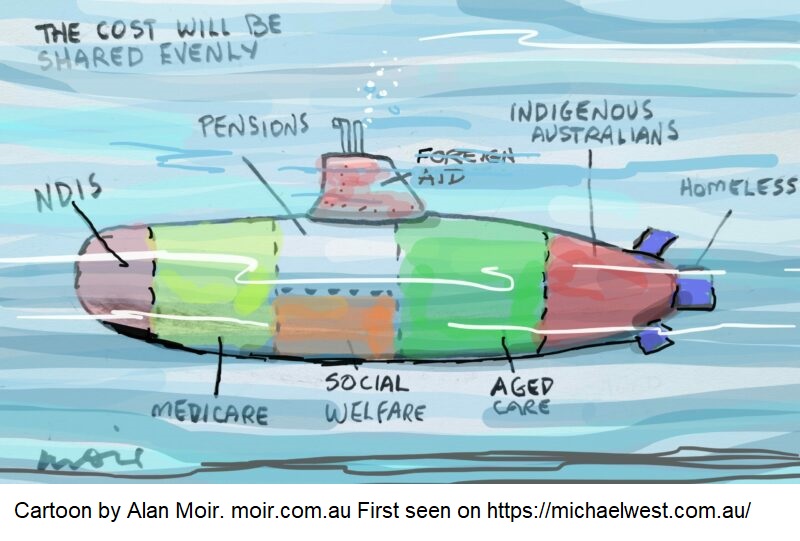
With Stage 3 tax cuts set to kick in next year, and revenue from coal and gas exports likely to decrease, it hard to work out how AUKUS will be paid for, other than by spending cuts.
Nation building spin
The Government has started to offset concerns about the spend and placate the punter by saying that this is a nation building project. But this is just spin.
Yes, shipbuilding creates trade jobs which can be utilised in a range of different industries other than defence. The same is true for the electronic engineers and software engineers that work on submarine combat systems.
But as for where a lot of workforce investment will take place, it will be in nuclear technology. This investment will not translate into benefits for the Australian economy, because there are no plans for us to have a civil nuclear industry. Even if Australia were to take a decision to go there, the US will not grant the nuclear technology release or transfer approval.
Any investment in a nuclear workforce will be a sunk Defence cost.
Dismantling of our sovereign submarine build capability
We will see an Australian flagged submarine in our waters in the early 2030’s. At that time we will start decommissioning Collins Class submarines and the workforce in Adelaide, who carry out full cycle dockings and life of type extension. That activity will stop, and 700 jobs will go.
The Government tells us that we will start building next generation SSN AUKUS submarines in 2040. But they are wrong. Once the Adelaide workforce is disbanded, we won’t rebuild a submarine build workforce. We will just buy an AUKUS submarine from the UK, or perhaps more US Virginia class boats instead.
Opportunity cost
There is a real tension building to our north. We need to have a Defence Force that can deter and, if that fails, fight.
This multi-billion dollar program will come at a great opportunity cost. What significant other capabilities do we miss out on as we fund this program? In that respect there is tragedy in the way we are moving forward.
Will it happen?
We’ve seen our future submarine go from an Australian “Son of Collins” under Rudd, to a Japanese submarine under Abbot, to a French submarine under Turnbull, to a US and UK submarine under Morrison and Albanese. The reality is that as Governments change moving forward, and that includes in the US and UK, the program will change again. And that’s not to mention significant changes that could take place in our geo-strategic circumstances.
In 2040, when we are purportedly going to start building an AUKUS submarine here in Australia, Anthony Albanese will be 77. You and I will be reading the second edition of his political memoirs, picked up from the discount bin at the front of the local bookstore. There’ll be a different program underway.
I’d love a new Ferrari, but I’d have to pay for it, so it just won’t happen. Unconstrained by the need to pay for it themselves, the Prime Minister, supported by a few Admirals, just wants nuclear submarines.
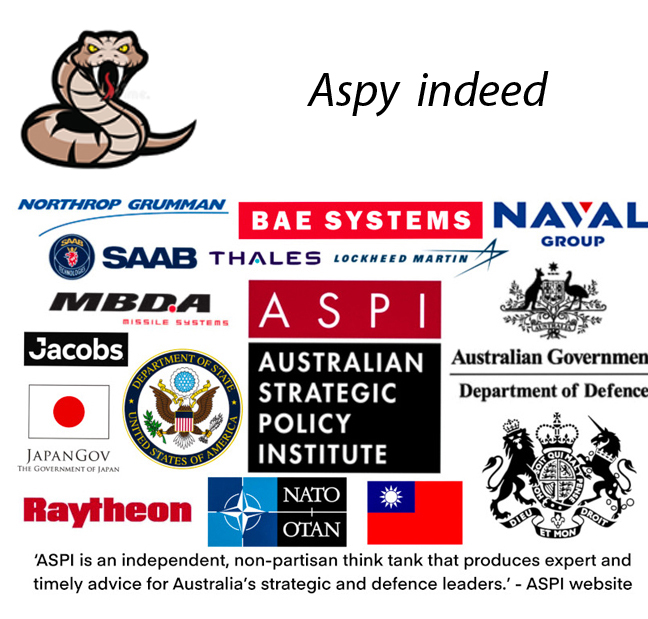
From producing reports and analysis for U.S. policy-makers, to enlisting representatives to write op-eds in corporate media, to providing talking heads for corporate media to interview and give quotes, think tanks play a fundamental role in shaping both U.S. foreign policy and public perception around that foreign policy. Leaders at top think tanks like the Atlantic Council and Hudson Institute have even been called upon to set focus priorities for the House Intelligence Committee. However, one look at the funding sources of the most influential think tanks reveals whose interests they really serve: that of the U.S. military and its defense contractors.
This ecosystem of overlapping networks of government institutions, think tanks, and defense contractors is where U.S. foreign policy is derived, and a revolving door exists among these three sectors. For example, before Biden-appointed head of the Pentagon Lloyd Austin took his current position, he sat on the Board of Directors at Raytheon. Before Austin’s appointment, current defense policy advisor Michèle Flournoy was also in the running for the position. Flournoy sat on the board of Booz Allen Hamilton, another major Pentagon defense contractor. These same defense contractors also work together with think tanks like the Center for Strategic and International Studies to organize conferences attended by national security officials.
On top of all this, since the end of the Cold War, intelligence analysis by the CIA and NSA has increasingly been contracted out to these same defense companies like BAE Systems and Lockheed Martin, among others — a major conflict of interest. In other words, these corporations are in the position to produce intelligence reports which raise the alarm on U.S. “enemy” nations so they can sell more military equipment!
And of course these are the same defense companies that donate hundreds of thousands of dollars each year to think tanks. Given all this, is it any wonder the U.S. government is simultaneously flooding billions of dollars of weaponry into an unwinnable proxy war in Ukraine while escalating a Cold War into a potential military confrontation with China?
The funding to these policy institutes steers the U.S. foreign policy agenda. To give you a scope of how these contributions determine national security priorities, listed below are six of some of the most influential foreign policy think tanks, along with how much in contributions they’ve received from “defense” companies in the last year.
All funding information for these policy institutes was gathered from the most recent annual report that was available online. Also note that this list is compiled from those that make this information publicly available — many think tanks, such as the hawkish American Enterprise Institute, do not release donation sources publicly.
1 – Center for Strategic and International Studies According to their 2020 annual report
$500,000+: Northrop Grumman Corporation
$200,000-$499,999: General Atomics (energy and defense corporation that manufactures Predator drones for the CIA), Lockheed Martin, SAIC (provides information technology services to U.S. military)
$100,000-$199,999: Bechtel, Boeing, Cummins (provides engines and generators for military equipment), General Dynamics, Hitachi (provides defense technology), Hanwha Group (South Korean aerospace and defense company), Huntington Ingalls Industries, Inc. (largest military shipbuilding company in the United States), Mitsubishi Corporation, Nippon Telegraph and Telephone Corporation (provides intelligence and information technology services to U.S. military), Qualcomm, Inc. (semiconductor company that produces microchips for the U.S. military), Raytheon, Samsung (provides security technology to the U.S. military), SK Group (defense technology company)
$65,000-$99,999: Hyundai Motor (produces weapons systems), Oracle
$100,000-$249,000: Huntington Ingalls Industries, Neal Blue (Chairman and CEO of General Atomics), Qualcomm, Inc., Raytheon, Boeing.
$50,000-$99,000: BAE Systems, Booz Allen Hamilton, Intel Corporation (provides aerospace and defense technology), Elbit Systems of America (aerospace and defense company), General Dynamics, Palantir Technologies
Submission 48 to Environment and Other Legislation Amendment (Removing Nuclear Energy Prohibitions) Bill 2022
There are many reasons why nuclear power is unlawful in Australia. Most are not new, and just as relevant as they always have been.
I do understand that the current push by the nuclear industry of Small Modular Reactors sounds appealing. Distributed ‘baseload’ power with a number of reactors producing no greenhouse gas emissions (unlike coal and gas). However, digging only slightly below the surface reveals insurmountable problems and dangers.
Nuclear Waste is quite frankly the elephant in the room. It is building up all over the world, a burden for future generations who have not had a say or benefited from its production. This itself is a major ethical issue. The intermediate level waste currently intended to be imposed against the South Australian law on a small and now divided farming community (Kimba) must be kept safe from people and the environment for a minimum of 10,000 years. Some radionuclides present in high level waste from nuclear power plants require containment for over 100,000 years. This needs to be acknowledged. It is constantly downplayed by the nuclear industry. (Any plan for a reactor build must have this ‘back end’ cost factored in). I would like to make a brief comment on the way the current plan for Australia’s relatively small amount of radioactive waste has played out since any proposed SMR waste would likely end up at the planned NRWMF at Kimba. The process has been manipulative and divisive (to put it politely). It has involved deliberate lies and bribery. It has deliberately trampled on the rights of First Nations people. A proper process to honestly and respectfully address the waste issue would be a pre-requisite for the consideration of nuclear power in Australia.
SMRs require at least 7 years to build (effectively stalling action on climate change) and require large taxpayer subsidies, whereas renewables can be up and running in 6 months. Furthermore, they have not been tried and tested in the US.
As much as denial is attempted by some, there is an inextricable link between domestic nuclear energy production and the production of plutonium for nuclear weapons. This is a long and deep subject, but this short summary is correct. Australia has its own history on this, which will be familiar to some on this committee.
The mining and processing of the uranium required to fuel the nuclear reactors produces radioactive tailings and presents a radioactivity hazard to the miners. Workers in nuclear power plants also experience radioactive risks, especially those involved in loading the fuel and handling the ‘spent’ fuel, which sits in cooling ponds for 7 years and is itself (along with the reactor) a potential radioactive threat (loss of electricity necessary for the cooling ponds results in uncontrolled atmospheric radioactive release, a real threat in the invasion of Ukraine). These and other important reasons are why nuclear power should remain prohibited in Australia. The reasons for its current prohibition have not gone away, they have grown stronger. https://www.aph.gov.au/Parliamentary_Business/Committees/Senate/Environment_and_Communications/Nuclearprohibitions/Submissions
Australia’s nuclear submarine program will cost up to $368 billion over the next three decades, with confirmation that the federal government will buy at least three American-manufactured nuclear submarines and contribute “significant additional resources” to US shipyards.
Key points:
The AUKUS class submarines will be operated by both the UK and Australia, using American combat systems.
One submarine will be built every two years from the early 2040s through to the late 2050s
From as early as 2027, four US submarines and one from the UK will start rotating through Western Australia
The Australian government will take three, potentially second-hand Virginia-class submarines early next decade, pending the approval of the US Congress.
There will also be an option to purchase another two under the landmark AUKUS defence and security pact, announced in San Diego this morning.
In the meantime, design and development work will continue on a brand new submarine, known as the SSN-AUKUS, “leveraging” work the British have already been doing to replace their Astute-class submarines.
That submarine — which will form the AUKUS class — would eventually be operated by both the UK and Australia, using American combat systems.
One submarine will be built every two years from the early 2040s through to the late 2050s, with five SSN-AUKUS boats delivered to the Royal Australian Navy by the middle of the 2050s.
Eventually, the fleet would include eight Australian submarines built in Adelaide into the 2060s, but the federal government is leaving open the option of taking some from British shipyards if strategic circumstances change.
Meanwhile, the federal government estimates the cost of the submarine program will be between $268 billion and $368 billion over the next 30 years.
As part of that figure, $8 billion will be spent on upgrading the naval base HMAS Stirling in Western Australia.
From as early as 2027, four US and one UK submarine will start rotating through Western Australia, to be known as the Submarine Rotational Forces West.
No decision has been made on a future east coast base for submarines, although Port Kembla has firmed as the most likely location.
Standing alongside Prime Minister Anthony Albanese and UK Prime Minister Rishi Sunak, US President Joe Biden spoke of the strength of the alliance already………..
US subs to rotate off Australian coast
During the announcement, President Biden flagged that, from this year, Australian navy personnel would embed with both US and UK crew on submarines and at their shipyards………………………
Mr Albanese confirmed that Australian submariners were already undergoing nuclear power training in the US……………
Money for US shipyards
Australia will also contribute $3 billion over the next four years to US and UK production lines, with the bulk of that money heading stateside.
White House officials insisted Australia was preparing to make a “substantial contribution” to US submarine production facilities.
The US government will also request an extra $US4.6 billion from Congress to upgrade the nation’s submarine infrastructure, with a concession that the readiness of American production lines are “not where it should be”.
Included in its overall project budget, Australia will spend $2 billion over the next four years upgrading the Osborne shipyards in South Australia.
The purchase of Virginia-class submarines from the United States was described by American officials as “a potent nuclear powered submarine force in the 2030s, much earlier than many had expected”.
US officials tried to allay concerns about restrictions on sharing its nuclear technology with Australia…………..
The three AUKUS leaders made the announcement at Naval Base Point Loma, in front of the Virginia-class submarine USS Missouri, which arrived in San Diego Harbor late last week.
Opposition Leader Peter Dutton said the Coalition would support the submarine deal “come hell or high water”.
“We were the authors of it. We give full credit to the government for continuing it and arriving at today,” he said.
Marles: Aukus program includes commitment to dispose of spent nuclear reactors
Marles: the sealed nuclear reactor is our friend, because by virtue of having a sealed reactor, we can provide assurance in respect of every piece of nuclear material through the life cycle of the nuclear material.
We are making a commitment that we will dispose of the nuclear reactor. That is a significant commitment to make. This is going to require a facility to be built in order to do a disposal that will be remote from populations. We are announcing that will be on defence land, current or future.
Now, to be clear, the first of the [nuclear material] we will dispose of will not happen until the 2050s, but within the year, we will announce a process by with this facility will be identified.
We are also a proud signatory to the treaty of Rarotonga. That commits us to not operate nuclear weapons from our territory.
Richard Marles says he is confident that the agreement will hold, even if America has a change in political direction……….
Q: Is it possible that we’ll be maintaining and operating three classes of submarines? That is the Virginia, the Collins and the Aukus submarines? And if so, is there any concern? And can I ask the admiral as well, is there any concern in defence about the prospect of operating three different submarines?
Marles:We obviously will be operating two as a result of this announcement. You know, the preference is to operate as few classes as possible.
Vice Admiral Mead: And once we work with the submarines coming to Western Australia and develop our own capabilities on the Virginias, then the move to SNN-AUKUS, which will have incredible commonality with propulsion systems, platforms, weapons, combat systems and sensors…………………. It remains the position of the Albanese government, that there won’t be foreign bases in Australia and this will not be a foreign base. It’s a forward rotation.…………..
Marles: ‘This is as good a value-for-money spend in defence as you will get’..……
Q: Is a high-level nuclear waste dump the price that South Australia will have to pay for the jobs that go to the state?
Marles:
Well, as I indicated earlier there will be a process that we will determine in the next 12 months … how the site will be identified. You’ve made a leap that we won’t make for some time. It will be a while before a site is identified but we will establish a process.
Q: The $9bn the government is spending over the forwards has a neutral impact on the budget, $6bn because of what was allocated to the attack class but $3bn is coming from the integrated investment program. Can you give more detail about … where that money is coming from? And if not today, when?
Marles: I won’t give you the detail today except you’re right to identify the integrated investment program and obviously the strategic review has had a good look at all of that. It will be plain in time of the budget.
Q: Why not now, though? You must have an idea where those cuts are going to be? In the interests of transparency, people want to judge what the opportunity cost of the nuclear submarines are. Unless you’re suggesting it’s cuts first and work it out later? Where are the cuts coming from?
In response to the news Australia will build and purchase nuclear submarines from the USA and the UK at a cost of up to $368bn between now and the mid-2050s, the Australian Conservation Foundation’s nuclear analyst Dave Sweeney said:
“The arrangement announced today will undoubtedly elevate regional tensions and increase risks for Australians and our neighbours.
“This deal introduces new and significant safety risks that Australia has never had to deal with before.
“There are risks of possible future accidents in our ports and waters, especially given nuclear regulator ARPANSA’s assessment that emergency management arrangements in Australia ‘are not fit for purpose for a future with nuclear powered submarines.’
“Pacific nations, Indonesia and others in our region have deep concerns about AUKUS.
“This arrangement further entangles Australia in the USA’s war-fighting plans.
“It raises serious non-proliferation concerns relating to access to highly enriched weapons-grade uranium and sets a disturbing precedent for imitation and escalation.
“Australia would be the only nation without nuclear weapons but with nuclear submarines. It may embolden other nations to go down this path, increasing global nuclear risks.
“There is no clarity about how the government intends to manage the resulting high level nuclear waste for the thousands of years it remains radioactive.
“As many Australians face daily cost of living pressures – and we all face the pressures of the climate crisis – this deal comes with a massive financial cost we will all bear.
“This whole process has lacked rigour or transparency and will cost Australians many billions of dollars that would be much better spent on social and environmental problems.
“ACF calls for the Albanese government to sign the UN Treaty on the Prohibition of Nuclear Weapons to give the Australian public and our region a clear commitment that nuclear subs are not a precursor to nuclear weapons.
“The Prime Minister should rule out Australia facilitating or hosting nuclear weapons – ‘neither confirm, nor deny’ is not an acceptable position. Australia must not facilitate unlawful weapons of mass and indiscriminate destruction.
“The PM should also rule out domestic nuclear power – nuclear subs must not become a Trojan Horse for subsidies for a deeply controversial and contaminating energy source.”
Today’s significant AUKUS announcement about Australia’s acquisition of nuclear-powered submarines provides significant, long-term strategic benefits for all three countries……..a transformational moment for our nation [Ed. it sure does! – transformed to a colony of USA’s military-industrial-complex]
…. provides significant, long-term strategic benefits [?] for all three countries……… our ability to be sovereign [?] ready.
……creating around 20,000 direct jobs [a very dubious claim – ?jobs for Americans and British military experts]
……… Businesses right across the country in every state and territory will have the opportunity to contribute to and benefit from these opportunities. [ a totally unlikely unrealistic claim, backed by no data]
one American commentator has already labelled the tripartite AUKUS project a looming “Goat Rodeo”. For which Google provided the following explanation : “a slang term for something going totally, unbelievably, disastrously wrong, and there’s nothing left to do but to sit back and watch the trainwreck. In other words, a goat rodeo is a chaotic situation, fiasco, or, more vulgarly, a s…show.”
Australia will have absolutely no sovereignty over the USN submarines
Details of the proposed AUKUS submarine deal to be announced next week in San Diego are leaking out all around the world. It seems that it will be much more complicated and expensive than intended at the outset of the path to the Holy Grail of an “optimal” solution. Already there are ominous signs that the three countries cannot even harmonise their rush into PR to launch the program.
Reflecting the reaction of a growing number of gobsmacked Australians to the extraordinary explosion of rumoured detail of the tripartite project, one American commentator has already labelled the tripartite AUKUS project a looming “Goat Rodeo”. For which Google provided the following explanation : “a slang term for something going totally, unbelievably, disastrously wrong, and there’s nothing left to do but to sit back and watch the trainwreck. In other words, a goat rodeo is a chaotic situation, fiasco, or, more vulgarly, a s…show.”
The claimed details of the project have been well covered in the media but what do they mean?
Sovereignty
A word in which Prime Minister Albanese has come to place great faith – and avoid others like “dependency” which has been expunged from the discussions. In a TV interview in India, Albanese has asserted that “Australia will retain, absolutely, our sovereignty — absolute sovereignty, 100 per cent. it is very important [for] Australia, as a sovereign nation state — and that’s something that’s respected by all of our partners as well.” It is arrant nonsense to claim “absolute” sovereignty when our geostrategic interests have become so enmeshed with those of the US – and have been for some time.
Let us not forget how we needed the US to weigh in with Indonesia before we launched the East Timor operation. Or more recently when Julia Gillard folded to US pressure for the rotational deployment of US Marines and greater USAF use of airfields in Northern Australia and our Defence force posture plans in return for a visit by President Obama. And so this has developed over subsequent years with embedment of senior Australian defence officers in the US IndoPacific Command in Hawaii and elsewhere, our increasing dependence on the US dominated Five Eyes intelligence network (despite some of its failures) and, of course, our ready participation in the disastrous US controlled “coalitions of the willing “ in Afghanistan and Iraq. And the conga line of US service and Pentagon chiefs which has graced our shores in the past year with their megaphones proffering “advice” on Australian strategic policy and defence procurement . Imagine if any other foreign country had done this in Australia with the DSR and submarine project underway !
Even without that background to just how “absolute” our sovereignty has not been, the details of the project definitely take this a significant step further. It is here where the spin from the US and Australia has already diverged. Defence Minister Marles has the temerity today to posit that there will not be any submarine “capability” gap because the Collins class subs are still very much in operation and will be around as we wait for the first of the new submarines to become operational.
(The Collins class, of course, does not have anything like the operational capability or weapons system of the new submarines).
But the US leaks have argued that the capability gap will be covered by US nuclear powered submarines expanding their current operations by regular visits in our region to Stirling in WA. The USN has long been keen to establish some homeporting arrangements there for its nuclear powered submarines and aircraft carriers. US media are also reporting that the early US Virginia class submarines to be delivered would be under US command with that gradually phasing out to mixed crews before eventually being run by the Australians. So Australia will have absolutely no sovereignty over the USN submarines in the first 15 years or so – and probably only very limited consultation with the Americans about their operations – which naturally are always so tightly held. For the following 10 years or so the command and control lines will be at best messy until the second set of submarines emerge. The British will want part of that action! So Albanese could well end up being the one with the credibility gap! As another US commentator has rightly pointed out that will be for politicians years down the track to sort!
Where will they be built?
Another key question on which there is some diverging spin. In keeping with his overall political strategy, Albanese has presented the deal so far as being a major plank in his efforts to boost manufacturing and R&D in Australia (and help argue the case for the huge budget damage the submarines alone will do). From the US side the push has been to emphasise how big a contribution the construction ( seemingly of all 5 or so) will be to US manufacturing and shipbuilding in particular. Some of the leaks have pointed out that very significant Australian funding will be required to US shipbuilders to expand their capacity to manufacture the Australian submarines. There has also been some persistently strong arguments in the US that the deal will exert too much pressure on US industry’s capacity.
A recent article in Foreign Policy summarised these concerns :
“But is it going to work? That’s been the major question all along through phase one of AUKUS, which has been beset by sticky U.S. export control and intelligence-sharing rules that have depth-charged key features of submarine design. First, the United States has to expand its own shipyard output to send five nuclear-powered submarines to Australia as well as make sure Congress is on board. Second, even if all goes to plan, the land Down Under will be operating a Frankenstein-like Navy with nuclear subs from two different countries, a potential nightmare for training and spare parts—and presumably, and most importantly, reactor maintenance and little details like that.”
Then there is the British spin. It seems clear from Prime Minister Sunak’s exuberant reaction to the leaks that they have probably received more out of the deal than they might have expected. No doubt BaE (in which the UK Government has a major interest and which also has bought out ASC in Adelaide) which runs the Astute class construction program in Barrow has been a major player in what appears to have been a relatively recent improvement in their prospects. This is also what Peter Dutton’s curious intervention would suggest as the Astute track record has been littered with failures, delays and cost overruns. ……………..
How much will it all cost?
Without confirmed details this cannot be estimated. But there is a consensus that it will well exceed not only the original French submarine but go well beyond.
Is the Virginia class submarine the best answer ?
In his rush to announce his preference for the Virginia class submarine over a new British design, Dutton placed weight on it being a simpler solution given that it was a proven design. But as I pointed out earlier this year in these columns (Nuclear submarines: from “optimal” to “the best they can get”) the Virginia has been the subject of detailed criticism from the Congressional Research Service and the GAO over its maintenance problems.
“Just last December the US Congressional Research Service issued a very detailed report (Navy Virginia (SSN-774) Class Attack Submarine Procurement: Background and Issues for Congress) outlining the significant delays in SSN repair and maintenance. It contains frequent references to serious concern expressed by a range of US Admirals with command responsibility for submarines. There have been similar criticisms from the GAO in recent years about the poor performance on SSN maintenance reducing significantly the already deficient number of SSN’s the USN can deploy.” https://johnmenadue.com/albanese-and-the-subs-the-goat-rodeo/—
the Australian order will be filled with a new and advanced SSN® model still in development. This is where the British come in. In a sense, Australia will be (a) serving as a test run and (b) will be creating extra economies of scale for the British Navy’s plans to develop and build SSN( R) models to replace its Astute class submarines by the early to mid 2040s.
China may well regard Taiwan as a renegade province. Yet the invasion of Taiwan – as the Australian economist and commentator John Quiggin points out – would pose massive challenges for the forces or Xi Jinping……………………………………………………What Quiggin is getting at here is that a concerted campaign is currently being waged by sections of the Aussie media with the aim of scaring the pants off the Australian public about the imminent threat from China in the Pacific, in the South China Sea and with regard to Taiwan.
The aim of this campaign is to justify a sky-high level of new defence spending by the Australian government. New Zealand is at risk of being carted along by the same momentum into authorising increases in our own defence spending that we don’t need, and can’t afford.
Acting the part
The campaign kicks into high gear today. As the Oscars get handed out in Los Angeles, another pantomime of power will be playing out on the docks just down the coast, in San Diego. Anthony Albanese, Rishi Sunak and Joe Biden will be standing shoulder to shoulder as they announce the first concrete manifestation of the AUKUS pact – a military alliance between Australia, Britain and the Americans that has China as its common target……………………………………
. As Reuters put it:
….[The] AUKUS pact, will have multiple stages with at least one U.S. submarine visiting Australian ports in the coming years and end in the late 2030’s with a new class of submarines being built with British designs and American technology, one of the officials said….after the annual port visits, the United States would forward deploy some submarines in Western Australia by around 2027.
In the early 2030’s, Australia would buy 3 Virginia class submarines and have the option to buy two more. AUKUS is expected to be Australia’s biggest-ever defence project and offers the prospect of jobs in all three countries.
That last bit is very important. Like his predecessors, Albanese will be treating Australia’s defence policy as a cutting edge ingredient of its manufacturing policy.
Australia’s defence policy as a cutting edge ingredient of its manufacturing policy. For Australian politicians, military policy and defence spending is as much about (a) creating jobs for Aussie workers, (b) gaining technology upgrades for Aussie industry and (c) scoring lucrative contracts for Aussie goods and services firms as it is about the actual defence of the nation.
…………………………………………………………………. In a worst case scenario, the Australians could well invite New Zealand to join AUKUS and assign us some “friend of AUKUS” status, as an observer. Our anti-nuclear legislation would complicate such a role. That aside, and given the ocean currents and prevailing winds, New Zealand has every good reason to feel nervous about the prospect of our near-neighbour learning on the job about how to build and maintain the nuclear reactors on its new submarine fleet.
Luckily, most of the new Aussie subs won’t be delivered until the early to mid 2030s. That means these massively expensive new purchases probably wouldn’t arrive in time to deter China from invading Taiwan, given that this is supposed to be imminent.
In the US, the building of Virginia-class subs are shared between two shipyards, one in Groton Connecticut and the other in Newport News, Virginia. Reportedly, the design variant that Australia has in mind will have been a three-headed upgrade project to the Virginia-class that will have been co-designed by Britain and the US, as amended to Australian specifications, with at least some of the subs being built by US-trained Australians who had no prior experience in this sort of construction. On top of these complications, all participants will be coming under pressure to deliver every stage of the project at the lowest cost possible. I mean, what could possibly go wrong with such a design and construction plan? And in this case, I don’t just mean the danger of cost blowouts.
Attack and defence
AUKUS is likely to make New Zealanders feel more unsafe in a number of other ways as well. For starters, AUKUS is not a “defend the homeland” pact. It is a forward projection alliance, to attack enemy targets and stifle the enemy’s ability to defend itself and respond. (Enemy = China.) Before we bow to the pressure coming from our traditional allies to join in with their chest-bumping rivalries with China, it is probably worth looking at the Aussie nuclear submarine deal in more detail.
The Albanese government has said the Aussie subs will not be nuclear-armed. (Not yet, anyway) However, the roughly 40 Tomahawk cruise missiles (the final design will limit the number) that each submarine will carry can all carry nuclear warheads. Only previous treaty commitments with Russia have prevented the cruise missiles carried on Virginia-class subs from being nuclear-armed.
Yet with the scrapping of nuclear proliferation treaties with Russia in the wake of the war in Ukraine, we could well be sailing in a few years time into “neither confirm nor deny” territory with our Australian neighbours. Regardless of their potential for carrying nuclear tipped Tomahawk cruise missiles alongside the usual torpedoes, mines, autonomous undersea drones, etc etc ….Would these nuclear-powered Australian subs be barred from docking at New Zealand ports under the terms of our anti-nuclear legislation? Yes, they would.
Therefore, it would be good to know if our current political leaders share a bi-partisan agreement to preserve our anti-nuclear stance in its current form and thereby ban those Aussie subs from our ports, now and forever more. Even if Labour and National did agree, the reality is that our new and expensive Poseidon anti-submarine surveillance aircraft will still be taking part in exercises which will increasingly have (a) a nuclear component and (b) an anti-submarine (ASW) component, courtesy of our ANZAC buddies. Lest we forget. (The growing ASW role for Virginia-class SSN category subs is mentioned on page 9 of the Congressional Review Service evaluation of the SSN programme. )
From what can be gleaned at this point i.e. prior to the formal announcement, the Australian order will be filled with a new and advanced SSN® model still in development. This is where the British come in. In a sense, Australia will be (a) serving as a test run and (b) will be creating extra economies of scale for the British Navy’s plans to develop and build SSN( R) models to replace its Astute class submarines by the early to mid 2040s.
To repeat: It would be unwise for New Zealand to be stampeded by the “defence” lobbyists both here and offshore into making significant increases to the allocations for Defence in the May Budget. If nothing else, the Aussie subs saga is a useful reminder that the regional tensions in the Pacific and the China bogey are both being driven and monetised by firms within the military-industrial complex, via the pork barrel politicking (lucrative jobs and contracts for our neighbourhood! ) that is so rife among our traditional military allies.
Footnote: While we spend billions on a fleet of new Poseidon anti-submarine aircraft, and the Aussies buy their fleet of mega-expensive nuclear submarines, the future of underwater warfare is seen by some observers to rest with unmanned underwater vehicles (UUVs). Apparently, the Australian military has a programme to develop UUVs called Ghost Shark, cutely named after the US Ghost Bat programme.
No. 46 Submission to the Inquiry into the Removal of Nuclear Prohibition (Federal) I note that this Bill seeks to remove the federal prohibition on nuclear installations in Australia. There are also state prohibitions that would also need to be removed for any nuclear installations to proceed in a state, but removing the federal prohibition would be a step towards promoting the nuclear industry in Australia.
My main point would be – regardless of the potential benefits and potential of nuclear industry in Australia, which would need to be considered against the costs, risks and community sentiment – that it is a distraction from the urgent action that needs to happen now.
Nuclear energy would conservatively take some 15-20 years to become operational. In the meantime, there would be tremendous public debate and opposition (whether nuclear energy can be determined to be safe, and arguably it could, public sentiment is still tough and perhaps insurmountable hurdle). Moreover, there would be immense costs in the construction of any nuclear installations, likely requiring much government support. For all that, there is the potential for something coming online perhaps in 2040 or later. Liberal governments have flirted with the idea of nuclear energy off and on for decades. Perhaps if they really committed to it back under John Howard and had a successful push for it, nuclear power would be coming online soon or be an option. However, the time has passed on nuclear energy being a realistic option.
While I would usually applaud long-term visionary thinking from members of Parliament, looking at starting up nuclear activities seems like a far off plan that can do little to address the challenges that we are facing – including the need to have a speedy transition to a low-emissions economy now. Where countries already have an established nuclear industry, it provides an important source of energy & will be a key part of their transition to a Net Zero economy. Once constructed, nuclear energy can operate with very few emissions. However, for a country without an established nuclear energy industry, such as Australia, it is not something that can be constructed simply.
Renewable energy is the cheapest, and fastest to build, source of new energy. With battery storage and transmission lines, renewable energy will be poised to assume an increasingly prominent role in the energy makeup in Australia. The decarbonisation of the energy sector will require a variety of strategies and technologies and creative solutions. However, renewable energy will clearly be key (and arguably largely sufficient) to transitioning to a more affordable and sustainable energy system. As economist Ross Garnaut writes, “I now have no doubt that intermittent renewables could meet 100 per cent of Australia’s electricity requirements by the 2030s, with high degrees of security and reliability, and at wholesale prices much lower than experienced in Australia over the past half-dozen.”1 I note that there is a concurrent Inquiry into Australia’s Transition to a Green Energy Superpower, which provides a good (and more relevant) window into the opportunities Australia can take up for our energy future.
Japan may soon start dumping radioactively contaminated waste water from the Fukushima Daichi nuclear plant into the Pacific Ocean, despite warnings from neighboring countries, marine scientists, and health experts. As soon as within a month or two, Japan could begin dumping into the Pacific Ocean 1.3 million tons of treated but still radioactively contaminated wastewater […]
As soon as within a month or two, Japan could begin dumping into the Pacific Ocean 1.3 million tons of treated but still radioactively contaminated wastewater from the stricken Fukushima Daichi nuclear plant. Construction of the kilometer long undersea discharge tunnel and a complex of pipes feeding it commenced last August.
This cheap and dirty approach of “out of sight out of mind” and “dilution is the solution to pollution” belongs in a past century. It ignores the significant transboundary, transgenerational and human rights issues involved in this planned radioactive dumping, projected to continue over the next 40 years.
Concerns about Japan’s ocean dumping plans have been strongly voiced by China and South Korea, and by numerous Pacific island nations. Multiple UN Special Rapporteurs have severely criticised the plan, which has also been opposed by the United States National Association of Marine Laboratories and many regional and international health and environmental civil society organisations.
Australia bears a particular responsibility in relation to the aftermath of the ongoing Fukushima nuclear disaster, since fuel fabricated with uranium from Australia was in each of the Fukushima reactors which exploded. Yet my letters to the relevant Australian federal ministers on this matter have gone unanswered for seven weeks, and no evidence is publicly available that the Australian government has supported our Pacific neighbours in raising concerns about the planned discharge with its Japanese counterparts.
We are in the UN Decade of Ocean Science for Sustainable Development (2021-30). As Pacific Islands Forum (PIF) Secretary-General Henry Puna reminded us in his piece in The Guardian on 4 January, in 1985 the Forum welcomed the then Japanese prime minister’s statement that “Japan had no intention of dumping radioactive waste in the Pacific Ocean in disregard of the concern expressed by the communities of the region.” The current plan is inconsistent with this commitment.
In a public event organised by the PIF in Suva on 18 January, Puna noted Prime Minister Kishida’s reassurance during Japan’s regular meeting with the Forum in July 2022 of the need to progress this matter consistent with international law and verifiable science. The Secretary-General reiterated his request on behalf of Forum members for postponement of the planned discharge in order to allow adequate consideration of alternative options and to engage in respectful and full evidence-based consultation with Pacific nations in planning the best course of action. His calls have been ignored.
The most authoritative independent scientific assessment of the planned discharge has been conducted by a five-member independent international scientific panel appointed by the PIF. The experts were unanimous in their conclusions and recommendations. Their main conclusions:
TEPCO’s knowledge of the specific radionuclide contents of all the tanks is seriously deficient. Only roughly one quarter of the more than 1,000 tanks at the site have been sampled at all, and in almost all cases only nine or fewer of 64 total radionuclides are measured in the data shared with PIF. TEPCO’s assumptions of consistent ratios of various radionuclides across different tanks are contradicted by the data, with show many thousand-fold variation.
Sampling and measurements have been unrepresentative, statistically deficient and biased, and have not included the debris and sludges, which Japan has acknowledged are present in at least some of the tanks. Sludges and debris are likely to be most radioactive, particularly in relation to harmful isotopes like plutonium and americium.
More than 70% of the tanks which had gone through ALPS (Advanced Liquid Processing System), designed to remove most of the radioactive contaminants, will require re-treatment. For some isotopes, the levels after treatment are up to 19,900 times higher than the regulatory limits for discharge. There is no evidence confirming that even repeated processing through ALPS can provide consistently effective purification.
There has been no adequate consideration of the behavior of radioactive elements in the ocean, with transport by ocean currents and organisms, accumulation in biota and sea floor sediments, or the behavior of organically bound tritium in an ocean environment. The seafloor off Japan’s east coast still contains up to 10,000 times the cesium concentration as before the disaster, before any planned discharge.
Neither TEPCO nor the IAEA acknowledged or addressed the many serious scientific questions raised by the panel. For example, TEPCO reported that tanks sampled in 2019 contained tellurium-127, an isotope with a half-life of only 9 hours. This signifies either that accidental criticality with fission reactions are occurring on an ongoing basis in the molten reactor cores, which would be very significant, or that the measurements are wrong. However no satisfactory answers were provided. Indeed the IAEA cut off contact with the panel.
Neither TEPCO, the International Atomic Energy Agency (IAEA) nor the Japanese Nuclear Regulatory Authority have properly considered several viable alternative approaches, including storage in purpose-built seismically safe tanks, possibly after initial purification, subsequent use in concrete for structural applications with little or no potential for contact with humans and other organisms, and bioremediation for some important isotopes such as strontium-90. All the proposed alternatives would have orders of magnitude less impact and avoid transboundary impacts.
The argument that the site is running out of room to store water is spurious. Contaminated water will continue to be generated for many decades hence, and there is plenty of nearby space available that will be unfit for other uses for a very long time and is already being used to store large amounts of contaminated soil from around the prefecture. There is in fact no urgency to begin ocean discharge.
The independent expert panel recommended unanimously that the planned ocean dumping should not proceed. Their overwhelming case, based on scientific evidence and the need to minimise transboundary and transgenerational impacts, is that new approaches and alternatives to ocean dumping are needed and are the responsible way forward.
This matter requires urgent attention. Construction of the pipeline through which the ocean discharge is planned to occur is well underway, and the discharge may commence as soon as this month. Given that the discharge is planned to continue over 30-40 years, reconsideration could still be undertaken even after ocean discharge commenced. However it would be far better if the planned discharge were postponed until better alternatives were properly considered and implemented.
Now is the time for the Australian government, scientists and citizens to join with our Pacific neighbours in calling on Japan to stop its irresponsible plan to use the Pacific Ocean as a radioactive waste dump.
But Western leaders while discussing AUKUS have taken pains to avoid calling out China directly, but it’s clearly aimed at countering Beijing’s influence in the Indo-Pacific, and certainly China sees it as directly impacting its own defense priorities – and has accused Australia of severely violating prior commitments to not introduce nuclear weapons or nuclear technology to its military.
In a major expansion and overhaul of its navy, Australia is planning to buy up to five US Virginia class nuclear powered submarines beginning in the next decade, Reuters and others are reporting. US as well as European officials have disclosed the future deal as part of a “landmark defense agreement between Washington, Canberra and London, four U.S. officials said on Wednesday, in a deal that would present a new challenge to China.”
The impending agreement is seen as central to the relatively new AUKUS partnership, and the major sub deal is expected to be announced when President Joe Biden, Australian Prime Minister Anthony Albanese and UK Prime Minister Rishi Sunak meet in San Diego Monday.
When the partnership was first announced and formalized eighteen months ago, President Biden said of it, “We all recognize the imperative of ensuring peace and stability in the Indo-Pacific over the long term,” and that “We need to be able to address both the current strategic environment in the region and how it may evolve.”
The nuclear submarines at center of the expected deal cost $3 billion each and will initially be built in Virginia and Connecticut. But sources say other submarines could be built in the UK and Australia while utilizing US technology and assistance.
The AUKUS partnership has multiple defense components components, chief among them the development of the nuclear submarine capability for Australia. This has been known since the AUKUS agreement was announced in Sept. 2021, but this week marks the first time specifics have been revealed.
Other components include security cooperation in cyberspace, artificial intelligence, quantum technologies and undersea capabilities. While the US, the UK and Australia already take part in common security arrangements, and all three participate in the Five Eyes alliance, an intelligence-sharing arrangement that also includes Canada and New Zealand, the AUKUS security structure provides for the technology cooperation needed to share nuclear submarine technology and other common efforts in a region where China poses growing security concerns.
But Western leaders while discussing AUKUS have taken pains to avoid calling out China directly, but it’s clearly aimed at countering Beijing’s influence in the Indo-Pacific, and certainly China sees it as directly impacting its own defense priorities – and has accused Australia of severely violating prior commitments to not introduce nuclear weapons or nuclear technology to its military.








 Antinuclear