South Australians very definitely dumped the nuclear dump plan, but a new battle looms.
Australia’s handful of self-styled ‘ecomodernists’ or ‘pro-nuclear environmentalists’ united behind a push to import spent fuel and to use some of it to fuel Generation IV fast neutron reactors. They would have expected to persuade the stridently pro-nuclear Royal Commission to endorse their ideas. But the Royal Commission completely rejected the proposal
Another dump proposal is very much alive: the federal government’s plan to establish a national nuclear waste dump in SA, either in the Flinders Ranges or on farming land near Kimba, west of Port Augusta.
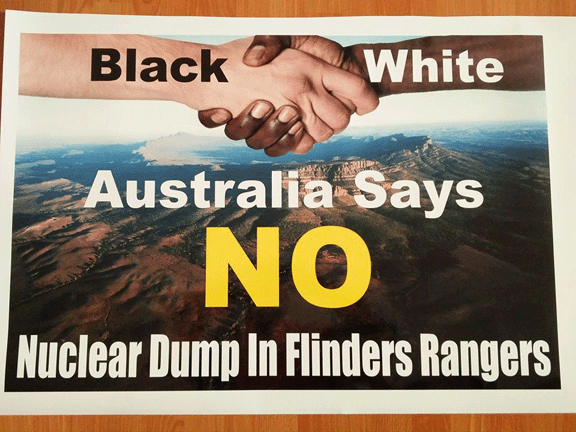 How the South Australians who dumped a nuclear
  dump may soon have another fight on their hands http://www.theecologist.org/News/news_analysis/2989048/how_the_south_australians_who_dumped_a_nuclear_dump_may_soon_have_another_fight_on_their_hands.html 15th June, 2017 The rejection of a plan to import vast amounts of high-level nuclear waste from around the world for profit was a significant result for campaigners but that threat is still far from over, writes JIM GREEN
Last November, two-thirds of the 350 members of a South Australian-government initiated Citizens’ Jury rejected “under any circumstances” the plan to import vast amounts of high-level nuclear waste from around the world as a money-making venture.
The following week, SA Liberal Party Opposition leader Steven Marshall said that “[Premier] Jay Weatherill’s dream of turning South Australia into a nuclear waste dump is now dead.” Business SA chief Nigel McBride said: “Between the Liberals and the citizens’ jury, the thing is dead.”
And after months of uncertainty, Premier Weatherill has said in the past fortnight that the plan is “dead”, there is “no foreseeable opportunity for this”, and it is “not something that will be progressed by the Labor Party in Government”.
So is the plan dead? The Premier left himself some wriggle room, but the plan is as dead as it ever can be. If there was some life in the plan, it would be loudly proclaimed by SA’s Murdoch tabloid, The Advertiser. But The Advertiser responded to the Premier’s recent comments, to the death of the dump, with a deafening, deathly silence.
Royal Commission
It has been quite a ride to get to this point. Continue reading
Peter Martin’s guide to the Finkel review, and Tony Abbott’s obstructionism
Doing nothing, as Abbott and other non-readers seem to want, doesn’t offer a way out.
Worse, it allows the system to become more fragile.
Finkel wants to keep the lights on and wants to keep the system stable so that new operators feel able to invest. Abbott is standing in the way.
 Finkel review: a bluffer’s guide for those who haven’t read it How Finkel would keep the lights on, and why Abbott’s not so keen http://www.brisbanetimes.com.au/comment/how-finkel-would-keep-the-electricity-on-20170614-gwqwqo.html Peter Martin So much does Tony Abbott dislike the Finkel review of the electricity market that he hasn’t read it. On Monday, three full days after it was released, he branded its key recommendation a “magic pudding” and a “tax on coal” while conceding that he had been guided by “reports of the report” rather than the report itself.
I understand where he is coming from. Who wants to wade through 200 pages of a report they won’t like? But I’d feel better about it if I thought that at least some of the 20 or so other backbenchers who spoke out against the Finkel Report at the Coalition party room meeting on Tuesday had taken the time to read it.
I fear that most haven’t, and I reckon you probably won’t as well.
So in the interest of ensuring the people deciding the future of our electricity system have some idea of what they are talking about, here’s my potted summary.
First up, electricity prices. While the wholesale price accounts for only 31 per cent of the typical bill (the rest is distribution, retailing and the like), wholesale prices have been soaring in recent months.
It’s happening because unreasonably cheap electricity is leaving the system. Until March the Hazelwood power station in the La Trobe Valley supplied as much as 25 per cent of Victoria’s electricity and 5 per cent of the nation’s. It was cheap partly because the brown coal that fed it wasn’t good enough for much else, and especially because its owner, a French firm called Engie, had bought it for next to nothing. It didn’t need to recoup the cost of building it.
It’s the same at the nearby Loy Yang A power station. Its owner, AGL, bought much of it from the Tokyo Electric Power Company in a fire sale after the Fukushima nuclear disaster. Whatever replaces Loy Yang A and Hazelwood will cost real money, which will have to be recouped.
Seven coal-fired power stations are due to close in the next 20 years, each having reached the “retirement age” of 50. Each is roughly the size of Hazelwood.
But for a decade now scarcely anyone has felt confident enough to put up real money to build a new conventional power station. The rules about carbon prices and targets keep changing against the ever-present backdrop of an official emissions reduction target that means they will have to change again.
Plenty of investors have been prepared to build new wind and solar plants (having little to fear from a change in the rules) but those wind and solar plants don’t operate around the clock, meaning gas has had to close the gap. Continue reading
New South Wales DEPUTY Premier John Barilaro renews calls for nuclear power
 Call for nuclear debate as NSW government arrives in Singleton, Newcastle Herald, MICHAEL McGOWAN 15 Jun 2017, DEPUTY Premier John Barilaro renewed his calls for nuclear power to be “part of the debate” about the state’s future energy mix before a cabinet meeting in Singleton on Thursday.
As debates about the role of coal-fired electricity in Australia’s energy mix heat up, and plants like Liddell and Bayswater in the Hunter approach their use-by date, Mr Barilaro said nuclear “should always be on the table” as a replacement source of energy.
“Right now those power stations are run by those companies and they will make those long-term decisions [but] when it comes to baseload energy gas, coal and nuclear should always be on the table,” he said.
“As a nation we’re going to export uranium, we’re going to possibly bring back waste, but yet we don’t want to use it for our own energy sources.”
Those comments come in the wake of the release of the Finkel Review into energy security released last week, which recommended governments implement a new Clean Energy Target which would provide incentives for new generators that produce electricity below an emissions baseline…..http://www.theherald.com.au/story/4731625/call-for-nuclear-debate-as-nsw-government-arrives-in-singleton/
Aboriginal leader, previous supporter of Adani coal project, now rejects it
“I want to withdraw my signature on the Ilua,” he said. “I take this position because I do not believe that the Ilua adequately compensates us for the destruction the project will wreak upon the traditional culture and lands of our people.”
He said that most in the meeting, which was boycotted by those opposing the deal, were “people I did not recognise as being members of our claim group”.
“Most importantly, I believe that QSNTS failed us by not ensuring that we were properly and independently advised on the benefits of entering the Adani Ilua,” Dallen said. “Only the benefits of entering the Ilua were discussed.””..…
Adani mine loses majority support of traditional owner representatives
Wangan and Jagalingou representative who had backed an Indigenous land use agreement now says he opposes the mine, Guardian, Joshua Robertson, 15 June 17 Adani has lost majority support from traditional owner representatives for a land access deal for its Queensland mine, casting doubt on moves to implement the agreement.
Craig Dallen, a Wangan and Jagalingou representative who last year backed an Indigenous land use agreement (Ilua) with the miner, now says he opposes a deal that will not make up for “the destruction the project will wreak upon the traditional culture and lands of our people”.
Dallen’s reversal, which came while he was sidelined from the decision-making process while in custody in a Queensland jail, has left the W&J representative group deadlocked on the Adani deal, with six in favour and six against.
But federal government native title amendments passed on Wednesday mean Adani’s agreement, unlike all future Iluas, do not need majority support to proceed. Continue reading
Tomago Aluminium boss wants government to invest in nuclear energy
Finkel review: Tomago Aluminium chief executive says nuclear energy should be an option, Newcastle Herald, 14 Jun 2017, THE boss of NSW’s largest electricity user, Tomago Aluminium, has welcomed increased energy security requirements recommended in the Chief Scientist Alan Finkel’s energy market reform report.But the smelter’s chief executive, Matt Howell, says he believes that if Australia’s politicians were “brave” they would consider nuclear energy……
The Clean Energy Target (CET) would provide incentives for new generators that produce electricity below an emissions baseline that, for the purposes of the Finkel Review, was modeled using 0.6 tonnes of carbon per megawatt hour.
While it’s prompted dissent in some parts of the government because it points investment incentives away from coal-fired electricity, the scheme has been welcomed by others because it’s essentially technology neutral.
That’s prompted some to call for the government to consider investment in nuclear energy, and Mr Howell is one of them. …..
But Shortland MP Pat Conroy says nuclear isn’t an option because it’s too expensive.
“One, it would take 15 years to build up a nuclear industry and secondly, the levelised cost of energy for nuclear is well above the cost of renewables,” he told reporters in Canberra on Wednesday.
“Leaving aside the environmental implications, if you want to get cheap energy in this country that’s reliable, you need to invest in renewables.”
NSW Deputy Premier John Barilaro has previously called for a debate about introducing nuclear energy to the state’s energy mix, and on Thursday Port Stephens MP Kate Washington accused the Nationals of wanting “to discuss any energy alternative except renewables”. http://www.theherald.com.au/story/4730851/be-brave-and-use-nuclear/
Federal Inquiry needed: Adani should be questioned on history on environment and ‘allegations of fraud, corruption
Push for Adani to appear before Senate inquiry into infrastructure fund https://www.theguardian.com/business/2017/jun/15/push-for-adani-to-appear-before-senate-inquiry-into-infrastructure-fund Greens say miner should be grilled on environmental history and ‘allegations of fraud, corruption and the use of tax havens’,  Guardian, Joshua Robertson 15 June 17, The Greens will push for Adani to front a federal Senate inquiry into Australia’s infrastructure fund and “grill” the miner on its overseas environmental and business record.
The Senate on Wednesday passed a motion for an inquiry into the Northern Australia Infrastructure Facility, which is considering a $900m concessional loan to Adani for a railway as part of its massive proposed Queensland coal project.
The Queensland Greens senator Larissa Waters said she would seek to have Adani appear before the inquiry to “grill them” on their environmental history and “the allegations of fraud, corruption and the use of tax havens”.
Waters said the company would be asked why it needed “a billion taxpayer dollars” if the mine, which would export up to 60m tonnes of coal a year to Asia, was financially viable.
A spokesman for Adani, which has denied any wrongdoing in relation to claims of invoicing fraud under investigation in India, did not immediately respond to a request for comment.
The inquiry motion came a day after reports emerged that Adani Enterprises, the parent company of the Australian mine venture, had been in talks about establishing a weapons venture with an arms business that had earlier been banned in India amid a corruption probe. An Adani spokesman told the Economic Times of India that the company abandoned early talks with the arms business as it was not comfortable with the idea.
The motion was passed with Labor and Greens support in the face of opposition by the government.
The inquiry, to be run by the economics references committee, will examine the “adequacy and transparency” of the $5b infrastructure fund’s project assessment and approval processes.
It will also scrutinise processes around Naif board appointments, including assessments of conflict of interest, and policies to manage these.
Jason Clare, the Labor shadow minister for resources and northern Australia, told parliament there had been a “cover up” around governance questions surrounding a Naif board member, Karla Way-McPhail.
Clare said an estimates hearing a fortnight ago had established that Way-McPhail, the CEO of two mining services companies that could benefit from Adani’s success, was a “personal friend” of the minister overseeing the Naif, Matthew Canavan, and was put forward by him as a board candidate.
“And this government refuses to say whether she was in the room for [Naif board] discussions about these projects or whether she recused herself,” Clare said.
Governance questions like that had prompted the inquiry and a separate Labor call for the Australian National Audit Office to investigate NAIF, he said.
The inquiry will look at the adequacy of Naif’s investment mandate, risk appetite statement and public interest test guiding decisions of its board.
It will also examine the role of state and territory governments, and any agreements with the federal government, around the fund.
Waters claimed the NAIF was “not about encouraging investment in Northern Australia” but “creating a slush fund to prop up the dying coal industry”.
Clare said it was a “fair bet” that Pippa Middleton’s Northern Territory honeymoon would “probably deliver more economic development to the north” than the Naif in its first two years.
No projects had yet been funded yet more than $600,000 had been spent on salaries and expenses for board members, he said.
“All we know is that over the last two years they have had 119 enquires for funding, they are apparently considering 60 active deals, but there are only four that are currently subject to due diligence.”
A spokeswoman for Canavan said: “The NAIF is accountable to the parliament and will cooperate with requests, as it always has done including through appearances at Senate estimates.
“This inquiry does not add any level of accountability as it is already possible for the Senate to call the NAIF before a committee, even if it’s not on a scheduled estimates day.”
Traditional Owners slam passage of Native Title amendments
Traditional Owners fighting Adani’s proposed coal mine have expressed profound disappointment at the passage of Attorney General Brandis’ amendments to the Native Title Act, stressing that while Mabo’s legacy has been diminished they will continue to fight for their rights.
Senior spokesperson for the W&J Traditional Owners Council, Adrian Burragubba, says, “Adani’s problems with the Wangan and Jagalingou people are not solved this week. The trial to decide the fate of Adani’s supposed deal with the Wangan and Jagalingou Traditional Owners is scheduled for the Federal Court in March 2018.
“Our people are the last line of legal defence against this mine and its corrosive impact on our rights, and the destruction of country that would occur.
“Senator Brandis has been disingenuous in prosecuting his argument for these changes to native title laws, while the hands of native title bureaucrats and the mining lobby are all over the outcome.
“This swift overturning of a Federal Court decision, without adequate consultation with Indigenous people, was a significant move, not a mere technical consideration as the Turnbull Government has tried to make out.
“It is appalling and false for George Brandis to pretend that by holding a ‘workshop’ with the CEOs of the native title service bodies, he has the unanimous agreement of Traditional Owners across Australia. No amount of claimed ‘beseeching’ by the head of the Native Title Council, Glen Kelly, can disguise this.
“The public were not properly informed about the bill, and nor were Indigenous people around the country, who were not consulted and did not consent to these changes.
“We draw the line today. We declare our right to our land. There is no surrender. There is no land use agreement. We are the people from that land. We’re the rightful Traditional Owners of Wangan and Jagalingou country, and we are in court to prove that others are usurping our rights”, he said.
Spokesperson for the W&J Traditional Owners Council, Ms Murrawah Johnson, says, “Whatever else this change does, we know that the Turnbull Government went into overdrive for Adani’s interests.
“Brandis’ intervention in our court case challenging the sham ILUA was about Adani. Most of what Senator Matt Canavan had to say in argueing his ill-informed case for native title changes was about Adani. The Chairman of Senate Committee inquiring into the bill, Senator Ian McFarlane, referring to the native title amendments as “the Adani bill” was about Adani. And the PM telling Chairman Gautam Adani that he’d fix native title was about Adani”.
“We are continuing to fight Adani in court and our grounds are strong. If anyone tells you this is settled because the bill was passed, they are lying”, she said.
Adrian Burragubba says, “The Labor Opposition seems to understand this, even though they supported passage of the bill. Senator Pat Dodson went so far as to say this bill does not provide some kind of green light for the Adani mine, as some suggest.
“Pat Dodson acknowledged that W&J have several legal actions afoot against Adani and we are glad that in the midst of this dismal response to the rights of Indigenous people some MPs, including the Greens who voted against the bill, recognise the serious claim we have to justice.
Mr Dodson said in the Senate that: “most of this litigation will be entirely unaffected by the passage of this bill. In particular, there are very serious allegations of fraud that have been made against Adani regarding the processes under which agreements with the Wangan and Jagalingou people were purportedly reached. And those proceedings, which may impact on the validity of any ILUA, will only commence hearings in March next year. Other legal action is also underway, including a case challenging the validity of the licences issued by the Queensland government.”
This week researchers from the University of Queensland released a report titled ‘Unfinished Business: Adani, the state, and the Indigenous rights struggle of the Wangan and Jagalingou Traditional Owners Council‘.
Liberal hard right oppose the Finkel Clean Energy Target
 George Christensen signals he won’t vote for Finkel’s clean energy target
LNP backbencher says he and most of the Nationals won’t vote for any clean energy target that penalises coal, Guardian, Katharine Murphy, 15 June 17, The LNP backbencher George Christensen has signalled he won’t vote for a new clean energy target because it won’t end the decade long climate wars – because Labor will “out Finkel us on Finkel”.
Christensen said on Wednesday evening that he saw no prospect of achieving policy stability on climate and energy policy through bipartisanship, because the gulf between the major parties was too wide.
“Given the history of climate policy in this place, given we’ve got the Labor party pushing 50% renewable energy targets … given we’ve got some Labor MPs talking about no more coal-fired power at all – how are we, honestly, going to have policy stability?” the outspoken MP told Sky News.
Christensen said he had no intention of voting for a clean energy target that penalised coal and neither would the bulk of the National party. “I’m out. I won’t support that”.
He said that, rather than legislating a clean energy target, the government would be better off building high-efficiency coal-fired power stations to replace the ageing coal fleet. Christensen contended that approach would reduce carbon pollution.
The backbencher’s public declaration of opposition follows an extraordinary Coalition party room meeting on Tuesday night in which government MPs ventilated their concerns about the Finkel review, which recommends introducing a clean energy target to deliver policy certainty for investors and reduce emissions……
The former prime minister Tony Abbott – who was a vocal participant in the special party room meeting, and floated the desirability of the government buying the Hazelwood power station – continued his public critique of the Finkel reviewon Wednesday afternoon.
Abbott said the “problem” with the review was it was “all about reducing emissions”. He said Australia did not need to conform with the commitments he made as prime minister in the Paris climate accord if those commitments “clobbered” power prices…..
In an interview with Guardian Australia this week, the chief scientist said it would be surprising if governments used the overhaul of energy policy to incentivise new coal-fired power stations.
He pointed out that modelling associated with the review did not envisage new coal power stations being built…..https://www.theguardian.com/australia-news/2017/jun/14/george-christensen-signals-he-wont-vote-for-finkels-clean-energy-target
More Australian renewable energy news
Eco Energy World says approval of three new solar projects, including 280MW solar farm in Bouldercombe, bring “ready to build” portfolio to total of 570MW.
http://reneweconomy.com.au/eco-energy-gets-approval-three-qld-solar-farms-20528/
Firm offered to fit jail solar panels for free
SOLAR energy wasn’t considered an “economically viable” option to power Darwin’s $1.8 billion prison – despite the Northern Territory Government receiving a proposal in 2013 from a company that offered to install the infrastructure for free
http://www.ntnews.com.au/business/firm-offered-to-fit-jail-solar-panels-for-free/news-story/4f13a19c0d1da8d58d16d4af3a1059ae
Hard to keep up with renewable energy news
Cheap wind, solar will make Australia a magnet
http://www.afr.com/news/cheap-wind-solar-will-make-australia-a-magnet–bloomberg-20170615-gwrwat
Coalition may require new solar and wind farms to match each megawatt of capacity with a megawatt hour of energy storage to “level playing field”
http://reneweconomy.com.au/coalition-wants-wind-solar-forced-match-mw-storage-15465/ Australians aren’t buying electric cars: Three charts illustrate why
EV Council says most Australians want to buy electric vehicles, but a lack of policy support – and cars – is getting in the way.
http://reneweconomy.com.au/australians-arent-buying-electric-cars-three-charts-illustrate-why-78101/
 Finkel to energise market: AEMO
AEMO CEO Audrey Zibelman says the Finkel blueprint for national electricity security is “spot on”.
http://www.theaustralian.com.au/business/mining-energy/alan-finkel-report-spot-on-aemo-chief-audrey-zibelman/news-story/4cf5e765df33ca2d07c45d4023f5170a Details cut off $90 power saving
Households will not receive a promised $90 annual saving from a clean energy target.
http://www.theaustralian.com.au/national-affairs/climate/new-electricity-reform-details-cut-off-promised-90-saving/news-story/5991f423ba3f0549edffbf37bbed3652
Latest renewable energy news from REneweconomy
-
Finkel’s Clean Energy target little more than state’s business-as-usualBy Giles Parkinson on 16 June 2017 A new analysis from The Australia Institute suggests that the renewable energy scenarios put in the Finkel review’s proposed clean energy target will deliver little more, or likely even less, than that proposed by current state-based renewable targets Coalition parties want to kill.Australian Energy Storage 2017 conference – the low key buzzIf the 2016 conference was lithium, lithium, lithium, the 2017 version has a more nuanced tone. Here are some of the highlights.
-
Bernardi goes solar to “keep the lights on,” but did he get storage?SA Senator Cory Bernardi has installed 12kW of solar at his family home – but will it keep the lights on?
-
Carnegie selected by US State Department to lead sustainability goalCarnegie has been selected as the company to lead global business in achieving the United Nation’s Sustainable Development Goal number 7 – Affordable and Clean Energy.
-
Australians aren’t buying electric cars: Three charts illustrate whyEV Council says most Australians want to buy electric vehicles, but a lack of policy support – and cars – is getting in the way.
Finkel energy review ignores battery storage, and falling cost of renewables
the cost estimates for consumers and emissions abatement for the scenarios that limit coal generation are painted as being significantly higher than allowing coal to continue.
 Finkel modelling ignores new technologies, cheaper renewables http://reneweconomy.com.au/finkel-modelling-ignores-new-technologies-cheaper-renewables-33626/ By Giles Parkinson on 14 June 2017
Here we go again. The Australian public and the Coalition party room are being told that allowing coal-fired generators to continue beyond their 50 year life offers the cheapest path to a transition to a low carbon economy.
But they are being misled. This conclusion is only reached through modelling prepared by a private consultancy for the Finkel Review that deliberately ignores certain new technologies such as battery storage that can provide grid security and replace coal-fired generation at a much cheaper cost than gas.
The detailed modelling – prepared by consultancy Jacobs for the panel led by chief scientist Dr Alan Finkel – also ignores recent big falls in the costs of wind and solar, and over-estimates the cost to build new wind and solar plants.
The Australian public – and the Coalition party room – are being told that the cheapest and most effective way to address emissions is to allow coal-fired power stations to remain in the system beyond their 50-year asset life.
But this is only justified by excluding renewables and associated “firming” technologies – such as storage and synchronous condensers – that the review itself admits could provide a much cheaper option than gas-fired generation to replace coal fired generation.
Many in the industry are happy to go along with that, reasoning it best, or good enough, to get a mechanism in place now, and tweak it later.
But that plan is not working out well. Even with the promise of longer life for coal plants, and falling bills for consumers over “business as usual”, the Coalition party room is being torn apart by disagreements between the moderates and the mostly climate science-denying hard right rump.
The details of the modelling, which were only published on the environment ministry website on Wednesday, show that Australia can be a whole lot more ambitious than the targets laid out under the central Finkel Review’s conclusions, and could save even more money if some realistic cost assumptions were made and some technology answers dialled in.
The report’s recommended policy mechanism, the Clean Energy Target, has caused controversy because it allows for coal-fired generation to still support 25 per cent of total generation by 2050, albeit in a scenario where climate targets reflect the Coalition’s modest down-payment and not the “well below” 2°C scenario signed up to in Paris.
But there appears to be confusion in the modelling. Finkel himself acknowledges that the cost of wind and solar is cheaper than both coal and gas-fired generation, even with storage and “firming” capacity added, and carbon emissions and environmental impacts of the fossil fuel plant ignored. (See graph above)
Those estimates, Finkel noted, took into account some of the latest contracts, including the stunning $55/MWh deal for a wind farm in Victoria, and recent estimates by Origin Energy and AGL on the contracting costs of solar.
ARENA’s Ian Kay said on Wednesday that wind was being built in Australia at costs in the “low to mid” $50s/MWh, while solar was in the low to mid $70s/MWh, and falling.
The acknowledgement of these cost falls is critically important for considerations on how to address Australia’s energy future, but the detailed work conducted by Jacobs appears to roll back on those estimates and distorts the impacts of various policy paths.
More alarmingly, when considering scenarios where coal generators were managed out of the grid after 50 years, the Jacobs modelling deliberately ignores certain technologies such as synchronous condensers, and “synthetic inertia batteries”, that could be used instead of more expensive new gas generation.
Instead, it says that coal plant would have to be replaced only by thermal generators, meaning gas, and this would put the prices up sharply compared to the “unlimited” life coal scenario included in the preferred Clean Energy Target mechanism.
“Jacobs understands that new technology developments (i.e. synchronous condensers, synthetic inertia batteries with power conversion electronics etc.) will potentially allow renewable technologies to provide these ancillary services (or at least a portion of these services) but a more conservative approach was chosen for that sensitivity in order to examine the full impact of the constraint,” it says.
Frankly, this is outrageous. As one competing industry consultant noted:
“I’m afraid I find a lot of this so-called modelling is pretty low-grade stuff. Turning the handle and get what you want. The track record of this stuff is laughable and it’s boring and worthless to keep on talking of it as if it means something.”
It was not clear whether he was disputing the Finkel Review’s conclusions, or simply wasn’t aware of them.
The cost estimates for wind and solar used by the Jacobs modelling are also faulty. It has not reduced its capital cost estimates for wind energy below the much criticised capital costs used in its report for the Climate Change Authority last year.
Wind capital costs are still estimated at $2,400/kW, while solar PV and solar PV with single axis tracking are lowered but put between $2,200kW and $2,300/kW. (In the graph above, the left column represents life span of asset, the fourth column the capital costs per kW, and the next column the learning rate).
Solar farm and wind farm developers have told RenewEconomy that these estimates are out of the ball-park. “We think it is closer to $,1500/kw for single axis solar, and $1,800 for wind,” said the head of one firm currently constructing both wind farms and solar farms in Australia.
Also, he pointed out that solar farms have a life of at least 25 years. Only 20 years is factored in to the Jacobs modelling. The capacity factors adopted by Jacobs (Maximum of 29 per cent for tracking solar) also appear to short-change solar technology, in particular, by around 10 per cent.
This is not the first time we have taken issue with Jacobs over its modelling – most notably for a report it did for the CCA and various different policy scenarios, including the suggestion that an ambitious renewable energy target would result in a more coal-fired power stations built after 2040.
The upshot of this is that the cost estimates for consumers and emissions abatement for the scenarios that limit coal generation are painted as being significantly higher than allowing coal to continue.
This is important because, as the International Energy Agency has pointed out, and numerous others, if there is any chance of reaching the Paris climate goal, the electricity grid needs to reach zero net emissions well below 2050.
But the result is to completely distort the result, as occurred in the modelling that was used by AEMC and CCA to justify and emissions intensity scheme over alternatives such as a high renewable energy target.
Finkel Review not much help for solar and storage home customers
Finkel Review: What’s in it for solar and storage customers like Jenny? REneweconomy By Dominic Adams on 14 June 2017 The focus of this piece is about what the Finkel Review delivers for a Mojo customer, Jenny. Jenny has solar on her roof and a smart battery in her garage.
Having your attention though (and also my cake and eating it) I’d like to start by noting that we should think carefully before opposing the Clean Energy Target (CET), the big ticket item in the Finkel Review designed to reduce emissions in the power sector.
It’s become more important to put the carbon wars behind us for a time than to find the perfect policy.
The CET is far from perfect. It’s all carrot and no stick. It’s a political and environmental compromise. But it’s our last best hope of ending the lost years of uncertainty in the generation sector that are now leading to wholesale electricity price rises that will start flowing through to customers like Jenny in a few weeks.
Mojo’s mission is to drive down the costs of energy for its customers (including Jenny), and we think that ending the uncertainty in the policy environment is an essential step in that direction.
The CET however makes up just a fraction of the 212 page report. It’s a few paragraphs out of the 7 pages packed with recommendations 1.1 through 7.14. It’s fair enough to ask the question, what’s in all those recommendations for Jenny?
The answer is somewhat unclear at this stage, but the signs aren’t great for Jenny in the short to medium term.
The big problem that the Finkel Review is charged with solving is how to decarbonise the energy sector while keeping the system secure and inexpensive for consumers.
A key focus however is on the security of the system in the wake of a particular storm in South Australia (plus more than a few in teacups in Canberra). The security issue is summed up well in the Review:
“Because [system security services such as inertia, system strength and voltage control] were historically plentiful, as essentially a by-product of power supply from synchronous generators, they were not explicitly valued in the [National Electricity Market (NEM)]. With their growing scarcity, the hidden value of these services has emerged. New mechanisms will be needed to source these services, or appropriate alternatives, from synchronous machines and a range of other technologies.”
As more renewable energy pushes into the NEM, driven initially by policy, but increasingly by sheer economics, system security services are in decline. The same process contributes to reliability issues, where the lights go out because available supply can’t meet demand in the NEM.
People with batteries and controllable devices behind their meters (the so called prosumers, or Jenny) can provide system security services to the market as well as help supply meet demand in the NEM.
The key issue in the Finkel Review for Jenny is what the mechanisms for sourcing these services will be, and whether she will be able to benefit from the value that her assets provide……..
What it ultimately means for Jenny is that her solar system and battery are less valuable. Her assets can’t access all the value in providing security and reliability services because initially the markets don’t exist for those services.
In the longer run, when the markets may exist after the long process of review and policy development, the value may not be there anymore. The lions share of the value could be taken by the grid scale batteries and other devices that were required to be built in the non-market phase.
We think a better approach is to fast-track the development of market based solutions to these issues. Doing so will not just increase the benefits for Jenny, but also reduce costs for other consumers not fortunate enough to afford solar and a battery.
At Mojo we will keep up the fight for Jenny and our other customers, because they have better things to do than read the Finkel Review.
Dominic Adams is Regulatory Strategy Manager for energy retailer Mojo Power http://reneweconomy.com.au/finkel-review-whats-solar-storage-customers-like-jenny-79674/
Ukraine uranium sales plan: Unreasonable, unstable and unsafe
In a statement tabled in the Senate last night, the Turnbull government has confirmed it will seek to proceed with selling Uranium to Ukraine despite significant safety and security concerns raised by the Joint Standing Committee on Treaties.
Uranium exports to Ukraine
“Australia, the nation that fuelled Fukushima should not sell uranium to the country that gave us Chernobyl,” said the Australian Conservation Foundation’s Dave Sweeney.
In February a JSCOT investigation found that existing safeguards were ‘not sufficient’ and there was a risk Australian nuclear material would disappear off the radar in Ukraine.
The government has ignored JSCOT’s recommended pre-conditions around risk assessment and recovery of nuclear materials and is looking to advance the deal despite the risks of war, civil unrest and nuclear insecurity in the eastern European country, which is involved in hostilities with Russia.
“The treaties committee’s report found ‘Australian nuclear material should never be placed in a situation where there is a risk that regulatory control of the material will be lost’, yet this is exactly what could happen under the deeply inadequate checks and balances that apply to exported Australian uranium,” said Mr Sweeney.
“JSCOT recommended the Australian government undertake a detailed and proper risk assessment and develop an effective contingency plan for the removal of ‘at risk’ Australian nuclear material prior to any sales deal.
“Unreasonably and irresponsibly the government response fails to credibly address this. Australia should be very cautious about providing nuclear fuel to an already tense geo-political situation in eastern Europe.
“Ukraine’s nuclear sector is plagued by serious and unresolved safety, security and governance issues.
“Two-thirds of Ukraine’s aging fleet of 15 nuclear reactors will be past its design lifetime use-by date in just four years.
“This is an insecure and unsafe industrial sector in a highly uncertain part of the world. Australian uranium directly fuelled Fukushima and this deeply inadequate response shows the government has learnt little and cares less”.
Turnbull once again in a bind with Liberal climate denialists over Clean Energy Target plan
 Tensions erupt in Turnbull government over climate and energy policy, The Age, James Massola, 14 June 17, Climate-change policy has ignited tensions within the federal government, with a group of backbench MPs led by Tony Abbott confronting Malcolm Turnbull over the proposed Clean Energy Target in a special party room meeting.
As one MP in the room put it afterwards: “Malcolm could lose his leadership over this if he doesn’t listen to us.”
The disquiet means that Environment and Energy Minister Josh Frydenberg is likely to have little choice but to significantly modify the Clean Energy Targert (CET), as proposed in chief scientist Alan Finkel’s review, to keep the backbench on-side as he finalises the Coalition’s policy response, which is expected as soon as the end of July.
If he does, Mr Frydenberg runs the risk of putting Labor offside – particularly if the policy is too coal-friendly – and dashing the chance of the major parties striking compromise and ending the climate policy wars.
According to several MPs in the room, at least 21 backbench MPs raised concerns about the CET, while five spoke in favour of it and five were said to be non-committal.
Another senior MP in the room said while 32 people had spoken, one third of the speakers had been in favour of the Finkel review’s recommendations, one third opposed them outright and one third expressed concerns but were non-committal. Continue reading
1 This month
17 October, Free Public Talk on Nuclear Issues in South Australia
David Noonan will speak on public interest concerns over the new Roxby Downs Indenture Act 2026 on BHP copper-uranium mining and ore processing in SA, and on how AUKUS may face SA with a High-Level nuclear waste agenda.
Dr Jim Green will discuss international developments in the field of nuclear power including ‘small modular reactors’ and Generation 4 ‘advanced’ nuclear reactor concepts.


Help Aunty Sue Protect Her Land and Sacred Sites From Destructive Rocket Testing.
.

Australians deserve the truth
about
AUKUS – https://aukuspublicinquiry.com/

PETITION – To: Prime Minister Anthony Albanese and the Australian Labor Government

of the week – Australians for War Powers Reform (AWPR)
To see nuclear-related stories in greater depth and intensity

