Adani coal mine expansion project is in the wars: Matt Canavan’s not helping!
 As with renewables, I am snowed under with news about Adani’s coal mine. It is indeed the critical issue in Australia right now, (well after the risk of joining Trump in war). However, as this site is dedicated to Australia’s fight to be nuclear-free, I am now, reluctantly, cutting short the posts on this topic.
Canavan’s call to boycott Westpac a colossally stupid salvo in the new Truth Wars
 Michael Bradley
Matt Canavan says Queenslanders should boycott Westpac since the bank is not going to lend money to the colossally wasteful Adani coal mine and becomes sucked into the Nationals Irony Generator.
https://www.crikey.com.au/2017/05/02/matt-canavans-call-to-boycott-westpac-for-adani-coal-mine/
Adani’s telling meltdown over Westpac’s new climate policy
Bob Burton
The angry denunciation of Westpac’s new climate policy – which rules out funding for new mines in the Galilee Basin – serves only to underscore how crucial support from at least one major Australian bank was to Adani’s push to win finance for its beleaguered Carmichael coal project.
http://reneweconomy.com.au/adanis-telling-meltdown-westpacs-new-climate-policy-14504/
Cash, not climate, real concern
Dennis Shanahan
Westpac’s announcement that it would refuse to finance the Adani mine appears to be ‘virtue signalling’.
http://www.theaustralian.com.au/opinion/columnists/dennis-shanahan/westpacs-dirty-big-secret-cash-not-climate-is-the-real-concern/news-story/6121c525df0eeae372e0adb9114d5adc
Fiji wants Australian PM to lobby Trump to stay with Paris climate deal
 Fiji asks Turnbull to lobby Trump to stay with Paris climate deal, REneweconomy, By Giles Parkinson on 2 May 2017 Fiji prime minister Frank Bainimarama, who will host this year’s climate change talks in Bonn, has asked Australia prime minister Malcolm Turnbull to urge US president Donald Trump to stay within the Paris climate treaty.
In his first address as president of COP23, Bainimarama told the Carbon Markets Institute conference in Melbourne on Tuesday that he had written a letter to Trump, who has dismissed climate science as a Chinese hoax, urging the US to stay within the Paris agreement.
Bainimarama met with Turnbull at the PM’s home in Sydney on Sunday and said he had asked Turnbull to convey the message to Trump when he meets with him next week.
“My message to Donald Trump, and the message that I hope Malcolm Turnbull will also convey is ‘Mr President, do not abandon the Paris agreement, please stay the course’.”
Bainimarama said it was clear from the latest climate science that the world is running out of time, and it may already be too late to avoid many of the impacts.
“Climate change is not a hoax, it is frighteningly real,” he said. “Billions of people are losing the ability to feed themselves … We need to limit the damage … failure is not an option.”
He has appointed a climate science denier, Scott Pruitt, to lead the Environment Protection Agency; appointed deniers to numerous other key portfolios; and has sought to roll back all climate change and clean energy initiatives, and remove rules restricting what he calls “clean coal.”
However, a decision on whether to leave the Paris deal, expected last week, has been delayed………http://reneweconomy.com.au/fiji-asks-turnbull-to-lobby-trump-to-stay-with-paris-climate-deal-96273/
Tasmania’s energy efficiency loans scheme now open
 Tasmanian households and small businesses can increase their energy efficiency through a new no-interest loan scheme, BLAIR RICHARDS, State Political Editor, Mercury

AGL Energy says there’ll be a shift from coal directly to large-scale wind and solar.
 AGL kills idea of gas as transition fuel: wind, solar + storage cheaper, REneweconomy, By Sophie Vorrath on 2 May 2017 Australia’s largest integrated energy company, AGL Energy, says Australia’s transition away from a coal power dominated national grid to low-carbon generation will largely bypass “baseload” gas, and instead shift straight to large-scale wind and solar.
As politicians and the gas lobby expend considerable energy over the need to guarantee supply of gas, the company founded some 180 years ago as The Australian Gas Light Co, says the combination of wind and solar and battery storage is already cheaper than new gas generators.
“The energy transition we have all been anticipating will skip ‘big baseload gas’ as a major component of the NEM’s base-load generation and instead largely be a case of moving from ‘big coal’ to ‘big renewables’,” AGL CFO Brett Redman says in a presentation to the Macquarie Australia Conference in Sydney on Tuesday.
The frank prediction – which flies in the face of Prime Minister Malcolm Turnbull’s plan to subsidise the delivery of more gas into Australia’s electricity market – is based on the now fairly well accepted economic view that gas power will continue up the cost curve, making it less and less competitive with large-scale solar and wind. Continue reading
Hydro electricity versus coal-fired power – northern Queensland election issue?
 Hydro electricity versus coal-fired power in north Queensland set to be major state election issue, ABC News By Chris O’Brien, 2 May 17 and staff Hydro electricity versus coal-fired power for north Queensland will be a major issue in the next state election, with voters to choose between rival plans that have support from opposite sides of federal politics.
The Queensland Government’s weekend announcement of a feasibility study for a hydro-electric power station at the Burdekin Falls Dam was strengthened today with a $200 million pledge by federal Labor leader Bill Shorten.
“With hydro-electric power being generated we can start doing something about providing greater reliable power for Townsville, for its residents and for its businesses,” Mr Shorten said.
That contrasted with Queensland Opposition Leader Tim Nicholls’ previously announced policy for a new coal-fired generator in the north……..The LNP’s coal-fired plan was supported by the Prime Minister and federal Resources Minister Matt Canavan…….http://www.abc.net.au/news/2017-05-02/hydro-electricity-vs-coal-fired-power-north-qld-state-election/8490232
Donald Trump could get Australia involved in war
every US ally is now on notice – you cannot rely on Trump’s America in a crisis

US Allies Now On Notice, The Age, Peter Hartcher, 2 May 17 It was five years ago that a senior US official brought to Canberra the sobering news that North Korea was turning its missiles towards Australia for the first time. He [Campbell, a former senior Pentagon official] has an update…….. .
“But the devastation of the South would be horrific – millions killed.”
A further restraint on any idea of a preemptive US strike to destroy North Korea’s nuclear facilities, says Campbell, is that there is recent evidence that the regime has distributed the nuclear infrastructure around the country and the US could not be fully confident that it knows every location.
There are no easy options. Trump has said that he’s expecting China’s Xi Jinping to do the hard work of deterring Kim from any further provocation. Xi says that Washington and Beijing are united in seeking to prevent the nuclearisation of the Korean peninsula.
But North Korea is nonetheless one of only two allies of China, and there are limits to how far it will go in pressing its ally. Campbell says he expects that “in the end, China will disappoint” American expectations……
He’s not impressed by Trump’s handling of the problem to date: “In a crisis like this the tendency is for the US to bring its allies closer. The president has instead roiled South Korea with his comments – it’s crazy….. In the midst of a crisis that Donald Trump has described his most urgent national security priority, he has picked a fight not with his adversary but with his ally.
In the past week or so, even as North Korea threatens an imminent attack on South Korea, Trump has chosen to denounce the US free trade agreement with Seoul as the “worst deal ever” and demanded renegotiations.
He has insulted his South Korean ally by saying in an interview that the country was once “part of China”, a falsehood that seems to concede to China a greater scope for legitimate influence over Seoul.
And, astonishingly, he has even demanded publicly that the South Korean government, which goes to an election in a month’s time, must pay for the defensive missile interception system that the US is installing on South Korean soil.
Malcolm Turnbull will strike a pose with Trump this week on the deck of a retired warship in New York Harbour to affirm the strength of the alliance with the US. Everyone will play happy allied families in a carefully choreographed performance.
But the reality of US alliances under Trump is not the cheerful one to be played out on the USS Missouri but Trump’s treatment of America’s South Korean ally.
Every US ally needs to note that, exactly when South Korea needs America most, Trump is putting pressure on it, picking a fight with it on trade and defence, publicly belittling it.
Turnbull has to do what he can to preserve as much of the alliance as he can. But every US ally is now on notice – you cannot rely on Trump’s America in a crisis. ….http://www.theage.com.au/comment/donald-trump-is-learning-a-lesson-from-north-korea–and-so-are-us-allies-20170501-gvwpbm.html
Port Augusta Mayor speaks at Parliament house rally for solar thermal power
 Demonstrators rally for Port Augusta solar thermal power plant http://www.adelaidenow.com.au/news/south-australia/demonstrators-rally-for-port-augusta-solar-thermal-power-plant/news-story/0c142b68f658a89d7c455202a4021d56 April 30, 2017 MORE than 200 people turned out on the steps of Parliament House on Sunday, with their own makeshift solar panels, urging the State Government to back a solar thermal power plant at Port Augusta.
Decked with mirror panels to mimic solar panels, the demonstrators were led by Port Augusta Mayor Sam Johnson and former coal power station worker Gary Rowbottom.
The Federal Government has committed $110 million in funding through a loan for the project, but the State Government is yet to commit any money.
Mr Johnson said a power purchase plan from the government would make it viable and secure jobs for the Far North city. “Our community has pushed for solar thermal for years,” he said. “Now, it’s time for action from the State Government. Federal funding is now locked in for solar thermal in Port Augusta so it’s time for the Premier to make solar thermal a reality.
“Building solar thermal won’t just help Port Augusta, it will create manufacturing jobs for SA, regional jobs and balance our electricity grid with big storage.”
Mr Rowbottom said the project would provide much-needed stimulus for Port Augusta. “This is Jay Weatherill and the SA Government’s chance to support our community for the long term, helping us build a new future and becoming the clean energy powerhouse of SA now the coal station has closed,” he said.
Energy Minister Tom Koutsantonis said solar thermal power was “absolutely in the mix” for the State Government going forward.
Political risk for Turnbull in pandering to Big Coal over Adani mine
 Turnbull’s foolish gamble to pander to Big Fossil over Adani coal mine, SMH, crispinhull.com.au Crispin Hull , 1 May 17, Is Malcolm Turnbull determined to lose the 2019 election? His statement this week that the government could underwrite the rail line for the Adani mine would have increased the anger among small businesses in the six reef seats. Continue reading
Western Australian suburb Baldivis tops nation for solar rooftops
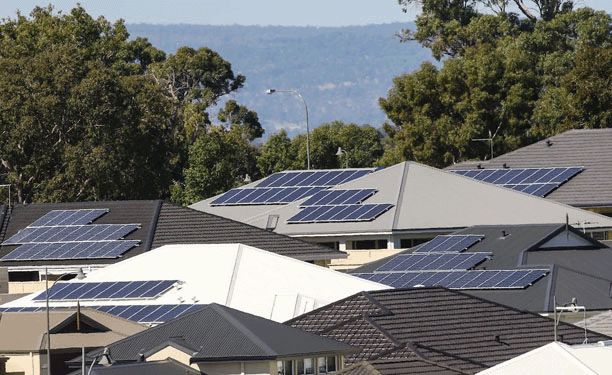
Baldivis tops nation for power from sun https://thewest.com.au/news/wa/baldivis-tops-nation-for-power-from-sun-ng-b88456809zMonday, 1 May 2017 The southern Perth postcode of Baldivis is Australia’s solar capital, with more than two-thirds of houses in the suburb generating their own power from the sun.
With electricity prices spiralling and a rush towards green energy, fresh figures show the rate of solar panel installations across Australia led by WA is gathering pace.
There are almost 230,000 households and small businesses with solar panels across WA after a massive 71 per cent increase in installations in past 10 months alone.
More than a quarter of WA homes have solar panels. But the figures show the rate of solar uptake in some suburbs is sky-high, with a staggering 69 per cent of households in Baldivis having a system.
According to the figures, from the Australia Photovoltaic Institute, there are 5765 “dwellings” in Baldivis and 3951 of them have solar panels — the highest rate of penetration in Australia.
It was a similar story in Byford, where 56 per cent of 3326 households had rooftop PV, as well as Rockingham, where uptake was 53 per cent.
The figures also show Mandurah, while having a lower penetration rate, had the second highest number of solar panel installations of any suburb in the country.
Of the 28,428 households in the southern centre, almost 10,000 had photovoltaic cells, behind only Bundaberg in Queensland, which had 10,529 systems. Australian Photovoltaic Institute chairman Renate Egan said it was remarkable that solar was so popular that in some suburbs the households without solar panels were outnumbered by those which did have them.
Warwick Johnston, an analyst with consultancy SunWiz, said WA trailed Queensland and NSW on installations.
“The biggest change has been WA leapfrogging Victoria into third place when it comes to the number of new solar installations,” Mr Johnston said.
The latest figures came as Energy Networks Australia — which represents grid operators such as Western Power — released a report showing the amount of solar power in WA was set to triple in the next 13 years.
It said using battery storage systems, electric cars and “smart homes” would also rise.
ENA boss John Bradley said more than 40 per cent of WA’s electricity was predicted to come from renewable sources by 2030 amid moves to de-carbonise the economy.
Farmers want the Australian government to embrace solar energy
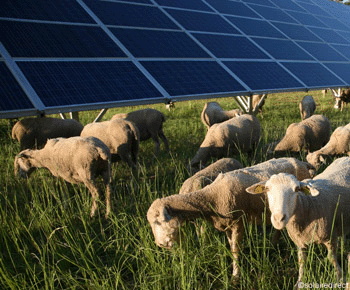
Farmers urge government to embrace solar for the future http://www.examiner.com.au/story/4625721/farmers-urge-government-to-embrace-solar-for-the-future/?cs=97 30 Apr 2017, A year ago, my family acquired solar panels in a very unusual way. Our farm is located in Quirindi, northern NSW, in the heart of Australia’s food bowl.
We’ve never before experienced a run of 40-degree days like we had last summer. Being farmers we are at the mercy of the seasons, and in recent years we have experienced extremes in our weather – extended hot summer periods and increasingly variable rainfall. It’s hard on our cows, it dries out the soil, stresses pastures and impacts the number of animals we can stock on the farm.
A few years back a concerned group of Christians called Common Grace crowdfunded enough money to buy solar panels for the then Prime Minister, Tony Abbott. It was an attempt to raise awareness of the value and importance of sustainable energy.
But when this gift was rejected, Common Grace turned to the front lines of climate change in Australia and offered the panels to farmers, like me. My parents taught me the value of caring for the land, and so, I appreciate the clean energy from solar which allows me to use appliances during the day knowing I am having minimal impact on the environment.
My family spends less on electricity now and with the price of solar storage falling, we’ve got plans to go completely off the grid.
It’s frustrating that our government is failing to transition Australia to sustainable energy when we are out in the paddock already trying to adapt to the impacts of worsening droughts and heatwaves.
We must tackle climate change so we can pass on healthy farmlands to our children, and so farmers can continue to produce food and clothes for generations to come.
Being given the opportunity to go solar has been great. I just wish our government will now give it a go. Kirrily Blomfield was 2014 NSW farmer of the year.
Federal Minister For Coal, Matt Canavan cause the Australian States “silly”
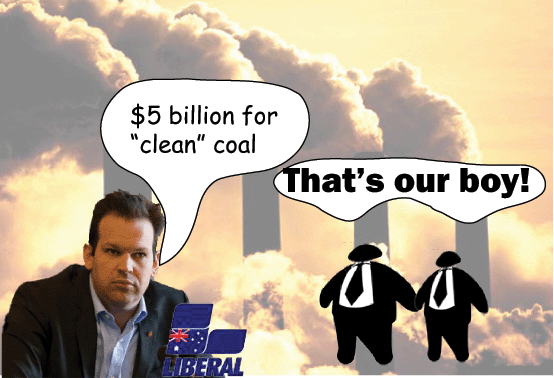 Canavan slams ‘silly’ states, Minister says firms are being by punished by states’ moratoria on gas exploration, as poll shows majority support for bans, THE AUSTRALIAN, RACHEL BAXENDALE, 29 Apr 17, Resources Minister Matthew Canavan says Australian businesses are being held back by the “silly decisions of state governments” who have placed moratoria on unconventional gas exploration, despite a new poll showing the majority of Australians support the bans.
More than twice as many Australians support moratoriums on fracking (56 per cent) as those who oppose them (20 per cent), according to an Australia Institute survey of 1420 people conducted over a week in March.
That majority in favour of bans on new unconventional gas extractions including hydraulic fracturing (fracking) was evident across all states.
The opposition to fracking also crossed party lines, with Labor, Liberal and minor party voters all expressing concern……
Australia Institute deputy director Ebony Bennett said industry demands to open more land to fracking were not about reducing energy prices but maximising profits.
“The current gas crisis and high gas prices are not an unintended consequence, but the result of linking Australia to the international gas market,” she said.
Shadow Environment Minister Mark Butler said Labor had dragged the government kicking as screaming to its decision to place export restrictions on the gas companies.
“We’d seen for a couple of years that there was a potential supply crunch coming our way because of the LNG operations and that’s why we announced in 2015 that we thought a policy of a national interest test should be adopted,” he told Insiders.
“We were rubbished by Malcolm Turnbull. He called us irresponsible. That we would wreck investment.
“The Commonwealth absolutely needed to take action and we welcome the fact that Malcolm Turnbull finally came to that decision this week.”
Greens senator Sarah Hanson-Young said the government’s export restrictions would do nothing to reduce the cost of gas domestically.
“What we’ve had happen is our gas market opened up to the international market, the prices are set at the world price,” she said. http://www.theaustralian.com.au/national-affairs/silly-states-holding-business-back-resources-minister/news-story/994a029f28672c0630e87dc10072346c
Federal Labor no longer supporting Adani coal mine
Federal Labor backtracking on support of Adani’s planned Carmichael coal mine, ABC News, 1 May 17 By political reporter Dan Conifer, Federal Labor is stepping back from its support of Adani’s proposed multi-billion-dollar Queensland coal project.
The Indian company is still to decide whether to proceed with its Carmichael mine in the Galilee Basin.
Earlier this month, Federal Opposition Leader Bill Shorten backed the project.
“I support the Adani coal mine so long as it stacks up. I hope it stacks up,” Mr Shorten said.
But Labor’s energy and environment spokesman Mark Butler today warned the development could hurt other coalmining areas……..
Westpac rules out lending to project
Westpac last week released a climate change policy stating it would only lend to projects involving higher-quality coal. The decision effectively ruled out financing the Adani development and any other ventures using coal from the Galilee Basin.
Mr Butler said the bank’s move was further proof “the economics of this project don’t stack up”.
“The demand for thermal coal exports around the world is in rapid decline,” he said.
“I think instead we should be thinking about other economic development and job opportunities for North Queensland.”
He said the Carmichael project would need a “miracle” to proceed.
Adani is seeking a $900 million taxpayer-subsidised loan for a rail line to the Abbot Point coal port.
According to Forbes’ rich list, group chairman Gautam Adani and his family are worth more than $8 billion.http://www.abc.net.au/news/2017-04-30/federal-labor-backtracks-on-support-of-adani-coal-mine/8483932
Westpac in tune with Australians about climate. Government sadly out of touch
Westpac’s anti-coal stance exposes a Coalition out of sync with business and public on climate http://www.theage.com.au/federal-politics/political-opinion/westpacs-anticoal-stance-exposes-a-coalition-out-of-sync-with-business-and-public-on-climate-20170428-gvuw4m.html Mark Kenny, Obviously Westpac’s public ‘un-friending’ of new coal – for which you can read Adani’s Carmichael coal mine in the Galiliee Basin – is a body blow for a project whose backers are thinning by the day.
Westpac is the last of the big four Australian banks to bin Adani’s publicly toxic prospectus.
All are unmoved by the lure of ongoing coal profits, especially if it comes with ties to a venture that has become a byword for climate change denial.
Adani will continue to seek other financiers – including extraordinarily, the Australian taxpayer from whom it is telling Indian backers, it remains eligible for a $1 billion loan. This is despite the Northern Australia Infrastructure Fund rules, which appear to render it ineligible.
With or without that welfare, the business case for new coal generally and the Adani mine in particular, looks to be ebbing. Fast.
Westpac’s decision is an environmental declaration of intent. But it is a coldly commercial one also that recognises what the Australian government defiantly rejects: coal’s day has passed.
Resources and Northern Australia Minister Matt Canavan hit out strongly at the bank, suggesting it had succumbed to the inner-city politics of Sydney rather than the employment needs of the sunshine state. Remarkably, Canavan – cabinet minister – even advocated a boycott, counselling potential customers to back a bank that backs Queensland’s interests.
Doubtless there would be many Queenslanders upset by the Adani venture, not least the thousands already employed around the Great Barrier Reef.
Besides, Westpac is hardly going out on a limb. Try going to the AGL website. One of the nation’s biggest energy companies has announced a new campaign to end its association with coal entirely: “The reasons for getting out of coal are all around us” its homepage proclaims.
Privately, Malcolm Turnbull must surely be hoping the Adani thing just goes away. The PM may be a progressive rationalist at heart but in his head there are other realities to balance. Party room realities like Tony Abbott, Peter Dutton, and the Nationals, whose head-in-the-sand record on climate change has left farmers so exposed that even the National Farmers Federation now proposes a carbon price.
Paul Keating once described Turnbull as a cherry on a compost heap. The trouble with compost heaps is they tend to be stationary. This issue is anything but, and if you want proof, just follow the money.
AEMO chief says its mandate remains reliability and “solar penetration will increase”
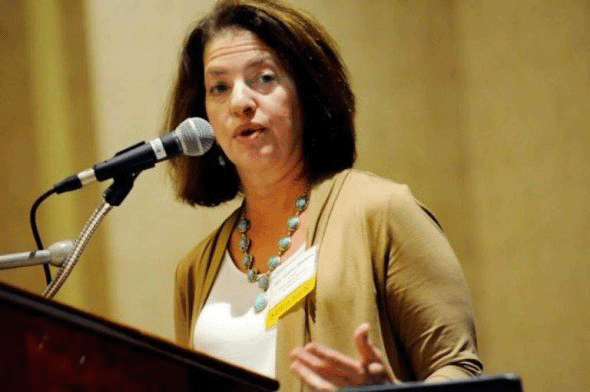 Reform not an ‘either or’: AEMO
The electricity operator’s new chief says its mandate remains reliability and “solar penetration will increase”. Mandate remains reliability in time of change: AEMO chief The Australian, ,Andrerw White, April 28, 2017 The new chief executive of the Australian Energy Market Operator Audrey Zibelman says reform of the electricity market is not “either or” choice between fossil fuels and renewable power and needs to focus on restoring the confidence of consumers amid a series of rolling crisis in the market.
Ms Zibelman said the market operator had to get “ahead of the game’” to ensure the energy networks were reliable at a time of technological change and consumer choice that was driving increasing use of renewable energy.
“We understand that the degree of solar penetration is going to increase,’’ Ms Zibelman told ABC Radio this morning.
“We need to ensure that the networks to deal with these increases in a way to secure reliability and that we are essentially really ahead of the game rather than always catching up as an enabler to consumers and that we are an enabler of the better economic outcomes for consumers.’’
Ms Zibelman, a New Yorker who replaced the late Matt Zema as AEMO chief executive last month, said policy questions such as calls for an emissions intensity scheme were the responsibility of politicians, rather than the market operator. But she said AEMO had to respond to technological changes and consumer choices that were taking place regardless of policy and ensure the reliability of the networks.
“The issue is not the either or — one is good and one is bad. The fact is that it (renewable energy) operates in a very different way and so we need to be moving towards how do we optimise the system around the resources that we are going to use so that we optimise the value of everything … and take advantage of low costs and the resources they need to be secure. That has been the focus.”
AEMO has come under increasing scrutiny after a series of power outages in South Australia — where its failure to order extra gas-fired power forced blackouts for 90,000 homes — since September and a scare in NSW in February…….
Ms Zibelman said gas exports had contributed to higher prices and that AEMO had previously warned about the scarcity of gas for te local market.
“That is not different to what has happened before this year with AEMO’s report … there was a recognition about scarcity and it is something frankly that has been talked about for a couple of years.
“ I think there is real attention to it this year and a recognition that has created a lot of uncertainty and been disconcerting for customers and that we need to take action to really regain the confidence of consumers in the market place.”http://www.theaustralian.com.au/business/mandate-remains-reliability-in-time-of-change-aemo-chief/news-story/d31d16a97d4520003b04e8cb9be18f85
Westpac lashed on Adani decision, by Australia’s Minister For Coal, Matt Canavan
Resources Minister Matt Canavan called for a boycott of the bank for buckling to the demands of “noisy activists”…. (subscribers only)
http://www.theaustralian.com.au/national-affairs/westpac-wimps-lashed-for-adani-coal-mine-loan-ban/news-story/e6bee3dcebb9c9b0b3f4cba523f4370d
1 This month
17 October, Free Public Talk on Nuclear Issues in South Australia
David Noonan will speak on public interest concerns over the new Roxby Downs Indenture Act 2026 on BHP copper-uranium mining and ore processing in SA, and on how AUKUS may face SA with a High-Level nuclear waste agenda.
Dr Jim Green will discuss international developments in the field of nuclear power including ‘small modular reactors’ and Generation 4 ‘advanced’ nuclear reactor concepts.


Help Aunty Sue Protect Her Land and Sacred Sites From Destructive Rocket Testing.
.

Australians deserve the truth
about
AUKUS – https://aukuspublicinquiry.com/

PETITION – To: Prime Minister Anthony Albanese and the Australian Labor Government

of the week – Australians for War Powers Reform (AWPR)
To see nuclear-related stories in greater depth and intensity

