‘David and Goliath’: Kimba nuke waste fight heads to Federal Court
Stephanie Richards, 6 March 23, https://indaily.com.au/news/2023/03/06/david-and-goliath-kimba-nuke-waste-fight-heads-to-federal-court/?utm_medium=email&utm_campaign=InDaily%20Lunchtime%20%206%20March%202023&utm_content=InDaily%20Lunchtime%20%206%20March%202023+CID_654499187b614fa7e1f09bd8ceb7100e&utm_source=EDM&utm_term=READ%20MORE
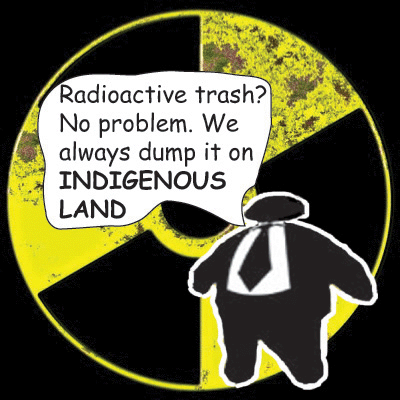
Barngarla Traditional Owners’ fight to stop a nuclear waste facility being built near Kimba on South Australia’s Eyre Peninsula has reached the Federal Court, with the first substantive case hearing in Adelaide today.
They were supporting the Barngarla Determination Aboriginal Corporation, which has applied for judicial review in an attempt to thwart construction of the federal government’s planned radioactive waste storage facility at Napandee near Kimba.
“We’re fighting against injustices that have been happening to the Barngarla people regarding this waste dump in Kimba,” Barngarla Traditional Owner Harry Dare told InDaily outside court.
“We’re actually fighting for a seven sisters and women’s dreaming site and we’re fighting for a vote in our local governance.
“The Australian Government has given back our Native Title, but they haven’t given us a voice in those Native Title areas, so we’re fighting for equality and for all of Australia to be nuclear free.”
The Napandee site was selected by the former Morrison Government, with then Resources Minister Keith Pitt saying the government had secured “majority support” from the local community after more than “six years of consultation”.
But Barngarla Traditional Owners opposed the project and argued they were not included in the consultation.
During today’s hearing, the Federal Court was told of how the decision to locate the dump at Napandee, near Kimba, played out.
After beginning the process to select the site through its administrative powers, the then Coalition Government changed tack and decided to legislate, partly to avoid delays through legal challenges.
However, when the legislation failed in the Senate, the government restarted the administrative process.
Counsel for the Barngarla told Justice Natalie Charlesworth that raised questions over whether Pitt, who ultimately named the Napandee location and who strongly supported the legislative approach, could properly carry out his administrative role.
“That, of itself, would excite a reasonable apprehension that the minister might be unable or unwilling to approach the matter with an open mind,” he said.
“Because, effectively, the decision had already been made.”
The court was also told that the Barngarla disagreed with the former government’s view that the dump had wide community support in Kimba and would also argue the decision on the dump was unreasonable given the lack of proper consultation with the Indigenous owners.
Given Pitt’s correspondence with the Barngarla people and his other statements, the impression that might arise was that consultation would largely amount to “matters around the edges”.
“In terms of identifying culture and the like in the implementation of the site, which had already been selected and to which the minister was committed,” counsel said.
With the case listed for several days, the federal government is expected to argue that much of the material to be relied on by the applicants is subject to parliamentary privilege.
The Barngarla launched their action in 2021 after being denied the right to participate in a community ballot to gauge local support for the Napandee site because many did not live in the Kimba council area.
The community ballot returned about 61 per cent in favour of the dump.
But when the Barngala conducted their own ballot among their community members, 83 voted no and none voted yes.
They argue they were denied the right to participate in a community ballot to gauge local support for the site, because many did not live in the Kimber council area.
Traditional Owner Linda Dare told protestors ahead of this morning’s hearing that the proposed location for the nuclear waste facility was near an important women’s site for the Barngarla people.
“It just seems to be that every time the government wants to put something it’s always around a women’s site,” she said.
“We need to fight as women around Australia to protect our sites.
“We need to say ‘no’ because it’s going to affect the waterways, not just in South Australia but everywhere.”
InDaily reported in September that the federal government was spending three times more than Barngarla Traditional Owners fighting the project in the Federal Court.
Information released to SA Greens Senator Barbara Pocock showed that between December and July, the government had spent $343,457.44 on legal fees.
That compares to the approximate $124,000 spent by the Barngarla Determination Aboriginal Corporation over the same period.
The Native Title group estimates that the total cost incurred by the federal government would run into the millions.
Barngarla Determination Aboriginal Corporation chairperson Jason Bilney told InDaily the judicial review was a “David and Goliath battle”.
“But, we’re dedicated. It took us 21 years to win our Native Title, come out of Native Title six months later and we’re fighting a nuclear waste dump on our country,” he said.
“What does that tell you about truth telling, the Statement From The Heart or the Voice?
“Our Voice isn’t being heard, truth telling isn’t being told and they’re going to break the First Nations’ heart – Barngarla – and put it (the nuclear waste dump) on our country.”
Bilney said Traditional Owners expected the Federal Court would take months to reach a decision, with hearings scheduled each day this week.
“It could take a year, but we would like it to have it sooner than later,” he said.
It comes after the Barngarla Native Title group last month won a separate Supreme Court bid to overturn former Premier Steven Marshall’s decision to allow a mineral exploration company to drill at Lake Torrens in the state’s outback.
At the time, Bilney said the group was buoyed by the win as they continued their legal fight to stop the Napandee nuclear waste facility from going ahead.
South Australian Labor has long called for Barngarla people to have the right to veto the project, with Premier Peter Malinauskas previously saying that the state government had expressed its views to the federal government.
Barngarla women warn Kimba nuclear waste plan will ‘destroy’ sacred site, Dreaming stories
ABC North and West SA / By Nicholas Ward 5 Mar 23,
Banners that feature children’s art are being used to protest against a proposed nuclear waste facility on South Australia’s Eyre Peninsula.
Key points:
- The Federal Court case to stop a proposed radioactive waste facility at Kimba resumes this week
- A native title group says the national nuclear dump will destroy women’s Dreaming stories
- Children from across SA are creating art to protest the federal government’s site decision
At the Barngarla Community House in Port Augusta, the finishing touches are being added to the protest banners, which will travel with a group of Barngarla elders to Adelaide.
Their native title group has brought a case against the federal government to stop the proposed National Radioactive Waste Management Facility at Kimba.
The case is set to resume in the Federal Court this week.
Barngarla woman Linda Dare says the art contributions have been made by children of various cultural backgrounds.
There’s a lot of interest in this, with not just Aboriginal kids and not just older people, but people of all ages and cultures who have been involved,” Ms Dare said………………..
Nuclear waste at women’s Dreaming site
Dawn Taylor, a Barngarla woman, grew up in Kimba and she said the proposed facility would interfere with a sacred site for women.
“The Seven Sisters Dreaming is through that area,” Ms Taylor said.
“A lot of people don’t know about this feminine sister Dreaming.
“But the Seven Sisters Dreaming means a lot to all of us as women, in each tribe, throughout the country.”
Ms Dare said the Seven Sisters story had been handed down for generations.
She fears the waste facility will “destroy those stories” that she has grown up with.
She has spoken to Federal Resources Minister Madeleine King to urge her to block the facility from going ahead.
“I actually spoke to [Ms King] when we met with her not long ago in Kimba, woman to woman, that she could actually be the one to say no to this,” Ms Dare said.
Site preparation works underway at the site are expected to take up to two years before construction on the radioactive waste facility can commence.
The matter to block its construction returns to court on Monday. https://www.abc.net.au/news/2023-03-05/barngarla-women-protest-against-nuclear-waste-at-kimba/102053982
Darwin, Australia in the forefront for USA’s Pacific war against China

preparing for possible island battles in the Western Pacific by acquiring additional bases in the area.
The first such installation to be established is the Marine Rotational Force (MRF) in Darwin, Australia. Located by the Timor Sea in Australia’s Northern Territory, the MRF facility is closer to the southern Philippines and the South China Sea than to, say, Sydney or Melbourne. As a result of an agreement signed by President Obama during a visit to Australia in 2011, the U.S. presence has grown from just 200 Marines in the first rotation to approximately 2,500 today. While in Australia, these troops engage in a six-month stint of training and exercises, usually in conjunction with Australian military personnel. In the event of a war with China, the Darwin facility could also be used to support combat operations throughout the South China Sea area.
Restructuring the Force
With China now identified by the U.S. Department of Defense as the most dangerous, or “pacing” threat to U.S. national security, all of the military services have been instructed to prepare for a U.S.-China conflict. Accordingly, both the U.S. Army and the Marine Corps are restructuring their Asia-oriented forces — those committed to the Pentagon’s Indo-Pacific Command (INDOPACOM) — to be capable of conducting multiple offensive and defensive operations throughout the Western Pacific. This has generally entailed lightening their arms and equipment to allow for easy deployment and acquiring more forward operating bases in the region. Both also seek new mobile missile systems (often called “precision fires”) for attacks on enemy ships and land installations.
Pentagon Prepares for Island Combat in the Pacific as US-China Tensions Rise The U.S. has been securing new basing facilities and conducting large-scale combat exercises in the Western Pacific. By Michael T. Klare , TRUTHOUT, February 28, 2023
“………………………………………………… the notion of another major amphibious campaign in the Pacific has largely evaporated. Recently, however, the U.S. Army and Marine Corps have begun preparing for precisely such a contest as China has emerged as the principal adversary to U.S. hegemony and neighboring Pacific islands have acquired fresh strategic significance.
Any major U.S. conflict with China, it is widely believed, will largely entail air and naval operations in China’s maritime areas, notably the East and South China Seas and the waters surrounding Taiwan. Such a clash, strategists assume, will involve intense air and sea battles for control of these areas. But, as in World War II, the fighting will also envelop any islands housing the air and naval bases of either side, such as China’s installations on islands in the South China Sea and U.S. bases in Japan, Okinawa and the Philippines. Aside from air and missile attacks on these island facilities, either or both sides may seek to occupy them through amphibious assault, resulting in the sort of brutal combat seen in those same areas during World War II.
These islands are all part of (or enclosed within) what Chinese strategists call the “the first island chain” — the long string of archipelagos stretching from Japan in the north to the Ryukyus and Taiwan in the middle and the Philippines and Borneo in the south, together acting as a sort of barrier to Chinese naval projection into the greater Pacific. (Strategists also speak of a second, outer island chain, consisting of the Mariana Islands and the western Caroline Islands.)
The United States has long maintained a major military presence on islands up and down the first chain, both to project U.S. power into the region and to sustain U.S. combat operations in the event of a war. These include the major concentration of Air Force and Navy forces in Japan, the large Marine Corps contingent on Okinawa and bare-bones facilities in the Philippines. Along with any U.S. ships in the area, these bases would be among the primary targets for Chinese air and missile attacks at the onset of a U.S.-China conflict, followed, conceivably, by amphibious assaults aimed at occupying or demolishing them — which would no doubt provoke an aggressive U.S. response.
Located between the Chinese coastline and the first island chain are several contested island groups — the Spratly Islands in the South China Sea and the Senkaku Islands in the East China Sea — that could also become sites of U.S.-Chinese fighting in the event of a future conflict. The Spratlys are claimed in their entirety by China and in part by Brunei, Malaysia, the Philippines and Vietnam; the Senkakus (called the Diaoyu by the Chinese) are claimed by both China and Japan.
Both island groups have witnessed clashes between Chinese vessels and those of the other claimants in recent years, and the U.S. has vowed to assist its allies in defending their territorial claims against future Chinese harassment. Should China attempt to test this pledge in some significant fashion — say, by seizing islands now occupied by Filipino personnel — U.S. forces might engage in an amphibious operation to repel such an attack. A Chinese attempt to occupy the Senkakus — now administered by Japan — could produce a similar result, especially given President Biden’s recent assertion that the U.S. mutual defense treaty with Japan extends to the Senkakus.
To further complicate the picture, China has established military installations on some of the islands and atolls it claims in the South China Sea, in some cases using sand dredged from the seafloor to expand their size to allow the construction of airstrips. These installations, outfitted with an array of anti-air and anti-ship missiles, pose a potential threat to U.S. and allied warships operating in the area and so would constitute a prime target for amphibious assault in the event of a major U.S.-China conflict.
Restructuring the Force
With China now identified by the U.S. Department of Defense as the most dangerous, or “pacing” threat to U.S. national security, all of the military services have been instructed to prepare for a U.S.-China conflict. Accordingly, both the U.S. Army and the Marine Corps are restructuring their Asia-oriented forces — those committed to the Pentagon’s Indo-Pacific Command (INDOPACOM) — to be capable of conducting multiple offensive and defensive operations throughout the Western Pacific. This has generally entailed lightening their arms and equipment to allow for easy deployment and acquiring more forward operating bases in the region. Both also seek new mobile missile systems (often called “precision fires”) for attacks on enemy ships and land installations…………………………………………………………………………………………………………………………………………………………
Training for Pacific Island Wars
To put all these plans into practice, both military branches have been conducting large-scale combat exercises in the Western Pacific and securing new basing facilities there.
Especially indicative of the Marines’ new thinking is a series of exercises called “Resolute Dragon,” held in conjunction with the Japan Self-Defense Forces (JSDF) over the past two years. Although ostensibly focused on defending Japan’s main islands, the exercises appear to embody a larger strategic sweep, involving joint amphibious operations throughout the region.
During Resolute Dragon 2021, held December 4-17 of that year, some 2,650 Marines and 1,400 soldiers from the JSDF engaged in simulated maritime assault operations. …………………………………
Resolute Dragon 2022, held last October, retained many features of the 2021 version but included an additional twist: while 1,600 U.S. Marines were training alongside JSDF soldiers in Japan, another 1,900 were partnered with Philippines Marine Corps personnel in a parallel exercise,…………….. also involved participation by the JSDF Amphibious Rapid Deployment Brigade and Republic of Korea Marines, suggesting the multinational and region-spanning nature of U.S. planning for future amphibious operations.
………………………………………………. Guam was again the site of a simulated airborne assault one year later,
…………………………………. Acquiring Forward Operating Bases
In addition to these training and restructuring efforts, the Army and Marine Corps are preparing for possible island battles in the Western Pacific by acquiring additional bases in the area.
The first such installation to be established is the Marine Rotational Force (MRF) in Darwin, Australia. Located by the Timor Sea in Australia’s Northern Territory, the MRF facility is closer to the southern Philippines and the South China Sea than to, say, Sydney or Melbourne. As a result of an agreement signed by President Obama during a visit to Australia in 2011, the U.S. presence has grown from just 200 Marines in the first rotation to approximately 2,500 today. While in Australia, these troops engage in a six-month stint of training and exercises, usually in conjunction with Australian military personnel. In the event of a war with China, the Darwin facility could also be used to support combat operations throughout the South China Sea area.
Just recently, on February 2, Secretary of Defense Lloyd Austin signed an agreement with Philippine President Ferdinand Marcos Jr. affording the U.S. military access to four more bases in his country, in addition to four other facilities the Pentagon has been allowed to use under a previous accord.
The acquisition of these bases, along with all the other developments described above, demonstrate just how far the Army and Marine Corps have proceeded in their efforts to prepare for major combat operations in the Western Pacific. Clearly, senior Pentagon officials believe that a war with China is becoming increasingly likely, and that, when and if such a conflagration erupts, it will entail heavy fighting over key islands in that region.
………………………………… With diplomacy making little progress in resolving U.S.-China tensions, both sides are continuing to arm and train their forces for combat over the critical island bases of the Western Pacific. And while these contests may not resemble those of World War II in every respect, the simulated battles enacted in exercises like Forager and Resolute Dragon suggest they will be equally ferocious and bloody. https://truthout.org/articles/pentagon-prepares-for-island-combat-in-the-pacific-as-us-china-tensions-rise/?eType=EmailBlastContent&eId=b8136138-3739-4340-98df-2fe56169438b
UK, US or a hybrid? Intense speculation as Australia’s $170bn nuclear submarine choice looms
Tory Shepherd Guardian, 6 Mar 23,
UK and Australian ministers have been hinting at a trilateral design for the eight boats, but all options are still on the table in Australia’s biggest defence purchase.
Australia is set to within a couple of weeks learn some basic details about a program that could cost more than $170bn and will run for decades.
The opposition leader, Peter Dutton, this week warned against opting for a new UK design. For now though, the Aukus submarine program is a “black box”, says Tom Corben, a foreign policy and defence research fellow at the University of Sydney’s United States Studies Centre.
“We’re just speculating until we get the announcement,” he says, adding that the secret has been very well kept, considering the prime minister, Anthony Albanese, is set to go to the US to announce it in March……………………………..
The US is currently building 19 Virginia class submarines (known as SSNs, the US classification code for nuclear-powered attack submarines – as opposed to SSBNs, which are nuclear-powered ballistic missile submarines).
These are more than 140m long and require a crew of 132. They displace (or weigh) more than 10,000 tonnes and carry Tomahawk cruise missiles.
From the mid 2030s, the Virginia class will be replaced with the next-generation SSN(X). That “X” means the design hasn’t been finalised yet. The US navy has described it as an “apex predator” that will be faster, stealthier, and bristling with more weapons.
The UK’s Astute class also carry Tomahawk cruise missiles, which allow the submarine to hit targets 1,000kms away and send back images of the battlefield. It also has Spearfish torpedos designed to destroy enemy submarines.
It has a crew of about 100, is almost 100m long and has displacement of 16,000 tonnes.
The UK, too, is thinking about the next generation. The SSN(R), which is still being designed, will replace the Astutes………………..
These are not submarines that can be plucked “off the shelf” from some global supermarket. The newer ones, still in the design phase, are years away from even starting trials. The older ones are desperately needed by their own navies. https://www.theguardian.com/australia-news/2023/mar/05/uk-us-or-a-hybrid-intense-speculation-as-australias-170bn-nuclear-submarine-choice-looms
AUKUS nuclear sub announcement surfaces as PM heads to India
Andrew Tillett 6 Mar 23
Prime Minister Anthony Albanese over the next week will seek to boost trade and security ties with emerging partner India before unveiling how the navy will acquire nuclear-powered submarines from Australia’s oldest allies, the United States and Britain.
British media is reporting Mr Albanese, US President Joe Biden and British Prime Minister Rishi Sunak will meet in San Diego next week for a “trilateral summit” to announce how they will share top-secret nuclear technology under AUKUS. The Financial Times and US military website Breaking Defense said the announcement could be made on March 13.
Mr Albanese’s office declined to confirm the report about his travel plans. San Diego is home to America’s major west coast naval bases, including Los Angeles-class nuclear-powered submarines.
The AUKUS announcement will outline the design of the submarine for Australia – with suggestions it will be the next generation British submarine but with a US combat system and weapons – the cost, timelines and measures to avoid a capability gap with the Collins-class subs before the new boats are delivered.
It will also outline the mammoth task to grow the workforce, including training nuclear submariners to crew the boats and the trades and professionals needed to build them, as well as establish a regulatory and safety regime………………………… https://www.afr.com/politics/federal/aukus-nuclear-sub-announcement-surfaces-as-pm-heads-to-india-20230307-p5cpzm
Traditional owners fight to stop SA nuclear waste dump
Peth Now, Tim Dornin, AAP, March 6, 2023
Issues with the decision-making process and questions over consultation have been raised by traditional owners in their court bid to block the federal government’s plans for a nuclear waste dump on South Australia’s Eyre Peninsula.
The case for a judicial review brought by the Barngarla people opened on Monday, with the Federal Court in Adelaide told of how the decision to locate the dump at Napandee, near Kimba, played out.
After beginning the process to select the site through its administrative powers, the then coalition government changed tack and decided to legislate, partly to avoid delays through legal challenges.
However, when the legislation failed in the Senate, the government restarted the administrative process.
Counsel for the Barngarla told Justice Natalie Charlesworth that raised questions over whether former resources minister Keith Pitt, who ultimately named the Napandee location and who strongly supported the legislative approach, could properly carry out his administrative role.
“That, of itself, would excite a reasonable apprehension that the minister might be unable or unwilling to approach the matter with an open mind,” he said.
“Because, effectively, the decision had already been made.”
The court was also told that the Barngarla disagreed with the former government’s view that the dump had wide community support in Kimba and would also argue the decision on the dump was unreasonable given the lack of proper consultation with the Indigenous owners.
Given minister Pitt’s correspondence with the Barngarla people and his other statements, the impression that might arise was that consultation would largely amount to “matters around the edges”.
“In terms of identifying culture and the like in the implementation of the site, which had already been selected and to which the minister was committed,” counsel said.
With the case listed for several days, the federal government is expected to argue that much of the material to be relied on by the applicants is subject to parliamentary privilege.
Before Monday’s hearing began, members of the Barngarla community and their supporters gathered outside the court, vowing to continue the fight no matter the result of the court proceedings.
“If it goes against the government, they are going to appeal it. If it goes against us, we are going to appeal it,” Elder Harold Dare said.
“We are going to appeal it as long and as hard as we can.
“It’s not just about the Barngarla, it’s about all of Australia and ultimately the world.
“We’re fighting for the protection of a sacred Aboriginal women’s site. It’s about the respect we are showing to our women’s sites.”
“We’re fighting for the protection of a sacred Aboriginal women’s site. It’s about the respect we are showing to our women’s sites.”
The Barngarla launched their action in 2021 after being denied the right to participate in a community ballot to gauge local support for the Napandee site because many did not live in the Kimba council area.
The community ballot returned about 61 per cent in favour of the dump.
But when the Barngala conducted their own ballot among their community members, 83 voted no and none voted yes……. more https://www.perthnow.com.au/news/crime/traditional-owners-fight-to-stop-sa-nuclear-waste-dump-c-9947910
The absurdities of AUKUS

I refuse to accept this spending without registering my protest, and I reject the ease with which we are expected to embrace this military madness.
Those who are pushing for war with China often know nothing about the country, while the academics and diplomats who are China specialists have been ignored.
Pearls and Irritations, By Marianne HansonMar 31, 2023
On 14 March, when the AUKUS nuclear powered-submarine details were revealed, I spent most of the day in the Emergency Department of a hospital in Brisbane, with a family member needing urgent medical care.
It took over 12 hours for my relative to get a bed in the ED and then several hours more before a doctor could see him. He was not given his regular medication – a potentially disastrous omission – because the nursing staff simply had no time to do so. They were rushed off their feet, with another 72 patients in Emergency to tend to at the same time.
These health professionals were obviously working under extremely difficult conditions with insufficient beds and a wholly inadequate number of staff.
Not once did their attitude shift from friendliness and genuine care to one of disregard or contempt for their patients.
The live broadcast in the ED room’s television of our Prime Minister smiling with Joe Biden and Rishi Sunak, proudly announcing the spending of 368 billion dollars to acquire eight nuclear-powered submarines was, by contrast, rather sickening. It seemed a betrayal of those who voted Labor less than a year ago who wanted a new direction in foreign policy and especially an end to Australia’s involvement in America’s disastrous wars.
Like me, they hoped that a focus on the things that really threaten Australia – environmental catastrophe, the lack of public housing and a record number of homeless people, declining health and education provisions – would take precedence over the smug militarism which the Morrison government had embraced.
The submarines announcement, with its accompanying regalia and carefully staged photos seemed to me to be giving the finger to the Australian public. Unlike staff in the Emergency ward who stoically and cheerfully continued to help the people who needed their care, here was a scenario on an American beach showing these three men almost as Hollywood stars. I could not see any sense of genuine care for the ordinary people ‘doing it tough’ back home, and certainly no acknowledged consideration of how that obscenely high financial commitment could benefit everyday Australians. (By the way, that figure is more than twice the cost originally estimated for the submarines.)
I refuse to accept this spending without registering my protest, and I reject the ease with which we are expected to embrace this military madness. I am also disturbed by those who believe that the only response to a growing China is the acquisition of hugely expensive attack submarines designed to sail up to the Chinese coast and launch missiles onto its mainland.
Set aside for one moment my belief that the threat of China attacking Australia has been wilfully manufactured and inflated by vested interests in Australia. Set aside the hysterical response by the West to what is normal behaviour for a rising power determined to secure its influence in its near-abroad, and which wants to reunite with a territory that the US, Australia and most of the world already recognises as a one of its provinces. Set aside the point that while China’s human rights record might be shocking, so too is India’s, a state with which we are happy to align ourselves.
Those who are pushing for war with China often know nothing about the country, while the academics and diplomats who are China specialists have been ignored. But the thing I find most troubling is the limited imagination on how we should respond to, and work with, a rising power in our region, and the use of ridiculous tropes on why the only option is to plan for war.
For example, on the ABC’s Q and A program on 27 March …………………………………………………………………
What about diplomacy? What about the usual tools of statecraft, such as ongoing negotiations and deepening trade ties? (which still allows us to criticise human rights abuses; ………………
Working with our regional partners and organisations to deepen engagement and build mutual security assurances?
None of these gets a look-in in the rubbish that passes for meaningful debate on AUKUS…………………. more https://johnmenadue.com/the-absurdities-of-aukus/
Don’t ask the government about the next war
By Alison Broinowski, Feb 22, 2023 https://johnmenadue.com/dont-ask-the-government-about-the-next-war/
This is war protest month, with more to follow. Will efforts against the Iraq war, that failed twenty years ago this week, succeed in heading off the next one?
On Sunday 19 February thousands protested at the Lincoln Memorial in Washington, DC against US militarism, proxy warfare, and the threat of nuclear conflict. The ANSWER Coalition plans a March on 18 March, marking the 20th anniversary of the Iraq invasion. They will demand ‘Negotiations not Escalation’ in Ukraine, and an end to US militarism abroad.
In London a rally organised by Stop the War UK and others on 25 February will call for immediate talks to end the war in Ukraine. They oppose the Russian invasion, as well as NATO’s role in Ukraine, and nuclear war. No2Nato
In Australia, the ABC broke its discreet silence on 20 February with a two-part series of interviews by John Lyons with four non-ASPI defence experts, all of whom agreed that for Australia to join in an American war with China would be disastrous. Part 1 and part 2
And this week Greenleft publicised anti-AUKUS events in six Australian cities on 24 February. Protesters will gather outside the electorate offices of Penny Wong in Adelaide, Jim Chalmers in Brisbane, Richard Marles in Melbourne and Geelong, Pat Conroy in Newcastle, and Anthony Albanese in Sydney. Take action against AUKUS, militarisation on Feb 24
This belated upsurge of anti-war protest takes its cue from 15 February 2003, when 30 million people around the world marched in opposition to the prospect of war in Iraq. Many had never joined a mass demonstration before. They were ignored, and the US-led invasion went ahead on 20 March.
The protestors knew they were lied to by political leaders who claimed Saddam Hussein had weapons of mass destruction, chemical, biological and nuclear. The covert purpose of invading Iraq was to gain control of its oil, and assert US dominance over seven Middle East states: Iran, Iraq, Lebanon, Libya, Somalia, Sudan, and Syria.
The war began, and spread to Libya, Yemen, Somalia, and Syria, provoking retaliation from al-Qaeda and its Islamic State successors. All of the invaded countries, including Afghanistan and Iraq, remain blighted. Millions are dead or displaced. To achieve this, the world’s nations, led by the US, spent sums surpassing $2tn on weapons of war in the past year.
On 5 February 2003, the Australian Senate voted against the Iraq war. In the House of Representatives, ALP leader Simon Crean spoke fervently against Australian participation. Soon after, ignoring both Houses, Prime Minister Howard sent elements of the ADF to join the SAS who had already been dispatched in secret.
Crean’s successors, now in government, might reflect on his remarks, selected here.
Two weeks ago, prime minister, you committed Australia’s young men and women to a war not yet declared, knowing all along that you couldn’t pull them out.
You committed them without the mandate of the Australian people, the Australian parliament or the United Nations. You committed them solely on the say so of George W Bush. You haven’t consulted the Australian people. You haven’t consulted your party. But you have consulted President Bush.
You said you were sending these troops because it was in the national interest. I want to know, prime minister, which nation?
You said yesterday that you are going to Washington to inform George Bush of the views of the Australian people. Well let me tell you what those views are. The Australian people don’t want peace at any cost, but they don’t your war at any price.
The US alliance has endured for over 50 years. It has always had bipartisan support. But it does not mean that we have to agree with every policy position of every US administration.
The prime minister must stop treating the Australian people like mugs…Only Labor governments have been prepared to tell our allies no when it’s been in our national interests.
Eight months after the invasion of Iraq, the Sydney Morning Herald published an open letter to President George W Bush. It was signed by 41 ALP MPs and Senators, and was headed, ‘Mr Bush, here is why we opposed the Iraq war’.
The writers stressed the dangerous precedent the Iraq war was setting, and described it as a mistake. They wrote: ‘The ALP firmly believes that international conflict should, wherever possible, be dealt with peacefully and through international co-operation under the auspices of the United Nations. When all attempts for a peaceful resolution have been exhausted, United Nations sanction is vital if force is to be used.’
The signatories included parliamentarians Anthony Albanese and Penny Wong, then in Opposition.
As Foreign Minister, Penny Wong has recently abandoned peaceful resolution of conflict, and doesn’t mention UN Security Council resolutions authorising war. She has joined Defence Minister Richard Marles in lockstep with the US in a predictable slide into war over Taiwan or the South China Sea.
Three American generals have recently anticipated war with China in the next two to five years. If the US preference for proxy wars – as in Ukraine – is an example, Australia and Japan could be the proxy fighters against China, with similar prospects.
No Australian leader has supported the UN Secretary-General’s appeals to member states to stop inflaming worse wars. Instead, they are spending more extravagant sums on new weapons systems which will be provocative, and if they are ever delivered, probably outdated and unfit for purpose. The remaining option is nuclear: and Australia refuses to ratify the Treaty for the Prohibition of Nuclear Weapons which ICAN initiated.
This month, Senator Wong re-stated the government’s commitment to the status quo on how Australia goes to war. She told Parliament on 9 February that it will not change, just as Marles did in September 2022.
She compounded that with a self-contradictory statement about US nuclear weapons ‘stationed’ in Australia. Backing Defence Department Secretary Greg Moriarty, Senator Wong claimed that Australia adheres to the South Pacific Nuclear Free Zone Treaty, and yet supports the ‘stationing’ of US B-52 and B-2 bombers in Australia without knowing if they are nuclear armed or not.
This, we now learn, has been going on quietly since at least 2005 (“‘Don’t ask, don’t tell’ Top End nuke policy”, Australian, 16 February 2023: 2). As Crean said, the prime minister must top treating Australians like mugs.
Isn’t it exciting? The USA is letting Australia buy air-to ground missile for attacking China

US State Department clears $500 million in anti-radiation missiles for Australia
The AARGM-ER is a medium-range air-to-ground missile, employed for the suppression or destruction of enemy air defense systems.
By AARON MEHTAon February 27, 2023 https://breakingdefense.com/2023/02/us-state-department-clears-500-million-in-anti-radiation-missiles-for-australia/
WASHINGTON — The US State Department has approved a potential Foreign Military Sale to Australia of Advanced Anti-Radiation Guided Missiles-Extended Range (AARGM-ERs), with a estimated price tag of $506 million.
Sales announcements are not final; Foreign Military Sales (FMS) cases announced like these have been approved by the executive branch, and now Congress must weigh in or do nothing. Should the Hill not object — an almost unfathomable situation, given relations with Australia — the quantities and dollar values in the deals can change during negotiations with industry.
The AARGM-ER is a medium-range air-to-ground missile, employed for the suppression or destruction of enemy air defense systems. According to the Pentagon, the weapon is compatible with the F/A-18C/D, FA-18E/F, EA-18G, Tornado IDS/ECR, F-16 C/J and the F-35 joint strike fighter — the latter of which is set to be the core of Australia’s military aviation fleet for years to come.
Australia is seeking to buy up to 63 AARGM-ERs and up to 20 AARGM-ER Captive Air Training Missiles (CATMs). Also included, per the announcement, are “Dummy Air Training Missiles (AARGM-ER DATMs), containers, component parts and support equipment; Repair of Repairables; software (Classified and Unclassified); publications (Classified and Unclassified); training (Classified and Unclassified); transportation; U.S. Government and Contractor engineering support; and other related elements of logistical and program support.”
This would be the second batch of AARGM-ERs approved by State for the Lucky Country in the last year. In June 2022, DSCA announced a $94 million agreement for 15 of the weapons.
Per the DSCA, “The proposed sale will improve Australia’s capability to meet current and future threats by suppressing and destroying land- or sea-based radar emitters associated with enemy air defenses. This capability denies the adversary the use of its air defense systems, thereby improving the survivability of Australia’s tactical aircraft.”
If the nuclear submarines aren’t ready in time – no worries – Australia will get lots of fun weaponry against China.
Mind the capability gap: what happens if Collins class submarines retire before nuclear boats are ready?
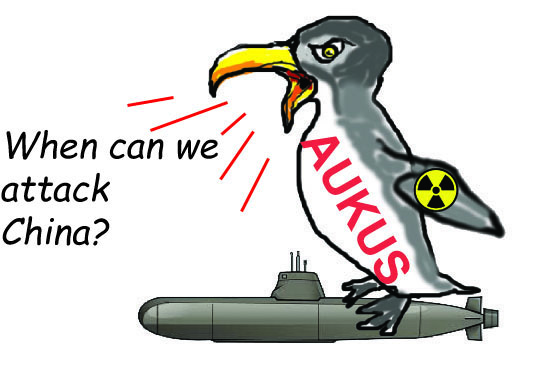
Nuclear subs are the first ‘pillar’ of Aukus, but defence experts are pointing to the second pillar – hypersonic weapons, AI and drones
Tory Shepherd, Guardian, 28 Feb 23,
“………….. The federal government is considering the defence strategic review and advice from the submarine taskforce on acquiring a fleet of nuclear-powered submarines, but there are concerns that they will not be in service in time for a seamless handover from the Collins class.
The defence minister, Richard Marles, has been sounding increasingly positive that there will be no such gap.
“I’m feeling confident about our ability to deal with this,” he told Guardian Australia in January, adding it would be part of “the optimal pathway” to be announced soon…………….
Acquiring that fleet of at least eight nuclear-powered submarines is the first “pillar” of the Aukus partnership between Australia, the United Kingdom and the United States, but the second pillar, which includes hypersonic weapons, artificial intelligence and underwater drones, will be needed in the short term.
It will be at least a decade before even the first submarine is delivered and some estimates even push the timeline out to 2050.
The prime minister, Anthony Albanese, is expected to meet with both the US president, Joe Biden, and the UK prime minister, Rishi Sunak, in the US in March, to announce the governments’ plans.
Marles has emphasised the “genuinely trilateral” nature of the Aukus agreement between the three countries, leading to speculation a new hybrid submarine to replace the ageing Colins class fleet will be built using elements of both the US and the UK’s boats.
The life of the Collins fleet will be stretched out as much as possible with life-of-type extensions, but the boats are still set to be retired by the end of the next decade.
When former prime minister Scott Morrison announced he was scrapping the deal with France to build 12 boats in favour of the Aukus deal to build “at least” eight submarines in South Australia in 2021, he also announced plans to acquire various missiles, including hypersonic and precision strike guided missiles over the next decade.
On top of the missiles, there is a second pillar of Aukus that includes working with the UK and the UK on underwater drones, quantum technology, artificial intelligence and autonomous technology, advanced cyber capabilities, electronic warfare, and other innovations.
………………………… In a statement last year, the White House said the Aukus partners had made “strong progress” on the advanced capabilities. Trials of autonomous vehicles are set to begin this year, it said, and trials of quantum technologies for position, navigation and timing, would happen over the next three years.
Work had already started on autonomous and artificial intelligence-enabled systems to improve the speed and precision of decision-making processes, while the three countries were also strengthening their defences against cyber-attacks, sharing information on electronic warfare, developing advanced hypersonic and counter-hypersonic capabilities.
The director of the Lowy Institute’s international security program, Sam Roggeveen, said there were other capabilities Australia could buy that could do “similar things” to submarines – such as sinking ships.
“One area we’re already getting into is mine warfare,” he said.
“But we’re also investing in anti-ship missiles that can be fired from the air and we’re even getting some land-based missile capability.”
Other options that have been floated include building entirely new air warfare destroyers equipped with more than 100 missile launching cells, in order to bolster firepower, or building an interim conventional submarine……………….. more https://www.theguardian.com/australia-news/2023/feb/28/mind-the-capability-gap-what-happens-if-collins-class-submarines-retire-before-nuclear-boats-are-ready
Avalon Militarism
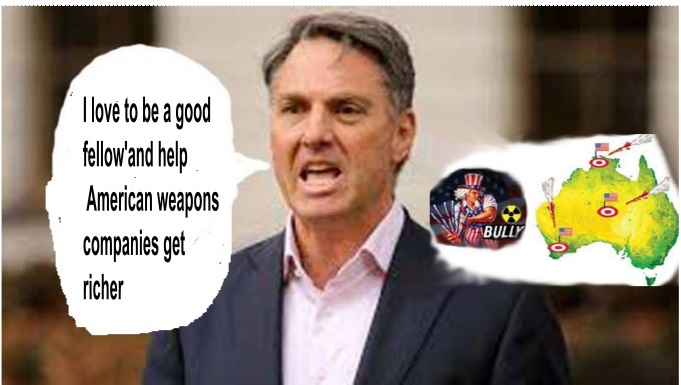
With this military bonanza unfolding on February 28, the Australian Defence Minister, Richard “Call me Deputy Prime Minister” Marles, has tooted his justifications for more hardware, more military merchandise and more engagement with the defence industry.
His address to the Avalon 2023 Defence and Industry Dinner revealed a boyish credulity typical in so many who lead that portfolio. The boys-with-toys credo becomes all seducing. Air forces, he noted, “are the coolest part of any military.” Trying to amuse, he called Top Gun Maverick “an important and insightful documentary.”
https://theaimn.com/avalon-militarism/, February 28, 2023, Dr Binoy Kampmark
The global pandemic was not completely catastrophic in its effects. It led to the cancellation, and postponement, of wasteful projects and events. It spared public money. But as the pandemic slides into the shadow of policymaking, bad habits have returned. The profligates are here to stay.
One such habit is the Avalon air show, a celebration of aeronautical militarism in the southern hemisphere best done without. In 2021, the organisers announced with regret that the event would be cancelled due to COVID-19 restrictions and uncertainty. Last October, however, organisers promised a return to form in 2023. Those with tickets “can look forward to a whole new program with jaw-dropping aerial displays, a refreshed food and beverage offering, and live entertainment.”
Also known as the Australian International Airshow and Aerospace and Defence Exposition, Avalon2023 promises to “showcase” much in the “dynamic world of aviation, aerospace and space, new materials, fuels and ways of flying.”
The program features both a specialist dimension and complimentary conferences “open to any accredited Trade Visitor.” The specialist aspect will feature presentations from, among others, the Royal Australian Air Force, Australian International Aerospace Congress, Australian Association for Unscrewed Systems (AAUS), Australian Industry Defence Network (AIDN), and the Australian Airports Association.
With this military bonanza unfolding on February 28, the Australian Defence Minister, Richard “Call me Deputy Prime Minister” Marles, has tooted his justifications for more hardware, more military merchandise and more engagement with the defence industry. His address to the Avalon 2023 Defence and Industry Dinner revealed a boyish credulity typical in so many who lead that portfolio. The boys-with-toys credo becomes all seducing. Air forces, he noted, “are the coolest part of any military.” Trying to amuse, he called Top Gun Maverick “an important and insightful documentary.”
With that treacly tribute out of the way, Marles could get down to the business of frightening Australians and delighting the military industrial mandarins. Australia faced “the most challenging and complex set of strategic circumstances we’ve seen since the Second World War.” The “global rules-based order” had been placed “under immense pressure”, largely due to the Russian invasion of Ukraine. “The post-Cold War era – a period of democratic expansion and unprecedented integration of global trade and investment – is now over.”
The scriptwriter had evidently gone to sleep in drafting such words. The post-Cold War era was streaked by brutal invasions and interventions (Iraq and Libya, to name but two instances), supposedly by the rules-abiding types in Washington, London and Canberra. The Russian invasion did feature the imposition of will by a larger state on a smaller neighbour using “power and might”, but the US-led invasion that kicked the hornet’s nest of sectarian violence in 2003 came from the same stable of thought.
The speech then follows a familiar pattern. First, call out the Russians. Then highlight the Oriental Armed Scourge to the North. “In the Indo-Pacific, China is driving the largest conventional military build-up we’ve seen anywhere in the world since the Second World War. And much of this build-up is opaque.”
Australia’s security, assured by its remote location and geography, could no longer be taken seriously. “Today we face a range of threats – including longer-range missiles and hypersonics and cyber-attacks – which render our geographic advantages far less relevant.”
The enemy could do damage from afar, causing harm “without ever having to enter our territorial waters or our air space.” It was therefore important to place Australian defence upon the footing of “being able to hold any potential adversaries at risk much further from our shores.”
This was a rather devious way of laying the ground for more cash and larger budgets, ignoring the clear point that Australia has no truly mortal enemies, but wishes to make them as Washington’s obedient deputy.
One particular product is meant to take centre stage. The Australian Defence Force is lagging in the department of murderous drone technology. One promises to be unveiled at Avalon. As reported by the national broadcaster, “The unscrewed air system has been developed by BAE Systems Australia and is designed to be stored in shipping containers.” The device is allegedly capable of carrying a lethal payload in excess of 100 kilograms.
Australia’s Chief of Air Force, Air Marshal Robert Chipman, has made no secret of his desire for low-cost killer drones. “We’ve seen a proliferation of low-cost drones and loitering munitions delivering both ISR [intelligence, surveillance and reconnaissance] and fires to great effect,” he told a Melbourne audience filled with foreign air force chiefs and senior officials, “they don’t replace the roles of contemporary combat aircraft, but they might serve as a useful complement.”
With that in mind, the RAAF was “considering the potential of low-cost drones that bring mass to our air combat system, and we’re considering what new measures are necessary to defend against them.” Such views thrilled the war mongering offices at The Australian, which expressed satisfaction that Australian military policy was finally “moving in the right direction.”
Chapman has been particularly busy in the leadup to the Avalon airshow, walking the tightrope of defence propaganda. Self-praise and capability must be balanced against a fear of achievement on the part of an adversary.
In an interview with the Australian Financial Review last week, the Air Marshal revealed that the RAAF had also joined the hysteria about targeting high altitude surveillance balloons. He also defended the merits of the F-35 fighter jet, praising their pilots as having “retained an edge over drones or other unscrewed platforms despite advances in technology.”
China, however, was causing jitters in the area of hypersonic missiles, capable of delivering a warhead at five times the speed of sound with extreme manoeuvrability. “I think China is in front when it comes to hypersonics […] and that is something we are actively working to address.” Thank goodness, then, for the Avalon Air Show, even if the organisers were not sagacious enough to invite both Chinese and Russian manufacturers.
Margaret Beavis | Here’s how to tone down the nuclear threat

We are at a turning point.
By signing the UN Treaty on the Prohibition of Nuclear Weapons, Australia would join 122 countries who supported the treaty at the United Nations. Although the US will very actively discourage such action, Thailand, New Zealand and the Philippines are all signatories and remain US allies.
By Margaret Beavis, February 27 2023 https://www.canberratimes.com.au/story/8100096/nuclear-war-is-not-winnable-heres-how-to-eliminate-the-threat/
With the invasion of Ukraine and now Putin suspending the New Start Treaty, the risk of both nuclear proliferation and nuclear war is increasing. But we can play a role in preventing this.
For more than seven decades we have been told that nuclear weapons are an essential political tool that make us safer, but in reality, each day we wake up without nuclear conflict is indeed a lucky day.
Myths come into being through the telling and re-telling of stories. Myths exist to help us make meaning of our world and our lives, however, not all myths are true.
There are three big myths about nuclear weapons.
The first myth is that a nuclear war is “winnable”. The research, however, is both clear-cut and horrifying. Even a “small” regional nuclear exchange – say between Pakistan and India – using less than 1 per cent of the global nuclear arsenal, would kill around 100 million people.
Massive fires would loft millions of tons of smoke into the stratosphere. Decade-long global cooling will follow. Crop yields of rice, wheat and corn would fall 15 to 30 per cent.
Conservatively estimated, around 2 billion people would starve.
If the US and Russia used their 1800 deployed weapons, food production would cease in most parts of the world. Most, if not all, of the human race would starve.
The second myth is an outdated, dogmatic belief that nuclear weapons make us safer. Nuclear deterrence assumes the threat of mutually assured destruction will prevent the use of nuclear weapons.
However, risk analysis demonstrates the reverse is true. Given increasing conflict, brinkmanship, and unpredictable world leaders, plus the risks posed by cyberattacks and extremists, it’s hard to rely on a mutually assured destruction strategy.
But the biggest risk, looking at history, is inadvertent use. We have – at least seven times – come within a hair’s breadth of global conflagration, due to human, computer or radar error, unusual weather patterns and even a faulty computer chip.
The US and Russia have come close on five occasions since 1979. It is inevitable that eventually our luck will run out.
The third myth is that nuclear disarmament is irresponsible. But it is hopelessly unrealistic to assume these weapons will never be used.
We are at a turning point.
By signing the UN Treaty on the Prohibition of Nuclear Weapons, Australia would join 122 countries who supported the treaty at the United Nations. Although the US will very actively discourage such action, Thailand, New Zealand and the Philippines are all signatories and remain US allies.
Sacred site, nuclear target are neighbours
26 February 2023, By ROD MOSS https://alicespringsnews.com.au/2023/02/26/sacred-site-nuclear-target-are-neighbours/
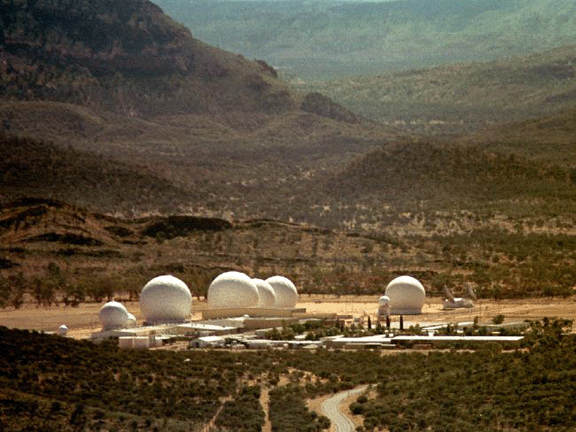
At the distant point of the track is the Joint Defence Facility, colloquially known as the Space Base or Pine Gap. Prior to awareness of Kweyrnpe, I’d joined peace activists in the 1980s, protesting at its gates about its role in war, surveillance and nuclear targeting.
Not until the mid nineties did I understand the significance of Kweyrnpe to the Hayes families when Patrick senior asked me to take him there to talk about the paintings.
He’d mentioned it was a sacred site when, as its TO, he’d been toured through the defence facility.
His grandson, Vernon Alice had accompanied him. The base was honouring an agreement with the TOs whenever new installations occurred though the family remain none the wiser about its inner workings.
Some of the younger men had spent time in Big House, the correctional centre, visible to the south of Kweyrnpe.
Whatever privations they’d endured, several admitted it wasn’t too bad as, unlike many inmates, they’d been on their own country which possibly explained the casual acceptance of many of their sentences and recidivism.
Initially it was the rock formations that fascinated me and those and the sky were painted first. But it wasn’t finished with me. Or me with it.
Some weeks later I imagined, then added, a wild dog pack lurching stealthily towards the viewer over; intruders beneath that apocalyptic sky.
The ridge to the right separates the initiated men’s site, with its overhang of protected paintings, from the women and children’s side which is adorned with native pines / alukerrwe.
Though no signage existed in the small car park at the time of this painting, a visitors book and a board with brief information about its significance for Arrernte has been erected advising on appropriate behaviour. A simplified story about the place also fronts the paintings.
Marrickville Peace Group (MPG) calls for keeping Australia’s nuclear bans, and particularly emphasises the nuclear waste problem

In brief , the pro nuclear power lobby presents a trouble free new generation front which assumes
just as trouble free social licence. This presentation flies in the face of proven historical fact.
Submission No. 21. to Senate Inquiry This submission argues that the current climate crisis creates an urgent need forAustralia to source its energy from renewable and not nuclear technology. Nuclear energy supply is
deeply flawed when examined wholistically. The safe long term disposal of nuclear waste (HLW)
issue is one to which no country in the world has a satisfactory answer to. It is an issue that will not
go away. The lack of wholistic social licence for nuclear waste disposal renders Australia in an
untenable position both internally and externally/internationally.
I write as a member of Marrickville Peace Group (MPG), situated in the Inner West of Sydney,
Federal Electorate of Grayndler. MPG learns with alarm of the attempt by the LNP to repeat a
pattern, not unknown of the LNP , of setting aside good legislation in order to return Australia to less
enlightened times. MPG objects most strenuously to the move to expand the viability of its current
nuclear technology to cater to the nuclear power industry. . The Private Senators Bill: Environment
and Other Legislation Amendment (Removing Nuclear Energy Prohibitions) Bill 2022) was put
forward by 9 Coalition Senators who have been incentivized by the government signing on to buy
nuclear-powered submarines (according to Senator Matt Canavan.). This promotion of things
nuclear to collateral expansion is arguably one of the more pernicious aspects of the AUKUS deal.
The world is in the grip of a climate crisis, the result of using carbon rich fossil fuels, once though to
be a great boon, as a source of energy. Gradually, since 1896 in fact, when scientist Svante Arrenius
first predicted the greenhouse effect, the world has come to know that climate change is real. Thus
the way we have sourced our energy has brought us to an environmental crisis. The irony is that
nuclear is proposed as counter to the environmental crisis brought about by fossil fuels, when the
disposal of High Level Waste (HLW) is itself a harbinger of deadly waste disposal issues. There is no
proven solution for managing high-level nuclear waste produced in power reactors. No operating
deep underground repository for high-level nuclear waste exists. MPG maintains that the
introduction of nuclear energy into its power mix is a case of replacing one environmental crisis with
another. (Don’t Nuke the Climate Submission Guide)………………………………………………………
The proposal to introduce nuclear power is a long term (and a very costly) project : the average time
to establish a nuclear power station, from planning to operational stage, is between fifteen and
twenty years.. It is not without good reasons that there is an increasing call for the power future to
be renewable and not nuclear.
There is more to the objection to nuclear power than simply the establishment timeframe. | Don’t
nuke the Climate! )
The Glasgow Statement (COP26 2021, signed by 479 international organisations , lists a cluster of
many defective factors associated with nuclear based on the latest Intergovernmental Panel on
Climate Change (IPCC) report. The primary summary statement “We need an urgent global shift to
clean and renewable energy and national governments need to actively facilitate and manage the
transition from reliance on fossil fuels and nuclear to renewable energy”.
A summary of criticisms of the nuclear power option include:
- The nuclear industry has a history of displacing, disrupting and damaging the health and
rights of workers and communities: - It diverts resources away from renewable energy technology;
- Nuclear is slow, expensive and dangerous.
- It is not carbon neutral-almost every stage of the nuclear chain requires additional nonnuclear
energy inputs. And - It poses unique security and waste management risks.
- Nuclear power is unsustainable . Nuclear power relies on uranium mining. Like coal mining
this causes adverse environmental impacts and puts workers and communities at risk. It is a
thirsty industry that consumes large volumes of precious water, from uranium mining and
processing through to reactor cooling. Nuclear power plants are vulnerable to threats that
are being exacerbated by climate impacts, including dwindling and warming water sources,
sea-level rise, drought, jelly-fish swarms and increasing storm severity - It is expensive. Nuclear power is now one of the most capital intensive and expensive ways
to produce electricity and costs continue to rise. (including establishment and decommission
expenses). - Climate threats :Nuclear power plants are vulnerable to threats which are being exacerbated
by climate change. These include dwindling and warming water sources, sea-level rise, storm
damage, drought, and jelly-fish swarms. Nuclear engineer David Lochbaum states: “You
need to solve global warming for nuclear plants to survive “ - Nuclear is increasingly vulnerable security risks. – witness current events at the Zaporizhzhia
power plant in Ukraine.
In Australia, the saga of nuclear waste disposal is long and unsatisfactory. It is characterized by a
high level of dysfunctionality……………………………………………….
THE REALITY OF EXTERNAL INTERESTS was dramatically revealed in the late 90’s when a closely
guarded secret in the form of a consortium Pangea Resources (80% owned by British Nuclear Fuels
Limited (BNFL) had been conducting research and discussions about establishing an international
high-level nuclear waste repository in Australia. A corporate video was leaked to Friends of the Earth
(UK) in the late 1990s. Until this video was leaked, Australians had no idea that we were being
targeted as the world’s nuclear dump. ……………………………………………..
The Friends of the Earth Australia site reveals also there is a list of very prominent politicians / expoliticians
supporting the development of a high level nuclear waste dump in Australia to take waste
from overseas include: Liberal Senator Judith Troeth called for Australia to build nuclear power
reactors and for the high-level waste to be dumped at Muckaty in the NT; former Prime Minister
Bob Hawke ;former foreign minister Alexander Downer; former foreign minister Gareth Evans .
Liberal/National Coalition Senators refused to support a Senate motion opposing an international
nuclear dump in May 2006. In 2005 Martin Ferguson responded to Bob Hawke’s call for Australia to
establish a high level waste dump by saying: “In scientific terms Bob Hawke is right. Australia
internationally could be regarded as a good place to actually bury it deep in the ground”.
THE WAY THINGS ARE SEEN – WHAT TO BELIEVE ?
The Minerals Council (TMC) is clearly supportive of the return to nuclear proposal : Removing the
Prohibition on Nuclear Power.
What is interesting is the selectivity of the MC’s arguments, which are summarised below :
Nuclear energy is zero emissions baseload energy. Fact check : nuclear reactors do not produce air
pollution or carbon dioxide while operating BUT : When it comes to nuclear, uranium extraction,
transport and processing produces emissions. The long and complex construction process of nuclear
power plants also releases CO2, as does the demolition of decommissioned sites.
Nuclear power is affordable ; Fact check The cost of wind and solar PV has decreased by 70-90 %
while nuclear costs have increased by 33%. (Don’t Nuke the Climate Submission guide. Op.cit.)
Nuclear power is safe, Fact check : For whom is it safe ? Of all the claims of the Nuclear lobby, this
surely is the hardest to sell .
Furthermore some aspects of this claim e.g. The risk of accidents in nuclear power plants is low and
declining. The consequences of an accident or terrorist attack are minimal. It is remarkable that the
Intergovernmental Panel on Climate Change (IPCC) says exactly the opposite: “Nuclear power plants
have been described as pre-deployed terrorist targets and pose a major security threat.”
Further, in referring to the “well publicized accidents” the Minerals Council deftly highlights “no
radiation fatalities” of two of the three. In the public mind it surely would loom large that there re
huge consequences to nuclear accidents, of which, as of 2014, there have been over 100 serious
nuclear accidents..the definition of which is : “an event that has led to significant consequences to
people, the environment or the facility. Examples include lethal effects to individuals, large
radioactivity release to the environment, reactor core melt.
TMC has a sales pitch which minimizes to the point of denial.
Nuclear power produces low waste : Fact check :This is a strangely deceptive claim. The “low” refers
merely to volume, NOT TO TOXICITY. The half Life of Plutonium is 24,000 years and of Uranium 238
is 4.5 billion years As argued above in some detail, Nuclear power produces High Level Waste (HLW)
which the world simply does not know, in real terms, how to deal with. Australia has no facility for
HLW. Reprocessing is in line to become a congested international waiting line. Given the possibility
of a wrong turn politically, Australia is a prime target for HLW dumping. The Removing Nuclear
Energy Prohibition Bill is an invitation to the world to focus on Australia as a nuclear waste dump…………
In brief , the pro nuclear power lobby presents a trouble free new generation front which assumes
just as trouble free social licence. This presentation flies in the face of proven historical fact.
The Independent Peaceful Australian Network (IPAN) rejects proposed changes to laws prohibiting nuclear power.

Recommendation 1
Reject the proposed amendments to bills
The Senate Standing Committees on Environment and Communications maintain the status quo in relation to
the Australian Radiation Protection and Nuclear Safety Act 1998 and the Environment Protection and
Biodiversity Conservation Act 1999.
Recommendation 2
Threat priorities
The Australian Government should prioritise as a matter of urgency:
(a) The two existential threats of climate change and nuclear war, and we support joining the Treaty on
the Prohibition of Nuclear Weapons. Prioritising climate change would necessitate a re-orientation of
the role of the Australian Defence Force (ADF).
Recommendation 3
Nuclear energy
The Australian Government should legislate the use of warships or submarines that only use a non-nuclear
energy source.
Submission No.17. The Independent Peaceful Australian Network (IPAN) Public Submission to the Inquiry into Environment andOther Legislation Amendment (Removing Nuclear Energy Prohibitions) Bill 2022
About IPAN
IPAN is a national umbrella organisation of community, peace, faith and environmental groups and trade
unions around Australia with an interest in peace and security. IPAN aims to build public dialogue and pressure
for change to a truly independent foreign policy for Australia – one in which our government plays a positive
role in solving international conflicts peacefully.
The announcement of the Inquiry into Environment and Other Legislation Amendment (Removing Nuclear
Energy Prohibitions) Bill 2022 comes at a very critical time for our country.
IPAN feels very strongly about providing a contribution to this inquiry and seeks to make comments on the
proposal to both amend the Australian Radiation Protection and Nuclear Safety Act 1998 to remove the
prohibition on the construction or operation of certain nuclear installations; and to amend the Environment
Protection and Biodiversity Conservation Act 1999 to remove the prohibition on the Minister for Environment
and Water declaring, approving or considering actions relating to the construction or operation of certain
nuclear installations. These Acts currently expressly prohibit the approval, licensing, construction, or operation
of a nuclear fuel fabrication plant; a nuclear power plant; an enrichment plant; or a reprocessing facility.
Australia currently faces rapidly changing strategic circumstances, global instability and planetary threats to
human security. This set of interlinking challenges, among others, requires an urgent and holistic response
from the Australian government.
Recognising the circumstances outlined above, in 2020 IPAN initiated its own national public inquiry to ‘Explore
the Case for an Independent and Peaceful Australia’ (the People’s Inquiry) so as to determine a path that would
lead Australia towards a genuinely independent, peaceful and secure defence and foreign policy.
IPAN led ‘People’s Inquiry: Exploring the Case for an Independent and Peaceful Australia’
The People’s Inquiry comprehensively questioned the foundations and assumptions underpinning the
cornerstone of Australia’s security – the Australia-US Alliance – across several impact areas: military and
defence, foreign policy, First Nations peoples, politics, society, workers, economy, and the environment.
The People’s Inquiry received 283 submissions from individuals and organisations across the country. An
interim report was released in October 2021 and the full report was released on 22 November 2022.
IPAN’s submission to this current inquiry draws, in part, on the findings and recommendations of the People’s
Inquiry, specifically those related to the area of impact on First Nation’s people, military and defence, foreign
policy and the environment. In particular, some submissions focused directly on issues surrounding nuclear
energy including concerns around storage of nuclear waste and consultation around land use (IPAN 2022a.
pp.21,23).
For a full copy of the Inquiry Report go to https://independentpeacefulaustralia.com.au/
Introduction
IPAN’S interest in matters related to nuclear energy, nuclear installations and nuclear weapons
IPAN has had a longstanding concern about nuclear issues, as a network of organisations and individuals
motivated by the desire to see peaceful resolutions to international conflicts and greatly concerned that our
world never sees a nuclear bomb dropped again – in particular such as the two bombs dropped on Hiroshima
and Nagasaki in 1945, leading to the immediate and subsequent deaths of over two hundred thousand people.
To this end, IPAN (and many member organisations and individual members) has been a very strong supporter
of the international Campaign to Abolish Nuclear Weapons (ICAN) regarding the adoption of a UN treaty to
prohibit nuclear weapons – i.e. the Treaty on the Prohibition of Nuclear Weapons (TPNW).
IPAN has been heartened by the positive steps that have been taken by the new Federal government, in
attending the first Meeting of States Parties to the TPNW in Vienna in June and ending Australia’s opposition tothe treaty by abstaining on a resolution at the UN First Committee after the previous government’s practice of voting ‘No’
Proposed Amendments to Federal Legislation
IPAN is concerned about the proposals in the bill to amend the Australian Radiation Protection and Nuclear
Safety Act 1998 to remove the prohibition on the construction or operation of certain nuclear installations;
and in the Environment Protection and Biodiversity Conservation Act 1999 to remove the prohibition on the
Minister for Environment and Water declaring, approving or considering actions relating to the construction or
operation of certain nuclear installations.
IPAN’ broad concerns with the use of nuclear power
First and foremost, IPAN believes that radiation is dangerous to people and the environment and that it is
critical to reduce human exposure to it. In addition, IPAN believes that the adoption of nuclear power in
Australia would increase electricity costs, slow the transition to a low-carbon economy and introduce the
potential for catastrophic accidents.
IPAN is also concerned about the water resources required for the production of nuclear energy, with huge
volumes required for the production of nuclear energy. We are also concerned about the contentious issue of
where to store nuclear waste, given the associated long-term risks of storage.
This submission therefore makes a number of key points in relation to the proposed amendments to the two
acts – which if adopted would remove the blanket prohibition on the construction or operation of certain
nuclear facilities. IPAN believes that the current blanket prohibition acts as a very important safeguard against
the risks and dangers associated with the nuclear industry – and that to remove this blanket prohibition would
be to the detriment of the Australian community, the environment and the Australian ecosystem.
Factors for the Senate Standing Committees on Environment and Communications to consider in its
decision regarding the proposed amendments
1 The dangers of radiation and risks of human exposure …………………………………………………….
2. Lack of compliance in the uranium mining industry.…………………………………………………….
3 The links between nuclear technology and military nuclear technology’
IPAN is in particular concerned with the links between civil nuclear technology and military nuclear technology.
The ACF have highlighted that uranium is a “dual use fuel and nuclear is a dual use technology – it can power a reactor or a weapon” and they have described how the current conflict in Ukraine has seen “the weaponization of nuclear facilities and the threat of an uncontrolled radiation release”, even if the Russian army does not use its nuclear weapons (ACF 2022a, p.1 cited in IPAN, 2022, p. 71).
The development of nuclear energy could be seen as a slippery slope to the eventual development of nuclearpowered weapons and even nuclear weapons themselves. It is important to recognise that nuclear power
programs have provided cover for numerous weapons programs over many years. An expansion of nuclear
power would simply worsen the situation……………………
Nuclear reactors are pre-deployed military or terrorist targets. The current situation in Ukraine illustrates the
risks:…………………………..
The current ban on nuclear energy in Australia provides a very important safeguard to avoid any chance of the
eventual development of nuclear-powered weapons and even nuclear weapons themselves. We must continue
this ban…………………………………………………………
4 The Costs of Nuclear Power
As pointed out in the second reading speech (by Senator Matt Canavan) of the ‘Environment and Other
Legislation Amendment (Removing Nuclear Energy Prohibitions) Bill 2022 Wednesday, 28 September 2022, the building of a nuclear plant requires high capital costs and long construction times. While the Senator also
argues that nuclear plants have relatively low operating costs – other factors must be considered, such as the
cost of rehabilitation of mines and the cost of storage of nuclear waste, as well as the many risks involved………………………………………………
5. The Costs of nuclear energy vs renewable energy sources
IPAN believes that it is important to address a number of the claims made by Senator Canavan in the Second
reading Speech (Australian Parliament 2022), for example where he asserted that “The relative costs of nuclear
compare well to renewable energy. Between 1965 and 2018 the world spent $2 trillion on nuclear compared to $2.3 trillion for solar and wind, yet nuclear today produces around double the electricity than that of solar and
wind.” He also added that costs may reduce soon.
As figures from Lazard Asset Investment (2021) in their annual Levelized Cost of Energy, Levelized Cost of
Storage, and Levelized Cost of Hydrogen Report showed, the cost of nuclear energy is far greater than that of
renewables, as per the following table. [ on original]
The costs of renewable technologies continue to decline globally, albeit at a slowing pace, reflecting reductions
in capital costs, increased competition as the sector continues to mature and continued improvements in scale
and technology. “Since 2010, the cost of energy has dropped by 82% for photovoltaic solar, by 47% for
concentrated solar energy (CSP), by 39% for onshore wind and by 29% for wind offshore.”
Unlike the costs of wind and solar, the cost of nuclear power has actually risen over time, since 2008, the
“projected cost of new nuclear power has risen by fourfold…and it is still rising”.
These figures are backed up by recent research from CSIRO and the national energy market operator (the
Australia Energy Market Operator (AEMO), with the 2022 CSIRO-AEMO GenCost report also showing that
nuclear power is simply not competitive with renewables, with 2030 cost estimates for Australia as follows
- A$136-326/MWh for Nuclear (small modular):
- A$61-82/MWh for 90 percent wind and solar PV with integration costs (transmission, storage and
synchronous condensers) necessary to allow these variable renewables to provide 90 percent of electricity in
the National Electricity Market. (CSIOR/AEMO, 2022).
IPAN believes that there is simply no economic case for nuclear power in Australia.
Senator Canavan also referred to the trials of Small Modular Reactors that are happening in a range of
countries currently and that “if they become a commercial prospect, their modular nature may deliver
substantial cost savings through mass production”.
The ACF/ICAN have made the very clear point that SMRs however are unproven and do not actually make
electricity in the real world, and further to this, the US Academy of Science in 2018 stated that “several
hundred billion dollars of direct and indirect subsidies would be needed to support their development and
deployment over the next several decades” (cited in ACF/ICAN 2022)……………………………………………………
6 Environmental Impacts
Urgent and Effective Action required.
The chaotic climate events that have punished Australia in recent years demand urgent and effective action.That urgency disqualifies the most expensive and slowest response (as outlined immediately above). In thisway, expense is not simply a consideration for investors. In addition, the imperative to better manage climate change is a strong argument against nuclear power
Storage of Nuclear Waste
IPAN is concerned that despite years of debate and attempted negotiations around the storage of nuclear
waste, it is now 2023 and there is still no agreement on a proven solution to manage or isolate and dispose of
high-level radioactive waste that has been produced in power reactors. Currently there is not one single
operating deep underground repository for high-level nuclear waste across the world……………………………
………………………………………
Another very significant factor is the extreme reluctance on the part of communities earmarked as a site or
potential site for nuclear waste. There are clear issues of racism in the choice of nuclear waste dump sites.
A pertinent point is made by Native American activist, Winona LaDuke,
The greatest minds in the nuclear establishment have been searching for an answer to the radioactive
waste problem for fifty years, and they’ve finally got one: haul it down a dirt road and dump it on an
Indian reservation.
Three years of electricity in a reactor leaves a legacy of 100,000 years of waste – a massive inter-generational
burden, which represents a “Poor risk to return ratio” and damage to the environment for hundreds of
thousands of years……………………………………………….
Water resources required
There are also significant issues around the water resources required for the production of nuclear energy, with
a huge volume of precious and at times scarce water resources required on an ongoing basis for the production
of nuclear energy. As an example from Australia, the Mulga Rock uranium project (200 kms east of Kalgoorlie – near the Queen Victoria nature reserve in the Great Victoria Desert), one of four proposed uranium
mines given approval by WA’s former Liberal-National government Environmental approvals, would see the
“extraction of 15 million litres of water per day, would create 32 million tonnes of tailings, threatens vulnerable species including the Sandhill Dunnart” (ACF/ICAN 2022)…………………………………………………….
Australia’s current independent stance in banning nuclear energy
AS rightly pointed out, by Senator Canavan in the Second Reading Speech, Australia is “the only developed
country, only G20 country in the world that actually bans nuclear energy (which has been in effect since the 10
December 1999 decision of Federal Parliament Australia is also one of only three countries within the 20
richest nations in the world to not have nuclear energy………………….. this must be a cause of celebration, not derision. IPAN feels that it is disingenuous of Senator Canavan to refer to Australia’s “status as a nuclear outcast”. While Senator Canavan highlights the fact
that “Australia has the largest reserves of uranium in the world” – this is not a reason to develop nuclear
energy, for all of the reasons that IPAN is highlighting in this submission.
Decisions about investing in nuclear energy
IPAN has concerns about Senator Canavan’s assertion that “The potential for high costs is not a reason to ban
anyone building a power station” and that “Decisions about the relative profitability of different investments
should be left to the businesses making those decisions”. This is not how public policy works. There are a rangeof processes and provisions that must be worked through with any public policy decision, with environmental impact assessments being one such example. Decisions such as these cannot happen in a void or be left purelyto the market (usually subsidised, in the case of nuclear power).
It also seems rather bewildering that the Senator also makes the seemingly very obvious comment that
“Our environmental laws should focus on protecting Australia’s natural environment.”. The proposal to amend
the two Acts in question represents precisely the kind of scenario where environmental laws should come in to
play – to assess any negative impacts on the natural environment that would result from future use of nuclearenergy.
Previous Inquiries regarding nuclear energy in Australia
A number of recent and very recent inquiries are very relevant to the issues being examined in this current
inquiry. It is fair to say each of the three inquiries listed did not come out favourably for the nuclear industry.
- 2019: Inquiry into the prerequisites for nuclear energy in Australia https://www.aph.gov.au/nuclearpower
- 2016: SA Nuclear Fuel Cycle RC http://nuclearrc.sa.gov.au/
- 2006: Uranium Mining Processing and Nuclear Energy Review (UMPNER)
https://catalogue.nla.gov.au/Record/3960972
The 2006 UMPNER was particularly comprehensive and very well resourced and contained a relatively high
proportion of people who were pro-nuclear – yet it concluded with a resounding, reluctant ‘no’.
10 Impact on First Nations peoples
First Nations’ peoples and their lands are especially impacted by the nuclear industry, both historically (sincethe UK nuclear bomb tests of the 1950s in outback South Australia) and presently.
11 Human rights issues
……………………………… There are clearly human rights implications whenever there is a proposal for the introduction or use of a substance or material that has the potential for catastrophic accidents and where there are inherent risks and challenges, such as those associated with the use of nuclear energy and high-level nuclear waste management. The exclusion of First Nations Peoples from their traditional lands used as the waste repository site represents a major denial of the human rights of those First Nations People.
12 Why Australia should sign and ratify the Treaty on the Prohibition of Nuclear Weapons (TPNW)…………………………………………………………………………………..
Recommendations
IPAN submits the following recommendations to the Senate Standing Committees on Environment and Environment and Communications:
Recommendation 1
Reject the proposed amendments to bills
The Senate Standing Committees on Environment and Communications maintain the status quo in relation to
the Australian Radiation Protection and Nuclear Safety Act 1998 and the Environment Protection and
Biodiversity Conservation Act 1999.
Recommendation 2
Threat priorities
The Australian Government should prioritise as a matter of urgency:
(a) The two existential threats of climate change and nuclear war, and we support joining the Treaty on
the Prohibition of Nuclear Weapons. Prioritising climate change would necessitate a re-orientation of
the role of the Australian Defence Force (ADF).
Recommendation 3
Nuclear energy
The Australian Government should legislate the use of warships or submarines that only use a non-nuclear
energy source.
1 This month

of the week – Australians for War Powers Reform (AWPR)
To see nuclear-related stories in greater depth and intensity
 Antinuclear