For a start, the NSW Coalition government now has one thing that the federal government no longer has – a long-term target (2050) to achieve zero net emissions for the state, including its electricity grid.
More than that, while it does not have its own state-based renewable energy target, it has high ambitions of its own that put it on a par with what has been achieved in South Australia, and what is being sought in Victoria, Queensland, and in the territories.
The Climate Change Fund Strategic Plan – unveiled as part of the NSW 2050 zero emissions target last October – openly canvasses a scenario where the state doubles its level of renewable energy to more than 10,000MW.
NSW could be dark horse of Australia’s renewable energy boom, REneweconomy, By Giles Parkinson on 18 April 2017 Federal energy minister Josh Frydenberg must feel a little friendless when he gets together with his state counterparts at the regular COAG energy meetings and looks around the room.
For a start, there are four Labor and Greens energy ministers – ACT (100 per cent by 2020), Victoria (40 per cent by 2025), and Queensland and Northern Territory (each 50 per cent by 2030) – with specific renewable energy targets far beyond the federal government
Then there is the new Labor energy minister in Western Australia, Ken Wyatt, who is yet to declare his hand, but who is likely to scupper the state subsidy for electricity which disguises the high cost of its fossil fuels. Renewables, and particularly rooftop solar, are likely to be the solution.
The Coalition states are not likely to be much help either. Tasmania wants a new Basslink so it can build more wind farms and export “baseload” renewables into the Victorian grid.
That leaves, NSW, the only mainland state or territory with a Coalition government and energy minister. It should be a strong ally – especially given that a year ago it was branded the worst place in Australia to invest in renewable energy. But appearances can be deceiving. Continue reading →
April 19, 2017
Posted by Christina Macpherson |
energy, New South Wales |
Leave a comment

Is there any awareness in Australia of the dangers of toxic radioactive trash from rare earths mining and processing?
Next mining boom in Australia will be driven by tech metals for renewable energy and technologies ABC Rural By Babs McHugh, 17 Apr 17 The Australian mining industry is on the verge of a new mining boom based around so-called tech metals.
And as the race cranks up across the nation to find new deposits of rare earths and other metals, industry itself is calling for the development of a value-adding component……
The tech metals complex is made up of rare earths and other minerals and metals that are used in what is referred to as the new economy. They are essential to making high technology componentry such as mobile phones, solar cells and autonomous vehicles.They are also used to make the different kinds of batteries needed to store power from renewable sources, and new types of lightweight engines to replace traditional combustion engines……..
Rare earth hunters also want local value-adding industry There are 17 rare earth elements on the periodic table, falling into the heavy rare earths or light rare earths depending on their atomic weight.
Up until recently, all rare earths were mined and exported from China, which has had a stranglehold on the industry and its pricing. Given their global importance, the race is well and truly on to find more rare earth deposits, and Australia is a favoured hunting ground.
“They’re actually quite ubiquitous in the Earth’s crust,” Arafura Resources managing director Gavin Lockyer said.”Why they’re associated with the term rare is the fact that it’s rare to find them in an economically recoverable quantity.”
Australia the perfect place for processing Arafura Resources has done that with its Nolans Bore project 135 kilometres north-west of Alice Springs in the Northern Territory.The find is considered significant, featuring a 56-million-tonne deposit with a 40-year mine life. It is full of neodymium and praseodymium, which is used to make magnets, the bulk of which are now sourced from China.
“We really think there’s much more value-add to be had by doing downstream processing, and Australia is the perfect place to do that. “We’ve got an existing regulatory environment that covers things like water usage, environmental aspects, air pollutants, transport and disposal. “There’s already a well-established regime and bureaucracy in place to regulate that, and we think it’s better to do that at the mine site where it all happens, rather than trying to do it offshore and making it somebody else’s problem……http://www.abc.net.au/news/2017-04-17/next-mining-boom-in-australia-is-tech-metals/8443172
April 19, 2017
Posted by Christina Macpherson |
AUSTRALIA - NATIONAL, rare earths |
Leave a comment
 Beetaloo Valley residents to fight against planned $500 million solar and wind farm by Neoen Erin Jones, Regional Reporter, The Advertiser April 17, 2017 SOUTHERN Flinders Ranges residents are vowing to stop a 50-turbine wind farm from ruining the landscape, fearing the project will be fast-tracked because of the state’s energy crisis.
The group of residents at Beetaloo Valley, 20km north of Crystal Brook, are outraged at a proposal by French company, Neoen, to create an “energy park” in their backyard.
The $500 million project would create 150 jobs during construction and include a battery storage facility, solar farm and 50 wind turbines, which would power 145,000 homes with renewable energy.
The turbines have been earmarked for a section of the 1200km Heysen Trail, on the ranges extending north of Crystal Brook to Beetaloo Valley and Colby Hill.
Group spokesman John Birrell feared the State Government would support the project to secure its energy supply network before summer, despite its development plan saying it was an area where “wind farms were not explicitly envisaged”.
“We have the suspicion that they (Neoen) have tapped on their solar and battery projects to push their wind farm,” Mr Birrell said.
“So if the South Australian Government is prepared to back a wind farm here, they should also be prepared to support opening up the Mt Lofty Ranges for similar developments.”
Mr Birrell said they were not against a battery or solar facility but the wind farm straddled two council areas, which had identified the area as being protected for its “natural character and scenic features”…..Neoen http://www.adelaidenow.com.au/news/south-australia/beetaloo-valley-residents-to-fight-against-planned-500-million-solar-and-wind-farm-by-neoen/news-story/b6c49f9a42c11f4a7e77ad64d534862f
April 19, 2017
Posted by Christina Macpherson |
South Australia, wind |
1 Comment
 Peak power users to pay more, The West.com.au , Daniel Mercer, Tuesday, 18 April 2017
Households that guzzle power during periods of peak demand would be charged more for the right to be connected to the grid under a mobile phone-style payment trial aimed at slashing costs for consumers.
In a move that could pave the way for electricity pricing reform across WA, State-owned regional power provider Horizon has tested charging customers according to how much pressure they put on the grid during peak demand times.
During the four months to March 31, more than 400 residential and small business customers were put on to payments plans and given a monthly “allowance” of energy they could use between 1pm and 8pm.
Those homes that used the most power during the peak were charged a higher monthly fixed sum than customers that drew relatively little from the grid…….
Horizon Power managing director Frank Tudor said the trial was aimed at cutting pressure on the grid during peak times — and thereby avoiding the need for costly upgrades to its capacity — by giving customers more choice and control over their bills.
Mr Tudor noted that under the trial households that were able to shift their use to off-peak periods could become eligible for a cheaper fixed plan, while they would avoid “bill shocks” from one month to the next.
He said the pilot also highlighted the benefits of advanced meters, which showed how much each customer typically uses during the peak and enabled Horizon to target individual allowances.
“A mobile phone style of electricity plan would give customers more choice and control over their electricity bills,” he said.
“This pricing structure is also sophisticated enough to adapt to new technologies like solar PV and battery storage solutions and to apportion charges to customers fairly but, at the same time, is simple enough to be easily understood by users.”
According to Mr Tudor, 97 per cent of customers were willing to change their behaviour to take advantage of the incentives.
He also said mobile phone-style payment plans would help rather than hinder the uptake of technologies such as solar panels and batteries. https://thewest.com.au/news/wa/peak-power-users-to-pay-more-ng-b88448262z
April 19, 2017
Posted by Christina Macpherson |
energy, Western Australia |
Leave a comment
 Submissions received until 28 April by Parliamentary Committee
Right now a Parliamentary Committee is considering Australia’s further involvement in the ‘Charter’ or Framework Agreement for International Collaboration on Research and Development of Generation IV Nuclear Energy Systems. The Committee consists of 9 Liberal MPs, 6 Labor, and one Green.
Australia secretly signed the ‘Charter’ on 22 nd June 2016 – signed by  Dr Adi Patterson COE of the Australia Nuclear Science and Technology Organisation. (pending this JSCOT review). ANSTO is to be the implementing agent.
The An international collection of 14 countries: Argentina, Brazil, Canada, France, Japan, South Korea, South Africa, the UK and the USA ( original charter members 2005) Switzerland, Euratom, China, Russia and Australia (signed later) . The World Nuclear Association describes the collection as countries for whom nuclear energy is significant now or seen as vital in the future.

When the Australian government quietly signed up to the GIF, it made no commitment to any particular action towards developing new nuclear reactors. Other countries, including Japan, Canada, France, South Korea, have committed to working on particular types ofGeneration IV reactors Australia might be expected to not only fully sign up as a member of the Charter, but perhaps also to provide funding and resources to develop one or more types.

Involvement of various countries in developing particular types of new nuclear reactor

April 17, 2017
Posted by Christina Macpherson |
ACTION, AUSTRALIA - NATIONAL, politics, secrets and lies |
Leave a comment
Energy policy: Gladys Berejiklian government might be greener than Mike Baird’s, SMH, 15 Apr 17 Kelsey Munro “….. Anthony Roberts, planning and housing minister in Gladys Berejiklian’s NSW government, which some believe is showing a far greener hue than the paralysed politics of climate change at federal level might lead anyone to expect.
Witness the Premier’s visit to the flood-stricken north coast earlier this month, where she said the flood was “a one in-40-year event, if not longer”, before adding, matter-of-factly, “Unfortunately, these freak weather incidents are going to increase.”
That is the language of a politician who takes mainstream climate science as an article of faith.
The government’s signals are particularly clear in energy policy, where the new Energy and Resources Minister Don Harwin is touting a statewide “boom in renewable energy projects”, mainly in large-scale solar. “Latest figures show our renewable energy sources already contribute 14 per cent to the NSW electricity energy mix,” he told Fairfax Media. “During the state’s heatwave on February 10 this year, at the time of peak demand, renewables provided 29 per cent of total energy generation.”
The government last week backed a Greens motion to support a technical change in the structure of the national energy market that would put batteries and other storage technologies on a level playing field with more established generators, with Mr Harwin saying in parliament he had already communicated that position to the Australian Energy Market Commission……..
According to the government’s modelling, 79 per cent of NSW greenhouse gas emissions come from fossil fuels………
One significant factor is that the economics have changed dramatically. It is now far cheaper to build large-scale solar or wind than new fossil fuel powered stations, Ms McKenzie said, pointing to the Council’s recent report which found electricity from new coal-power stations would cost $160 per megawatt hour, while solar farms are around $110 per megawatt hour and falling……
Nationally, Australia’s greenhouse gas emissions are rising steadily, after a carbon tax-driven dip between 2012 and 2014. http://www.smh.com.au/nsw/energy-policy-gladys-berejiklian-government-might-be-greener-than-mike-bairds-20170414-gvkyod.html
April 17, 2017
Posted by Christina Macpherson |
climate change - global warming, New South Wales |
Leave a comment
 http://www.sydneycriminallawyers.com.au/blog/indigenous-treaty-now-not-just-constitutional-recognition/~ Paul Gregoire 9 April 2017:
Treaty now
“A treaty is a formal settlement or agreement made between independent states. Treaties establish binding obligations and formal relations between two parties.
“Mr Terry Mason explained that treaties between the government and each of the land’s Indigenous nations would deal with matters of self-determination, land rights and custodianship.
And he believes they would guard against “discriminating legislation,” such as the Turnbull government’s recent attempts to amend native title laws.
““Aboriginal peoples must be able to take control of their own lives and resources in a progressive manner at both political and economic levels,” Mason added. … “
April 17, 2017
Posted by Christina Macpherson |
aboriginal issues, AUSTRALIA - NATIONAL, legal |
Leave a comment
Households being lured into misleading electricity and gas deals: energy watchdog, The Age, 15 Apr 17 Adam Morton The head of Victoria’s energy watchdog has warned that households are being lured into deals with the promise of large discounts unaware that companies can ratchet up prices at any time.
Ron Ben-David, the chairman of the Essential Services Commission, says discounts of up to 40 per cent offered by electricity and gas retailers are rarely locked in, and called for a dramatic rethink to make power bills fairer for consumers…….
With Victoria holding a bipartisan review of the retail electricity and gas markets headed by former Labor deputy premier John Thwaites and ex-Liberal cabinet minister Terry Mulder, Dr Ben-David is urging reforms to force more effective competition between companies.
Should those steps fail, he says Parliament should consider the “nuclear option” – starting to re-regulate electricity pricing – just eight years after the state became the first in the country to fully de-regulate.
Power bills have increased dramatically in recent years, with retail margins playing a significant part in the rise in Victoria in particular. Several submissions to the review suggest retailers are making large profits and vulnerable households are paying the highest prices.
Last month, think tank the Grattan Institute found up to 43 per cent of household power bills goes into the pockets of electricity retailers as profits.
Prime Minister Malcolm Turnbull ordered an Australian Competition and Consumer Commission inquiry, and Victorian Premier Daniel Andrews appointed himself chair of a new cabinet taskforce on energy and promised to keep the state’s electricity supply “as affordable, resilient and secure” as possible……..
The energy review is due to report to the government by May 31. http://www.theage.com.au/victoria/households-being-lured-into-misleading-electricity-and-gas-deals-energy-watchdog-20170415-gvlgyw.html
April 17, 2017
Posted by Christina Macpherson |
energy, Victoria |
Leave a comment
The global giants of nuclear power are in disarray. As Westinghouse Electric, Toshiba,  AREVA struggle in the wake of the Fukushima disaster, a new breed of sophisticated nuclear campaigners, led by US billionaire Bill Gates, are spruiking “Small Modular Reactors”. Veteran anti-nuclear campaigner Noel Wauchope investigates the pro-nuclear push, the smart social media offensives and the latest government lobbying. http://www.michaelwest.com.au/ , 15 Apr 17
We don’t hear much about this, yet. It’s an international nuclear industry plan to develop new nuclear reactors, reactors which are still only in the design phase.
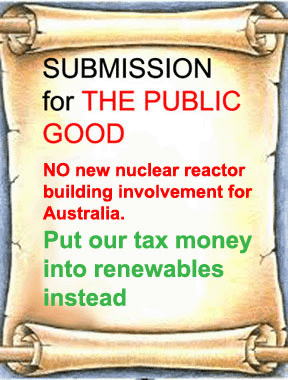
The Treaties Committee of the Australian Parliament is holding an inquiry into the Framework Agreement for International Collaboration on Research and Development of Generation IV Nuclear Energy Systems. Australia already signed up for this in June 2016, without any public discussion. Now the plan is to extend Australia’s involvement and the Committee has called for submissions by April 28, 2017.
Most people would think the idea of expanding the nuclear industry in Australia was dead and gone, following last year’s debacle of the South Australian government’s attempts to get a nuclear waste import business set up in Australia. The latest plan however is different……..
In the current climate of financial crisis for AREVA, Westinghouse, Toshiba and so on, “new nuclear” companies such as Terrestrial Energy, Transatomic and NuScale now pitch their products as a radically different alternative to conventional nuclear reactors.
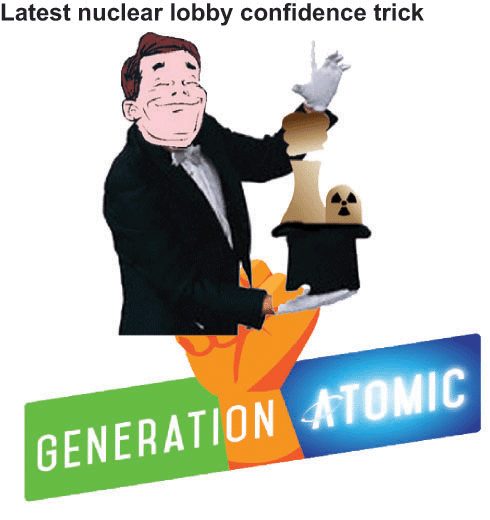
This new nuclear propaganda is certainly out there, but it is not yet prevalent in Australia. The nuclear lobby’s first step is to get government commitments in principle, getting Australia in step with USA and the other nations in the campaign. While the government is certainly well aware of the rejuvenated pro-nuclear campaign, the soft-sell to the Australian public is barely underway. It will come……..
The most important target however is the public, and particularly youth via social media……..
It is quite a small number of individuals who produce both the wordy, technical presentations for government, industry and mainstream media and the bright and snappy messages for the young and for non-technical environmentalists…….
In Australia, this nuclear PR is typified by the work of Ben Heard, who sends sophisticated submissions to government, tweets constantly, and who champions the environment via the nuclear front group Bright New World…….
Now targeting youth via new media the spin has taken on humanitarian and nature-loving elements. Although a collective of billionaires and big corporations are behind it, it promotes an alternative to big corporations. It is about saving the planet. It is about endless cheap and pollution-free energy for all, recycling nuclear wastes, combating climate change, promoting the beneficial uses of ionising radiation, freeing people from irrational fears and from anti-science.
The SMR lobby has been successful already in gaining the attention of government and media for technologies which do not yet even commercially exist. In today’s world of “alternative facts” this success is not surprising. It remains to be seen if “new nuclear” can win the public approval that it needs. http://www.michaelwest.com.au/reactivated-new-nuclear-push-ramps-up/
April 16, 2017
Posted by Christina Macpherson |
AUSTRALIA - NATIONAL, spinbuster |
Leave a comment
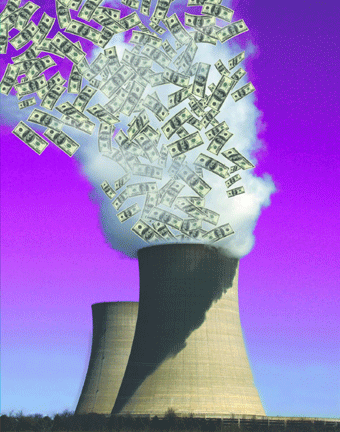
 The Adani coal mine would be a poor use of our taxes, SMH, 15 Apr 17, The Adani coal mine in the Galilee Basin of Central Queensland looks like the Trump presidency did around this time last year: a bad idea with foreseeable bad consequences that may yet prove unstoppable.
In New Dehli this week Prime Minister Malcolm Turnbull met with billionaire Gautam Adani, whose company intends to seek a concessional loan of $900 million from the Australian taxpayer to support building the Carmichael coal mine, which would be Australia’s largest, with the express purpose of shipping coal to India.
The project will create “tens of thousands of jobs” and generate “an enormous amount” in taxes and in royalties, revenues for federal and state government”, the Prime Minister enthused. Meanwhile Barnaby Joyce has been banging the drum about how the coal will light up hundreds of thousands of poor households. In other words, lending our taxes to the billionaire proprietor would do India’s poor people a favour.
For now, new native title legislation that would remove one obstacle is blocked in the Senate, but the government is determined to fix that…….
It would be a very bad look indeed if the project goes ahead with the help of funds from the Australian public. It not only goes against this government’s belief in the wisdom of the free market, but would be yet another piece of embarrassing climate change denialism that sets us apart from more forward-thinking nations – including China and India – that are walking away from coal in favour of renewables.
The pivotal question for now is whether the project meets the eligibility criteria for a loan. The fact that the loan would only be available if the project couldn’t proceed otherwise (or would be seriously delayed) creates the bizarre situation that taxpayers are left footing the bill when commercial lenders baulk.
But it’s not up to politicians to decide whether Adani Mining gets the loan, although resources minister Matt Canavan, a strong supporter of the Carmichael mine, has the ultimate sign-off on disbursement of the loan funds. It’s up to the board of the Northern Australia Infrastructure Fund to make a fully independent assessment on commercial grounds. Taxpayers are entitled to expect the board to be scrupulously diligent in its decision.
To date more than a dozen banks and other funding sources have declared they won’t back the project or have pulled out of existing funding arrangements. The project’s opponents say it’s no longer financially viable, if it ever was. It augurs badly that India’s coal and power minister Piyush Goyal has repeatedly stated a goal to stop importing coal, even specifying a time frame of between two and three years, so Adani coal imports would be up against the tide.
Add to that ongoing Indian government investigations into Adani group companies, including for alleged profiteering on coal imported from Indonesia and for international tax arrangements, it’s clear the NAIF board has a lot to consider…….http://www.smh.com.au/comment/smh-editorial/the-adani-coal-mine-would-be-a-poor-use-of-our-taxes-20170413-gvkac0.html
April 15, 2017
Posted by Christina Macpherson |
AUSTRALIA - NATIONAL, business, climate change - global warming |
Leave a comment
Leading the transformation, though, is the city of Port Augusta in South Australia……Nothing highlights the clean energy transformation more dramatically than what is happening in that city.
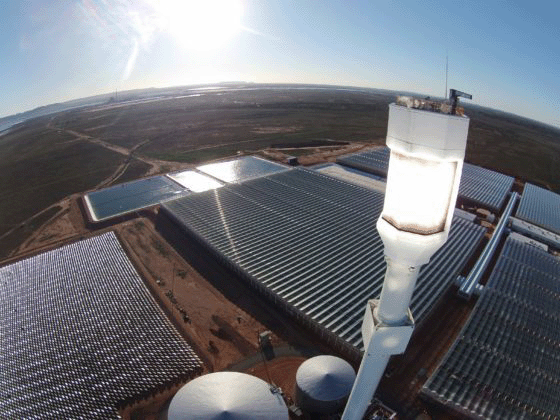
Tide turns as solar, storage costs trump ideologues and incumbents, REneweconomy, By Giles Parkinson on 13 April 2017
But there is no doubt that the transition is happening. Over the last few months, small but significant gains have been made as key politicians, regulators, market operators and many incumbents realise just how quickly the cost of new competition technologies are falling, and how quick the transition to a smarter, cleaner, more reliable and cheaper grid might be.
Awareness about the plunging costs of wind energy, solar energy and battery storage, along with the enabling software that could lead to a complete redesign of the way we generator, share, transport and use energy, is growing each day.
Politicians – both to the left and the right – are starting to embrace this change. The public is supportive, while the fossil fuel incumbents are slowly and surely losing their social licence, both due to the pollution levels of their plant and their manipulation of prices. Even the regulatory barriers that currently protect their business models are starting to unwind.
This is not to say that victory is at hand, or that this transformation will suddenly be complete within a few years. It won’t. But change is starting to happen quickly, old plant is being replace by new, rules are being changed, industry leaders are starting to talk of a new energy vision. Consumers are picking up new technology with increasing speed.
And here are a bunch of key developments in Australia over the last few months that indicate that the plunging cost of key technologies costs will trump the resistance of conservative ideologues and fossil fuel incumbents: Continue reading →
April 15, 2017
Posted by Christina Macpherson |
AUSTRALIA - NATIONAL, energy, South Australia |
Leave a comment
South Australian energy users club together for energy purchasing, AFR, by Angela Macdonald-Smith Simon Evans, 13 Apr 17, Cement maker Adelaide Brighton, steelmaker Arrium and 22 other major energy users in South Australia have won draft clearance from the competition regulator to jointly purchase electricity in a significant move that looks set to change the balance of power in the state’s fragile energy market. Continue reading →
April 15, 2017
Posted by Christina Macpherson |
energy, South Australia |
Leave a comment
 Australian Climate Denial Think Tank Picks Cat Author and Moonman Ken Ring as Climate Expert, Desmog blog, By Graham Readfearn, April 9, 2017 Do you love cats and want to know what makes them tick? Do you think climate change is a hoax being pushed as part of a eugenics plot? Do you like rubber band magic?
April 15, 2017
Posted by Christina Macpherson |
AUSTRALIA - NATIONAL, climate change - global warming, spinbuster |
Leave a comment
 Professor Emeritus of science at Griffith University says govt energy policy risks ‘catastrophe’ Nick Whigham news.com.au
A “CATASTROPHIC collapse of life” is drawing closer and parts of Australia could become unlivable by the end of the century if we don’t change course
UNLESS the Australian government fully embraces renewable energy and moves to decarbonise our energy supply in line with the Paris Climate Agreement, parts of Australia like Bourke and Alice Springs will become unlivable in our lifetime.
That’s the warning from the highly decorated Professor Emeritus of the School of Science at Griffith University, and former president of the Australian Conservation Foundation, Professor Ian Lowe.
As public debate rages over the potential opening of the Adani coal mine in Carmichael, Queensland, Prof Lowe believes the government’s dedication to fossil fuels is taking the country in a troubling direction.
Speaking to news.com.au he worried that the government’s intention to not only open up the controversial Carmichael coal mine but also open up the Galilee basin will “effectively guarantee the frying of the planet”.
“If we continue to expand fossil fuels — which is what things like opening up the Galilee Basin means — by 2050 the average global temperature will be at least two degrees more,” he said.
Under such a scenario, he expects parts of inland Australia to see average temperature rises that would make them virtually unlivable by the second half of the century.
“It’s difficult to imagine how life will continue in places like Alice Springs and Bourke under that sort of regime.”
In the coming decades, he believes countries including Australia who are not doing enough to combat global warming will receive backlash from the international community.
“I think there’ll be increasing international pressure for Australia to get into line,” he said……. .http://www.news.com.au/technology/environment/conservation/griffith-universitys-head-of-science-says-govt-energy-policy-risks-catastrophe/news-story/f7cf7b285a7e9e5fdba0457d28591997
April 15, 2017
Posted by Christina Macpherson |
AUSTRALIA - NATIONAL, climate change - global warming |
Leave a comment
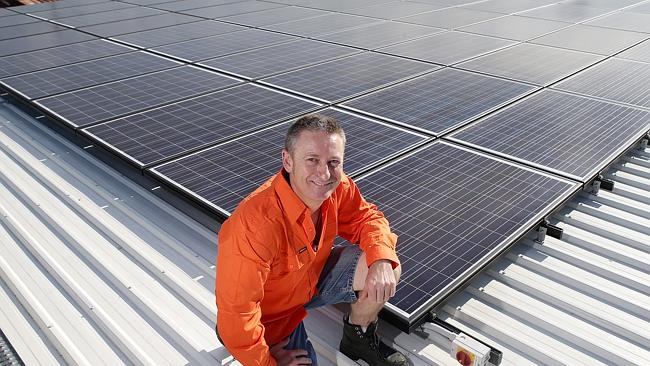
Solar panel installations ‘skyrocket’ in Australia, ABC News, By consumer affairs reporter Amy Bainbridge , 14 Apr 17 There has been a big surge in the number of households installing solar panels, with March installations reaching their highest level in almost five years.
Key points:
- Solar panels were installed on about 15,000 homes and businesses in March 2017
- Installations have hit their highest level in almost five years
- Experts say rising electricity bills and recent blackouts in SA are turning people to solar
Warwick Johnston from energy consultancy firm Sunwiz crunched the numbers and said 91 megawatts of solar photovoltaic (PV) systems were installed during the month.
“March has been a very impressive month for 2017,” he said.
“We already saw a surge starting to build up in 2016, and we were wondering if that was going to continue into 2017 and it really has just continued to skyrocket.”
Queensland led the way, installing 25 megawatts of capacity, which is enough to power about 5,500 homes and businesses.
Installations were also up in South Australia, New South Wales and Victoria.
Mr Johnston said the recent blackouts in South Australia were a factor in the rising demand.
“People are certainly aware of the benefits of solar power and storage to offset or protect against grid blackouts, and that has been a driving factor in the uptake of solar,” he said.
“We’re seeing the uptake occur in states which weren’t affected by those blackouts as well, so it really is people being aware that solar panels are a great way to beat rising electricity bills.”
Installation figures in Tasmania, the Northern Territory and the ACT were flat……http://www.abc.net.au/news/2017-04-14/solar-panel-installations-skyrocket-in-australia/8443550
April 15, 2017
Posted by Christina Macpherson |
AUSTRALIA - NATIONAL, solar |
Leave a comment