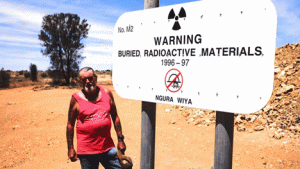
Australian tolerance of the British and their obsessive secrecy may be explained by the deference and loyalty to the ‘motherland’. Prime Minister Menzies identified so strongly with Britain that he considered British national interest as Australia’s national interest.
Another factor which underlay Australian deference during the course of the testing program was the role of Sir Ernest Titterton.
The full legal and political implications of the testing program would take decades to emerge. The secrecy which surrounded the British testing program and the remoteness of the tests from major population centres meant that public opposition to the tests and awareness of the risks involved grew very slowly.
 Wayward governance : illegality and its control in the public sector / P N Grabosky
Canberra : Australian Institute of Criminology, 1989
“…..Admittedly, in the 1950s knowledge of radiation hazards was not as advanced as it is today. At the time it was not generally recognised that small doses of low level radiation might increase the risk of cancer years later. But even in the light of knowledge of the time, the information on which Menzies based his decisions was seriously deficient.
There seems little doubt that the secrecy in which the entire testing program was cloaked served British rather than Australian interests. Continue reading →
April 12, 2017
Posted by Christina Macpherson |
aboriginal issues, AUSTRALIA - NATIONAL, reference, South Australia, weapons and war |
Leave a comment
 Isn’t this a brilliant outcome? For the last few years, the nuclear lobby has been touting Port Augista as the place for a nuclear power station. Following the absolute defeat of the shonky South Australian Nuclear Fuel Cycle Royal Commission, and thanks to all those who fought against it, so brilliantly – South Australia now could become a world leader in modern clean energy.

 REneweconomy, By Giles Parkinson on 11 April 2017 The first two stage of a 300MW solar farm – Australia’s biggest – has begun construction near Port Augusta in South Australia after its developers last Friday reached financial close on the project, and agreed to sell it to two of Europe’s biggest investors in renewables, Italy’s Enel Green Energy and the Dutch Infrastructure Fund.
The first two stages, totalling 220MW, of the Bungala project is being built around 12kms from Port Augusta, where the state’s last coal fired generator closed last May. Ironically, project developer Reach Energy is headed by Tony Concannon, the former head of the owners of the Hazelwood brown coal generator in Victoria which closed late last month.
The two first stages of Bungala will be completed late in 2018, and will be built by Spanish company Elecnor, which recently completed the 57MW Moree project in NSW and the smaller 21MW Barcaldine project in Queensland.
Bungala will be built “battery storage ready”, and will also likely be the first major solar farm to participate in Australia’s FCAS market (frequency control and ancillary services), using SMA inverter technology to provide voltage control for the grid.
Concannon says the remaining 80MW of capacity could be built – along with battery storage – should the company win a South Australian government tender for 25 per cent of its electricity needs with “dispatchable” renewables.
Reach has submitted proposals for both 20MWh of battery storage and 100MWh, although it did not participate in the other tender for a separate 100MWh battery unit. If the tender is not successful, there are also discussions with other potential off-takers in train…….
The new plant, he says, will be designed to provide FCAS – even at night, after the sun has gone down. “What a number of people don’t realise is that you can design ancillary services for solar plants to operate at night time.
“We can draw in power from the grid at night, and use the inverter technologies to regulate voltage, and that helps stabilise the system, even when the sun is not shining.”
Unlike battery storage in households, which he describes as mostly “passive” and focused on converting the output of solar panels from DC power to AC power so it can be put into the grid, utility-scale inverter technologies are able to shape voltage and current very quickly and in a very flexible manner. Modern wind farms are also using the same technologies.
“The inverter changes phase between the voltage and current … inverters can pull the current in, and change the phase to what grid wants.”
Concannon, a power engineer, says it is a tricky subject to try and explain, but says a lot of the articles he has read in the media – about wind and solar not being able to provide grid services – are wrong……..http://reneweconomy.com.au/huge-300mw-solar-farm-begins-construction-near-port-augusta-63411/
April 12, 2017
Posted by Christina Macpherson |
solar, South Australia, storage |
Leave a comment
“His idea of protecting the Reef is giving a coal billionaire a billion dollars to build a coal mine right on the Reef’s doorstep.
Turnbull slammed for “sucking up” to Adani, as business pushes 50-year life for coal plants, REneweconomy, By Sophie Vorrath on 11 April 2017 Prime Minister Malcolm Turnbull has come under renewed criticism from Australian environmental groups after meeting with senior executives from Indian coal mining giant Adani Group as part of his three-day state visit to India.
The meeting with Adani chair Gautam Adani and other company executives in New Delhi on Monday coincides with deliberations on company’s final investment decision on the $21-billion Carmichael coal mine in Queensland’s Galilee basin, which is set to be Australia’s largest coal mine, if built. Continue reading →
April 12, 2017
Posted by Christina Macpherson |
AUSTRALIA - NATIONAL, climate change - global warming, politics |
Leave a comment
 Turnbull, ScoMo and coal-lovers look out: Here comes Audrey Zibelman, Independent Australia, Norm Sanders 10 April 2017, Once they work out that Audrey Zibelman is pro-renewables, her appointment as AEMO’s new CEO is bound to upset the Coalition, writes Dr Norm Sanders.
WHO IS Audrey Zibelman?
On 17 March 2017, she became the new CEO of AEMO, that’s who! And what is AEMO? It is the Australian Energy Market Operator.
Although few are aware of it, AEMO plays a major role in our lives. It manages the NEM(National Electricity Market) and the Victorian gas transmission network. It also oversees retail electricity and gas markets in eastern and southern Australia and is working on the establishment of a Short Term Trading Market (STTM) for gas.
AEMO is also responsible for national electricity transmission planning. It investigated the South Australian blackouts and had a brief moment of media fame when the results of the investigation were released. ……..
Since the Turnbull Government was too busy shooting itself in the foot to exert any leadership over the energy situation, the task was left to AEMO. That organisation surprised some observers and delighted others by recruiting Audrey Zibelman from New York to head the task of sorting out the mess.
Once they understand what this means, the Government will be appalled by the appointment. Not only is Ms Zibleman extremely knowledgeable in the field of electricity generation, she was a major force in New York State’s the Reforming the Energy Vision (REV) plan, which has 50 per cent renewables by 2030 as one of its goals. (Hang in there, Bill!) REV’s other 2030 goals are to achieve a 40 per cent reduction in greenhouse gas emissions from 1990 levels and a 23 per cent decrease in energy consumption from buildings from 2012 levels. Ms Zibelman’s appointment is an indication of a new direction for AEMO’s culture and technology……. Continue reading →
April 12, 2017
Posted by Christina Macpherson |
AUSTRALIA - NATIONAL, energy |
Leave a comment
Senate inquiry sparks ideological fight over Australia’s energy supply and climate change, ABC News, By political reporter Angelique Donnellan, 10 Apr 17, A Senate inquiry report into Australia’s electricity supplies has descended into a slanging match between members, prompting questions about its value for taxpayers.
The Select Committee into the Resilience of Australia’s Electricity Infrastructure in a Warming World heard from 60 witnesses in Adelaide, Canberra and Melbourne, including major energy generators, retailers and industry regulators.
But in the committee’s draft report released today, Federal Greens senator and chairwoman Sarah Hanson-Young took aim at the Coalition and its policies.
“The introduction of a market-based carbon trading scheme would effectively end the decades-long subsidy that coal has received in the electricity generation market,” she said.
“Yet like the proverbial ostrich, the Coalition Government has buried its collective head in the coalmine and refuses to address in any meaningful way the crisis facing the nation.”
The committee had seven other members, including three Labor senators, two Liberal, One Nation and Nick Xenophon.
All dissented to Senator Hanson-Young’s draft report, with Coalition senators calling it biased, false, misleading and dismissive of coal as a generator for electricity…….
Senator Hanson-Young questioned the use of gas as a transition fuel and the need for more gas mining.
“The misplaced notion that coal seam gas could provide a solution to the gas shortage on Australia’s east coast displays a profound ignorance of how the market works,” she said.
“Any unconventional gas will surely find its way onto the export market.”http://www.abc.net.au/news/2017-04-10/coalition-senators-take-aim-at-senates-draft-electricity-report/8431790
April 12, 2017
Posted by Christina Macpherson |
AUSTRALIA - NATIONAL, climate change - global warming, politics |
Leave a comment
 Malcolm Turnbull talks up coal in Delhi, despite India’s aim to stop imports Glut in Indian coal market, plans to phase out imports and lower than forecast energy demands cast doubt on future for exports from proposed Adani mine, Guardian, Michael Safi , 11 Apr 17, Malcolm Turnbull is adamant that Australian coal will play “a very big role” in powering India’s future despite a glut in the local market and clear signals from Delhi that it aims to eliminate imports of the fossil fuel as soon as possible. ………..On Monday Turnbull met Gautam Adani, the mining magnate whose company will soon decide whether to begin building the world’s largest coalmine in Queensland’s Galilee basin. Continue reading →
April 12, 2017
Posted by Christina Macpherson |
AUSTRALIA - NATIONAL, climate change - global warming, politics international |
Leave a comment
 People who blame sickness on windfarms ‘may be bypassing doctor’ Windfarm commissioner’s first report says complainants may fail to seek medical advice ‘due to the possibly incorrect assumption’ that nearby turbines are to blame,Guardian, Elle Hunt, 10 Apr 17 The office of the national windfarm commissioner is concerned people are not going to the doctor because they are incorrectly attributing symptoms of illness to windfarms.
Commissioner Andrew Dyer published his first report to the Australian parliament on 31 March which revealed the office had received 90 complaint between November 2015 and 31 December 2016.
Complainants cited health conditions including “sleep disturbance, headaches, earaches, ‘pounding’ in the ears, tinnitus, tachycardia, high blood pressure, sight impairment, diabetes, chest-tightening, nausea and general fatigue”, which they blamed on both audible and low-frequency noise, “including infrasound, emanating from turbines”.
Because complainants gave only “anecdotal evidence” it was difficult to establish causality with the windfarm’s operations, the report noted. It expressed concern that complainants may fail to seek medical advice “due to the possibly incorrect assumption” that a nearby windfarm was to blame.
But the report also noted that the presence of a windfarm or concerns about a proposed one could cause stress, annoyance or anxiety that could, in turn, result in health conditions. When relating to a proposed windfarm, that pressure could extend for several years.
In February last year, Dyer said half the complaints his office had received pertained to windfarms that had yet to be built.https://www.theguardian.com/environment/2017/apr/10/people-who-blame-sickness-on-windfarms-may-be-bypassing-doctor
April 12, 2017
Posted by Christina Macpherson |
AUSTRALIA - NATIONAL, wind |
Leave a comment
Telco, online energy retailer merge to take on coal-laden utilities, REneweconomy, By Giles Parkinson on 10 April 2017
Junior telecommunications company amaysim has agreed to pay $120 million for online energy retailer Click Energy in a move designed to challenge the dominance of the big utilities in both the telco space and the energy sector.
The potential merger of telecommunications and energy offerings has long been mooted. But, despite Telstra snapping up PowerShop’s Ben Burge last year to head the newly created Telstra Energy and promising its own line of solar and storage, little has happened to date, although combined offerings have become common in the US and Europe.
“I think it will be standard here in the next few years time,” says Dominic Drenen, who will continue his role as CEO of Click Energy. “We think we can put together a bundled product that is quite compelling. For consumers, they will be dealing with one platform, so it’s just one less hassle.”
The two companies think there are significant opportunities for an “asset-light” retailer that is not burdened by legacy assets such as ageing coal-fired power stations.
“Retailing industry players are burdened with complex legacy systems and pricing structures, with most major providers also owning ageing coal-fired generating assets,” amaysim CEO Julian Ogrin said in a presentation. “Customers face large confusing bills, bill shock, no real online engagement or DIY experience and poor customer service is common.”
Ogrin sees a “once-in-a-generation” opportunity in the forced migration of around 8 million Australian homes changing their broadband service by 2020. He says the telco and energy sectors are typically “inert”, so the opportunity to increase market share in the forced migration of NBN is a unique opportunity.
It expects to have its first combined offers available in 2018, and sees major savings in “back-end” IT platforms and other synergies of around $5 million a year…….http://reneweconomy.com.au/telco-online-energy-retailer-merge-to-take-on-coal-laden-utilities-99299/
April 12, 2017
Posted by Christina Macpherson |
AUSTRALIA - NATIONAL, business, energy |
Leave a comment
 Polling brief: renewable energy http://apo.org.au/node/75503, Tom Swann, 10 April 2017
Summary:
New polling shows that despite a concerted campaign from sectors of the federal government and coal and gas industries, public support remains very high for renewable energy, and for the strengthening of state and federal targets.
The poll, conducted by The Australia Institute through Research now, asked a representative sample of 1420 Australians about renewable energy policy.
- 67% said Australia was moving into renewable energy too slowly. Only 9% said Australia was moving too fast.
- 77% of Australians support a state renewable energy target to provide extra renewable energy in their state – virtually unchanged over the last 18 months.
- 52% supported increasing the current federal Renewable Energy Target for 2020, only 9% wanted to reduce it.
April 12, 2017
Posted by Christina Macpherson |
AUSTRALIA - NATIONAL, energy |
Leave a comment
The motion taken by the Young Nats brings them into line with the National Farmers’ Federation, the Business Council of Australia, the Australian Industry Group and much of the energy sector, including the electricity transmission and distribution businesses
Young Nationals reject federal party policy to back emissions trading, The Age, Heath Aston , 10 Apr 17, The Young Nationals have split with the senior ranks of the party, voting to support the introduction of a carbon trading scheme. Continue reading →
April 12, 2017
Posted by Christina Macpherson |
AUSTRALIA - NATIONAL, climate change - global warming, politics |
Leave a comment

The contents of the Coalition’s dissenting report, however, are quite extraordinary, and highlight the difficulties that prime minister Malcolm Turnbull would have if he ever chose to implement sensible energy policies, or sought to implement the inevitable conclusions of the Finkel Review.
In essence, the Coalition’s report was a collection of renewable energy myths that might have been collected from far-right anti-wind and climate denying websites
Coalition says wind turbines increase emissions, more coal needed, REneweconomy, By Giles Parkinson on 11 April 2017 Coalition Senators say that wind turbines are likely to cause greenhouse gas emissions to increase, and insist that the best thing that Australia can do to combat climate change is to export more thermal coal.
The extraordinary conclusions – from Senators Chris Back and Jonathon Duniam – were included in the dissenting report to the Senate inquiry into the resilience of electricity infrastructure in a warming world. They also insist that coal and gas would remain the dominant sources for electricity around the world for “many generations to come.”
“Energy generated by wind turbines do not reduce greenhouse gas emissions within the electricity sector by the amount claimed. In fact, there is some evidence that the addition of wind energy onto the grid actually increases carbon emissions,” the Coalition Senators wrote.
It was one of four dissenting views on the report prepared by the Greens chair Sarah Hanson-Young, highlighting the impossible nature of Australia’s energy politics, and the apparent refusal of any parties to agree on anything, including facts.
One Nation’s Malcolm Roberts issued a dissenting report which simply claimed that there was no such thing as a warming world. Continue reading →
April 12, 2017
Posted by Christina Macpherson |
AUSTRALIA - NATIONAL, politics |
Leave a comment
The Indian company has applied for a $900 million concessional loan from the government’s Northern Australia infrastructure fund to help build a rail line connecting the central Queensland mine and the Abbot Point port.
“If you want to have a good commercial operation in Australia, I am not convinced the taxpayer of Australia should underwrite the risk of the project through a billion dollar loan,” Opposition Leader Bill Shorten told reporters in Brisbane.
Mr Shorten said other mining companies are not getting billion dollar railways built for them.
“We have to make sure it stacks up,” Mr Shorten said.
The company’s Carmichael coal mine project in Queensland was approved in December but has faced serious opposition from environmental and indigenous groups.
Senior executives of Adani, including founder and chairman Gautam Adani met with Prime Minister Malcolm Turnbull in India on Monday.
Mr Adani requested an early resolution of native title issues surrounding the mine, which was hit by a Federal Court ruling that invalidated deals with traditional owners across Australia.
Legislation dealing with the problem is before the Senate and Mr Turnbull is understood to have assured the company the issue would be fixed.
Mr Shorten said Attorney General George Brandis was to blame for the confusion over native title.
Anything he touches turns to “custard”, the Labor leader said.
“In an incompetent government, he is the gold medal of incompetence,” he said.
April 12, 2017
Posted by Christina Macpherson |
AUSTRALIA - NATIONAL, politics |
Leave a comment
Abbot Point Coal Terminal under investigation after satellite images show water release, ABC News, By Andrew Kos, 10 Apr 17, Satellite imagery appearing to show sediment-laden water flowing into wetlands from the nearby Abbot Point Coal Terminal has prompted an investigation by Queensland’s Department of Environment and Heritage Protection.
Adani was granted a temporary emissions licence (TEL) to help it manage water on the site during Tropical Cyclone Debbie.
A spokesman for Adani said the company had been in constant contact with the department prior to and since Cyclone Debbie.
But the department became aware of the satellite images last week and is looking into whether there had been any unauthorised releases of water from the terminal into the Caley Valley Wetlands…….
Peter McCallum from the Mackay Conservation Group said it had written to Environment Minister Steven Miles to request more information about the release.
“We have no confidence that Adani will be able to manage the environmental impacts of the port expansion or any other aspect of its massive coal mining operation,” Mr McCallum said.
The department will continue to monitor the situation.
The wetlands are important habitat for at least 22 migratory shore birds listed under the national environmental legislation. http://www.abc.net.au/news/2017-04-10/abbot-point-coal-terminal-released-into-wetlands/8430934
April 12, 2017
Posted by Christina Macpherson |
environment, Queensland |
Leave a comment
 Australia’s hospitality, largesse and loyalty to Britain were not without their costs. Moreover, the sacrifices made by Australians on behalf of the ‘motherland’ were not equally borne. Whilst low population density and remoteness from major population centres were among the criteria for the selection of the testing sites, the Emu and Maralinga sites in particular were not uninhabited. Indeed, they had been familiar to generations of Aboriginal Australians for thousands of years and had a great spiritual significance for the Pitjantjatjara and Yankunytjatjara people.
A variety of factors underlay the harm to public health, Aboriginal culture and the natural environment which the British tests entailed. Perhaps most significant was the secrecy surrounding the testing program.
During the entire course of the testing program, public debate on the costs and risks borne by the Australian public was discouraged through official secrecy, censorship, misinformation, and attempts to denigrate critics
Wayward governance : illegality and its control in the public sector / P N Grabosky
Canberra : Australian Institute of Criminology, 1989 “……. In 1950, Labor Prime Minister Clement Atlee sent a top secret personal message to Australian Prime Minister Menzies asking if the Australian government might agree to the testing of a British nuclear weapon at the Monte Bello Islands off Western Australia. Menzies agreed in principle, immediately; there is no record of his having consulted any of his Cabinet colleagues on the matter.
The Monte Bello site was deemed suitable by British authorities, and in a message to Menzies dated 26 March 1951 Atlee sought formal agreement to conduct the test. Atlee’s letter did not discuss the nature of the proposed test in minute detail. He did, however, see fit to mention the risk of radiation hazards:
6. There is one further aspect which I should mention. The effect of exploding an atomic weapon in the Monte Bello Islands will be to contaminate with radio activity the north-east group and this contamination may spread to others of the islands. The area is not likely to be entirely free from contamination for about three years and we would hope for continuing Australian help in investigating the decay of contamination. During this time the area will be unsafe for human occupation or even for visits by e.g. pearl fishermen who, we understand, at present go there from time to time and suitable measures will need to be taken to keep them away. We should not like the Australian Government to take a decision on the matter without having this aspect of it in their minds (quoted in Australia 1985, p. 13).
Menzies was only too pleased to assist the ‘motherland’, but deferred a response until after the 195 1 federal elections. With the return of his government, preparations for the test, code-named ‘Hurricane’, proceeded. Yet it was not until 19 February 1952 that the Australian public was informed that atomic weapons were to be tested on Australian soil. On 3 October 1952 the British successfully detonated a nuclear device of about 25 kilotons in the Monte Bello Islands. Continue reading →
April 10, 2017
Posted by Christina Macpherson |
aboriginal issues, AUSTRALIA - NATIONAL, history, reference, South Australia, weapons and war |
Leave a comment