Australian government releases rather unsatisfactory climate review, amid resignations of key advisors
Submissions on the paper close at 5pm AEST on 5 May 2017
 Coalition sets climate parameters, as two more quit key advisory body, REneweconomy, By Sophie Vorrath on 24 March 2017, Stage one of the federal government’s 2017 review of climate change policies is finally underway, with the release on Friday of a 40-page discussion paper for public consultation.
The Coalition’s climate review, announced by the Turnbull government in December 2016 and due for completion by the end of the year, was seen by some – at the time – as a positive development; an opportunity for it to get serious about its climate change policy, both current and future.
But the publication of the discussion paper – almost two months behind schedule and amid claims from the federal government’s own Climate Change Authority that it “doesn’t take the issue seriously” – does not immediately inspire confidence. Continue reading
Fossil fuel industry screwed Australians: mainstream media helped them
How the fossil fuel industry has screwed energy consumers, REneweconomy, By Giles  Parkinson on 24 March 2017 As we absorb the hysterical claims – in the ABC, Fairfax, the Murdoch media and commercial TV – about the prospect of imminent power shortages, let’s just cast our eyes back just two and a half years when the fossil fuel industry was predicting …. wait for it …. an unprecedented supply glut.
According to the Australian Energy Market Operator at the time, there would be no need for any new generation for up to 10 years in south-eastern Australia, because of what was then described as that “unprecedented glut”.
“What we’re saying is that is that there’s an oversupply of generation capacity at present,” an AEMO spokesman, Joe Adamo, told the ABC at the time. And you can see that from those forecasts there. [graph on original]
The fossil fuel industry and big business seized on those forecasts to argue forcefully that the renewable energy target should be heavily cut, if not scrapped.
The Abbott government needed no encouragement, and despite being foiled by the Senate in its attempts to kill it entirely, it did succeed in cutting the RET, and sparking an investment drought that lasted from 2013 until the end of last year.
As Alan Pears and David Leitch each wrote in separate pieces on Thursday, Australian consumers and businesses are now paying the price for that act of policy vandalism, and the huge delays in investment in renewable energy that occurred thanks to the Abbott government.
Leitch puts the extra cost – in terms of wholesale electricity prices – at more than $11 billion. And soon enough, that will filter through to retail costs, already surging out of control according to a recent study by the Grattan Institute (and many others)……
Fast forward to now, and even though there has been no increase in demand, the fossil fuel industry is revelling in unprecedented profits, as spot and future price soar across the nation – particularly in the coal states.
Because of the lack of competition that could have been introduced if the RET policy was held steady, the incumbent generators can now use their market power to artificially inflate prices, and somehow convince mainstream media and conservative politicians that it is all the fault of wind and solar.
“It looks like the generators succeeded, as expected, in delaying investment until they could enjoy a price bonanza as they withdraw faster than replacement can get underway now,” says one senior executive, who declined to be named.
Spark Infrastructure, which runs two of the three networks in Victoria, and the only network in South Australia, was not so shy, writing in its submission to the Finkel Review that fossil fuel generators were deliberately dealing in “scarcity” to push up prices.
They did this, it said, by deliberately withdrawing capacity at critical times…….
The South Australian government, to its credit, has decided to try and tackle this nonsense by introducing an “energy supply target”, which seems deliberately calibrated to ensure that the fossil fuel industry does not shut down more capacity, and create more scarcity………http://reneweconomy.com.au/fossil-fuel-industry-screwed-energy-consumers-18974/
The Waubra anti-wind power campaign still lives!
 Can wind turbines make you sick? Debate divides tiny Victorian town of Waubra, ABC Radio, PM By Danny Tran, 24 Mar 17, In the sleepy Victorian town of Waubra, a bitter feud over wind power is driving a wedge between neighbours and friends.
Key points:
- There are 79 wind farms in Australia and more than 2,000 turbines producing 5 per cent of the nation’s electricity
- Waubra’s own wind farm is one of the largest in Australia, with 128 turbines on the properties of 37 farmers
- Wind turbine syndrome describes symptoms a small number of people claim arise from living near wind farms
About two hours north-west of Melbourne, Waubra produces enough electricity from its wind turbines to power two of Victoria’s largest regional cities.
But after almost a decade of operating, wind power remains a painful issue in the town, which is only home to about 500 people.
Waubra is so synonymous with wind power that opponents have christened the so-called illness that some claim comes with living near turbines “Waubra disease”.
The town might be at loggerheads over whether wind can make you sick, but what does the science say?
What is wind turbine syndrome?
Waubra disease, better known as wind turbine syndrome, describes a range of symptoms a small number of people claim arise from living near wind farms, ranging from headaches to nausea.
It was first coined in 2009 by New York paediatrician Dr Nina Pierpont, who claimed wind turbines disrupted the inner-ear through inaudible, low-frequency vibrations.
The claims were rubbished by science and health bodies across the world, but anti-wind power groups seized on Dr Pierpont’s claims, which quickly spread to Australia.
Experts dismiss wind turbine syndrome as the result of a “nocebo” effect, where negative expectations of symptoms can amplify an actual negative effect — the opposite of a placebo.
But that hasn’t stopped Waubra locals from taking a side………
the Australian Medical Association’s Victorian president, Dr Lorraine Barker, said that anxiety over being near wind turbines can cause symptoms of its own.
“There is no indication that infrasound, for instance, could induce the symptoms … [but] anxiety certainly can,” Dr Barker said.
“Noises that are continuous in the background can be irritating, so that level of irritation may affect someone if they are standing very close to a wind turbine.
“However, infrasound, or the sound that is beyond the detection of the human ear, is not believed to cause harm to humans.” http://www.abc.net.au/news/2017-03-24/victorian-town-divided-over-wind-turbines/8373760
Adnyamantha Aboriginal elder considering legal action against federal government’s proposed nuclear waste dump

 Aboriginal Elder Tony Clark concerned with nuclear waste facility, Transcontinental, 23 Mar 2017, Adnyamantha and Kujani Traditional Elder Tony Clark says if the federal government’s proposed nuclear waste facility at Barndioota continues to the next stage, a federal court legal intervention may take place.
Mr Clark has previously led the charge of the Kujani people’s Federal Court win against the federal government’s proposed nuclear waste facility for Woomera in 2004.
The potential intervention would come from a group of Adnyamantha and Kujani people who are concerned the proposed facility holds a significant risk to the survival of the Pungu Purrungha song line.
The songline travels across a body of water more than 70 kilometres in length from Hawker to Lake Torrens, and is an important piece of local Aboriginal history.
It’s also believed to be at least 85,000 years old.
Mr Clark said he’s opposed to the facility and that he and others are not afraid of taking potential legal action. “If they proceed to the next step on our country … then we would look towards seeking legal intervention in the federal courts,” he said.
The proposed site,130 kilometres north of Port Augusta, will store low-level and some intermediate-level nuclear waste. The low level purpose-built repository would be about the size of four Olympic size swimming pools with a 100 hectare buffer on the 25,000 hectare property.
Designs have not been prepared for the national repository but it will be modelled on above-ground storage and disposal facilities overseas……
Mr Clark said the ‘cultural and spiritual well-being’ of the Adnyamantha people is at risk if the facility proceeds, and he believes section 47 of the Pastoral Land Management and Conservation Act (1989) plays an important role in the facility’s future.
The act states an Aboriginal person may enter, travel across or stay on pastoral land for the purpose of following the traditional pursuits of the Aboriginal people.
Mr Clark said the Adnyamantha people’s cultural and spiritual well-being may be at risk if they can’t access the Pungu Purrungha song line and that this section shows no Pastoralist can stop Aboriginal people accessing a traditional site like the Pungu Purrungha song line.
“Our cultural and spiritual well-being is at risk, along with our physical contact to the land under various acts of parliament, including section 47 of the Pastoral Land Management and Conservation Act (1989).”
A Spokesperson for the Department of Industry, Innovation and Science said the (federal) government has said it will deliver a National Radioactive Waste Management Facility in a centralised, purpose-built repository.
“The government has not formed a view that it should be located in Barndioota,” the spokesperson said…..http://www.transcontinental.com.au/story/4547617/nuclear-proposal-may-go-to-courts/
Stop Adani Alliance launching by former Greens leader Bob Brown
 Former Greens leader Bob Brown to launch alliance to oppose Adani coalmine https://www.theguardian.com/business/2017/mar/22/former-greens-leader-bob-brown-to-launch-coalition-to-oppose-adani-coalmine The Stop Adani Alliance says north Queensland coalmine would ‘fuel catastrophic climate change’, Guardian, Paul Karp, 22 Mar 17, The former Greens leader Bob Brown will launch a new alliance of 13 environmental groups opposed to Adani’s Carmichael coalmine on Wednesday in Canberra.
The Stop Adani Alliance will lobby against the coalmine in northern Queensland, citing new polling that shows three-quarters of Australians oppose subsidies for the mine when told the government plans to loan its owners $1bn.
The alliance’s declaration argues the mine will “fuel catastrophic climate change” because burning 2.3bn tonnes of coal from the mine over 60 years of operation would create 4.6bn tonnes of carbon dioxide. It states the project would “trash Indigenous rights”, citing the fact Adani does not have the consent of the Wangan and Jagalingou people.
The alliance’s members include the Bob Brown Foundation, the Australian Conservation Foundation, 350.org, Get Up, the Australian Youth Climate Coalition, the Seed Indigenous Youth Climate Network and the Australian Marine Conservation Society.
The alliance will call for:
- A complete withdrawal of the Adani Carmichael mine, rail and port project;
- A ban on new coalmines and expansions in Australia; and
- An end to public subsidies for polluting projects.
Brown said the groups were “drawing a line in the sand with Adani, just as previous generations did with the Franklin River dam”, a campaign of which he was a leader.
“Adani’s coalmine will be the most dangerous in our history, ramping up global carbon pollution precisely when emissions need to be drastically cut,” he said.
Brown will be joined at the launch in Canberra by alliance spokesman and president of the Australian Conservation Foundation, Geoff Cousins, and Seed Indigenous Youth Climate Network codirector Amelia Telford.
According to a new ReachTel poll taken on 14 March, 74.8% of voters agree that “Adani should fund its own project” rather than rely on a proposed $1bn loan from the federal government.
The poll replicates results in January that showed three-quarters of respondents were opposed to loaning $1bn for a train line to the Adani coalmine.
The government’s Northern Australia Infrastructure Fund granted Adani “conditional approval” for a $1bn loan in December 2016.
Leaders of Australian Climate Change Authority quit over government’s inaction
 Two quit Australian climate authority blaming government ‘extremists’ John Quiggin and Danny Price resign over Coalition’s ‘rightwing anti-science activists’ and climate change political point-scoring, Guardian, Helen Davidson, 23 Mar 17, Two members of the Climate Change Authority have resigned, with one accusing the government of being beholden to rightwing, anti-science “extremists” in its own party and in the media.
John Quiggin told Guardian Australia he informed the federal minister for environment and energy, Josh Frydenberg, of his resignation on Thursday. It follows the resignation of fellow climate change authority member, Danny Price, who quit on Tuesday.
“The government’s refusal to accept the advice of its own authority, despite wide support for that advice from business, environmental groups and the community as a whole, reflects the comprehensive failure of its policies on energy and the environment,” Quiggin said.
“These failures can be traced, in large measure, to the fact that the government is beholden to rightwing anti-science activists in its own ranks and in the media. Rather than resist these extremists, the Turnbull government has chosen to treat the vital issues of climate change and energy security as an opportunity for political point-scoring and culture war rhetoric.”
Quiggin said his immediate reason for resigning was the government’s failure to respond to the authority’s third report of the special review into potential climate policies, which the government had requested and which it was legally required to respond to.
“The government has already indicated that it will reject the key recommendations of the review, particularly the introduction of an emissions intensity scheme for the electricity industry.”
Quiggin said he didn’t believe there was anything to be gained “by giving objective advice based on science and economic analysis to a government dominated by elements hostile to both science and economics”…….https://www.theguardian.com/environment/2017/mar/23/two-quit-australia-climate-change-authority-john-quiggin-danny-price
Australian media distorts facts on renewable energy: 3. Fairfax media
It actually shows the most extreme demand scenarios that it can think of – a one in ten year likelihood in this case – and graphs that over and above what it considers to be the “average” supply. Repeat. That is average supply, not total supply available.
the idiotic and ignorant reporting in the mainstream media is allowing the fossil fuel generators and their protectors in the Coalition to blind public perceptions with complete nonsense. Fake news indeed.
Fairfax joins media hysteria over post-Hazelwood “blackouts” http:// reneweconomy.com.au/fairfax-joins-media-hysteria-over-post-hazelwood-blackouts-37842/
Fairfax Media led the front page of The Age newspaper (see image right) [on original] with an “exclusive” story that warned of 72 days of potential blackouts across the state over the next two summers.
“Victoria’s energy security has been thrown into question, with the state facing an unprecedented 72 days of possible power supply shortfalls over the next two years following the shutdown of the Hazelwood plant next week,” the story by Josh Gordon begins.
And how does it come to this breathless conclusion? Fairfax, like other media, such as the ABC’s political editor, Chris Uhlmann, is basing the forecasts of blackouts on this graph that appears on the website of the Australian Energy Market Operator.
It purports to show – in the light red at the top – the periods when Victoria could face a shortfall of supply. The graph for South Australia is even more dramatic. But is that really what is says? Blackouts all summer?
Not at all, says the AEMO – a reply they would happily give anyone who bothered to ask. Continue reading
Australian media distortion of facts on renewable energy: 2 THE AUSTRALIAN
there we have it. A report that says South Australia could easily aim for 40 per cent renewable energy is portrayed as a warning that 20 per cent is the natural limit. It boggles the mind.
Weatherill – to his credit – keeps on repeating that the blackouts and near misses in South Australia have not been about technology choices, but about grid management. Even AEMO agrees. But some journalists don’t want to know.
The CSIRO outlines a scenario for 86 per cent in that state by 2035. Zinc refiner Sun Metals is building a solar plant because it is cheaper than coal-fired generation in Queensland. The former head of Hazelwood says that solar and battery storage is already cheaper than baseload gas.
But don’t expect to read much about those exciting developments in much of the mainstream media. They just don’t seem interested.
How The Australian distorted S.A. renewables advice http://reneweconomy.com.au/how-the-australian-distorted-s-a- renewables-advice-19781/ By Giles Parkinson on 22 March 2017 Readers of Rupert Murdoch’s The Australian newspaper would have been fascinated to learn this week that the South Australian government had apparently ignored advice in 2009 to limit the amount of wind energy in their state’s grid to 20 per cent. South Australia has, of course, gone well beyond that, with wind energy now meeting more than 40 per cent of the state’s electricity demand, and rooftop solar another 5-6 per cent. The combined total is likely to exceed 50 per cent by the end of the year, well ahead of its 2025 target.
But this target is under attack from the fossil fuel industry and their proxies in the Murdoch media – as Media Watch documented so well on Monday – and by some in the ABC itself.
On Sunday, the ABC’s political editor Chris Uhlmann wrote that it was “well documented” that any more than 20 per cent wind energy created problems for the grid.
We debunked that piece of nonsense with this story – The ABC’s Uhlmann gets in wrong on renewables. Again – on Monday, which noted that the CSIRO regarded anything up to 30 per cent penetration of wind and solar as “trivial.”
On Tuesday, The Australian followed on from Uhlmann, and with gusto, in this report titled Energy crisis puts the wind up Jay Weatherill (subscription required). Continue reading
Australian media distorts facts on renewable energy: 1. ABC’s Chris Uhlmann
ABC’s Uhlmann gets it wrong on renewables. Again http://reneweconomy.com.au/abcs-uhlmann-gets-it-wrong-on- renewables-again-79117/ By Giles Parkinson on 20 March 2017
“Once wind energy passes about 20 per cent of generation it creates a series of well-documented challenges for electricity grids in both managing intermittency and stabilising the system’s frequency,” Uhlmann writes, without citing any such documents.
That, indeed, is what the fossil fuel industry would have you believe. It was what many engineers believed back in the 1980s and 1990s. And some still may do. But it is not true. Continue reading
“Small” rooftop solar is driving Australia’s solar energy boom
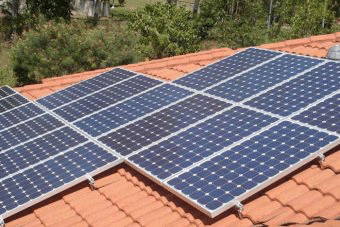 Regional home and business owners driving Australia’s solar energy boom ABC, PM By Angela Lavoipierre 22 Mar 17 When you think of solar, you probably think of vast fields of black panels at large-scale solar farms, producing enormous quantities of power.
Key points:
- The highest uptake of rooftop solar is in the regional and urban fringe areas
- Moree, NSW is a perfect example, with 19 per cent of homes sporting rooftop panels
- The cost of installing solar systems has decreased by around 80 per cent in the last decade
But Australia’s real solar engine, at least for the time being, is a much more humble sight. It is small collections of solar panels on ordinary homes and businesses around the country.
At 2.8 per cent, rooftop solar contributes far more to Australia’s total energy mix than largescale solar, which currently comes in at around a quarter of a per cent.
Claire O’Rourke is the national director of Solar Citizens, a group which lobbies for private solar owners.
“It’s not the inner-city latte-sippers who are going solar,” she said.
“It’s definitely the highest uptake around those urban fringe areas and in regional areas as well where you’ll see in some areas 30-40 per cent of homes with solar on rooftops.”
There are nearly 1.6 million Australian homes with solar panels on their rooftops. To put it in perspective, 1.4 million of those homes took up solar installations in the last decade.
“These are kind of remarkable figures for an industry that was seen as more of a cottage industry 15 or 20 years ago where it was kind of off-grid hippies that were taking it up,” Ms O’Rourke said.
“But it’s very much a mainstream option for people to manage their energy use and also to take control of their rising power bills.”
According to the Grattan Institute, consumers in Melbourne, Sydney, Brisbane and Adelaide are paying nearly twice as much for electricity as they were a decade ago. Ms O’Rourke said that was part of the reason rooftop solar had been booming. “Prices have gone up, bills have gone up, and the other contributing factor is that the costs of solar has rapidly decreased,” she said. “So if you look at a bit of technical analysis, it’s dropped from $9-a-watt for out-of-pocket expenses on installing a solar system, to $1.60.”So it’s like an 80 per cent decrease in out-of-pocket installation costs in only a decade.”
Moree embraces solar….. http://www.abc.net.au/news/2017-03-23/regional-australia-drives-solar-boom/8377670
Adani investors misled? Money shifted to tax haven as Australian govt subsidises loan
The Cayman Islands-controlled rail company has rights to a royalty stream worth up to $3 billion from the proposed mine, the ABC recently revealed — a payment that would come at the expense of shareholders in the publicly listed Adani Enterprises.

 Adani facing growing pressure on fears investors may have been misled http://www.abc.net.au/news/2017-03-22/adani-facing-growing-pressure-investors-may-have-been-misled/8376794 By Stephen Long, Adani Group is facing growing pressure to reveal which company in its complex corporate web has applied for a $1 billion subsided loan from the Australian Government, amid fears money could be shifted to a tax haven and investors may have been misled.
An Australian law firm has written to the Bombay Stock Exchange asking it to clear up the confusion about a $1 billion funding application to the Federal Government’s Northern Australia Infrastructure Facility (NAIF).
The loan would finance a 400-kilometre railway from Queensland’s Abbot Point Coal Terminal to a planned massive mine in the Galilee Basin, which, if it goes ahead as proposed, would contain six open-cut pits and five underground collieries.
It is “absolutely possible” investors have been misled about the loan, lawyer David Barnden from not-for-profit law firm Environmental Justice Australia (EJA) told the ABC. “In terms of misleading the market, the NAIF funding is really, really important for Adani’s share price,” Mr Barnden explained.
“When [Resources Minister] Matt Canavan told Reuters last week that Adani Enterprises had applied for the funding, the share price went up 4 per cent.”
Senate Inquiry report tabled: Labor support for Native Title Bill profoundly disappointing
http://wanganjagalingou.com.au/senate-inquiry-report-tabled-labor-support-for-native-title-bill-profoundly-disappointing/ 21 March 2017:
 “Wangan and Jagalingou (W&J) Traditional Owners fighting Adani’s Carmichael mine are profoundly disappointed that Labor senators have today backed in the Government’s rushed and ill-considered amendments to the Native Title Act, giving a free kick to Indian billionaire Gautam Adani and plans for a Qld coal mine.
“The Native Title Amendment (Indigenous Land Use Agreements) Bill 2017 is designed to overturn the recent McGlade decision that upheld the Native Title Act requirement that all applicants are needed to sign a land use agreement. The bill is expected to be debated in the Senate today.
“Senior spokesperson for the Wangan and Jagalingou (W&J) Traditional Owners Council Mr Adrian Burragubba said, “Labor has lined up with the Government to wind back our rights – and their own commitment to land rights. They have swallowed the arguments of the mining and agricultural lobby that there is a crisis that needs an urgent response. …
“Youth spokesperson for the W&J Traditional Owners Council Ms Murrawah Johnson said, “The major parties have given Adani and their dirty mine a free kick today.
““Politicians at the Federal and State level are falling over themselves to push this controversial proposed mine through, denying us our rights to self-determination. …
“Mr Colin Hardie, Lawyer for the W&J native title claimants objecting to Adani’s purported ILUA said, “The risk involved in this legislation is so great it should not be proceeding.
It is a case where the cure is worse than the complaint. My clients will retain their objection to the purported Adani ILUA in the court, and consider grounds for challenging the legislation”. … “
Immense coal mine “good for the environment” says fossil fuel lackey Resources Minister Matt Canavan
 This Politician Reckons Australia’s Largest Coal Mine Will Actually Be Good For The Environment March 23, 2017, Rob Stott BuzzFeed News Reporter, Australia Australian resources minister Matt Canavan has defended the proposed Carmichael coal mine, saying it will actually have a positive effect on the environment. The mine, which would produce more than 60 million tonnes of coal per year and significantly contribute to global carbon emissions, is proposed for Queensland’s Galilee Basin.
Rooftop solar the unsung hero in recent South Australia blackouts.
Regional home and business owners driving Australia’s solar energy boom, ABC PM By Angela Lavoipierre , 23 Mar 17
“……….Rooftop solar panels do not necessarily power the buildings they are attached to.Most of the time, the power generated by those panels is sold straight back to the energy market.
Generous state-based schemes designed to tempt people into the market paid handsomely for that energy in the past, but those deals all but disappeared.
At another time in Australian history, that change might have had a chilling effect on solar uptake, but soaring energy prices have made sure that is not the case. To those who own their own homes, with mounting power bills, solar still looks pretty tempting, even if it is just for your own personal use. The rapid pace of growth in rooftop solar has slowed.
But Hugh Saddler, an energy analyst based at the Australian National University, said Australia could expect to see an ongoing boom in the uptake of small-scale solar for businesses.
“The steady or in more case rapid increase in the commercial sector is being driven to a significant degree by the steadily falling cost of installing a solar system,” Dr Saddler said.
There are currently industry-based schemes, paid for by consumers, to encourage businesses to go solar.
Dr Saddler predicts those schemes, once they end, could prove to be a hiccup in the growth of Australia’s solar industry, but little more. “I suppose one challenge will be whether it will still be an attractive investment when the small renewable energy scheme comes to an end and I’m sure that it will be because the prices are coming down all the time,” he said.
If 2.8 per cent does not sound like much, Dr Saddler makes the case that rooftop solar was the unsung hero in recent SA black outs. “If it hadn’t been for the rooftop solar making a very large contribution at about 4 o’clock in the afternoon … then that peak would have been about 7 per cent higher than the peak demand on the grid two hours later,” he said.
“And that would have roughly doubled the number of consumers that had to be cut off for load shedding.” http://www.abc.net.au/news/2017-03-23/regional-australia-drives-solar-boom/8377670
Huge savings predicted from Tasmania’s largest solar rooftop farm.
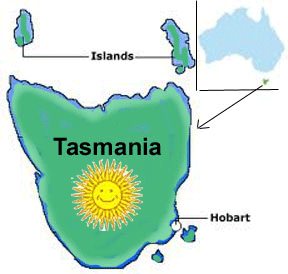 Proponents predict big savings from 4000-panel solar farm http://www.themercury.com.au/news/tasmania/proponents-predict-big-savings-from-4000panel-solar-farm/news-story/d6d5333b757f4cc6f33fecad23dcdc20 NICK CLARK, Mercury March 23, 2017 A $2 million solar farm, Tasmania’s largest, will inject power into the state’s grid during summer and save thousands of tonnes of greenhouse gases.
Proponent Nest Energy will place 4000 solar panels on the sawtooth roof of a former wool store in the Launceston suburb of Kings Meadows. Partner Mark Barnett said 15 people would be employed during construction with the project anticipated to be running by August. He said the privately funded project would produce about 1GWh of electricity a year – enough to fully power 200 homes.
It would reduce greenhouse gas emissions by 20,000 tonnes over the 35-year project life.
Mr Barnett said in winter the panels would produce enough for several businesses while in summer there would be 30 per cent excess electricity, which would be injected into the grid with the company receiving a feed-in tariff. “The building tenants will receive their power at a significant discount while the building owner will realise an improved building value so it’s a fabulous win/win” he said.
Mr Barnett said the project had been two years in the planning. He said a drop in the price of renewable components coinciding with a trend of rising power prices, meant there was plenty of opportunity for further projects, especially in agriculture. Treasurer Peter Gutwein said the project demonstrated an increased level of confidence in the northern Tasmanian economy.
1 This month
17 October, Free Public Talk on Nuclear Issues in South Australia
David Noonan will speak on public interest concerns over the new Roxby Downs Indenture Act 2026 on BHP copper-uranium mining and ore processing in SA, and on how AUKUS may face SA with a High-Level nuclear waste agenda.
Dr Jim Green will discuss international developments in the field of nuclear power including ‘small modular reactors’ and Generation 4 ‘advanced’ nuclear reactor concepts.


Help Aunty Sue Protect Her Land and Sacred Sites From Destructive Rocket Testing.
.

Australians deserve the truth
about
AUKUS – https://aukuspublicinquiry.com/

PETITION – To: Prime Minister Anthony Albanese and the Australian Labor Government

of the week – Australians for War Powers Reform (AWPR)
To see nuclear-related stories in greater depth and intensity

