Federal government bribing Aborigines to accept nuclear waste dump?

The feds are offering Traditional Owners trips to France, Spain and to Sydney ….. hmmm this sounds like another form of bribery to me, another form of trickery and I think a waste of tax payers monies, why???? https://www.facebook.com/groups/344452605899556/

Mystery of South Australian Labor tying the State’s prosperity to a nuclear waste toilet
 Nuclear Poker: The Premier declares his hand, but who will win?, Adelaide Review, John Spoehr, NOVEMBER 24, 2016 You Don’t generally establish a Royal Commission on a major economic question unless you have an answer in mind. Tom Playford initiated a Royal Commission into the Electricity Industry in South Australia to bring the industry under greater public control. He was fed up with the privately run Adelaide Electric Supply Company (AESC) and was open to radical change. By the mid-1940s, most states had nationalised their electricity industries…..
It is against the weight of this history that the Premier and the State Government push. They also push against great disappointment – disappointment that the state’s prosperity should, in any way, be tied to becoming a nuclear waste dump. Surely we can do better than that, many South Australians are saying. More than 3000 protestors on Parliament House steps made it clear that a dump was not an option.
What frustrates many about the latest twist in the nuclear waste dump debate is the apparent abuse of process when the State Government didn’t get the result it wanted. It has created an expectation that the Citizens’ Jury would guide the decision. When the Jury came out against the dump, the Premier had a plan B – put it to a referendum.
The election of Donald Trump sharpened views about the political cost of not listening to the Citizens’ Jury. While the Premier was prepared to take the risk and face accusations of having a tin ear, Opposition Leader Steven Marshall made a captain’s call to oppose the dump on economic grounds. While the Premier alienated many in his traditional support base by being the architect of the impossible, he won new friends on the other side of politics by daring to do what they would not have done themselves. Whether this translates into Labor votes from disgruntled Liberal voters at the March 2018 State election is difficult to know.
Having criticised the Opposition Leader for abandoning bi-partisan support, the Premier has few cards left to play in his game of nuclear poker. There has been talk of trying to lock in a customer nation to demonstrate that there is real demand for the dump, but customers will remain cautious, preferring not to declare their hand. Steven Marshall has laid his cards on the table and so too has the Premier. Their parties are divided on the stance they have both taken. …..
Just why the development of a nuclear industry in South Australia should be so attractive to some is a fascinating question. Those who support a waste dump generally also support the enrichment of uranium and nuclear power generation. Some also see merit in South Australia manufacturing nuclear-powered submarines. I doubt that the pursuit of a dump will satisfy the ambitions of the nuclear lobby. https://adelaidereview.com.au/opinion/politics/nuclear-poker-premier-declares-hand-will-win/
South Australian government herded Citizens Jury towards a “yes” vote on nuclear waste importing
 EP citizen juror loses trust in state government on nuclear process, http://www.eyretribune.com.au/story/4292223/loss-of-trust-in-nuclear-process/?cs=1447 14 Nov 2016, CLEVE resident Deb Carlaw, who was one of 10 Eyre Peninsula representatives on the Nuclear Fuel Cycle’s Citizens’ Jury, has returned from her time on the jury, with a “strong feeling” of distrust in the state government.
“We felt we were being herded toward making the middle vote (go ahead with investigations into the facility) and I was horrified by the manipulation and subterfuge underway – it really opened my eyes,” Mrs Carlaw said.
The jury was a collective of 350 people from across the state which Mrs Carlaw said did not include many regional or rural people. Two thirds of the jury voted to not go ahead further with the waste proposal, with economic benefits, trust, safety and lack of indigenous consent key points in their decision. Mrs Carlaw said 100 per cent of the EP representatives voted a strong ‘no’ to the proposal.
South Australian Premier Jay Weatherill has now said the discussion should continue on the proposed facility, which will only be achieved by political party bipartisanship and a state wide referendum. Mrs Carlaw said she was disappointed but not surprised Mr Weatherill was continuing on with the proposal, regardless of the fact the jury was “supposed to be the voice of the state”.
“Fuorteen million dollars down the drain because the government won’t accept the verdict we came up with,” she said.
Mrs Carlaw had used social media as a platform to ask what people on Eastern Eyre felt regarding the nuclear proposal before she attended the jury, with the majority saying ‘no’ to the idea.
“We had people stand up, including a representative from PIRSA, who advised the jurors that country people wanted this facility, which I couldn’t believe, as from the information we had received from community members, this was not the case.”
She said the responses to any questions regarding nuclear accidents were met with a blanket statement of “there will never be any”. Mrs Carlaw said the facts she received while on the jury firmly made her mind up to not support the proposed facility.
She said the experience had been challenging, physically and mentally and had missed out on important family events, because she wanted to be able to see the experience to the end.“I wanted to be able to devote myself to this responsibility – I studied, I talked, I listened and I learnt,” Mrs Carlaw said.
Indigenous leaders Micklo Corpus and Regina McKenzie win Rawlinson Award for Environmental Justice
25 Nov 16, Micklo Corpus, a Yawuru Traditional Owner from the Kimberley region of West Australia, and Regina McKenzie, an Adnyamathana Traditional Owner from the Flinders Ranges of South Australia, have jointly won the 2016 Rawlinson Award for outstanding leadership in their efforts for Indigenous and environmental justice in their regions.
“ACF is thrilled to announce that Micklo Corpus and Regina McKenzie have been chosen by the selection committee as joint winners of the 2016 Peter Rawlinson Award for their great leadership in caring for their people’s land against environmental threats from fracking and nuclear waste,” said ACF CEO Kelly O’Shanassy.
“For over two years, Micklo Corpus has camped on his own traditional country, 70 kilometres east of Broome in West Australia at the gates of Buru Energy’s Yulleroo fracking site, sharing his knowledge of culture and love of country while engaging the community and industry to keep the Kimberley frack free.
“Through this award we commend his efforts in highlighting the threats from potential contamination of his land and groundwater.
“For many years, Regina McKenzie and other Adnyamathana Traditional Owners have worked to regenerate and protect their homelands around Yappala Station in the Flinders Ranges.
“In April 2016, they woke to the news the area was being considered for a nuclear waste dump – without their consultation or consent.
“Since that time, Regina has lead the opposition to this proposal among her people and the broad Australian community.
“Although engaged in very different struggles, Micklo Corpus and Regina McKenzie have both shown extraordinary leadership standing up for their country against the interests of dirty energy and inappropriate development – for this we salute them and stand beside them.
“The Australian Conservation Foundation has a long history of working closely with Indigenous people around the country and we are pleased to have the opportunity to honour the work of these two remarkable Aboriginal leaders,” she said.
The Peter Rawlinson Award is named after former ACF Councillor Peter Rawlinson, who made his own outstanding contribution caring for our unique natural environment and wildlife.
Adelaide campus of University College London (UCL) – a nuclear Trojan horse

Dennis Matthews, 24 Nov 16
The Adelaide based campus of University College London is a Trojan Horse for the nuclear industry which, as I recall, was the brain-child of Mike Rann and Alexander Downer and was (I think) conceived on a train when the opening of the Ghan line extension from Alice Springs to Darwin, which just happens to be a great boost for exporting minerals such as uranium and for importing nuclear waste.
Michael West casts a satirical searchlight on South Australia’s nuclear waste import plan
“By removing this tricky “back end problem” of where to store the waste Australian taxpayers can really assist foreign investors to make more money”
It’s not simply a matter however of digging a best-of-breed hole with the taxpayer bearing 100 per cent of the cost – and sanctioned by a cost-benefit analysis focused on benefits but not costs.
The nuclear dump proposal probably couldn’t have got where it is today without the helpful influence of UCL Australia, the “international campus” of the University College London, which is located in Adelaide.
This university campus was started in 2008 with helpful funding from BHP (Olympic Dam – the world’s largest known deposit of uranium in South Australia) and Santos.
 Visit Australia, home of the world’s nuclear waste dump! http://www.michaelwest.com.au/visit-australia-home-of-the-worlds-nuclear-waste-dump/ November 23, 2016 “Come visit Australia, home of the world’s nuclear waste dump!”
It’s got a ring about it, no doubt about that. Imagine the tourism potential, imagine the premium prices our agricultural produce would fetch! We would be the envy of the global community. Yet this visionary proposal by South Australian premier Jay Weatherill is being white-anted, shot down by naysayers, people who have little understanding of the benefits of hosting the world’s high-level nuclear waste.
Thankfully Rupert Murdoch’s quality newspaper, The Adelaide Advertiser, has thrown its wisdom and authority behind the shrewd plan for the state’s glowing future.
There is still some conjuring of consent to be done though. Despite the Premier and his crack cabinet holding a Royal Commission which recommended the waste dump; and despite expert’s advice in the guise of the Jacobs report, the naysayers have kept their dastardly campaign afoot.
They even alleged this Jacobs report was somehow lacking in independence just because it was written by paid advocates of the nuclear industry. Continue reading
Nuclear Fuel Cycle Watch South Australia queries Nathan Paine’s statement
Steve Dale to Nuclear Fuel Cycle Watch South Australia, 22 Nov 16 Nathan Paine has been engaged by AREVA as a consultant. In his recent article for the Advertiser he mentioned: “..it may not have been publicly stated but global companies like AREVA, Posiva and others from North America were  already starting to look at investing in South Australia.”
Two things from this statement: First, I wonder whether the “others” included Jacobs, and second, whether Posiva are looking for a cheap dump-and-run option for its own waste in South Australia – their “mock-up” of a nuclear dump might be proving too expensive to turn into a reality. https://www.facebook.com/groups/1021186047913052/
Nuclear lobbyist Nathan Paine rubbishes the economic experts who informed South Austraslia’s Nuclear Royal Commission
Nathan Paine: Yet again South Australia throws the opportunity to have a sensible debate about a big, contentious issue under the bus Nathan Paine, The AdvertiserNovember 21, 2016 AS a business person and proud South Australian, it appears to me that we have once again seen the opportunity to have a sensible debate about big, contentious issues get thrown under the bus in favour of the appeasement of a vocal minority. I am of course talking about the nuclear waste debate cum debacle……

there are people with economics degrees opposed to the proposal and holding themselves out as experts to the Jury.
I personally prefer to consider the facts.
The simple facts are that there are countries which have nuclear waste in short and medium term repositories for which there are large sums of money already held in trust for the long term management of the waste…..
As a consultant engaged by AREVA, one of the world’s biggest nuclear energy companies, I have been fortunate to visit Finland, France and England to tour their facilities and meet the experts on the systems and industry.
Having met and talked with the experts, there was a common consensus that there is a significant opportunity for South Australia.
It has been said by the Jury and others that if this such a good idea, why is industry not supporting it — it may not have been publicly stated but global companies like AREVA, Posiva and others from North America were already starting to look at investing in South Australia.
Yes, the business case is full of assumptions and the next step would have been to prove up those assumptions and secure MOUs with potential customers…..
We must not allow the debate to wither and die on the political vine rather let’s take breath, check the numbers and if they stack up continue the discussion.
Solar thermal plant is the best solution for Port Augusta
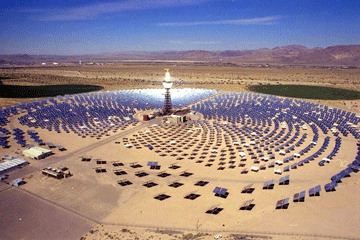 Port Augusta can show the world what just transition for workers looks like https://www.theguardian.com/commentisfree/2016/nov/21/port-augusta-can-show-the-world-what-just-transition-for-workers-looks-like Sharan Burrow
A solar thermal plant in Port Augusta is the best fit for providing both jobs and clean energy. It only needs political will to work Port Augusta, a country town of 14,000 people in South Australia, could have been a perfect example. For 68 years, coal-fired power stations and the local mines generated jobs for 400 workers and provided power for South Australia.
This is the story of a community, its power station workers and their union taking their plan for jobs and solar thermal power to state and federal government, and to global energy giants in France and the United States, demanding a just transition for the people of Port Augusta, demanding a zero carbon future for people everywhere.
The coal-fired power station was on borrowed time. Worried about air quality and environmental health, the community looked for alternative plans for energy, industry and jobs.
Five years of work – during which all options were considered – resulted in a decision that a solar thermal plant was the best fit for both a clean energy base and for skills transfer for existing energy workers.
A feasibility study and three companies interested in constructing this renewable alternative added further cause for optimism.
Even the political support appeared to line up, a promise of funding support before a national election, state government support, and a local mayor backing in his community and workers and their unions with environmental activists singing in tune.
For a moment, Port Augusta held its breath. The plan was in place. A source of energy that would allow workers to transfer from the defunct coal-fired power station. A company willing to build, the community behind it, the workers having hope for a future.
So why are they still waiting?
The missing ingredient is a shared sense of urgency to get the job done, leaving the community and governments out-manoeuvred by corporate greed.
The power station owner, Alinta, deserted its workers and the community in a shocking decision to close years ahead of public commitments. More than 250 workers are potentially stranded.
A dishonest company is nothing new; a company that takes no responsibility for the community from which they have drawn a loyal workforce that made their profits for them is sadly a global tale but where is the rescue team?
A standoff on what comes first, a contract or investment security, seems to be the villain. A standoff between layers of government with a missing procurement contract for purchasing energy from the company willing to invest in the solar thermal plant and a start-up clean tech grant.
Anti-uranium crusaders win top conservation award
Kalgoorlie Miner (print only 23rd Nov 2016)
 The David-versus-Goliath battle of two Leonora women against uranium mining has been recognised, with the pair becoming the first Aboriginal recipients of the State’s top conservation award. Shirley and Elizabeth Wonyabong received the Bessie Rischbieth Conservation Award at a Conservation Council of WA ceremony in West Perth at the weekend.
Shirley and Elizabeth had, during 46 years of resisting uranium mining proposals, displayed “outstanding qualities of courage, integrity, perseverance and commitment” in challenging government and non-government decision-makers, Conservation Council of WA executive director Piers Verstegen said. For the past six years they had been leading people through country on Walkatjura Walkabout to stop a mine being started at Yeelirrie.
Victoria to ban fracking
Victorian fracking ban legislation to be in introduced, ABC News By Stephanie Anderson, 22 Nov 16 The Victorian Government will introduce legislation today to permanently ban fracking following what the Premier described as “one of the most amazing community campaigns” in Australian history.
Fracking is used to extract so-called unconventional gases such as coal seam, tight and shale gas by pumping high-pressure water and chemicals into rock, fracturing it to release trapped gases.
There has been fears the chemicals could contaminate groundwater supplies and threaten agricultural industries.
The Victorian Government held a parliamentary inquiry into unconventional gas industries and announced earlier this year it would bring in a permanent ban.
Premier Daniel Andrews said there was a strong community campaign against fracking and unconventional gas.
“This is a triumph of one of the most amazing community campaigns that our state and indeed our nation has ever seen,” Mr Andrews said.
“Local communities have put an elegant and articulate argument, and we have responded to that.”
Fracking occurs in all other states except the Northern Territory, with the most by far in Queensland.
Government to pay compensation to licence holders…… http://www.abc.net.au/news/2016-11-22/fracking-permanently-banned-in-victoria/8045264
The saga of the South Australian nuclear waste import plan continues – Michele Madigan
 Opposition growing to SA nuclear plan https://www.eurekastreet.
com.au/article.aspx?aeid=50250#.WDIQoNJ97Gg Michele Madigan | 16 November 2016
‘We are not a dump is SA, we want to keep it beautiful’ — Umoona Community. ‘We’ve got to think about the country’ — Ceduna. The last 30 days have seen some big developments in the ongoing attempts of SA Premier Weatherill’s plan to import high-level and intermediate level radioactive waste into South Australia.
On Sunday 6 November came the surprising decision of the Premier-initiated Citizens Jury. By the end of their six day deliberations, the 350 second round jurists showed a decided shift in opinion. Their 50 page report, presented to a somewhat discomfited Premier, had a strong two thirds majority declaring the international nuclear dump was not to go ahead ‘under any circumstances’.
Contrary to expectations, my own included, the jury, realising the bias of the royal commission and other government initiated forums, had insisted on their own choice of counter experts. Continue reading
Sunday Mail survey reveals opposition to nuclear waste dump
 A poll* commissioned by the Sunday Mail reveals that only one-third of South Australians support Premier Jay Weatherill’s plan for a high-level nuclear waste dump in SA and that public support has fallen by 14 percent in the space of just two months.
Respondents were asked to pick which nuclear facilities SA should build and they were invited to choose as many options as they liked. Of the 3702 respondents, only 35% supported an international nuclear waste repository in SA.
Dr Jim Green, national nuclear campaigner with Friends of the Earth, said: “The Sunday Mail poll finds that just one-third of South Australians support Jay Weatherill’s plan to turn SA into the world’s high-level nuclear waste dump. The results are consistent with the findings of the Citizens’ Jury. One-third of the Jury members gave conditional support to the proposal while two-thirds concluded that SA should not pursue a high-level nuclear waste dump under any circumstances.”
“A September 2016 poll** commissioned by The Advertiser found 49 percent support for the nuclear dump. Thus public support has fallen sharply from 49 percent to 35 percent in the space of just two months. If support continues to fall at that rate, Jay Weatherill may be the only South Australian supporting a nuclear dump by the time of the next state election. Even Business SA chief Nigel McBride acknowledges that the dump plan is ‘dead’ yet the Premier keeps trying to revive it.
“A majority of South Australians and a majority of SA political parties oppose Weatherill’s waste dump. South Australians opposed to the nuclear dump will be spoilt for choice at the next state election with the Liberal Party, the Nick Xenophon Team and the Greens all strongly opposed to the plan.
“The Sunday Mail survey also found that only 39.8 percent of South Australians support the establishment of a national nuclear waste dump in SA. The Premier should abandon his efforts to turn around public opposition to an international high-level nuclear waste dump in SA. He should instead defend SA against Canberra’s plan to impose a national nuclear waste dump in the Flinders Ranges and support Adnyamathanha Traditional Owners who are fighting the plan,” Dr Green concluded.
Scarce and his pro nuclear Royal Commission not looking credible
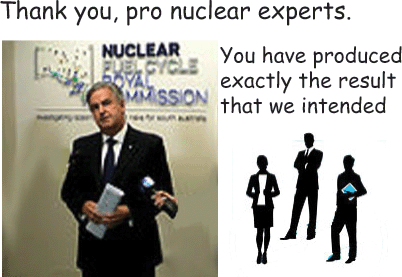 On radio this week, Scarce denied his commission had “cooked” the numbers. There was nothing wrong with contracting pro-nuke lobbyists to do the work…….
there will be more consultation. There is also a parliamentary inquiry into the issue, due to report on November 29, which sources suggest is likely to split three-all, with Labor and Family First on one side and the Greens and Liberals on the other.
And further analysis of the royal commission’s economic calculations, received by the state parliament this week, is highly critical
SA’s citizen jury defies royal commission, SA’s citizen jury, which rejected the Nuclear Fuel Cycle Royal Commission’s pro-storage stance, reveals the democratic tension when governments open decision-making to the people while seeking a predetermined outcome. Saturday Paper 19 Nov 16 MIKE SECCOMBE
The available evidence, however, suggested he was taking a lot of water. Over more than a year the former navy man and South Australian governor had steered his royal commission into the nuclear fuel cycle towards a radioactive future. Now, six months after the release of his report recommending the state become a repository for nuclear waste, it had been badly holed.
A citizens’ jury of 350 randomly selected people had looked into the findings, had heard evidence from witnesses selected for them and from their own selected witnesses and had come down by a margin of about two-to-one against any plan to store high-level nuclear waste in the state. This was a surprise to many, including some opponents of the plan who already had put a deal of work into formulating elaborate conspiracy theories and disseminating the message that the citizens’ jury was designed as a stitch-up.
If it was – and we’ll come back to the claims – then it was very badly stitched. The jury’s opposition was absolute.
“Under no circumstances should South Australia pursue opportunity to store and dispose of nuclear waste from other countries for reasons of consent, economic, trust and safety,” the report said. Continue reading
Turnbull govt – hails climate accord while rejoicing in coal industry!
 On climate change policy, neither time nor Trump are on Turnbull’s side, Guardian
Lenore Taylor, 20 Nov 16
Australia cannot hail the Paris accord as a turning point and simultaneously rejoice in a great long-term economic future for coal
“……Abbott declared Trump’s election would “put climate change into a better perspective” and diminish the “moral panic” about global warming. Presumably the better perspective is one where we don’t do very much about it, and the “morality” not worth panicking about is the idea that we should not leave our children a world experiencing dangerous and irreversible change.
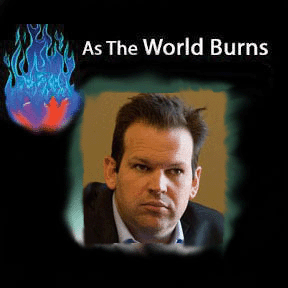 ……… the man Turnbull has now appointed as resources minister, the Liberal National party senator Matt Canavan.
From the moment he took up the portfolio, Canavan has talked up the “uncertainties” of climate science.
And soon after Trump’s election, Canavan was hailing it as a budgetary boon for Australia, in part because coal mining would be able to continue unconstrained.
“Donald Trump is good for fossil fuels, good for steel and good for Australia,” he told the Australian.“President-elect Trump was very clear in his support for the coal mining sector, whereas President Obama had taken steps to restrict expansion of the coal industry,’’ he said.
“The newly elected president has said he’ll rescind those regulations and that’s having an effect on world markets.”
But at exactly the same time, Turnbull was announcing that Australia would go ahead and ratify the Paris agreement, despite some of his own backbenchers declaring that Trump’s victory had rendered the deal “cactus”.
The Paris pact, Turnbull declared, was “a watershed and a turning point”.
Problem is, it’s only a turning point and a watershed if nations do what they promised – that is, constrain global warming to “well below 2C”, which requires them not only to meet the greenhouse emissions reductions already pledged but also to increase them over time to actually meet that aim.
And that requires the phasing out, over time, of coal.
The latest world energy outlook from the conservative International Energy Agency shows that under the scenario necessary to meet the existing Paris targets (still not enough to limit warming to 2C), fossil fuels decline from 67% of the energy mix to 24%, and 16% of that 24% is carbon capture and storage, the viability of which remains uncertain.
A Climate Analytics report has found that developed countries will have to stop burning coal for electricity by 2030, China by 2040 and the rest of the world by mid-century in order to meet commitments made in Paris.
To underline the obvious, we really cannot simultaneously hail the Paris agreement as a turning point and rejoice in a glorious long-term economic future for the coal industry. Except that is exactly what the Turnbull government is doing…….https://www.theguardian.com/australia-news/2016/nov/19/on-climate-change-policy-neither-time-nor-trump-are-on-turnbulls-side
1 This month
17 October, Free Public Talk on Nuclear Issues in South Australia
David Noonan will speak on public interest concerns over the new Roxby Downs Indenture Act 2026 on BHP copper-uranium mining and ore processing in SA, and on how AUKUS may face SA with a High-Level nuclear waste agenda.
Dr Jim Green will discuss international developments in the field of nuclear power including ‘small modular reactors’ and Generation 4 ‘advanced’ nuclear reactor concepts.


Help Aunty Sue Protect Her Land and Sacred Sites From Destructive Rocket Testing.
.

Australians deserve the truth
about
AUKUS – https://aukuspublicinquiry.com/

PETITION – To: Prime Minister Anthony Albanese and the Australian Labor Government

of the week – Australians for War Powers Reform (AWPR)
To see nuclear-related stories in greater depth and intensity

