‘reckless’ and ‘indefensible’ Carmichael coal mine approved by Queensland govt
 Queensland fast tracks ‘reckless’ and ‘indefensible’ Carmichael coal mine, Independent Australia Renew Economy 11 October 2016 Minus financial backing, reneging on the Paris Agreement and even ignoring Adani’s own loss of interest in the project, the Queensland Government is fast tracking the Carmichael coal mine, writesRenewEconomy‘s Sophie Vorrath.
IN A MOVE that has been labelled “indefensible” and “reckless” by green groups, the Queensland Government has declared the massive Carmichael coal mine and port proposed for the State’s Galilee Basin as “critical infrastructure”, in an effort to fast-track its development.
State development minister Anthony Lynhamsaid on Monday that the Labor PalaszczukGovernment had invoked special powers to help progress Adani’s $21 billion project, reinstating and expanding its “prescribed project” status to include its water infrastructure…….
while governments of all colours appear to be rolling out the red carpet for the coal project, there are other hurdles it has yet to clear – not least of all economic ones – as coal looks more and more like a high-risk investment.
As John Quiggan wrote last month, a long list of banks and other funding sources have announced they won’t touch the project, or have pulled out of existing finance arrangements.
The list includes the Commonwealth Bank of Australia (formerly a big lender to Adani), NAB, the Queensland Treasury and global banks including Standard Chartered (another former big lender), Citigroup, JP Morgan Chase, Goldman Sachs, Deutsche Bank, Royal Bank of Scotland, HSBC and Barclays, as well as BNP Paribas, Credit Agricole and Societe Generale. The U.S. and Korean Export-Import banks and the State Bank of India have been touted as possible sources, but appear to have backed away.
Even Adani Group, the Indian conglomerate behind the project, has appeared to lose interest in its coal plans. And just this week, the energy minister for India – the main market for the coal that would be dug up at Carmichael – called on the country’s power generators to cease coal imports if the nation was to come good on its “One Nation, One Grid, One Price” energy goal…..https://independentaustralia.net/politics/politics-display/queensland-fast-tracks-reckless-and-indefensible-carmichael-coal-mine,9578
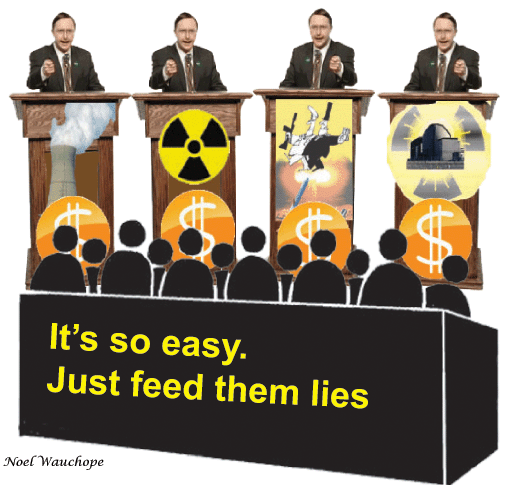
Will South Australia’s Nuclear Citizens’ jury be fed lies and half-truths?
 Nuclear waste storage plan prompts more citizens’ jury debate in South Australia, ABC 7
Oct 16, Greens leader Mark Parnell is worried members of the South Australian Government’s citizens’ jury are not getting all the facts as they consider whether the state should pursue a nuclear future.
The Government is considering a royal commission’s recommendation that SA store high-to-intermediate-grade nuclear waste, most likely in the outback.
A citizens’ jury of more than 300 people is meeting in Adelaide this weekend to hear a range of expert views, the second such process after a first jury pondered the business case at a weekend forum back in July.
Mr Parnell said he was worried the citizens were not getting the best information, especially as the Government pointed out other countries with nuclear waste storage facilities.
“The Government seems keen on promoting this idea that Finland have got all the answers,” he said. “The Finland facility isn’t finished, it’s been 30 years in the making, it’s at least six or eight years away from taking any nuclear waste.
“What’s proposed for South Australia is 20 times bigger.”……..
SA senator Nick Xenophon said citizens’ juries might have a role, but could not replace taking the nuclear issue to the wider community.
“The ultimate citizens’ jury to decide an issue so big, so momentous for SA has to be 1.2 million South Australian voters at a referendum,” he said…….
[Mark Parnell said] “I’m worried that the [current] parliamentary committee won’t have finished its work, and the most important bit of work that is needed I think is a second and third economic opinion.”………http://www.abc.net.au/news/2016-10-08/nuclear-waste-storage-south-australia-citizens-jury-debate/7915292
Turnbull government has misused clean energy funds
 Unlawful reallocation of clean energy investment by the Coalition, Independent Australia, 8 October 2016, John Ward discusses the Turnbull Government’s misuse of Clean Energy Finance Corporation funds.
THERE IS NOW clear evidence of misleading and deceptive conduct by members of the Coalition Government.
This crookedness needs to be exposed.
The sectional interests of our government ministers’ corporate donors are taking precedence over the national interest and the sustainability of financing for the renewable energy industry.
In 2015, then treasurer Joe Hockey and finance minister Mathias Cormann directed theClean Energy Finance Corporation (CEFC) to exclude investments in household and small-scale solar from the $10 billion fund in the future. The draft investment mandate called for ‘mature and established clean energy technologies … including wind technology and household small-scale solar’ to be excluded from the Corporation’s activities.
Interestingly, the authority to make such changes can only come from the Parliament, not the executive. The Executive Council cannot change an act of parliament. The Parliament also authorises the government to spend public money — not the other way around.
Any change, such as the revocation of a part and/or a new investment mandate to the Clean Energy Finance Corporation Act 2012, may only be modified by amendments made, requested or agreed to by the senate. Stephen Keim SC has provided advice to environmental groups about the government’s ability to direct the CEFC. He said the government had the power to put in place an investment mandate but it had to “tread a fairly thin line”.
During 1998, American Petroleum Institute (API), the USA’s largest oil trade association (member companies include BP, Chevron, Conoco Phillips, Exxon-Mobil and Shell) planned a “roadmap” for a climate of deception, including a plan to have “average citizens” believe that the realities of climate science were vague and uncertain.
Australians have been subject to fraudulent and misleading representations regarding climate change over the past ten years by the people we elected.
The direct effect of the CEFC responsible ministers acting as de facto or shadow directors of the CEFC has been to create the perception that Australian policy support for clean energy is uncertain or diminished.
These are the same negative outcomes envisaged by the American Petroleum Institute’s (API) 1998 campaign.
A third entity involved in this deception is lobby group the Institute of Public Affairs (IPA). The IPA was founded by a conglomerate of like-minded groups at the same time as the Liberal Party formed in 1943-44, after the break-up of the United Australia Party. The policy agenda of the Institute of Public Affairs (IPA) has been linked directly to Coalition policy ever since…….
Prime Minister Turnbull, Deputy Prime Minister Joyce, Former Prime Minister Abbott, Ministers Pyne, Hockey, Cormann and Hunt are attempting to falsely convince the public that the Cabinet can re-purpose and re-direct legislation without going back through the Parliament. These changes to the CEFC Act 2012 are still to be legislated. ……..
Let’s consider the limits the Clean Energy Finance Corporation Act 2012 imposes on the responsible ministers’ mandate.
Section 65 states:
The responsible Ministers must not give a direction under subsection 64(1):
(a) that has the purpose, or has or is likely to have the effect, of directly or indirectly requiring the Board to, or not to, make a particular investment; or
(b) that is inconsistent with this Act (including the object of this Act).
The object of Act is to facilitate increased flows of finance into the clean energy sector.
Joe Hockey and Mathias Cormann attempted to skirt around the law. If this gross ideological interference had not happened, the growth and jobs in the clean energy industry might have delivered some real balance to the downturns in other parts of the economy.
The Coalition Government is in contempt of Parliament. Its ministers have betrayed our trust. The Caolition and the IPA are still using the same script and still following the API’s line of climate deception.
There are strong connections between the API and the IPA’s disinformation and the Coalition’s campaign aims.
The links are there. The wrongs have been done. Let’s promote public debate on this matter. https://independentaustralia.net/politics/politics-display/unlawful-reallocation-of-clean-energy-investment-by-the-coalition,9567#.V_loHsmJvtk.twitter
National electricity review headed by a nuclear power enthusiast, Alan Finkel
 Don’t forget: Alan Finkel is a nuclear power enthusiast, and the Grattan Institute is largely funded by BHP. This all sounds good, but be wary. “ The Chief Scientist will, amongst other things, bring to the review his knowledge of current and likely future developments in energy technologies.”
Climate change must be part of Australia’s electricity system review, The Conversation Program Director, Energy, Grattan Institute,October 8, 2016 On Friday, Australia’s federal and state energy ministers met for an extraordinary meeting following the complete loss of power in South Australia on September 28. The COAG Energy Council announced a wide-ranging independent review to provide advice to governments on a coordinated, national reform blueprint. The review will be chaired by Australia’s Chief Scientist, Dr Alan Finkel.
Dr Finkel has been challenged with steering Australia’s energy system around some big potholes while keeping his eye on the horizon. And all in about six months.
The review will consider work already being done around maintaining the security, reliability and affordability of electricity as delivered by the National Electricity market (NEM) (which covers all states except Western Australia and the Northern Territory)…..
The review is expected to deliver a blueprint via a final report early in the new year. It is likely to include specific actions, both physical and financial, that respond to recent events such as South Australia’s price shock in July and blackout in September. …….
The council has highlighted the significant transition underway in the Australian electricity market. The drivers include “rapid technological change, the increasing penetration of renewable energy, a more decentralised generation system, withdrawal of traditional baseload generation and changing consumer demand”. The blueprint will address all of these issues in a comprehensive and coordinated way not previously a feature of the council’s output.
There is much uncertainty to how some of these drivers will evolve over the next two decades. To be really effective, the blueprint will need to consider a range of plausible long-term scenarios but focus on near-term options that can be adapted to evolving developments on all fronts.
The Chief Scientist will, amongst other things, bring to the review his knowledge of current and likely future developments in energy technologies. This will be important in considering policy, legislative and rule changes that favour the adoption of technologies that could address both low-emissions and reliability but are otherwise technology-neutral……..https://theconversation.com/climate-change-must-be-part-of-australias-electricity-system-review-66684
In Western Australia, retirees trading solar power
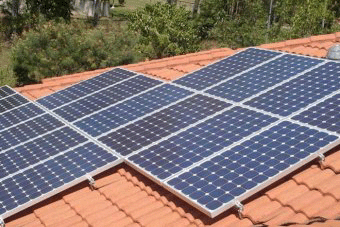 Trading solar power: Retirees test way to beat shrinking feed-in tariffs http://www.abc.net.au/news/2016-10-08/trading-solar-power:-retirees-‘plan-for-the-future’/7914736?section=environment By Kathryn Diss Retirees in the West Australian town of Busselton are trialling a new system which allows them to sell excess energy they have generated from their solar panels direct to their neighbours.
The system bypasses the state’s energy utility Synergy, saving consumers money and increasing returns for solar adopters. Continue reading
More safety problems in canisters for storing nuclear wastes
Premature failure of U.S. spent nuclear fuel storage canisters, San Onofre Safety.org, “……Stainless Steel Dry Canister Problems Darrell Dunn, an NRC materials engineer, stated stainless steel dry storage canisters are vulnerable to failure within about 25 – 42 years. If any of the fuel cladding in the canister fails, there is no protective barrier and we could have a serious radiation release.
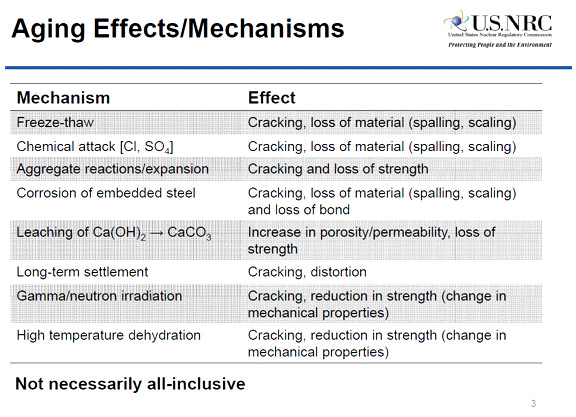
The NRC said they have no current mitigation plan for that consequence. They suggested we MIGHT be able to put the fuel back in the spent fuel pool. However, Edison plans to destroy the spent fuel and transfer pools. And there is no technology to repair the canisters. The NRC said they HOPE there will be a solution for mitigation in the future. Even an NRC May 2nd High Burnup Fuel letter admits there are mitigation problems.
No Inspections of Stainless Steel Canisters EPRI 2012 presentation To make matters worse, these stainless steel canisters are not inspected after they are loaded into the unsealed concrete overpacks (Areva NUHOMS) or concrete casks (Holtec and NAC Magnastor). The NRC proposed having each nuclear plant inspect the outside of only ONE stainless steel canister before they receive a license renewal and then do that once every 5 years. The industry balked at having to even check one canister at every plant. The problem with the stainless steel canisters is they do not protect against gamma rays; so it’s not a simple task to remove a canister from the concrete overpack/cask to examine the exterior for corrosion or other degradation. And since welded canisters do not have monitoring for helium leaks, we may not have any warning of an impending radiation release.
Concrete Overpack Corrosion Problems Darrell Dunn discussed serious corrosion problems with the concrete overpacks/casks, especially in coastal environments…….. https://sanonofresafety.org/2014/08/21/premature-failure-of-u-s-spent-nuclear-fuel-storage-canisters/

Aboriginal Treaty movement gets boost from Yolngu man Yingiya Mark Guyula’s elecion victory
 We Need To Talk Much Less About Andrew Bolt And Much More About Treaty Liam McLoughlin @situtheatre
https://newmatilda.com/2016/10/08/we-need-to-talk-much-less-about-andrew-bolt-and-much-more-about-treaty/
“A Yolngu man’s extraordinary win at the Northern Territory election is a significant milestone for the Treaty movement.
Yet all the media can talk about is the ‘Indigenous’ Andrew Bolt.
“In recent weeks it was declared that Yolngu man Yingiya Mark Guyula had won a stunning victory
over Labor’s Lynne Walker at the Northern Territory election, running proudly on a Treaty platform. …
“Held by the ALP since 1980, the seat was categorised as “Very Safe Labor” with a margin of 13.7 per cent.
While Labor’s Lynne Walker won the majority non-Indigenous mining town of Nhulunbuy,
Guyula won the vote in every single Yolngu community and was declared the overall winner by eight votes. … “
Citizens’ Jury members not allowed to change the wording of their set question.
 9 Oct 16 Tim Bickmore Some of the Jury Members requested that the form of the question be changed to adjust the term ‘circumstances’ into better context ie the question should be along the lines of …. whether or not to pursue the HLW dump, & if so, under what circumstances…..
They were informed that there would be no change to the question. This calls into question any claims that the Jury is in Charge of the process.
The set question is “Under what circumstances, if any, could South Australia pursue the opportunity to store and dispose of nuclear waste from other countries?”
Monitoring South Australia’s Nuclear Citizens’ Jury
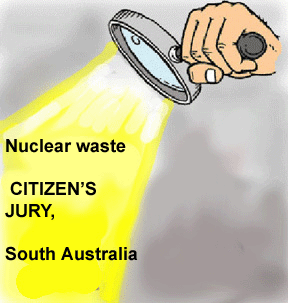 I have not been watching today’s Citizens’ Jury Two Livestreaming and Video. However, these sessions are available for viewing. I saw at the agenda – See the agenda here – that the gathering was to be opened by Premier Jay Weatherill, and Kevin Scarce, former chief of the Nuclear Fuel Chain Royal Commission.
Unlike may other critics of the nuclear industry, I have some faith in the process. I did think that DemocracyCo ran the first Citizens’ Jury meetings well, and the jury members asked intelligent questions. The problems were:
- The whole premise was not really a jury situation in any sense. The jury were told that they were not to make a decision (the essential brief of any real jury). They were told to produce a ‘Summary of the Nuclear Fuel cycle Royal Commission’s Report.
- The witnesses were not always well informed, and some were both ignorant and biased. They were chosen at an early stage by the jury members, who clearly did not then have access to impartial and well informed experts.
- Members of the Nuclear Fuel Chain Royal Commission were far too prominently present and vocal. Greg War and Chad Jacobi made sure to dazzle all with their pro nuclear knowledge, whenever it looked as if criticism of the nuclear industry was coming up.
This new Citizens’ Jury has been given a loaded question to consider:
“Under what circumstances, if any, could South Australia pursue the opportunity to store and dispose of nuclear waste from other countries?”
So – much as I admire DemocracyCo’s the group management efforts, and real attempts at fairness, I am not optimistic about the outcome of this Citizens’ Jury 2. I think it will boil down to another delaying tactic by the Weatherill government, to keep the State guessing – while behind the scenes, the nuclear lobby gets on with its preparations for nuclear waste importing to south Australia.
Liberal Senator Eric Abetz’s remarkable faith in nuclear power
South Australian blackout: Eric Abetz says door should remain open on nuclear power, ABC AM By Richard Baines , 8 Oct 16 Australia should revisit the possibility of more nuclear power after South Australia’s blackout, senior Liberal Eric Abetz says…….Senator Abetz said one potential power source was being overlooked.
“We should be opening the door to considering nuclear power,” he said…….
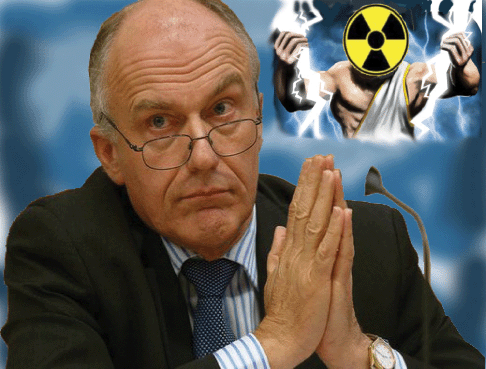
Storage no longer an issue: Abetz A major problem has always been public concerns about storing nuclear waste. Senator Abetz said global technology had evolved, and it was safe to store the waste.
“The waste product would be at a minimum, and what’s more we’ve got the stability of a land mass which is geologically stable, is secure, and would enable us to secure it quite safely,” he said……..
Senator Abetz said the recent problems in South Australia proved a different approach to energy supply was needed.
“With great respect to solar power and wind power, they cannot and will not provide secure base load and that has now been shown in South Australia in a manner that is devastating,” he said……..http://www.abc.net.au/news/2016-10-08/eric-abetz-wants-door-open-on-nuclear-power-after-blackout/7914624
Renewable energy transition is the future, whether Turnbull likes it or not
 The electricity storage revolution now underway is charcterised by increasing storage capacity and continuously falling battery prices. Two outcomes of this storage revolution are that it will:
- have the effect of making renewable energy available 24/7 and cheaper than electricity produced by coal fired power stations. The latter will cease to operate as they are replaced at an accelerating rate by solar and wind generation, and
- enable improved grid management, permitting electricity generators to buy and sell energy at optimum prices with price determined by demand, rather than supply.
 Whether the Turnbull government likes it or not, these developments are already underway. They are bringing about change in the cost of and way in which electricity is produced, stored and used. These developments make it possible for the government to solve the budget problem it faces – by progressively withdrawing the subsidies it currently pays fossil fuel producers and applying them to budget deficit reduction.
Coal is on a one-way trip to oblivion as an energy source, whether subsidized or not.
The need for renewable electricity http://www.onlineopinion.com.au/view.asp?article=18569 By Mike Pope –, 7 October 2016 In response to the September State-wide loss of electricity in South Australia (SA), the Australian Prime Minister (Malcolm Turnbull) and Environment Minister (Josh Frydenberg) both blamed that event on a severe climate event. Both attempted to conflate the loss of power with the rate SA had adopted renewable energy (40%), particularly generated by wind, resulting in closure of all coal-fired power stations in that State.
They asserted this left SA with inadequate back-up for its overly rapid adoption of renewable energy and that the outage should be seen as a salutary wake up call for retention of fossil fuelled electricity generation. Mr. Turnbull went further, declaring that the SA power failure demonstrated the need to retain use of coal as an energy source, pointing to the importance of coal mining, employing 10,000 people and earning the country important income.
He went on to criticize the renewable energy targets of Queensland (50% by 2030) and Victoria (40% by 2025), describing both as ideologically driven and incapable of being achieved without risking the loss of energy experienced by SA. He described State targets as grossly in excess of Commonwealth emissions targets of 26-28% by 2030. He had asked his Environment Minister to negotiate with all States to ensure that their targets were consistent with achieving the Commonwealth Renewable Energy Target (RET) of 23% by 2020.
For the Turnbull Government there are 3 problems: (1) Unless Queensland and Victoria meet their targets, the Commonwealth RET is unlikely to be achieved. (2) Climate conditions in Australia, particularly the southern half, are likely to become more extreme, more often. (3) Commonwealth emissions target (26%-28% below 2005 emissions by 2030) may not be achieved or provide a fair, effective, contribution to achieving an average global temperature of no more than 1.5°C above the pre-industrial average by 2100. These things matter. Continue reading
Uranium mining companies desperate to survive, but no improved market in sight
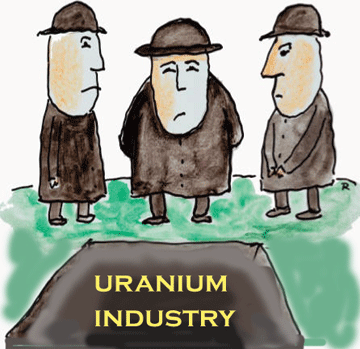 Desperate uranium miners switch to survival mode despite nuclear rebound, Reuters, 7 OCT 16 LONDON “……..BULGING INVENTORIES Mining executives partly blame the slump on their customers’ wait-and-see attitude, as utilities believe that the uranium market’s over-capacity will persist for years and see no need to rebuild their dwindling stockpiles.
Demand for uranium is determined by the number of nuclear plants in operation worldwide, but supply and demand are disjointed by huge stocks and uranium’s long production cycle……..
In the five years before Fukushima, utilities worldwide bought about 200 million pounds of uranium per year, he said. Although Japan’s consumption averaged only around 25 million pounds per year, when it closed its reactors demand was cut far further, falling by half. European and U.S. utilities saw that the market was over-supplied and reduced inventories, buying less.
Mining firm Energy Fuels estimates global uranium stocks held by utilities, miners and governments are now at around 1 billion pounds. That is down from a peak around 2.5 billion pounds in 1990, but still many years’ worth of consumption.
Despite the plunge in uranium prices after the 2008 financial crisis and again after Fukushima, uranium production has doubled from 80-90 million pounds in the mid-1990s to about 160 million pounds last year, according to Energy Fuels data……
DESPERATE TIMES
With so much new supply, and demand sliding, prices have fallen to a level where most uranium miners operate at a loss.
“At today’s spot prices, the primary uranium mining industry is not sustainable,” US uranium producer Energy Fuels COO Mark Chalmers told the World Nuclear Association’s London conference last month.
He added that many legacy long-term supply contracts will expire in 2017-18, which will force many mines to close or throttle back even further than they already have.
Miners like Canada’s Cameco, France’s Areva and the uranium arms of global mining companies have closed or mothballed several mines and deferred new projects in order to cut back supply.
Paladin – the world’s second-largest independent pure-play uranium miner after Cameco and the seventh or eighth-largest globally – has production capacity of 8 million pounds of yellowcake uranium but produced just 4.9 million pounds last year at its Langer Heinrich mine in Namibia.
Molyneux said the firm will produce about 4 million pounds this year and will cut output further to about 3.5 million pounds next year if prices do not recover.
Paladin suspended production at its 2.3 million pounds per year capacity Kayelekera mine in northern Malawi in 2014 but maintains equipment so it can resume when prices recover.
Meanwhile it is trying to further reduce its debt, which already fell from $1.2 billion five years ago to $362 million.
Paladin has agreed to sell 24 pct of Langer Heinrich to the China National Nuclear Company and plans to use the expected proceeds of 175 million dollars to further reduce debt.
Bigger peer Cameco in April suspended production at its Rabbit Lake, Canada mine while also curtailing output across its U.S. operations, saying market conditions could not support the operating and capital costs needed to sustain production.
Cameco marketing head Tim Gabruch told the WNA conference that “desperate times call for desperate measures”.
Supply adjustments and producer discipline had not yet been sufficient to counter the loss of demand, he said.”As difficult as those decisions have been, we recognize that those actions may not be enough.”(Reporting by Geert De Clercq; editing by Peter Graff) http://www.reuters.com/article/us-uranium-nuclearpower-idUSKCN1230EF
Virtual reality film “Collisions” tells one Aboriginal man’s story of Maralinga nuclear bombing
Aboriginal man’s story of Maralinga nuclear bomb survival told with virtual reality By Alex Mann ABC News, 7 Oct 16 In an unlikely collision of cultures, state-of-the-art 3D film technology is bringing an Aboriginal man’s unique tale of nuclear bomb survival to audiences across Australia.
In the 1950s Nyarri Morgan was a young man, walking and hunting in South Australia’s northern deserts. His dramatic first contact with whites came when he witnessed a nuclear bomb explosion at the British testing site at Maralinga.
Now, as an old man, and with the help of director Lynette Wallworth and some technology, he is sharing his story in a film called Collisions that is screening in selected venues around Australia.
“It happened in a desert where people assumed there were very few people [and] there was not much life and not much to be lost,” Wallworth said.
“Every one of those assumptions was wrong.”
‘People still have that poison today’ As the radioactive dust fell, Mr Morgan walked an ancient trade route at the edge of the test site. He had no idea of what he was witnessing.
In making the film, Wallworth asked Mr Morgan what he thought he was seeing. “He said, ‘We thought it was the spirit of our gods rising up to speak with us’,” she said. “[He said] ‘then we saw the spirit had made all the kangaroos fall down on the ground as a gift to us of easy hunting so we took those kangaroos and we ate them and people were sick and then the spirit left’.”
Mr Morgan is sharing his story, in his words, so it won’t ever be forgotten. “After the explosion the fallout went north,” Mr Morgan said. “Powder, white powder killed a lot of kangaroos [and] spinifex [grass]. Water was on fire, that’s what we saw.”
Mr Morgan said water “died” but that he and the two men he was with drank the water, even though it was still hot. “The smoke went into our noses, and other people still have that poison today,” he said.
“We all poisoned, in the heart, in the blood and other people that were much closer they didn’t live very long, they died, a whole lot of them.” ‘In virtual reality everything becomes personal’………..http://www.abc.net.au/news/2016-10-07/aboriginal-mans-story-of-nuclear-bomb-survival-told-in-vr/7913874
Legal challenge to Adani’s Abbot Point plans in Queensland’s Supreme Court
Adani’s Abbot Point plans face court challenge,SMH , 7 Oct 16 Whitsunday residents are bound for court in a bid to show the Queensland government failed the environment when it approved a port expansion for Adani’s new mega-coal mine.
Whitsunday Residents Against Dumping say dredging required for Adani’s expansion of the Abbot Point coal terminal, north of Bowen, could do untold environmental harm and the mine itself will fuel global warming and endanger the reef.
Lawyers for the group will appear in the Supreme Court in Brisbane on Friday, arguing Queensland’s environment department failed to properly assess the port project before it gave Adani the go ahead.
The expansion is needed to ship coal from Adani’s planned $16 billion Carmichael mine in the Galilee Basin…….
The action group’s case will be heart in the Supreme Court in Brisbane from 10am (AEST). http://www.smh.com.au/business/mining-and-resources/adanis-abbot-point-plans-face-court-challenge-20161007-grx2s3.html
8 – 9 October – Nuclear Citizens Jury 2, Adelaide: LOOK OUT FOR THE WITNESS LIST
I say “Look out for the witness list, because for citizens’ jury 1, the big weakness was in 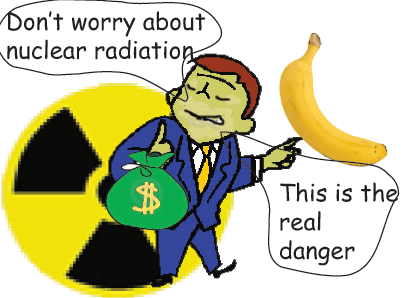 the witnesses – some of whom were clearly ignorant and biaseed. This was particularly apparent in the appalling way they covered (up) the question of ionising radiation and health.
October 8th and 9th Citizens’ Jury Two Livestreaming and Video
See the agenda here. Note these two important sections on Sunday 9th:
3.45pm Working afternoon tea – witness selection
4.15pm Defining the witness list
Citizens’ Jury Two will be held over two weekends in October and one weekend in November. The original 50 members of Citizens’ Jury One will be supplemented by an additional 300 South Australians to answer the question: Under what circumstances, if any, could South Australia pursue the opportunity to store and dispose of nuclear waste from other countries?
The Jury will deliberate on the question using both the Nuclear Fuel Cycle Royal Commission Report and first Citizens’ Jury report, with feedback from the community consultation and expert witnesses also used as important inputs.
The unedited and unchanged jury report will be presented to the Premier and tabled in the South Australian Parliament. The report will play a vital role in informing the State Government’s response to the Royal Commission’s Report later this year.
Dates for Citizens’ Jury Two are 8/9 October, 29/30 October, 5/6 November 2016.
1 This month
17 October, Free Public Talk on Nuclear Issues in South Australia
David Noonan will speak on public interest concerns over the new Roxby Downs Indenture Act 2026 on BHP copper-uranium mining and ore processing in SA, and on how AUKUS may face SA with a High-Level nuclear waste agenda.
Dr Jim Green will discuss international developments in the field of nuclear power including ‘small modular reactors’ and Generation 4 ‘advanced’ nuclear reactor concepts.


Help Aunty Sue Protect Her Land and Sacred Sites From Destructive Rocket Testing.
.

Australians deserve the truth
about
AUKUS – https://aukuspublicinquiry.com/

PETITION – To: Prime Minister Anthony Albanese and the Australian Labor Government

of the week – Australians for War Powers Reform (AWPR)
To see nuclear-related stories in greater depth and intensity

