Questions about Senator Sean Edwards’ nuclear waste proposal
 Nuclear Fuel Cycle Watch, Andrew Allison July 21 Rumour has it that once of the anonymous countries that Sean Edwards will not name is South Korea. One might speculate about where the money for Sean Edwards’ very glossy submission to the NFCRC came from? ….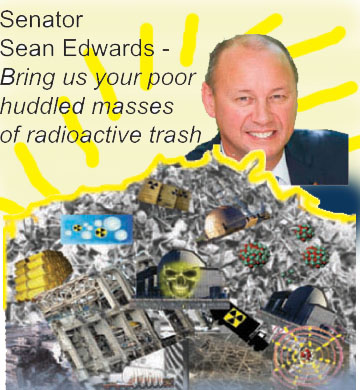
I have many reservations about Sean Edwards’ proposal, but two obvious questions come to mind:
1/ If the deep-underground storage of nuclear waste is a “solved” problem and South Australia can supposedly acquire and implement the technology at low cost (leading to high profits…) then why can’t South Korea do that?
2/ If the generation IV reactors are going to solve the waste storage problem then why can’t an advanced technological country like South Korea do that? https://www.facebook.com/groups/1021186047913052/
Nick XenophonTeam backs 40pc renewables
Xenophon party backs renewables but wants Senate electricity inquiry The Australian July 25, 2016
NXT federal MP Rebekha Sharkie, who won the Adelaide Hills seat of Mayo from Liberal Jamie Briggs, said the party was committed to the renewables target, but NXT wanted a Senate inquiry into electricity prices “so we can get the arguments on the table and look to a solution”.
Ms Sharkie believed a second interconnector between South Australia and the eastern states could help the situation, though it had been discussed for 15 years without action…….http://www.theaustralian.com.au/news/nation/xenophon-party-backs-renewables-but-wants-senate-electricity-inquiry/news-story/3a2920c0274a22994f377395acb6b5bc
Solar and battery mini grid hits the suburbs

Australian Mini-Suburb ‘Tesla Town’ Project with Powerwalls gives a glimpse into future sustainable communities, Electrek, Nathaniel Kobza, 15 July 16 Near Melbourne, Australia lies an incredible suburban project underway dubbed Yarrabend. This development is currently home to 60 houses and is planned to eventually hit around 2500. What is unique about this venture is not only the art, food or shopping that will be near it, but that all of the houses will come standard with Tesla Powerwalls and solar panels. Via the Heidelberg Leader, Nick Marinakis, sales and marketing manager of the Glenvill development team for Yarrabend, states that the suburb…
will achieve the highest possible ESD rating under the UDIA (Urban Development Institute of Australia) Envirodevelopment scheme, a first for an infill development site in Melbourne.
UDIA’s chief executive, Danni Addison, said that a big reason that this will receive the highest rating is because it will “be one of the most environmentally sustainable developments in Australia.” Further, Ms. Addison goes on to explain:
Some areas that are a standout include water reduction of 43 per cent, landfill reduced by 80 per cent and the potential to reduce energy use by 34 per cent. The Powerwalls, combined with solar panels, will mean that future residents will be able to benefit in a variety of ways, including dramatically smaller power bills and knowing that the majority of their energy usage is coming from a clean and renewable source…….http://electrek.co/2016/07/15/australian-mini-suburb-tesla-town-project-with-powerwalls-gives-a-glimpse-into-future-sustainable-communities/
The critically important work of Australia’s indigenous rangers
Indigenous rangers play a silent and undervalued role as leaders and educators in their communities, role models for how to progress in both worlds. It’s important to provide local, challenging, culturally relevant, real jobs to keep these leaders embedded within the fabric of their families and communities.
They need a commitment beyond 2018 that their real jobs will still exist.
[The video below does not apply to The Numbulwar ranger group, but still gives an example of the kind of work that they do]
Queensland Indigenous Land and Sea Ranger Program
As well as protecting the land, Indigenous rangers play an undervalued role as leaders in their communities. It’s never been more important to protect these jobs. Many conservative politicians and commentators argue Indigenous ranger jobs are not “real jobs”. This is perfectly illustrated by the recentleaking to Crikey of a secret federal Coalition government plan to radically change this successful Indigenous ranger program in order to “get participants into employment”. While the minister for Indigenous affairs, Nigel Scullion has denied he is planning an overhaul of the program, his government has not made a commitment to fund the program beyond 2018.
This question of whether ranger jobs are “real jobs” can easily be put to rest.
The Numbulwar ranger group in Arnhem Land was re-established in November 2015, Continue reading
Will Australia’s new Resources Minister Matt Canavan really listen to Aboriginal people?
 Matt Canavan has now the opportunity to correct these mistakes and engage in a truly inclusive and transparent process which actually listens to the concerns of the community and other stakeholders. Although a nuclear proponent, he should ensure that this process is not dealt with light-heartedly and pays attention to all aspects involved.
This would best be achieved through an independent inquiry into Australia’s nuclear waste and options for managing it.
Aboriginal communities all across Australia have sustainably managed the land for thousands of years, longer than any other group of people can claim. Their knowledge and concerns are valuable. Let’s hope they will be listened to.
3rd Minister in two years to handle Australia’s nuclear waste dump http://www.onlineopinion.com.au/view.asp?article=18394&page=0 Anica Niepraschk – , 22 July 2016 The recent federal election has once more seen a bit of a reshuffle in PM Turnbull’s cabinet and thereby thrown the portfolio for Australia’s national radioactive waste dump in the hands of another Minister for the third time in less than two years.
After 20 years of failed siting processes for the proposed dump, then Industry and Science Minister Ian MacFarlane only announced a new attempt in November 2014. The first half of last year saw a voluntary nomination process happen where landowners across Australia could propose their property to host Australia’s low and intermediate level nuclear waste. Out of the 28 sites nominated, six were shortlisted for further consultation and investigation last November. All six site nominations were highly contested by the local communities.
Although the government, with its new ‘voluntary’ approach promised to not impose a nuclear waste dump on any community and therefore rely on voluntary nominations and community consultation, one of these six sites, Wallerbidina/ Barndioota in the Flinders Ranges, SA, made it to the next stage of the process, despite the strong opposition of the local Adnyamathanha community at Yappala station, just kilometres away from the site.
Not only chose the government to once again, after pursuing Coober Pedy from 1998 to 2004 and Muckaty in the NT from 2005 to 2014, to target an Aboginial community but it also chose a culturally highly significant site. The proposed property, nominated by former Liberal Senator Grant Chapman, is part of a songline and hosts many cultural sites, including the beautiful Hookina springs, a sacred women’s site for the Adnyamathanha. The local community remains actively connected to the maintenance and preservation of the land and is documenting and preserving their culture and history through recording traditional heritage sites and artefacts and mapping storylines in the area. Continue reading
South Australia: Resuscitating a Nuclear Waste Nightmare
The project to bury the world’s nuclear poison in the heart of the Australian desert has not sprung out of a void. It is an idea that has been insidiously festering for two decades in a variety of incarnations.
The first stirrings of the hellish project to turn Australia into the world’s nuclear dumping ground emerged in the late 1990s when Pangea Resources, a U.K. based company promoted the construction of a commercially-operated international waste repository in Western Australia. The project was supported by a $40 million budget, 80% of which came from British Nuclear Fuels Limited (wholly owned by the U.K. government), with the remaining 20% from two nuclear waste management companies.
Australia’s Overflowing Nuclear Waste Dumps
One of the more disturbing elements of the Royal Commission report is its explicit endorsement of the progressive nuclearisation of the planet over the course of the next century. But given the make-up of the Royal Commission, this comes as no surprise.
Poison In The Heart: The Nuclear Wasting Of South Australia Counter Currents by Vincent Di Stefano — July 22, 2016 “……..It is a curious thing to observe the confidence with which the recent Nuclear Fuel Cycle Royal Commission has embraced the promotion of South Australia as the ideal destination for over one third of the world’s accumulated stores of spent nuclear fuel. This spent fuel, together with the 400,000 cubic metres of intermediate-level nuclear waste that the Royal Commission recommends be transported to South Australia, represents a problem that nations with decades-long histories of nuclear energy production have failed to resolve. The entrancement induced by a whiff of billions of dollars of new revenue presently has a closed circle of nuclear advocates and politicians straining to persuade the people of South Australia to obligingly make their way as latter-day lemmings towards a dangerous and uncharted nuclear abyss.
In the short term, the Commission calls for the transportation of vast tonnages of highly radioactive materials from around the planet for decades-long storage in above-ground facilities. In the longer term, it proposes the construction of a deep underground repository for the “permanent” burial of the most dangerous wastes produced by a destructive and senescent civilisation. Continue reading
Australian uranium miner Paladin questioned by Australian Securities Exchange
 Paladin cops ASX query over deals The West Australian on July 22, 2016, Paladin Energy has been forced to halt trading of its shares after a query from the Australian Securities Exchange demanding more information about $US200 million worth of deals flagged to the market yesterday.
Paladin did not outline the additional information requested by the ASX, but yesterday’s announcement was notable in that it did not give the name of the party offering to pay $US175 million for 24 per cent of its Langer Heinrich uranium mine in Namibia.
Paladin said yesterday the agreement was non-binding and that “key terms of this proposed transaction remain confidential, including the identity of the counterparty”.
Paladin promised yesterday to disclose details as the deal firmed up, including the identity of the buyer.
But the ASX has been on the warpath over non-disclosure of counterparties to major funding deals since the Padbury Mining scandal in 2014, when shares in the market tiddler surged after it said funding had been “secured” from an unnamed party that would supposedly deliver $US6.5 billion to build the Oakajee port and rail project…….Paladin shares closed down 3.5¢ to 20.5¢ on the announcement yesterday. https://au.news.yahoo.com/thewest/wa/a/32125776/paladin-cops-asx-query-over-deals/#page1
Complete ecosystem collapse in sections of Great Barrier Reef
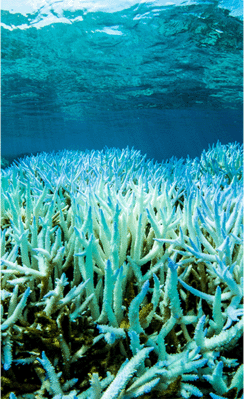 Sections of Great Barrier Reef suffering from ‘complete ecosystem collapse’
Coral Watch investigator reports ‘shocking’ lack of fish and says the surviving corals are continuing to bleach, even during winter, Guardian, Michael Slezak, 22 July 16, “Complete ecosystem collapse” is being seen on parts of the Great Barrier Reef, as fish numbers tumble and surviving corals continue to bleach into winter, according to a scientist returning from one of the worst-hit areas.
“The lack of fish was the most shocking thing,” said Justin Marshall, of the University of Queensland and the chief investigator of citizen science program Coral Watch. “In broad terms, I was seeing a lot less than 50% of what was there [before the bleaching]. Some species I wasn’t seeing at all.”
Marshall spent a week this month conducting surveys on the reefs around Lizard Island………overall, Marshall estimate that more than 90% of the branching corals had died around Lizard Island. He said many of the huge porites corals, which could be a thousand years old, had died.
Coral and other organisms like anemones and giant clams bleach when water temperatures are too high for too long. When they become stressed, they expel their colourful symbiotic algae that provide them with energy, becoming pale or white. Unless the water temperatures quickly return to normal, many of those organisms die.
Lizard Island was particularly badly hit by the global bleaching event that hit every major reef region in the world and killed almost a quarter of the coral on the Great Barrier Reef. But, in the northern section of the Great Barrier Reef, between Lizard Island and the Torres Strait, a majority of the coral is thought to have died.
The mass bleaching this year was driven by climate change, which raised water temperatures close to the maximum threshold coral could stand, and a strong El Niño that bumped the temperatures above that threshold. https://www.theguardian.com/environment/2016/jul/21/sections-of-great-barrier-reef-suffering-from-complete-ecosystem-collapse
Investments in wind have brought costs down- THE AUSTRALIAN got it SO wrong!
 How The Australian got it hopelessly wrong on wind energy The Australian got its facts wrong on wind energy in South Australia. Investments in wind have brought costs down. Giles Parkinson Crikey, 22 July 16 The Murdoch media attack on the Australia wind industry knows no bounds, and not many facts either.
This week’s front-page “exclusive” in The Australian suggests South Australia’s wind turbines were producing significant amounts of “negative power” from the grid at the height of the recent electricity “crisis”. But the numbers it quotes are ridiculously wrong.
The story, by Adelaide bureau chief Michael Owen, suggests the state’s wind turbines were “producing about 5780MW” between 6am and 7am, but by mid afternoon were producing “negative 50MW”. Asanalysis from Ron Brakels observes, the report confuses energy terminology, apparently not knowing the difference between capacity and output.
In fact, the state’s wind turbines cannot produce 5780MW — they only have a combined capacity of 1600MW. There’s not even 5780MW of wind capacity in the whole country……
As SA Energy Minister Tom Koutsantonis told the ABC, that’s precisely why the government encouraged investments in wind and solar: to bring costs down. That has largely succeeded. https://www.crikey.com.au/2016/07/22/558133/
Turnbull’s gift to the nuclear and coal industries – Minister Josh Frydenberg
It’s time the Turnbull Cabinet came clean on energy http://www.sbs.com.au/news/article/2016/07/21/comment-its-time-turnbull-cabinet-came-clean-energy Forget 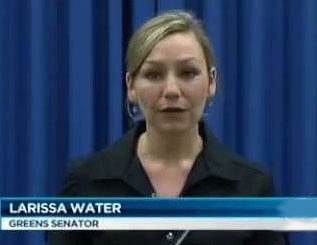 merging the environment and energy portfolios – we need Minister for the Environment and for Clean Energy, writes Senator Larissa Waters.
21 JUL 2016 – In an ideal world, combining the federal environment portfolio with the federal energy portfolio, as Malcolm Turnbull has just done in his Cabinet reshuffle, would make perfect sense.
But in today’s political context, which sees big mining companies pour mega donations into the two big parties, it’s a troubling move, especially as the responsibility for the merged ministry falls to Josh Frydenberg.
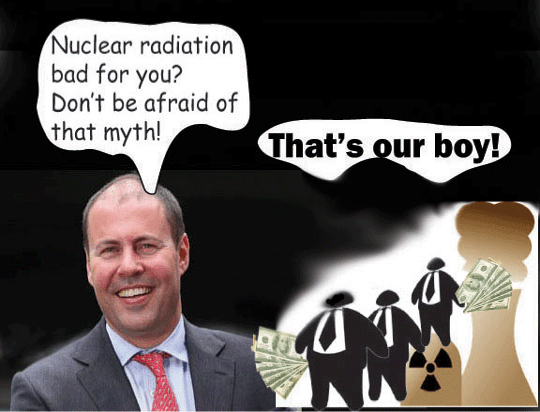
Minister Frydenberg is a well-known coal supporter who has argued for nuclear power from his first speech in the Parliament. Alarmingly, Frydenberg’s appointment could signal Malcolm Turnbull’s support for nuclear is growing since he left uranium mining, processing and storage ‘on the table’ late last year, even though nuclear power is a dangerous, expensive and slow-off-the-ground distraction from job-rich renewable energy.
As Resources Minister, Frydenberg pushed ahead with a proposed nuclear waste dump in South Australia that stands to financially benefit a landholder who happens to be a retired Liberal politician, despite opposition from Traditional Owners.
Championed by Andrew Bolt as ‘Mr Coal’, the former Resources Minister believes there is a “moral case” for the Adani mega-coal mine. He argues that the coal mine will lift people in India out of energy poverty, ignoring the fact that four out of five people without electricity in India are not connected to an electricity grid so can’t access coal-fired power.
The solution to energy poverty in India is localised renewable energy. Unlike coal, clean energy doesn’t cause millions of premature deaths every year through air pollution a year or pollute local water supplies.
Given Minister Frydenberg’s track record, his approach to his role as Environment and Energy Minister threatens to be very different from what is required to save our Great Barrier Reef and safeguard our very way of life from global warming.
To give the Reef a chance and to protect our Pacific neighbours from sea-level rise, the title really should be Minister for the Environment and for Clean Energy. We need an ambitious, rapid transition to clean energy that embraces storage technology for reliability, provides assistance to communities affected by the end of fossil fuels, and helps workers with training to benefit from this job-rich 21st century industry.
Malcolm Turnbull’s Cabinet re-shuffle gives no indication that his government is up for the task of leading this necessary national transition from dirty to clean energy. Mr Turnbull has announced the largest Cabinet team in 40 years but despite the size and the breadth of issues covered in his colleagues’ titles, climate change has been completely ignored.
Climate change is the biggest economic challenge we face and a stand-alone Minister and Department would provide a serious advantage in meeting it.
Instead climate change has been completely forgotten and environment has been relegated to a part-time role for a known coal-loving, nuclear fan.
No wonder the fossil fuel lobby is happy.
Shortly after Minister Frydenberg’s appointment was announced, The Australian Petroleum Production and Exploration Association put out a glowing media release. The Qld Resources Council executive Michael Roche said the sector had “won the trifecta”, in energy and environment and with Matt Canavan, who questions climate science while cheering on coal, taking over from Frydenberg as Resources Minister.
Some environment groups carefully expressed qualified hope that the merger of environment and energy could assist in the economic transition we so desperately need toward clean energy.
I’d love nothing more than for that to be true. However, the environment movement’s caution is well warranted, given the control fossil fuel companies exert over both the old parties.
As political donations are not disclosed in real time, we’ll have to wait for at least half a year to find out which big mining companies have donated with the aim of holding on to the polluting status quo.
From the looks of Malcolm Turnbull’s Cabinet reshuffle though, the dirty donations continue to be more than enough to keep the Prime Minister forgetting about the once-genuine concern he seemed to have for future generations surviving global warming.
Queensland Senator Larissa Waters is the Australian Greens Deputy Leader and climate change spokesperson.
Investors run from Australian uranium company, debt-laden Paladin Energy
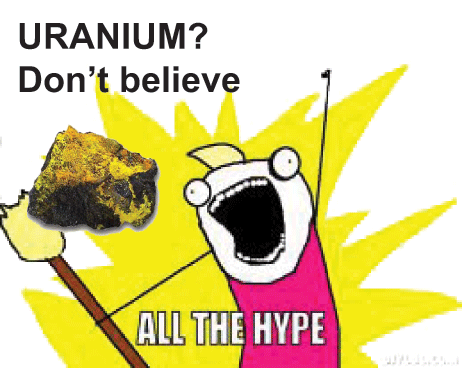 Paladin sold down despite $US200m in deals Peter Klinger – The West Australian on July 21, 2016 Investors have failed to applaud news from debt-laden Paladin Energy that it had struck almost $US200 million worth of deals, including offloading a big slice of its flagship Langer Heinrich uranium mine.
The news also includes a plan to sell 75 per cent of the undeveloped Manyingee uranium project east of Onslow to Chinese-backed, ASX listed tin miner MGT Resources for up to $US30 million. The Manyingee deal does not include the Carley Bore deposit.
The proposed sale of a 24 per cent stake of Langer Heinrich, in Namibia, to an unnamed party for $US175 million is the main plank of Paladin’s long-awaited debt reduction plan.
The Perth company, which remains one of the world’s few pure-play uranium producers but is fighting to remain viable because of the nuclear fuel’s long-term depressed price, has $US212 million in convertible bonds due in April next year.
Paladin is refusing to name the “major participant in the global nuclear power industry” which will buy the stake, which will cut Paladin’s interest in its only operating asset to 51 per cent.
But analysts will be focusing on China National Nuclear Corporation, which bought 25 per cent of Langer Heinrich for $US190 million two years ago.
The lack of clarity or certainty around the Langer Heinrich sale saw Paladin shares fall 2.5 cents, or 10.42 per cent, to 21.5 cents at noon on solid turnover this morning.
“The parties are using their best endeavours to prepare definitive documentation for formal execution, including (a) sale and purchase agreement, shareholders agreement, and documentation for the uranium off-take arrangements,” Paladin said.
“Paladin is working towards a formal close of the transaction in the fourth quarter (of this year). Other than set out in this announcement, the other key terms of this proposed transaction remain confidential, including the identity of the counterparty.” https://au.news.yahoo.com/thewest/wa/a/32114763/paladin-sold-down-despite-us200m-in-deals/#page1
Wind down for the “dirtiest industry” – uranium mining in Africa
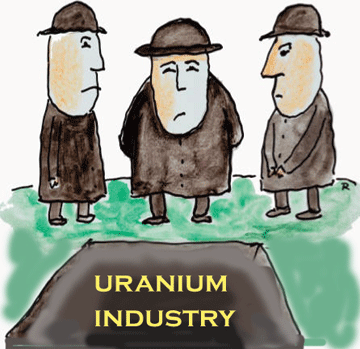 Uranium is the dirty underbelly of nuclear – scientist , Engineering News, BY: NEWS24WIRE, 21 july 16 Anti nuclear sentiment tends to focus on nuclear waste or operational risks, but more focus should be on the “dirty underbelly” of uranium mining, according to a science adviser.
“Whenever people get excited about nuclear power stations, they kind of forget where the actual uranium comes from,”Dr Stefan Cramer, science adviser for environmentalist groupSafcei, told Fin24 in an interview recently.
“Nuclear is a fallacy, both economically and environmentally,” Cramer, who was born in Germany but not now lives in Graaff-Reinet, claimed. “Uranium mining is the dirty underbelly of this whole nuclearcycle,” he said. “It’s where it all starts.”
“One must stop nuclear industries in (their) tracks because it leaves future generations with an immeasurable task and legacy,” he said. “The best point to start is at the source, where the whole cycle of nuclear technology begins, and that is at uranium mining.
“Uranium mining is very much the dirtiest part of the entire industry.” Anti-uranium mining boost
Cramer’s focus on anti-uranium mining was given a boost this month when Australian company Tasman Pacific Minerals Limited said it is downsizing its mining application in South Africa by almost 90%.
“Overall, the area covered by Tasman’s new and existing mining right and prospecting right applications in the Western and Eastern Cape will reduce by almost 300 000 ha to approximately 465 000 ha,” it said…… http://www.engineeringnews.co.za/article/uranium-is-the-dirty-underbelly-of-nuclear-scientist-2016-07-21
Canberra’s solar farms with sun- tracking technology
Mr Han says the ACT’s solar projects are small, but internationally the industry is indebted to Australia.
“In China scales are much bigger, ultimately the solar voltaic cell is actually Australian technology that was originally developed out of the University of NSW,” Mr Han said. “That technology was commercialised in China as well as Europe. A lot of the technology and breakthroughs we still owe to Australia research and development.”
The proponents say the ACT is Australia’s front -runner in solar projects.
“The long term off-take agreements, or power purchase agreements, mean it has a reliable and predictable revenue stream for owners and investors, ” Mr Crockett said.
 “The ACT has proved how efficient, effective and cheap it is to transition your electricity sector, you are seeing now the Victorian Government is going to do something very similar,” Mr Crockett said.
Mugga Lane and Williamsdale solar farms to begin tracking sun by year’s end http://www.canberratimes.com.au/business/energy/mugga-lane-and-williamsdale-solar-farms-to-begin-tracking-sun-by-years-end-20160718-gq8lrg.html July 21 2016 John Thistleton
A GPS-guided pile-driver sinking steel posts into the ground is swiftly changing the landscape in South Canberra for a new solar farm. Continue reading
Australia rates rather poorly on UN Sustainable Development Goals
 Australia ranks 20th on progress towards the Sustainable Development Goals, The Conversation, John Thwaites July 21, 2016 Australia may be home to some of the world’s most liveable cities, but we have a long way to go to meet the world’s Sustainable Development Goals (SDGs).
Australia ranks 20th in the world – well behind Canada and many European countries but ahead of the United States – according to a new index that compares different nations’ performance on the SDGs, which were adopted last September.
Launched at this week’s United Nations SDG talks in New York, the index marks each country’s performance towards the 17 goals. These aim to put the world on a more sustainable economic, social and environmental path, and feature 169 targets to be met over the next 15 years in areas such as health, economic growth and climate action.
The ranking, called the SDG Index and Dashboard and prepared by the UN Sustainable Development Solutions Network and the German think tank Bertelsmann Stiftung, ranks countries’ performance using a set of 77 indicators.
Australia: good water, bad energy
Australia, with some of the world’s highest carbon emissions per person, rates poorly on the clean energy and climate change goals. It also falls down on the environmental goals, with high levels of solid waste and land clearing as well as loss of biodiversity…….
The SDG Index will be updated regularly to improve its quality and coverage and allow people around the world to measure progress against the goals. Australia’s plan for implementing the SDGs within Australia is not yet clear and this will be an important item on the agenda for the re-elected Turnbull government. https://theconversation.com/australia-ranks-20th-on-progress-towards-the-sustainable-development-goals-62820
How much is the South Australian government spending on its pro nuclear extravaganza?
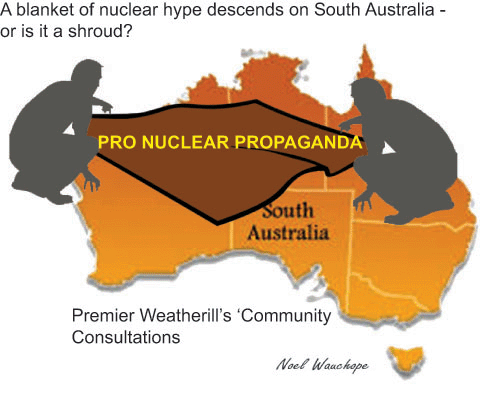
 What I’m worried about is the amount of tax-payers’ money that is going into this State-wide nuclear brainwash. Is Premier Jay Weatherill squandering so much of the State’s coffers on this fool’s enterprise that he and the rest of the politicians will feel that they MUST go on and complete the damn thing – commit to an international nuclear waste dump? Current estimate is $13 million. But will it be more?
From July 29 to October 20 they will be sending teams of nuclear spruikers all over the State of South Australia.
Teams from Nuclear Fuel Cycle Royal Commission Consultation and Response Agency will be there to spread the jolly word of the biased Nuclear Fuel Chain Royal Commission. Who’s on this Agency anyway? Can we expect to hear, yet again, from Greg Ward and Chad Jacobi giving their polished pro nuclear spiel? Will there be deceptive and trivialised presentations on the healthiness of ionising radiation – as there were at the recent Citizens’ Jury hearings?
1 This month
17 October, Free Public Talk on Nuclear Issues in South Australia
David Noonan will speak on public interest concerns over the new Roxby Downs Indenture Act 2026 on BHP copper-uranium mining and ore processing in SA, and on how AUKUS may face SA with a High-Level nuclear waste agenda.
Dr Jim Green will discuss international developments in the field of nuclear power including ‘small modular reactors’ and Generation 4 ‘advanced’ nuclear reactor concepts.


Help Aunty Sue Protect Her Land and Sacred Sites From Destructive Rocket Testing.
.

Australians deserve the truth
about
AUKUS – https://aukuspublicinquiry.com/

PETITION – To: Prime Minister Anthony Albanese and the Australian Labor Government

of the week – Australians for War Powers Reform (AWPR)
To see nuclear-related stories in greater depth and intensity

