UCL Australia – key player/driver in South Australia nuclear push
“University College London’s International Energy Policy Institute (IEPI), based at its Australia campus in Adelaide, undertakes economic, regulatory and policy research on how Australia could develop a nuclear energy industry and manage its externalities, including decommissioning and waste.”
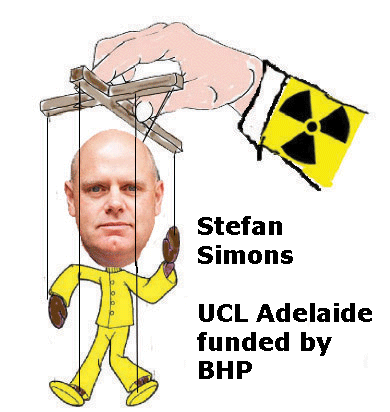
UCL Australia https://en.wikipedia.org/wiki/UCL_Australia 10 Nov 2015
UCL Australia is an international campus of the University College London, located on Victoria Square in Adelaide, South Australia.
Industry partnerships
UCL Australia has key corporate partnerships with two major resource and energy companies operating in South Australia: Santos and BHP Billiton. Santos’ South Australian interests include onshore and offshore oil and gas developments while BHP Billiton’s interest is concentrated on the expansion of the Olympic Dam mine- the world’s largest known deposit of uranium.
International Energy Policy Institute
The International Energy Policy Institute (IEPI) is housed on the Adelaide campus of University College London, Australia. In 2011, UCL signed a five-year $10 million partnership with BHP Billiton to establish the International Energy Policy Institute in Adelaide and an Institute for Sustainable Resources in London. Continue reading
Malcolm Turnbull all tied up over Climate Change and Paris Conference
 Malcolm Turnbull: Verbal acrobatics required for Paris climate
  talks, Independent Australia, 8 November 2015, Malcolm Turnbull will need to utilise his obvious talent for rhetoric to convince a global audience at the Paris climate talks in November, as there is no substance to the Government’s “Direct Action” climate policy, says Noel Wauchope.
Australia’s new Prime Minister Malcolm Turnbull has an appealing and glib turn of phrase. He’s going to need that talent when he speaks at the United Nations Paris Climate Conference in late November.
The thing is, Malcolm has to sell to the conference Australia’s current policy on climate change. The Government’s “Direct Action” climate policy is unchanged, despite the departure of climate sceptic Tony Abbott. Its flagship is the Emissions Reduction Fund (ERF).
The ERF boils down to tax-payer handouts to polluting companies that volunteer to cut their greenhouse emissions. There is no enforcement policy, meaning that the companies get the money, and for a year or more, do not need to show that they have reduced emissions.
After a year, the government proposes a ‘safeguards mechanism’, to be explained fully then, so allowing the companies plenty of leeway to lobby to make it meaningless. ……..
What happened to Turnbull? Mark Kenny & James Massola wrote in The Age in February:
‘Amid feverish speculation over the leadership, unconfirmed reports also claimed Mr Turnbull had moved to assuage fears in the conservative wing of the party that his return to the leadership would see a reprise of the carbon tax or an emissions trading scheme. It was claimed Mr Turnbull had promised, in a secret deal, that there would be no such reprise if elected.’
More recently, Kenny expressed it in this way:
‘Turnbull has his hands tied, having lost the leadership in 2009 to Abbott for supporting emissions trading, and then having regained it in 2015 on the express condition of opposing it. Release from such Houdini-esque chains will take some doing.’…….
Turnbull’s support for nuclear waste dumping in Australia might go down okay at the Paris talks. There will be a strong push there for nuclear power to be portrayed as cure for a climate change. At present, “new nuclear” is hamstrung in the U.S. because there has to be a waste solution before it can go ahead. ……
However, to persuade the world on Australia’s entire climate inaction package is a task that will demand Turnbull’s very best linguistic acrobatics.
Malcolm Turnbull faces an epic task to keep faith with Liberal Coalition climate denialists, while making Australia’s pathetic climate policy look at all reasonable to the global audience. https://independentaustralia.net/politics/politics-display/malcolm-turnbull-verbal-acrobatics-required-at-the-paris-climate-talks,8356
Why interim storage at Lucas Heights is the least worst solution for returning nuclear wastes.

 Dave Sweeney, Australian Conservation Foundation, 9 Nov 15 Last week Natalie Wasley (BNI) and myself spent a few days talking to a range of stakeholders in Sydney and Sutherland Shire and this note seeks to provide some context for the ENGO response to this development.
The BBC Shanghai left the French port of Cherbourg in mid-October carrying twenty five tonnes of Australian origin intermediate level waste returning here after reprocessing in France.
There has been controversy about the shipment, including safety and capacity concerns raised by Greenpeace about the vessel and a statement from the Indonesia’s Maritime Security Board that it can not pass through Indonesian waters. There is sure to be more domestic and international media attention when it arrives in Port Kembla (Wollongong), expected to be in early December.
After arrival in Kembla it is planned that the waste – which is in solid form inside a special transport container – will be moved by road to the Australian Nuclear Science and Technology Organisation’s Lucas Heights reactor facility in southern Sydney.
Some local residents are/will be calling for this material to not be stored in Sydney – this is an understandable response, but it is not one supported by the wider national nuclear free movement and key civil society partners.
We advocate that extended interim storage at Lucas Heights is the current least worst option as:
- ANSTO is already both the continuing producer of and home to the vast majority of Australia’s higher level radioactive waste
- ANSTO has certain tenure, a secure perimeter and is monitored 24/7 by Australian federal police
- Storing the waste at ANSTO means the waste will be actively managed as operations at the site are licensed for a further three decades – it also keeps waste management on the radar of the facility/people with the highest concentration of nuclear expertise and radiation response capacity in Australia
- Since the government realised in 2012 that the planned national waste dump at Muckaty would not be in place prior to the return of this waste, ANSTO has constructed and commissioned a new purpose built on site storage shed dedicated to housing this waste
- Extended interim storage at ANSTO helps reduce the political pressure to rush to find a ‘remote’ out of sight, out of mind dump site and increases the chances of advancing responsible management
- Storage at ANSTO has been publicly identified as a credible and feasible option by ANSTO, the nuclear industry lobby group, the Australian Nuclear Association and the federal nuclear regulator, the Australian Radiation and Nuclear Safety Agency (ARPANSA)
Importantly, this approach also provides the ability to have a circuit breaker in this long running issue in the form of an evidence based and open review of the best longer term management options.
Nothing about the nuclear industry, especially nuclear waste, is clean or uncomplicated and some in the wider community might be critical of this position.
However we believe that extended interim storage is the least worst approach and that coupled with a sustained ENGO call for a wider public review, is the path that is most likely to usefully advance the debate about future management options.
There is also an unusually high level of common acceptance that storage at Lucas Heights is the best option in the current circumstances – as well as ENGO’s this view is shared by the Sutherland Shire Council, local Greens and environmentalists, ANSTO and the Maritime Union.
Given this, pending a safety inspection upon the ship’s arrival, we do not forsee protest action aimed at disrupting the transfer of this waste from the Port to ANSTO – we want to see that happen with as low risk as possible. There are plans for a peaceful presence to witness the arrival and transfer and convey that while we (reluctantly) accept the need for this transport to occur we will not accept these shipments becoming routine and will actively resist moves to impose a national waste dump on remote communities or develop international waste dumps/storage in Australia.
Clearly this is an important message to convey in the context of the South Australian Nuclear Royal Commission and recent comments by PM Turnbull and other senior Coalition figures.
There is also both a real opportunity and need for a clear social and wider media profile at this time on the need for an open review of the best ways to manage this material and to end/reduce its production.
Nuclear fuel leasing – not economically viable for Australia
 When nuclear reactors shut (as they are doing in USA) – where is the income stream to pay Australia for having all that radioactive trash?
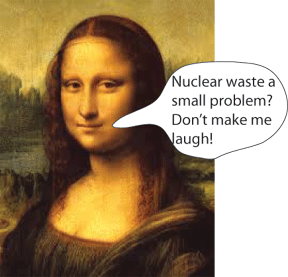 Proponents are talking up the billions that might be made by swallowing our pride and making Australia the world’s nuclear waste dump. But they have been silent about the costs.
And the waste would need to be monitored and problems addressed for millenia
Wasting Australia’s Future: Why We Shouldn’t Become The World’s Nuclear Waste Dump, New Matilda, By Dr Jim Green on November 9, 2015 There are many good reasons why Australia should not set its sights on becoming a dumping ground for nuclear waste. Dr Jim Green takes up the case.
While sceptical about the prospects for nuclear power in Australia, Prime Minister Malcolm Turnbull has given cautious support to the idea of a nuclear fuel leasing industry in Australia. Such an industry would involve uranium mining, conversion (to uranium hexafluouride), enrichment (increasing the ratio of uranium-235 to uranium-238), fuel fabrication, and disposal of the high-level nuclear waste produced by the use of nuclear fuel in power reactors overseas.
In the Prime Minister’s words: “We have got the uranium, we mine it, why don’t we process it, turn it into the fuel rods, lease it to people overseas, when they are done, we bring them back and we have got stable, very stable geology in remote locations and a stable political environment.”
Regardless of its merits, a nuclear leasing industry is an economic non-starter. That much is clear from the data provided in the latest edition of the International Atomic Energy Agency’s Nuclear Technology Review. Uranium miners could be compelled to participate in an Australian nuclear leasing industry. But try telling that to BHP Billiton. The company bluntly stated in its submission to the 2006 Switkowski Review: “BHP Billiton believes that there is neither a commercial nor a non-proliferation case for it to become involved in front-end processing or for mandating the development of fuel leasing services in Australia.”
And there’s no point appealing to the patriotic fervour of Australia’s uranium miners: they are majority foreign-owned. Continue reading
Australia’s demonstrated incompetence on dealing with radioactive trash
 Wasting Australia’s Future: Why We Shouldn’t Become The World’s Nuclear Waste Dump, New Matilda, By Dr Jim Green on November 9, 201 “…….Is there any reason to believe that Australia would manage a deep underground repository any more responsibly than the US? No.
Is there any reason to believe that things might be worse in Australia? Yes.
The US has a wealth of nuclear expertise at its disposal; Australia has comparatively little.
Moreover, Australia has its own sordid history dealing with long-lived nuclear waste. In the late-1990s, the Australian government carried out a clean-up of the Maralinga nuclear test site. It was done on the cheap and many tonnes of plutonium-contaminated debris remain buried in shallow, unlined pits in totally unsuitable geology.
A number of scientists with inside knowledge of the Maralinga project publicly noted their concerns. Nuclear engineer Alan Parkinson said of the ‘clean up’: “What was done at Maralinga was a cheap and nasty solution that wouldn’t be adopted on white-fellas land.”
US scientist Dale Timmons said the government’s technical report was littered with “gross misinformation”. Geoff Williams, an officer with the Commonwealth nuclear regulator ARPANSA, said the ‘clean up’ was beset by a “host of indiscretions, short-cuts and cover-ups”. Nuclear physicist Prof. Peter Johnston said there were “very large expenditures and significant hazards resulting from the deficient management of the project”.
Barely a decade after the Maralinga ‘clean-up’, a survey revealed that 19 of the 85 contaminated debris pits have been subject to erosion or subsidence.
Australia’s demonstrated incompetence feeds back into the economic debate. Some − perhaps many − countries would surely think twice about entrusting nuclear waste to a country that has already proven that it is not up to the task.https://newmatilda.com/2015/11/09/wasting-australias-future-why-we-shouldnt-become-the-worlds-nuclear-waste-dump/
Costs of new nuclear, high, higher and astronomic
 You’ll never guess how much this Australian nuclear power plant will cost, http://www.bizjournals.com/pittsburgh/blog/energy/2015/11/youll-never-guess-how-much-this-australian-nuclear.html Matt Stroud, energy reporter for the Pittsburgh Business Times. Nov 6, 2015 A nuclear power plant has never been built in Australia before, but Westinghouse is putting a price tag on a new one they’re hoping to build there.
The price? About $12.3 billion.
 Australian state of South Australia should build the nation’s first nuclear power plant — Westinghouse executive Rita Bowser said that price was all inclusive, according to The Advertiser in Adelaide, South Australia. It would include land, environmental safeguards and construction.
Australia has zero nuclear power plants — and is known for being extremely averse to nuclear energy; it won’t even allow nuclear ships into its ports.
 The historical aversion won’t affect the price much, apparently; the company’s guesstimate is in line with its current Vogtle project in Georgia, which has been plagued by cost overruns. It’s less than a comparable Chinese project, set to cost $24 billion. And it’s cheap in comparison to a project proposed in Johannesburg that could cost $100 billion.
The South Australia project’s future is fluid at the moment: the Nuclear Royal Commission hasn’t even decided whether it wants to recommend a nuclear facility.
That decision is set to come in May 2016. Tokyo-based Toshiba Corp. (TYO: 6502) owns 87 percent of the Cranberry-based Westinghouse Electric Co.
Banks NAB and CBA support climate action (but watch out for nuclear investment)
This is a good start. But use of the words “low carbon”always needs to be taken with a grain of salt, as it is often code for “nuclear”
Would these banks back nuclear power as a “low carbon” option?
Banking On Climate Action, NAB And Commonwealth Bank Move To Support Paris Talks, New Matilda, By Thom Mitchell on November 6, 2015 The move has drawn praise from green groups, who are still warning both institutions need to back away from investments in coal. Thom Mitchell reports.
Two of Australia’s biggest banks stepped up their commitments to climate action, outlining how they will support the international push to limit the rise in average global temperatures to two degrees or less ahead of a major United Nations summit in Paris this December.
The Commonwealth and National Australia Banks confirmed they support the two degree target, with NAB even going as far as to committing to spending at least $18 billion by 2022 “to help address climate change and support the transition to a low carbon economy”. “NAB believes the financial sector has an important role to play in assisting the transition to a low carbon economy, through both the energy we purchase directly and through financing,” the institution said in a statement.
The $18 billion will be spent on “new lending, debt market activity, provision of risk management products, development of financing solutions and advisory activity”.
“Finance will be provided to our customers to undertake climate change mitigation such as renewable energy and energy efficiency including low carbon property, low emission transport, and climate change adaptation activities,” the statement reads. Continue reading
Trans Pacific Partnership final text confirms fears of critics
 TPP Environment Fears Confirmed By Final Text https://newmatilda.com/2015/11/06/tpp-environment-fears-confirmed-by-final-text/
By Thom Mitchell on November 6, 2015 The content of the TPP is finally known, and it appears to be as bad as critics feared. Thom Mitchell reports.
The Trans Pacific Partnership leaves the door open for corporations to inhibit the ability of governments to legislate for environmental protection, critics of the biggest free trade deal in history said after the release of the final text yesterday.
Like many trade deals, the TPP includes ‘Investor State Dispute Settlement’ clauses which allow multinational corporations to sue governments in trade tribunals outside of national judiciaries if laws are passed that risk their profits. According to Dr Mathew Rimmer, a Professor of Intellectual Property and Innovation law at the Queensland University of Technology, “They have given foreign investors very broad ranging powers to go into investment tribunals to make complaints about decisions by government that affect their foreign investments.”
“There are some clauses there dealing with protection of the environment…and the right to regulate, but they aren’t absolute defences,” Dr Rimmer said.
The Executive Director of America’s influential Sierra Club, Michael Brune, said the fact that “the words ‘climate change’ don’t even appear in the text [is] a dead giveaway that this isn’t a 21st-century trade deal”.
“It sets us back further, empowering fossil fuel corporations to challenge our public health and climate safeguards in unaccountable trade tribunals while increasing dirty fossil fuel exports and fracking,” Brune said.
Over more than half a decade, the deal was negotiated in secret between 12 ‘Pacific Rim’ countries, including Australia, the United States, Canada, Japan, Malaysia, Mexico, New Zealand, Peru, Chile, Singapore, Vietnam and Brunei.
Adelaide’s January heatwave attributed to climate change
The findings are reported in the fourth issue of the American Meteorological Society’s report into extreme weather. The report looked at 33 extreme weather events around the world and analysed which could be attributed to human activity and which were the result of natural variability in weather patterns.

As David Mark reports, detecting the human hand in climate change is a developing area of climate science.
Continue reading
Indonesia to deny nuclear waste ship access to Indonesian waters
 Nuclear Waste Ship will be Denied Entry to Indonesian Waters http://www.globalindonesianvoices.com/23422/nuclear-waste-ship-will-be-denied-entry-to-indonesian-waters/ 05 Nov 2015 By : Leo Jegho
“Our investigation has found that the vessel had ever entered our seawaters when sailing to France. And now we are monitoring its travel back to Australia,” Bakamla Chief Vice Admiral Desi A Mamahit told reporters at his office in Jakarta, according to Detik.com.
Transporting the nuclear waste is BBC Shanghai, an Antigua & Barbuda-flagged general cargo ship. Admiral Desi mentioned two reasons why Indonesian authorities disallow BBC Shanghai passing through Indonesian waters on its way to Australia. The first reason is that the Indonesian seawaters are not part of the routes allowed for foreign vessels traveling from Europe to Australia and vice versa. The second reason is that BBC Shanghai carries nuclear waste.
BBC reported that BBC Shanghai is due to reach Australia by 27 November and that it is now in Africa. France-based nuclear company Areva sent the nuclear waste back to Australia.
The waste reportedly derives from the spent nuclear fuel sent from Australia to France in 1990s and early 2000s. French law obliges such nuclear waste to be sent back to Australia.
Forget climate change spin: Nuclear lobby’s aim is South Australia as radioactive trash dump
But the main game according to recent statements by Turnbull is to establish South Australia as a permanent waste dump for the world’s 350,000 tonnes of spent fuel containing more than 100 isotopes including plutonium-239 which lasts 250,000 years – one millionth of a gram is carcinogenic, americium, more toxic than plutonium and strontium-90 and caesium-137 lasting 300 years .

Increased uranium mining and more radioactive waste would be bad news for Australia http://www.theage.com.au/comment/increased-uranium-mining-and-more- radioactive-waste-would-be-bad-news-for-australia-20151103-gkpyp3.html November 4, 2015 Helen Caldicott
The nuclear industry may advocate in Paris that nuclear power is the answer to global warming. When Malcolm Turnbull mooted the question about storing radioactive waste in Australia, I felt that I finally understood the aim of the Nuclear Fuel Cycle Royal Commission being conducted in South Australia. Then I wondered whether the nuclear industry is going to propose in Paris that nuclear power as the answer to global warming.
A curious situation is developing in South Australia that will have serious health ramifications, especially for Aboriginal communities, and will also severely impair the state’s reputation for its superb wine and food. Continue reading
Fact-checking Senator Sean Edwards’s claim on future nuclear bonanza
 FREE ENERGY – WITH NUCLEAR? http://www.factsfightback.org.au/free-energy-with-nuclear/ November 4, 2015
The claim
Senator Sean Edwards claimed that an expansion of the nuclear fuel 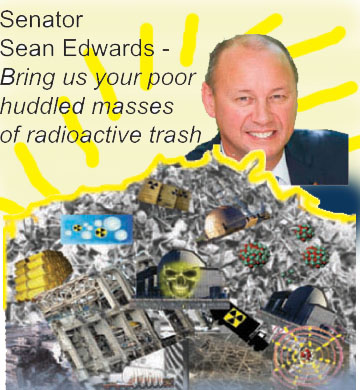 cycle in South Australia could provide low or even no cost electricity, create a generation of high-paying jobs and do so without any subsidies from government. His plan is to take spent fuel from older nuclear power plants from around the world, and reprocess them for use in fourth generation reactors here in Australia. We could be paid to take waste which we then turn into fuel, providing free electricity.
The facts
So called fourth generation reactors are not yet commercially available but are predicted to become available sometime in the 2030s. If these reactors become commercially available they will be able to take spent fuel rods(currently treated as nuclear waste) from older nuclear reactors and use them to generate electricity. This effectively turns a waste source into a valuable commodity.
The claim that low or no cost electricity can be produced comes from the idea that other countries would pay South Australia to take their nuclear waste. This would mean that not only will South Australia pay nothing for its fuel costs but it would generate an additional revenue source from taking other countries waste and turning it into a commodity.
We will address his argument as three linked claims:
- Other countries will pay Australia to take nuclear waste for storage.
- Australia can build fourth generation reactors to use this spent fuel to generate electricity.
- This will result in free electricity, and perhaps even earn sufficient profit for the state that it will allow a reduction in taxes.
Claim 1
The expert advice to the South Australian Royal Commission into expanding the nuclear fuel cycle gave a time-frame of 25 years to complete a long term waste storage facility. The Generation IV International Forum expects fourth generation reactors – capable of using existing waste stockpiles as fuel – to be commercially deployed in 2030-2040. This means that any waste storage facility that South Australia develops is likely to be completed at about the same time as fourth generation reactors become commercially available. It is likely that South Australia’s own waste storage business would need to compete with other countries’ fourth generation reactors. Spent fuel will cease to be waste, and will become a commodity. Why would anyone pay South Australia to take a commodity?
Claim 2
The circular reasoning is clear. If fourth generation reactors work as hoped, no-one will pay South Australia to take their spent fuel. Further, if fourth generation technology proves to be expensive and difficult to maintain, South Australia would have locked itself into expensive electricity generation, having set up a waste import industry. In either case, countries with existing stockpiles of spent fuel have a clear competitive advantage over South Australia. It makes more financial sense for them to build fourth generation reactors next to existing stockpiles than it does to transport it half-way around the world. There is no good outcome for South Australia.
Claim 3
According to the US Energy Information Administration, fuel represents less than 15% of the cost of generating electricity with advanced nuclear power plants. Most of the cost is in the initial capital expense and maintenance of the reactor. Even if Australia received “free” fuel – a wildly optimistic hope – the cost of building reactors is still great. Wind and solar have no fuel costs, but no one thinks renewable electricity is free. Furthermore, the cost of setting up an international waste storage component would be extreme large. The Pangea proposal which looked at setting up a nuclear waste disposal facility in the late 1990’s included port facilities and a fleet of specialised ships. It showed that any waste facility would be very expensive.
The first ton of waste that Australia received would require a gamble of many billions of dollars.The findings
Perhaps the cheapest way to take a gamble on nuclear power might be to create temporary storage facilities now, use this brief window before fourth generation reactors are deployed commercially to get paid to take waste, and be among the first in the world to build the reactors which can use our newly acquired waste for fuel.
However, the risks are obvious. If fourth generation reactors turn out to have high costs of operation, we would be locked into expensive electricity. If they can’t be made to work commercially at all, we would have given ourselves a high-level waste problem for tens of thousands of years, a problem that may not have a solution. And if they are cheap and effective, most countries could build their own and bid for the fuel we are so generously taking for a fee. If we can plan ahead for fourth generation technology, so can everyone else.
Even at best, if everything goes just as hoped, the payoff for our gamble is paltry. A 15% reduction in energy costs from nuclear reactors, which already have a higher cost per unit of energy than new wind and solar generators, is far from “free” electricity. A waste industry, costing billions to set up, which will see its revenues killed off – in as little as ten years – by the very technologies we hope to champion, can hardly be said to provide “generations” of high-paying jobs. And we will inherit a nuclear waste storage problem that must be solved for at least hundreds, and perhaps thousands, of years.
The most risk for the least reward is not a smart business plan. Free electricity is no more than a pleasant dream.
Christopher Pyne joins Australia’s pro nuclear dance troupe

In February Mr Pyne said he did not support either a nuclear enrichment industry or nuclear waste storage in South Australia. “I don’t support a nuclear waste dump in South Australia,” he told the ABC.
Now, he has softened his stance, saying he will have a look at proposals to start an industry.
“I’m looking forward to the royal commission’s findings and if Kevin Scarce can convince the Australian public through his Royal Commission that we should go down the track of investing in a nuclear industry, well I’m interested in having a look at it. I’m not convinced but I’m happy to look at it,” he said,……
Mr Pyne signalled he may be open to nuclear waste storage, a politically explosive issue in the state.
“There are countries around the world which have managed to solve the issue of the storage of nuclear waste, so I think that is a bit of an old-fashioned argument,” he said.
Prime Minister Malcolm Turnbull last month said Australia should consider getting involved in the nuclear fuel cycle of production, export and storage and Assistant Science Minister Karen Andrews said that developing a nuclear waste disposal industry was an option…….
Earlier this year Mr Pyne had cautioned of the political dangers of dredging up the issue. http://www.afr.com/news/christopher-pyne-signals-turnaround-on-nuclear-20151104-gkqgkc#ixzz3qeTZQrA1
Iluka Resources to subdivide West Victoria land with radioactive trash tomb
 Miner Iluka Resources gets Horsham Council approval to subdivide Douglas mine land http://www.abc.net.au/news/2015-11-04/miner-iluka-gets-nod-to-subdivide-douglas-mine-land/6910420 Horsham Council has approved an Iluka Resources’ application to subdivide land at its Douglas mine in western Victoria.
The approval is subject to a range of planning and environmental conditions.
“The mineral sands miner said it did not need some parts of the site, including Pit 19 where radioactive mining by-product was buried.
The council’s planning committee has been reviewing the application for the past month and it has now been approved with conditions. Future activities on the land deemed sensitive will trigger an environmental audit and previous use of the land would be disclosed to any future buyer.
The conditions require a plan which clearly outlines land previously used for mining purposes and the disposal of radioactive by-product.
Trans Pacific Partnership fails the environment, ignores climate change
Climate change missing from full Trans-Pacific Partnership text, The Age November 5, 2015 Gareth Hutchens “…….this is the first time Australians have had a chance to see what the federal government has been negotiating on their behalf for over five years.
Matthew Rimmer, Professor of Intellectual Property and Innovation Law at the Queensland University of Technology, told Fairfax Media it looks like US trade officials have been “green-washing” the agreement.
“The environment chapter confirms some of the worst nightmares of environmental groups and climate activists,” Dr Rimmer said.
“The agreement has poor coverage of environmental issues, and weak enforcement mechanisms. There is only limited coverage of biodiversity, conservation, marine capture fisheries, and trade in environmental services. The final text of the chapter does not even mention ‘climate change’ – the most pressing global environmental issue in the world.”
Controversially, the deal includes a clause giving foreign companies the right to sue Australian governments if they introduce laws they say have harmed their investments.

Dr Patricia Ranald from the Australian Fair Trade and Investment Network said the “safeguards” Mr Robb claimed he had won to prevent foreign tobacco companies suing Australian governments for pursuing anti-smoking policies do not appear strong enough.
“The general ‘safeguards’ in the text are similar to those in other recent agreements which have not prevented cases against health and environmental laws,” Dr Ranald said.
“Public health groups have influenced governments to include in the text the option of more clearly excluding future tobacco control laws from ISDS cases, which is important and has angered the tobacco lobby. But this also begs the question of how effective are the general ‘safeguards’ for other public health and environmental laws.”
Dr Rimmer also criticised the investment chapter, saying it was one of the most “labyrinthine” in the agreement……..http://www.theage.com.au/federal-politics/political-news/details-of-transpacific-partnership-finally-released-20151105-gkrivo.html
1 This month
17 October, Free Public Talk on Nuclear Issues in South Australia
David Noonan will speak on public interest concerns over the new Roxby Downs Indenture Act 2026 on BHP copper-uranium mining and ore processing in SA, and on how AUKUS may face SA with a High-Level nuclear waste agenda.
Dr Jim Green will discuss international developments in the field of nuclear power including ‘small modular reactors’ and Generation 4 ‘advanced’ nuclear reactor concepts.


Help Aunty Sue Protect Her Land and Sacred Sites From Destructive Rocket Testing.
.

Australians deserve the truth
about
AUKUS – https://aukuspublicinquiry.com/

PETITION – To: Prime Minister Anthony Albanese and the Australian Labor Government

of the week – Australians for War Powers Reform (AWPR)
To see nuclear-related stories in greater depth and intensity

