NoNukes South Australia comments on the South Australian media
 The News’ media in South Australia are daily and nightly having a nuclear field day in what they say promoting human nuclear as saviour of the planet.
It is easy to see who and what this Mr Jacobi and his mob are about.
The human nuclear mob have been intensively above and behind the scenes of the human nuclear movement since early the past century.
IT IS IMPORTANT TO POINT OUT THAT THE DEBATE REGARDING HUMAN NUCLEAR WAS ALREADY DONE – ALREADY COMPLETED – IN THE 1970’s IN AUSTRALIA
THE VERDICT OBTAINED BY ALL EXPERTS ASSEMBLED AT THE TIME FROM NEAR AND FAR WAS
vvvvvvvvvvvvvvvvvvvvvvvvvvvvvvvvvvvv
NO HUMAN NUCLEAR.IN AUSTRALIA
^^^^^^^^^^^^^^^^^^^^^^^^^^^^^^^^^^^^^^
and especially since there is an extreme pristine clean perpetual abundance of Sunshine and Natural Gas in over and all around Australia that could last almost forever in a conservative frugal austere sustainable society, such as the People Society who has a record of over 50,000 years of natural pre-Invasion habitation.
Regarding the sudden re-appearance of the erroneous need for human Nuclear evaluation and approval:, the same words of wisdom apply as they did for the mass falsetto of the South Australia State Bank Debt crisis (deliberately engineered by human world finance in the 1980’s) and also the pre-emptive dumping of the Libya-like Gough Whitlam government earlier in the 1970’s
“The World is governed by very different personages from what is imagined by those who are not behind the scenes.”
Benjamin Disraeli – British Statesman
NEVER TRUST NEWS
NEVER TRUST HUMAN NUCLEAR
Fed up with the #NuclearCommissionSAust
 Yes, I am fed up with the charade of this Royal Commission – its pro nuclear bias is apparent from the very start – with nuclear enthusiasts strongly represented, starting from Commissioner Kevin Scarce.
Today I looked for the transcript of the hearing with Dr Helen Caldicott on 27 October. Well, it’s hard to find. When you go to the appropriate page on the Commission’s website – not a mention of Dr Caldicott, though she was the first speaker that day.
The one that they do mention is Professor Geraldine Thomas, Imperial College London. Prof Thomas is a very well known pro nuclear speaker. She appeared prominently on the nuclear dragon thing soft sell series on SBS. Thomas has spruiked about radioactive iodine, but conveniently has ignored other radioactive isotopes. (I’ve not read her latest spruik to the RC, but you can bet your boots that she is lobbying away there for the nuclear cause. Sadly Imperial College is becoming notorious for this.)
I have been reading through the transcript of Dr Caldicott’s speech, or more correctly, interrogation. by the redoubtable Mr Jacobi.
I am amazed at the aggressive questioning of Dr Caldicott – it seems to me to be aimed at discreditiing her.
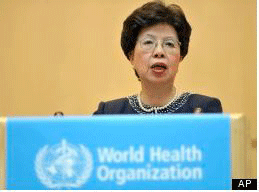 Not long ago, Dr Margaret Chan of the World Health Organisation stated “There is no safe low level of radiation”
Yet when Dr Caldicott said that same thing, she was subjected to aggressive questioning and demand for exact sources.
I wonder whether Mr Jacobi would have subjected the head of the WHO to the same insulting inqusition.
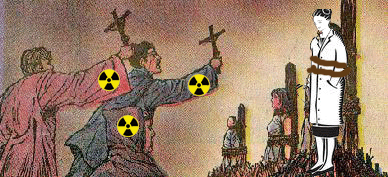
Australia’s Minister For Nuclear soon to release shortlist for waste dump site
Seven locations make nuclear waste dump shortlist October 29, 2015, James Massola http://www.smh.com.au/federal-politics/political-news/seven-locations-make-nuclear-waste-dump-shortlist-20151029-gklxu4.html
 Resources Minister Josh Frydenberg is poised to release a shortlist of sites that could play host to a permanent nuclear waste storage facility in Australia.
Fairfax Media has been told the shortlist contains seven possible locations for the facility and had been finalised and approved by the Abbott government before Ian Macfarlane was replaced as Resources Minister by Mr Frydenberg.
The list of sites was originally scheduled to be released by August. Mr Frydenberg now intends to release the short list by the end of the year, after consulting with local MPs affected the decision, the opposition and other stakeholders over the politically sensitive issue.
Two locations in South Australia’s Kimba shire, west of Port Augusta, and two in Western Australia, at Leonora, north of Kalgoorlie and Yalgoo, north of Perth, have voluntarily nominated to be considered for the shortlist, while a proposal for the facility to be located at Mt Isa, in remote Queensland, was recently advanced. The full list of possible locations is a tightly held secret.
Once the shortlist has been released, a further period of public consultations will begin before a preferred site is identified in mid-2016, with a detailed business case due in mid-2017 and construction and operation of the facility due by the end of the decade.
The pending decision on the waste facility comes amid renewed debate on a possible future nuclear industry in Australia.
The facility will store low and intermediate-level radioactive waste from Lucas Heights and Australian-produced waste that had been sent to France, the United States and Britain between 1996 and 2009, which is to be returned under an international agreement.
An interim facility has been constructed at Lucas Heights to hold waste being sent back to Australia. A general purpose cargo ship called the BBC Shanghai is currently en route to Port Kembla from the French port of Cherbourg carrying 25 tonnes of waste and is due to arrive at the end of the month. The waste aboard that ship will then be driven to the Lucas Heights facility.
Prime Minister Malcolm Turnbull went further on Wednesday, suggesting that many Australians had a “perfectly reasonable” view that said “we have got the uranium, we mine it, why don’t we process it, turn it into the fuel rods, lease it to people overseas, when they are done, we bring them back and we have got stable, very stable geology in remote locations and a stable political environment”.
“That is a business that you could well imagine here.”
South Australian Labor Premier Jay Weatherill has an ongoing royal commission into the nuclear industry.
The Australian Conservation Foundation’s anti-nuclear campaigner Dave Sweeney, who was also a member of the government’s advisory panel on the permanent waste facility, said achieving consent from residents of whatever area was selected for the site was crucial.
“Successive governments have failed to realise the importance of this [consent], or to achieve it. We are at the point of the process now, which is the test of the government’s commitment to community inclusion and having social licence to do this,” he said.
“We believe there is no environmental or public health reason to rush this [site selection]. The majority of the waste is currently in secured federal facilities and we need to take the time to get it right.”
Opportunity for Port Augusta to be repowered with solar thermal energy
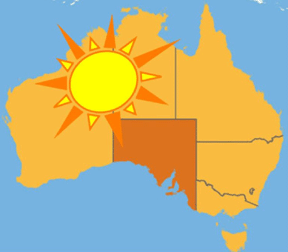 Repower Port Augusta, 30 Oct 15 In incredibly exciting news, after returning from a visit to a massive solar thermal plant in the United States, the federal local member for Port Augusta Rowan Ramsey has revealed to The Transcontinental that US solar thermal giant SolarReserve have made a bid to build solar thermal with storage in Port Augusta!
After a long running community campaign, numerous studies and actions from people like you this revelation is a huge step forward in the community driven push to Repower Port Augusta with solar thermal.
So, what does this mean?
The ACT Government are using a policy called a reverse auction to help them meet their 100% renewable energy target by 2025. This is a policy where they effectively bid for projects to buy renewable power from and early this year they called for bids from projects across the country from solar with stoage.
This is the policy we called on the SA Government to adopt in our submission to the state government that many of you signed onto.
We are still waiting on the result of the bid, but we know the bid for solar thermal from Port Augusta is one of thirty from across the country.
It’s a huge step forward and a testament to the community campaign backed by people across the country that SolarReserve are ready to build solar thermal in Port Augusta.
Seed – Indigenous Youth Declaration for Climate Justice
 http://www.seedmob.org.au/indigenous_youth_declaration
“As Aboriginal and Torres Strait Islander young people we are a part of the oldest continuing culture in the world and have lived in harmony with our land for generations.
Right now climate change is disproportionately affecting Aboriginal and Torres Strait Islander people. We are experiencing rising sea levels in the Torres Strait, the loss of sacred country, diminishing food and water accessibility.
For Aboriginal and Torres Strait Islander people the injustices go beyond the climate impacts. The fossil fuel industry has been putting stress on our land, our culture and our communities for decades.
Our vision is for a just and sustainable future with strong cultures and communities, powered by renewable energy. Our vision and the fossil fuel industry cannot coexist. … “
Aboriginal and Torres Strait Islander’s legal action against coal port at Abbot Point
 Seed – Risking the Reef Campaign http://www.seedmob.org.au/risking_the_reef
“Right now, there’s currently a proposal to build the world’s biggest coal port on the Great Barrier Reef at Abbot Point. If built it would unlock the Galilee basin – one of the largest reserves of coal in the world.
Aboriginal and Torres Strait Islander communities are already facing the impacts of climate change today, we need to be moving beyond coal and gas and transitioning to clean renewable energy, not digging up more of our sacred land. This means ensuring the proposed Abbot Point port expansion,
subsequent railway line and coal mines don’t go ahead. …
The Wangan and Jagalingou Traditional Owners have launched a legal case in the Federal Court to reject this project. … We’re sending a clear message to the banks that if they invest in reef and climate destruction, then were dumping them. …
Take action now by heading to riskingthereef.org.au “
Fijian PM slams Turnbull for giving in to climate denialists
 Fiji PM decries Australia’s ‘climate change deniers’ in Turnbull cabinet, Guardian, Oliver Milman, 28 Oct 15, Frank Bainimarama says: ‘The Australian government, in particular, seems intent on putting its own immediate economic interests first’ The prime minister of Fiji has delivered a blistering broadside at his Australian counterpart, Malcolm Turnbull, over the “climate change deniers” in his government who are helping doom Australia’s “unlucky island neighbours”.
Frank Bainimarama criticised Australia and New Zealand for failing to back Pacific island nations over climate change, claiming that the entire region risked being wiped out by rising sea levels, extreme weather and ruined agriculture.
“The Australian government, in particular, seems intent on putting its own immediate economic interests first,” Bainimarama said in a speech delivered in Nadi, Fiji. “The ‘lucky country’ determined to stay lucky, at least for the short term, at the expense of its unlucky island neighbours.
“To Malcolm Turnbull, the new Australian prime minister, I want to send a special plea. Make good on your previous strong stance in favour of deep and binding cuts in carbon emissions. Do not do deals with those who have enabled you to gain high office and betray your principles and our position.”
Bainimarama said Turnbull should halt new coalmines in Australia and embrace an economy based on clean energy. Such a ban has been proposed by a coalition of Pacific nations in the recent Suva declaration. Continue reading
Barrier Reef to become a fossil fuel highway – Senator Larissa Waters
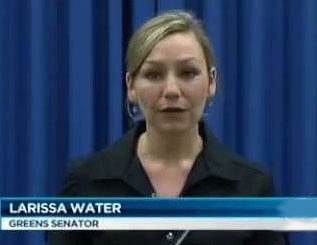 Qld Senator Larissa Waters, Greens Deputy Leader & climate change spokesperson:
Abbot Point EIS confirms Palaszczuk Government’s agenda to turn Reef into a coal highway http://larissa-waters.greensmps.org.au/content/media-releases/abbot-point-eis-confirms-palaszczuk-government%E2%80%99s-agenda-turn-reef-coal-highwa 27 Oct 15:
“The Palaszczuk Government’s lodgement of the Abbot Point coal port expansion final Environmental Impact Statement with Minister Hunt today, confirms it’s forging ahead with its agenda to turn the Great Barrier Reef into a fossil fuel highway.
“The Palaszczuk Government is continuing to do Adani’s dirty work for it,” Qld Senator Larissa Waters Australian Greens Deputy Leader and climate change spokesperson, said. “Labor has paid for this environmental impact statement with taxpayers money, when usually the company itself foots the
bill.
“And now Labor is set to pay for the dredging in this World Heritage Area to create one of the biggest coal ports in the world, which will turn the Reef into a highway for coal ships.
“There’s no guarantee we will get this money back – Adani is mortgaged to the hilt and hasn’t attracted any finance for its Carmichael coal mine. In fact 14 banks internationally have ruled out financing it. …
“Queenslanders care deeply about our Great Barrier Reef and halting global warming. The unprecedented amount of public submissions to the EIS, at 55 000, is testament to
Queenslanders’ love for the Reef. “So many Queenslanders are deeply disappointed that the
Palaszczuk Government has turned out to be just as bad as the Newman Government when it comes to treating our Reef as a highway for climate-destroying fossil fuels,” Senator Waters said.”
Senator Larissa Waters,
Australian Greens Deputy Leader & environment spokesperson
http://larissa-waters.greensmps.org.au/
Malcolm Turnbull favours importing radioactive trash to Australia
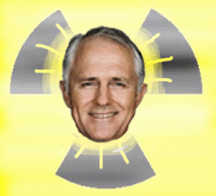 Australia could store nuclear waste for other countries, Malcolm Turnbull says, Guardian, Daniel Hurst, 28 Oct 15 PM tells Adelaide radio that he was sceptical Australia would ever build nuclear power stations, but a larger role in nuclear fuel industry was worth exploring….
Australia should “look closely” at expanding its role in the global nuclear energy industry, including leasing fuel rods to other countries and then storing the waste afterwards, Malcolm Turnbull has said.
But the prime minister said he was “sceptical” about whether Australia would ever build its own nuclear power stations to provide electricity to domestic customers, given the country had plentiful access to coal, gas, wind and solar sources.
Turnbull made the observations in a radio interview on Wednesday, a day after he named Dr Alan Finkel, a vocal advocate of nuclear power and the outgoing chancellor of Monash University, as Australia’s next chief scientist.
He was asked to weigh in on the issue during a visit to South Australia, where the state Labor government has launched a royal commission into options for participation in the nuclear fuel cycle. Turnbull praised the premier, Jay Weatherill, for setting up the inquiry…..
“…it’s a perfectly reasonable view: we’ve got the uranium [and] we mine it; why don’t we process it, turn it into the fuel rods, lease them to people overseas; when they’re done, bring them back – and we’ve got very stable geology in remote locations and a stable political environment – and store them?”
“That is a business that you could well imagine here.”….. playing that part in the nuclear fuel cycle I think is something that is worth looking at closely.”
Turnbull was environment minister in the Howard government, which commissioned a study into the feasibility of nuclear power by a task force led by the former Telstra chief, Ziggy Switkowski, who is now chairman of NBN Co……
The Australian Conservation Foundation described Turnbull’s comments as “ill-considered” and warned that radioactive waste was “a complex and contested policy area”.
“Radioactive waste presents serious environment, security and public health challenges – and it lasts a lot longer than any politician’s tenure,” said Dave Sweeney, a foundation campaigner.
Greenpeace dismissed nuclear power as “an expensive distraction from the real solutions to climate change, like solar and wind power”.
“It leaves a legacy of radioactive waste which remains dangerous for hundreds of thousands of years,” said Emma Gibson, head of program for Greenpeace Australia Pacific.
“We only have to look at the Fukushima disaster in Japan to be reminded of the health, social and economic impacts of a nuclear accident, and to see that this is not a safe option for Australians.”
Turnbull is seeking to bolster the Liberal party’s popularity in South Australia, where the government suffered political difficulties after his predecessor, Tony Abbott, backed away from a pre-election promise to build 12 submarines locally……. http://www.theguardian.com/environment/2015/oct/28/australia-could-store-nuclear-waste-for-other-countries-malcolm-turnbull-says
Australia’s govt and Opposition swing towards the nuclear industry
New Resources Minister Josh Frydenberg, who has said there is a moral obligation to exporting coal to provide energy for millions of people without access to electricity, has been a long-time supporter of nuclear power and said in his maiden speech that it was “inexplicable that in Australia we have yet to have a constructive and thorough debate about nuclear power, the only baseload, carbon-neutral energy source”.
Showing how the nuclear debate is moving, Mr Shorten also did not rule out nuclear power in the future, saying he would watch what the South Australian royal commission says
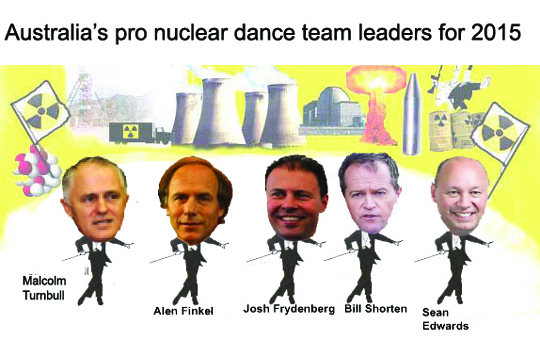
Nuclear power option should not be closed: federal government, Financial Review, by Laura Tingle, 27 Oct 15, The federal government is keeping open the possibility of adopting nuclear energy to fulfil Australia’s baseload electricity needs while asserting the central role of coal to global energy needs.
The government has told the South Australian Nuclear Royal Commission that nuclear power plants can deliver large amounts of electricity with very low carbon emissions, and should not be closed off as an option.
The revelation came as Prime Minister Malcolm Turnbull rejected a call by a group of 60 prominent citizens for a moratorium on coal exports and new mines amid a revived debate about Australia’s energy future.
“No I don’t agree with a moratorium on the idea of exploiting coal”, Mr Turnbull said on Tuesday, a position backed by Opposition Leader Bill Shorten……. Continue reading
Conflict of interest in nuclear authorities: Dr Gordon Edwards explains
 Dr Gordon Edwards at SA NUCLEAR FUEL CYCLE ROYAL COMMISSION hearing, 21 October 15
Dr Edwards gave a wonderful explanation of the danger of nuclear technology, focussing on explaining radioactivity.
He also spoke of his concerns about the independence of nuclear regulators, and of safety measures needed for population near nuclear facilities, for example, how Canada supplies potassium iodate pills to communities.
Extract DR EDWARDS: The complexity of the technology means that a lot of people 45 are mystified by it, including decision-makers, and politicians, for example, .SA Nuclear 21.10.15 P-742 Spark and Cannon generally don’t necessarily have a background in nuclear science. One of the only ones I know, I think, was Jimmy Carter, he was actually a nuclear engineer in the American nuclear navy. But outside of him, I don’t think of any major politician who has a background in nuclear science.
So that the technology is sufficiently complicated that people tend to be mystified by it and therefore feel a little bit – they find it difficult to judge, other than by trusting the experts in the industry itself. The difficulty with trusting the people in the industry itself, is that there is either consciously or unconsciously a kind of a conflict of interest there because they are devoted to the industry 10 and they want the industry to succeed and of course they try to reassure the public that it’s safe and they try their best to make it safe but there is this problem of – well, what if they weren’t so devoted to the industry and had the same knowledge, would they make the same judgment? Would they perhaps see it as being unsafe? And one of the difficulties with dangerous technologies 15 is that people who work on the technology feel conflicted and it’s difficult to blow the whistle on a technology that you truly believe in. So this is an inherent problem.
Similarly when you have a regulator, although independence is the goal, it’s 20 difficult to maintain that independence. The people in the regulatory body are often drawn from the very industry that they are regulating because they are experienced in that field and consequently you need people with understanding and expertise, so how do you kind of keep regulatory independent when in fact there is this constant interaction between the people in the regulatory body and 25 the people in the industry. They tend to come to see themselves as colleagues and if I might draw an analogy, you might think of the regulator as drifting towards being more of a coach than a referee…….So this problem of independence is not an easy one to deal with…….
Another thing that I think would be very helpful in my own opinion would be regulators, as the industry itself, they tend to be very top heavy with engineers and physical scientists, geologists and such like, 5 chemists, the so-called hard scientists and they tend to be extremely thin on biomedical expertise. I think it’s very helpful to have some biomedical expertise in the regulatory body because they have a different perspective. They have a different approach and also if and when things do go wrong, the biomedical team can be very helpful in advising the public and the workers and 10 everybody, as to what kind of precautions to take in terms of protecting yourself. What kind of foods should be avoided? What kind of measures should be taken? I think it would be very reassuring to the public to have such people on board.
Moreover, if you had a health department, which we do not have in our regulator, if you had a health department staffed with competent and independent biomedical people, they could also help to educate workers and the public as to why we are so careful with this technology. Why we must invest in all these safety precautions because they could make it clear what the dangers are. Continue reading
Time that Australia took a responsible attitude to radioactive trash management at Lucas heights
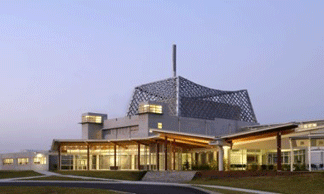 Australia’s Policy On Nuclear Waste Is All At Sea, Huffington Post, Dave Sweeney, 27 Oct 15 “…….. Australia has dropped the ball badly in relation to responsible radioactive waste management. For over 20 years, successive federal governments have repeatedly tried and failed to ‘solve’ this issue by imposing a national nuclear facility on unwilling remote communities. Apart from causing unnecessary and deep community stress, this approach has delivered little.
ANSTO’s Lucas Heights facility has secure tenure and is actively policed. The site is fenced and patrolled and both generates and is home to the majority of Australia’s radioactive waste. The facility is also home to Australia’s highest concentration of nuclear expertise and technology.
Furthermore, after an Aboriginal-led campaign saw Muckaty Station in the NT removed as a possible waste site during a Federal Court trial last year, ANSTO has improved its ability to store waste at Lucas Heights with a new dedicated and purpose built on-site storage facility.
Key parties including ANSTO, industry lobby group The Australian Nuclear Association, and federal regulator The Australian Radiation Protection and Nuclear Safety Agency all agree that the secure management of radioactive waste at ANSTO is feasible and credible. And in a rare case of consensus on matters nuclear, national environment groups agree.
Two decades of short-term political ‘fixes’ for a long-term environmental and human challenge have delivered very little. Extended interim storage at the site of production at Lucas Heights offers the least-worst solution and provides a circuit breaker in a long running but scarcely advanced public debate.
It gives us the assurance and ability to do what Australia has never done and clearly needs to do. We need an evidence-based and open review into the best options to most responsibly manage Australia’s radioactive waste.
In the interest of all, including future Australians, this is an opportunity we cannot afford to waste. http://www.huffingtonpost.com.au/dave-sweeney/australias-nuclear-waste-_b_8387352.html
Camp Concern: protestors recall and reactivate anti nuclear campaign in Kakadu
“The mining company that has benefited and profited from the use of this area and the mining lease now needs to move towards a comprehensive clean-up.
“We’re still not completely aware of contamination problems that need to be rehabilitated.
“What’s promising is the protest from Aboriginal communities against the mining is as strong as ever. There’s a lesson [from Camp Concern] in partnerships between Indigenous and non-Indigenous activists sharing information together.”
 Camp Concern: Activists reunite for anti-uranium mining protest 40 years later inside Kakadu 105.7 ABC Darwin By Emilia Terzon and Lisa Pellegrino , 27 Oct 15 As uranium mining near Kakadu faces an uncertain future, activists calling themselves Camp Concern have reunited inside the Northern Territory park to mark 40 years on from the launch of an anti-mining protest. Continue reading
100% renewable energy electricity company launched in South Australia
South Australian company to launch country’s first 100 per cent renewable energy utility provider, ABC News By Alex Mann, 26 Oct 15 A South Australian company will launch the country’s first 100 per cent renewable energy utility company, with the author of the 2008 Climate Change Review signalling his support.
Professor Ross Garnaut has been appointed chairman of Zen Energy and said the company’s launch would be a game changer.
“I’ve been disappointed that the established energy companies have not taken the opportunity that’s there,” he said.
The company will use a combination of solar power generation, battery storage, and localised energy grids to create self-sustained communities that will buy back the power they generate.
For years, Zen Energy has been putting battery units in people’s homes.
Now its chief executive Richard Turner plans to take entire communities off the grid — from social housing stock, to apartment buildings and regional communities.
He said he will generate the power, then sell it back to users at a fraction of the current costs.
“We’re looking at a spot in the market very soon where we’re going to be almost half the cost of the grid,” he said.
It could be the end of the power grid as we know it
It is just the latest disruption in an energy revolution sweeping across Australia which could spell the end of the power grid as we know it……….http://www.abc.net.au/news/2015-10-26/sa-company-launch-renewable-energy-utility-company/6886578
Queensland’s huge wind solar plant goes ahead
 Australia’s First Wind/Solar Plant To Be Built In Queensland October 28, 2015 Energy Matters Construction of a $140 million combined wind and solar energy facility in North Queensland is expected to begin within a year.
Kennedy Energy Park will go ahead as a result of a 50/50 joint venture agreement between Canberra-based Windlab Limited and Japan’s Eurus Energy Holdings Corporation.
The first stage of the Kennedy Energy Park will see 6 wind turbines and 64,000 solar panels installed. The wind turbines used will have the largest span in Australia – 136 metres in diameter. The first stage of the park will generate enough power to supply more than 25,000 Queensland homes.
The second stage will involve 1200 MW of renewable energy capacity; enough to meet most of the state’s contribution to Australia’s Renewable Energy Target.
Windlab Chief Executive Officer, Roger Price, says Kennedy Energy Park will be able to match North Queensland’s’ current energy demand profile more than 80% of the time.
“This particular site has been carefully mapped and we know it is predominantly windy through the afternoon and into the evening, and obviously experiences sunlight during daylight hours. This resource profile ensures almost constant energy production,” he said.
Flinders Shire Council has backed the project…….. http://www.energymatters.com.au/renewable-news/kennedy-energy-park-em5153/
1 This month
17 October, Free Public Talk on Nuclear Issues in South Australia
David Noonan will speak on public interest concerns over the new Roxby Downs Indenture Act 2026 on BHP copper-uranium mining and ore processing in SA, and on how AUKUS may face SA with a High-Level nuclear waste agenda.
Dr Jim Green will discuss international developments in the field of nuclear power including ‘small modular reactors’ and Generation 4 ‘advanced’ nuclear reactor concepts.


Help Aunty Sue Protect Her Land and Sacred Sites From Destructive Rocket Testing.
.

Australians deserve the truth
about
AUKUS – https://aukuspublicinquiry.com/

PETITION – To: Prime Minister Anthony Albanese and the Australian Labor Government

of the week – Australians for War Powers Reform (AWPR)
To see nuclear-related stories in greater depth and intensity

