Australia’s electricity retailers not investing in renewable eneregy projects
 Renewable investment drought to continue as utilities extend buyers’ strike, REneweconomy, By Giles Parkinson on 31 August 2015 The investment drought that has plagued the Australian large-scale renewable energy industry for the last two years could extend for another six to 18 months, with big and small electricity retailers showing no interest in contracting new wind or solar projects.
Infigen Energy said on Monday that the deal to cut the large-scale renewable energy target from 41,000GWh to 33,000GWh has yet to have any impact on the market, or to send a signal to retailers to contract new construction.
Infigen CEO Miles George says it could be six to 18 months before retailers will start to act. “The big three are in no hurry to contract now,” he told a conference call on Monday for the release of its annual results.
This confirms the indications from Origin Energy, AGL Energy and EnergyAustralia in recent weeks that they were not interested in writing long-term pricing contracts, either because of perceptions about the policy environment in Australia or because they had enough renewable energy certificates on their books.
Renewable energy investment in Australia plunged nearly 90 per cent since the election of the Abbott government, and even after the slashing of the RET the only projects going ahead now are those supported by the ACT government’s own renewable energy scheme (Ararat, Coonooer Bridge and Hornsdale).
Some big turbine manufacturers may enter the market on a “merchant basis” – taking the price risk – because they have the balance sheet to do so. This includes Suzlon’s Ceres project in South Australia and Goldwind’s project in NSW, and Infigen says it recently sold stakes in two wind projects with an unnamed wind turbine supplier with a mind to do the same thing.
The only other activity in the market has come from Queensland, where Ergon Energy has called for a tender for 150MW of renewable energy and the Queensland government has foreshadowed a tender for 40MW; and in Victoria, which has announced an initiative that may get a small number of wind turbines built.
In the meantime, the renewable energy developers are virtually hamstrung. Infigen Energy, despite the sale of its US wind and solar assets, remains loaded down with relatively high debt levels, so can’t develop projects on its own.
Pacific Hydro, the other major Australian developer, is up for sale and not in the construction market. Meridian Energy, the $5 billion New Zealand renewable energy giant, says it is not interested in investing in new wind farms in Australia as long as it is run by a government which does not like renewable energy…….
The federal government has commissioned the Clean Energy Regulator to do a regular update on the state of the market. The first one is due in April.
The industry is hopeful that this could be used as an incentive to push the industry along. But some fear – given the rhetoric from the Abbott government about renewable energy – that it could be used as an excuse to further weaken the target, despite the government’s promise not to do so before 2020.
Infigen reported a net loss of $304 million as it took a major hit from the write down of its US wind assets, which it sold to reduce its debt burden. It said wind conditions had been particularly poor in the last financial year, but were expected to improve. http://reneweconomy.com.au/2015/renewable-investment-drought-to-continue-as-utilities-extend-buyers-strike-28325
Danger of nuclear stations to coastal communities, Aboriginal people and to water
 The ongoing impact of mass dispossession of Anangu people because of nuclear testing on their traditional homelands has very real consequences today, for many residing on the Far Coast of SA
Maralinga is also raised because of the interest it attracts as a potential nuclear waste dump location. The logic appears to be that it is already contaminated, so it perfect for more radioactive waste. CBAA dismiss this logic outright.
Clean Bight Alliance Australia Submission to: Nuclear Fuel Cycle Royal Commission SA
Clean Bight Alliance Australia is a local community group based in Ceduna on the far west coast of SA. Members have a strong interest in the ongoing health of the marine and coastal areas of the Great Australian Bight and the Eyre Peninsular. CBAA advocate for appropriate use of the region’s natural marine resources and educate the community on the risks associated with industrialization of the marine environment.
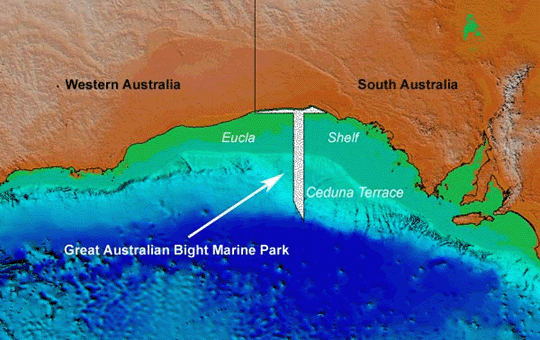
Extract “……CBAA take the position that there are no suitable areas in South Australia for a nuclear reactor. Currently our position is supported by legislation as Nuclear Power generation in South Australia is prohibited by the Environment Protection and Biodiversity Conservation Act 1999 Act and the Australian Radiation Protection and Nuclear Safety Act 1998. CBAA strongly encourages the Royal Commission to appreciate the background to these important pieces of legislation and implications if these were to be further altered or weakened.
Furthermore Nuclear power generation requires large quantities of water for cooling – typically 36.3 to 65.4 million liters per reactor per day. 1 South Australia is known as one of the driest states on one of the driest continents. No inland areas are suitable for the establishment of a nuclear reactor for generating electricity. The amount of water needed can definitely not be sourced with current reservoirs and transportation of the large amounts of sea water required would be unfeasible and costly. Locating a Nuclear Reactor in South Australia is restricted to coastal areas.
However this is also highly unsuitable as siting a nuclear reactor would conflict with other key industries Continue reading
Kevin Scarce off to S Korea, later will conduct public hearings
Nuclear royal commissioner Kevin Scarce about to start public hearings, The Advertiser August 29, 2015 PAUL STARICK CHIEF REPORTER Sunday Mail (SA) DISTINGUISHED economist Ross Garnaut will be among the first expert witnesses at the nuclear  royal commission’s public sessions, as the inquiry reaches the business end.
From September 9, Royal Commissioner Kevin Scarce will question experts on topics such as long-term demand for electricity, along with the cost benefits and safety risks of expanding nuclear activity in South Australia.
Determining electricity demand for up to 40 years will effectively produce detailed predictions of the state’s economic future, aided by Professor Garnaut, because this will be required to determine predicted energy supplies.
The electricity market study will consider whether nuclear power will be economically viable and where it fits in the mix of renewable energy, gas and coal……..
……..would conduct 30 to 40 public sessions — two to three per day of about 90 minutes each — aided by counsel assisting, Chad Jacobi.
The topics and his questions will be guided by more than 250 public submissions sent to the 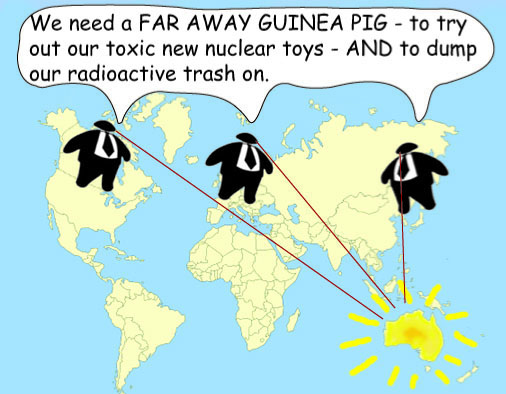 inquiry………..
Mr Scarce, a former SA governor, left yesterday for what is expected to be the commission’s final overseas study tour, visiting South Korean nuclear power plants and speaking to the country’s nuclear regulator…….
……….we need to learn what’s worked well overseas and how that process can be managed.” [ note: S Korea is in a chaotic dilemma about its nuclear wastes]
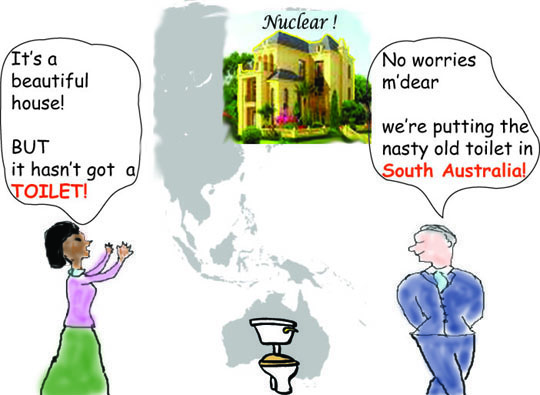
Mr Scarce has repeatedly faced criticism that the royal commission is an expensive and time-consuming bid to mask state and federal governments’ desire to again impose a nuclear dump on SA.
The State Budget has set aside $1.83 million for the royal commission this financial year……….
Three leading environment groups — Conservation SA, the Australian Conservation Foundation and Friends of the Earth — this month said the axing of hundreds of jobs from the Olympic Dam uranium mine raised huge questions about the nuclear industry’s growth potential.
“SA’s future lies in renewable energy, not nuclear. It’s cheaper, safer and quicker to roll out,” Conservation SA chief Craig Wilkins said.
“With renewables, we can be in charge of our own destiny, not dependent on decisions made in corporate boardrooms on the other side of the world.”
Mr Scarce expects to release tentative findings, including detailed recommendations, in a report in February. After five weeks of public consultation, the final report is due by May 6. Policy decisions about whether to adopt any recommendations, should they call for a nuclear dump or other changes, will be taken by the State Government. http://www.adelaidenow.com.au/news/south-australia/nuclear-royal-commissioner-kevin-scarce-about-to-start-public-hearings/story-fni6uo1m-1227504415906
New South Wales way behind on renewable energy
 NSW ‘at bottom of pack’ for renewable energy; Government says it’s committed to clean projects, ABC News By state political reporter Brigid Glanville. 30 Aug 15, It may be known as the premier state, but New South Wales is a clear under-achiever when it comes to renewable energy.
NSW has the highest level of greenhouse gas emissions in the country and does not have a renewable energy target.
In 2014 the renewable industry body, Clean Energy Council, listed New South Wales at the bottom of the states for renewable energy production. Only 6 per cent of its electricity is from wind, solar and water — compared with Tasmania, which uses 95 per cent renewables. “New South Wales is at the bottom of the pack of the Australian states when it comes to renewable energy,” Climate Council CEO Amanda McKenzie said.
“It’s behind the pack in terms of generating renewable energy and the amount of rooftop solar on people’s roofs.”
New South Wales and the two territories remain the only jurisdictions where Solar PV panel penetration is under 10 per cent.
In South Australia, take up is almost 25 per cent.
Clean energy penetration by state
- Tasmania 95%
- South Australia 40%
- Western Australia 13%
- Victoria 10%
- Queensland 7%
- NSW 6%
Source: Clean Energy Council, Clean Energy Australia Report 2014
Enova Energy New South Wales community organisation starts new renewable energy provider

The directors said in the prospective that the “nimble and collaborative locally based social enterprise model” used by Enova could be replicated and scaled across like-minded communities in Australia.
The share offer closes on September 25.
Northern Rivers community seeks $4m in energy IPO http://www.theage.com.au/business/energy/northern-rivers-community-seeks-4m-in-energy-ipo-20150828-gja99q.html#ixzz3kLbExZM1 August 30, 2015 Angela Macdonald-Smith A community-owned organisation in north-eastern NSW is set to take on the big guns in electricity supply through a $4 million initial public offering to fund a renewable energy retailing and solar company it hopes will stimulate local renewable energy projects across the country.
Enova Energy, chaired by consultant and former NSW state librarian Alison Crook, is aiming to capture customers in the Northern Rivers region, where retailing major Origin Energy dominates the market.
Ms Crook said Enova was not aspiring to be a major competitor of Origin but sought mainly to provide a customer for small wind farms, hydropower and bio-energy projects that were not large enough to be of any interest to major retailers as a green power provider.
“We see this as a game-changer to get community renewable energy really going in Australia,” Continue reading
No place for nuclear power in Australia – economist warns
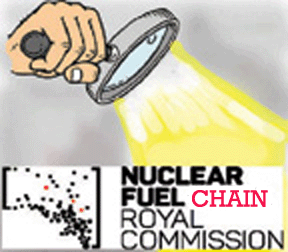 Nuclear power is an expensive, inferior resource that has no place in Australia’s future energy mix, a US economist has warned.http://www.theaustralian.com.au/national-affairs/state-politics/nuclear-power-a-costly-relic-us-economist-warns-commission/story-e6frgczx-1227500265740?sv=f70611a9445ad64e9d33b11dcffd7050 27 Aug 15
Vermont Law School senior fellow for economic analysis Mark Cooper has called on South Australia’s Nuclear Fuel Cycle Royal Commission to reject nuclear power on the grounds that natural gas-fired generation is more cost-competitive.
The former Fulbright fellow’s submission to the royal commission argues that the rapid development of renewable energy technology renders nuclear power a 20th-century “relic” that will be outdated before a reactor can be built in Australia.
“Nuclear power is an inferior resource that has no place in a least-cost portfolio to meet the need for electricity in a low-carbon environment,” he says. “Before a new nuclear reactor could be brought online, efficiency, renewables, other distributed resources and the deployment of the physical and institutional infrastructure to build an intelligent electricity system should well be on their way towards creating a new 21st-century system.”
Nuclear reactors can take up to 15 years to build before becoming operational. Dr Cooper said the huge capital investment required over a long period of time to build a nuclear power plant meant investors would be exposed to “significant risk”.
Royal commissioner Kevin Scarce has acknowledged the rapid development of renewable energy technology could quickly change the goalposts for assessing the economic viability of nuclear energy. Because of this, “heavy assumptions” were being built into the royal commission’s report to government, he said.
French ACT co-operation on renewable energy for Canberra and South Australia
French diplomacy delivers renewable energy to Canberra and $250m to South Australia, ABC, SA Country Hour By James Jooste, 26 Aug 15 A joint venture between French company Neoen and the Australian Capital Territory Government will inject $250 million into the South Australian economy and deliver clean energy to the capital. Continue reading
#Nuclear waste will be NO bonanza for South Australia
CHRISTINE ANDERSON SUBMISSION TO THE NUCLEAR FUEL CYCLE ROYAL COMMISSION HEALTH EFFECTS OF IONISING RADIATION
“……..The economic costs of nuclear reactor decommissioning are a negligible component of lifetime nuclear reactor costs when a decision is made to build a nuclear reactor, largely because these costs are so far into the future and have been heavily discounted to net present values.
When it comes to actually decommissioning a nuclear plant, the experience of the UK Nuclear Decommissioning Authority at Sellafield is costs are rapidly escalating with actual experience at the site – from 25.1 billion pounds in 2009-2010 to 47.9 billion pounds in 2013-2014 according to the UK Audit Office report at http://www.nao.org.uk/report/progress-on-the-sellafield-site-an-update/ .
WASTE STORAGE
Payments for waste storage might well be in the billions, but nowhere in the world have payments ever come close to meeting the full costs of storage so far, let alone for half a million years. It is definitely not a bonanza when the costs are higher than any income. I think it highly unlikely that any company or country will pay South Australia the money needed to identify a site, design and construct the storage facilities , and presumably operate it for many years and maintain it securely until it is full, and presumably totally closed off for at least 250,000 years. Even if any waste storage facility was restricted to Australia’s own nuclear waste, this will include reprocessed fuel rods from Lucas Heights , including small amounts of plutonium.
These wastes are from Australian government facilities, and although the federal government might pay some upfront design and construction costs, I can’t see them paying SA for the full costs, let alone a bonanza.. The Advertiser published an article on 11 April 2015 about Yucca Mountain, Nevada which was intended to be permanent storage for 70,000 tonnes of hazardous waste in casks in 8 kilometres of tunnels 305 metres underground. Funding was cut off in 2007 because Nevadans oppose the site. The US government has already spent somewhere between $15 billion and $100 billion in drilling and testing this site so far. A federal court ordered the US Nuclear Regulatory Commission to resume the licensing process for the site, and it seems likely Congress will support it again in the next few years.
Australia has already been through at least 4 series of processes over the last 30 years for identifying and building a waste storage site for its own wastes, mainly for Lucas Heights fuel. I doubt if anyone has attempted to calculate the public cost to date. Most of the likely sites will be aboriginal land or pastoral lease or Crown land subject to native title claims, and I believe most aboriginal groups will oppose further and effectively permanent loss of control and poisoning of their lands.
If we receive the waste, we are not going to be able to get rid of it. Continue reading
Abbott government onside with South Australia’s pro Nuclear Royal Commission
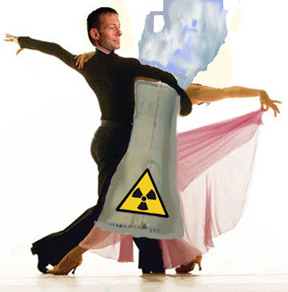 The federal government has reaffirmed its support for South Australia’s royal commission into nuclear energy. Source: http://www.sbs.com.au/news/article/2015/08/26/govt-backs-nuclear-inquiry AAP 26 AUG 2015
Industry Minister Ian Macfarlane says Australia needs an informed debate about nuclear energy industry and the royal commission is a good start.
He says any increased involvement must come with a robust, stable and predictable regulatory system to give the community confidence that risks can be managed effectively.
“Some of the activities being investigated by the royal commission would require change in commonwealth legislation and the establishment of supporting regularly and policy frameworks,” the minister told a resources conference in Port Augusta on Wednesday.
“While the government’s submission does not advocate any change in commonwealth policy, it has committed to seriously consider the royal commission’s report in 2016.”
SNC Lavalin charged with corruption (advisor to South Australia’s Nuclear Fuel Chain Commission?)
 Is the Royal Commission considering SNC Lavalin’s technology for South Australia? Did SNC Lavalin put in asubmission? (we won’t know, because commercial submissions are “in confidence”)
South Australia’s Nuclear Fuel Chain Commission visited Toronto on 14tth July and had discussions on the CANDU reactor design and technology. That CANDU technology is owned and marketed by SNC Lavalin.
RCMP charges SNC-Lavalin with fraud and corruption linked to Libyan projects Graeme Hamilton, Financial Post Staff | February  19, 2015MONTREAL – Once a jewel of the Quebec business establishment, SNC-Lavalin Group Inc. now stands criminally accused of fraud and corruption after the RCMP announced charges against the engineering giant Thursday.
The case against SNC and two of its subsidiaries stems from the company’s dealings in Libya between 2001 and 2011, when a senior executive established close ties with Saadi Gaddafi, son of dictator Muammar Gaddafi.
Court documents allege the company offered bribes worth $47.7 million “to one or several public officials of the ‘Great Socialist People’s Libyan Arab Jamahiriya,’” as Gaddafi called the nation he ruled until he was overthrown and killed in 2011.
SNC and its subsidiaries SNC-Lavalin Construction Inc. and SNC-Lavalin International Inc. are also alleged to have defrauded various Libyan public agencies of approximately $129.8 million. Continue reading
Solar energy to power Perth
 Solar to fuel new power generation https://au.news.yahoo.com/thewest/wa/a/29358326/solar-to-fuel-new-power-generation/ Daniel Mercer August 27, 2015,
Fuelled by falling solar panel prices and rising electricity tariffs, demand for solar cells has been running at 20-30 per cent in Perth for the past six years.
About 170,000 households in the South West grid covering Perth now have a system.
Dr Nahan said installed solar capacity across the city was about 500MW — or the equivalent of a major base-load power station — and this was expected to more than double within years.
“We expect that the bulk of generating capacity during sunlight hours in the metro area in about 10 years time will be provided by rooftop solar,” Dr Nahan said.
“That’s the reality. So it is going to provide the bulk of additional capacity going forward.
“It will also displace a lot of the existing capacity. It’s low-priced, it’s democratically determined and it’s something we’re committed to facilitating.”
The comments came as Dr Nahan provided an update of the Government’s plans to shake up the electricity sector.
He said moves to end Synergy’s monopoly over the household power market and throw it open to competition by 2018 were on track.
Before the Government could do that, however, he said the subsidy to the State-owned utility would need to be erased and excess capacity from the system stripped by reducing some Synergy capacity.
He said it was too early to say which plants would be closed
Twisting the public’s perception about ionising radiation
In Muller’s previous presentations on his YouTube show Veritasium, he has consistently confused the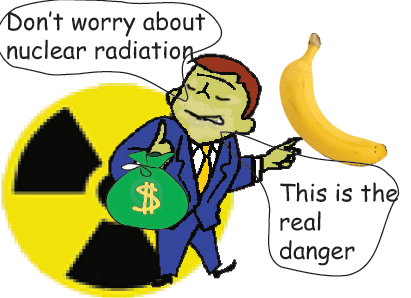
naturally occurring radioactive potassium K, with the nuclear fission produced radioactive isotopes…..Muller seems to have no understanding of the way in which bananas are used in the body
What Muller and Thomas are doing is following the script from the tobacco and asbestos industries.
This documentary “Uranium – twisting the Dragon’s Tail” is just Series One. I would love to know who helped to fund Gene Pool Productions for PBS and SBS to produce this. I’m betting that Series Two will follow before long, with a glossy and positive story about Generation IV nuclear reactors.
The half lie of the Dragon’s Tail. Online opinion, By Noel Wauchope Thursday, 27 August 2015 The documentary “Uranium – Twisting the Dragon’s Tail” is the latest glossy and highly sophisticated soft sell for the nuclear industry. It’s also, if you look at it closely, rather confusing.
I will start from the end, because that’s where the main message of this film comes out clearly “Just imagine a world where reactors can produce immense amounts of clean, safe, energy. There is no such thing as a future without uranium.” These final words are said against a background of soaring celestial choirs.
This seems to be the formula now, in nuclear promotion. The 2013 propaganda film “Pandora’s Promise” carried the same positive message – an ever rocketing energy demand to be met by ever increasing, indeed limitless, electrical energy provided by new nuclear reactors.
But, like ‘Pandora’s Promise’, this new documentary devotes the first two thirds of its series to discussing the negative aspects of the nuclear industry. Episode One covers its history, ill effects of radiation, the atomic bomb and its use. Episode Two continues this, with a sympathetic attitude to Australian Aboriginal concerns.
Unlike “Pandora’s Promise” this film does not denigrate anti-nuclear activists, and there is no attempt to ridicule Dr Helen Caldicott, as “Pandora’s Promise” did.
Indeed, the first two episodes are beautifully clear and accurate, as well as entertaining. Really, I couldn’t criticise them.
With the final episode – that’s when the message kicks in, and also when it gets confusing…….
Muller consistently mixes up “natural” radiation with ionising radiation from nuclear fission. He talks about background radiation as “natural”. There’s no mention of the increased ionising radiation in the biosphere as a result of the atomic bomb testing in the 1950s and 60s.
In Muller’s previous presentations on his YouTube show Veritasium, he has consistently confused the naturally occurring radioactive potassium K, with the nuclear fission produced radioactive isotopes, such as caesium 137 and strontium 90. As part of this confusion he constantly uses bananas as a comparison .comparison https://www.youtube.com/watch?v=TRL7o2kPqw0
Cesium-137 is 12 million times more radioactive than potassium-40. Another highly-radioactive fission product, strontium-90, releases almost 20 million times more radiation per unit mass than does potassium-40. Muller seems to have no understanding of the way in which bananas are used in the body. The human species has had thousands of years of experience with bananas and other foods containing potassium 40 (K40). We have a natural trace level of K40 in our bodies. When we eat bananas, our bodies excrete the extra cesium, so by the natural process of homeostasis, our K40 level remains the same. This is not the case with the very recently created radioactive isotopes from nuclear fission; they remain….., there is absolutely no mention of the effects of internal emitters of radiation – that is, the radioactive isotopes breathed in or ingested, that can sit in a body’s organs for years, decades, emitting high dose gamma radiation..
Moving on to the Fukushima nuclear accident, we are told that the psychological effects are the serious ones. What a great piece of spin this is! Of course the psychological effects are extremely serious. Wouldn’t you be worried, if you were a pregnant woman, or if you feared that your child might later get leukaemia, because you decided to return to a radioactive environment? It is the reality of increased risk of fatal illness that accentuates the other disastrous consequences of that accident.
Prof Thomas assures us “The most important studies will be those on the mental effects”. In the context of this documentary, that just makes me envisage more documentaries like this one – with more spin about how we mustn’t worry about ionising radiation…….
The documentary appeared in Australia at a very convenient time for the South Australian Royal Commission. Dr Muller often covers his back with remarks about nuclear weapons “the most savage thing that man has ever built” and like his “feeling that renewables are going so fast – perhaps we can use alternatives”. But ultimately, his is a message of confidence in nuclear power. He says “Every year uranium saves more lives than it has ever destroyed” Really? Where are the facts to back up these kinds of statements? And all is spoken with guru like solemnity, and the backing of soaring holy choral music……..
What Muller and Thomas are doing is following the script from the tobacco and asbestos industries. They know full well that the toll of cancers, heart conditions, birth defects, from persistent exposure to ionising radiation will not become apparent for decades. They would have us believe that it will be impossible to establish ionising radiation as the cause of this toll of suffering and death…….
We are living in a strange time, where science is valued if it brings a benefit to corporations. Dr Derek Muller and Professor Geraldine Thomas are comfortably ensconced in that world. But there must be some scientists out there who are like Sir Richard Doll, and whose work is motivated by the public good.
And we desperately need those scientists.
This documentary “Uranium – twisting the Dragon’s Tail” is just Series One. I would love to know who helped to fund Gene Pool Productions for PBS and SBS to produce this. I’m betting that Series Two will follow before long, with a glossy and positive story about Generation IV nuclear reactors. http://www.onlineopinion.com.au/view.asp?article=17624
Climate system changing more rapidly than expected: new report

 A STUNNING new Climate Council report that reveals the climate system is changing more rapidly than expected and with larger and more damaging impacts paints a stark picture of the urgent need for action, Professor Tim Flannery said today.
Climate Change 2015: Growing Risks, Critical Choices provides the most up-to-date, comprehensive synthesis of climate science in Australia and exposes the extent of the dramatic changes in the climate system worldwide.
“In short, the more we know about climate change, the riskier it looks,” Prof Flannery said.
“Heatwaves, sea level rise and ice loss are all increasing as the air, the ocean and the land continues to warm strongly. Extreme weather events like dangerous bushfire weather are becoming more severe and frequent.
“But this is a future we don’t have to have. Tackling climate change and moving to clean, renewable energy is the right thing to do. It’s the right thing to do to protect our health and wellbeing. The right thing to do to protect us from economic shocks from worsening extreme weather and opening new opportunities for jobs and investment in new industries. Unfortunately the barriers to action are political.”
The report found:
Australia:
- SEA LEVEL RISE: Australian sea levels are projected to continue to rise through the 21stcentury at a rate faster than that over the past four decades or over the 20th century as a whole. More than $226 billion of buildings and infrastructure are vulnerable to 1.1m of sea-level rise.
- EXTREME HEAT: Hot days have doubled in the last 50 years and heatwaves have become hotter, longer and happen more often. The number of deaths in summer in Australia has steadily increased over the last 40 years. In the future extreme heat increases are very likely with more frequent and hotter hot days and longer and more severe heatwaves.
- BUSHFIRE: Extreme bushfire weather has increased in the south east of Australia in the last 30 years and a “Catastrophic” category was added following Black Saturday bushfires. Longer and hotter fire seasons in eastern and southern Australia are likely in the future.
SOUTH AUSTRALIA:
- HEATWAVES: In Adelaide, the number of heatwave days has nearly doubled since 1950 and the average intensity of the peak heatwave day has increased by 4.3°C. In 1995, Adelaide experienced 20 days above 35°C. By 2090 it could experience up to 47 per year. Deaths from heatwaves in Australian cities are projected to double over the next 40 years.
- BUSHFIRES: Climate change is already increasing the risk of bushfires in southern South Australia; extreme fire weather has increased over the last 30 years in South Australia. The fire season in South Australia is starting earlier and lasting longer. In 2014 the bushfire season started earlier in seven of 15 districts in South Australia. By about mid-century, the total economic costs of South Australian bushfires are projected to almost double, potentially reaching $79 million.
- COASTAL FLOODING: In Adelaide, today’s 1-in-100–year flooding event would occur every year or so by 2100 under a high emissions scenario. A sea level rise of 1.1 m exposes a significant amount of infrastructure to the impacts of flooding and erosion in South Australia, including between $5 billion-$8 billion worth of residential buildings
Globally:
- Arctic sea ice retreat over the past three decades was unprecedented in at least the last 1,450 years.
- The 1980s, 1990s and 2000s were all hotter than any other decade in recorded history.
- Sea level rise is accelerating – the average rate of sea-level rise between 1901 and 2010 was 1.7 mm per year, increasing to 3.2 mm per year between 1993 and 2010.
The report underscored that Australia’s post 2020 emissions reduction targets were too weak to protect Australians from worsening climate change impacts, Professor Will Steffen said.
“As the escalating risks of climate change have become clearer and more disturbing, other countries have started to heed the warnings, putting in place tangible and ambitious policies,” he said.
“But Australia’s response to meeting the challenge of Paris is disappointingly weak; it is out of step with the science and out of step with most of the developed world.”
Professor Lesley Hughes said Australia had critical choices to make as country.
“We can embrace the range of solutions to climate change, which are more feasible and less costly than ever before, and build a healthier and more economically viable future or we can continue to pay the many costs that come from delaying action on climate change,” she said.
The Climate Council is an independent, crowd-funded organization providing quality information to climate change to the Australian public. For media enquiries, please contact Senior Media Advisor Jessica Craven on  0400 424 559.
Lucas Heights (terrorism target) gets security upgrades
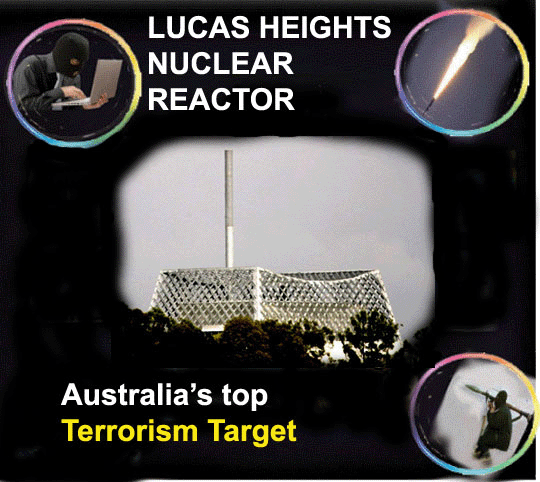
Security upgrades at Lucas Heights nuclear reactor not influenced by trespasser scare, SMH, August 25, 2015 Henry Belot Canberra Times Reporter
Security upgrades at Australia’s oldest nuclear reactor were not triggered by the arrest of five men caught loitering outside the site last year, according to officials.
The men were arrested and questioned in September after parking their vehicles within 100 metres of the security gates to the Lucas Heights reactor in southern Sydney.
The group were eventually released without charge but their actions led police to question why they had strayed onto restricted Commonwealth land.
In response to a question on notice, Australian Nuclear Science and Technology Organisation chief executive Dr Adrian Paterson said security upgrades in October were not prompted by the scare.
“Control room operations were outsourced to one of Australia’s largest security firms with significant expertise and experience in control room monitoring,” an ANSTO spokesman said.”ANSTO’s first responder safety function was also outsourced to a private company.”
The spokesman said both changes were made after a detailed review of security arrangements and after consultation with the Australian Federal Police. “The changes have been successfully implemented and are delivering improved operational outcomes as well as cost savings,” he said.
“The AFP continues to be responsible for the 24-hour-a-day physical protection of the ANSTO site as well as armed first response.”
Dr Paterson said ANSTO received regular briefings from the intelligence community and their security posture could be strengthened quickly in response to specific threats……..
In 2001, Greenpeace activists gained entry to the Lucas Heights complex and unveiled banners claiming nuclear power was “never safe”…….
. The Lucas Heights site will also receive a shipment of radioactive waste returned to Sydney from France this year, after being sent to Europe for processing in the 1990s.
According to legal requirements, the waste must be returned from France by December with more waste set to be returned from Britain in 2017……….
ANSTO marketing material states the returning waste is equivalent to one third of a shipping container.
The cost of transferring waste from Britain is expected to cost nearly $27 million over four years, while the return of waste from France has been funded in budgets since 2010…….. http://www.smh.com.au/national/security-upgrades-at-lucas-heights-nuclear-reactor-not-influenced-by-trespasser-scare-20150825-gj71pv.html#ixzz3jrTJrpgg
Australia’s bushfire and flood danger, as climate change accelerates
 Climate system changing faster than expected: Climate Council, ABC Radio Angela Lavoipierre reported this story on Tuesday, August 25, 2015
MICHAEL BRISSENDEN: The Climate Council says the case for the link between climate change and severe weather events has become much stronger. In a new report the Council states that the world’s climate system is changing more rapidly than expected.
ANGELA LAVOIPIERRE: The Climate Council’s report gives a snapshot of the changes so far to Australia’s climate, as well as changes it expects over the coming century.
The Council’s professor Will Steffen paints a grim picture.
WILL STEFFEN: One of the things that we can say is that we’re already seeing some impacts. Heat waves are lasting longer and starting earlier.
We’re seeing in the south-east of the country high bushfire danger weather has increased significantly over the last 30 years. We’ve seen that sea level has risen about the global average around Australia. That’s led to a threefold increase in coastal flooding.
ANGELA LAVOIPIERRE: And then, there’s what’s to come.
WILL STEFFEN: If we keep, if the globe keeps emitting fossil fuel emissions like we are now, we could see up to a metre of sea level rise around Australia. That could for example make a one in a hundred year flooding event in Sydney a daily event……..http://www.abc.net.au/am/content/2015/s4299445.htm
1 This month
17 October, Free Public Talk on Nuclear Issues in South Australia
David Noonan will speak on public interest concerns over the new Roxby Downs Indenture Act 2026 on BHP copper-uranium mining and ore processing in SA, and on how AUKUS may face SA with a High-Level nuclear waste agenda.
Dr Jim Green will discuss international developments in the field of nuclear power including ‘small modular reactors’ and Generation 4 ‘advanced’ nuclear reactor concepts.


Help Aunty Sue Protect Her Land and Sacred Sites From Destructive Rocket Testing.
.

Australians deserve the truth
about
AUKUS – https://aukuspublicinquiry.com/

PETITION – To: Prime Minister Anthony Albanese and the Australian Labor Government

of the week – Australians for War Powers Reform (AWPR)
To see nuclear-related stories in greater depth and intensity

