Australian submariners to train onboard British nuclear-powered submarines under AUKUS deal
ABC, By Jack Hawke in London, 1 Sept 22,
Australian submariners will train onboard British nuclear-powered submarines for the first time in the latest announcement under the AUKUS security pact.
Key points:
- Royal Australian Navy submariners will train with British Royal Navy counterparts on nuclear-powered subs
- Australia will be provided with its own nuclear-powered submarines under the AUKUS agreement
- Defence figures have warned Australia is facing a capability gap because of ageing submarines
Under the deal, Royal Australian Navy sailors will join their British counterparts on the Astute-class submarines after completing specialised nuclear training courses.
Defence Minister Richard Marles met with British Prime Minister Boris Johnson and Defence Secretary Ben Wallace on Wednesday in Barrow-in-Furness in England’s north-west to attend the commissioning of the latest Astute-class submarine, the HMS Anison.
Mr Marles said Australia was “eager to learn from our counterparts”.
……………………………………. But where exactly the new submarines will be built and whom will build them will not be revealed by the federal government until at least March next year.
Concerns have also been raised by some defence experts over the timeframe for the delivery of the next generation submarines, which may not happen until the 2040s…………….. https://www.abc.net.au/news/2022-09-01/australian-submariners-to-train-on-british-nuclear-submarines/101389052
AI Group Unveiled: a propaganda service for Defence, big business and the Coalition
Michael West Media, by Michael West | Jul 22, 2020 ,
Is AI Group just a front for big business and foreign weapons manufacturers? Michael West reports on the rise of government and business propaganda outfits who are suddenly mute when the subject turns to the delicate matter of who funds them.
“Given the tone of the questions and misspelling of Willox you can list it as “no response”,” sniffed Tony the PR man for AI Group.
“Dang!” we muttered … “Willox, Willox, Willox. No “c”!”
And two “ns” in Innes too! This was indeed a grave error, a double-banger, getting the name of a PR guy wrong in an email to a PR guy. Unforgivable!
Albeit unsurprising. Lobbyists are famously taciturn when it comes to the subject of their own affairs, even as their views are plastered weekly across national media.
Our questions were about who funded them and how much of their hefty $72 million in annual revenue comes from big business, multinational weapons makers and the Government itself.
These questions are important because AI Group and other lobbyists such as the Australia Strategic Policy Institute (ASPI) are sermonising constantly about the way governments and everybody else should be conducting their affairs.
ASPI too is largely funded by foreign defence contractors and the Federal Government. It was little surprise therefore that, hard of the heels of Prime Minister Scott Morrison’s urgent yet vague warning earlier this month that Australia was the victim of menacing cyber attacks, it was ASPI which promptly named China as the culprit and affirmed the urgent nature of the unnamed threats.
Looking at the 2019 financial statements for AI Group, which you will not find on its website, the “peak employer organisation” made $14.3 million from Federal Government contracts last year, which rather helps explain why it is rare to see any criticism of government policy, other than a spot of whining at decisions which do not favour big business enough.
It is by no means alone in this. The Big Four consulting firms Deloitte, EY, PwC and KPMG are in the same boat, reeling in some $700 million in fees annually by consulting to the Government.
On top of its taxpayer take, AI made $38 million from “consulting, management services and training businesses”. So, not only is AI a lobby group but it is also is running businesses for profit, even a law firm while it pays no income tax.
This self-appointed not-for-profit (NFP) is sitting on cash and liquid assets of $76 million and it notched up income of $72 million last year. What did it spend it all this money on?
Some $55 million went on employees. The next biggest item was “Communications” at $5.6 million. They do do a lot of communicating and when it comes to having their voice heard in mainstream media, AI – and particularly its chief executive – Willox are slick operators, perhaps the best in the business lobby.
But unlike the Business Council of Australia, the Minerals Council, and think tanks such as the Sydney Institute and the Institute for Public Affairs (IPA), they actually get large government consulting deals as well as running profitable businesses.
In this, they are similar to the NSW Business Chamber, which boasts revenues of $237 million a year, also runs a law firm and vocation businesses and is even a registered charity…………………………………………..
 |
Australian government working with pro-nuclear zealot Jonathon Mead to plan US/UK nuclear submarines for Western Australia.
Australia’s defence forces investigating Garden Island nuclear submarine capabilities. Peter Law, The West Australian, Fri, 26 August 2022,
The strategic review of Australia’s defence forces is investigating the capacity of HMAS Stirling at Garden Island to simultaneously receive multiple nuclear-powered submarines from the US and UK.
The Henderson maritime precinct, south of Perth, has also been identified as a potential site for maintenance work on Australia’s planned nuclear submarine fleet, former defence minister Stephen Smith revealed.
Mr Smith and retired Air Chief Marshal Sir Angus Houston were earlier this month appointed to lead the sweeping review of the army, navy and air force, which will report to the Albanese Government by next March.
Speaking at the Indian Ocean Defence and Security Conference in Perth on Friday, Mr Smith said a draft report with initial findings would be given to Defence Minister Richard Marles on November 1.
Mr Smith said the review was working “hand in glove” with a separate task force chaired by Vice-Admiral Jonathan Mead, which is looking at the options for Australia acquiring a nuclear submarine powered capability.
The pair this week visited Garden Island to see what infrastructure improvements were needed in the short and long term, “if a number of nuclear submarines, UK or US, would arrive at HMAS Stirling tomorrow”.
“We also are interested in, ultimately, on the basis that at some stage Australia acquires nuclear submarines, what potential do we have for maintenance and sustainment on the Henderson maritime strip,” he said.
Similar visits will take place in Port Adelaide and Brisbane in coming months, as well a tour of the nation’s “northern and western approaches”, including at RAAF bases Curtin and Learmonth………………….. https://thewest.com.au/news/wa/australias-defence-forces-investigating-garden-island-nuclear-submarine-capabilities-investigated-c-8018706
Ranger Mine uranium-contaminated waste trucked to Darwin suburb.
finding 50 kg of uranium tailings waste off-site is not a “small scale” event as claimed by ERA, and near three months for this radioactive event to make the media…
Potentially ‘deadly’ toxic waste accidentally trucked into Darwin
Energy Resources Australia is investigating how Ranger Mine toxic waste came to be transported through the Kakadu National Park and left on a truck in a Darwin suburb.
In June an excavator at Ranger Mine used to dig uranium tailings, was removed from the site with 50kg of mixed material still inside the vehicle.
The removal of any toxic waste is a major breach of Energy Resources Australia’s Ranger Mine rehabilitation plan as it poses a deadly contamination risk to people and the environment.
According to Energy Resources Australia the compacted waste was in a steel encased void of an excavator and not detected by radiation screening before leaving the site………………………
Supervising Scientist Keith Taylor said the breach was “regrettable” but he was confident there was no risk posed to people or the environment.
“There have been other incidents of this nature, most notably the 2004 prosecution which is of public record,” he said.
“There have been others as well but that is the most notable.”
Mr Taylor said scientists and ERA were working together to review the ‘clearance processes,’ which includes a radiation screening.
Mirarr Traditional Owners and the NLC were made aware of the incident on June 3.
In February, ERA announced the rehabilitation plan for Ranger Mine had blown out to an estimated $1.2bn.
It left the company scrambling for cash and relying heavily on its major shareholder Rio Tinto.
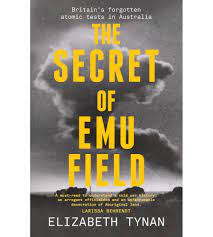
Nuclear bomb tests at Emu Field remain obscured by Maralinga and the mists of time
https://www.abc.net.au/news/2022-08-24/nuclear-testing-at-emu-field-featured-in-new-book/101329172 ABC Radio Adelaide / By Daniel Keane, 22 Aug 22,
In hindsight, Michael Parkinson’s TV talk show hardly seems the likeliest forum for sober reflection on nuclear annihilation.
But in 1971, the celebrity interviewer welcomed onto his celebrated stage journalist James Cameron, a man who had, 18 years earlier, witnessed the first atomic blast at Emu Field in outback South Australia.
Nuclear weapons, he told Parkinson, were “the ultimate punctuation mark” in humanity’s “progress towards perdition”.
The words echoed his front-page report for The Age on October 16, 1953 — the day after the test:
“The familiar mushroom column climbed unsteadily for 15,000 feet, leaned and dropped, and the world stumbled one more step towards the twilight.”
Codenamed Totem, the two Emu Field bomb tests have, in the view of James Cook University author Elizabeth Tynan, been regarded for too long as mere precursors to the more notorious detonations at Maralinga.
Her new book seeks to correct this by establishing Operation Totem as a portentous episode in its own right.
“The tests there pre-dated Maralinga by three years and they caused enormous difficulty and disruption and tragedy to the Aboriginal people of the Western Desert,” Dr Tynan said.
The Secret of Emu Field is the product of extensive archival excavation, including in the United Kingdom.
Amid Cold War hardships and anxieties, British officials were desperate to develop an affordable nuclear arsenal for their new fleet of jet bombers.
“They were looking to create a workable weapon; I call it the austerity bomb,” Dr Tynan said.
“They wanted to do it quickly because they had the V bombers coming, they had a number of political pressures and geopolitical pressures as well.”
Among several remarkable occurrences at Emu Field was the flight of a Royal Air Force Canberra bomber through the Totem 1 mushroom cloud barely six minutes after detonation.
“In colour it was a dark red-brown,” Wing Commander Geoffrey Dhenin, who enthusiastically piloted the plane, later wrote.
“Until just before we emerged, the forces on the elevators increased to such an extent that I thought I might lose control.”
One of the aims of that mission was to determine the threat from fallout in atmospheric testing to commercial airline traffic.
In an unforeseen irony, the atomic cloud from Totem 1 — which kept its mushroom shape “for 24 hours because of wind conditions” — was spotted by airline passengers passing over Oodnadatta.
The black mist
Today, it isn’t a cloud but a mist that remains one of the few aspects of the Totem tests to endure in the collective consciousness.
The so-called “black mist” was reported by nearby Aboriginal communities, but it wasn’t until a 1980 report by The Advertiser that it came to public attention.
The 1985 royal commission into British nuclear tests was equivocal on the health effects, but concluded that “Aboriginal people experienced radioactive fallout from Totem 1 in the form of a black mist or cloud at and near Wallatinna”.
Bruce Lennon was a young boy at the time and likened the impact to “having a really bad flu”.
“We were close to Emu Field; dad was a contractor, we did a lot of moving around,” he said.
Also in the area, at Mabel Creek station, was the family of Sister Kenise Neill.
“My father at the time of the Emu Field [tests] would have been 22. There’s a story that my grandmother used to tell about him,” she recalled.
“He was out fencing with Aboriginal people around the station and came home covered in a black, slimy, greasy stuff.”
Murray Neill was 24 when he died in 1956.
His daughter said it was now almost impossible to know whether the story told by her grandmother was an account of fallout.
“I didn’t really know about Emu Fields … and because our family had left before the [later] Maralinga testing, it didn’t make sense,” Sister Neill said.
“I presumed the black fallout with my dad wasn’t nuclear.
“It’s really only through reading Elizabeth Tynan’s book that I thought that my dad could have actually died from radiation.”
The persistence of secrets
The black mist may have dissipated, but other mists still cloud the Totem tests.
Dr Tynan said British files she inspected during her research had since been “withdrawn from public view”, and that there were unanswered questions about the second test and the plutonium fuel.
“The Operation Totem tests at Emu Field were intended as a comparative trial to test two different kinds of nuclear fuel,” Dr Tynan said.
I can’t say that I ever got to the bottom of what was happening with Totem 2. From the documents I’ve seen, [it] was a very, very secret weapon.”
By the time of the second test on October 27, James Cameron and the rest of the press pack had long since departed.
But the bomb had left its mark on Cameron’s mind.
In a piece published the day after he died, in the same year as the royal commission into British tests, Cameron reflected on the nuclear age with typical grace and resignation:
“I personally witnessed the explosion of atom bombs, and did nothing about it, and could do nothing except protest, tiresomely and uselessly.”
This article is the second in a two-part series, the first of which focused on the tests at Maralinga.
Refuting the nonsense by Sam Usher of the Australian Radioactive Waste Agency in favour of dumping nuclear waste at Kimba, South Australia
Mr Sam Usher
Chief Executive Officer
Australian Radioactive Waste Agency
Dear Mr Usher
I am amazed at the rather unconvincing and inaccurate comments bordering to some extent on outright silliness in your letter in the Sunday Mail of 14 August 2022 regarding the safety of the proposed nuclear waste facility at Kimba
While you claim that it will be a highly engineered and purpose-built facility the simple fact remains that it will struggle to get the necessary licences for its construction and operations since it fails to meet the basic prescriptions of the International Atomic Energy Agency (IAEA)
To begin with the location chosen for the facility is completely unsuitable as it is in the heart of prime agricultural land which will undoubtedly have a devastating economic and social effect on the region
What is more the whole environmental and geophysical setting of the Kimba region is completely inappropriate for the facility adding to the unsafe nature of the proposal
This situation will only be exacerbated by using an above the ground structure particularly with regard to the intermediate level waste which even for temporary storage should be geologically buried as the safest possible option
Considering that you speak of our country’s national interest most of your letter is confusing in its meaningless management speak and fails to provide any proper and accurate information mainly for the local community but generally for the Australian population
Your mention of the regulatory aspects of the nuclear industry in Australia is simply unconvincing when despite numerous requests the federal government has failed to give the Kimba community the technical and monetary assistance so that it can have its own independent assessment of the government’s proposals
Perhaps the most blatant failings by the federal government are that it has never developed a progressive safety case for the local community which is considered an undisputed necessity by international requirements and best practices and the persistent refusal to provide the community with the inventories of the radionuclides for the intermediate level waste intended to be stored at Kimba
You should in your capacity be well aware that the safety case must be started when a particular location is first considered for any form of nuclear installation and must fully involve the local community at the outset on a continuing basis so that it is kept properly informed of all aspects of the installation’s development
However the conduct and actions by the federal government in all its capacities including the so-called independent regulator in ARPANSA with regard to establishing the nuclear waste facility at Kimba are nothing short of disingenuity tantamount to a deprivation of human rights
Your letter stemmed from the fact that your Agency did not include any information on the transport of nuclear waste to and from Kimba in its environmental referral and study for the facility
Unless you mean that there is radioactivity in everything on this planet then your claim that nuclear or radioactive material has been transported safely around Australia for sixty years is simply wrong – perhaps you should tell me where most radioactive material is currently being transported within Australia excluding the uranium mines and I will then give you my answer
If your comments are not enough I understand from a relatively reliable source that you are now pushing the federal government to refuse a visit by the UNHCR special rapporteur mandated for nuclear waste and provide him with any pertinent information
I write of course with the knowledge and experience of the Azark Project facility at Leonora which in all respects including its relationships with and support by leading international experts on nuclear waste and the design and planning of the facility which is regarded as probably the best in the world and is light years ahead of the imprecise and grossly unacceptable efforts by the federal government and its various entities including your yet to be constituted agency
All I need to say is that you and your bureaucratic colleagues should stop playing your childish games clothed in sheer ignorance for Kimba – and in this I include ARPANSA – before you recklessly plunge its region into some nuclear disaster which will be completely beyond your competence and control
Yours sincerely
PETER REMTA 23 August 2022
Letter from Sam Usher Letter to the Editor Sunday Mail August 14th 2022
Nuclear Safety
I write in relation to “Alarm on nuclear waste transport” (Sunday Mail July 31st).
The National Radioactive Waste Management Facility will be highly engineered and purpose built, consistent with international best practice and Australia’s national interest.
It will safely and securely manage Australia’s radioactive waste, and protect heritage and environment during construction and operation.
There is no one application you can make to site, construct and operate the NRWMF in Australia.
Multiple applications are expected and have been prepared for across many years.
In line with this, there is an environmental application which relates to the construction, operations, decommissioning and closure stages.
The safe packaging for transport, and the routes will be assessed.
Subject to the highest of regulatory and safety standards, radioactive material has been safely transported around Australia and the world for about 60 years. The nuclear industry is, quite rightly, one of the most regulated in Australia, and we recognise and appreciate the role of regulators.
SAM USHER, Australian Radioactive Waste Agency chief executive officer
‘Reject the deadly logic of nuclear deterrence’
So, who is on board? More than 100 federal MPs and another 150 in state and territory parliaments, the Australian Greens, Labor and most other cross-benchers, including most of the new independents.
Two dozen unions, including the Australian Council of Trade Unions, more than 60 faith-based organizations, including the Australian Catholic Bishops Conference, the Australian Medical Association, dozens of civil society organisations and three quarters of the general public.
Fifty five former Australian Ambassadors and High Commissioners signed an open letter urging PM Albanese to fulfill Labor’s commitment.
Gem Romuld, August 21, 2022, Gem Romuld, the Australian Director at International Campaign to Abolish Nuclear Weapons, Australia, delivered this speech to the Sydney Hiroshima Day rally on August 8.
I want to acknowledge that First Nations people suffer the worst of nuclear technologies, not just nuclear weapons’ testing but all aspects of the nuclear chain, including uranium mining and radioactive waste dumping.
These struggles are ongoing today with threats of uranium mining at Mulga Rock in Western Australia, a radioactive waste dump planned for Barngarla land at Kimba, South Australia and the ongoing un-remedied impacts of 12 major nuclear explosions at Monte Bello in WA, Emu Field and Maralinga in SA, followed by hundreds of radioactive experiments — “the minor trials” —at Maralinga.
Today is a really important marker in time, one that we are keeping alive by gathering here.
What happened in Hiroshima and Nagasaki is why the vast majority of sensible people totally abhor nuclear weapons and want to see every last one decommissioned and dismantled.
Five years ago, the treaty banning nuclear weapons was created and last year it entered into force. It is something that experts, governments, diplomats and, even some activists, said could and would not happen.
But with strategy and persistence it did. Now, it has permanently altered the international legal architecture on nuclear weapons: it has raised the bar and all nations are measured against this powerful new standard.
Right now, the Treaty on the Prohibition of Nuclear Weapons has 86 signatories and 66 states parties, with those numbers going out of date regularly as more nations sign on.
Every new signature and ratification is a rejection of the deadly logic of nuclear deterrence and a bold expression of the alternative — human security without nuclear weapons.
The first meeting of states parties in Vienna in June was a big success that culminated in a Declaration and Action Plan, including 50 Points outlining practical ways members of the TPNW can “facilitate effective and timely implementation” of the Treaty articles and the Vienna Declaration commitments.
The second meeting of states parties will be in November-December 2023 at the United Nations in New York City. It will come around quickly. We need Australia to be at that meeting at least as a signatory, if not a state party.
Why is this treaty important?
It’s the first treaty to make illegal everything to do with nuclear weapons.
It completes the triad of bans on the three weapons of mass destruction: nuclear weapons; biological weapons and chemical weapons.
It is a powerful instrument of international law, as well as humanitarian law: it not only prohibits, but it also compels states’ parties to seek nuclear justice by assisting victims and remediating environments impacted by nuclear weapons.
In force as of January last year it is the ultimate test for all nations, including Australia. You are either against nuclear weapons or complicit with them.
Any nations that profess commitment to nuclear disarmament and nonproliferation but haven’t yet joined this treaty are exposed for their double-speak.
Under the previous federal government, prospects for this treaty were dire.
But Prime Minister Anthony Albanese and the Labor Party have committed to sign and ratify the Treaty on the Prohibition of Nuclear Weapons since 2018. Further, three quarters of all Labor MPs have personally pledged their commitment.
We all know that MPs make and break promises. But this is one we won’t let them break, will we?
Our efforts right now are critically important. We cannot for a minute drop the expectation that the government will do what it has promised. We have to be involved and keep up the pressure with MPs, councils, superannuation funds, unions and civil society organisations.
Like most meaningful change, it will take time and be hard won but we are well and truly on the way.
So, who is on board? More than 100 federal MPs and another 150 in state and territory parliaments, the Australian Greens, Labor and most other cross-benchers, including most of the new independents.
Two dozen unions, including the Australian Council of Trade Unions, more than 60 faith-based organizations, including the Australian Catholic Bishops Conference, the Australian Medical Association, dozens of civil society organisations and three quarters of the general public.
Fifty five former Australian Ambassadors and High Commissioners signed an open letter urging PM Albanese to fulfill Labor’s commitment.
We have all the right ingredients: the moment is ripe. We can get Australia to join the nuclear weapon ban treaty in this term of government.
Doing that will help other nuclear endorsing states resist the pressure of the nuclear-armed bullies. Slowly, they will be isolated and, eventually, one of them will begin the process of disarming.
CIA spying on Assange “illegally” swept up US lawyers, journalists: Lawsuit
Newsweek SHAUN WATERMAN ON 8/15/22 CIA surveillance of Wikileaks founder Julian Assange while he was sheltering in the Ecuadorian Embassy in London included recording his conversations with American lawyers, journalists and doctors, and copying private data from visitors’ phones and other devices, violating constitutional protections, according to a lawsuit filed Monday.
The suit – filed on behalf of four Americans who visited Assange – seeks damages personally from then-CIA Director Mike Pompeo for violating the plaintiffs’ Fourth Amendment rights against unreasonable search and seizure. The suit also seeks damages against a Spanish security firm contracted to protect the embassy, and its CEO, alleging that they abused their position to illegally spy on visitors and passed on the surveillance data they collected to the CIA, which is also named a defendant in the suit.
Legal experts, including a former senior intelligence official, told Newsweek that the allegations in the lawsuit, if proven, show the CIA crossed lines drawn to protect American citizens from surveillance by overzealous intelligence agencies………………………………………………..
The suit cites evidence gathered in a preliminary criminal inquiry by the Spanish High Court, launched after whistleblowers came forward from the Spanish firm hired to provide physical security for the embassy. The firm and its CEO are under investigation for alleged violations of Assange’s privacy and the confidentiality of communications with his lawyers – both of which are guaranteed by EU law.
The plaintiffs in the U.S. suit – filed in federal District Court in New York – are two New York attorneys on the Assange international legal team and two American journalists who interviewed him. A U.S. doctor who conducted medical interviews with Assange about his mental state chose not to join the lawsuit but told Newsweek he was subjected to the same surveillance. The surveillance also swept up visits from a U.S congressman and celebrities such as model and activist Pamela Anderson.
“As a criminal attorney, I don’t think that there’s anything worse than your opposition listening in on what your plans are, what you intend to do, on your conversations. It’s a terrible thing,” said the lead plaintiff, attorney Margaret Kunstler, a member of Assange’s U.S. legal team. “It’s gross misconduct,” she added, “I don’t understand how the CIA … could think that they could do this. It’s so outrageous that it’s beyond my comprehension.”
New York-based attorney Richard Roth, who filed the suit, said, “This was outrageous and inappropriate conduct by the government. It violated the most profound privacy rights” of the plaintiffs and others who visited Assange in the embassy.
And the violation is worse, Roth added, because it included “conversations of an absolutely privileged and confidential nature,” such as those with his lawyers, and the “theft of data” from devices owned by people such as journalists and doctors who rely on confidential relationships with their sources and patients.
“All my conversations with Julian Assange were covered by doctor-patient confidentiality,” said Sean Love, a physician and faculty member at Johns Hopkins, who visited Assange twice in 2017 to conduct a study of the effects of his confinement on his physical and mental health………………………………
The privacy of other American visitors not party to the lawsuit was also violated, according to copies of surveillance material turned over to the Spanish court and reviewed by Newsweek. Every visitor had their passport photocopied and most seem to have their phones photographed. Among the visitors subject to surveillance was then-California GOP Rep. Dana Rohrabacher, who was trying to negotiate a deal for a presidential pardon for Assange. .Washington Post reporter Ellen Nakashima’s phone was photographed and a detailed written account of her visit (revealing that she removed the battery from her phone before handing it over) was prepared by embassy security guards. Anderson’s passwords for her email and other accounts were included in surveillance photographs allegedly sent to the CIA, according to disclosures by Spanish whistleblowers.
Email messages sent to Anderson’s foundation requesting comment were not returned.
Apart from the constitutional violations against Americans swept up in the surveillance, the sheer magnitude and sensitivity of the material obtained by U.S. authorities may make it impossible for Assange to get a fair trial, Roth said. In addition to the surveillance, after the Ecuadorian government allowed British police to enter the embassy and arrest Assange, it publicly turned over all his legal papers and computer equipment to the U.S. Department of Justice.
“When a federal prosecutor comes after a lawyer with a search warrant and seizes their devices, there are multiple layers of review and protection for privileged lawyer-client communications,” Roth said. The court might appoint a special master – typically a retired judge or a senior attorney independent of the government – to oversee the process and ensure that privileged communications were segregated from those collected for the prosecution.
“None of that happened here. They just grabbed everything.”
…………………………………………………………………………………. Anyone who visited was required to leave their phones and other electronic devices with security guards at the embassy, according to the lawsuit.
“Julian’s visitors weren’t allowed to bring their devices into the embassy, nothing that could photograph or record or connect to the Internet,” WikiLeaks media attorney Deborah Hrbek, the other attorney suing, told Newsweek. “We turned them over to the security guards. We thought they were embassy personnel. We believed it was a measure to protect Julian.”
In fact, the guards were contractors, working for the Spanish private security firm UnderCover Global. Engaged by the Ecuadorian government to provide security for the embassy and its long term houseguest, UC Global in 2017 began secretly also working for U.S. intelligence, according to the lawsuit, citing evidence compiled by the Audiencia National, the Spanish High Court.
UC Global CEO David Morales returned from a Las Vegas security convention in early 2017, telling colleagues they were now working “in the big leagues,” “for the dark side,” and with “our American friends,” according to whistleblower testimony from former UC Global employees. The testimony says it became clear over the subsequent weeks and months that he was being paid substantial sums of money to share surveillance data with the CIA…………………………………………………………………………………….
The suit is directed against Pompeo personally because U.S. law and the Constitution make it difficult to sue executive branch agencies for damages, said Robert Boyle, a constitutional law attorney who consulted with Roth on the suit.
A 1971 Supreme Court judgment “made it possible to personally sue government officials for violations of certain constitutional rights,” he said……………………………………………
The surveillance revealed by the Spanish courts was likely “the tip of the iceberg,” said lead plaintiff Kunstler. “We happen to have discovered that. Who knows what else they were up to?”
https://www.newsweek.com/cia-spying-assange-illegally-swept-us-lawyers-journalists-lawsuit-1731570—
Richard Marles reaffirms Australia’s commitment to the one-China policy and ‘stabilising’ Canberra-Beijing relations
The Defence Minister and acting Prime Minister reiterated Australia’s support for the one-China policy and said its principal motive was to see a “de-escalation of tensions” in the Taiwan Strait.
Sky News Miriah Davis, Digital Reporter, August 14, 2022 –
Richards Marles has reaffirmed Australia’s commitment to the one-China policy as Canberra moves towards “stabilising” its relationship with Beijing.
Speaking with Sky News Australia’s Kieran Gilbert on Sunday, the Defence Minister and acting Prime Minister said Australia’s principal motive was to see a “de-escalation of tensions” in the region.
“What we want to see is a return to normal peaceful behaviour what underpins that, from Australia’s point of view, is not wanting to see any unilateral change to the status quo across the Taiwan Strait,” he said.
“That means we have a one-China policy that’s been the status quo in Australian policy, and indeed for the United States and other countries, for a very long period of time.”
Under Australia’s version of the one-China policy Taiwan is acknowledged as a province of China and is not recognised as its own country, however, the policy allows for unofficial contact including visits from MPs on parliamentary delegations.………………………………………………….
Traditional owners seek documents in nuclear dump case
The Transcontinental. By Tim Dornin, August 15 2022 ,
Traditional owners have asked for wide-ranging access to federal government documents as part of their efforts to block the construction of a nuclear waste dump in South Australia.
The Barngarla Determination Aboriginal Corporation is engaged in Federal Court action seeking to stop the proposed dump at Napandee, near Kimba on the Eyre Peninsula.
On Monday their lawyers outlined the reasons why the government should hand over a considerable volume of material it relied on in choosing the site and in preparing supportive legislation.
Some of the most contentious material related to correspondence the applicants contend must have taken place between then resources minister Keith Pitt and his department.
Others related to commitments the previous government made not to impose the dump on an unwilling community.
But the Commonwealth argued the Barngarla had been given a “complete record of the decision-making process” and what was being asked for went far beyond an orthodox judicial review.
“They should focus their efforts upon minister Pitt’s conduct rather than essentially seeking to have a royal commission into the cacophony that surrounds the drafting of legislation and the announcement of particular political decisions,” the court was told.
Justice Natalie Charlesworth indicated she was mindful to allow discovery of some of the material, regarding it relevant to the case.
However, she asked the parties to negotiate further to potentially narrow the scope of the documents being sought, particularly in two of the seven categories outlined.
Justice Charlesworth also cautioned that while production of the documents might be ordered, whether or not they proved admissible in the substantive case, now likely to be heard in March next year, was yet to be determined.
The case will return to court next week.
The Barngarla launched their action last year seeking to overturn the coalition government’s decision to develop the dump by quashing the ministerial declaration.
The corporation also recently wrote to new Prime Minister Anthony Albanese urging him to scrap plans for the dump.
It said the previous federal government had tried to silence the traditional owners at every turn, denying their right to participate in a community ballot to gauge local support for the site.
The corporation said the coalition also refused access to the land to undertake a proper heritage survey and tried to remove its right to judicial review.
Ahead of Monday’s hearing, Barngarla chairman Jason Bilney said it was hoped the new federal government would quickly realise how badly the former government handled the project.
“We fought 21 years to win our native title and if we have to fight 21 years to stop this nuclear waste dump damaging our country, then we will have to do it,” he said…… more https://www.transcontinental.com.au/story/7861791/traditional-owners-seek-docs-in-dump-case/
How even small nuclear war would kill billions in apocalyptic famine
https://www.9news.com.au/national/even-small-nuclear-war-would-kill-billions-from-famine/0aadd094-e5be-471f-8278-b8bf485f759a By Mark Saunokonoko • Senior Journalist Aug 16, 2022,
Australia may be the best place in the world to shelter if nuclear war broke out, a study has predicted, although an “influx of refugees” from Asia and other regions would likely rush the country to try and survive the atomic holocaust.
Various apocalypse scenarios showed even a small nuclear war would cause devastating climate chaos, plunging the world into mass famine and starving billions to death.
The study estimated more than 2 billion people would die from a contained nuclear war between India and Pakistan, while more than 5 billion around the world would perish inside two years if the US and Russia launched thousands of nukes at each other.
Nuclear strikes on major cities and industrial areas would unleash massive firestorms, the peer-reviewed study said, injecting soot into the atmosphere, blocking sunlight from reaching the Earth’s surface and severely limiting food production.
Such catastrophic “soot loadings” would cause at least 10-15 years of disruption to global climate, researchers said.
As land and ocean food production faltered, and in the face of worsening hunger, the study said food exporting countries such as Australia would hunker down and hoard supplies.
“Wherever there’s scarcity, you start to see more conflicts,” Dr Ryan Heneghan, a co-author of the study from Queensland University of Technology, told 9news.com.au.
“Whether that makes Australia a (post-nuclear war) target, I don’t know.”
Being a food exporter and its location in the southern hemisphere, away from likely conflict zones, were the key factors that meant Australia was able to weather a nuclear catastrophe better than most, Heneghan said, with New Zealand not far behind.
“Australia has some resilience if there were drops in food productivity because of changes in climate caused by a nuclear war,” he said.
“We already produce more than enough food for our population.”
But waves of migrants would inevitably put “pressures” on any Australian stockpiles.
One factor not included in the models, but which could seriously affect Australia’s ability to cope, was the country’s lack of domestic fuel supplies, Heneghan said.
“Australia isn’t energy independent.
“So we would probably have shortages of fuel.”
Australia, the planet’s sixth largest country after Russia, Canada, China, the US and Brazil, would face huge challenges trying to transport food from agricultural heartlands into big, densely populated urban centres, he said.
“Even though we might make enough food, we might not be able to move it to where it needs to go,” he said, calling that a “big caveat” to the study’s models.
Researchers modelled the impacts of six atmospheric soot-injection scenarios, based on one week of nuclear war, on crop and fish supplies and other livestock and food production.
Even if humans reduced food waste reduction and began to eat crops grown primarily as animal feed and biofuel, researchers predicted livestock and aquatic food production could not compensate for reduced crop output in most nations.
Any nuclear weapon detonation that produces more than 5 teragrams (5 trillion grams) of soot, such as 100 warheads fired between India and Pakistan, would likely cause mass food shortages in almost all countries, the study said.
A nuclear war between the US and Russia could send more than 150 teragrams of soot into the stratosphere.
The bushfires that swept across Australia in 2019-20 generated 0.3 – 1 teragrams of smoke, which swirled around the world and lingered for many months.
Nuclear power – never a realistic option for Australia.
Peter Dutton wants Australia to consider nuclear power. SBS News 13 Aug 22,

“…………………………………………. In one of his most significant policy moves as Opposition Leader, Peter Dutton has been agitating for a public discussion over nuclear power……… He announced the Coalition would be formally reviewing Australia’s potential to adopt “next-generation nuclear technologies”.
………………………….. Worldwide, there are mixed feelings on how much reliance should be placed on nuclear energy………………….
Could Australia have its own nuclear industry?
Climate Energy Finance director Tim Buckley said building a homegrown nuclear power industry would never be a realistic option for a country like Australia.
He said it was extremely costly to build, required expertise Australia doesn’t have, and the public would never be comfortable with the storage of radioactive waste.
“It would be very charitable to think that Australia could have a nuclear power plant operational in the next 10 or even 20 years,” he said.
“I would absolutely bet against that probability. And the only way you could do it is with $20 billion or $30 billion of government funding underwriting the project.”………………………………………….
Energy finance analyst Bruce Robertson said investing in conventional nuclear would be a waste of money for Australia.
“We’ve got no expertise in the construction of nuclear power plants, we’ve got no expertise in their operation.
“We don’t have lots of nuclear engineers – they don’t exist in Australia. So if we wanted to build a nuclear industry here, it’s going to take a very large upfront cost.”
Could Australia build a nuclear reactor?
Australia currently has only one nuclear reactor, which is a government-run facility at Lucas Heights in Sydney. That reactor doesn’t produce electricity – rather, it is mostly used to generate chemical elements used in medicine.
While Lucas Heights produces a comparatively tiny amount of nuclear waste, there has been fierce debate within Australia over where it should be stored. Mr Buckley said this would only intensify with commercial-scale nuclear energy.
“Nuclear is a very, very divisive topic in the energy space,” he said.
“It is clearly zero emissions – but it generates toxic waste, and there is no solution for that. There are a lot safer and cheaper alternatives.”……………………………..
Nuclear fusion

………………….. Dr Adi Paterson is the former chief executive of the Australian Nuclear Science and Technology Organisation – one of Australia’s largest publicly-funded research bodies. Now he is working with an Australian start-up called HB11, which aims to commercialise nuclear fusion technology.
While nuclear fusion is incredibly promising, it has also proved to be technically frustrating. Researchers are still struggling to create conditions in which nuclear fusion produces more electricity than it requires to run……………..
The world’s largest nuclear fusion reactor is currently under construction in southern France, at a cost upwards of $21 billion.
Some 35 countries, including Australia, have been involved in the construction of the ITER reactor, one of the most ambitious energy projects in the world. Plagued by construction delays, it is now expected to start powering up in 2025.
Mr Buckley said nuclear fusion could be useful in the long term, but would not be ready soon enough to solve the immediate problems caused by global warming.
“When I was in nappies 55 years ago, nuclear fusion was a decade away from commercialisation,” said Mr Buckley.
“And now – 55 years later – it’s still just a decade or two away from commercialisation.”
Nuclear bomb tests at Maralinga triggered Hedley Marston to study fallout over Australia
ABC Radio Adelaide / By Daniel Keane 10 Aug 22,
Hedley Marston could be charming, genial and witty but he was not above fulmination, especially where fulminations of a different kind were concerned.
In the mid-1950s, the CSIRO biochemist emerged as arguably the most significant contemporary critic of Britain’s nuclear weapons testing program, which was launched on Australia’s Montebello Islands almost 70 years ago in October 1952.
Despite the imminent anniversary Marston remains an obscure figure, but his biographer Roger Cross believes that should change.
“He appears to be totally unknown to the Australian public and, of course, to South Australians — he was a South Australian after all,” Dr Cross said.
Marston’s reservations about the nuclear program were far from spontaneous; indeed, his strongest concerns weren’t voiced until several years after the first test, when he recorded a radioactive plume passing over Adelaide.
The source of that plume was Operation Buffalo, a series of four nuclear blasts in 1956, and Marston was especially outraged by the fact that the general population was not warned.
“Sooner or later the public will demand a commission of enquiry on the ‘fall out’ in Australia,” he wrote to nuclear physicist and weapons advocate Sir Mark Oliphant.
“When this happens some of the boys will qualify for the hangman’s noose.”
What made Marston’s fury difficult to dismiss, especially for those inclined to deride opposition to nuclear testing as the exclusive preserve of ‘commies’ and ‘conchies’, was the fact that he was no peacenik.
Detractors might have damned him as an arriviste, but never as an activist: his cordial relations with Oliphant and other scientific grandees demonstrate that Marston was, in many respects, an establishment man.
Dr Cross has described Marston’s elegant prose as “Churchillian”, and the adjective is apposite in other ways.
While the roguish Marston might not have gone as far as the British wartime leader’s assertion that, during conflict, truth is so precious “that she should always be attended by a bodyguard of lies”, he had, in a 1947 letter to the editor, publicly defended scientific secrecy:
Under present conditions of fear and mistrust among nations it is obvious that military technology must be kept secret; and to achieve this end it should be conducted in special military laboratories where strictest security measures may be observed.”
But by late 1956, Marston’s alarm at radioactive fallout across parts of Australia was such that he was privately demanding greater disclosures to the general public.
Much of his ire was aimed at the Atomic Weapons Tests Safety Committee — a body established before the Maralinga tests, but after blasts had already occurred at Emu Fields* and the Montebello Islands.
“He was the only senior Australian scientist to express concerns and, because of his character, the concerns that he expressed were very forthright,” said Dr Cross, whose biography of Marston, aptly entitled Fallout, inspired the documentary Silent Storm.
“When the safety committee after each explosion said there was absolutely no effect on Australians, he believed that they were lying.”
‘If the wind changes, we need to go’
The experiments that led Marston, whose reputation largely rested on his expertise in sheep nutrition, to reach this conclusion were two-fold.
In the more protracted one, he analysed the presence of radioactive iodine-131 — a common component of nuclear fallout — in the thyroids of sheep.
“One group he kept penned up under cover eating dried hay, which had been cut some time before. The other group, he put outside eating the grass,” Dr Cross said.
“He tested the thyroids in each group – the ones on the hay only had background amounts of iodine-131.
“But the ones in the fields had a tremendously high concentration of this radioactive isotope, both north and south of the city.”
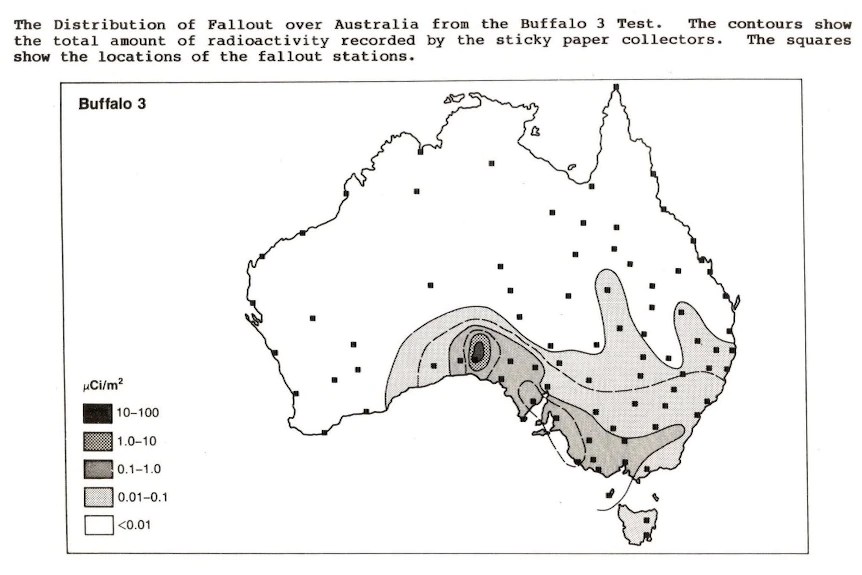
A fallout map from the 1985 royal commission, which stated that while fallout at Maralinga Village from the October 11, 1956, test was “considered to be ‘negligible from a biological point of view’ it does suggest difficulties with the forecast prior to the test”.(Royal Commission into British Nuclear Tests in Australia)
For the other experiment, Marston conducted air monitoring in Adelaide.
He was especially alarmed by what he found for the period following the Maralinga test of October 11, 1956.
“There was a wind shear and at least part, maybe the major part, of that cloud, blew in a south-easterly direction and that took it towards Adelaide and the country towns in between,” Dr Cross said.
“The safety committee — who must have known of the wind shear — had done nothing about warning Adelaide people perhaps to stay indoors.”……………………………………………………
Despite Marston’s reservations, the nuclear program carried on regardless.
Less than a year after the Operation Buffalo tests, Maralinga was hosting Operation Antler.
In September 1957, newspapers around Australia reported on an upcoming “second test” that would, weather permitting, proceed as part of a “spring series”.
If it hadn’t been for the presence of the words “atomic” and “radioactive”, a reader might easily have inferred that what was being described was as commonplace as a game of cricket.
|
Elon Musk’s SpaceX now leaving junk in our own backyard
Independent Australia, By Darren Crawford | 10 August 2022 After a SpaceX capsule crashed onto an Australian farm, we’re left wondering if Elon Musk will clean up his own mess, writes Darren Crawford.
ACCORDING TO the ABC, the Australian Space Agency (ASA) has confirmed that debris found in a sheep paddock in the Snowy Mountains region of New South Wales, Australia, belongs to Elon Musk’s SpaceX Dragon capsule, which was launched in November 2020.
Local authorities were alerted after nearby residents heard a loud bang earlier this year on 9 July. It is now thought the bang was the noise of the capsule re-entering the Earth’s atmosphere. New South Wales Police and the ASA visited one of the sites on Saturday 31 July and confirmed that two of the pieces are from a SpaceX mission.
According to the ABC, the ASA is continuing to engage with its counterparts in the U.S. as well as other parts of the Commonwealth and local authorities.
An ASA spokesperson said:
“The agency is operating under the Australian Government Space Re-entry Debris Plan which outlines roles and responsibilities for key Australian government agencies and committees in supporting the response to space re-entry debris.”
So who is responsible for the clean-up?
According to the ABC report, the space debris will remain in place for now. However, the pieces could eventually be returned to U.S. soil.
Australian National University’s Institute of Space deputy director Dr Cassandra Steer said there was an obligation under international space law to repatriate any debris to the country from where it originated.
Dr Steer went on to confirm that “Any space object, or part thereof, has to be repatriated” and should be sent back to the U.S. However, SpaceX has only confirmed that the debris is theirs and is yet to commit to the costs associated with returning it to the U.S.
Dr Steer added:
“We have clarity in terms of lines of responsibilities. The U.S. is liable for any damage that is caused by this space debris… and Australia could go to the U.S. and seek some form of compensation if there are any costs involved in cleaning it up.”
Elon Musk and SpaceX have a poor environmental record
As reported earlier this year, Elon Musk and fellow billionaires Richard Branson and Jeff Bezos are currently participating in a dick-swinging rocket contest to see who can get to Mars first. Suffering from massive rocket envy, these three men are speeding up the climate change process by increasing the amount of carbon dioxide and other gases in the Earth’s atmosphere with every launch.
The Guardian reports that one rocket launch alone can release up to 300 tons of carbon dioxide into the Earth’s upper atmosphere and it can stay there for years. This is in comparison to a standard long-haul flight which produces three tons of carbon dioxide per passenger/per flight, into the lower atmosphere.
These impacts do not include what happens on the ground during a launch, including the heat and noise pollution in the immediate area, or the impacts on local wildlife.
There appear to be few controls put in place to protect the planet and its inhabitants from falling space junk by Elon Musk and SpaceX. In March 2021, a SpaceX rocket blew up on launch and debris was scattered throughout the protected area. According to a local non-profit environmental group, it took three months to clean up the mess.
According to the report, launch site ditches on SpaceX land and public property in the U.S. have dumped runoff water directly into the tidal flats threatening local fish breeding grounds, and public beaches and roads have been closed for longer than the agreed times.
Finally, at an earlier launch in 2018, a jettisoned SpaceX booster rocket missed its target drone ship a few hundred kilometres out to sea and destroyed itself on impact slamming into the ocean at 500 km/hour.
So, will Elon Musk and SpaceX clean up their mess down under?
This is the great unknown, as Elon Musk’s environmental record in relation to his SpaceX program is extremely poor.
It is also clear, as can be seen by his recently abandoned Twitter purchase, that Elon Musk doesn’t care who he burns, or how hard he burns them, to get his own way.
It is apparent that Elon Musk sees the increasing amount of pollution produced by his SpaceX endeavours as little more than collateral damage and less of a threat to our civilisation. Similarly, he doesn’t care whose backyard he trashes (as long as it’s not his, obviously).
Instead of turning his immense intelligence (and wealth) to solving our current problems, Elon Musk (and his billionaire space mates) seek to exacerbate these problems by polluting the planet further.
It will be interesting to see whether he does the right thing by the Australian Government and its people and pays for the clean-up of his mess.
Update, 10 August 2022:
The ABC is reporting that SpaceX has confirmed that the space debris spread throughout an Australian sheep paddock is indeed remnants of their Dragon Capsule and is sending a team down under to investigate………………………….
What was not stated was whether any ASA or government agencies were aware of or engaged in any of SpaceX’s planning. Space Law Lecturer at UNSW Canberra, Duncan Blake, wondered if they had coordinated with Australian agencies prior to their risk assessment — “If they didn’t, then that seems somewhat arrogant to make a decision that affects Australia without consulting Australians,” he said.
There has been no mention of the cost of removal or the debris, or as to whether Elon Musk and SpaceX will be more honest and open in the future and advise all Australians about the potential damage falling SpaceX junk may cause in their country.
https://independentaustralia.net/environment/environment-display/elon-musks-spacex-now-leaving-junk-in-our-own-backyard,16650
1 This month
7 April – WEBINAR – Australia and the Doomsday Clock – Preventing nuclear war through NoFirstUse and other policies
Online | Tuesday April 7, 4:00-5:30pm, Australian Eastern Time / 8:00-9:30am Central Europe Time
– Access the registration link
15 April – Zoom –Nuclear Power is Not the Solution
Apr 15, 2026 01:00 AM in Canberra, Melbourne, Sydney

Join the International Physicians for the Prevention of Nuclear War (IPPNW) on Tuesday, April 14th for a timely webinar exploring the risks associated with nuclear power and challenging the myth that it offers a simple, safe, carbon-free solution to the climate crisis

21 April Webinar: No Nuclear Weapons in Australia
Start: 2026-04-21 18:00:00 UTC Canberra, Melbourne, Sydney (GMT+10:00)
End: 2026-04-21 19:30:00 UTC Canberra, Melbourne, Sydney (GMT+10:00)
Event Type: Virtual
A virtual link will be communicated before the event.
Host Contact Info: australia@icanw.org

of the week – Australians for War Powers Reform (AWPR)
To see nuclear-related stories in greater depth and intensity
 Antinuclear