Small Nuclear Reactors for Australia would require same planning as large, proponents conclude
INFRASTRUCTURE, GOVERNMENT AND RESOURCE REQUIREMENTS FOR BOTH LARGE AND SMALL MODULAR REACTOR POWER PLANTS IN AUSTRALIA PART 1- INFRASTRUCTURE 1,2 JAMES BROWN, 1,2 STEFAAN SIMONS and 1,2ANTHONY D. OWEN 1 International Energy Policy Institute (IEPI), UCL Australia, Adelaide, Australia 2 University College London, UK e-mail: james.c.brown@ucl.ac.uk
Abstract This paper considers the minimum infrastructure, construction and waste resource requirements for Australia to deploy both large reactors and small modular reactors to be licensed in the near term, including NuScale, mPower and Westinghouse SMR. The requirements for other types of small modular reactors are provided in some of the comparisons to broaden the range of estimates.
Preliminary estimates suggest that FOAK large and small reactor plants would likely have similar land, infrastructure, fuel and waste requirements per MWe capacity under current regulatory regimes.
This is somewhat in contrast to the perception that SMRs allow for faster approvals, siting and deployment of power plants requiring less infrastructure and resources. However, in the U.S. the development of regulatory approaches for SMR licensing continues, in order to take into account the various designs, modularity, collocation features, and size of the emergency planning zone (EPZ).
 This paper concludes that there are sound arguments for reducing the regulatory requirements due to the inherent safety features of new reactor designs.
However, it would be prudent, though, for governments to proceed with nuclear infrastructure and regulatory planning on the basis that the regulatory requirements for SMRs will not be significantly different to large nuclear power plants, until sometime after they have been commercially deployed.
While this paper acknowledges that SMRs may provide some financial benefits over larger reactors, it is argued that there is little difference in the scale of preparations required to develop Australia’s nuclear that there is little difference in the scale of preparations required to develop Australia’s nuclear power programme capabilities in the near term……..ttp://www.jnrd-nuclear.ro/images/JNRD/No.7/jnrd-7_art1.pdf
Australia loses jobs as the Abbott government attacks renewable energy
 By leaving the current target in place and providing an assurance that they support renewable investment the government could make a tangible and significant step to help restart an industry that will stimulate employment.
Renewable energy is popular, and job growth is essential. Committing to the existing Renewable Energy Target would be a good first step for policy makers on all sides to show they are serious about creating Australia jobs rather than fighting ideological battles.
This is occurring while renewable energy companies such as TrustPower, Infigen Energy and Pacific Hydro are suspending further investments in Australia because of the uncertainty around the RET. Continue reading
Minerals Council wants environmental groups to be stripped of charity status
 AUDIO: Minerals Council calls for green groups to be stripped of charity status ABC Radio The World Today Tim Lamacraft reported this story on February 16, 2015
ELEANOR HALL: The peak lobby for the New South Wales mining industry is calling for green groups to be stripped of their charity status. The Minerals Council says activists are masquerading as environment organisations and should not receive special tax treatment.
Critics say it’s an attempt to squash free speech.
Tim Lamacraft has our report……..
SIMON LONGSTAFF: When the NSW Minerals Council makes this claim, I’d really be cautious to know whether or not their membership supports this.
There’s some very large international companies, like BHP Billiton and Rio Tinto there, and I’d be quite personally surprised if they supported this kind of call.
The second thing I’d be wanting to think about is who’s actually making the call, and in the case of the Minerals Council from New South Wales, they are a body which is an industry association, they have an interest to promote things like subsidies, tax relief for mining and a whole lot of other benefits and clearly anything which seems to stymie the progress of their members……..
PHIL LAIRD: Minerals Council have had a history of trying to silence people who oppose different projects that are put up.
They’ve only just recently put a strategy in to try and remove the planning assessment commission in New South Wales, the independent decision maker, after two mines had been rejected.
What they see is how farmers and others who have a charity that’s working on their behalf to put forward their concerns about mining and for the Minerals Council this is something that they don’t want to see.
I think that these guys are trying to shut down free speech on behalf of multimillion dollar mining companies who are basically exporting our wealth overseas. http://www.abc.net.au/worldtoday/content/2015/s4180628.htm
Dr Jim Green – The SA Royal Commission and uranium enrichment
 Nuclear non-starter: Oversupplied, losing money and without a constituency, Climate Spectator, JIM GREEN 16 Feb 15 “… South Australian Premier Jay Weatherill announced a Royal Commission on February 8 to investigate options to expand the state’s involvement in the nuclear fuel cycle beyond uranium mining. There is some hope that a value-adding enrichment industry could compensate for the weakened uranium mining industry.
But the 2006 Switkowski report found that there was no realistic prospect of an enrichment industry in Australia, due to overcapacity at enrichment plants around the world. The SA Royal Commission will reach the same conclusion. Former World Nuclear Association executive Steve Kidd noted in Nuclear Engineering International in July 2014 that “the world enrichment market is heavily over-supplied”.
There are other reasons to be concerned about uranium enrichment … though it hardly matters given that it is an economic non-starter. Australia’s involvement in enrichment R&D began in 1965 with the ‘Whistle Project‘ in the basement of Building 21 at Lucas Heights, then run by the Australian Atomic Energy Commission. Those in the know were supposed to whistle as they walked past Building 21 and say nothing about the enrichment R&D. Why the secrecy? Because enrichment provides a direct path to nuclear weapons.
Forty years later, John Howard was likening uranium enrichment to value-adding to the wool industry. Perhaps Lucas Heights also had a secret program to knit woollen garments? Or perhaps not.
The enrichment R&D was publicly revealed in the Atomic Energy Commission’s 1967-68 Annual Report and plodded along until it was terminated in the mid-1980s. Nuclear power was growing steadily from the mid-1960s to the mid-1980s, yet Australia didn’t come close to establishing an enrichment industry. It’s hardly likely to happen when nuclear power capacity is stagnant, when the enrichment market is heavily over-supplied, when there is growing international momentum to curb the spread of sensitive nuclear technologies (enrichment and reprocessing), and when the atomic bomb lobby is far smaller and weaker than it was in the mid-1960s.
Clutching at straws, enrichment lobbyists argue that an Australian enrichment industry could supply nuclear power reactors in Southeast Asia. That argument would carry more weight if there were any power reactors in Southeast Asia.
Dr Jim Green is the national nuclear campaigner with Friends of the Earth, Australia. http://www.businessspectator.com.au/article/2015/2/16/energy-markets/nuclear-non-starter-oversupplied-losing-money-and-without
How come Tony Abbott is regarded as silly on everything else, but not on nuclear power?

Now why didn’t the mainstream media greet this one with a gale of laughter
South Australia’s nuclear inquiry is ‘a gale of commonsense’, Tony Abbott says Prime 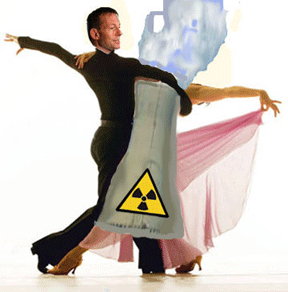
minister backs debate on use of nuclear energy in Australia and says: ‘If it’s right to mine it, why can’t it be right to use it?’ – http://www.theguardian.com/australia-news/2015/feb/15/south-australias-nuclear-inquiry-is-a-gale-of-commonsense-tony-abbott-says 15 Feb15
Autralian nuclear experts (nuclear advocates!) worried about uranium to India sales deal
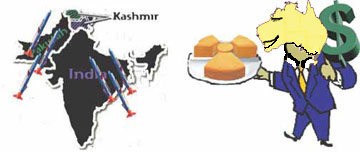 Risk Of Australian Uranium In Indian Nuclear Weapons Spark Worries, International Business Times, By Reissa Su on February 16 2015
 Australian uranium might end up in the hands of India as part of the country’s nuclear weapons program. Two experts on nuclear power believe the concessions agreed between the two nations could lead to this scenario.
Ronald Walker, a former Australian ambassador and chairman of the international Atomic Energy Agency, said the Abbott government’s deal to sell the country’s uranium to India has “drastically changed” Australia’s longstanding policy on safeguards. He added that the agreement has risked countries playing with nuclear weapons, reports The Guardian.
Risk of nuclear weapons building
Walker told a hearing of the parliamentary joint standing committee on treaties that deal with India is different from Australia’s 23 other uranium export deals. He believes the uranium agreement between Australia and India will only cause damage to the non-proliferation regime………. John Carlson, the head of the Australian Safeguards and Non-Proliferation Office between 1989 and 2010, shares the same view with Walker. He said it would be inexcusable for Australia to push through with the agreement. According to the provisions of the deal, Australian material can be used to make unsafeguarded plutonium that may potentially end up in India’s nuclear weapon program……..http://au.ibtimes.com/risk-australian-uranium-indian-nuclear-weapons-spark-worries-1421523
Australia’s uranium industry in a sick and sorry state
 Australia’s uranium industry is in a sick and sorry state. Production of 5000 tonnes in 2014 was the lowest for 16 years. The industry generates less than 0.2 per cent of national export revenue and accounts for less than 0.02 per cent of jobs in Australia (about 1200 jobs).
The Ranger open-cut mine in the NT has been mined out and the planned Ranger 3 Deeps underground mine is subject to doubt and delay. Energy Resources of Australia has posted losses for each of the past five years, totalling $500 million. The uranium industry in the NT may come to an end when the last of the Ranger ore stockpile is milled in two years time.
In South Australia, the planned expansion of the Olympic Dam copper-uranium mine was cancelled in 2012, and hundreds of workers have been retrenched by BHP Billiton since then. The Honeymoon mine has been put into care-and-maintenance. Beverley Four Mile started production last year, at the same time as the nearby Beverley mine was put into care-and-maintenance. Instead of the usual fanfare, The Advertiser reported: “South Australia’s newest mine will lose money and won’t create any jobs.”
Nuclear non-starter: Oversupplied, losing money and without a constituency, Climate Spectator, JIM GREEN 16 Feb 15 As discussed in Climate Spectator recently, some nuclear insiders and lobbyists are starting to confront the reality that the global pattern of nuclear power stagnation is likely to continue. With the number of ‘operable’ power reactors declining from 443 to 437 over the past decade, the rhetoric about a nuclear renaissance is becoming hard to sustain.
Similar opinions about the uranium industry are becoming increasingly common. Continue reading
Australia’s peak medical research agency put under pressure about wind farms
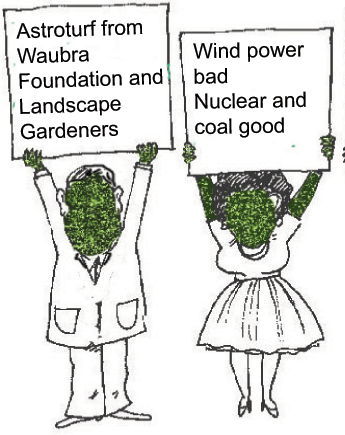 NSW, Victorian health officials objected to federal wind farm study conclusion, February 14, 2015 Peter Hannam Environment Editor, The Sydney Morning Herald Australia’s peak medical research agency recommended additional research into the effects of wind farms on health based on the “macro policy environment” rather than the scientific report they commissioned, ignoring objections from senior officials in the NSW and Victorian governments.
The NHMRC ought to be able to provide advice to government without fear or prejudice, but I’m not sure that it can
Peter Doherty, Nobe Prize winning researcher
According to emails seen by Fairfax Media, public health officers in the two states wanted the final statement accompanying the release of the National Health and Medical Research Council’s latest report on wind farms “to make it clear that the total available evidence (parallel and direct) suggest[s] little health risk.”……….
It is understood that the reference group of scientists that conducted the review did not get to review the statement.
The emails raise more doubts over the conclusions of the study ordered by the Abbott government, with the underlying report citing 1500 metres and three kilometres as possible distances of concern. So-called wind farm syndrome has been reported by some residents near turbines, with sleep deprivation, headaches and other effects reported.
“The NHMRC ought to be able to provide advice to government without fear or prejudice, but I’m not sure that it can,” Peter Doherty, a Nobel Prize-winning researcher, said…….
Greens senator Richard Di Natale said he was shocked at what appeared to be political interference.
“It’s scandalous and I’ll be following it up in the next Senate estimates. There’s a real concern here that we’re politicising what should be an independent science review.”
Higher priorities for the estimated $500,000 in funds to be allocated for the wind farm research include cancer, diabetes and many other subjects, Senator Di Natale said…….
Bruce Armstrong, chair of the study, said concerns over wind farm noise had “not come up through the normal scientific process.” http://www.smh.com.au/environment/nsw-victorian-health-officials-objected-to-federal-wind-farm-study-conclusion-20150213-13e8go.html
Crikey explores the purpose of a Royal Commission into Nuclear Power
Crikey clarifier: why is a royal commission investigating nuclear power? http://www.crikey.com.au/2015/02/13/crikey-clarifier-why-is-a-royal-commission-investigating-nuclear-power/ by Crikey Intern The South Australian Labor government has called for Australia’s first royal commission into the nuclear fuel cycle, raising questions about the use of nuclear power. Royal commissions are mostly held to explore issues and events that have already taken place, so it is unusual that a royal commission has been appointed to analyse the case for nuclear power. Why a royal commission? And is that really the proper forum to investigate the potential use of nuclear power?
Why is a royal commission being used instead of a normal inquiry process?
A royal commission is a form of “public inquiry” where government-appointed bodies provide advice on or investigate an issue. Royal commissions are used to analyse issues of high importance or controversy, and they can last for several years.
The royal commission itself follows a recent call by Julie Bishop for a renewed discussion about nuclear power, as she says it is an “obvious direction” for reducing greenhouse emissions.
The infamous nuclear disasters that took place in Chernobyl and Three Mile Island have made people wary of nuclear power, and there is concern nuclear power stations could be “potential targets for terrorist attacks”.
Energy expert Mike Sandiford told Crikey the “irrationality in nuclear debate” requires a mature discussion. Continue reading
Abbott government made dangerous concession to India, in its rush to sell uranium
A former Australian diplomat and chairman of the International Atomic EnergyAgency (IAEA), Ronald Walker, said the agreement to sell uranium to India “drastically changes longstanding policy” on safeguards and risked playing “fast and loose” with nuclear weapons.
It differed substantially from Australia’s 23 other uranium export deals and “would do damage to the non-proliferation regime”, Walker told a hearing of the parliamentary joint standing committee on treaties this week.
The prime minister signed an agreement to make Australia a “long-term, reliable supplier of uranium to India” in Delhi in September, but the terms of the deal are yet to be endorsed by the committee.
Walker’s concerns were echoed by John Carlson, the head of the Australian Safeguards and Non-Proliferation Office (Asno) between 1989 and 2010, who said proceeding with the agreement would be “inexcusable”.

Its provisions meant Australian material “could be used to produce unsafeguarded plutonium that ends up in India’s nuclear weapon program”, Carlson said………… Continue reading
Victoria’s Green Party has plan for boosting Renewable Energy
 Victorian Greens to use renewable energy group as bargaining chip with Labor http://www.theage.com.au/victoria/victorian-greens-to-use-renewable-energy-group-as-bargaining-chip-with-labor-20150211-13bzxm.html February 11, 2015 Richard Willingham State Political Correspondent for The Age The findings of a new Victorian renewable energy group to improve the sector will be used by the Greens as a bargaining chip in upper house negotiations with the Labor government.
The Greens have invited industry and experts to help tackle Victoria’s low investment in renewable energy, under a Greens plan.
Last year the Climate Council found that Victoria had the least favourable regulatory conditions of any Australian state for renewable energy.
Greens Melbourne MP Ellen Sandell is hosting a meeting next month with experts from the sector to address the state’s poor performance and has invited Premier Daniel Andrews and Industry Minister Lily D’Ambrosio. Both said they would not be attending.
The Greens, who hold five critical upper house votes, say the roundtable will produce a plan for how to bring jobs in clean energy to Victoria, accusing Labor of having no real plan for the sector at last year’s election.
Ms Sandell, who is energy spokeswoman, said the roundtable and its findings could be used as a bargaining chip in upper house negotiations.
“We have always said we will use our power to get the best outcomes for climate change and renewables however, we can. I’m starting by bringing renewables experts together and I hope the Premier listens to their recommendations,” Ms Sandell said.
“Despite incredible wind and solar resources, we have the most restrictive policy environment in the country, making it the worst place in Australia to invest in new energy sources.”
“As a result, we have the second lowest renewable energy capacity per capita of all of the states. Something has to change, and I’m determined to make it happen.”
Ben Courtice from Yes2Renewables said uncertainty around Australia’s renewable energy target had stalled investment in large-scale renewable energy projects.
“There is a real role for state governments to keep renewable energy’s share of our electricity use growing and sustain the industry into the future,” Mr Courtice said.
Invitations have been sent to Infigen, Solar Council, Metro Solar, Keppel Prince, local universities and Environment Victoria.
Over last 6 months, wind energy in Australia exceeded hydro generation
 Wind energy overtakes hydro for first time in Australia http://reneweconomy.com.au/2015/wind-energy-overtakes-hydro-for-first-time-in-australia-17364 [good graph] By Giles Parkinson on 12 February 2015 The Australian wind energy industry achieved a milestone in January, with wind generation exceeding hydro generation for the first time.
According to data compiled by Green Energy Markets, the wind industry boosted production to its highest level in six months -thanks to good wind speeds – while hydro generation fell sharply from previous years, mostly as a result of the carbon price repeal, which has removed much of the incentive for the hydro generators to increase production.
This graph below [in original] illustrates the change. In January, wind energy generated 893,352MWh, while hydro generated 884,730MWh.
The GEM data shows that NEM wind generators achieved more than 36 per cent capacity factor in the month of January, the highest level in six months.Wind farm generators such as Infigen Energy recorded significantly lower generation in the six months to December due to lower wind speeds.
As for hydro, the output from most generators (other than Dartmouth) is well below their average baseline levels at the end of January. Hydro generation from Tasmania in particular, is 38 per cent below levels at the same time a year ago – when hydro plants there generated a lot to take advantage of carbon price.
Total hydro generation over the last three months has been at its lowest level for more than three years. i.e. since before the carbon price was introduced.
However, the overall share of renewable energy in Australia in January fell to 11.7 per cent, compared to its peak of more than 18 per cent in August, September and October in 2013. The figure does not include the nearly 4,000GW of rooftop solar, which accounts for between two and three per cent of overall demand, although much of it is not metered.
Australians unaware of what they will lose with the Trans Pacific Partnership
Australia’s imminent TPP disaster: Crowning corporations, Independent Australia Dr Matthew Mitchell 13 February 2015, The controversial top-secret Trans-Pacific Partnership is due to be signed very soon and is likely to have negative impacts upon many areas of ordinary Australian’s lives without any financial gain whatsoever, writes Dr Matthew Mitchell.

The Trans-Pacific Partnership (TPP) is a global trade agreement being pushed by the United States onto nations around the Pacific. What is so disturbing about the TPP compared with other trade agreements is that it covers so many areas. Its breadth means it will affect many aspects not only of Australian business, but also of everyday Australian life. Continue reading
Australi’s electricity utilities making it as hard as they can for the renewable energy industry
Utilities hold renewables to ransom over coal pay-outs, REneweconomy By Giles Parkinson on 12 February 2015 Australia’s largest utilities are being accused of holding the renewable energy industry to ransom, by suggesting that they will not sign contracts for new large-scale renewable energy projects unless they are paid to close excess coal capacity. Continue reading
Uranium miner Energy Resources of Australia tight-lipped about its Ranger mine’s gloomy financial situation
 ERA keeps its Ranger delay very hush-hush BY CRAIG DUNLOP NT NEWS FEBRUARY 11, 2015 ENERGY Resources Australia has quietly delayed the expansion of the Ranger uranium mine, with work now set to commence at an unspecified date in 2016, rather than its original target date of late 2015.
The company, 68 per cent owned by mining giant Rio Tinto, made the announcement to the Australian Stock Exchange late on Friday.
“Dependent on the outcome of further work, and subject to board and regulatory approvals, first development ore for Ranger 3 Deeps is now expected to be in 2016,” the report said.
It also said that ERA was likely to require further investment for the expansion to go ahead.
The knock-on effects from the failure of a leach tank in 2013 continued to be felt until mid-2014, as the company was forced to purchase, and then onsell, uranium in order to meet its prearranged sales contracts.
The delay has pleased environmental groups, who have long objected to Ranger 3, with the Environment Centre NT and the Australian Conservation Foundation labelling the expansion plans “unviable”.
The Environment Centre NT’s Lauren Mellor said: “The delay on investment in the Ranger 3 Deeps project is a major setback for both Rio and ERA, with costs continuing to blow out and time running out for this short-term, high-risk venture.”………
- In light of the losses and the investment required in Ranger 3, the company’s directors have not issued a dividend.
1 This month.
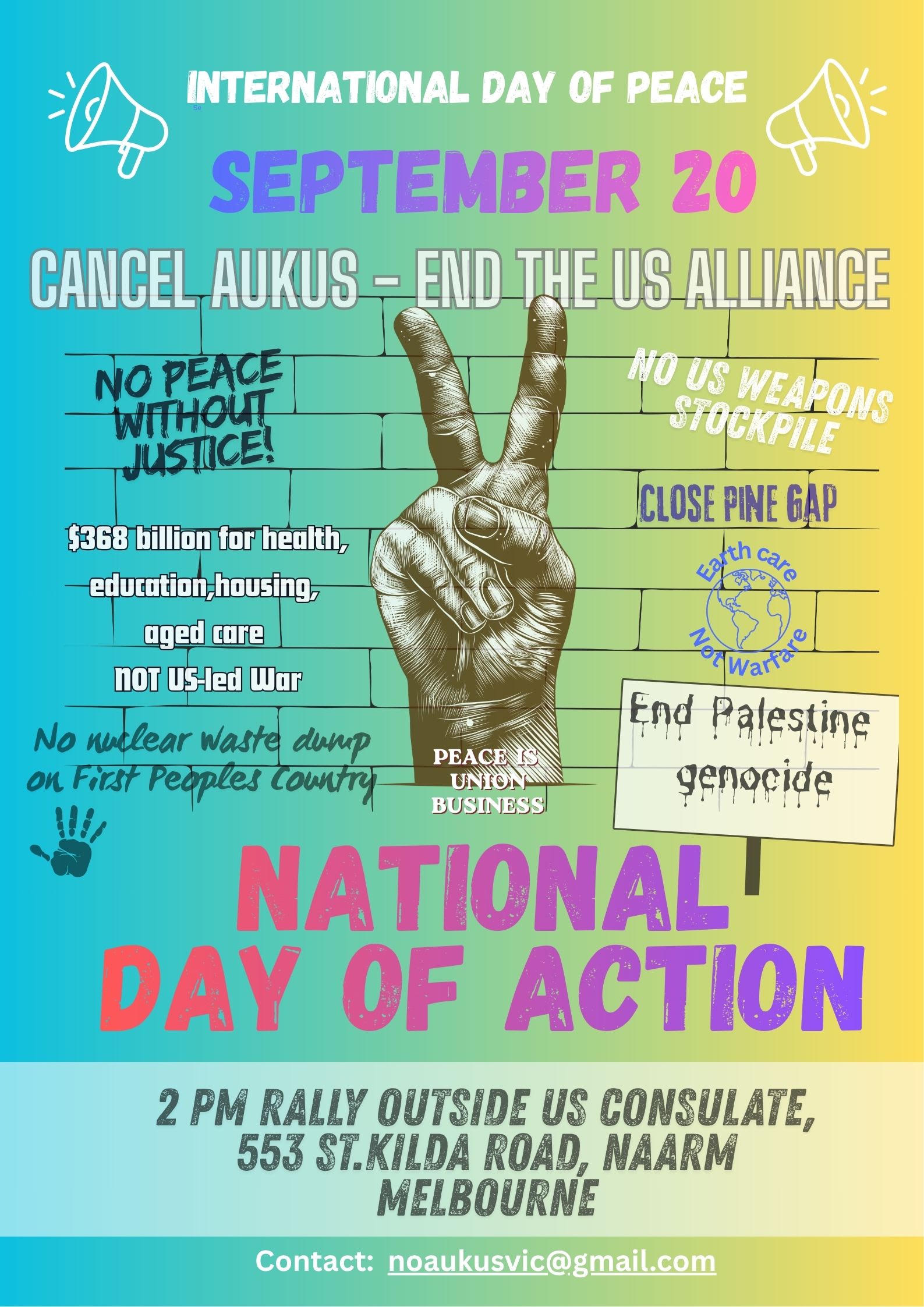
20 September –National Day of Action in Melbourne on the International Day of Peace

Help Aunty Sue Protect Her Land and Sacred Sites From Destructive Rocket Testing.
.

Australians deserve the truth
about
AUKUS – https://aukuspublicinquiry.com/


PETITION – To: Prime Minister Anthony Albanese and the Australian Labor Government

of the week – Australians for War Powers Reform (AWPR)
To see nuclear-related stories in greater depth and intensity
 Antinuclear