Liberals’ panic over climate change put Abbott in a role beyond his abilities
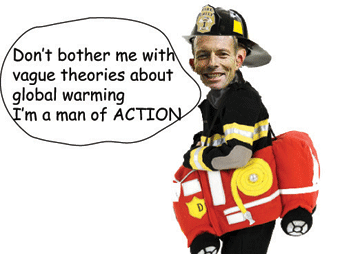 Remember, Abbott is the product of the Liberals’ freak-out over climate , Guardian Jason Wilson 10 Feb 15
 The facts on the ABC’s Fact Check
The ABC Fact Check budget is modest, a tiny fraction of the $10 million mischievously bandied around. ABC Fact Check does not check the media, not ABC journalists nor any others. In the age of 24/7 news, frenetic social media commentary and shrinking newspapers, it interrogates the claims of elected representatives, prominent individuals, influential institutions and lobby groups engaged in the public policy debate. I would have hoped Mr Cameron would have seen that as a positive step.
Fact-check journalism began in the US following the weapons of mass destruction debate before the 2003 Iraq invasion. It has proliferated in the US, Britain, the EU, South Africa, Ukraine, Egypt and South America.
Russell Skelton, Editor, ABC Fact Check, Ultimo THE AUSTRALIAn 11 Feb 15
Australian govt to cut off basic services to up to 200 indigenous communities
The remote communities are mainly located across the northern tip of Australia and the Kimberley in the country’s northwest. The federal government announced late last year that it would stop paying for the utilities, making states responsible for the communities. The Western Australia (WA) state government says it can’t afford to cover the costs.
Rodney Dillon, an indigenous advisor at Amnesty International Australia, told VICE News that some members of the indigenous communities might not survive a move.
“It would be a complete culture shock, a complete mental shock,” Dillon said. “This is their homeland. It’s where they belong it’s where they are proud. They are the keepers of the land. Some might stay and die on the land. The older individuals won’t manage it — it might kill them.”……..
Initial hopes of establishing a $1 billion “Royalties for Regions” fund, which would have used 25 percent of the state’s mining royalties to cover the cost of power and water for the communities, were quashed this week by WA Premier Colin Barnett, who stressed that the government has not yet reached a solution.
Minster for Regional Development Terry Redman originally floated the “Royalties for Regions” idea, but has since said he was “misunderstood” by the media. He stressed to VICE News that it was simply one option……….
Asked if communities had been contacted about the potential closures, the state’s Aboriginal Affairs Minister Peter Collier said last week that a consultation that involved “going out to all the communities” would be “just nonsensical,” and that “consultation in a general sense will continue” instead.
Dillon said such a consultation has been non-existent so far.
“The communities haven’t been contacted, no one’s asking anything,” he said. “This is going to be done without consultation, it will be a couple of blokes with a coffee in Perth making these decisions.”
The government will decide which communities stay open and which are “not viable” for investment, Dillon added.
The Partnership of Western Australian Aboriginal Land Councils invited Barnett and other key WA politicians to discuss the issue in early March, but they have yet to receive a response…….
The criteria that determines whether a community is viable has not been released, but both Redman and Barnett have stressed the likelihood that at least some of the 274 communities in the state will have to close, perhaps as many as 200.
Lauren Pike, a spokeswoman for the Kimberley Land Council, described what happened in 2011 when the government shuttered an indigenous community in Oombulgurri, a community in the eastern Kimberley, and relocated the residents to Wyndham, about 45 kilometers away.
“The result was just devastating,” Pike said. “They literally told these people to get out of their homes and that they couldn’t stay or come back, and then dumped them in the mangroves around the town.
“Houses weren’t provided — nothing was provided,” she continued. “People in the town literally had to hand out borrowed sleeping bags and blankets for these people coming in so they could have something to sleep on outside. It caused so much trouble in the community, and it only got worse from there. Suddenly people had access to alcohol, to illicit substances. It was just an absolute state of poverty.”……..
Dillon believes any future living conditions in the remote communities would consist of the bare minimum.
“They would be moved to very poor conditions,” he said. “They’re frightened and scared and they speak a different language. Now they’re all possibly going to be moved into slums and shanty towns in the city.”
Groups campaigning against the closure also believe moving the indigenous people into new towns would cost the government more in the long run than if they just maintained the status quo. https://news.vice.com/article/australia-may-stop-providing-water-and-power-to-remote-aboriginal-communities
Australia’s political deadlock is financially hurting windfarm companies
Some 44 Australian windfarm projects, about half overseas-funded, have been shelved since a new conservative government said it wanted to cut state support for the industry a year ago, with investors and operators saying they are considering either downscaling or leaving the country altogether if it succeeds.
Even Australian windfarm companies such as Infigen and Pacific Hydro have effectively shelved their Australian operations, with Infigen saying it plans to pour all its financial muscle into the more amenable U.S. market.
“It’s a difficult time at the moment, and the policy uncertainty is the main cause of it,” said Shaq Mohajerani, an Australian spokesman for wind farm company Union Fenosa, owned by Spanish energy giant Gas Natural.
“We’re still considering all options on how to proceed. The parent company will provide us with the strategy.”
A Gas Natural spokesperson said the firm had an “attractive backlog” in Australia but “we are waiting for the whole development of the new framework for renewable energy and hope our presence … in the country can be maintained”.
Wind power in Australia is not the only renewable energy sector to be affected by uncertainty over government subsidies or actual cuts. ……
Windfarms are Australia’s No. 2 renewable energy source, behind hydropower but ahead of solar, providing a quarter of the country’s clean energy and 4 percent of its total energy demand.
But while households can collect rebates for installing their own rooftop solar panels, windfarms rely on “certificates”, or tradeable securities handed out by the government, to offset costs.
That support hit a roadblock a year ago when new conservative prime minister Tony Abbott ordered a review of the country’s target for clean energy use by 2020, which ultimately recommended slashing it by a third, in line with falling overall energy demand. A lower target would mean a lower certificate price……..
A spokeswoman for U.S.-owned GE Australia & New Zealand, which has stakes in several renewable energy projects, said further investment “will only occur once investor confidence in the policy environment is restored. For this to happen, bipartisan support regarding the future of the renewable energy target is essential.”
The Australian arm of Spanish infrastructure group Acciona, the world’s largest renewable energy firm, has frozen about A$750 million of windfarm projects because of the stalemate, said local managing director Andrew Thomson.
“When you’re a subsidiary (of a global business), you’re competing for capital, you’re competing for your budget allocation next year,” he said.
“If the parent company can’t see that there’s a stable environment it becomes really difficult to get traction. For us at the moment it’s a really difficult sell.”
If the renewable energy target is cut, “it’s the type of jolt to industry that basically would create such an upheaval that you would have a mass exodus”, said Alex Hewitt, managing director of Bulgarian-Polish-U.S.-backed windfarm operator CWP Renewables, which has A$1.5 billion of projects on ice.
“I can’t say whether we’d completely exit the country, but you would be looking at such a level of reduction in the level of investment into people in the company that it would be very significant,” Hewitt said. http://www.sbs.com.au/news/article/2015/02/08/australian-windfarms-face-13-billion-wipe-out-political-impasse
Hotter summers to become ‘normal’ in Australia
The 2013 heatwave in Australia would be impossible if not for climate change. The scorching heat experienced by Australians in late 2012 and early 2013 had set new temperature records in ever state and territory in the country.
According to the Bureau of Meteorology, the national average of daily temperatures in 2013 had rise to record-breaking levels for an extended period. NASA had noted that Australia’s extreme temperatures in Jan. 2013 were extended not just days but weeks, The Washington Postreports.
A new report by Australia’s independent Climate Council has found that 2013, the country’s hottest year ever, would be “virtually impossible” without climate change. The summer heatwaves of late 2012 and early 2013 were also enhanced by global warming and increased the chance of reaching extreme temperature levels.
The Climate Council report was written by Will Steffen, a professor at the Australian National University, and based his research on several climate change models. …….
The professor said the report highlighted the importance of developing an action plan to reduce emissions. If something is not done, Steffen warned that an extreme heat event would be a normal occurrence by the middle of the century.
Climate Council chief councillor Professor Tim Flannery said the report allowed scientists to “quantify” the effect of human activities on extreme weather events, reports ABC. He said Australia should reduce greenhouse gas emissions if it wants to achieve a better climate in the future. http://au.ibtimes.com/australia-experience-hotter-prolonged-heatwaves-extremely-hot-summers-normal-1420002
Now wonder the nuclear lobby targets South Australia
The USA and UK nuclear lobby has worked on gullible South Australians for decades – happily encouraging fame-seeking pretend environmentalists like Barry Brook and Ben Heard, as well as career academics like Stefan Simons and Pamela Sykes. Then there are the pack of straight out greedy business people.
But why did they pick South Australia?
Because South Australia already has the ignominious nuclear history of Maralinga, and the great white elephants of the uranium industry – Olympic Dam, Beverley, FourMile (with its military connections)
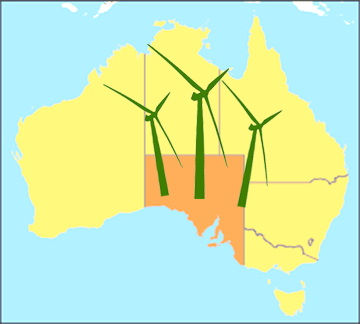 Why are they pushing nuclear power now?
Because South Australia has been, and continues to be a dazzling success in  renewable energy.
Panic is no doubt setting in – and there are plenty of Aussie politicians glad to get on the well-funded nuclear bandwagon.
Clean energy vs nuclear: the battle intensifies http://safeenergy.org/2015/02/06/clean-energy-vs-nuclear/ Michael Mariotte February 6, 2015
“…../The war on solar, which is real, is really a war over what kind of energy system we will have in the 21st century. Will it be the 21st century model we at GreenWorld and NIRS advocate, based on clean renewable energy, distributed generation and the rest?
Or will it be a continuation of the 20th century model of large baseload power plants, whether they be coal or nuclear? That’s the fundamental issue and how it is resolved may well determine the future of our planet….”
The greedy people who want to make money out of importing radioactive trash
 These are some of the people behind the push that got South Australia’s Premier Jay Weatherill to change his tune and open the door to the toxic nuclear chain in Australia. Note that I write “chain” – not “cycle”
Directors at SA Nuclear Energy Systems Pty Ltd – the list includes former Labor federal MP Bob Catley, Ian Kowalick, a former head of the Department of Premier and Cabinet during John Olsen’s Liberal Government and later an information technology consultant to the Rann Labor Government, and climate scientists Professor Stephen Lincoln and Professor Tom Wigley
The nuke lobby would have us believe in a cycle, whereby suddenly, by magic – radioactive trash is no long trash. It becomes a “valuable resource” – recycled into gee-whiz new (exiting only in blueprint) innocuous little nuclear reactors.
Apart from all the disecoomics, and health and environment aspects – the promised new reactors themselves create highly toxic radioactive wastes, and eventually themselves become highly toxic radioactive corpses.
South Australian Business and Premier want to import radioactive waste
Business groups embrace nuclear industry debate in South Australia ABC News 9 Feb 2015,The prospect of a nuclear industry in South Australia has been embraced by the state’s peak business group as a multi-million-dollar industry. Business SA chief executive Nigel McBride said it would be good for the state and could result in reduced carbon emissions.
“We’re talking about a massive, potential nuclear recycling industry,” he said.
“We’re talking about low energy costs and a huge rise in job opportunities through cheaper manufacturing, cheaper water.” SA Chamber of Mines and Energy chief executive Jason Kuchel said it was “about time” options for the future were discussed.
“One of those things that we would be hopeful for is that we might able to consider enriching uranium in South Australia,” he said.
Mr Weatherill …. indicated that he did not think the establishment of a SA nuclear power plant was on the horizon but said a nuclear waste dump and the creation of a nuclear enrichment industry should be considered……
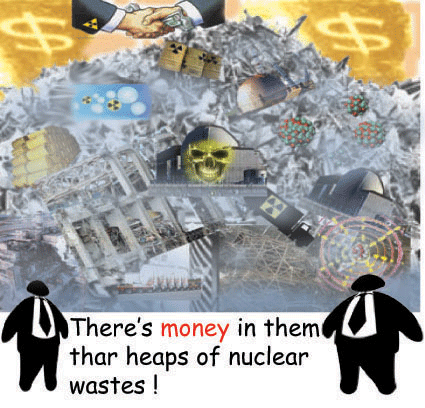
But the Conservation Council’s chief executive Craig Wilkins described any use of nuclear energy in SA as “unwanted” and “unsafe”.
“It’s old thinking, rather than new thinking and it’s so frustrating to spend time, energy and resources investigating this when we are on the cusp of an energy revolution in renewable,” he said….http://www.abc.net.au/news/2015-02-09/business-lobby-embraces-nuclear-debate/6079348
A warning on greedy businessmen’s push for nuclear chain in South Australia
 South Australia takes first step to nuclear power GEORGE LEKAKIS The New Daily, Financial Services Editor 9 Feb 15 “……..The setting up of the Royal Commission follows lobbying by prominent South Australian business figures for an independent evaluation of nuclear power and enrichment proposals for the state……..South Australian Nuclear Energy Systems has been discussing its business proposals with Federal and State politicians, with a view to amending laws that ban nuclear power generation.
Mr Hundertmark told The New Daily last year that the company had identified international capital sources for funding local nuclear projects and had formed connections with global players.
“The funding of the things that need to be done is not a real problem – the problem is to get the legislative changes needed,” he said at the time.
Australian Conservation Foundation spokesman David Sweeney warned that the Royal Commission could merely be a pretext for conditioning South Australians to the prospect of establishing a nuclear waste dump.
“There’s no doubt that a large part of this inquiry is to de-sensitise people to the idea of creating an international radioactive waste dump in the state,” he said.“People need to be wary of the possibility that the inquiry is just a Trojan horse for getting a waste dump built.”
Mr Sweeney said any independent inquiry would find that the economic case for nuclear power did not stack up. “As far as nuclear power is concerned, this is a fanciful exercise because of the outstanding growth of renewable alternatives,” he said.
Mr Weatherill said the government would finalise the terms of reference for the Royal Commission in consultation with experts.
In June last year, The New Daily revealed that a group of high-powered businessmen and scientists led by former News International director Bruce Hundertmark had formed a new company to prepare business proposals for nuclear power stations in South Australia.
Apart from Mr Hundertmark, the board of South Australian Nuclear Energy Systems Pty Ltd, includes Ian Kowalick, the former chief of staff to ex-Liberal premier John Olsen. http://thenewdaily.com.au/news/2015/02/08/south-australia-takes-first-step-nuclear-power/
The Adelaide Advertiser is in the grip of the nuclear lobby
 Dennis Matthews, 9 Feb 15 From its comments denigrating would-be opposition to the nuclear industry whilst at the same time paying lip service against radical pro-development forces it’s pretty obvious that The Advertiser has already made up its mind about Jay Weatherill’s opportunistic so-called independent Royal Commission into the nuclear industry (The Advertiser, 9/2/15).
With subjective comments like those from the media, business communities and pro-nuclear politicians why waste taxpayers money on window dressing a foregone conclusion?
Once again the public is being led like lambs to the slaughter in the name of development, which in truth is nothing less than a proxy for narrow-minded, regressive, vested interests.
South Australia could make “$billions” out of nuclear power – Adelaide Advertiser
 DANIEL WILLS STATE POLITICAL EDITOR THE ADVERTISER FEBRUARY 09, 2015CONSTRUCTION of a uranium enrichment plant could inject billions of dollars into the South Australian economy and modern waste-treatment facilities could double as cheap power generators if the state’s nuclear capacity is expanded, industry says.
Premier Jay Weatherill has reversed decades of Labor opposition to the state taking a greater role in the uranium industry, yesterday announcing a royal commission to investigate opportunities for nuclear storage, uranium enrichment and power creation.
It has raised immediate ire from the green lobby and been dismissed by the Opposition as a backflip and tactical distraction from health controversies.
Mr Weatherill conceded the announcement was a major reversal from his previous stance on the nuclear industry. He said he now had an “open mind” amid opportunities for jobs and investment, and growing fears about climate change.
“I have in the past been opposed to nuclear power, all elements of it,” he said. “I now have an open mind. “When the facts change, people should change their minds.”
Jay Weatherill (Labor) and Julie Bishop (Liberal) in unison promoting nuclear power
 South Australia calls royal commission on nuclear power, SMH February 8, 2015 David Wroe National security correspondent The South Australian government has called the nation’s first ever royal commission on nuclear fuel, raising the prospect of generating nuclear power in Australia and enriching uranium for export……..
The move is significant, as it could open the door to an expanded role for nuclear power in Australia. It follows a recent call by Foreign Minister Julie Bishop for a fresh discussion about nuclear power, which she said was an “obvious direction” for any country considering how to cut its greenhouse emissions.
Mr Weatherill likewise cited climate change as a key driver of his decision to call a royal commission on the issue, saying that while he had in the past been sceptical of nuclear power, global warming meant he was taking another look………
Mr Weatherill acknowledged that large-scale nuclear energy generation might not be economically viable but said “technological changes are occurring with much smaller nuclear generation plants”……….
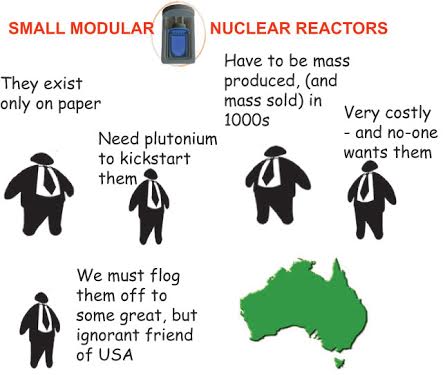
He said there could be “extraordinary economic opportunities” for South Australia in storing medium and high-level nuclear waste and also a potential in enriching uranium,” adding value to the ore we send overseas”.
A spokeswoman for Industry Minister Ian Macfarlane said the federal government’s Energy White Paper was considering all options for Australia’s future energy needs…….http://www.smh.com.au/federal-politics/political-news/south-australia-calls-royal-commission-on-nuclear-power-20150208-1390sc.html
Bob Hawke and Jay Weatherill – Labor fans of nuclear power and radioactive waste dumping
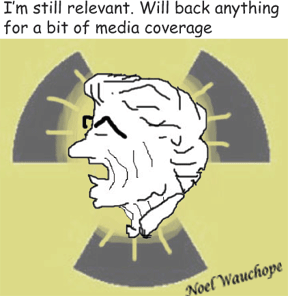 Bob Hawke supports SA nuclear dump The Australian, 9 Feb15 FORMER prime minister Bob Hawke has backed siting a nuclear waste dump in South Australia after Premier Jay Weatherill revealed he would hold a royal commission into the state’s deeper involvement in the nuclear industry.
The commission’s findings could also open the door to opportunities for nuclear generation and construction of nuclear-powered submarines in the state, said nuclear physicist Ziggy Switkowski, who led the 2006 commonwealth government inquiry into the viability of a domestic nuclear 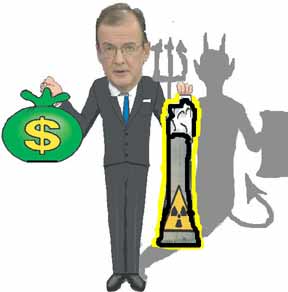 power industry.
Consultation on terms of reference begin today, and are expected to cover the state’s further potential for mining, enrichment, energy generation and storage phases of the nuclear cycle for peaceful uses.
Mr Hawke’s decades-long lobbying for Australia to take the world’s nuclear waste had been a no-go zone with the state Labor government, despite South Australia being a prime storage candidate with a vast, geologically sound backyard. The former Labor PM called the commission a “hell of a good idea” and said the ALP, which has a platform forbidding the establishment of nuclear power plants and all other states of the nuclear fuel cycle in Australia, had previously been open to altering its nuclear policy.
“The Labor Party has shown that it has a degree of flexibility in the nuclear debate, particularly with export of uranium,’’ he said……….
Mr Weatherill said his personal anti-nuclear stance had changed and he was “well along the journey” Continue reading
Australian Youth Climate Coalition condemns South Australian government’s proposal on nuclear issues
Nuclear issues to be examined by SA royal commission, Premier Jay Weatherill announces //www.abc.net.au/news/2015-02-08/nuclear-issues-royal-commission-jay-weatherill/6078260Sun 8 Feb 2015,
A royal commission will look at the future role South Australia should play in the nuclear industry, Premier Jay Weatherill says.
The SA Premier called a news conference to make the surprise announcement, telling reporters the inquiry would be a first for Australia.
He said the inquiry would look at SA’s involvement in the mining, enrichment, energy and storage phases in the life cycle of nuclear fuel.
“We believe South Australians should be given the opportunity to explore the practical, financial and ethical issues raised by a deeper involvement in the nuclear industries,” he said.
Mr Weatherill said SA had one of the world’s biggest uranium deposits and had been involved in uranium production for more than 25 years.
“It is now the time to engage in a mature and robust conversation about SA’s future role in the nuclear industry,” he said.
He said consultation would start in the coming day on the terms of reference.
“We need to understand all these issues so that the community can make an informed judgment,” he said.
A number of independent experts would be engaged to support the royal commission’s work, Mr Weatherill said.
The Australian Youth Climate Coalition was swift to condemn the Government’s announcement.
It said the state needed to focus on its renewable energy potential rather than nuclear potential.
ABC political reporter Nick Harmsen said it put the proposition of a nuclear waste dump in South Australia back on the political agenda, after a previous Labor administration fought federal moves.
Energy Resources of Australia, uranium miner, suffers another annual loss
 Uranium miner’s loss widens, Yahoo News 7 Feb 15 The operator of the Ranger uranium mine in Kakadu National Park has suffered another annual loss and expects the uranium market to remain challenging.
The Rio Tinto-owned Energy Resources of Australia made a $188 million loss in 2014, after suffering a loss of $136 million in 2013.
The company expects to increase its uranium production in 2015, after output was dented in 2014 because of the suspension of processing operations for more than six months after the failure of a leach tank in December 2013.
The company’s purchase of uranium oxide to fulfil sales dragged on its earnings……..https://au.finance.yahoo.com/news/uranium-miners-loss-widens-100814187.html
1 This month.
20 September –National Day of Action in Melbourne on the International Day of Peace


Help Aunty Sue Protect Her Land and Sacred Sites From Destructive Rocket Testing.
.

Australians deserve the truth
about
AUKUS – https://aukuspublicinquiry.com/
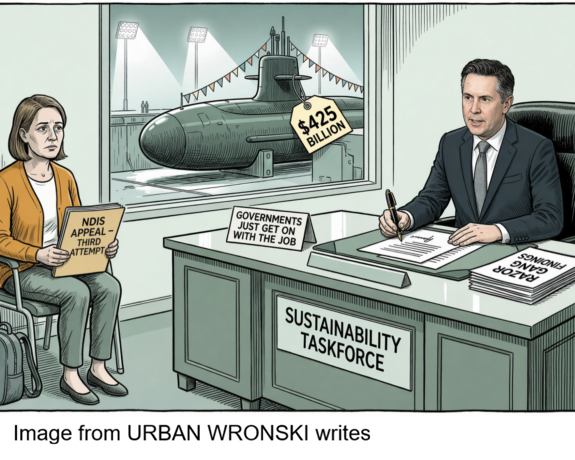

PETITION – To: Prime Minister Anthony Albanese and the Australian Labor Government

of the week – Australians for War Powers Reform (AWPR)
To see nuclear-related stories in greater depth and intensity
 Antinuclear