Recalling the Liberal Party’s push for importing foreign nuclear wastes
the previously secret deal followed the Liberal Party’s federal council meeting in June at which it unanimously supported an international waste dump being built in Australia.
 Australia next ‘nuclear dump’ http://www.sbs.com.au/news/article/2007/07/20/australia-next-nuclear-dump The Wilderness Society has warned a deal between Prime Minister John Howard and US President George W Bush to join an exclusive global nuclear club would ensure Australia became the dumping ground for the world’s nuclear waste. Source: 20 JUL 2007 UPDATED 22 AUG 2013
The ministers for foreign affairs and resources had urged Mr Howard to announce the joint nuclear energy plan during the Asia-Pacific Economic Cooperation visit in Sydney in September, Fairfax newspapers reported.
The statement
“The proposed action plan would help to open the way for valuable nuclear energy co-operation with the United States,” the briefing note says.
“It would also be consistent with the government’s strategy for the nuclear industry in Australia. Continue reading
Remembering the Howard government and businessmen’s push for nuclear power
 Call to’unveil nuclear plans’ http://www.sbs.com.au/news/article/2007/02/27/call-tounveil-nuclear-plans Labor is demanding the federal government reveal what it knows about plans by three leading businessmen for Australia’s first nuclear reactor. Source: AAP 27 FEB 2007 – UPDATED 22 AUG 2013
Former federal Liberal Party treasurer Ron Walker, Hugh Morgan and Robert Champion de Crespigny are the key shareholders in Australian Nuclear Energy Pty Ltd, a private company reportedly behind the plan. Continue reading
Warming of Southern Oceans
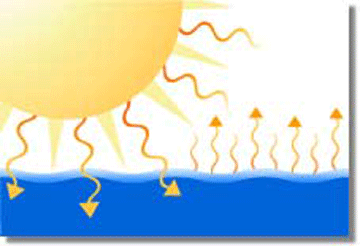 Southern oceans play major role in absorbing world’s excess heat, study finds February 3, Peter Hannam Environment Editor, The Sydney Morning Herald The world’s oceans are heating at the rate of two trillion 100-watt light bulbs burning continuously, providing a clear signal of global warming, according to new study assessing data from a global fleet of drifting floats.
The research, published on Tuesday in the journal Nature Climate Change, used data collected from the array of about 3500 Argo buoys from 2006-13 to show temperatures were warming at about 0.005 degrees a year down to a depth of 500 metres and 0.002 degrees between 500-2000 metres.
Oceans south of the 20-degree latitude accounted for two-thirds to 98 per cent of the heat gain during the period studied, with three giant gyres in the southern Pacific, Indian and Atlantic oceans largely responsible for drawing down the extra warmth.
“The global ocean heat content right now is the most reliable metric of that radiation imbalance” between the energy received from the sun and what is radiated back to space, said Susan Wijffels, an oceans expert at the CSIRO and one of the report’s authors………..
“The ocean is just vertically transferring the heat away from the surface to the depth,” Dr Wijffels said. “The ‘hiatus’ is not meaningful.”
Even with the relative slowdown in surface temperature increases, 14 of the world’s 15 warmest years on record have been in the 21st century, the World Meteorological Organisation said on Monday.
The United Nations body also confirmed that 2014 was the hottest year, edging out 2010 and 2005. The readings were based in part on United States agencies, including NASA which last month also declared 2014 as its warmest year.
John Church, another of the paper’s authors and also from the CSIRO, said the temperatures in the atmosphere – which accounts for just 1 per cent of the planet’s heat uptake – would rise sharply if oceans absorbed less of the heat……..
As it is, warming oceans are swelling in volume, lifting sea levels, and also affecting ecosystems, he said.
“If we want to avoid the worst impacts of climate change then we need to start taking some mitigation action,” Dr Church said. This included cutting carbon emissions and lifting renewable energy targets at home and overseas.
Future Argo missions will extend coverage to higher latitudes, including sea-ice zones, and reach depths of 6000 metres.
However, Dr Wijffels said Australia’s contribution is in doubt with about half of its Argo budget tied up with the Abbott government’s stalled higher education reform bills. Those funds run out “in a few months”, she said.
The Nature study was led by Dean Roemmich of the California-based Scripps Institution of Oceanography. http://www.smh.com.au/environment/climate-change/southern-oceans-play-major-role-in-absorbing-worlds-excess-heat-study-finds-20150202-133j2p.html
Australians ignoring the danger from UV radiation
 Sunburn cases continue to surge as Australians forget to slip, slop slap on the weekends SUE DUNLEVY NATIONAL HEALTH REPORTER NEWS CORP AUSTRALIA NETWORK FEBRUARY 03, 2015, COURIER MAIL,
NEARLY 2.4 million Australians are ignoring the slip slop slap message and getting sunburnt on the weekend new research released by Cancer Council shows.
A 22 per cent surge in the number of Australians getting sunburnt was a wake-up call about the need for a new national skin cancer campaign the Cancer Council says.
The council’s National Sun Survey has found the number of sunburn cases was up by over 433,000 on the last survey four years ago.
Men are the worst offenders with 18 per cent getting sunburnt on the weekend compared to 12 per cent of women………
The failure of Aussies to protect themselves against the sun comes despite the fact we the melanoma capital of the world with more than 14,200 new cases a year.
Melanoma, which is caused by exposure to ultraviolet radiation from the sun, kills over 1,500 Australians a year……..http://www.couriermail.com.au/lifestyle/health/sunburn-cases-continue-to-surge-as-australians-forget-to-slip-slop-slap-on-the-weekends/story-fnihoylo-1227206866638?nk=12eb6391f5cbbe65f220fb12fca19ba4
Tony Abbott’s Big Speech: no mention and NO QUESTIONS on climate change
 I have just listened to Australia’s Prime Minister, Tony Abbott, delivering a lengthy, waffling and repetitive speech at the National Press Club luncheon. Not that this was a surprise, seeing that it represents a last ditch of a beleagured politician to convince sceptical journalists, and the public, that he is The Greatest. That was pretty much the theme – that and the previous labor government being responsible for all our ills.
No matter – as far as I’m concerned, everything that Tony Abbott says is pretty irrelevant to Australia’s present and future condition.
IN 2007 Australia had a Prime Minister who stated that climate change is “the great moral, environmental and economic challenge of our age”

I didn’t expect Abbott to mention Climate Change.
But what about our journalists? There they were – apparently aiming to trap Tony about his leadership position.
I would have liked some more questions about the government’s policies. And at least just one little question about Australia’s policy, or lack thereof, on Climate Change
CSIRO Report on Climate Change in Australia
 Climate change in Australia http://apo.org.au/research/climate-change-australia
 CSIRO and the Bureau of Meteorology have released climate change projections for Australia that provide updated national and regional information on how the climate may change to the end of the 21st century.
The projections are the most comprehensive ever released for Australia and have been prepared with an emphasis on informing impact assessment and planning in the natural resource management sector. Material has been drawn from observations and from simulations based on up to 40 global climate models and four scenarios of greenhouse gas and aerosol emissions during the 21st century.
The 2015 projections provide greater levels of detail and confidence compared to previous projections. Findings are consistent with previous projections research and analysis for Australia, and incorporate an increased knowledge base.
The new climate change projections for Australia are funded by the Department of the Environment through the NRM Planning for Climate Change Fund with co-funding from CSIRO and the Bureau of Meteorology.
The Technical Report is intended to provide detailed information for researchers and decision makers. It is a comprehensive report outlining the key climate change projection messages for Australia across a range of variables. The report underpins all information found in other products, including this website. It contains an extensive set of figures and descriptions on recent Australian climate trends, global climate change science, climate model evaluation processes, modelling methodologies and downscaling approaches. The report includes a chapter describing how to use climate change data in impact assessment and adaptation planning.
Key findings
Overarching findings
Australia’s climate has already changed.
- It has become hotter since 1910, with warming across Australia of 0.9°C
- Rainfall has increased in northern Australia since the 1970s and decreased in south-east and south-west Australia
- More of Australia’s rain has come from heavy falls and there has been more extreme fire weather in southern and eastern Australia since the 1970s.
- Sea levels have risen by approximately 20cm since 1900.
Projections for Australia’s future climate vary regionally and depend on which of the four greenhouse gas and aerosol emissions scenarios is considered. Overarching findings include:
- Australia’s average temperature will increase and we will experience more heat extremes and fewer cold extremes.
- Extreme rainfall events that lead to flooding are likely to become more intense.
- The number of tropical cyclones is projected to decrease but they may be more intense and reach further south.
- Southern and eastern Australia is projected to experience harsher fire weather.
- Sea levels will continue to rise throughout the 21st century and beyond.
- Oceans around Australia will warm and become more acidic.
Additional findings
Temperature
- Australian average temperature has increased by 0.9° C since 1910.
- We have seen more hot days and less cold days.
- Temperatures will continue to increase over the 21st century.
- The extent of those increases will depend on global emissions of greenhouse gases and aerosols.
- By late in the century (2090), Australian average temperature is projected to increase by 0.6 to 1.7°C for a low emission scenario, or 2.8 to 5.1°C under a high emission scenario.
- Hot days are projected to occur more frequently while there will be fewer frost days.
Rainfall
- Winter and spring rainfall in southern Australia is projected to decline while changes in other areas are uncertain.
- For the rest of Australia, natural climate variability will predominate over rainfall trends caused by increasing greenhouse gases until 2030. By 2090, a winter rainfall decrease is expected in eastern Australia.
- Overall, extreme rain events are projected to become more intense.
- This finding is consistent across Australia even in areas where average rainfall is projected to decrease or the average direction of change is uncertain. This is largely due to the ability of a warmer atmosphere to hold more water.
- However, the projected reduction in average rainfall in south-west Western Australia may be so strong as to weaken this extreme rainfall tendency.
Drought
- The time in drought will increase over southern Australia, with a greater frequency of severe droughts.
- The time in drought and the frequency of extreme droughts may increase elsewhere in Australia.
- A projected increase in evaporation rates will contribute to a reduction in soil moisture across Australia.
Tropical cyclones
- Tropical cyclones may occur less often; however they will likely be more intense.
Snow
- There will be a decrease in snowfall, an increase in snowmelt and thus reduced snow cover.
Fire Weather
- Southern and eastern Australia are projected to experience harsher fire weather, including an increase in the number of days with a ‘severe’ fire danger rating.
- Projections for fire weather in northern Australia and inland areas are less certain.
Sea level rise
- Sea levels will continue to rise throughout the 21st century and beyond.
- Projections of sea level rise for the Australian coastline by late in the century (2090) are comparable to, or slightly larger than, the projected global mean sea level rise of up to 82 cm under a high emission scenario.
- A collapse in the marine based sectors of the Antarctic ice sheet could make sea level rise projections several tenths of a metre higher by late in the century.
Massive Upper Hunter wind and solar farm underway, despite Abbott govt
Upper Hunter wind and solar farm operator undeterred by RET changes http://www.abc.net.au/news/2015-01-31/upper-hunter-wind-and-solar-farm-operator-undeterred-by-ret-cha/6059566 The company behind a massive Upper Hunter wind and solar farm has not been deterred by renewable energy target changes, with work on its project now underway.
Pamada plans to have 34 wind turbines, along with its solar plant and associated substations, at its Kyoto energy Park near Scone. Access roads have been constructed, ahead of work starting on a site compound.

Reductions in the Renewable Energy Target (RET) have hampered the project, but project director Mark Sydney said he is determined to push ahead. “We’ve got a lot of support in the community, for a whole lot of reasons,” he said. “Yes we have started work.
“We have access happening, but we will then continue in a measured way to do everything we can until hopefully government policy changes a little bit better for investor outlook in renewables.”
Mr Sydney said his company is undeterred by the RET changes, mindful of the benefits the project could have. “With the new technology, if you just looked at the residences and businesses aside, probably the Upper Hunter, the Hunter and half of Newcastle would come from just the wind turbines themselves,” he said. “Most of the Hunter could easily be served by just the wind farm.”
Environmental regulations in fact have benefits for the economy – OECD
 They also found market-based environmental policies, such as the scheme to price carbon dumped by the Abbott Government last year, “tend to have a more robust positive effect on productivity growth.”
The way some vested interests complain you’d think Australia’s green tape burden was terribly onerous by international standards. But the OECD’s international comparison of environmental stringency tells a different story.
OECD says green tape is not damaging the economy, The Age January 31, 201 Matt Wade Senior writer Economists are at their best when they challenge conventional wisdom and debunk the spurious claims of vested interests. The boffins at the Organisation for Economic Cooperation and Development, one of the world’s top research outfits, have done just that with a ground-breaking analysis of the economic effects of environmental policies, often derided as “green tape.”……….
economists at the OECD have made a surprising discovery: green tape might not cost nearly as much as politicians and business leaders claim. The Organisation has created an index that calculates the explicit and implicit cost of environmental policies. Its economists used this index to assess the strictness of environmental regulations across 24 wealthy OECD members – including Australia – between 1990 and 2012 and to measure the effect of those regulations on productivity. Continue reading
New South Wales distances itself from Abbott govt on Climate Change
NSW signs up to global climate group, SMH, Peter Hannam February 1, 2015 The Baird government has moved to burnish its climate change credentials, becoming Australia’s first conservative government to sign up to The Climate Group.
- NSW will join South Australia and Tasmania as the only Australian states to be members of the international non-profit organisation, which brings business, governments and communities together to promote renewable energy and cut carbon emissions blamed for global warming. Both SA and Tasmania signed up under Labor-led governments……….
- NSW has distanced itself over the past year from conservative counterparts, including the Abbott government, on climate and other issues. It backed leaving the Renewable Energy Target as it is, in contrast to the Abbott government’s efforts to cut the 2020 goal by as much as 40 per cent, and has spent $3 million preparing climate change studies for expected impacts to 2030 and 2070……..
- London-based The Climate Group shut its Australian offices in mid-2013, citing an “increasingly challenging political environment for action on climate change” at the time.
Its States & Regions members account for more than 300 million people and 13 per cent of global GDP, said Libby Ferguson, a group director.
NSW was “a forward-thinking state” with “progressive renewable policies”, Ms Ferguson said…..http://www.smh.com.au/environment/nsw-signs-up-to-global-climate-group-20150201-13301u.html
Victorian government seeking federal climate money for energy efficiency programs
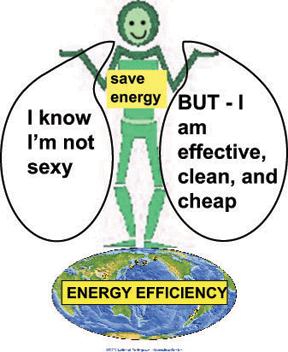
Schools and hospitals could win from climate-fund bid, The Age February 1, 2015 Jason Dowling and Tom Arup School buildings and hospitals could be upgraded to save power and reduce emissions under a potential bid from Victoria for a slice of the Abbott government’s multibillion-dollar climate-change fund.Victorian school buildings and hospitals could be upgraded to save power and reduce greenhouse gas emissions under a state government bid for a slice of the Abbott government’s multibillion-dollar climate-change fund.
Environment Minister Lisa Neville met her federal counterpart Greg Hunt to discuss how Victoria could access the $2.55 billion emissions reduction fund – the central pillar of the Coalition’s “direct action” policy.
She said while it had previously been unclear how states could win federal funding to reduce emissions, the conversation with Mr Hunt had been encouraging that it would be possible to get support to introduce energy efficiency measures across a series of schools and hospitals.
“He was saying we could do that, so hopefully that’s right,” she said.
Under the federal policy, companies and governments can bid for funding to cut emissions. Funding will go to projects that show through an auction process that they can cut emissions at lowest cost.
On other climate change policies, Ms Neville told Fairfax Media the Andrews government would review the state Climate Change Act and would look at reintroducing a state emissions reduction target. The former Labor Brumby government introduced a target of a 20 per cent emissions cut by 2020, but it was scrapped by the Coalition………
Ms Neville said South Australia was also reviewing its climate change laws and she hoped the two states could work together to become an investment target for renewable energy. A joint emissions reduction target with South Australia was not out of the question.
Environment Victoria chief executive Mark Wakeham said he would also like to see the state government explore ways to use the federal emissions reduction fund to shut some of the state’s high-emissions brown coal power generation.
On a new emissions reduction state target, Mr Wakeham called for a body such as the federal Climate Change Authority to be given the job of advising Victoria on targets.
He said Labor’s previous state target should be the starting point, and that targets should be short term to remain front of mind for politicians. ……..http://www.theage.com.au/environment/schools-and-hospitals-could-win-from-climatefund-bid-20150131-13277i.html
Solar power systems in Australia save money for households, businesses, schools and community organisations
 Solar power systems can contribute significantly to reducing energy costs for a household, business, school or community organisation. And with consistent rising electricity prices, the benefits of solar will only continue to accumulate over the 25 year life of an installed system. “The benefits of solar can be multiplied when used in conjunction with other energy-saving measures
Instead of making it difficult, the Government should be making it easier for educational institutions, religious organisations and small businesses to cut their power bills,”
Why Supporting Renewable Energy in Australia Will Save Both Money and the Environment: Geelong Solar Power Company Reveals http://www.webwire.com/ViewPressRel.asp?aId=195168#.VMvuodKUcnk WEBWIRE – Tuesday, January 27, 2015
VICTORIA, Australia January 2015 – When Tony Abbot took his seat as Australian Prime Minister in September 2013, the Liberal Party took a conscious step away from prioritising climate change on the political agenda and backing the Renewable Energy Target scheme (RET scheme). Since then, it has become increasingly clear that the coalition is hesitant to support environmental progression in commercial industries, evidenced by the most recent proposal to cut the solar rebate to small and medium sized businesses, including schools and churches. Continue reading
Over 230 excellent business projects funded by Australian Renewable Energy Agency
 Australian Renewable Energy Agency Funding More Than 230 Projects http://cleantechnica.com/2015/01/30/australian-renewable-energy-agency-funding-230-projects/ January 30th, 2015 by Joshua S Hill
The Australian Renewable Energy Agency has invested $1 billion into more than 230 projects, fellowships, and scholarships throughout the country “that are paving the way for a more diverse energy future for Australia.”
In a press release on its website, the government agency publicized their efforts, despite the obvious roadblocks currently in place in Australian energy politics.
The news comes only a few days after the country’s Bureau of Meteorology and science agency, CSIRO, released a report which claimed Australia will be subject to massive current and future climate impacts.
According to the Australian Renewable Energy Agency (ARENA), it has invested $1 billion in a number of projects, of which 31 are already complete, and “with many more scheduled to reach key milestones and/or completion in 2015.”
“Each of these projects is producing valuable knowledge and outcomes that are being shared with the energy industry to help overcome challenges and advance renewable energy in Australia,” according to its site. Continue reading
Aboriginals, Maralinga nuclear bomb tests, and The Australian Nuclear Free Alliance.
“The elderly people had talked about the Nullarbor[12] dust storm, not knowing that they had seen the fall-out from Maralinga. I knew about Maralinga and started questioning the amount of cancer deaths…..More and more people were dying of leukemia and thyroid cancer
In terms of measuring radioactivity we are totally cut off from acquiring information because it is illegal to have a Geiger counter! We are particular concerned of the uranium mining industry, exploiting sands found near the former testing site. Plutonium testing took place at the Woomera rocket range site. The place is military territory and we do not know what actually is going on there.
 The Australian Nuclear Free Alliance. ANFA (http://anfa.org.au). “Our alliance is well connected and once a month the community leaders link up by phone and we talk about what to do next. During meetings, governmental people are absent. We have international visitors from France, Japan and so on. People from all over the world should know that we do exist, that we are humans (laughter).
THE CARETAKER AND THE PLAGUE: BRITISH NUCLEAR WEAPONS TESTING IN AUSTRALIA, Nuclear Age Peace Foundation, 30 Jan 15 by Ursula Gelis Ursula Gelis, Executive director of the ‘Global Women’s Association against Nuclear Testing’ works for the rights and needs of victims of nuclear weapons explosions and nuclear testing. Her partners are in Kazakhstan and other states, affected by the long-term effects of nuclear weapons testing. At the Vienna Conference on the Humanitarian Impact of Nuclear Weapons in December 2014[1], she interviewed an anti-nuclear activist and nuclear test victim from Australia.
The Plague column in Vienna convincingly depicts human suffering; in this case – the tragedy of the Black Death epidemic from 1679 in Austria which killed about 30 000 to 75 000 souls. A Black Death does not distinguish between a noble and a beggar, and a nuclear weapon explosion does not either.
In today’s Australia, Aboriginal communities are still suffering from European racism that came in the aftermath of Captain Cook (1770) who looked at the Aborigines as lucky people, even if they did not own many material goods! Continue reading
In 2015 Aboriginal rights movement is rising, with renewed strength
an Aboriginal Spring – has arisen where now there is the urgent call for more of the changes still 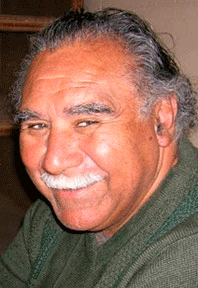 outstanding to be addressed for the descendants of the First Peoples.
The last remaining founder of the 1972 Aboriginal Tent Embassy, Michael Anderson, leader of the Euahlayi People, announced at the forecourt of Federal Parliament, “We will be back February 9 and we will stay.
From the western most region of the continent, an advocate of the Noongar people, Marianne Mackay journeyed six days to reach Canberra. “The Government wants to push our people  off our homelands to make it easier for the miners and big business. Our homelands will be dispossessed unless we stand up.”
In Australia, there is the Aboriginal rights struggle, The Stringer, by Gerry Georgatos January 30th, 2015 In Australia there is no greater rights struggle than the Aboriginal rights struggle. It is a human rights struggle where not only the First Peoples of this continent were violently and murderously dispossessed of their lands but since the advent of British colonialism onto their shores they were subjected to segregation, apartheid and the systematic destruction of their cultures and languages – more than 350 First Peoples’ nations and languages have been impacted.
On January 26, 1972, four young Aboriginal men pitched a beach umbrella on the front lawns of Australia’s Federal Parliament in Canberra, and then sat under the umbrella. They declared it Aboriginal Tent Embassy. This inspired a peaceful resistance movement, with at first hundreds and then thousands converging to Canberra to join them on the parliamentary lawns – setting up tents and camping. Their stances shone the lens of the media – domestic and international – onto the horrific social inequalities and disparities between the First Peoples of this continent and the rest of the population. Their stance contributed to the demise of the then incumbent Government. Some positive changes occurred but 43 years later for far too many of the descendants of the First Peoples little has changed while for many circumstances have worsened – to third world-akin conditions. Continue reading
Australian entrepreneurs ready for the solar energy revolution: let’s keep Renewable Energy Target
 There are over 2 million homes with solar PV or solar water heating installed on their homes, which equates to 24 per cent of all Australian homes. This growth, the shift in consumption patterns and changing paradigm of how our electricity industry delivers energy is a direct result of the Renewable Energy Target. It is making Australians more personally responsible for the way they consume electricity. The “age of entitlement” is over and the Renewable Energy Target is a positive driver.
1 This month
17 October, Free Public Talk on Nuclear Issues in South Australia
David Noonan will speak on public interest concerns over the new Roxby Downs Indenture Act 2026 on BHP copper-uranium mining and ore processing in SA, and on how AUKUS may face SA with a High-Level nuclear waste agenda.
Dr Jim Green will discuss international developments in the field of nuclear power including ‘small modular reactors’ and Generation 4 ‘advanced’ nuclear reactor concepts.


Help Aunty Sue Protect Her Land and Sacred Sites From Destructive Rocket Testing.
.

Australians deserve the truth
about
AUKUS – https://aukuspublicinquiry.com/

PETITION – To: Prime Minister Anthony Albanese and the Australian Labor Government

of the week – Australians for War Powers Reform (AWPR)
To see nuclear-related stories in greater depth and intensity

