Australian government snubs International Renewable Energy Agency congress
 Australia thumbs its nose at global renewable energy market REneweconomy, By Giles Parkinson on 23 January 2015 Australia has again courted controversy on the international stage, refusing to send its energy minister to a key meeting of the world’s peak renewable energy body, and sending instead a mere embassy staffer to the annual congress of the International Renewable Energy Agency.
IRENA met in Abu Dhabi last weekend, ahead of the World Energy Future Conference in the same venue. Some 150 members sent delegates and 65 of those countries sent their energy ministers. The heads of numerous energy companies, and financing chiefs also attended.
It shouldn’t come as much of a surprise, perhaps, given the Coalition government’s antipathy to renewables, and its attempts to wind back or even cancel its current renewable energy target. The Abbott government has ensured that the large scale renewable energy industry in Australia has come to a virtual standstill, just as global investment in renewables increases.
The decision to snub IRENA’s annual conference is being seen in the same vein as its decision not to send a minister to the climate change talks in Warsaw in late 2013. It has angered and surprised some here, although the truth is that Australia – as in the climate space where it has also reversed course – is now seen as something of a no-hoper and an outlier in terms of large scale renewable energy.
Having become the first country to dump a carbon price in 2014, Australia has toyed with the idea of becoming the first to dump its renewable energy target. It appointed a pro-nuclear climate denier to head a review of the renewable energy target, and the result has been policy gridlock and virtually no investment in large scale renewables in Australia in 2014.
Financiers have declared Australia to be effectively a “dead” market. It is now ranked last in terms of climate and clean energy policies. Many companies and financiers have turned their attention elsewhere, although some project developers remain in the hope that some policy certainty can return, and some of the $20 billion in projects can be unlocked, along with thousands of jobs.
ARENA director general Adnan Amin said it was disappointing that Australia did not send a senior representative to the Abu Dhabi conference………
Amin said preliminary data from IRENA indicated that global investment in renewable energy jumped 15 per cent in 2014 to more than $US260 billion, despite the austerity of some budgets.
But there was a bigger change taking place.
Amin said it was clear that renewable energy technologies were now competing with fossil fuels in many parts of the world, and seismic shifts were taking place in the structure of the industry, from a centralized to a distributed model……
“The old model is stagnating. Change is coming and it is going to be dramatic,” Amin says. http://reneweconomy.com.au/2015/australia-thumbs-its-nose-at-global-renewable-energy-market-86233
Queensland: McKinlay Shire plans solar panels for business and Council buildings
 McKinlay Shire solar levy to help businesses cut power bills ABC News, By Kate Stephens 22 Jan 2015, A north-west Queensland council says it is moving ahead with an innovate plan to help local businesses reduce their power bills.
The McKinlay Shire has put out an expression of interest for a renewable energy company to install solar panels on 14 local businesses and some council building…..http://www.abc.net.au/news/2015-01-22/outback-qld-council-sheds-light-on-solar-panels/6034296
Precedent-setting Aboriginal native title grant over large area of SA Eyre Peninsula
 AUDIO: Barngarla people granted partial native title over large area of SA Eyre Peninsula
The Barngarla people filed a native title claim for the area in April 1996.
Justice John Mansfield delivered his judgment on their right to the land on Thursday.
The group’s claim covered 44,500 square kilometres, an area almost triangular in shape and encompassing the coast between Port Augusta and Port Lincoln and the surrounding land and sea……..
Judgment could set precedent for claims in SA, interstate
Solicitor Philip Teitzel said the case was one of the first in the nation to go over densely settled areas and could have broad implications…….http://www.abc.net.au/news/2015-01-22/barngarla-people-granted-partial-native-title-in-eyre-peninsula/6033826
Investors are wary, as Australian miner Paladin sells uranium at way below cost of producing it
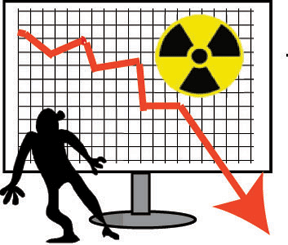 Paladin Energy Ltd revenues soar 79% but shares sink Motley Fool By Mike King – January 19, 2015 Uranium miner Paladin Energy Ltd (ASX: PDN) has announced sales of US$69.9 million in the December quarter, a rise of 79% over the previous quarter.
But despite the news, shares are down 2.8% at 35 cents at lunchtime.
So why are investors selling out of a stock reporting such strong growth?
The problem is that Paladin sold 1.9 million pounds of uranium in the quarter, at an average price of US$36.58 per pound. That last figure is the issue – that price is well below what it costs Paladin to produce the uranium, and there are no signs that the price is…[members only] http://www.fool.com.au/2015/01/19/paladin-energy-ltd-revenues-soar-79-but-shares-sink/
For the convenience of uranium mining, Aborigines are moved off remote homelands
 Waging a war over land rights MEENA MENON , THE HINDU,January 19, 2015 ‘Protests are continuing in various parts of Australia over mining’
In her book of poems, Love Dreaming, aboriginal writer Ali Cobby Eckermann from Australia writes, “Every grain of sand in this big red country is a pore on the skin of my family.” Her writing and her new book, Too Afraid to Cry reflect the alienation of the ‘Stolen generation’ of children who were selectively taken away from their families and raised by white people and also the plight of her people who are waging a war over land rights.
Thousands of people from indigenous communities plan to hold massive protests over land issues on Australia Day on January 26, she says. Protests are continuing in various parts of Australia over mining uranium and minerals and even Kakadu National Park, on the UNESCO World Heritage Site is under threat.
In New Delhi to deliver the annual Navayana lecture, she told The Hindu in an interview that a serious lack of understanding between cultures persists in Australia at a political level and with mining it has expanded. “We worry for our children. Now the Western Australian government wants to use bulldozers and close 150 or 180 small aboriginal communities — they say it is not sustainable to keep these communities going. Where do these people go? They can wander to the city to become a makeshift community under tarpaulin as they are not going to rehouse them,” she says.
The sudden move, she suspects, is to do with mining and removing people from the area so that even that little bit of resistance is gone. That’s the scary part but the aboriginal people will survive. It’s all about land, the war is over land, she says and no one really articulates it like that. “Why would they want these remote areas which are mineral rich to be emptied of people. Western Australia is among the richest mining areas but why is not the government saying some percentage of that mining rights should go to the community. That doesn’t happen, the miners don’t pay tax and we watch the money fly away,” she points out. Continue reading
Liberal Party kids at Uni dutifully toe the Party line on fossil fuels
 Liberal student movement hits back at fossil fuel divestment campaign by ‘vocal minority’ ABC Rural By Babs McHugh 20 Jan 15 The Australian Liberal Students Federation (ALSF) has hit back at the fossil fuel divestment movement which wants universities to sell shares they have in mining businesses.
The divestment lobby is also calling for educational bodies to end sponsorship and partnership deals with resource companies……
we’ve come out to provide the alternate viewpoint of what we feel students are really concerned about, which is jobs and opportunities.”
In October 2014, the Australian National University announced it was selling the shares it held in seven mining companies.
Student activist group Fossil Free ANU had several meetings with the ANU Council before Vice Chancellor Ian Young made the announcement.
Despite opposing the policy, Mr Lesh said the ALSF fully supported renewable energy development.
“It’s not that we don’t support renewable energy at all, we support all forms of energy,” he said.
“But the practical side is we need fossil fuels like coal and gas to provide baseload energy.
“And the mining industry employs thousands of people and contributes billions to our economy.
“And the fossil fuel divestment campaign is an ideological attack on that economy, and comes at a time of increasing difficulty for many students finding jobs.”…….http://www.abc.net.au/news/2015-01-19/liberal-students-oppose-university-mining-shares-divestment/6024952
Wherever did Epuron get the idea that the Abbott government is against wind energy?
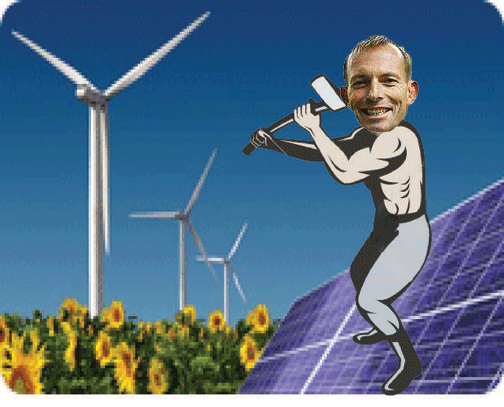 Epuron claims Abbott Government against wind energy, ABC News By Melinda Hayter 20 Jan 15 Renewable energy company, Epuron, claims federal government inaction on the Renewable Energy Target (RET) has Australians paying more for electricity than they should be.
An independent review into the target, which attracted more than 24,000 submissions, was released in August but the government is yet to release its response.
The New South Wales Greens recently cited a report which showed an 88 per cent reduction in investment in the renewable energy sector nationally last year.
Project Manager with Epuron, Donna Bolton, says banks remain wary of lending money to industry players, despite the review’s findings. “The review found that while there was a marginal increase in the cost of household electricity initially, the RET in its current state would actually bring electricity prices down,” she said.
“Despite this there’s been no action.
Epuron has windfarm interests in a number of areas of New South Wales, including the South West Slopes.
Ms Bolton says the government’s inaction has caused the industry to stall.
“It’s very difficult because it’s all about investment confidence,” she said.

“A bank looking to lend $400m, you need to know that that investment is rock solid, that the mechanisms behind it will stay in place and that your return on investment is reasonably secure.
“That’s not the case apparently, so investment has pretty much stopped.”………Epuron has accused the 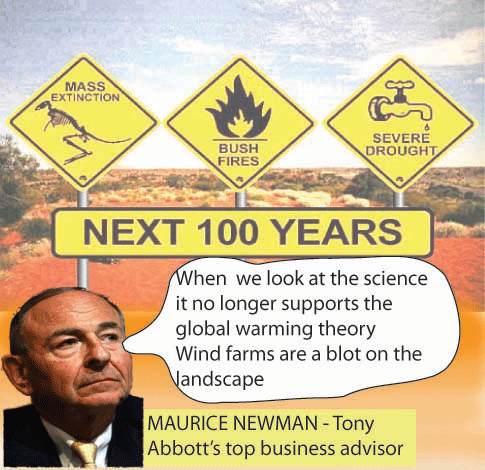 Abbott Government of being against wind energy.
“For some reason there is a lot of resistance, for particularly wind energy, in the current federal government, Ms Bolton said……“I believe the Abbott Government is firm in its belief that it wants to develop the coal industry to the maximum before that gate closes,” she said…..http://www.abc.net.au/news/2015-01-20/ret-comment/6026696
Gunnedah Shire Council takes the solar power plunge
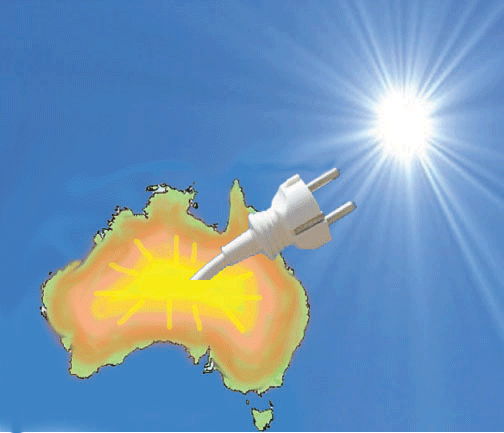 Gunnedah moves to solar power ABC News 19 Jan 2015, Gunnedah Shire Council is the latest in a string of local governments across the region to join a movement embracing solar energy to power public buildings.
The council is in the process of installing solar systems across a number of public buildings, including Council’s administration building, Gunnedah Shire Library and the works depot.
Mayor Owen Hasler said the buildings are historically high energy users and transitioning to solar is expected to save council thousands of dollars annually.
“We want to be seen as being proactive in reducing council’s carbon footprint, and secondly of course there’s also the financial implications,” he said.
“It reduces our operational costs and effectively makes savings for our ratepayers.
“For example in the depot, we’re expecting to save over $6,000 per annum and the administration building about $5,500.”……..http://www.abc.net.au/news/2015-01-19/gunnedah-moves-to-solar-power/6025214
Nowhere to put Lucas Heights nuclear waste – but they still keep making it!
 Nuclear waste returning to Sydney from France http://www.smh.com.au/nsw/nuclear-waste-returning-to-sydney-from-france-20150117-12seco.html Kirsty Needham State Politics Editor, The Sun-Herald A shipment of radioactive waste being returned to Sydney from France by December has raised concerns Lucas Heights is becoming a “de facto” national store.
Federal government plans to build a national radioactive waste dump at Muckaty Station in the Northern Territory collapsed last year, and a new search for a site will begin in March.
With no permanent national repository, the Australian Nuclear Science and Technology Organisation has been forced to build an interim waste store at Lucas Heights for the French shipment. It will include 28 stainless steel canisters of reprocessed waste, and six cemented drums of technological waste, including gloves and protective clothing worn by French nuclear workers.
The waste will be shipped from La Hague from July, immobilised in glass in canisters and shielded inside a specially designed forged steel transport container with 20-centimetre thick walls.
Australia sent the radioactive material from its nuclear research reactor to France in the 1990s for reprocessing, but under legal agreements, it must be removed from France by December 2015. More waste will be returned from Britain in 2017. Continue reading
Western Sydney residents again face threat of radioactive waste dump at Kemps Creek
 Controversial radioactive clean-up to go ahead,SMH January 18, 2015 Kirsty Needham State Politics Editor, The Sun-Herald A bitter fight over radioactive waste between Sydney’s western and northern suburbs is set to be reignited by the Baird Government on the eve of the state election.
The NSW government will push ahead this year with a $12.4 million clean-up of Hunters Hill land contaminated by a uranium smelter 100 years ago, a government report has revealed.
But the only site in Australia identified by a string of government studies as the best option to store the waste – Kemps Creek near Penrith – is in a marginal Liberal seat where sitting MP Tanya Davies campaigned against the dump while in opposition. Continue reading
Uranium price rally was short-lived
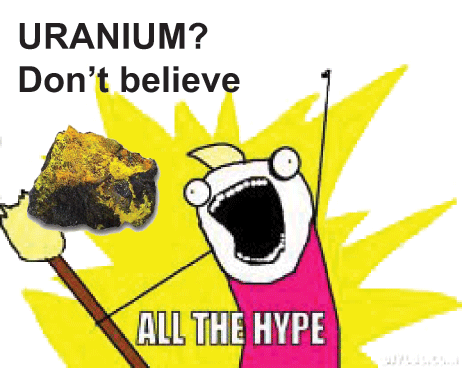 Uranium Rally Running Low on Juice After shooting higher, prices have come back down amid questions about how much more of the radioactive metal China needs to buy. BARRON’S
 Uranium bulls have long pointed to China’s nuclear-industry expansion as a catalyst for a recovery in the market. In mainland China, there are 22 nuclear reactors currently operating, 26 being built and more about to start construction, according to the World Nuclear Association.
However, Australian investment bank Macquarie thinks there are now “serious question marks” about how much uranium the world’s No. 2 economy will need. “China is clearly the most positive story globally when it comes to nuclear-power-capacity expansion,” according to Macquarie analysts. “The concern, however, is that China has already procured a substantial amount of uranium well in excess of what it has consumed and that this advance purchasing might limit its need to enter the market to source material over the next few years,” they add in a note.
Uranium prices have mostly languished since the 2011 Fukushima disaster………with uranium prices rising 37% from August through November as Japan moved closer to restarting its idled reactors. Consultants Ernst & Young said they thought the market had bottomed. Analysts at Australian brokerage Bell Potter agreed.
BUT THAT RECOVERY HAS STALLED…….While the revival of Japan’s nuclear sector is positive for prices, China’s potential demand is more important……..But Macquarie’s analysts say China’s growing store of uranium may be bigger than anyone previously thought. Their latest analysis suggests China increased its stockpiles by 17% last year and now has enough uranium to meet domestic demand for about seven years at forecast 2020 consumption rates. China doesn’t provide data on its uranium inventories…. JPMorgan expects uranium prices to average $30.70 a pound this year, down from last year’s $31.70…….http://online.barrons.com/articles/uranium-rally-running-low-on-juice-1421462807
Quakers remove funds from 4 major banks – cannot fund uranium, nuclear weapons, coal
 Quakers to pull funds from Australia’s four major banks, citing ethical concerns http://www.theguardian.com/australia-news/2015/jan/18/quakers-pull-funds-australia-four-major-banks-ethical-concerns Religious group says it can no longer support investment and lending practises lacking ‘clear ethical policies’. The Quakers are pulling their funds from Australia’s big four banks, saying they can no longer support investment and lending practises lacking “clear ethical policies”.
The religious group says it will remove all corporate funds from the four major banks – and also Macquarie and St George – and they are calling on others to do the same.
Presiding clerk Julian Robertson said the group had for years avoided direct investment in alcohol, tobacco, military weapons, uranium and other mining industries.
“We also have a problem with the investment policies of the larger banks in Australia, where our money is being used for financing some of these companies.
“We are particularly worried about carbon-intensive industries and some others which do not have the ethical standards that we would like,” he said.
Tony Abbott ‘frozen in time’ as Western Australia sizzles with climate change
 WA sizzles as scientists reveal 2014 was the hottest in a century news.com.au JANUARY 18, 2015 NOT even the beach offered respite from the sun’s nuclear intensity as WA sizzled and the mercury approached 40C in Perth on Saturday…….Ambulance officers advised the elderly to stay inside and drink plenty of water and slip, slop, slap was the order of the day as the UV index peaked at 14. Readings of 11 and above are considered “extreme”.
New research from the US National Oceanic and Atmospheric Administration and the US space agency NASA shows 2014 was the hottest year in more than a century, reviving alarm about global warming.And WA’s top meteorologists agree, saying West Australians face decades of rising temperatures with hotter, drier and more extreme summers as a result of climate change.
Australia in 2014 experienced its third hottest year and hottest decade on record, according to the Bureau of Meteorology.
“It’s climate change. Temps across Australia are warming. There is no getting away from it,” weather bureau spokesman Neil Bennett said.
The NOAA report found that “globally averaged temperature over land and ocean surfaces for 2014 was the highest among all years since record-keeping began in 1880”. The average temperature in 2014 was 0.69C above the 20th century average, beating the previous record-holding years of 2005 and 2010. Russia, Alaska, parts of the US and South America, eastern and western coastal Australia, North Africa and most of Europe all experienced record heat.
Federal Labor environment spokesman Anthony Albanese said in the wake of the NOAA report that Prime Minister Tony Abbott can no longer ignore the evidence on climate change. “Tony Abbott is frozen in time while the world warms around us,” he said……http://www.news.com.au/national/western-australia/wa-sizzles-as-scientists-reveal-2014-was-the-hottest-in-a-century/story-fnii5thn-1227188545684?from=public_rss
John Pilger discusses his film “Utopia” on Australia’s land steal from Aborigines
 John Pilger Interview: White Australians Would Like Aboriginal People to DisappearSunday, 18 January 2015 00:00By Mark Karlin, Truthout | Interview Noted journalist John Pilger directed and is the lead investigator in an extraordinary documentary, Utopia: An Epic Story of Struggle and Resistance.
Pilger incisively and tenaciously reveals the brutal conquest and continued racist treatment of the Aboriginal people in Australia. Against this appalling historical documentation of conquest, discriminating and neglect, Pilger also highlights the continued resistance of the original inhabitants of the land stolen by British settlers.
The following is a Truthout interview with John Pilger about Utopia. Continue reading
Australia’s unstoppable solar energy revolution
“If you look at what the mainstream analysts are saying now, they are talking about the solar  revolution,” said Parkinson. “Even the energy distributors in Australia, they are talking about the end of centralisation and the rise of the micro-grid.” According to Parkinson, solar is now at “grid parity” with traditional sources of electricity.
 “You can’t address climate change using heavily centralised, obsolete, hideously risky fission reactors,” Milne told Al Jazeera. “It’s a humiliating stance. Australia needs to phase out fossil fuels and move to 100 percent renewable energy for the climate – and for our economy.”
Australia’s rising solar power ‘revolution‘, Aljazeera, After record-breaking solar project, scientists question why coal-dominated nation ignores renewable innovation. Royce Kurmelovs 13 Jan 2015 Adelaide, Australia – Australian researchers broke the world’s solar power efficiency record last month with their design of a novel commercial energy system, raising hopes the fossil-fuel dominated country may someday switch off its reliance on coal.
Led by Professor Martin Green, the University of New South Wales team worked with a local company to create a highly efficient solar energy system that uses mirrors to concentrate sunlight onto a central solar panel to generate electricity.
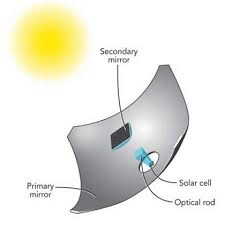 The method is known as concentrator photovoltaics (CPV), and the end product is a system with an efficiency of 40 percent – meaning 40 percent of the sunlight hitting the solar panels is converted into energy, the highest such level ever achieved.
Most importantly, the design uses readily available materials that makes putting the system into operation easier – and cheaper – than trying to commercialise more experimental designs.
Green, who is also the director for the Australian Centre for Advanced Photovoltaics, has a history of this kind of innovation.In 2011, he and his team built a solar cell that operated with 19.3 percent efficiency and soon after pushed this to 19.4 percent, edging out the previous record holder with 18.9 percent efficiency.
Off the grid
This kind of innovation has become the hallmark of the solar energy industry, and it is only going to grow, according to Green. Continue reading
1 This month
17 October, Free Public Talk on Nuclear Issues in South Australia
David Noonan will speak on public interest concerns over the new Roxby Downs Indenture Act 2026 on BHP copper-uranium mining and ore processing in SA, and on how AUKUS may face SA with a High-Level nuclear waste agenda.
Dr Jim Green will discuss international developments in the field of nuclear power including ‘small modular reactors’ and Generation 4 ‘advanced’ nuclear reactor concepts.


Help Aunty Sue Protect Her Land and Sacred Sites From Destructive Rocket Testing.
.

Australians deserve the truth
about
AUKUS – https://aukuspublicinquiry.com/

PETITION – To: Prime Minister Anthony Albanese and the Australian Labor Government

of the week – Australians for War Powers Reform (AWPR)
To see nuclear-related stories in greater depth and intensity

