AUDIO: Sweden’s biomass energy system could be applied in Australia
 AUDIO The Swedish renewable energy model, ABC Radio National Ockham’s Razor 3 November 2014 Andrew Lang While discussion of renewable energy in Australia has largely focused on wind, solar and hydro for electricity generation, Sweden has opted for an economy-wide biomass-based system. Farmer Andrew Lang takes a look at the Swedish model and how it could be applied here. …….. Continue reading
Casltlemaine’s remarkable launch of a solar energy revolution
 Renewable energy: power to the people, SMH, November 3, 2014 Michael Green Chewton’s primary school, student population 40, perches on a hill above the houses of the small central Victorian town, which borders Castlemaine. Before the year is out, its red tin roof will be home to solar panels facing east and west, positioned to best offset its demand. The school is crowdfunding for a renewable energy system, by way of a new scheme called the People’s Solar.
“Our savings won’t go back into the big bucket,” says principal Julie Holden. “They won’t be used for staffing and books.” She’s promising to fund environmental initiatives by students around the town instead, as well as more energy efficiency improvements for the buildings.
Modest though its goal sounds, Chewton Primary is one front in a revolution. Continue reading
Wind power surging ahead in South Australia
The $450 million addition of 90 turbines increases the farm’s capacity from Sunday by 1350 gigawatt hours a year, enough to power 230,000 homes.
The wind farm in the state’s mid-north is now the largest in the state, the government says.
The Premier has also warned projects such as the Snowtown wind farm are at risk if the federal government scaled back the Renewable Energy Target.
Mr Weatherill told media the project is creating ‘a new future for this region in South Australia’, but a scaling back of the RET would see large scale renewable initiatives become unviable.
Rum Jungle uranium mine- its pollution still a costly problem over 60 years later
$200m sought to rehabilitate former Rum Jungle uranium mine, ABC News 31 Oct 14 By Joanna Crothers The 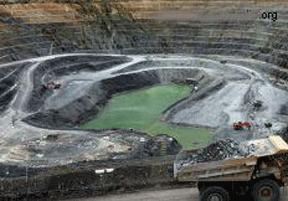 Department of Mines and Energy is seeking $200 million from the Federal Government to rehabilitate the former Rum Jungle mine site.
Attempts to rehabilitate the site, Australia’s first uranium mine, stem back to the 1970s.
Scientists from the Department of Mines and Energy (DoE) have been drilling at the site over the past three weeks and analysing rock samples.It is estimated that five million cubic metres of rock will need to be relocated or re-buried in two of the mine’s deepest pits.
The process is likely to take three years and cost millions, scientists say…….Uranium and copper were mined at the site from the 1950s until the site closed in 1971. Waste rock at the site was buried but it started releasing acid and metals into the nearby East Finniss River. Ms Laurencont said the rocks were larger and more oxidised than was thought.
Last year the Federal Government allocated $14 million for developing a rehabilitation plan, in addition to $8 million already spent on a preliminary plan.
Acidic drainage has plagued the site since it closed and the Finniss River is a significant fishing sport for Indigenous people and Territory anglers.
The recreational reserve now known as the Rum Jungle South Recreation Reserve was shut from 2010 until 2012 by the Northern Territory Government where some low-level radiation was detected.
The Department will present its plan of rehabilitation to the Treasury in March next year.Other plans to rehabilitate include cleaning up other areas of the site and reintroducing vegetation onto the site. http://www.abc.net.au/news/2014-10-31/mines-department-seeking-200m-to-fix-former-rum-jungle-mine/5858764
Australian Conservation Foundation (ACF) ‘s education campaign on the government’s ‘Direct Action’ policy
AUDIO: Environmentalists launch direct action education campaign, ABC Radio Friday, October 31, 2014 ELIZABETH JACKSON: The recently appointed head of the Australian Conservation Foundation (ACF) says the organisation will embark on a public education campaign in response to the Government’s direct action legislation passing through Parliament.
Businessman, environmental activist and former Howard government advisor, Geoff Cousins says the legislation is shameful because it pays big polluters to keep polluting.
Mr Cousins has lashed out at the Business Council of Australia (BCA) for supporting the legislation which he says individual companies would have rejected…….
It is really quite a shameful situation and to have the Prime Minister of Australia running around the world as he did a couple of weeks ago saying coal is our future. Goodness me. It’s really just ridiculous. Not even the coal companies actually believe that……
But the Prime Minister and the Government are still trying to figure out whether there’s, in quotes, “any truth in it”……
Clean Energy Finance Corporation’s success – making money, cutting greenhouse emissions
Green bank makes money, cuts emissions http://www.heraldsun.com.au/news/breaking-news/green-bank-makes-money-cuts-emissions/story-fni0xqi4-1227108689612?nk=0c29fda6cefe7b7916e293378f3d795c PAUL OSBORNE, AAP SENIOR POLITICAL WRITER OCTOBER 31, 2014
IT may be able to cut carbon emissions for $2.40 a tonne, but the Clean Energy Finance Corporation still faces the government axe.
THE CEFC, set up by Labor to leverage investment in a wide range of clean energy projects, has built a $931 million portfolio in its first full year of operation.
- Chairwoman Jillian Broadbent said in the corporation’s annual report it had leveraged $2.20 for every $1 to produce projects valued at over $3.2 billion.Once the projects are running they will abate 4.2 million tonnes of carbon dioxide, achieving an effective “carbon price” of $2.40 a tonne.However, the CEFC has been asked by Treasury to prepare its accounts for the mid-year economic and fiscal outlook due in December on the basis that it will stop making investments on December 31 and cease operating on June 30, 2015.The one thing standing in the way of this is the Senate, with the Palmer United Party, Greens and Labor opposed to the corporation’s abolition.The annual report is expected to give further ammunition to their argument to keep it running for the long-term.
The CEFC reported its portfolio would return an average seven per cent, or 3.5 per cent above the government rate.Across its portfolio are wind, solar and bioenergy projects, innovative energy efficiency programs and low emissions technology in manufacturing, building and local government.Despite uncertainty about its future, the CEFC is in talks with more than 30 project backers seeking $1.2 billion in finance for total project costs of over $3 billion.It is understood there are discussions within the government on how the CEFC could co-operate with the government’s $2.55 billion emissions reduction fund passed by the Senate on Thursday.
The threat of uranium mining to Cape York’s river system
It was recently revealed that the French nuclear corporation Areva has been exploring for uranium in the Carpentaria basin in south west Cape York and the north east of the Gulf country for uranium deposits. Areva state that Australia possesses one of the largest uranium reserves in the world and that tens of thousands of hectares are of exploration interest.
Areva already have a track record in Australia. They are the same company that Kakadu Traditional Owner Jeffrey Lee refused to allow to mine on his ancestral lands. As the senior Traditional Owner of the Djok clan and senior custodian of Koongarra where uranium was found, Lee decided to never allow mining in the culturally and ecologically sensitive area.
Despite this opposition, Jeffrey Lee endured years of pressure to allow mining in the former Koongarra Project Area, long excluded from the surrounding Kakadu National Park and World Heritage area.
Turning his back on personal wealth, Lee chose to prioritise country and culture over cash stating; “I could have been a rich man. Billions of dollars… You can offer me anything but my land is cultural land.”
Only last year did the threat of uranium mining on Jeffrey’s country get laid to rest with the area finally and formally added to Kakadu. With the right to veto mining afforded to Traditional Owners in the Northern Territory under the Land Rights (NT) Act 1976, Mr Lee had the legal power to say no. Fortunately for all Australian’s – now and in the future – he exercised this power.
Unfortunately, this opportunity is not afforded to Traditional Owners under Queensland’s Aboriginal Land Act 1992. On Cape York Peninsula Areva has largely flown under the radar, and have been exploring in the Mitchell, Coleman and Gilbert river basins and areas further south and south west. …….
Clearly, the health of the Mitchell River and its tributaries affects the health of the people who rely on its waters for food, culture and lifestyle. As a healthy functioning ecosystem, the Mitchell River floodplain region is part of the real northern food bowl.
When Campbell Newman went to the 2012 state election with a ‘crystal clear’ commitment not to overturn the ban on uranium mining, Areva were already were warming up their drill rigs. Uranium mining is a dirty game and we’ve already seen severe contamination from leaks at Rio Tinto’s Ranger mine in the Northern Territory. Given the amount of wet season flooding on the Mitchell River, there is no doubt of direct risk to the Cape’s rivers from any future uranium operation.
What’s more, it seems as though the public’s right to contest and object to mining proposals is being eroded. Regardless of whether you live next door, downstream or elsewhere, your rights to contest mining proposals was diminished with the passing of the Mineral and Energy Resources (Common Provisions) Bill 2014 in Queensland’s parliament recently. When enacted this heavy handed law will take away our rights to contest around 90% of mining projects.
Our healthy rivers and waterways are more than just unallocated commodities for the resource sector to consume and then dispose of. Our quality of life, through culture and lifestyle, depend on the life-giving water of the regions spectacular and precious river systems.
In the Mitchel River basin we are already seeing in-stream mining, a massive increase in exploration and increased sediment loads in aquatic environments. Introducing the risk of uranium contamination into the Mitchell and other rivers would be a disaster for people and country. It makes no sense to threaten the resource that sustains life with the ill-conceived and fast-tracked digging of a mineral that threatens life. http://www.acfonline.org.au/news-media/acf-opinion/uranium-new-threat-cape-york%E2%80%99s-rivers
|
|
Renewable energy projects funded by community action
Citizen funded renewable energy projects EcoGeneration — April 2014
Margaret Hender from the Citizens Own Renewable Energy Network Australia explains the citizen owned renewables funding mechanism and highlights what is needed to encourage uptake of the concept.
The Citizens Own Renewable Energy Network Australia (CORENA) brings together people in the community who are keen to contribute to action on climate change and that technology by enabling people to help collectively fund practical renewable energy projects.
Passing on the benefits of renewables
At first glance there is nothing particularly unusual about the 7 kilowatt high quality solar photovoltaic (PV) system that was installed in November 2013 on the roof of Tulgeen Disability Services in Bega, New South Wales. It will provide 58 per cent of the electricity used by the Tulgeen cheese packaging facility, which employs people with disabilities, and 21 per cent of the usage at the Training and Education Services day programs centre.
The novel element is the mechanism used to fund the project. CORENA gave Tulgeen an interest free loan of $12,000, funded entirely by voluntary contributions from citizens across Australia. Tulgeen CEO Pete Gordon plans to repay the zero interest loan in three years from the savings in power bills, however, the system will be generating electricity for 25 years. This translates into reduced costs for Tulgeen’s clients and a greater range of services able to be offered by the centre.
This represents a win-win scenario. Tulgeen chose to cover part of the cost themselves, but typical solar PV installations funded by CORENA don’t cost community organisations a cent, and their loan repayments help to fund installations for other organisations.
How CORENA began………..
Quick Small Projects
CORENA’s donated seed funds allow us to pursue what is needed, rather than being bound by conventional financial constraints.
CORENA’s Quick Small Projects take the capital expense out of energy efficiency and solar installations for community serving organisations by using donated funds to give interest free loans. As the loans are repaid out of savings from power bills, the funds then revolve into the next project, and then the next. When approximately 120 projects are funded, there will be enough revolving seed money to fund one new project per month on an ongoing basis. Our Quick Small Projects will then essentially cost nothing. To reach this point, we will need around $2.4 million in seed funds, or $24 from each of 100,000 people.
Solar thermal: the Big Win Project
Similarly, all income generated by CORENA’s solar thermal Big Win Project will be paid forward to help build additional utility-scale projects…….http://ecogeneration.com.au/news/citizen_funded_renewable_energy_projects/089762/
Some more community renewables organisations
Citizen funded renewable energy projects EcoGeneration — April 2014
Embark (Aus)
Embark works to shift the community energy sector into the mainstream, as a proven and financially viable model capable of attracting large-scale investment and growing to meet its full potential.
Hepburn Wind (Aus)
Hepburn Wind is the owner and operator of Australia’s first community owned wind farm, at Leonards Hill, just south of Daylesford, Victoria. The 4.1 MW wind farm comprises two turbines and is approximately 100 km north-west of Melbourne.
The Community Power Agency (Aus)
The Community Power Agency was set up to support community groups in navigating the complex process of setting up a community owned renewable energy project.
Ranges Energy (Aus)
Ranges Energy is a community co-operative managed by a volunteer board of directors elected by shareholders. Ranges Energy grew out of a joint initiative of engineer Antony Howard of Sustainability Engineering and the Dandenong Ranges Renewable Energy Association. The project was inspired by similar community energy projects around the world.
Denmark Community Wind Farm (WA, Aus)
Denmark Community Wind Farm Incorporated is a non-profit community group, incorporated in September 2003 to progress legal and financial structures for an organisation to own and operate Denmark’s community wind farm project in Denmark, Western Australia, as a local response to the global challenge of climate change.
Burger Windpark Gehlenberg GmbH and Co KG (Germany)
The Burger Windpark, located in Lower Saxony, Germany, includes 19 turbines each of 1.5 MW capacity and is a successful community owned wind farm. The project was initiated by the local farmers’ association and the manager of the local farmers’ bank, Raiffeisenbank.
RE-volv (US)
RE-volv is building a citizens movement for solar energy by helping people to invest in solar, building solar projects in communities, and educating people about the benefits of solar in the US.http://ecogeneration.com.au/news/citizen_funded_renewable_energy_projects/089762/
Abbott government does deal with Clive Palmer to pass its “Direct Action” (so-called) Climate Policy
Direct Action set to pass Senate after Government strikes deal with Clive Palmer ABC News, By political correspondent Emma Griffiths, 29 Oct 14 Tony Abbott’s plan for a $2.5 billion Direct Action emissions reduction fund is set to pass the Senate after the Government made several concessions to win over the support of Palmer United Party and other crossbench senators.
PUP leader Clive Palmer won a Government commitment to salvage the Climate Change Authority and to ask it to conduct an 18-month review of the PUP plan to legislate an emissions trading scheme (ETS) at a zero rate.
“The authority will conduct a review examining whether there are emissions trading arrangements in other countries and what form they take,” Environment Minister Greg Hunt said………
Under the Direct Action plan, polluters would be paid to reduce emissions, in a scheme which has been estimated to cost more than $2.5 billion over four years……..
Greens leader Christine Milne has slammed the direct action policy as “embarrassing”.
“What we have here is no contribution to bringing down emissions, no modelling to backing up the claims, a government and Clive Palmer which tore down an emissions trading scheme which was bringing down emissions,” she said.
In July, the Coalition succeeded in scrapping the carbon tax with PUP support……..http://www.abc.net.au/news/2014-10-29/direct-action-set-to-pass-senate/5851914
Renewable energy is cheaper: union recommends switching to Powershop
 I switched to Powershop recently, I had several satisfactory years of fully renewable energy with AGL. But now I am especially glad about the switch. Apart from Powershop being cheaper and more efficient – it IS dedicated to renewable energy. And alas, looks as if AGL has now gone well and truly over to the dark side. (See the article further down this page.)
 ETU branch urges members to back Powershop http://www.heraldsun.com.au/business/breaking-news/etu-branch-urges-members-to-back-powershop/story-fnn9c0hb-1227105301934 JOHN CONROY OCTOBER 28, 2014
The Electrical Trades Union – Victorian Branch (ETU) has announced that it will be recommending an electricity offer with new Victorian market entrant and renewable energy backed electricity retailer Powershop to its members.
ETU State Secretary Troy Gray said: “We are urging our 20,000 strong membership in Victoria to switch to Powershop to show their support for the Renewable Energy Target (RET) and Australia’s renewable energy future.”
“For us it was a no brainer. Powershop has been ranked the greenest energy company in Australia by Greenpeace, they are backed by 100 percent renewable energy generator Meridian, they are the only energy company to put up a fight to defend the Renewable Energy Target and the jobs and investment it creates and they are 100 percent carbon neutral too.”
“Our research indicated that companies, like Powershop, who support the RET, are 20-30 per cent cheaper than those who oppose it. The Warburton Review of the RET failed to make the case that the RET drives up power prices and with Powershop we know that our members can back renewable energy and the RET and save money.
“Importantly, by encouraging our members to switch to Powershop, we can also help break the cycle of the big three energy companies (AGL, Origin and Energy Australia) ripping off our members with rapacious deals and self serving energy policies.”
“For too long, our members, and other consumers across Victoria, have been in the grip of an oligopoly that has kept them at arms length from their own energy usage data. The emergence of Powershop, enabled by the RET, has brought unprecedented levels of innovation and choice to a broken market.”
Powershop is backed by Australasia’s largest renewable energy company, NZ-based Meridian Energy. It launched on the Victorian market in February 2014 and has recruited over 20,000 customers to date. Powershop says it is a modern power company that’s designed from the ground up with the sole purpose of empowering consumers and saving them money.
The company has been working to make the case that renewable energy reduces the cost of electricity for consumers. When Renew Economy reviewed submissions to the RET review from energy companies in June 2014, Powershop was found to be “the only retailer to call unequivocally for the current (renewable energy) target to be retained.”
The ETU will not be receiving a payment from Powershop related to this offer to its members. ETU members switching to Powershop through this offer will each receive a sign up credit payment.
Cutting Renewable Energy Target brings risk of legal compensation action against Australian government
 Compensation action shadows government proposal to cut renewable energy target: law report, October 28, 2014 Peter Hannam Environment Editor, The Sydney Morning Herald Lowering the renewable energy target is likely to undermine existing investments while freezing new ones, and open the federal government to demands for compensation, a leading law firm has said in a report.
International law group Baker & McKenzie, which has provided legal services to clean energy projects such as wind farms, said any reduction in the goal would increase the cost of capital “to make many existing and future projects financially unviable”.
Financing arrangements would be reviewed following any change in the target because the industry’s currency – renewable energy certificates – would fall by between 10 and 30 per cent, affecting the viability of even established ventures. “The vast majority of existing projects will be up for refinancing over the period 2016-2018,” Baker & McKenzie said in the report. “Existing projects might not be able to meet the minimum financing requirements based on the revised set of risks and parameters.”Kane Thornton, acting head of industry lobby group Clean Energy Council, said the report shows the risks of cutting the renewable energy target or RET.
“This report shows that a cut in the target of the scale proposed by the government would have far reaching and damaging consequences, and also that ensuring adequate compensation would be an extraordinarily complex and expensive task,” he said. Continue reading
AGL electricity utility wants complete scrapping of Renewable Energy Target!
 AGL Energy calls for renewables target to be scrapped completely Echo Net Daily 28 Oct 14, RenewEconomy, by Giles Parkinson
AGL Energy – once the ‘greenest’ retailer in the country and now the largest producer of coal-fired energy – has called for the renewable energy target to be scrapped altogether.
As speculation increased in Canberra and media circles that the Abbott government and Labor would agree on a compromise that would result in a significant hair-cut to the current 41,000GWh target, AGL intervened in the debate by saying that was not good enough – the RET should be dumped completely.
Chief executive Michael Fraser, who has overseen the change in AGL Energy’s business model fromgreen to black, says the RET policy is broken. He endorses the controversial Warburton Review’s more extreme finding that the target should be dumped altogether.……..
There are a couple of issues with what Fraser has said. For a start, as all the inquiries to date have found, the RET has actually worked very well. It spurred billions of dollars of investment, thousands of jobs, and in states such as South Australia has caused dramatic falls in emissions.
What has caused the hiatus in the last two years is the uncertainty caused by the Abbott government’s review, and the inability of developers to get power purchase agreements from the likes of AGL Energy and others, and therefore to get finance. Still, the government likes to use the ‘target is impossible’ argument – despite its own modelling rejecting the idea. ……
AGL Energy has an interest in not having a carbon price, or a renewable energy target, particularly since its purchase of the 2.2GW Loy Yang A brown coal generator, and the 4.6GW Bayswater and Liddell coal-fired generators in NSW. That changed the colour of its revenues to $12 black for every $1 of green energy.
As it made clear in July, its long-term business interests now lie firmly in removing environmental policies such as the carbon price and renewables:
‘While the removal of the carbon tax and associated transitional assistance has a negative impact on the short-term earnings of the Loy Yang A power station, it has a materially positive impact on its long-term value. Any reduction in the Renewable Energy Target would also have a positive impact on the value of Loy Yang A.’ Ditto for Macquarie Generation.
AGL Energy, therefore, has an interest in ensuring that carbon and renewables do not trouble its business plan. ………http://www.echo.net.au/2014/10/agl-energy-calls-renewables-target-scrapped-completely/
Esperance ideal area for localised, distributed renewable energy generation
 Report finds renewable energy supply critical to Esperance future By JESSE McCARTHY-PRICEhttp://www.esperanceexpress.com.au/story/2645482/renewable-energy-key-to-esperance-development/?cs=1268 Oct. 23, 2014 ESPERANCE’S economic future would be bolstered by investment in renewable energy, according to a report Esperance Region Economic Development Strategy.
It identifies Esperance as a viable place for renewable energy generation opportunities due to an abundance of natural assets, available land and being close to infrastructure. “Esperance has a strong history of embracing renewable technology with the Ten Mile Lagoon wind farm one of the state’s first commercial-scale renewable projects,” the report said.
“Energy cost and access is currently a critical barrier to economic development for a significant proportion of the Esperance region. “Enabling reliable access to cost-effective energy will greatly enhance the viability of new and existing operations and make the region more competitive with alternative residential and investment destinations.”
Not being connected to the South West Interconnected System power grid prevented large scale energy generation and export for the region.
“However, the isolation of the region may make it attractive as a trial area for new renewable technologies given appropriate marketing, incentive and inducement,” it said.
“The isolation also makes the region ideal for localised, distributed generation.” Esperance Chamber of Commerce and Industry chief executive Grant Shipp said lowering energy costs would benefit local business.
Australian companies going to Germany to develop renewable energy technologies
Germany’s renewable energy incentives and regulations attracting Australian companies Yahoo News, By Emily Stewart for The BusinessOctober 29, 2014, 1
An Australian company which invented a renewable energy electricity generator says it was forced to move its operation to Germany because of a lack of opportunities in Australia.
Ceramic Fuel Cells, a Melbourne-based CSIRO spin-off company, said its generator could cut electricity bills by up to 50 per cent for households and small businesses.
But the company moved its operations to Germany two years ago to benefit from generous German government subsidies not on offer in Australia.
“This is what we need right now,” the company’s Germany-based managing director, Frank Obertnitz said.
“We are at an early stage. We need to commercialise the product and the incentives in Europe are much better for that.”
Germany is in the middle of an energy transition it calls Energiewende, which aims to shut down nuclear plants, reduce carbon emissions and increase electricity produced from renewable sources.
“After Chernobyl, and then Fukushima, the German population said no to nuclear,” said Dr Patrick Graichen of the influential think-tank, Agora Energiewende.
The program was accelerated after the Fukushima nuclear disaster in 2011. Before then, Germany was heavily reliant on nuclear and fossil fuels………..https://au.news.yahoo.com/vic/a/25372077/germanys-renewable-energy-incentives-and-regulations-attracting-australian-companies/
1 This month
17 October, Free Public Talk on Nuclear Issues in South Australia
David Noonan will speak on public interest concerns over the new Roxby Downs Indenture Act 2026 on BHP copper-uranium mining and ore processing in SA, and on how AUKUS may face SA with a High-Level nuclear waste agenda.
Dr Jim Green will discuss international developments in the field of nuclear power including ‘small modular reactors’ and Generation 4 ‘advanced’ nuclear reactor concepts.


Help Aunty Sue Protect Her Land and Sacred Sites From Destructive Rocket Testing.
.

Australians deserve the truth
about
AUKUS – https://aukuspublicinquiry.com/

PETITION – To: Prime Minister Anthony Albanese and the Australian Labor Government

of the week – Australians for War Powers Reform (AWPR)
To see nuclear-related stories in greater depth and intensity

