Australia vilified at New York Climate Summit
 Australia’s climate stance savagely condemned at New York summit SMH September 27, 2014 Nick O’Malley US correspondent for Fairfax Media “…….in his address to the General Assembly, Leonardo DiCaprio sought to buttress his call for drastic and immediate action to reduce carbon emissions with a voice harder to challenge than his own.
The speech was well given and well received, but it turned out that his prediction was not entirely correct. Australia did not have to wait for history, it was vilified for its stance on climate change on the spot…….”I’m disappointed but not surprised with Australia,” Pa Ousman Jarju, Gambia’s Climate Change Minister who represents the 54 least developed nations at UN climate talks, told the Responding to Climate Change analysis website later. “What the Foreign Minister [Julie Bishop] said was as good as not coming. It’s nothing… as good as not attending.”Indeed Tony Abbott did not attend Tuesday’s meeting, though many attendees detected a reference to Australia – among a handful of other notable recalcitrants – in Barack Obama’s keynote speech……..
it was Australia and to an extent Canada that were subject to most of the opprobrium, in part because they have already enjoyed the economic benefits of carbon emissions, in part because China is perceived to be on the brink of significant action.
One of the successes of Tuesday’s meeting was China’s announcement for the first time ever that it would set an emissions target, aiming to reduce its emissions of carbon per unit of GDP by 45 per cent by 2020, compared with levels in 2005.
“As a responsible major country, a major developing country, China will make even greater effort to address climate change,” Vice-Premier Zhang Gaoli said.
“All countries need to follow the path of green and low carbon development that suits their national conditions, [and] set forth post-2020 actions in light of actual circumstances.”
An adviser who attended a meeting of small island states that excoriated Australia’s inaction on climate said the group now viewed China’s commitments optimistically.
The reaction to Australia’s presence could not have been more different. Tony de Brum, the Foreign Minister of the Marshall Islands, told Fairfax that small islands states were frustrated and baffled by Australia’s stance, especially as they had regarded the nation as a “big brother down south” and advocated for its seat on the United Nations Security Council.
Asked if “betrayal” was too strong a word, he paused and said, “Now it is, maybe not soon.”
On Tuesday the Pulitzer Prize-winning climate change news website Inside Climate News published a story about the “Canada-Australia axis of carbon”. It suggested that not only were the two nations not willing to pull their weight, but that they were seeking to derail the binding agreement on emissions reductions at next year’s talks in Paris that many view as the world’s last best hope to prevent catastrophic climate change.
“Neither the prime ministers of Canada nor Australia will speak at the summit, and the subordinates they have sent will not be offering the kind of “bold” new steps that UN Secretary-General Ban Ki-moon is seeking on the way to a treaty in Paris late next year,” it reported.
“Instead, these two governments, with their energy-rich domains sprawling across opposite ends of the earth, will present strikingly similar defences against what much of the rest of the world is offering. And their stance is earning them opprobrium among advocates of strong and immediate action.”
The online magazine Slate published a story headlined, “The Saudi Arabia of the Pacific, How Australia became the dirtiest polluter in the developed world.”
It charted Australian climate politics since the last election – noting for an international audience Australia’s history as a leader in solar technology, the creation and then scrapping of a carbon trading scheme, the promotion of climate change sceptics to key advisory roles, the attacks on the solar industry, the scrapping of the mining tax, the failed bid to expand logging in Tasmanian wilderness.
“Let’s hope that the rapacious policies of the current government represent only a temporary bout of insanity,” Slate concluded. “If the Australian people cannot recover some of their earlier regard for their environment they may find in time that their great land is no longer merely apathetic toward their residence there but openly hostile.” http://www.smh.com.au/world/australias-climate-stance-savagely-condemned-at-new-york-summit-20140926-10mc0x.html#ixzz3Eac7HHfN
Melbourne and Moree get new solar businesses and employment openings
Spanish renewable energy firm sets up Melbourne-based subsidiary, THE FIFTH ESTATE 23 September 2014 Spain’s Elecnor Group has ignored the current political climate in Australia’s renewable energy sector and launched an infrastructure subsidiary based in Melbourne. ……..
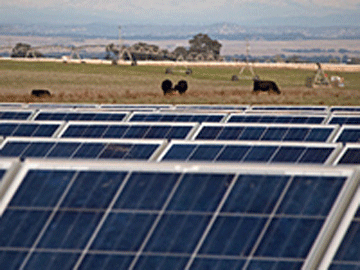
Elecnor Australia’s first project is the $164 million solar photovoltaic farm in Moree, New South Wales for the Moree Solar Farm Company Pty Ltd, part of Fotowatio Renewables Venture. The joint venture originally included Pacific Hydro, which announced in August it was withdrawing from the project due to the policy-driven uncertainties impacting the renewable energy industry.
The Australian Renewable Energy Agency has contributed $101.7 million towards construction and operation of the project, and $47 million has been provided by the Clean Energy Finance Corporation.
Covering 191 hectares, the farm will comprise 232,960 panels with a forecast annual output of 150 gigawatt-hours direct into the main energy grid, enough to power about 15,000 homes. It is expected to be complete and commissioned by the second quarter of 2015.
In a media statement, Elecnor said Australia will be a base for it to expand operations in the Asia-Pacific region, focusing on developing business infrastructure and renewable energies………
The Moree project has already created a number of positions to be based at the town, with the firm earlier this month advertising for an assistant project manager (engineer), a construction manager, six technical engineers as sub-contract supervisors, mechanical and electrical engineers, a civil engineer, two draftpersons, accounts and administration, purchasing and logistics.http://www.thefifthestate.com.au/business/investment-deals/spanish-renewable-energy-firm-sets-up-melbourne-based-subsidiary/67877
Citigroup predicts a good future for the Australian solar market
 Outlook for Australian Solar Market is Positive, says Citigroup http://www.energydigital.com/renewables/3600/Outlook-for-Australian-Solar-Market-is-Positive-says-Citigroup Kevin Smead 26 Sept 14
In a surprisingly optimistic forecast, Citigroup predicted that the Australian solar market would reach 14 GW by 2020. This would require a growth of 2.2 GW per year—with current capacity at 3.5 GW—to reach the predicted goal. This prediction includes both rooftop and utility-scale solar.
The biggest question mark for the prediction remains Australia’s Renewable Energy Target and how its potential scaling back could dramatically affect the solar market, though that ultimately remains to be seen.
“There is no commentary directly linked to the Australian forecasts—which are part of a global solar demand forecast—so it is unclear whether this takes into account any changes to the renewable energy targets,” CleanTechnica’s Giles Parkinson notes. “If the large scale RET stays in place, a large amount of utility-scale solar could be built in Australia—as Bloomberg New Energy Finance has predicted. Certainly, many companies such as US-based Recurrent Energy, Spain’s FRV and others have large pipelines of projects.”
The Australian market is certainly an attractive one due to its high-value natural resources. However, the scaling back of the RET could pull the rug out from under the rooftop solar industry, as subsidies and any form of aid would effectively vanish.
Still, some parts of Australia are fighting for renewable energy. South Australia has committed to a lofty goal of using 50% renewable energy by 2025. This, and other smaller state initiatives, could help drive an industry that the federal government looks to scale back—and ultimately help make Citigroup’s prediction come true.
Australian governments continue to disempower Aborigines
the combined psychological impact on the remote communities affected was devastating: they went from being small places with a high degree of control over their small, welfare-based economies to being small places wholly run by outsiders with agendas of their own.
This pattern extended across the board: services, housing, jobs as well. With the Intervention came the gradual shut-down of the locally focused, long-running and much-modified Community Development Employment Program
 A decade after ATSIC was axed, Aborigines still have little say NICOLAS ROTHWELL THE AUSTRALIAN SEPTEMBER 27, 2014 A DECADE ago, after a protracted period of reviews, critical reports and controversies, then-prime minister John Howard announced, with bipartisan support, the abolition of the Aboriginal and Torres Strait Islander Commission. “The experiment in elected representation for indigenous people has been a failure,” he declared. It was the start of a cascading process of disempowerment that has continued unabated ever since.
Fresh slogans and watchwords were heard in Canberra back then: there was much talk of combating remote community chaos through “shared responsibility agreements”, of increasing economic opportunity and freeing indigenous people from the passive welfare trap. But at the peak of the federal bureaucracy a new phase was dawning in indigenous affairs: one of increased control and surveillance, of close statistical monitoring and constraint, the better to effect social reform at the scale of an entire population group.
This deep, persisting mismatch between announced aims and actual methods defines the landscape of indigenous politics to this day. In place of self-determination and reconciliation, the rhetoric of recognition and empowerment now fills the air — but autonomy and institutional power have been withdrawn from Aboriginal groups and communities, step by relentless step.
A clear blueprint for the next stage in this process was unveiled with the release in late July of the artfully titled report by Andrew Forrest, Creating Parity, which in pursuit of its program of full equality of opportunity recommends blanket welfare income management and intensive oversight of infants and young children in “target” indigenous communities……… Continue reading
Australia’s ClimateWorks and Australian National University show the way to 50% renewable energy by 2050
 Australia Encouraged To Set 50% Renewable Energy Target By 2030 September 25th, 2014 by Giles Parkinson RenewEconomy.
Imagine a world in 2050. Everyone drives an (electric) car, homes have all the gadgets, appliances and nick-nacks. The public transport system is emissions free. Mining work and transport is electrified, and diesel is dumped. Electrification has taken place in much of the steel industry. And it is all emissions free. It might be powered by 100 per cent renewables – the sun, wind, the sea, and geothermal, hydro and biomass. And the economy is still strong.
Welcome to the zero carbon world awaiting Australia and much of the rest of the world.
Major new analysis – Pathways to Deep Decarbonisation – produced by Australia’s ClimateWorks, along with ANU, shows that 15 of the world’s biggest economies can move to “net carbon zero” by 2050, and it need impose no extra costs over business as usual. In fact, electricity bills will be lower than what they are now. Economic growth will remain more or less the same, and the benefits, in terms of health and the environment, will be enormous.
The report is timed for the New York climate summit being hosted by the UN this week, and in the 12 months leading up to the Paris event that will hopefully result in a new climate treaty next year. It is designed to help change the political rhetoric around decarbonisaion. In Australia, only one party, the Greens, talks in terms of net carbon zero by 2050, and of higher renewable energy targets. Yet this report says not only is it necessary to meet climate goals, it is eminently doable.
Anna Skarbek, the executive director of ClimateWorks, says that Australia’s political rhetoric needs to change quickly. While the Abbott government is talking of the need to “cut” the renewable energy target down to a “real” 20 per cent, for “fear” that it might reach 25 or 26 per cent by 2020, Skarbek says that to achieve climate goals, Australia’s renewable energy target needs to be at least 50 per cent by 2030 – and then carbon free by 2050.
“There are many pathways for Australia to substantially reduce emissions, but all include greatly improved energy efficiency across the economy, a nearly carbon free power system and switching to low carbon energy sources in transport, buildings and industry,” Skarbek says.
“Taking the carbon out of our electricity system provides the largest reduction in emissions. Then we can use the carbon-free electricity to replace petrol in cars, and gas in buildings and some industrial processes.”
“The move to a low emissions electricity system can be developed with technologies that exist today. But we need to move faster – this report shows we’ll need at least 50 per cent renewable electricity by 2030 to achieve a decarbonised electricity system in the time we have left to stay within the carbon budget.”….in all scenarios, even those that hope for cost-competitive carbon capture and storage, renewable energy is the dominant technology, and solar provides at least 50 per cent of all generation.
By 2030, under the renewable scenario, coal is nearly eliminated, although it plays a greater role in the other scenarios because CCS will take a decade at least to bring into production (if it can ever deliver the costs, which many think it won’t), and nuclear will not have a presence before 2030.
Even then, it is assumed that nuclear would provide no more than one-quarter of generation – and this is based on the rather generous cost estimates of past government reviews, and does not reflect the significant cost declines that can be expected of solar. Note however, that the emissions per MWh is the renewables scenario is nearly half of that entertained in the CCS or nuclear scenario – that’s because coal generators get to pollute for many years longer in those scenarios……..
The ClimateWorks report was one of 15 prepared for the UN Deep Decarbonisation Pathways Project that involves modelling teams from 15 major emitters that also include Australia, Brazil, Canada, China, France, Germany, India, Indonesia, Japan, Mexico, Russia, South Africa, South Korea, the UK and the USA.
The findings are being presented to the UN this week by leading economist Jeffrey Sachs. It shows that these countries account for 70 per cent of the world’s greenhouse gas emissions. The interim results show that all 15 countries found ways to achieve near zero carbon electricity by 2050, while sustaining economic growth……http://cleantechnica.com/2014/09/25/australia-renewable-energy-target-50-2030/
CSIRO breakthrough in solar thermal research
SUPERCRITICAL SOLAR: CSIRO’S SOLAR BREAKTHROUGH OFFERS NEW OPPORTUNITIES, Techly, by Bianca Wright Thursday 25 September 2014 “…….In June, the CSIRO announced that it had managed to generate supercritical steam using solar energy. The CSIRO’s Energy Director Dr Alex Wonhas called it a game-changer.
“It’s like breaking the sound barrier; this step change proves solar has the potential to compete with the peak performance capabilities of fossil fuel sources.”
According to the CSIRO, supercritical solar steam is “water pressurised at enormous force and heated using solar radiation”. Wonhas noted, “Instead of relying on burning fossil fuels to produce supercritical steam, this breakthrough demonstrates that the power plants of the future could instead be using the free, zero emission energy of the sun to achieve the same result.”
Sarah Miller of CSIRO Energy Technology explained that thermal power stations produce steam that spins a turbine, which converts the steam’s thermal energy into mechanical energy to drive an electrical generator that ultimately produces electricity………
The CSIRO leads the Australian Solar Thermal Research Initiative (ASTRI) which believes the cost of generating concentrating solar thermal power could be reduced from 26.5 cents per kilowatt hour to around 12 cents by 2020.

“This reduction in costs would mean that concentrating solar thermal power station would be cost competitive with traditional power plants and will be able to provide near-zero emissions electricity without destabilising the grid,” Miller said. “Concentrating solar thermal power technologies have advantages over many other renewable energy technologies because thermal energy can be stored and converted to electricity when needed, allowing dispatchable power generation.
“Concentrating solar thermal technologies can also be used to produce high quality process heat and drive chemical reactions. A future concentrating solar thermal world achievement will be 24 hour production of supercritical steam from storage.”
But, Hoogesteger said, it’s also important to recognise that one of the advantages of solar power is that solar often works best by decentralising power generation………
“Solar means that we need to think differently. As a result of the kind of ongoing, gradual innovation that doesn’t always get the headlines, businesses and homes can be their own power plants right now. So it would be wrong to seize on this one innovation and overlook what solar is already doing for business, government and households.”
Despite this, the CSIRO’s breakthrough represents a step forward in terms of solar as a viable option at a larger scale than previously envisaged…….http://www.techly.com.au/2014/09/25/supercritical-solar-csiros-solar-breakthrough-offers-new-opportunities/
Australia’s Lucas Heights nuclear reactor to get less security
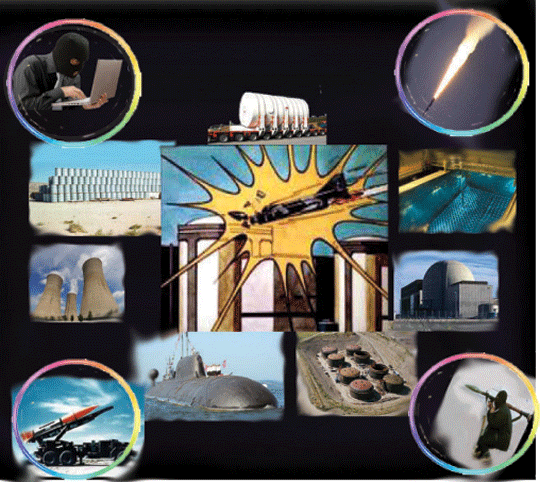 Lucas Heights nuclear reactor’s security may be cut DANIEL MEERS THE DAILY TELEGRAPH SEPTEMBER 24, 2014 THERE are fresh fears federal police numbers may be cut at the Lucas Heights nuclear reactor, the site of a security breach on Monday.
Just a day after police intercepted bushwalkers at the restricted site 31km southwest of Sydney, the Australian Manufacturing Workers Union claimed Australian Federal Police numbers would be cut from 21 to six at the site next month and restructured. The union’s claims follow funding cuts for the Australian Nuclear Science and Technology Organisation (ANSTO) which the organisation says has led to a restructure in operations.
Safety supervisors would also be outsourced under the restructure.
A spokesman for ANSTO yesterday said the union figures on policing were wrong but conceded there had been changes to roles…..
AMWU NSW secretary Tim Ayres said he was concerned about security at the site. “In a climate of heightened security risks, we’re about to hand over security of a nuclear reactor to a contractor firm. How can this deliver better safety?
“The community expects our high-risk security targets are patrolled by professional federal police officers and a strong on-site safety culture. But ANSTO … has decided to go with the cheaper option.”….http://www.dailytelegraph.com.au/news/nsw/lucas-heights-nuclear-reactors-security-may-be-cut/story-fni0cx12-1227068424540
Gas, Coal, & Nuclear power are the focus of Abbott’s Energy Green Paper
It devotes one special appendix to nuclear energy.
In short, this paper is everything it was expected to be – despite its supposed focus on the future, it is looking in the past rather, completely oblivious to global trends, technology costs and the rapid change in energy systems, not to mention the challenge of reducing emissions
Abbott’s energy green paper focuses on gas, coal, nuclear, REneweconomy By Giles Parkinson on 23 September 2014 The long-awaited energy green paper from the Abbott government is playing to form, focusing largely on Australia’s booming gas industry and how to get more investment into extractive energy resources, so that Australia can become an energy “superpower.”
As the UN meets in New York, and bodies such as it, major investment funds and the World Bank urge a price on carbon and a rapid path to decarbonisation, the green paper makes a virtue of becoming the first country to dump a carbon price.
It also warns against “distorting” subsidies, although this seems focused more on renewables than it does on not accounting for the health and environmental impacts of fossil fuels, which the Climate Institute said today was costing $14-39 billion a year.
To get an idea of where the government sees its priorities, in the four-page executive summary, for instance, gas gets 18 mentions, coal gets four and solar gets just two. Wind energy doesn’t rate a mention. Storage is mentioned once, as is nuclear.
But in the 78-page body of the green paper, gas is mentioned 434 times. Coal is mentioned 100 times, followed by nuclear on 67. Storage gets 32, solar gets 26, and wind energy just 13 mentions.
That certainly doesn’t relate to Australia’s current energy mix, or even the future energy mix. And certainly not the decarbonised energy systems that are advocated by the likes of ClimateWorks, or even the International Energy Association. Continue reading
Australia helps destabilise Asia-Pacific in selling uranium to India
 Australia and uranium: the pusher of the Pacific https://overland.org.au/2014/09/australian-and-uranium-the-pusher-of-the-pacific/ By Adam Broinowski 19.Sep.14 “……… The new demand from India will include uranium mined from Ben Lomond near Mt Isa which is likely to be shipped from Townsville Port, and coal mined from the gargantuan Galilee Basin and shipped from Abbott Point, passing through the dredged Great Barrier Reef, or freighted by road to Darwin or Adelaide ports (which hold uranium licenses). The Australia-India uranium agreement supports this concerted and accelerated push.
In cementing a nuclear deal with India, the Abbott government has committed to selling uranium to a nation-state that barely conceals its intentions to expand its nuclear weapons arsenal and that rejects the NPT and Comprehensive Test Ban Treaty (CTBT)………..
First, the Australia-India uranium trade agreement is unsafe. If Japan’s nuclear industry and government have proven unable to properly contain the potential for serious nuclear accidents at its domestic nuclear power plants, then India’s nuclear industry, which is much less reliable and possibly even more corrupt, poses even higher risks of mismanagement.
Internally, India is also unstable, as the government fights an embedded insurgency. It maintains a violently repressive approach to imposing nuclear installations and uranium operations (such as Gorakhpur, Koodankulam, Jaitapur, Jagudoga) upon vulnerable communities, and against the wishes of civil protesters, five of whom have been killed since 2010. While guaranteed only intermittent electricity supply, such communities are experiencing higher rates of disease, congenital malformations and early deaths. In Jagudoga, Jharkhand (19,500 people), those living near the central uranium mine operated by Uranium Corp. of India Ltd. (UCIL), have suffered disproportionately high health problems……….
Second, while Tony Abbott reiterated that ‘suitable safeguards’ were in place to ensure that Australian uranium would be used for ‘peaceful purposes’ and for ‘civilian use only’, such ambiguous terms create false impressions. Nuclear technologies are inherently dual-use (both for civil energy production and military use), and it is disingenuous to claim that a water-tight separation can be ensured. In fact, ten of India’s twenty nuclear facilities do not fall under International Atomic Energy Agency (IAEA) supervisional authority, and India only selectively recognises IAEA safeguards for specific foreign supplied reactors and facilities. With no mechanism to inspect this nuclear technology to ensure that the fuel is not diverted into nuclear weapons production, safety cannot be guaranteed.
Even if the diverted fuel was discovered, neither Australia nor the IAEA could force compliance. An influx of imported foreign uranium will simply make it easier for India to reserve some of its indigenous uranium for enrichment and/or reprocessing weapons-grade plutonium, or for some of Australia’s uranium to be ‘misallocated’ toward military facilities.
In effect, Tony Abbott’s policy to treat India as the exception undermines the IAEA standards within the disarmament regime, and breaches Australia’s obligations to the Rarotonga Treaty for the South Pacific Nuclear Free Zone.
Third, and perhaps most significant, the deal will upset the ‘balance’ between India-Pakistan and in the South Asian region so as to aggravate rivalries and intensify tensions between the two nations, as well as others such as China and Bangladesh………
While leaders such as Abe, Abbott and Modi downplay the reality confronting people affected by radiation exposures from the Fukushima Daiichi nuclear power plant, we should remember that this contamination came, in part, from Australian uranium.
The refusal of executive leaders to acknowledge the dangers of the uranium trade reflects the centrality of nuclear power to the US-led security regime that seeks to dominate non-compliant nations such as China or Russia………
Dr Adam Broinowski is an ARC postdoctoral research fellow at the College of Asia and the Pacific, the Australian National University.
Australia isolated internationally, with no credible plan on Climate Change
Australia out in the cold as world turns up the heat on climate change, SMH September 24, 2014 – Tom Arup Environment editor, The Age As world leaders sit down in New York to discuss climate change, it is unlikely Australia will be trying to scupper the talks.
But nor is it going out of its way to be very helpful either.
The New York summit is critical. Over the past five years, getting world leaders to engage in climate change negotiations has been nigh on impossible.
This time it took a personal plea from UN Secretary-General Ban Ki-moon to get 125 heads of state to go to New York. And even then the top leaders of China and India are not among the attendees, though US President Barack Obama will be there……..
Now, as in Copenhagen, Australia risks finding itself out of step. But this time it is shaping up to be a laggard.
The global discussions on climate change are in a more positive place than they have been for many years, the result of recent stronger, though imperfect, efforts by China and the US to reign in their greenhouse gas emissions.
It would be foolish to believe this guarantees the elusive new global climate deal will be signed off at a meeting in Paris next year, where it is due to be finalised.
But China and the US have re-engaged.
Meanwhile, Australia is swimming against the tide. For example, the World Bank on Tuesday released a statement signed by 73 countries and about 1000 businesses and investors, in support of pricing carbon. China, Indonesia and Britain were among the signatories.
However, the Abbott government has made Australia the first country to repeal a national carbon price. And its replacement policy to cut emissions, the ill-formed Direct Action, languishes in the Senate with little political support.
It leaves Foreign Minister Julie Bishop, who is representing Australia in New York, coming to the talks with no comprehensive plan to cut Australia’s emissions under her belt. Nor does she bear any increased ambition to slash Australia’s emissions deeper than the meagre targets presently promised………
All this points to a government that sees climate change as an annoying diplomatic distraction, akin to a minor trade dispute, rather than a central tenet of foreign and environment policy.
It is a position that belies the seriousness of the problem http://www.smh.com.au/federal-politics/political-opinion/australia-out-in-the-cold-as-world-turns-up-the-heat-on-climate-change-20140923-10kynu.html#ixzz3EGq5HWVk
Tony Abbott exaggerated India’s nuclear safety
 Fact check: Tony Abbott exaggerating India’s ‘absolutely impeccable record’ on nuclear non-proliferation ABC News, Wed 24 Sep 2014, A new bilateral agreement signed by Prime Minister Tony Abbott in early September will allow Australia to sell uranium to India for the first time.
The agreement formalises a 2007 Howard government policy to allow Australian uranium to be exported to India for energy generation, overturning a decades-old ban on uranium sales to countries which had not signed the Treaty on the Non-Proliferation of Nuclear Weapons (NPT)………
Mr Abbott says the agreement is a sign of trust between the two countries. “India has an absolutely impeccable record when it comes to nuclear non-proliferation,” he said…..
Diverting nuclear material from peaceful purposes
The promise not to divert nuclear material, such as uranium, from peaceful purposes to the development of nuclear weapons is a key plank of both the NPT and Australia’s uranium export policy.
Dr Rublee says India certainly does not have an impeccable record when it comes to nuclear non-proliferation.
“I do believe it’s a stretch to say it’s impeccable and in fact, the fact that India’s program began by explicitly breaking a legal commitment to Canada, tells you that there’s a problem from the very start,” she said.
Dr Rublee is referring to India’s first nuclear test, when it exploded the ‘Smiling Buddha’ nuclear bomb in 1974 using plutonium from a nuclear reactor supplied by Canada. The Canadian government immediately stopped supplying India with nuclear materials, a ban that was only overturned in 2010.
Former Labor foreign minister Professor Gareth Evans, who convenes the Asia Pacific Leadership Network for Nuclear Non-Proliferation and Disarmament, also cites India’s diversion of Canadian resources to making nuclear weapons as evidence that their record is not impeccable.
“There should be no waiving of our standard safeguards requirements when it comes to accounting for Australian-supplied nuclear material,” he said.
Dr Rublee says there are also issues with how India secures its nuclear material………
India has increased its nuclear weapons stockpile, conducted nuclear testing and refused to sign the NPT. There are also question marks over its safety procedures. India’s record when it comes to nuclear non-proliferation is not “absolutely impeccable”.
Mr Abbott’s claim is exaggerated. http://www.abc.net.au/news/2014-09-24/tony-abbott-india-uranium-record-fact-check/5736514
South Australia goes for 50% renewable energy by 2025
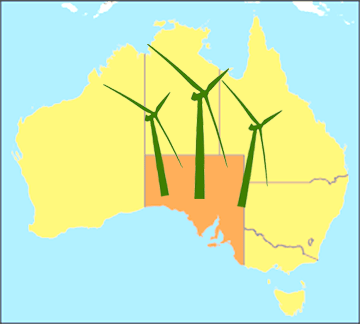 South Australia commits to 50pc renewable energy target by 2025 (includes AUDIO), ABC News 23 Sep 2014, The South Australian Government says it will increase its Renewable Energy Target (RET) and aim for 50 per cent of the state’s power to be generated by renewables by 2025.
Premier Jay Weatherill said figures from last financial year showed 31.5 per cent of energy produced in the state came from renewable sources.
He said updated figures were expected to show SA had since exceeded its current target of 33 per cent by 2020.
“Modelling shows that the RET has underpinned $5.5 billion of expenditure to date,” he said.
“[It is] forecast to support a further $4.5 billion by 2025. “This new target of half of the state’s power to be generated by renewable sources will create jobs and drive capital investment and advanced manufacturing industries.”
Mr Weatherill said SA had demonstrated that with appropriate policies and incentives, highly ambitious targets were achievable.
This new target of half of the state’s power to be generated by renewable sources will create jobs and drive capital investment and advanced manufacturing industries.
Jay Weatherill
He said the Federal Government needed to heed that message.
“The sovereign risk created by the Federal Government’s unnecessary and unexplained review into the national RET has caused a number of projects to be placed on hold, putting many construction projects and ongoing jobs at risk,” he said.
“There are hundreds, if not thousands, of SA jobs in the renewable energy sector and these are the growth areas we should be supporting, not undermining.”…..
Conservation Council CEO Craig Wilkins urged the SA Government to keep fighting the federal move to downgrade the RET.
“We have reaped the benefits of the Commonwealth Renewable Energy Target over the last decade with enormous investment in wind and solar infrastructure, particularly in regional SA,” he said
“This new state target of 50 per cent renewable energy generation by 2025 will be extremely difficult to achieve if the federal RET is dismantled.”
Andrew Bray from the Australian Wind Alliance said South Australia had proved itself a wind power success story.
“While more wind and solar power in SA is being fed into the grid, the wholesale cost of power has stayed the same,” he said.
“South Australians are paying the same for wholesale power as they were eight years ago, even accounting for the cost of renewable energy certificates.
“This decision to increase the target shows that with the rise of renewable energy is inevitable and beneficial to Australians’ costs and standard of living.”http://www.abc.net.au/news/2014-09-23/sa-commits-to-50-per-cent-renewable-energy-target/5763640
Nuclear agreement with Argentina( may mean return of radioactive wastes?)
Argentina reaches nuclear agreements with Australia, Russia, Business News America By Andrew Baker – Tuesday, September 23, 2014 Argentina signed a contract to provide Australia with nuclear fuel for the latter’s Opal research reactor, built byArgentine technology firm Invap.
Argentine planning minister Julio De Vido encouraged further nuclear cooperation between the two countries at the signing, which took place at an event in Vienna, Austria held by the International Atomic Energy Agency……… The Australia contract follows news of an agreement between Argentina and Russia to cooperate on nuclear development. (I’m prety sure that this agreement includes the return of nuclear wastes to Australia)…….http://www.bnamericas.com/news/electricpower/argentina-reaches-nuclear-agreements-with-australia-russia?utm_source=feedburner&utm_medium=feed&utm_campaign=Feed%3A+BusinessNewsAmericas-TopStoriesEN+(Business+News+Americas+-+Top+Stories+EN)
Greens urge that Western Australia get a nuclear emergency plan.
 Greens want Barnett to make emergency nuclear plan for WA http://www.watoday.com.au/wa-news/greens-want-barnett-to-make-emergency-nuclear-plan-for-wa-20140919-10iutv.html September 18, 2014 Brendan Foster With Australia on the brink of new conflict with Iraq, Greens MP Lynn MacLaren says she can’t believe the Barnett government doesn’t have an emergency plan if a nuclear accident happened at Fremantle Port.
On Monday, Prime Minister Tony Abbott said Australia would send 600 troops, including SAS soldiers and eight FA18 Super Hornets, to the Middle East in preparation for military action against the Islamic State terror group.
And on Thursday, more than 800 police officers raided homes in Sydney in an attempt to foil a plot to “commit violent acts”, including plans to behead a member of the public.
Ms MacLaren asked Attorney-General Michael Mischin on Wednesday night in State Parliament if the Liberals had an action plan for workers and residents living near the port in the event of the nuclear reactor incident from a nuclear-powered warship. Mr Mischin said a nuclear detonation was not a defined hazard prescribed within the Emergency Management Act 2005.
“The state emergency management arrangements allow for a controlling agency to be appointed for any hazard not prescribed in the act,” Mr Mischin said.
Ms MacLaren said as Australia prepared to send troops to Iraq, “we cannot afford to have a head-in-the-sand approach to an emergency response”.
“Since nuclear-powered vessels visit our shores, we need to be ready in the event of an accident or incident. The report tabled in response to my question was last updated in 2010,” she said.
“Nuclear weapons have been a major threat to world peace for decades, how can the state government not have an emergency response to the risk of a nuclear weapon detonation or accident?
“The consequence of even a small incident would be catastrophic. Yet, we should have a plan which factors in health care facilities and staff to provide triage care in the event of a nuclear detonation or other nuclear incident.” Ms MacLaren said with the Mayors of Peace Conference in Fremantle next week, the call to prohibit nuclear weapons was more important than ever.
Junko Morimito who will describe her experience as a 13-year-old in Hiroshima when the atomic bomb went off is one of the guest speakers at the conference.
“I will be attending the Fremantle Peace Walk which will take place on International Peace Day, Sunday 21 September – celebrating the opening of Fremantle Peace Grove. Tthis issue must be kept as a priority for leaders and the community,” Ms MacLaren said.
Slashing of Renewable Energy Target will mean loss of thousands of rural jobs
 Renewables energy suppliers warn on RET jobs http://www.businessspectator.com.au/news/2014/9/19/policy-politics/renewables-energy-suppliers-warn-ret-jobs 19 SEP,
Suppliers working on Australia’s renewable energy projects say many thousands of jobs will be lost – most of them in rural and regional areas – if the federal government slashes the Renewable Energy Target (RET).
Forty small and medium businesses from around Australia have jointly written to the government, urging it to retain the current policy, rejecting the recommendations of the recent Warburton review to shut down or severely reduce the RET.
“We are writing as suppliers to Australia’s renewable energy industry, which has now generated more than $10 billion worth of investment in large-scale renewable energy projects,” the companies said.
The companies (listed at bottom) between them operate across all Australian states and territories. “Our businesses build electrical infrastructure, roads and components for power stations in wind, solar, hydro and bioenergy, along with supplying safety equipment, cranes, trucks and cement.
“They provide catering, cleaning services, security, logistics and accommodation to construction teams, manage environmental and cultural heritage plans, and supply many other essential inputs to the renewable energy industry.
“While the industry directly employs 21,000 people, our companies collectively employ many thousands more as a result of the clean energy sector.”
The companies, whose sizes range from 1 to 2000 employees, said Australia’s 68 wind farms, 49 large-scale solar projects, 139 bioenergy projects, 123 hydro projects and trial marine and geothermal projects had provided the incentive to grow and employ more workers.
“Many of these jobs are in rural and regional areas where other job opportunities are scarce,” they said.
“We have hired and trained workers and invested in our businesses on the basis of the development of renewable energy in Australia. Maintaining the RET in its current form will help us continue to create jobs and opportunities for Australian workers,” they wrote.
The companies also referred to analysis undertaken by ACIL Allen for the Federal Government, which found that retail electricity prices will be lower over the long term if the RET is maintained, as it will help shield Australians from rising gas prices.
“This is beneficial to all Australians, consumers and businesses alike,” the companies said.
Signatories: ………
1 This month
17 October, Free Public Talk on Nuclear Issues in South Australia
David Noonan will speak on public interest concerns over the new Roxby Downs Indenture Act 2026 on BHP copper-uranium mining and ore processing in SA, and on how AUKUS may face SA with a High-Level nuclear waste agenda.
Dr Jim Green will discuss international developments in the field of nuclear power including ‘small modular reactors’ and Generation 4 ‘advanced’ nuclear reactor concepts.


Help Aunty Sue Protect Her Land and Sacred Sites From Destructive Rocket Testing.
.

Australians deserve the truth
about
AUKUS – https://aukuspublicinquiry.com/

PETITION – To: Prime Minister Anthony Albanese and the Australian Labor Government

of the week – Australians for War Powers Reform (AWPR)
To see nuclear-related stories in greater depth and intensity

