Clive Palmer throws Abbott’s climate policy into chaos
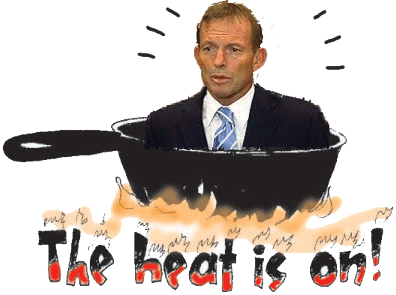 Shock and Gore: Clive Palmer shows his hand June 26, 2014 The Age, James Massola, Mark Kenny, Heath Aston
Clive Palmer has thrown into chaos Tony Abbott’s plan to abolish the carbon tax, demanding the Prime Minister instead create an emissions trading scheme that would swing into action when Australia’s major trading partners adopt similar measures.
A day before Mr Palmer sits down with Mr Abbott to discuss the federal budget and the government’s signature pledge to repeal the carbon tax, the erratic Palmer United Party leader was joined by former US vice-president Al Gore to announce his position on a suite of climate change legislation.
Mr Palmer said his trio of senators would move to enshrine in law a guarantee that energy producers pass on to households the benefits of repealing the carbon tax, while they would also move to block the government’s plans to scrap the Clean Energy Finance Corporation and potentially wind back the Renewable Energy Target, which mandates 41,000 gigawatt-hours of electricity be produced by large clean energy sources by 2020.
The abolition of the independent Climate Change Authority would also be opposed.
Mr Palmer said his party would move to legislate an emissions trading scheme with a starting price of zero dollars.
”The government and the parliament of the day have the ability to set the financial parameters of the [emissions trading] scheme based on the action of our leading trading partners such as China, the United States, the European Union, Japan and Korea,” he said.
In a later interview on ABC’s Lateline, Mr Palmer made clear that repeal of the carbon tax was contingent on energy producers refunding to consumers the benefits of the repeal of the tax.
But it would not be contingent on the other measures Mr Palmer proposed on Wednesday night, such as the proposed emissions trading legislation.
The proposal to introduce the ETS in the Senate would be attached to the bill that would repeal the Climate Change Authority and the PUP would attempt to have that passed by the Senate.
“We want a scheme that is conditional upon other countries and doesn’t become operable until those countries do that, introduce a similar measure,” he said.
Mr Palmer also said his party had not adopted a final position on whether to oppose or support the abolition of the Australian Renewable Energy Agency……..
Mr Palmer said his discussions with Mr Gore had helped him reconsider the ”important issues facing Australians and the rest of the world”.
The PUP leader said the government’s Direct Action policy was ”a waste of money” and should not be implemented when Australians faced other unfair budget measures………
PUP ally Ricky Muir, of the Australian Motoring Enthusiast Party, and other cross-bench senators John Madigan and Nick Xenophon are looking closely at the merits of renewable energy. http://www.smh.com.au/federal-politics/political-news/shock-and-gore-clive-palmer-shows-his-hand-20140625-3atpd.html#ixzz35ndf8vLk
Climate change to be on the G20 agenda, if USA gets its way
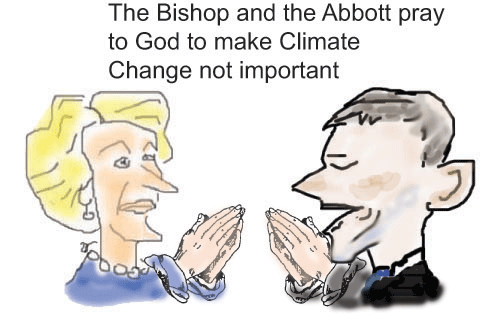 USA will push for climate change at G20 http://www.heraldsun.com.au/news/breaking-news/us-will-push-for-climate-change-at-g20/story-fni0xqi4-1226966794377?nk=38b4e03626cff750bb726e65c1a3e9f4 THE United States will push for climate change to be discussed at this year’s G20 summit in Australia, even if the federal government doesn’t want it on the agenda.
US Ambassador John Berry says his country’s G20 representatives – known as sherpas – are already raising climate change in the lead up to November’s summit in Brisbane.
The passionate conservationist said President Barack Obama believed climate change was a “critical” issue and his administration wouldn’t shy away from encouraging all nations to do their part.
“It’s one the United States will raise in every international forum,” he told the National Press Club on Wednesday.
“It is one we will continue to press on.”
Some countries have criticised Australia for neglecting to put climate change on the G20 agenda, with the government opting to focus on sustained economic growth, trade, and investment.
Ambassador Berry said the US shared these objectives, but also believed they could be advanced while making the planet healthier.
“The president believes we can do this (address climate change) without damaging or hurting the economy,” he said. The Obama administration has pledged to cut its emissions by 30 per cent by 2030, and will be pushing each country to adopt their own “aggressive” targets to do their fair share.
Trade Minister Andrew Robb conceded while climate change was off the agenda, Australia wouldn’t stop any country from discussing whatever matter they wished.
“So we quite welcome climate change if it was raised by the US or by any other country,” he told reporters in China.
Labor’s climate change spokesman Mark Butler said the government was out of step with the rest of the world on climate change but couldn’t ignore the issue for much longer. http://www.smh.com.au/environment/climate-change/bipartisan-us-climate-report-paints-dark-picture-of-future-economic-costs-20140625-zskpp.html#ixzz35nei9hSr
Coalition’s own modelling shows that their renewable energy policy is wrong
Renewable energy cheaper: reviewFINANCIAL REVIEW : 25 JUN 2014 Electricity prices fall – not rise – as more renewable energy is deployed, according to modelling done for the federal government’s review of the renewable energy target, in a finding which undermines the central argument in the Coalition’s bid to repeal the scheme.-…. (Subscribers only) http://www.afr.com/p/national/renewable_energy_cheaper_review_8dDTjd57IgYLxk4jV6IVsO
Financial modelling – the new style of anti coal activism
Swapping picket lines for pinstripes: Meet the new face of anti-coal activism, SMH June 24, 2014 Jamie Freed and Nassim Khadem
Tim Buckley, a former head of equity research at Citigroup, once spent his days doing financial modelling for conglomerates like Wesfarmers, which has a coalmining business.
When you talk to them privately, they say to do the right thing while the government is doing the wrong thing is actually going to cost our business.
Now he works for the US-based pro-renewable energy group Institute for Energy Economics and Financial Analysis. One of his projects is demonstrating why spending $40 billion on coalmines and infrastructure in Queensland’s Galilee Basin doesn’t make financial sense.
His aim is to convince superannuation funds, lenders and governments that funding infrastructure for the projects would be a bad long-term investment and they should focus on energy sources with more promising futures, such as solar and wind………
‘Evidence’ top miners know
He says BHP Billiton’s decision to stop investing in new coal projects and Rio Tinto’s $US1 billion ($1.05 billion) sale of its Clermont mine in Queensland are evidence that even the top miners recognise the way the world is heading.
He would like to convince the big four banks to stop lending to coalminers, but says that is unlikely under the current government.
“When you talk to them privately, they say to do the right thing while the government is doing the wrong thing is actually going to cost our business,” he says. “They say it will damage their political standing in Canberra.”……..
‘Evidence’ top miners know
He says BHP Billiton’s decision to stop investing in new coal projects and Rio Tinto’s $US1 billion ($1.05 billion) sale of its Clermont mine in Queensland are evidence that even the top miners recognise the way the world is heading.
He would like to convince the big four banks to stop lending to coalminers, but says that is unlikely under the current government.
“When you talk to them privately, they say to do the right thing while the government is doing the wrong thing is actually going to cost our business,” he says. “They say it will damage their political standing in Canberra. : http://www.smh.com.au/business/carbon-economy/swapping-picket-lines-for-pinstripes-meet-the-new-face-of-anticoal-activism-20140624-3aqeu.html#ixzz35ngwl0eW
Australia’s rapid growth in renewable energy
The result is up from 13.14 per cent in 2012.
Clean Energy Council chief executive David Green said both energy efficiency and renewable energy had an important role to play in building a stronger, cleaner economy, and 2013 represented another exciting year for the uptake of these technologies.
“Last year saw another year of steady growth for solar power and wind energy in Australia, despite sustained uncertainty about the key policy settings for the sector. Australia’s renewable energy potential is massive, but we have so much more to do to fully unlock it,” Mr Green said………
Key results from the Clean Energy Australia 2013 report include:
· $5.2 billion was invested in clean energy during the calendar year, the third successive year that domestic investment has been more than $5 billion.
· Almost 1.25 million solar power systems were installed at the end of 2013, meaning more than 3.1 million Australians now live or work beneath a set of solar panels.
· Renewable energy produced 14.76 per cent of Australia’s electricity in 2013 – enough to power the equivalent of almost 5 million homes. While hydro had an extremely strong year, wind and solar power use also grew to record levels.
· Approximately 21,000 people were employed by the renewable energy industry at the end of 2013. This is several thousand fewer than the year before, mainly due to a contraction in the market for household solar power.
· The largest wind farm in the Southern Hemisphere, the Macarthur Wind Farm, opened in 2013. In total, Australia’s 1639 wind turbines across the country provided enough electricity to power the equivalent of 1.3 million homes. http://www.theaustralian.com.au/business/latest/renewables-generation-grew-to-nearly-15-in-2013/story-e6frg90f-1226965788613
Over 70% of Australians want to keep the Renewable Energy Target
Majority Of Australians Support Renewable Energy Target http://www.energymatters.com.au/index.php?main_page=news_article&article_id=4359 A survey has found not only do most Australians want to maintain the nation’s Renewable Energy Target, a majority want to see it set higher.
A related report to be released on Monday by the Climate Institute states the number of people supporting an RET of 20 per cent and above has risen to 71 per cent this year. Just 9 per cent want to see the target reduced or abolished altogether.
76 per cent believe state governments should be putting in place incentives for more renewable energy.
On Sunday, the Climate Institute kicked off a last-ditch campaign dubbed Stop The Dinosaurs, urging Parliament to take note of public sentiment and key factsand save not only the Renewable Energy Target, but also carbon laws.
One of the high-profile people supporting the campaign is former Liberal Party leader Dr John Hewson. “From 2010 to 2012, Australians were subject to a historic scare campaign about the impacts of the carbon laws, but it is quite clear now that these laws are not a ‘wrecking ball’ or ‘python squeeze’,” said Dr. Hewson.
“The fact is that since the carbon laws were enacted, Australia’s pollution has been reduced by millions of tonnes and the economy has grown. Average households are not worse off as many feared they could be.” The survey also indicates the Prime Minister’s claimed commitment to battling climate change isn’t believed by many Australians.
“Only 20 per cent trust Tony Abbott when he says he is concerned about addressing climate change, in contrast to 53 per cent who do not, including 37 per cent who strongly distrust the Prime Minister,” states The Climate Institute. 82 per cent of Australians choose solar power in their top three energy sources and 64 per cent choose wind. Coal, recently referred to by the Prime Minister as one of “nature’s gifts“, was even less popular than nuclear.
“It is OK to like dinosaurs, but this year’s Climate of the Nation survey shows that it may well be politically dangerous to be one when it comes to climate change and its solutions,” said John Connor, CEO of The Climate Institute.
The full Climate of the Nation 2014 report will be available at 11am on Monday from the Climate Institute web site.
Australia’s Climate Denialism: the Age of Abbott
 How Rupert Murdoch created the world’s newest climate change villain, Salon Australia was once a leader on climate action. Thanks to American conservative powerhouses, that’s no longer true ALEXANDER WHITE 21 June 14, Australia, the sunburned country, is uniquely vulnerable to the dangers and risks of global warming. Whether it is the severe effects of flooding, unseasonal heat waves, devastating bush fires or decade-long droughts, Australia’s people, economy and natural environment have all keenly felt the impact of extreme weather and climate change.
Australia’s national scientific organizations have been raising the alarm for more than a decade, and the previous government accepted that scientific consensus and enacted a cap-and-trade scheme in 2012. But after a divisive election last year — one that saw native-born Rupert Murdoch exercise his considerable influence in Australian media markets to disastrous effect — the country is now governed by a deeply unpopular Liberal-National government, crafted in the image of the most climate-denying elements of the Tea Party. And its position on climate change has significant impacts on global efforts to reduce carbon emissions: Australia is not only the chair of the G-20 group of nations, but also holds a place on the U.N. Security Council.
The rest of the world saw this ideology on full, embarrassing display with the recent visit by Prime Minister Tony Abbott to Canada and the United States. Continue reading
Clean Energy Council report shows Australia reached15% renewable energy in 2013
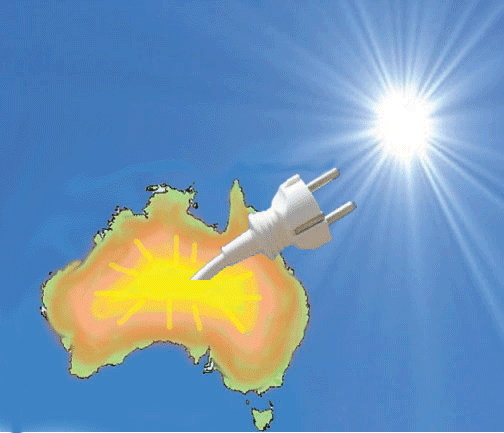 Clean Energy Australia Report 2013 http://www.energymatters.com.au/index.php?main_page=news_article&article_id=4360 24 June 14 A just-released report from the Clean Energy Council reveals renewable energy provided 14.76 per cent of Australia’s electricity last year.
While hydro power made up the lion’s share, Clean Energy Australia Report 2013 states 1.25 million solar power systems were installed by the end of 2013, with more than 200,000 systems installed during last year. There were 4595 solar installers across Australia at the end of 2013.
Again addressing the “solar is for the rich” myth; the report says: “Residents from affluent inner-city suburbs generally installed solar at much lower rates than those in mortgage belt, retirement and regional areas.”
Wind power provided 4 per cent of Australia’s overall electricity demand in 2013, with 1639 wind turbines cranking enough clean power to supply the needs of 1.3 million homes.
Renewables continued to be a significant employer in Australia, with 21,000 jobs across all sectors.
The report states the renewable energy industry has contributed $5 billion of investment to the economy each year for the past three years.
“This report shows that this is an industry poised to unlock tens of billions of dollars in investment, if the national Renewable Energy Target remains in place following the current review process,” said Clean Energy Council Chief Executive Dave Green.
Japan’s plans to restart nuclear reactors – not likely to save Paladin
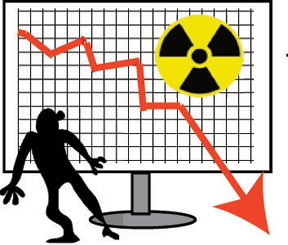 Japan to restart nuclear reactors: Will it save Paladin Energy Ltd? http://www.fool.com.au/2014/06/23/japan-to-restart-nuclear-reactors-will-it-save-paladin-energy-ltd/ By Mike King – June 23, 2014 Plans to restart at least two of Japan’s 48 nuclear reactors could have positive implications for the price of uranium and deliver a boost to ASX-listed uranium miners, including Paladin Energy Ltd (ASX: PDN).
According to The Diplomat, Japan’s Nuclear Regulation Authority (NRA) is about to begin safety inspections on at least one power plant. Japan’s nine nuclear power companies all have plans to restart their nuclear reactors.
But with 58% of Japanese people opposing any restart, and 59% opposing the use of nuclear energy to kickstart economic growth, the government and the energy providers will have their work cut out for them. The issue for Japan is that meeting peak summer energy demand without the nuclear power plants is going to be tough.
Uranium prices have crashed since the Fukushima incident in 2011, losing a further 30% in the last year to hit US$28.15 a pound. That’s well below the cost of production for most uranium miners. And in the short to medium term the outlook is not good, with RBC Capital Markets Analysts forecasting a price of US$31.50/lb this year and US$40 for 2015. But RBC has slashed its forecasts for 2016 to 2018 to between US$40 to US$45/lb, amid expectations that the uranium market will be in surplus until 2021.
Paladin’s cost of production in the last quarter at its Langer Heinrich mine stood at US$29/lb – and that’s not the all-in sustaining cost. The company was forced to place its other main mine Kayelekera mine on care & maintenance, with its production cost running at US$32.90/lb in the last quarter.
So it appears that the tough times will continue for Paladin and other ASX-listed uranium miners, including Energy Resources of Australia Limited (ASX: ERA) – which is majority-owned by Rio Tinto Limited (ASX: RIO). Investors may want to skip the uranium producers for now.
Aboriginal Australia has had a huge victory in the Muckaty nuclear waste dump case
This has been hard fought litigation, and we are proud to have given voice to the resilience and determination of our clients Elizabeth O’SheaToday, the Commonwealth Government has agreed not to act upon the nomination of land at Muckaty Station as a site for Australia’s first radioactive waste dump. The resolution comes seven years after the nomination, four years after the court case was started, and two weeks into a seven week trial. The matter has settled with no admission of liability. Maurice Blackburn’s social justice practice conducted this case on a pro bono basis, and we couldn’t be prouder of the outcome or happier for our clients.Muckaty Station, 110km north of Tennant Creek, is an Aboriginal land trust under the Aboriginal land rights act. In the 1990s, the Aboriginal land commissioner, justice Gray, was tasked with working out who were the traditional owners of that particular country and the nature of land tenure under customary law. He wrote a report and handed the land back to Aboriginal people on the basis of his findings.
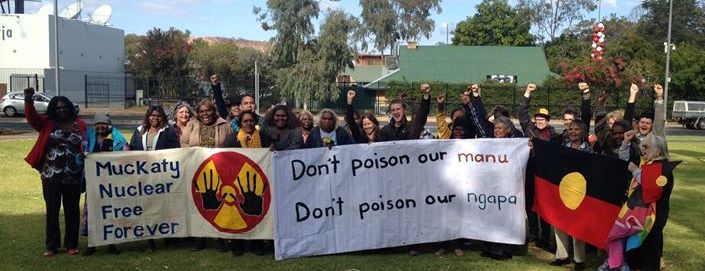
Understandably, the return of land to Aboriginal people is a source of immense pride for many. Aboriginal people treat their customary obligations seriously and with dignity, undercutting many of the old lines about Aboriginal people from the reactionary songbook.
In relation to Muckaty, there may be many Aboriginal people who have an interest in the land under customary law. The NLC is charged with dealing with land according to certain rules. They have legal duties to obtain informed consent from people who have primary spiritual responsibility for country, but also to give those with an interest in the land the opportunity to express their views.
In 2005, the Howard government introduced legislation to facilitate the building of Australia’s first radioactive waste dump. The Commonwealth had sites that it owned already and could use, but the NLC lobbied to introduce a provision which permitted Aboriginal people to volunteer a site.
In 2006, the NLC began negotiations with the Commonwealth about a nomination of a site on the Muckaty land trust. The proposed nomination was immediately contentious. Eventually, the Commonwealth offered $12m in the event that the nomination was declared to be the site of the dump. The NLC say they obtained consent and consulted with the right people. The deal was signed in 2007.
There is no doubt that some traditional owners consented to the nomination. It is easy to see why – these are some of the poorest people in Australia and this is a lot of money, though it starts to look quite miserly when compared with international examples.
However, there are five key dreamings on Muckaty that are relevant to this site. The NLC’s stated position was that one sub-branch of one dreaming group were exclusively able to consent to the nomination. Representatives of every other dreaming oppose the dump.
This contrasts with justice Gray’s report, which clearly articulates how decisions about country in the Central Desert area are made collectively, by consent. It is also troubling for other reasons. This proposal is not a microwave tower, or a railway or even a mine. This proposal involves burying radioactive waste on country, within a short distance from a significant sacred site. Even if, as the Commonwealth maintains, it will be safe within a couple of hundred years, it arguably involves permanent sterilisation of land under customary law. The consultation for a proposal of this significance should have been thorough, so people knew exactly what it was they were consenting to, but also that any dissent was treated seriously and as potentially a reason not to proceed with the proposal.
The court heard evidence last week from traditional owners and witnesses on behalf of the applicants seeking to stop the dump. The court was presented with a united front from traditional owners, who explained that the consultation process was confusing and unclear, with people not certain about the location of the proposed dump or who that land belonged to. Meetings were very tense and people felt like they weren’t listened to. The witnesses told the court that they were not told who would be getting the money or how it would be managed.
The NLC maintains it has done everything properly. The traditional owners maintain that they were ridden over roughshod and the anthropology which identified the relevant people to speak for country was mistaken. Hopefully, this is an opportunity for the NLC to reflect on their processes and try to get it right.
This has been hard fought litigation and we are proud to have given voice to the resilience and determination of our clients. In the seven years since this nomination was made, the movement to stop a dump on Muckaty has grown. Local council, unions, community groups all got on board and stood firm in their opposition to the dump.
But the truth is that this is a much bigger issue than the court case. This is an opportunity to rethink these issues from a public policy perspective. These remain some of the most important discussions we can have. If you are a person who places importance on the rights of Aboriginal people, the protection of the environment or simply good governance, you have a duty to be part of them.
Tony Abbott and Julie Bishop determined to keep Climate Change OFF the G20 Agenda
 Audio: Julie Bishop confirms climate change won’t be high on G20 agenda ABC Radio. Te World Today Rachael Brown reported this story on Friday, June 20, 2014 TANYA NOLAN: After weeks of speculation, the Federal Government has today confirmed it won’t be making climate change a priority during November’s G20 summit in Brisbane. The issue dogged Prime Minister Tony Abbott on a recent overseas trip, where he met world leaders, including US president Barack Obama who supports a cap and trade scheme and wants the issue on the G20 agenda.
But the Foreign Minister, Julie Bishop, says it’s not the right forum to discuss climate change.
She’s made the comments at Melbourne’s C20 forum, a grouping of civil society organisations, which say the Federal Government is missing an opportunity to make climate change a top priority.
But the World Wildlife Fund says climate change is an economic issue………. Julie Bishop says the summit has to stick to a strong and focused economic agenda.
But the World Wildlife Fund says climate change is an economic issue. http://www.abc.net.au/worldtoday/content/2014/s4029630.htm
Northern Land Council in 2005 asked Australian government to change law. to faciliiate nuclear dump on Aboriginal land
NT News, 20 June 14 The NLC’s decision to pull out of a Federal Court case, which was arguing the NLC had acted deceptively and had consulted the wrong traditional owners, means the site on Muckaty will no longer be used for a radioactive waste dump. The NT News welcomes this decision, which has also seen the Commonwealth agree to settle the case and abandon Muckaty.
While understanding the nation needs to store radioactive waste, we do not believe the fact we do not have full statehood should see the Territory forced to take a dump on any form of land, Aboriginal or otherwise.
The site should be chosen based on the best scientific advice, not because money is waved in the faces of impoverished Aboriginal people. If the proper scientific advice is that the dump should be located on land within the Territory, we will look closely at the proposal when the  time comes.
The NLC is, however, hardly above criticism in this saga. It asked the Commonwealth to change the law in 2005, so traditional owners could nominate their land.
It says it used the right anthropology and located the right people, but we will never know: they pulled out of the case before their lawyers were subject to cross-examination in the Federal Court.
They wasted an untold amount of money arguing for the dump, causing a lot of anguish for people in Tennant Creek and nearby Elliott, and a lot of confusion in Darwin and Alice Springs.
We are prepared to take Mr Morrison at his word that the reason the NLC agreed to settle the case was because he did not enjoy seeing such deep fractures among the traditional owners…….” http://www.ntnews.com.au/news/opinion/good-first-step-by-council-boss-over-muckaty/story-fnk0b216-1226961682192
What will happen next, about Australia’s obligation to take back its high level nuclear waste?
 Australia’s first nuclear waste dump in limbo after Muckaty Station ruled out news.com.au 21 June 14, paul.toohey@news.com.au“……..In 2012, Labor introduced changes to the Commonwealth Radioactive Waste Management Act. It broke its promise by continuing to allow Aboriginal groups to nominate land (therefore validating Muckaty) but included another significant clause.
It said if a nomination on Aboriginal land should fail, any private landholder, anywhere in Australia, could nominate their land for the waste dump, as long as vaguely specified community consultations were made.
What is likely now to happen is that some small struggling outback town — preferably one in a geologically suitable arid zone — is likely to get together and go for some of that $12m, or whatever amount the Commonwealth is prepared to offer.
The Beyond Nuclear Initiative will then likely relocate and begin another campaign. And the reality is that it will be able to raise much more substantial popular opposition than it did with remote Muckaty, which was pretty much out of sight and mind…….
Behind the scenes, Muckaty has been deeply divisive. As traditional owners fought each other, it became clear that few had real traditional knowledge of land they rarely, if at all, visited.
And some in the NLC, the organisation that is supposed to represent the interests of traditional owners, wondered why they were involved in a dump nomination at all…….
The case got going in Melbourne several weeks ago and then moved to Tennant Creek where, last Saturday, there was explosive evidence that went widely unreported…….
The Ngapa clan can now nominate another site on the northern part of Muckaty for a dump, and the Commonwealth has given them three months to do so. But the same disputes about who owns that site would almost certainly curse that nomination, as it would any other nomination of Aboriginal land in the Territory……
The government is prepared to store the repatriated fuel rods at Lucas Heights near Sydney in the short term, but this case has only stalled, not ended, the search for a site. http://www.news.com.au/technology/science/australias-first-nuclear-waste-dump-in-limbo-after-muckaty-station-ruled-out/story-fn5fsgyc-1226961714663
Muckaty still at risk of getting radioactive trash dump
 Muckaty could still house nuclear dump, 9 News 20 June 14 Opponents of a nuclear waste dump in the Northern Territory have won the battle, but perhaps not the war. The Northern Land Council has three months to nominate another site for Australia’s nuclear waste storage facility after abandoning the Muckaty site, following a seven-year battle with Aboriginal traditional owner groups who launched a Federal Court challenge against the NLC for what they said was inadequate consultation and a failure to obtain informed consent from all traditional owners.
The NLC settled with opponents of the dump midway through a trial that had travelled from Melbourne to Tennant Creek and Muckaty, and was due in Darwin next week. “The NLC have walked away without being held truly accountable,” said Gerry McCarthy, local member for the Barkly tablelands, of which Muckaty is a part.
He now hopes for a scientific approach to locating the dump, which previous reports said would suit conditions in the northwestern corner of South Australia.
“Science will prove this facility needs to go to the driest part of this continent, (with) a water table very deep and preferably contaminated by salt, and also an area of minimal infrastructure that provides access to what will be low to intermediate-level waste coming home from France shortly,” he said.
Australian Conservation Foundation spokesman Dave Sweeney told AAP that for 20 years, successive governments had tried to find a “remote and vulnerable community and a remote place to dump Australian waste”. He said the federal government needed “an open, inclusive, evidence-based assessment of the range of radioactive waste management options available” for responsible and effective long-term storage.
Clan members think the NLC capitulation is not the end of the matter, with Marlene Bennett saying they were “still feeling slightly apprehensive”…….. Federal Minister for Indigenous Affairs Nigel Scullion told ABC he hoped for another nomination of a northern site at Muckaty, not susceptible to the conflicts of the first.
Mr McCarthy said the NT couldn’t refuse the dump, which “should never be forced on a community due to constitutional exploitation”.Spent nuclear fuel rods are due to be returned to Australia from France by mid-2015, and traditional owners are ready to continue their fight if Muckaty is circled again. http://news.ninemsn.com.au/national/2014/06/19/10/05/land-council-abandons-muckaty-dump-push#g3vDwhQZgipFw5Th.99
A new battle could be coming, to save Aboriginal land from radioactive trash dumping
 Muckaty battle won, but war far from over Crikey Paddy Gibson Friday, 20 June 2014 After much wrangling, yesterday the federal government agreed not to continue with its original plans for a nuclear waste dump at Muckaty Station, a win for the local Aboriginal community. But another fight could be coming.
The Northern Land Council and federal government yesterday announced their … (registered readers only)http://www.crikey.com.au/2014/06/20/muckaty-battle-won-but-war-far-from-over/?wpmp_switcher=mobile
1 This month
17 October, Free Public Talk on Nuclear Issues in South Australia
David Noonan will speak on public interest concerns over the new Roxby Downs Indenture Act 2026 on BHP copper-uranium mining and ore processing in SA, and on how AUKUS may face SA with a High-Level nuclear waste agenda.
Dr Jim Green will discuss international developments in the field of nuclear power including ‘small modular reactors’ and Generation 4 ‘advanced’ nuclear reactor concepts.


Help Aunty Sue Protect Her Land and Sacred Sites From Destructive Rocket Testing.
.

Australians deserve the truth
about
AUKUS – https://aukuspublicinquiry.com/

PETITION – To: Prime Minister Anthony Albanese and the Australian Labor Government

of the week – Australians for War Powers Reform (AWPR)
To see nuclear-related stories in greater depth and intensity

