St George & Sutherland Shire relieved that radioactive trash will go from their area to Northern Territory
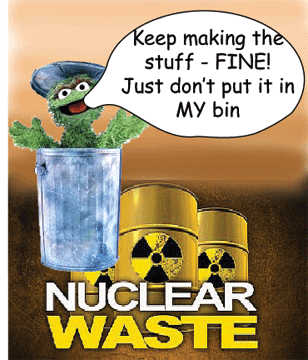 Federal Budget 2014: Radioactive waste funding relief St George & Sutherland Shire Leader May 17, 2014 THE federal budget provides $22.6 million to develop detailed design options for a national radioactive waste management site at a location outside Sutherland Shire.
This is the first firm indication that the Coalition government will press ahead with plans for a permanent nuclear waste storage.
It is expected to be welcomed by Sutherland Shire Council, which opposes plans for a temporary storage site to be built at the Australian Nuclear Science and Technology Organisation (ANSTO) at Lucas Heights.
It is thought the federal government is considering several sites in the Northern Territory……The allocation of $22.6 million over three years for the design of the permanent nuclear storage site comes under the federal Department of Industry budget.
ANSTO also received a $654 million, four-year funding allocation under the budget.
This includes $76.6 million over five years for the OPAL reactor at Lucas Heights — Australia’s only nuclear research reactor…….http://www.theleader.com.au/story/2282157/federal-budget-2014-radioactive-waste-funding-relief/?cs=1255
Aboriginal traditional landowners condemn Abbott’s policies, and scorn Warren Mundine
Traditional owners slam PM, Sky News, , 16 May 2014 Indigenous traditional owners have slammed Prime Minister Tony Abbott for not following through with his promise to be a PM for First Australians.
It came on the final day of the full meeting of the Northern Land Council in Katherine.
NLC deputy chairman John Daly said “We need Mr Abbott’s ear, not his puppets anymore.”The Government has just buried its head in the sand,” he said.There’s also been a protest over water licences and allegations the NT Government is ignoring traditional custodians.
Federal Indigenous Affairs Minister Nigel Scullion addressed the 78- members today at Katherine, 300km south of Darwin.He was grilled on budget spending cuts to Indigenous Affairs, his use of sections of the Land Rights Act to circumvent going through the NLC, and instead dealing directly with Traditional Owners.
Indigenous leaders also marched on a water summit being hosted by Primary Industry Minister and local member Willem Westra Van Holthe.Mr Van Holthe said water allocations were made to benefit all Territorians.
At the annual general meeting of the Northern Land Council in Katherine on Friday, traditional Aboriginal landowners were clearly unimpressed with what they see as a lack of consultation about the half a billion dollars to be cut from indigenous spending……..
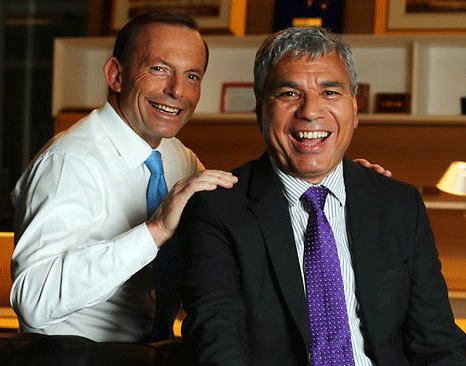 The council also derided the head of Mr Abbott’s Indigenous Advisory Council, Warren Mundine, for not taking up an invitation to visit and meet with traditional owners.
‘Warren Mundine is a poshy indigenous person who has never set his foot in this Aboriginal community,’ said Matthew Ryan, a traditional owner from the West Arnhem region.
He said Mr Mundine didn’t understand what life was like for people living in remote communities.
‘Most of us live with 30 other people in our house, he doesn’t,’ Mr Ryan said.
– See more at: http://www.skynews.com.au/news/national/2014/05/16/abbott-criticised-at-indigenous-meeting.html#sthash.AhWHWJAu.dpuf
Climate research censored by Queensland University?
 Queensland University tries to block climate research GRAHAM LLOYD THE AUSTRALIAN MAY 17, 2014 THE University of Queensland has threatened legal action to stop the release of data used in a paper that establishes a 97 per cent scientific consensus on anthropogenic climate change
The paper, lead authored by John Cook, has been the subject of debate over its methodology since it was published last year…..(subscribers only) ww.theaustralian.com.au/higher-education/queensland-university-tries-to-block-climate-research/story-e6frgcjx-1226920713818#
Aboriginal people not participating in govt’s decisions that savagely cut indigenous funding
AUDIO: Indigenous affairs hit by ‘savage budget cuts’ ..http://www.sbs.com.au/news/article/2014/05/14/indigenous-affairs-hit-savage-budget-cuts By Darren Mara, 14 May 14 Government to dramatically reduce Indigenous programs, NITV News reports
Before his election last September, Tony Abbott claimed he’d be a Prime Minister for Indigenous affairs.
But in his government’s first budget, Indigenous affairs have taken some of the most savage cuts……..The budget will see 150 Indigenous program areas cut down to five: employment and land, education, health and safety, culture and remote strategies.
Funding for Indigenous languages has been cut by almost 10-million dollars over four years.
Indigenous leader and head of the Indigenous Land Corporation, Dawn Casey, says there are no other elected bodies in Australia that could fill the role played by Congress.
 “It means that Aboriginal people aren’t truly making decisions about what ever area they’re dealing in and that should happen. This is the 21st Century. What comes with the decision making comes responsbility and accountability, so don’t take that away from people, given that it’s well over 200 years since Australia was colonised. We should in fact be growing organisations to take on more of those.”
There will be some money going into Indigenous affairs – or perhaps a redirection of funding…..
Clean energy industries will require compensation as Australian govt slashes renewable energy funding
 Budget 2014: Clean energy bodies call for compensation as Government cuts green funding ABC Radio Australia, 16 May 2014, Clean energy industry representatives have slammed federal budget cuts in the sector, calling for compensation if legislation is changed. By environment and science reporter Jake Sturmer, Alex McDonald – The Federal Government has taken the sword to renewable energy, cutting hundreds of millions of dollars from various green programs.
“I think it’s a very depressing message for the industry and for the investors in it,” said Miles George, head of the 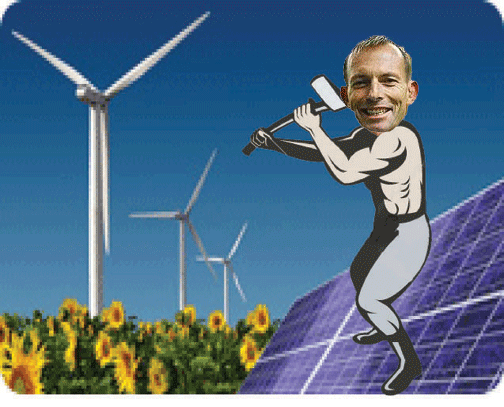 country’s largest renewable energy provider, Infigen.
Among the changes is a decision to spread the Government’s $2.55 billion Emissions Reduction Fund (direct action policy) over 10 years rather than four.
-……………………“If we actually throw away options, a fear for me is that the energy mix that we currently have just gets ossified,” said ARENA chairman Greg Bourne.
“Infrastructure is hospitals, infrastructure is schools, but infrastructure is also the energy system that you have within a country and without the energy system, your overall system begins to grind to a halt.” Mr Bourne says the current reliance on traditional energy sources is “not fit for purpose in this century”.
The last significant piece of green energy legislation, the Renewable Energy Target (RET), is currently under review. After investing billions in the sector, Mr George warns any changes would be a breach of faith. “If the legislation is now to be changed we would expect to be fully compensated,” he said.
“If [they] took the RET away tomorrow … we would lose 40 per cent of our revenue and our Australian business would fail … along with nearly all wind farms and wind farm businesses in Australia.” Mr George says Infigen has made investments over the past 10 years on the basis of legislation that had “bi-partisan support”.
“If the legislation is now to be changed retrospectively and that has a negative effect on our business, we would expect to be fully compensated,” he said. “This is the way Australia does it. Australia does not wreck existing legislation without compensation.”
The Environment Minister declined an interview but maintains that tough decisions needed to be made in the current economic climate.
Giles Parkinson muses on the Australian government’s fierce antipathy to renewable energy
 Five things we learned about … the Far Right and renewables REneweconomy, By Giles Parkinson on 16 May 2014
Prime Minister Tony Abbott doesn’t like wind turbines, and neither does Treasurer Joe Hockey, but it seems like their antipathy towards green energy runs deeper than anyone had suspected – it must be a tool of the Left, and so must be eradicated. It’s hard to find any justification, other than ideology, for the latest broken promises from the Abbott government, the proposed repeal of the Australian Renewable Energy Agency, and the disappearance of the million solar roofs program.
The decision to close ARENA – which means an end to new funding for Australia’s world leading solar research, future support for home-grown technologies in wave energy, battery storage, concentrated solar power and geothermal production – adds to a litany of actions that Abbott has taken since his election victory. The carbon price is going, the $10 billion Clean Energy Finance Corporation is going, the renewable energy target is certain to be either removed or diluted, and now ARENA and a host of energy efficiency and other schemes have been dumped. Indeed, anything that might provide a market signal that we should be making a transformation towards a clean energy economy.
Why Coalition MPs find the thought of melting glaciers amusing
There are two explanations for this – either, in the words of Climate Change Authority chairman Bernie Fraser, it is the result of the government’s “sickening and disappointing” pandering to vested interests, or it is merely continuing the Abbott “climate change is crap” ideological mantra. If you don’t have to address climate issues, then you don’t need to clean up the power supply. Or perhaps it is the result of both.
Liberal Senator Ian Macdonald appeared to speak for the majority of the Coalition MPs and ministers when he took another dig at the climate science in the Senate this week, insisting that the climate is changing, but only “as it has done for literally millions of years”. He noted that one of the reasons the south of Australia is becoming drier is apparently because of “the record amount of sea ice” in Antarctica, which he read about in that august scientific journal, The Australian newspaper.
“That always makes me smile when people talk about global warming,” Macdonald told the Senate. Less amusing, perhaps, were the scientific reports released that same day which showed that the melting of the West Atlantic Ice Cap is now considered irreversible and unstoppable, and could lead to massive rises in sea levels. Probably, however, beyond the Senator’s current parliamentary term, which is about as far as this government is willing to look.
Boganaire, unbowed by “green terrorists”, buys back into coal
That same disregard for climate policy appears to be driving not just conservative policies, but Australian coal barons – both major and minor. One of the lesser barons, Nathan Tinkler, the Newcastle “Boganaire” – as Paddy Manning’s book described him – has dusted himself off from the collapse of his first coal empire and re-entered the market with the proposed $150 million of a thermal coal mine in Queensland – vowing not to be derailed by “terrorist acts by green parties”, or even environmental considerations. He was sure, Tinkler told The Australian, that Australian coal was of such high quality that digging up hundreds of millions of tonnes of it would help the world reduce emissions.
Tinkler may be disappointed to find that it is not green terrorists and “extremists” that threaten coal projects the most, so much as the world’s financial markets and a long term structural decline in the coal industry. The Institute for Energy Economics and Financial Analysis this week noted that thermal coal prices are at a record low. Tinkler thinks that is a great time to buy, unless of course you recognise – as Citigroup suggested this week – that a combination of regulatory and technology changes will force an unstoppable transformation in energy markets. Good luck with the financing.
Conservatives continue grants to “clean” brown coal projects
Despite the death of ARENA and other incentives for renewable, one fund the federal government is continuing to support is the $90 million Advanced Lignite Demonstration Program which it shares with Victoria. The desire to export vast quantities of lignite goes against history, the financial risks identified by the Citigroup reports, and warnings from the International Energy Agency, which this week reminded everyone that coal fired generation must be phased out quickly, and gas-fired generation too from 2025, if the world is to meet climate goals. Standard & Poor’s also issued a new report highlighting increasing “sovereign risk” from climate change.
But, unbowed by what official news outlet The Australian blithely dismissed as “green alarm”, and unabashed by the aforementioned dumping of support for renewables, and its vow to remove “corporate welfare”, the Federal and conservative Victorian governments have decided to chuck $50 million into projects to turn brown coal into diesel and synthetic oils, and to try and create “vast scales” exports of a “higher grade” coal. The Victorian brown coal reserves were of national significance, said Industry minister Ian “we must extract every molecule of gas” Macfarlane.
What do camels and wind farms have in common?…..http://reneweconomy.com.au/2014/five-things-we-learned-about-the-far-right-and-renewables-18949
Australian uranium mining company arousing concern in Greenland
 The prospect of a relatively unknown Australian company exploiting massive untapped resources in Greenland deserves a robust public and political debate. It has thus far received nothing in Australia, and little in Denmark and Greenland. In an age of worsening climate change, mining uranium is an arguably unsafe and potentially explosive answer to the problem.
Australian uranium mining in Greenland is tearing the country in half http://www.theguardian.com/commentisfree/2014/may/15/australian-uranium-mining-in-greenland-is-tearing-the-country-in-half After Greenland’s prime minister repealed a law on uranium mining, Australian firms are staking out the country for exploitation. Local political opposition is heating up
Antony Loewenstein This is a story about an Australian company you’ve never heard of, operating in a nation that rarely enters the global media: Greenland. It’s a story about the intense search for energy sources in a world that’smoving away from the dirtiest fossil fuels.
>Aleqa Hammond, the prime minister of Greenland, is the first woman to lead this autonomous country within the Kingdom of Denmark. She also welcomes the financial opportunities from climate change and a melting Arctic Circle.
“I simply refuse to be the victimised people of climate change”, she toldBusiness Week this month. “This time we have other options than just hunting. We have the right now to our own underground.”
In October last year, Hammond pushed legislation through Greenland’s parliament to overturn a 25 year old ban on the extraction of radioactive materials, including uranium, despite countless leading environmental NGOs urging otherwise. It attracted global interest from the rare earth and uranium industries, including from China. Concerns were also raised about Greenland’s ability to manage a toxic substance in the wake of Fukushima and Chernobyl.
The company Greenland Minerals and Energy Limited (GMEL) is based in Perth, Western Australia. This year GMEL announced a major step forward in their plan to open one of the world’s largest uranium mines in southern Greenland, at Kvanefjeld. The mine will also produce fluoride, thorium and other rare earths.There is still significant opposition to the Kvanefjeld project. The Ecological Council, a Danish NGO, organised a conference to discussthe potential contamination risks in March, noting that the mine poses serious risks for the inhabitants of the nearby village, Narsaq. Many locals told the BBC that they worried about pollution and challenges to traditional ways of life if GMEL moved ahead with its plans. Unsurprisingly, Danish green groups have pushed for a continued ban on uranium mining. They claim that rare earth elements can be extracted without uranium mining in Greenland.
This would have been an important but fairly typical contest over resources, but after issues surrounding the ownership and status of Perth-based GMEL were raised in the Greenlandic parliament, the prospects of the Australian firm may be in jeopardy.Late last year, Greenland MP Sara Olsvig (tipped by some as a future prime minister) wrote to the country’s minister of industry and minerals, Jens-Erik Kirkegaard. She demanded details about any and all of GMEL’s shareholders, after Australian media outlets had raised allegations about both the company back in 2009 (here and here) and mining prospector Mihran Shemesian, also known as “Mick Many Names“.
In 2009, Fairfax media claimed that Shemesian controlled more than 20% of GMEL stock. Range Resources, another company tied to Shemesian, had earlier been accused of paying the disputed government of the Puntland State of Somalia, linked to Somali rebels, more than $US6m ($A9.3m) for resource rights to the region. Since then, there have been very few stories about him.
Kirkegaard responded that the government dismissed any concerns about GMEL – “the alleged events all occurred outside Greenland’s jurisdiction” – and claimed that the company didn’t own an exploration license anyway, so there was nothing to worry about. This isn’t quite the case: Greenland Minerals and Energy A/S (GME), the firm granted the licence, is the wholly-owned Greenlandic subsidiary of GMEL.So is “Mick Many Names” Shemesian involved with GMEL? John Mair, the company’s executive director, told me he isn’t “registered as a shareholder”. But he would not guarantee that Shemesian has no involvement with GMEL.
Mair is proud of the Kvanefjed project, where “risks can be appropriately mitigated”. GMEL was “working with Greenland to help establish a secure and viable economy that will help sustain their increasing political independence,” he told me, adding that he was “optimistic” GMEL would be granted a mining license in the foreseeable future because “we have much local community support in Greenland”.A key shareholder in GMEL is Perth-based geologist Greg Barnes, founder and CEO of Tanbreez. He told me by phone from Singapore that he has personally invested $40m towards mining possibilities in Greenland. He says he has known Shemesian for 30 years and “has heard that he has a 50% share in GMEL and I’ve heard that he has 0%. I have no relationship with him.”
But in December last year he told Grønlandsposten, a Greenlandic newspaper that, “he and Shemesian could probably fire GMEL’s board if they wanted to”. He told me that this referred to the make-up of GMEL many years ago – not today.
“[Greenland] is the size of Western Australia but it has no mines”, he said. “In Western Australia an application for mining would take three months but in Greenland it takes years.” A vast part of Greenland has been “staked out by a number of Perth companies.” Barnes isn’t concerned about climate change “because it didn’t really show up in places like Greenland apart from some ice sheets reducing”.
There is another view. Niels Henrik Hooge is a Danish consultant who works with green NGOs. He’s been at the forefront of the campaign against uranium mining in Greenland. He says to me that the people of Greenland are “split down the middle regarding the repeal of the [uranium] ban.”
Hooge explains that the “mineral authorities” have fed the public disinformation over the last years but the tide may be turning, with growing concerns over environmental effects and the leftist party Inuit Ataqatigiit pledging to roll back the repeal if it wins back power.
The prospect of a relatively unknown Australian company exploiting massive untapped resources in Greenland deserves a robust public and political debate. It has thus far received nothing in Australia, and little in Denmark and Greenland. In an age of worsening climate change, mining uranium is an arguably unsafe and potentially explosive answer to the problem.
Uranium stock prices at last come to the reality of the market decline
CHART: Uranium stocks vs spot price – something’s gotta give #auspolhttp://tinyurl.com/n25brbj Frik Els | May 15, 2014
The prospect of a Japanese nuclear reactor restart. The end of the Russia-US megatons to megawatts program last August, eliminating a huge source of supply. China’s accelerated plan to approve six to eight plants a year through 2020; part of its war on pollution. The possibility of a rethink in Germany about phasing out nuclear (coal is the only viable alternative and Putin’s gas is becoming dearer).As the stars aligned for a pickup in global uranium demand so did investors for uranium stocks.
But the rapid run-up in uranium shares – especially developers – didn’t turn out to be a leading indicator.
The spot price continued to slide going below $30 a pound to levels last seen in 2005. That dragged the long term price, where most uranium business is conducted, down to $45, a six year low.
Uranium stocks have now come down to earth as this chart from Haywood Securities shows.

The independent investment dealer with $5 billion under management says now that the spot price appears to have found something of a floor, the sell-off may begin to slow down.
But the Vancouver-based firm cautions that the shares of producers and developers “remain at or above their indexed price point of 12 months ago, when spot uranium was $40.70 U3O8, a 40% premium to current spot”.
There may be more pain ahead
Synroc a radioactive waste storage method rejected in USA, France, but to be used in Australia
 Synroc is not a disposal method. Synroc still has to be stored. Even though the waste is held in a solid lattice and prevented from spreading, it is still radioactive and can have a negative effect on its surroundings.http://en.wikipedia.org/wiki/Synroc
Australia Synroc plant construction approved by regulator, Nuclear Engineering, 15 May 2014 by Will Dalrymple, Australia’s nuclear regulator has approved siting and construction of its proposed Synroc intermediate-level waste treatment plant at the ANSTO campus in Sydney’s Sutherland Shire.
Synroc is an Australian invention that immobilises radioactive waste in a durable solid rock-like material. In September 2012, ANSTO announced plans for the cutting-edge Synroc plant, which will be co-located with an export-scale nuclear medicine manufacturing facility…….This week’s Australian federal budget also included $22.6 million to develop detailed design options for this national waste facility, which will be located outside of the Shire.
The decision this week by the Australian Radiation Protection and Nuclear Safety Agency (ARPANSA) came after an expert assessment, including a public consultation process, and enables ANSTO to site and construct the Synroc facility.
Construction of the Synroc plant is scheduled to start in 2015 and be completed by the end of 2017. Further approvals will be required before the plant is made operational. http://www.neimagazine.com/news/newsaustralia-synroc-plant-construction-approved-by-regulator-4267988
Australian government keeps nuclear ‘foot in the door’ with spending on Lucas Heights reactor etc
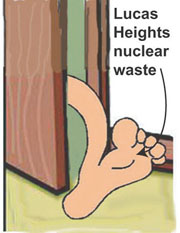 Nuclear spending to top $99m http://www.theaustralian.com.au/national-affairs/budget-2014/nuclear-spending-to-top-99m/story-fnmgnk9v-1226918049789# ANTHONY KLAN THE AUSTRALIAN MAY 15, 2014 THE federal government will spend $22.5 million over the next three years developing plans for a national radioactive waste dump and will ramp-up Sydney’s Lucas Heights nuclear research reactor, at a cost of $31.6m over four years.
To handle the excess nuclear waste from Lucas Heights the government will spend another $45m to send the materials to the US for “processing and permanent storage”, the budget papers say.
“The government will provide $45m over five years to send two shipments of spent nuclear fuel assemblies from the Open Pool Australian Lightwater (Lucas Heights) nuclear research reactor to the United States for processing and permanent storage,” the government said.
“Disposal of the spent fuel assemblies will create additional capacity for the temporary storage of spent fuel … which is essentially for the continued operation of the reactor.”
Over the four years from June the government will spend $22.5m to develop “detailed design options” for a national facility to “address Australia’s future radioactive waste management requirements”.
The Lucas Heights, or OPAL reactor, uses low-level enriched uranium fuel to produce neutrons for nuclear medicine production and for “environmental and material research”, the government said.
Money to fund the ramped-up operations at Lucas Heights included funding to meet the increased costs of “nuclear fuel and electricity”.
Australia part of the USA’s militarisation of the Pacific
 In the coming months, the world will mark the 70th anniversary of Pacific battles in Saipan, Guam, the Mariana Islands, New Guinea, Palau, the Philippines and Burma. More anniversaries will be recognized next year to commemorate battles in Bataan, Manila and Iwo Jima, followed by anniversaries of the firebombing of Tokyo, the battle of Okinawa and then, in August 2015, the destruction of Hiroshima and Nagasaki. Each event represents death and destruction of the past in a region scarred by militarism and an ongoing legacy of war without end
The Militarized Pacific: An Anniversary Without End 14 May 2014 By Jon Letman, Truthout | Op-Ed “……..(Another) Asia-Pacific Pivot The plight of the Marshall Islands is the back-story of today’s increasingly militarized Asia-Pacific, but David Vine, associate professor of anthropology at American University, sees nothing particularly new about Obama’s Asia-Pacific pivot.
“Very early on islands were identified as playing a very important role in expanding the reach of the United States, and US commerce in particular,” Vine says, citing early US military forays into Okinawa and the tiny Bonin (Ogasawara) Islands southeast of Japan. In the 1960s US nuclear weapons were kept in Okinawan ports and have been documented as passing through Japanese islands despite Japan’s stated opposition to introducing and storing nuclear weapons.
Similarly, in 1987, the nation of Palau, under pressure from the US, dropped its opposition to the entry of US nuclear armed and powered vessels into its territory.
Vine talks about the post-World War II “forward posture” of creating a wall of Pacific islands as close as possible to Asia for its own strategic interests. He describes Pacific island nations like the RMI, Palau and FSM as being technically sovereign but, like American Samoa, Guam, Saipan and the Northern Mariana Islands, effectively run as colonies. Vine says these islands exist under conditions that overwhelmingly benefit US military interests, perhaps best illustrated by the US insisting on the “right of strategic denial.” This “right,” claimed under COFA, grants the US exclusive military control over half a million square miles of the Pacific and includes provisions allowing for the use of RTS on Kwajalein through 2066 with the option to extend to 2086. Continue reading
Now the Abbott government is wavering about its OWN “climate policy”
Doubt over emissions reduction fund , The Age, Lisa Cox 15 May 14, National political reporter The opposition says the government is preparing to slash its flagship Direct Action climate policy, the emissions reduction fund, after Tuesday’s budget showed proposed spending on the scheme would be $1.4 billion less than expected in the first four years.
But Environment Minister Greg Hunt says there has been no change to the policy and the budget still allows the government to issue contracts for the promised $2.55 billion from July 1.
Doubt over the government’s plans for its replacement for Labor’s carbon tax emerged after Tuesday’s budget papers showed $1.1 billion in projected spending on the fund, which will pay polluters to reduce their emissions, in its first four years.

The government said the figure was not a cut because the bulk of the $2.5 billion would be budgeted for in years beyond the forward estimates as polluters completed long-term projects.
But Labor environment spokesman Mark Butler said businesses could rely only on the spending outlined in the budget papers and ”the budget papers show this policy has been slashed by more than half”.
”While it barely seemed possible, last night saw Tony Abbott backslide even further on Australia’s fight against climate change,” Mr Butler said.
”This fig leaf of a climate policy now lies in tatters.”
Proposed expenditure sets out $75.5 million for the fund in 2014-15, $300 million in 2015-16 and $354.5 million in 2016-17……..http://www.theage.com.au/federal-politics/political-news/doubt-over-emissions-reduction-fund-20140514-zrcpr.html
Tony Abbott more intent on punishing Greens than in practical climate policy
 Environment: green policies casualties of Abbott’s vengeance mission, Crikey, GILES PARKINSON | MAY 14, 2014 10:47AM| TONY ABBOTT SEEMS TO HAVE TAKEN PERSONAL UMBRAGE AS A RESULT OF GREENS AND GREEN-MINDED MPS DENYING HIM POWER IN 2010. NOW HE’S IN CHARGE, AND OUR SUSTAINABLE PROGRAMS ARE ON THE CHOPPING BLOCK. FOR PRIME MINISTER TONY ABBOTT, HIS WAS NOT SO MUCH A BUDGET AS A SETTLING OF OLD SCORES.
Cast your mind back to 2010, when Abbott was denied power in a hung Parliament by Labor, the Greens and two country independents who wished to advance policy on climate change and renewable energy. Ever since, Abbott and the right-wing faction that put him there — the people Paul Keating famously described as “right-wing nutcases” — have vowed revenge.
The proposed trashing of the $3.1 billion Australian Renewable Energy Agency, which under various guises has for years backed Australia’s world-leading solar research and demonstration projects for the energy technologies of the future, was the coup de grace.
The budget has provided Abbott and Treasurer Joe Hockey the opportunity to implement many of the 75-point wish list drawn up by the influential Institute of Public Affairs, which the government attempted to disguise by asking the Commission of Audit to prepare its 86 recommendations in its ham-fisted documents. Hence the attack on education, health funding and welfare payments that will affect the least advantaged, and the tax cuts for corporates.
But it is “green policy” and anything that resembles it that riles this government the most. Consider Hockey’s comments about wind farms being “utterly offensive”. With proposals to repeal the carbon price, dismantle the Climate Change Authority and the Clean Energy Finance Corporation, and the dilution of the Renewable Energy Target already in train, the budget measures, which include the closure of the Australian Renewable Energy Agency, the dumping of the million solar roofs program (both contrary to election promises) and the research funding cuts at the CSIRO, Bureau of Meteorology and elsewhere, means that the obliteration of the Clean Energy Future package will be complete — if it can get past the Senate. The closure of ARENA, which still had $3.1 billion of funds to be invested over the next 10 years, appears the most vindictive, and like the move to pull the CEFC, a case of economic and environmental vandalism. The budget document talks endlessly about the need for “innovation”, for new investment and infrastructure. ARENA, like the CEFC, was able to leverage billions of dollars in private finance — a rate of $2.50 of private funds for every $1 invested.
Chief executive Ivor Frischknecht says that until the Senate decides otherwise, the agency will continue to work through its applications. It has more than 190 proposals worth $7.7 billion (two-thirds private money) on the table. He says that reflects not just the level of disappointment, but the “scale of investment that is unlikely to go ahead because of the proposed closure”.
ARENA has been branded as one of many examples of “corporate welfare”, but in reality more than 150 of its 180 projects already allocated are in support of research and development, a core competency of any advanced economy. Future funding of that research will be lost. Corporate welfare will continue to be doled out to manufacturers in other sectors.
ARENA was not the only victim of the budget axe. The million solar roofs program, once a $1 billion centrepiece of Direct Action to bring solar to lower-income earners and renters, has sunk without trace — replaced by a derisory $2.1 million program to install solar on RSLs and bowling clubs in seven marginal electorates (yes, really)………
The centrepiece of the government’s Direct Action policy, which replaces the carbon price, also seems to be in a state of utter confusion. The budget papers mention $2.55 billion set aside “over 10 years” rather than the four set aside by the government previously……. Welcome to the asphalt economy. http://www.crikey.com.au/2014/05/14/environment-green-policies-casualties-of-abbotts-vengeance-mission/
reactions to Australia’s Anti Renewable Energy Budget
The Anti-Renewable Energy Budget – Reactions http://www.energymatters.com.au/index.php?main_page=news_article&article_id=4303 As feared, the first Budget delivered by the new Government has seen the axe swung upon the Australian Reneweable Energy Agency (ARENA).
According to the Budget papers:
“The Government will achieve savings of $1.3 billion over five years from 2017-18 (including $223.3 million in 2018-19, $455.9 million in 2019-20, $125.4 million in 2020-21 and $131.1 million in 2021-22) by abolishing the Australian Renewable Energy Agency and repealing the Australian Renewable Energy Agency Act 2011. Funding of $1.0 billion over eight years will remain available to support existing priority projects.” The Government says the savings will be redirected to repairing the Budget and to fund policy priorities.
The Clean Energy Council expressed its disappointment in the announcement.
“A global race for renewable energy is on, and the removal of ARENA will see potential Australian and international investors now look to countries with much stronger support for renewable energy innovation, meaning we may well miss out on billions of dollars of investment and highly-skilled jobs,” said Deputy Chief Executive Kane Thornton.
“Abolishing ARENA is a backwards step for the ‘clever country’ at a time when job losses in traditional industries like the automotive and manufacturing sectors mean we need new, innovative industries to take their place and fill this void.”
 The Australian Solar Council also reacted strongly, calling the budget a “boulevard of broken dreams” for the solar industry.
“The Budget has delivered a trifecta of broken promises to the solar industry,” said John Grimes, Chief Executive of the Australian Solar Council. “The Government promised the Australian people an additional million solar roofs by 2020. The Budget contains no funding to make this happen. A Million Solar Roofs is a mirage.”
“The Government promised to maintain the Australian Renewable Energy Agency (ARENA) but, instead, the Budget has delivered a death warrant for ARENA. Unless the Senate stands up to the Government, ARENA will be abolished.”
“The Government promised to maintain the Renewable Energy Target but every indication is this key policy will also be thrown on the scrapheap.”
The Sustainable Energy Association of Australia called the axing of ARENA a regressive step.
“ARENA was designed to increase the supply of renewable energy in Australia and to make it more affordable. It has been welcomed by both the industry and by investors, who were looking at Australia as a growing market for clean technologies,” said SEA Chief Executive Kirsten Rose.
“Unfortunately, the proposed scrapping of ARENA means it’s likely that investment in a cleaner energy sector won’t happen in Australia, but will go to other countries with stronger, more stable policy environments for renewable energy,” said Ms Rose.
Greens leader Senator Christine Milne said the Budget was “just a tunnel vision for motorways and stranded fossil fuel assets that will be worthless to our economy within decades.”
The sorry tale of the Abbott government’s dismantling of Australia’s Climate Change Action
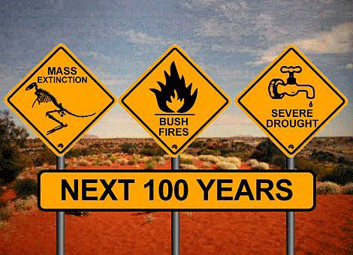 Australia’s Abbott Government Dismantles Climate Safeguards by News Editor in Air/Climate, Gov/Politics, Latest News, RSS on May 12, 2014 CANBERRA, Australia, (ENS) – Step by step, the Australian Coalition Government, headed by Liberal Prime Minister Tony Abbott, is tearing down the climate change mitigation and adaption measures put in place by the previous two Labor governments.
The carbon price established through a cap-and-trade emissions trading scheme that took effect in July 2012 under the Gillard Government is on its way out.
Called a “carbon tax” by opponents, it is to be replaced by an extension of the Emissions Reduction Fund introduced as draft legislation Friday by Environment Minister Greg Hunt.
Hunt said, “Australians voted for the removal of the carbon tax and for the implementation of a climate change policy that actually reduces emissions. Through the ERF, we will achieve our emissions reduction target without a tax on families and small business.” But the vast majority of Australia’s carbon price has been paid by a small number of larger companies, including 25 electricity generators.
Australia is a major coal-producing nation, and burning coal generates about 85 percent of Australia’s electricity. Coal-burning power plants emit carbon dioxide, the most prevalent greenhouse gas, and the coal industry is a vigorous opponent of the carbon price.
The Emissions Reduction Fund is the centerpiece of the Coalition Government’s Direct Action Plan to reduce Australia’s greenhouse gas emissions by five percent below 2000 levels by 2020, the same target as adopted by the previous governments.
An extension of the existing Carbon Farming Initiative, the ERF allows farmers and land managers to earn carbon credits by storing carbon or reducing greenhouse gas emissions on the land. These credits can be sold to people and businesses wishing to offset their emissions.
The latest step in the Abbott Government’s policy of scrapping all support of climate-related or renewable energy action was revealed this morning. The budget due out Tuesday is likely to eliminate the Australian Renewable Energy Agency, ARENA.
ARENA Chairman Greg Bourne warned that the agency’s remaining unallocated funds of about A$1 billion could be returned to the general revenue pool.
ARENA was established in 2012 to improve the competitiveness of renewable energy technologies and increase the supply of renewable energy in Australia. The agency has a $2.5 billion budget to fund renewable energy projects, support research, development and activities to capture and share knowledge.
The Abbott Government has also moved to eliminate the $10 billion Clean Energy Finance Corporation and may also weaken or delay the country’s Renewable Energy Target.
Australian Greens Leader Christine Milne said, “Axing the Australian Renewable Energy Agency is a damning reflection on the backward thinking of the Abbott government. The Abbott government has no vision for the future, or indeed, the present day.”
The country’s largest environmental group, the Australian Conservation Foundation, is outraged.
“If the government chooses to scrap ARENA, it is yet another instance of prioritising the profits of big polluters over Australians’ desire for a safe climate and clean energy,” said Victoria McKenzie-McHarg, the Foundation’s climate change program manager.
“The government could choose to scrap the $13 billion in planned handouts for big polluters to get discount diesel and other subsidies to miners, but instead, it seems it is choosing to scrap an agency that is helping strengthen the major growth industry of the 21st century,” said McKenzie-McHarg.
“With ARENA possibly gone, the Clean Energy Finance Corporation, the Climate Change Authority and price on pollution all on the chopping block, Australian jobs and investment in solar and other clean technology across the country will come to a stand still,” she said.
“It’s ripping the heart and soul out of Australia’s clean energy future,” said McKenzie-McHarg……..http://ens-newswire.com/2014/05/12/australias-abbott-government-dismantles-climate-safeguards/
1 This month
17 October, Free Public Talk on Nuclear Issues in South Australia
David Noonan will speak on public interest concerns over the new Roxby Downs Indenture Act 2026 on BHP copper-uranium mining and ore processing in SA, and on how AUKUS may face SA with a High-Level nuclear waste agenda.
Dr Jim Green will discuss international developments in the field of nuclear power including ‘small modular reactors’ and Generation 4 ‘advanced’ nuclear reactor concepts.


Help Aunty Sue Protect Her Land and Sacred Sites From Destructive Rocket Testing.
.

Australians deserve the truth
about
AUKUS – https://aukuspublicinquiry.com/

PETITION – To: Prime Minister Anthony Albanese and the Australian Labor Government

of the week – Australians for War Powers Reform (AWPR)
To see nuclear-related stories in greater depth and intensity

