Broken Hill’s solar farm, part funded by ARENA will keep going
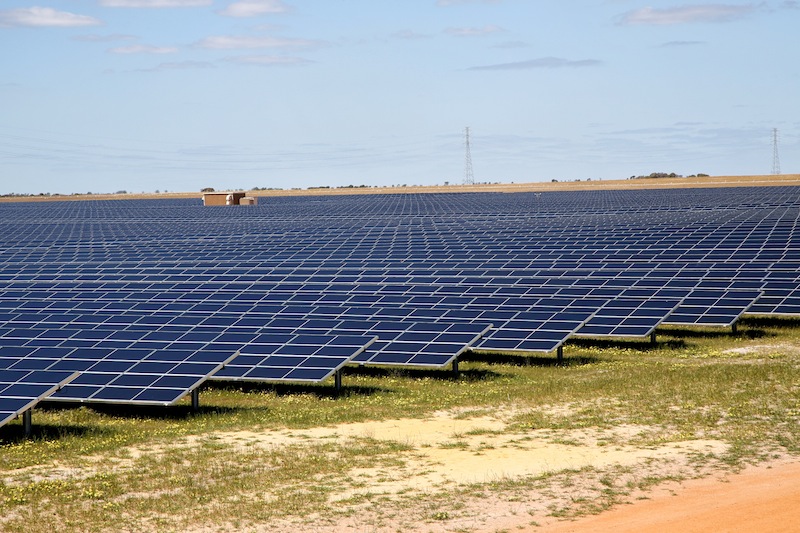 ‘Business as usual’ for Government agency part-funding Broken Hill and Nyngan Solar Farms, ABC News 10 April 14 Gavin Coote A solar farm at Broken Hill in far-western New South Wales will still go ahead, despite the contractor’s uncertainty about future renewable energy investment in Australia.
First Solar is building the Nyngan and Broken Hill Solar Farms, but is reconsidering its future investments because of uncertainty surrounding the Federal Government’s Renewable Energy Target.
The Australian Renewable Energy Agency, or ARENA, is an independent government agency and is helping fund the solar farm, along with the NSW Government.
The Agency says it won’t comment on any future projects in western New South Wales until they are signed off financially, but says it’s business as usual for the ARENA’s current programs, including those at Nygnan and Broken Hill…… “It is business as usual for ARENA, we are continuing to manage our existing projects and to assess and progress proposals we receive in accordance with our procedures and decision making processes.”….http://www.abc.net.au/news/2014-04-09/broken-hill-solar-farm-still-on-track-despite-investor-uncertai/5376866
First operating wave energy array scheme in the world, in Western Australia
 Western Australia wave energy project on the brink of commercialisation Oliver Milman theguardian.com, Wednesday 9 April 2014 A major sustainable energy plan has come closer to fruition with the launch of three giant buoys in Perth Australia could be set for a breakthrough in energy derived from waves, following the launch a major new project in Western Australia.
Carnegie Wave Energy unveiled three large buoys in Perth on Wednesday as part of a new $70 million technology which will feed energy into the Australian grid later this year.
The enormous buoys, called buoyant actuators, will be towed out into the ocean near Garden Island, off the coast of Perth.
The buoys will then be submerged and attached to underwater pumps. The movement of the ocean’s waves will cause the buoys to shoot high-pressure water through pipes which, in turn, will drive turbines and generators onshore, creating electricity.
The high-pressure water will also be fed into an onshore desalination plant, creating fresh water without the need for pumps.
Electricity and water provided by the project will be used by the department of defence for HMAS Stirling, Australia’s largest naval base, which is on Garden Island. The government, which has provided $13.1 million in funding through the Australian Renewable Energy Agency (ARENA), said the project will be the first operating wave energy array scheme in the world……
Ivor Frischknecht, chief executive of ARENA, said Carnegie should be congratulated for helping push forward the viability of wave energy in Australia.“Australia’s wave energy resources along our south and south-west coasts are among the best in the world and, importantly, can be reliably predicted days ahead,” he said.
“There is great long-term potential for wave energy in Australia, with a range of competitive Australian technologies being developed towards commercialisation.” http://www.theguardian.com/environment/2014/apr/09/western-australia-wave-energy-project-on-the-brink-of-commercialisation
Plan for underground mine at Ranger is high risk and low return
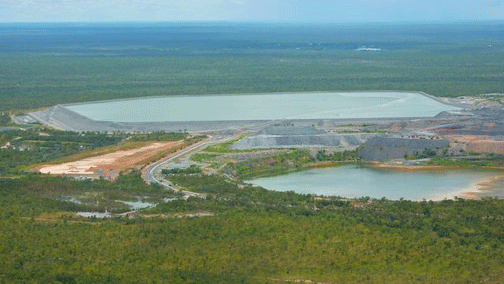 ERA told: Clean up Ranger uranium mine site and clear out rather than shifting underground, 9 April 14
http://www.abc.net.au/news/2014-04-09/era-urged-to-clean-up-ranger-uranium-mine-site-and-clear-out/5377698?section=ntPublic health experts have joined traditional owners and environmentalists in calling for Energy Resources of Australia (ERA) to focus on land rehabilitation rather than expansion of its Ranger uranium mine in the Northern Territory.
The company’s latest report shows that despite operations being suspended at the site since a toxic leak last year, plans to mine uranium underground continue.
ERA is holding its annual general meeting in Darwin today.
NT branch secretary of the Public Health Association of Australia, Dr Michael Fonda, says underground uranium mining poses serious health risks. One of the main things that is concerning us is that they [miners] are going to be exposed to dangerous levels of radon gas,” he said. Dr Fonda says ERA has a troubling safety record and it cannot be trusted to ensure safe work practices for the underground uranium mining.
“What is being planned for the R3 Deep’s expansion is for very large extraction fans to take much of that radon [gas] out of the mine,” he said.”I am concerned, and the Public Health Association is concerned, that will not be enough.”
Australian Conservation Foundation (ACF) national nuclear campaigner Dave Sweeney says ERA should focus on land rehabilitation in the final years of its mining lease. “Realise this is high risk and low return,” he said.
“Instead of accepting the inevitable and cleaning up and exiting, and having a staged and a costed and managed rehabilitation of the Ranger site, ERA is increasingly desperate and is chasing the illusion of dollars by going underground with the Ranger 3-Deep project.”Mr Sweeney says ERA and its parent company Rio Tinto should realise the planned underground mine is high risk and low return.
Indigenous traditional owners have expressed concerns that ERA will not have enough money to follow through on rehabilitation plans for the mine, which is near Jabiru and inside the boundaries of Kakadu National Park.
Australia-Japan joint military exercises (China won’t like that)

 Abe, Abbott agree on joint research on submarine technology, Kyodo News International April 7, 2014 Global Post Prime Minister Shinzo Abe and Australian Prime Minister Tony Abbott agreed Monday to conduct joint research on submarine-related technology as part of efforts to bolster bilateral security ties under Japan’s new policy on defense equipment.
The agreement reached during a summit between the leaders in Tokyo came nearly a week after Japan relaxed its arms export ban by adopting new principles and guidelines for the first time in nearly 50 years.
Abe and Abbott picked marine hydrodynamics used for submarines as the first area of bilateral cooperation. The Japanese and Australian defense and foreign ministers will meet in Tokyo in June and work out details. “We confirmed that we will expand practical cooperation to include joint exercises,” Abe told reporters after the summit. …….http://www.globalpost.com/dispatch/news/kyodo-news-international/140407/abe-abbott-agree-joint-research-submarine-technology
The end of an era for Energy Resources of Australia’s uranium mining in Kakadu
 The ERA of uranium mining is over http://www.onlineopinion.com.au/view.asp?article=16200, Dave Sweeney 9 April 14, In the early hours of Saturday December 7th 2013 the evacuation order was given in the processing area of Energy Resources of Australia’s troubled Ranger uranium mine in Kakadu.
Minutes later came the unforgiving sound of peeling metal followed by a surge of over one million litres of highly acidic uranium slurry from the buckled and broken number one leach tank. The toxic tide swept over the concrete bunds meant to contain any spills and moved uncontrolled through the night and the site.
Four months later and ERA remains under pressure, under performing and under scrutiny. Mineral processing remains suspended at Ranger pending the findings of a federal government review of the tank collapse and this week the ERA board and management will face sceptical shareholders and no doubt plenty of critical questions at the company’s annual meeting in Darwin. Continue reading
Abbott government policies cloud the future for solar energy projects
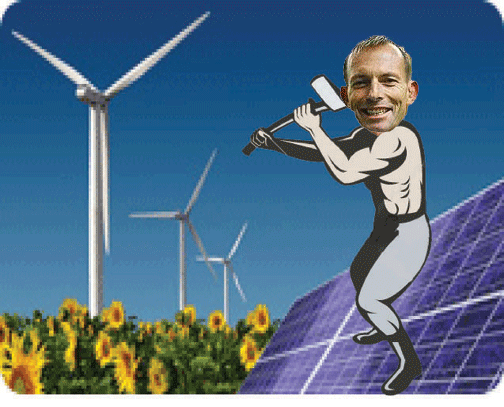 Policy cloud puts up to $110m in solar energy projects on hold SMH, April 8, 2014 Jared Lynch Business reporter Solar projects totaling tens of millions of dollars are at risk after the Abbott government launched a review into its renewable energy targets.
First Solar, the company building the southern hemisphere’s biggest solar plant, said it was reconsidering its future investment plans for Australia, citing increased policy uncertainty.
About $90 million to $110 million worth of projects have been put on hold, First Solar vice president for business development Jack Curtis said. ”We don’t have a great line of sight as to where the next round of projects is coming from, largely as a function of the uncertainty in the policy backdrop,” Mr Curtis said.
The government had planned to source 41,000 gigawatt hours from renewable sources by 2020, or 20 per cent of total supply in that year. But that is being questioned after the government appointed former Reserve Bank board member and global warming sceptic Dick Warburton to head the review.
Mr Curtis said many solar projects only needed short-term incentives. He believed the solar industry had a ”credible path” to become self sustainable, citing its ability to ”dramatically” reduce costs.
For example, in the past five years, the US solar industry had cut costs by 60-70 per cent, Mr Curtis said.
”We are not saying ‘support solar … and we’ll keep saying thanks’. What we are saying that there is a very credible path given the cost reduction demonstrated by the solar industry that it can get to a point where it is a sustainable industry.” First Solar is building two solar plants at Nyngan and Broken Hill in NSW with energy company AGL………
The projects that are on hold are mainly in the mining sector, helping companies with the off-grid operations, Mr Curtis said.
He said those projects had an economic multiplier effect of 1.5x, so for every $1 the government spent, $1.50 was injected into the broader economy. ”[The federal government] obviously has a tight fiscal outlook that they have to manage and we are sympathetic of that.
”But if their other industries that are on the up and up that can generate a 1.5 multiplier for every $1 the government invested, I’d like to hear about them because I think that’s a pretty good positive return on the allocation of government funds.” http://www.smh.com.au/business/carbon-economy/policy-cloud-puts-up-to-110m-in-solar-energy-projects-on-hold-20140408-36a7c.html
Tony Abbott to share advanced military technology with Japan (Will China mind?)
Tony Abbott moves to strengthen defence ties with South Korea DAVID CROWE SEOUL THE AUSTRALIAN APRIL 08, 2014 TONY Abbott has moved to tighten defence ties with South Korea by laying out plans to conduct more joint exercises and share more military technology, helping to mend a bruising row two years ago over a cancelled weapons deal.
Blasting North Korea as an “outlaw state” that must give up its nuclear weapons, the Prime Minister used high-level talks in Seoul to assure his Korean counterpart about future defence collaboration.
The plans come one day after Mr Abbott formally launched negotiations with Japan to share advanced military technology and one day before he arrives in China, which has objected in the past to Australia’s defence declarations with Japan………
How safe are the nuclear facilities of Australia’ uranium customers? Jim Green Reports
 Nuclear security and Australia’s uranium exports Jim Green, 8 April 2014, http://onlineopinion.com.au/view.asp?article=16197“………Australia’s uranium customers Nuclear security standards are demonstrably inadequate in a number of Australia’s uranium customer countries. Nuclear security risk factors in Russia include political instability, ineffective governance, pervasive corruption, and the presence of groups determined to obtain nuclear materials. A March 2014report by Harvard University’s Belfer Center for Science and International Affairs notes that Russia has the world’s largest nuclear stockpiles stored in the world’s largest number of buildings and bunkers, and that underfunding raises serious questions about whether effective nuclear security and accounting systems can be sustained.”
In a 2011 report, the US Director of National Intelligence discussed nuclear smuggling in Russia: “We assess that undetected smuggling of weapons-usable nuclear material has occurred, but we do not know the total amount of material that has been diverted or stolen since the dissolution of the Soviet Union. We judge it highly unlikely that Russian authorities have been able to recover all of the stolen material.”
Nuclear security lapses have repeatedly made headlines in the USA over the past two years. Example include:
- the Air Force removed 17 officers assigned to guard nuclear-armed missiles after finding safety violations, potential violations in protecting codes and attitude problems;
- Air Force officers with nuclear launch authority were twice caught napping with the blast door open;
- an inspection by the Department of Energy’s Inspector General found that Los Alamos National Laboratory failed to meet its goal of 99% accuracy in accounting for the lab’s inventory of weapons-grade nuclear materials, including plutonium;
- a report by LBJ School of Public Affairs at Texas University detailed inadequate protection of US commercial and research nuclear facilities;
- at least 82 missile launch officers from an Air Force base in Montana face disciplinary action forcheating on monthly proficiency tests or for being aware of cheating and failing to report it. Former missile-launch control officer Bruce Blair said cheating “has been extensive and pervasive at all the missile bases going back for decades”;
- missile launch officers in two different incidents were found to have violated security regulationsdesigned to prevent intruders from seizing their ICBM-firing keys;
- nineteen officers at Minot Air Force Base, North Dakota, were forced to surrender their launch authority because of performance and attitude problems;
- the Navy has opened an investigation into accusations of widespread cheating by sailors at an atomic-reactor training school in South Carolina;
- the congressionally mandated Advisory Panel on the Governance of the Nuclear Security Enterprise says that drastic reforms are crucial to address “systemic” management shortcomings at the National Nuclear Security Administration; and
- former military contractor Benjamin Bishop will plead guilty to providing nuclear-arms secrets and other classified information to his Chinese girlfriend.
Time magazine describes the most embarrassing lapse: “In the U.S. in 2012, an 82-year old nun and two other peace protestors broke into Y-12, a facility in Tennessee that contains the world’s largest repository of highly enriched uranium (HEU) in metal form and until the incident was colloquially known as “the Fort Knox of HEU” for its state-of-the-art security equipment. The nun bypassed multiple intrusion-detection systems because faulty cameras had not been replaced and guards at the central alarm station had grown weary of manually validating sensors that produced frequent false alarms. When the protestors started hammering on the side of a building that contains enough HEU for hundreds of weapons, the guards inside assumed the noise was coming from construction workers that they had not been told were coming. She and her fellow protestors were eventually challenged by a single guard.”
The United States’ credibility is also undermined by its failure to ratify the 2005 amendment to the Convention on the Physical Protection of Nuclear Materials and the International Convention on the Suppression of Acts of Nuclear Terrorism. Moreover US federal government budget requests and allocations for nuclear security have been reduced repeatedly since 2011, with programs such as the Global Threat Reduction Initiative, the International Material Protection and Cooperation program, Securing the Cities, and a program to replace HEU research reactor fuel with low-enriched uranium, suffering………
The March 2014 report by Harvard University’s Belfer Center for Science and International Affairs details significant nuclear security gaps in a number of countries that import uranium − or want to import uranium − from Australia. For example it states that India’s approach to nuclear security is “highly secretive”; the threats India’s nuclear security systems must confront “appear to be significant”; India faces challenges “both from domestic terrorist organizations and from attacks by terrorist organizations based in Pakistan”; India also confronts “significant insider corruption”; and the risk of theft or sabotage in India “may be uncomfortably high”……….
So what is Australia doing? So what is the Australian government doing about the vital problem of inadequate nuclear security standards in uranium customer countries? And what are the uranium mining companies operating in Australia doing about the problem? The short answer is: nothing. They adopt a head in the sand approach, just as they ignored the disgraceful nuclear safety standards in Japan that led to the Fukushima disaster.
There are simple steps that could be taken − for example uranium exports could be made contingent on customer countries ratifying the amendment to the Convention on the Physical Protection of Nuclear Materials, and the International Convention on the Suppression of Acts of Nuclear Terrorism. http://onlineopinion.com.au/view.asp?article=16197
Climate denialists and opponents of renewable energy in power in Australia
 Australia’s renewable future in hands of policy fringe dwellers, http://reneweconomy.com.au/2014/australias-renewable-future-in-hands-of-policy-fringe-dwellers-71359 By Giles Parkinson on 7 April 2014 So, it’s come down to this. The defence of Australia’s renewable energy industry has been entrusted to the hands of a man who thinks carbon pollution is caused by nature, not people, and another who is openly hostile to wind farms.
The re-run of the Senate election in Western Australia this weekend provides some interesting fodder for the psephologists: Labor’s continued electoral implosion, the Scott Ludlum-inspired revival of the Greens, and the outstanding success of Clive Palmer’s expensive electioneering.
But for the key policies that will affect Australia’s renewable energy industry – and the decarbonisation of the Australian economy – the equation is essentially unchanged. The numbers in the new Senate, to site from July 1 means that the carbon price – despite whatever hoops that Palmer may try and get the Abbott conservative government to jump through – is effectively dead and buried.
Any changes to the renewable energy target – or even its ditching – will likely go unimpeded through parliament. At best, Labor and the Greens would need support for the RET from Nick Xenophon, not a fan of wind farms, and the DLP’s John Madigan, who has been celebrating what he is sure is the impending demise of the RET.
“The wind industry is panicking in Australia with the likely death of the Renewable Energy Target and this is another example of its peddling influence and money to manipulate the truth,” Senator Madigan told The Australian last week.
At worst, Labor and the Greens would need support from the Palmer United Party to support the renewables target. Good luck with that; Palmer, who now has three of his own Senators and a fourth from the Motoring Party tied up in an unspecified “alliance,” says renewable energy targets should not be compulsory.
“We don’t intend to legislate to make people do something they may not want to do,” Palmer told ABC’s Lateline program last week. This, as economist Ross Garnaut pointed out on the same program, would be about as effective as making taxes voluntary.
What’s not clear is the future of the $10 billion Clean Energy Finance Corporation, or likely budget cuts to the Australian Renewable Energy Agency, both of which would require legislative approval.
The CEFC was actually supported by Xenophon and Madigan in a repeal vote earlier this year because, while they are not supporters of wind energy, they see the upside of bringing in new renewable technologies. Xenophon, in particular is a fan of what he calls “baseload” renewables, meaning geothermal and ocean energy – even those these are years away from commercial deployment. The CEFC has been largely focused on energy efficiency, waste-to-energy, and some emerging solar technologies. ARENA is similarly focused on techologies that do not yet match wind energy on cost.
If Labor can somehow grab the sixth seat in the WA Senate, then Xenophon and Madigan could protect the CEFC, and allow it to continue beyond early July. If not, and the sixth seat falls to the Liberals, then the fate of the CEFC lies in the hands of Palmer.
Quite what he makes of the CEFC is anyone’s guess. The fact that it brings in private money at a ratio of nearly $3 for every $1 in loans may be appealing, so might its ability to develop a profit to the government, and abatement at a “net benefit.”
The abatement equation, however, may just fall on deaf ears. Palmer, it seems, appears to believe that any sort of abatement is a waste of time. Quoting material from what must be one of the more extreme climate denier websites, Palmer told Lateline last week:
“Now we know that 97 per cent of the world’s carbon comes from natural sources. Why don’t we have money to look at how we can reduce the overall carbon signature by reducing it from nature, not just from industry. It’s entirely wrong-focused.”
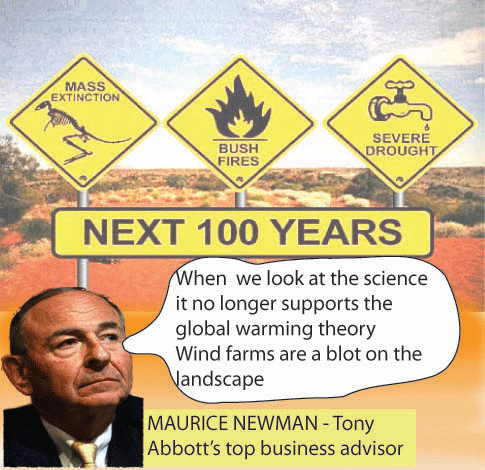 And there’s more. Check out the transcript, it gets feisty in part but it is as though Palmer is channeling the thoughts of Tony Abbott’s main business advisor, Maurice Newman, and those of Dick Warburton, the head of the RET review panel. The climate skeptic brigade is now in full control of climate and renewable energy policy in this country.
Of course, it did not need to have come to this. Climate change and renewable energy policies were supposed to be bipartisan, and for a brief moment in time they were, before the relentless and pig-headed push by the Rudd government to make climate change a wedge issue for the conservatives saw Malcolm Turnbull’s reign at the head of the Coalition ended abruptly, the Liberal Party swerve dramatically to the far right with his replacement by Abbott, and the Greens reject the then CPRS after Rudd refused to even talk to them.
The renewable energy target was also supposed to be bipartisan, and Labor had the opportunity to put this issue to rest if it had the conviction to accept the Climate Change Authority’s recommendation to provide certainty for the industry and push the next review out to 2016.
In the end, Labor backed off. It was the only one of the CCA’s key recommendations that Labor refused to implement. Not only did that decision make the rest of the CCA’s recommendations and endorsement of the RET irrelevant (because of lingering uncertainty about the future of the policy), it left the way open for the Abbott government to conduct its own review, and justify it as a legislative requirement.
And so it appointed a special panel comprising a climate change sceptic, a fossil fuel lobbyist and the former head of one of Australia’s most emissions intensive generation companies to consider the merits of wind and solar.
Now, the renewables industry has to rely, possibly beyond hope, on the support of politicians who think that human-caused climate change is a myth, and that renewables should not be mandated, probably cause health problems, are expensive and unreliable.
It should never have come to this. But it has.
Cost of Australia’s decentralised solar energy is plunging, despite opposition from electricity utilities
 Australia’s Plunging Cost Of Solar Energy (Stats) (Excellent graphs) http://cleantechnica.com/2014/04/07/australias-plunging-cost-solar-energy-graphs/ Giles Parkinson…...“People are told that solar is too expensive,” Greene says. “But we have seen a staggering reduction of the cost of solar in the last couple of years, so I hope that these graphs frame what the actual cost of solar is.”…..
All of this is causing some fierce push-back from the utility industry. Greene and other speakers cited numerous ways that distributors are seeking to slow down the uptake of solar – one is by drawing out the application process (taking 65 business days for each amendment or query), requiring systems to be installed to stop exports back into the grid, or simply refusing the installation.
That, of course, leads to users thinking that they might be better off without the grid. How far is that away?…….
Public Health Association concerned about health dangers of planned Ranger uranium mine expansion
 Proposed Ranger 3 Deeps expansion too risky says PHAA , 7 April 14, The Northern Territory Branch of the Public Health Association of Australia (PHAA NT) is today launching its submission to the Social Impact Assessment process for the proposed ‘Ranger 3 Deeps’ (R3D) underground expansion at the Ranger uranium mine. This comes ahead of a public forum about the future of Ranger in Darwin titled “Reconsidering Ranger”.
The PHAA NT submission focusses on the health and safety impacts for the local population, mine workers and the environment as well as the impacts the exported uranium is having overseas.
“There have been over 200 significant safety incidents at Ranger in its 30 years of operation, including the December 2013 spillage of more than 1 million litres of radioactive and acidic slurry from a storage tank,” said Dr Michael Fonda, PHAA NT Branch Secretary.
“It is of great concern that Energy Resources Australia intends to use the same ageing processing equipment for its proposed R3D expansion,” Dr Fonda said.
PHAA NT is concerned about the health impacts underground mine workers will face from radon exposure.
“Radon inhalation is a particularly dangerous form of radiation exposure and PHAA NT wants reassurances that the R3D design would meet world’s best practice standards. Evidence has emerged linking Ranger to adverse impacts on the surrounding population and environment,” said Dr Fonda.
A 2006 Australian Institute of Aboriginal and Torres Strait Islander Studies report investigating cancer rates in the local population found that the number of actual cases of cancer was 90% higher than expected.
“The research findings to date are very alarming. We believe it is unsafe and unethical to approve this underground expansion before further studies into the health effects in the region have been carried out,” he added.
In the wake of the 2011 Fukushima reactor disaster, which was fuelled in part by Australian uranium, the United Nations called for an urgent review into the health and environmental impacts of uranium mining in Australia. “This review still has not been initiated by the Australian Government. We believe Australia needs an inquiry into its entire nuclear industry before proceeding with any further expansions and PHAA have repeatedly called for this,” Dr Fonda said.
Dr Fonda will be talking about these issues along with other speakers at the “Reconsidering Ranger” public forum being held at the Hilton Hotel in Darwin on Tuesday 8 April 2014. Entry is free and doors open at 6:30pm.
For further information/comment:
Dr Michael Fonda, NT Branch Secretary, Public Health Association of Australia 0429 435 595
This media release – and the related submission – will be available on the PHAA website at: www.phaa.net.au
The Greens’ Scott Ludlam polled16% of the primary vote, in Western Australia’s Senate election
 Western Australia Senate election: is this a new moment for the Greens? Ben Eltham theguardian.com, Monday 7 April 2014 Scott Ludlam’s victory in Western Australia has some important implications for those keen to write off the Greens as a political force
Saturday’s Senate by-election in Western Australia is certainly good news for the environmental party. The Greens polled nearly 16% of  the primary vote, a result that saw Scott Ludlam handily re-elected with quota to spare. The result represented a swing to the Greens of more than 6%.
Ludlam’s result is a personal triumph for the soft-spoken Western Australian. After narrowly losing his seat in the contested result of 2013, Ludlam has roared back into the Senate for another six years on the back of a highly effective Greens campaign.
Beginning with the unexpected social media success of his “Welcome to Western Australia, Tony” speech, Ludlam honed a re-election campaign that was well targeted and technologically savvy. He leveraged his excellent online profile and policy expertise on issues like the NBN andsurveillance to attract a wider following of voters under 40. In just a month, Ludlam has tweeted and DJ’d his way from likely has-been to future leader.
While Saturday’s result may not herald a new age of verdant ascendancy, it does have some important implications for those keen to write off the Greens as a political force in Australia. Their demise is regularly forecast by major party figures and journalists, many of whom appear to believe that the environmental party will one day share the fate of the Australian Democrats……….http://www.theguardian.com/commentisfree/2014/apr/07/western-australia-election-is-this-a-new-moment-for-the-greens
Australian Renewable Energy Agency (ARENA) funding towards Wave Energy
Australian wave energy company receives grant funding, Renewable Energy Magazine, Robin Whitlock, 04 April 2014 Ocean Power Technologies (OPT) has announced that its partner company, Victorian Wave Partners, has received A$5 Million Initial Grant Funding from the Australian Renewable Energy Agency (ARENA) Victorian Wave Partners (VWP) is a project-specific entity that is wholly-owned by OPT (Australasia) Pty. Ltd (OPTA), which is in turn 88 percent owned by OPT. The funding is the first payment under the A$66.5 million grant that was awarded by ARENA to VWP toward the cost of building and deploying its planned wave power station project off the coast of Australia……http://www.renewableenergymagazine.com/article/australian-wave-energy-company-receives-grant-funding-20140406
Western Australian election – so far – 7 % swing to the Greens
WA Senate count shows swing to Greens, PUP, The Age, April 6, 2014 – Rebecca Le May Greens Senator Scott Ludlam appears to have retained his seat in the re-run West Australian Senate election, with early results showing a big swing to the party.
At 12.44pm local time, when 70.88 per cent of polling places had counted first preferences, there was a 5.91 per cent swing against the Liberals and a 5.33 per cent swing against Labor, while the Greens had put on 6.69 per cent.
At the same time, there was a 7.51 per cent swing towards the Palmer United Party (PUP).
Labor’s member for Perth, Alannah MacTiernan, said it appeared some of her party’s traditional voters had backed the Greens……….<>Greens Senator Rachel Siewert said it appeared from comments made to her at polling booths that the party had gained votes from both of the majors.
She said one woman told her: “I’ve been a Liberal voter but we need to keep a check on Tony Abbott.”
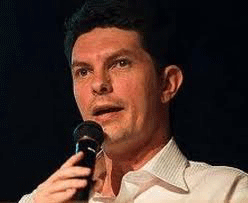 “This is the strongest vote [for the Greens] I’ve seen,” Senator Siewert said……Both major parties had low-profile lead candidates, he said, but the Greens had promoted a lead candidate – Mr Ludlam – who made the others look dull.
And the party was creative in its campaign, said Former Labor workplace relations and tertiary education minister Chris Evans………”It looks like Scott’s home and hosed,” Labor Senator Sam Dastyari said……”It will be interesting to see where the Greens end up – how much over a quota they’ll get.”
Australian uranium miner Paladin hit by costs of water.
 Uranium Miners in Namibia Face Rise in Water Price, Paladin Says http://www.businessweek.com/news/2014-04-04/uranium-miners-in-namibia-face-rise-in-water-price-paladin-says By Felix Njini April 04, 2014 Uranium miners in Namibia, already coping with water shortages in the semi-arid Erongo region, face a steep rise in costs, Paladin Energy (PDN) Ltd. said.
“When we get it, sometimes we have problems with the quality of the water and the cost,” said Simon Solomons, managing director of Paladin’s Langer Heinrich mine. “At the moment there is no long-term solution to the water-supply situation.”
The mines operated by Paladin, Rio Tinto Plc and China General Nuclear Power Group rely on water from a 20 million-cubic-meter capacity desalination plant operated by Areva SA, a French reactor maker. Areva is in talks to sell a majority stake in the plant to state utility Namibia Water Corp. after shelving its Trekkopje project in 2012 as uranium prices slumped in the wake of the Fukushima disaster.
Namwater has “to look for finance to buy the plant,” Solomons said yesterday during a tour of the Subiaco, Western Australia-based company’s mine. “They will pass on those charges to the uranium mines.”
Calls to Namwater weren’t immediately answered.
The three mines, which require as much as 10 million cubic meters of water a year, were previously supplied by the Omaruru Delta aquifer, which has dwindling volumes as demand from the mines and surrounding towns of Swakopmund and Walvis Bay rises.
Langer Heinrich, which consumes 130,000 cubic meters of water a month, has had “no long-term and no firm discussion” with Namwater over supplies, Solomons said.
Namibia is the fourth-largest uranium producer after Kazakhstan, Canada and Australia.
To contact the reporter on this story: Felix Njini in Windhoek at fnjini@bloomberg.net
1 This month
17 October, Free Public Talk on Nuclear Issues in South Australia
David Noonan will speak on public interest concerns over the new Roxby Downs Indenture Act 2026 on BHP copper-uranium mining and ore processing in SA, and on how AUKUS may face SA with a High-Level nuclear waste agenda.
Dr Jim Green will discuss international developments in the field of nuclear power including ‘small modular reactors’ and Generation 4 ‘advanced’ nuclear reactor concepts.


Help Aunty Sue Protect Her Land and Sacred Sites From Destructive Rocket Testing.
.

Australians deserve the truth
about
AUKUS – https://aukuspublicinquiry.com/

PETITION – To: Prime Minister Anthony Albanese and the Australian Labor Government

of the week – Australians for War Powers Reform (AWPR)
To see nuclear-related stories in greater depth and intensity

