Legal bullying made a scientific journal remove its article about climate change
 The journal that gave in to climate deniers’ intimidation The Conversation, Elaine McKewon, Research Associate, Australian Centre for Independent Journalism at University of Technology, Sydney 1 April 14,
In February 2013, the journal Frontiers in Psychology published a peer-reviewed paper which found that people who reject climate science are more likely to believe in conspiracy theories. Predictably enough, those people didn’t like it.The paper, which I helped to peer-review, is called “Recursive fury: Conspiracist ideation in the blogosphere in response to research on conspiracist ideation”. In it, cognitive scientist Stephan Lewandowsky and his colleagues survey and analyse the outcry generated on climate skeptic blogs to their earlier work on climate denial.
The earlier study had also linked climate denial with conspiracist thinking. And so by reacting with yet more conspiracy theorising, the bloggers rather proved the researchers’ point.
Yet soon after Recursive Fury was published, threats of litigation started to roll in, and the journal took the paper down (it survives on the website of the University of Western Australia, where Lewandowsky carried out the study).
A lengthy investigation ensued, which eventually found the paper to be scientifically and ethically sound. Yet on March 21 this year, Frontiers retracted the paper because of the legal threats.
The episode offers some of the clearest evidence yet that threats of libel lawsuits have a chilling effect on scientific research………
the journal’s management and editors were clearly intimidated by climate deniers who threatened to sue. So Frontiers bowed to their demands, retracted the paper, damaged its own reputation, and ultimately gave a free kick to aggressive climate deniers.
I would have expected a scientific journal to have more backbone, certainly when it comes to the crucially important issue of academic freedom. http://theconversation.com/the-journal-that-gave-in-to-climate-deniers-intimidation-25085
Aboriginal elder treated with disrespect by Toro Energy uranium company
Wiluna Martu peoples against uranium mining, The Stringer, by Gerry Georgatos March 29th, 2014 “……. “The Senior Lawmen acknowledge that there are divergent views about uranium mining within the wider Martu community and these divergent views have to be accommodated in this negotiation.”
Late last year and earlier this year Mr Cooke walked into Toro Energy AGMs and expressed his concerns at the prospective impacts on Martu Country were the uranium mines to proceed. He is also concerned that signatories to the mining proposal from within his people have been “misled”.
“The signatories have been persuaded to believe the uranium operation will have low environmental impacts.”
“These people are targeted and influenced by deals to sign over the rights of the land. These people Toro talked to are now driving around in Toyotas they didn’t have before. About eleven Toyotas just appeared,” said Mr Cooke.
“We must care for our land and children and not put our future at risk. These corporations only want to make money, they are full of broken promises.”
Ms Fitzwater accompanied Mr Cooke into the Toro Energy AGM. “When Elder Glen Cooke asked a question he was treated abruptly by Toro and with complete disrespect. He was not permitted to reiterate any questions. It is clear the company tolerates no opposition and has been unfair and biased during their submission period no matter what their convictions.”
“The EPA should seriously reconsider this approval basis and commit to protecting our ecosystem. Our State cannot afford this mistake, we will pay the consequences for an incomprehensible amount of time. This concerns all Australians,” said Ms Fitzwater.
Mr Cooke said he has a complete understanding of the effects of radiation. He was eight years old when the Maralinga atomic tests took place.
Former radiation worker, Bill Macham said that Governments must amend legislation from measures of understanding radiation effects in terms of “half lives and instead to baseline measures of what are biologically safe levels”. With anti-nuclear activists relocating to Alice Springs and the Arnhem to support communities and Elders against uranium expansion, the call for the closure of Jabiluka and for Muckaty to not be used as a radiation waste dump, it appears the next generation’s tensions will highlight the proliferation of uranium mining and the rapacious rise of nuclear reactors.
“For those who care about the earth and people, this is our duty, if those who don’t care about the earth and people win their war to make piles of money, then there will come the day that this earth and its people will pay very high, at what cost to the earth and to people, well we’ve seen Fukishima and Chernobyl,” said Mr Cooke. http://thestringer.com.au/wiluna-martu-peoples-against-uranium-mining/
Don’t worry, the Science Media Centres are on Abbott’s side
 Arclight 1 April 14 Australia and the UK covered up Fukushima using the Science Media centres with a small group of UK and Australian hand picked scientists..
The Science media centre (SMC) in the UK makes the BBC put on 1 of the 99 per cent who think there is a problem, with 1 climate denier from the remaimng 1 percent..
The UK government tells the SMC to manage the news..
The SMC is pro fracking and pro GMO too!
basically pro big buisness…
I think you were too kind with Cameron, Christina. The UK is managing climate change by saying it will be too far into the future to have any immediate effects. even after the weird weather and flooding we have been having in the UK over the winter. Also, they are commissioning some weather modification studies and has asked the SMC to deal with it.. So no articles on weather modification..
The SMC is funded and supported by petroleum, nuclear, pharma, BBC and the Department of Energy and Climate Change (DECC UK) etc etc
follow the money! The SMC did
Great comments! I hope the refrigeration is solar!!
Australia’s Prime Minister, Tony Abbott, is not worried about Climate Change
(Video) T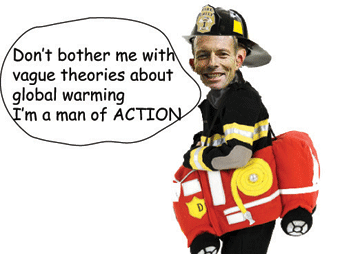 ony Abbott unmoved as UN report finds climate change happening all over the world BERNARD HUMPHREYS AND KATRINA STOKES THE ADVERTISER MARCH 31, 2014
PRIME Minister Tony Abbott has played down a United Nations climate report that predicts a dire future for the Murray-Darling Basin and the Great Barrier Reef, saying that “Australia is a land of drought and flooding rains, always has been and always will be”.
The UN’s Intergovernmental Panel on Climate Change says governments around the world can still avoid the worst of forecast droughts, floods and bushfires, but Mr Abbott says he remains reluctant to link extreme weather events to climate change.
US Pentagon’s military city in Australia – Darwin
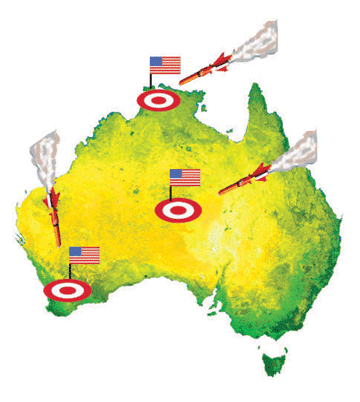 Darwin: Australia’s most militarised city, and a lily pad for the Pentagon Australians know the isolated and exotic city of Darwin through stories about cyclones, crocodiles and Aboriginal art, but it really is a cleverly camouflaged garrison town Tess Lea theguardian.com, Monday 31 March 2014 In his recent book Anzac’s Long Shadow: The Cost of our National Obsession, former ADF soldier James Brown correlates deep Australian ignorance about our contemporary military with our increasingly fantastical commemoration of the Anzac legend. Bedazzled by myths of Gallipoli, Australians neglect more pressing defence policy concerns.
It’s a compelling thesis, and one that closely parallels the situation in one of Australia’s most militarised city,  Darwin.
Australians prefer to see the isolated and exotic city of Darwin through stories about cyclones, crocodiles, Aboriginal art, spicy market food and unlimited road speeds; a place that lets you go to the supermarket in bare feet and look normal. This way, we don’t have to notice the most significant militarisation effort in Australia’s post-war history, which is happening under our noses. The militarisation of the north is unknown to most of us and thanks to this ignorance, the new Cold War brewing in the Asia Pacific region, and Darwin’s place in it, is rarely being debated………
In allowing Australia’s foreign policy interests to be played out of sight, out of mind, in a town that also hides its own nature from itself, we avoid debating difficult questions. What does being a subordinate ally to a military force clinging to its global primacy commit us to? What are our liabilities and responsibilities? At what point do Australian sovereign interests diverge from America’s security objectives? And what are we prepared to do about it? http://www.theguardian.com/commentisfree/2014/mar/31/darwin-a-complicated-but-dazzling-history
Western Australian election: is Clive Palmer’s Party FOR or AGAINST the Renewable Energy Target?
 RET And PUP – Confusion (Still) Reigns http://www.energymatters.com.au/index.php?main_page=news_article&article_id=4244 The Palmer United Party (PUP) still appears not to have a solid stance on the future of Australia’s Renewable Energy Target (RET).
PUP’s WA candidate, Zhenya ‘Dio’ Wang, recently expressed support for the Renewable Energy Target to be left as is and Clive Palmer appeared to indicate the same view. Shortly afterwards, Mr. Palmer clarified; stating it perhaps shouldn’t be a “mandatory thing”.
Nearly 2 weeks later and it seems there still isn’t a unified position at PUP.
According to the Guardian, a PUP spokesman told the publication on Monday “the policy is what Clive says; the target has to be voluntary”. However, when Mr. Wang was again asked about when asked about the RET policy on Monday; he told Guardian Australia, “We are still discussing our policy. We are working out what it is.”
With voters set to go to the polls in Western Australia this Saturday, the mixed signals from PUP wouldn’t be very encouraging for solar supporters considering the party – and the outcome of WA’s election could have major implications nationally for renewable energy.
According to the Australian Solar Council, 500,000 WA residents live in solar households and hundreds of thousands more will go solar if the RET is left as is; something that is in doubt due to the Federal Government’s RET review.
“By putting barriers up for 350,000 people in WA who want to install solar on their homes and slashing large-scale solar projects back from the current path of 700 MW, the Federal government looks set to break a key election promise,” says Australian Solar Council CEO John Grimes.
Mr. Grimes says Western Australian householders and small businesses will invest their own money to build 445 megawatts of generating capacity if the RET is retained for rooftop PV systems and hot water. With regard to large-scale solar, the existing RET could deliver more than 700 MW of projects in WA, employing an additional 7,000 people during the construction phase between now and 2020.
With solar so popular in the state; the parties that clearly support the RET in its current form may have a bit of an edge this Saturday.
Solar power making economic sense for remote mining projects in Australia
 First Solar close to deal to power Australian mines, SMH, April 1, 2014 First Solar, the largest US solar-panel maker, is close to announcing agreements to supply its technology to remote mining projects in Australia to help resources companies save on fuel costs.
The company expects to develop as much as 200 megawatts of capacity for the mining industry over the next three years, Jack Curtis, First Solar’s Sydney-based vice president of business development for the Asia-Pacific, said in a phone interview. The Arizona-based company plans to combine solar power with diesel, he said.
“In an environment where profitability isn’t what it used to be, with the mining industry focused on cost control, the electricity that powers the mines is becoming a bigger line item, and the ability to put a dent in that and hedge against fuel price volatility is something that solars offers,” Curtis said. “We expect fairly shortly to announce some pretty exciting projects in that space.”
The U.S. company is increasing efforts to install solar systems at industrial sites and warehouses as utilities demand smaller projects, and is seeking deals in other regions including Saudi Arabia, India and South America. The world’s largest mining companies, including BHP Billiton and Rio Tinto Group, at the same time are reining in spending as a decade-long boom in metal prices wanes.
Mining sites
First Solar will target mining sites in Western Australia, the Northern Territory and South Australia and seek to expand as the solar industry proves that it can provide reliable supply, Curtis said, declining to name any companies.
Operators of Australian mines facing high diesel fuel costs should grow more comfortable using solar technology to generate some of their power, said Nathan Lim, who oversees $127 million in assets and owns First Solar shares as manager of the Australian Ethical International Equities Trust.
“The high cost of energy at a facility in the middle of nowhere has always made it interesting to anyone offering an alternative solution,” Lim said. “The difference between today and five to 10 years ago is the reliability, and that the cost of solar has come down. It’s becoming a no-brainer for people in remote locations.”….. http://www.smh.com.au/business/carbon-economy/first-solar-close-to-deal-to-power-australian-mines-20140401-35uth.html
IPCC report strengthens activisim against coal and gas industries
 Australian activism reaches fever pitch as IPCC warns on climate, Guardian, 1 April 14 New South Wales campaign group is harnessing community support to confront oil and gas companies over drilling As George Bernard Shaw put it: “The reasonable man adapts himself to the world; the unreasonable one persists in trying to adapt the world to himself. Therefore all progress depends on the unreasonable man.”
Australia‘s coal and gas operators may not agree with Shaw, but it is the power of these unreasonable people that new campaign group Our Land, Our Water, Our Future hopes to tap. Continue reading
Sunshine: balance the need for Vitamin C with the avoidance of skin cancer
Concerns women may not be getting enough sunshine http://www.sunshinecoastdaily.com.au/news/concerns-women-may-not-be-getting-enough-sunshine/2215239/ Rae Wilson 31st Mar 2014 Professor John Wark, who works at both organisations, said vitamin D was an essential nutrient for everyone, young and old.
“Vitamin D is necessary for strong bones, muscles and overall health. Ultraviolet radiation from the sun is the best natural source of vitamin D, but it is also the main risk factor for skin cancer and premature ageing of the skin,” he said.
“A balanced approach to sunlight exposure can help you avoid vitamin D deficiency, which has been linked to many chronic health conditions such as poor bone and muscle health, cardiovascular disease, some cancers and adverse mental health conditions to name only a few. Continue reading
Australia is a “canary in a cage” when it comes to climate change
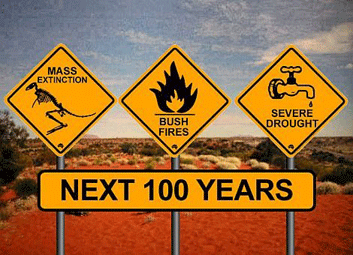 Climate change could be putting human health at risk: Australian IPCC report researchers ABC News, By Carl Smith 31 March 14, Climate change will increasingly harm people’s health and Australians will be particularly vulnerable, according to Canberra authors of the latest international climate change report.
The health section of the United Nation’s Intergovernmental Panel of Climate Commission (IPCC) report shows humans will be more at risk over coming years with areas of the world likely to become uninhabitable.
University of Canberra’s Professor Helen Berry is one of three Canberra researchers who have contributed to the health section of the report. She says human health has so far been neglected in public discussions on climate change, as debate has generally focused on the environment and the economic effects of reducing emissions.
“If climate change goes on unchecked we will see many deaths – we are seeing many deaths already – and you can imagine the human population could possibly go extinct if you take the effects of climate change to their extreme logical conclusion,” she said.
“We as a nation and we as a world really need to be focusing on health and well-being, because it’s the bottom line for human survival.”
Fellow contributor Professor Colin Butler, also from the University of Canberra, says climate change could be a major threat in the decades to come.
“We might be heading into a new dark age, not in the next five years but maybe in the next 100 years,” he said.
“We’ve got to put far more effort onto slowing down the pace of climate change, rather than deluding ourselves to the idea that we can adapt to it.
“I’m very concerned that within 100 years there will be devastation through multiple interacting pathways – more expensive foods, sea level rise, migration, ultimately war.”
Australia a climate change ‘canary in a cage’
Professor Helen Berry says Australia should be particularly concerned. “Australia’s already a hot country, warming is not good for us,” she said. “Warming brings about an increased risk of droughts, of bushfires, of floods and storms, and heatwaves. “All of these climatic conditions are common already in Australia and they will become more and more common and more and more erratic and wild and unpredictable. “When that happens, larger numbers of people are affected, injured, sometimes killed tragically in these disasters.”
Professor Berry warns Australia is a “canary in a cage” when it comes to climate change………http://www.abc.net.au/news/2014-03-31/climate-change-researchers-say-climate-puts-human-health-at-risk/5356306
20 Australia-wide organisations call for W.A. government inquiry into Wiluna uranium project
 United call for uranium inquiry 31 March 14 Today twenty* different public health, union, Aboriginal and environment groups have called on the WA Environment Minister Albert Jacob and the WA EPA to hold a dedicated Public Inquiry into the states most advanced uranium proposal, Toro Energy’s Wiluna uranium project.
State Secretary of the AMWU Steve McCartney said “The nuclear industry is increasingly marginal and uneconomic. This industry is worth 0.02% of our national export revenue and holds just 0.015% of Australian jobs. The risks far outweigh any rewards. Uranium mining does not pass the asbestos test for us – it impacts on the workers extracting it, transporting it and the end users.”
Dr Peter Underwood, National Vice President Medical Association Prevention of War, said “We need to have a way to look at all the risks of a uranium project including a detailed look at the public health risks from this industry here and overseas. A public inquiry is the only way to address these issues. We know it was Australian uranium that fuelled Fukushima and that’s something we need to look at before we push forward with plans to mine uranium.”
Melanie Walker, Acting CEO of the Public Health Association of Australia commented “We have seen a number of accidents at uranium mine sites across Australia, most recently at Ranger uranium mine in the Northern Territory. There needs to be public and transparent process to look at the risks of this industry on workers and the public.”
Mia Pepper, Nuclear Free Campaigner with the Conservation Council of WA said “This small inexperienced company is now proposing a uranium precinct – including four mines across two lake systems and a proposal to store over 50 million tonnes of radioactive mine waste in a lake bed*.”
“This idea lacks credibility and the company lacks capacity, experience and financial backing,” concluded Dave Sweeney Nuclear Free Campaigner with the Australian Conservation Foundation.
Media Comment
- Dr Peter Underwood: (08) 9840 9626
National Vice President Medical Association for the Prevention of War
- Melanie Walker: 0438 430 963
Acting CEO, Public Health Association of Australia
- Mia Pepper: 0415 380 808
Nuclear Free Campaigner, Conservation Council WA
- Dave Sweeney: 0408 317 812
Nuclear Free Campaigner, Australian Conservation Foundation
* Australian Conservation Foundation, Public Health Association of Australia, Australian Manufactures Workers Union WA, Conservation Council of WA, Medical Association for the Prevention of War, Social Justice Board Uniting Church, Maritime Union Australia, UnionsWA, United Voice, Electrical Trade Union, The Wilderness Society, Greenpeace Sustainable Energy Now, Friends of the Earth Australia, Mineral Policy Institute, Anti-Nuclear Alliance WA, Australia Nuclear Free Alliance, WA Nuclear Free Alliance, Beyond Nuclear Initiative,
* Based on the assumption that mining 1 tonne of uranium oxide produces approximately 2,400 tonnes of low level radioactive waste. Total of 22,270 + tonnes of uranium at the four deposits = 53,448,000 + tonnes of tailings.
For solar power in Australia, the Western Australian Senate election is critically important
 Western Australia’s Election Crucial In National Solar Battle http://www.energymatters.com.au/index.php?main_page=news_article&article_id=4241 As the people of Western Australia prepare to return to the polls, the Australian Solar Council says the outcome will play a major role in the battle solar is facing nationally.
“There are increasing indications that the Federal Government is planning to remove or scale back support for rooftop and large scale solar through its review of the Renewable Energy Target (RET),” says Australian Solar Council CEO John Grimes. Mr. Grimes says with Labor and the Greens supporting the position of not changing the RET, if numbers can be secured in the Senate, any changes the Abbot Government seeks to make that would negatively impact the RET can be blocked.
The Australian Solar Council has secured letters of support regarding the Renewable Energy Target from Labor and The Greens. Palmer United Party issending mixed signals. The Council’s Save Solar campaign is currently focusing the majority of its efforts in Western Australia and recently launched its first ever TV and print advertising campaign.
The response from the community is such that it says several political parties have asked the Council stop all of the emails being sent by solar supporters as they are receiving hundreds each day.
“Our clear message – anti-solar policies will only happen at great political cost, because the people are with us,” says Mr. Grimes.
“This campaign says to governments across Australia that solar is the future and the industry will not tolerate ad-hoc policy changes that damage our businesses and most of all restrict access to solar for the 3.5 million people who want solar over the next 5 years.”
Shadow Minister for Environment, Climate Change and Water, Hon. Mark Butler MP will meet solar workers in Perth on Monday to discuss the importance of the Renewable Energy Target for the solar industry; which employs thousands of people in Western Australia.
Liberal policies make sense when you realise who funds them
 The rise and rise of mining company donations. Crikey BERNARD KEANE | FEB 21, 2012 Labor’s mining tax and the resources boom may have permanently and significantly changed the balance of political donations, with millions of dollars flowing from mining companies to the Coalition, Australian Electoral Commission data shows.
Mining companies began increasing their stake in the political process before the financial crisis, favouring the Coalition but also contributing to Labor. However, the mining tax saw an extraordinary increase in donations to the Coalition that has opened up a huge funding resource for the Liberals.
Mining company donations to state and federal Labor parties and the Coalition since 2004 show the extent to which Coalition benefited from the surge in mining company largesse after the Rudd government infuriated them with its RSPT proposal in May 2010.

But the largesse is predominantly from Western Australia. In Queensland, the ongoing support of Clive Palmer has been the primary mining contribution to the conservative cause, including a monster donation of $500,000 to the LNP by his Queensland Nickel. Other than Palmer, the federal Liberal Party took $100,000 from controversial miner New Hope — the target yesterday of a protest led by Alan Jones and Bob Katter — maintaining the Queensland representation in 2010-11.
Last year the Queensland government capped donations at $5000 to parties and $2000 to candidates, but the cap only applies to donations relating to campaign purposes; general purpose donations to parties are not capped).
Santos and Beach Petroleum each gave big donations to the SA Liberals in 2010-11 as well……….
Federally, Labor’s take from miners slumped to a bare $50,000 worth of small donations and fund-raising dinner contributions, from $200,000 before the 2007 election.
The sheer scale of mining company generosity illustrates why Tony Abbott remains committed to repealing the carbon pricing package  and the mining tax despite the difficulties he will face in securing Senate support. That should continue to lock in big mining company donations this year and next and establish the mining industry as a go-to source for big donations that Labor cannot access for years to come.
The donations are widespread across the WA industry, with 25 companies giving the party on average $95,000. The list doesn’t include Rio Tinto and BHP Billiton, who no longer donate or only provide small donations; given they can pick and choose prime ministers and dictate how much tax they pay, donations would appear to be of limited value for the big foreign miners………..http://www.crikey.com.au/2012/02/21/the-rise-and-rise-of-mining-company-donations/
Superannuation fund is deeming fossil fuels as an unethical investment
 Superannuation fund UniSuper plans to to add fossil fuels to list of unethical investments http://www.abc.net.au/news/2014-03-30/super-fund-adds-fossil-fuels-to-unethical-investments-list/5354066 By Nonee Walsh 30 Mar 2014, One of Australia’s top 10 superannuation funds is planning to add fossil fuels to its list of unethical investments.
UniSuper, Australia’s seventh largest fund that services higher education and research workers, told members who chose its socially responsible packages that investment in fossil fuels, gaming, alcohol and weapons would be withdrawn this year unless members objected.
Those sectors are currently included in the Dow Jones sustainability index.
UniSuper proposes initially withdrawing from exploration and production in the coal and gas sector.
However it says in the future it will look at withdrawing from investment in power suppliers and other fossil fuel companies.
UniSuper has $1.6 billion in its sustainable investments, which is a small proportion of its overall fund
Adelaide wake up: the nuclear lobby is trying to put it over you!
Adelaide is under attack from nuclear advocacy fraudsters who tell lies to promote their evil nuclear fantasies.
Our universities and our politicians have been “influenced” by junk science that falsely claims that nuclear power is “safe”.
Our universities and our politicians have been “influenced” by junk economics that falsely claims that nuclear power is “cheap”.
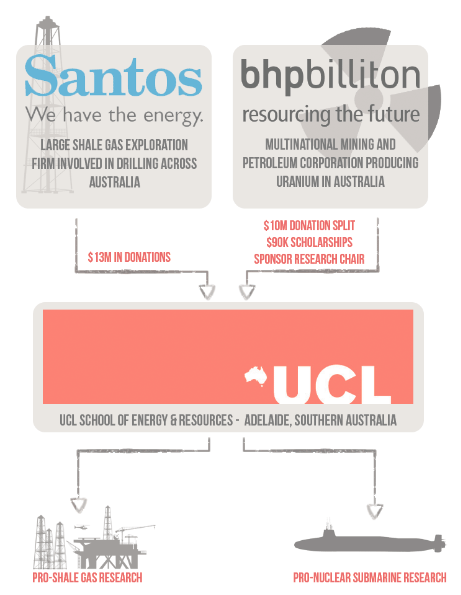
Our newspapers falsely claim that we want nuclear power in South Australia – this page is a place where you can register your protest at this false claim, where you can say “No Nukes In South Australia”.
1 This month
17 October, Free Public Talk on Nuclear Issues in South Australia
David Noonan will speak on public interest concerns over the new Roxby Downs Indenture Act 2026 on BHP copper-uranium mining and ore processing in SA, and on how AUKUS may face SA with a High-Level nuclear waste agenda.
Dr Jim Green will discuss international developments in the field of nuclear power including ‘small modular reactors’ and Generation 4 ‘advanced’ nuclear reactor concepts.


Help Aunty Sue Protect Her Land and Sacred Sites From Destructive Rocket Testing.
.

Australians deserve the truth
about
AUKUS – https://aukuspublicinquiry.com/

PETITION – To: Prime Minister Anthony Albanese and the Australian Labor Government

of the week – Australians for War Powers Reform (AWPR)
To see nuclear-related stories in greater depth and intensity

