Time for Australia’s Future Fund to stop investing in nuclear weapons
In 2011 the Future Fund barred all investments in companies that manufacture anti-personnel landmines and cluster munitions, but a loophole remains in the policy allowing the Fund to continue investing in nuclear weapon companies.
 Congratulations, Costello – now it’s time to give up the nukes Gem Romuld Outreach Coordinator International Campaign to Abolish Nuclear Weapons- Australia 5 February 2014Following yesterday’s announcement that former federal treasurer Peter Costello has been appointed Chair of the government-owned Future Fund, the International Campaign to Abolish Nuclear Weapons (ICAN) calls for a review the Fund’s investments in nuclear weapons companies.
Campaigners from ICAN visited the Fund’s Melbourne headquarters today to deliver a congratulatory card to the new Chair. “We’ve visited Peter Costello on the first day of his new job, to call on him to use his new Chairmanship as an opportunity to steer the Fund out of the nuclear weapons industry”, said ICAN spokesperson Gem Romuld. Continue reading
Brisbane Aboriginal activists to push for land rights and sovereignty
 Aboriginal News Aboriginal Way – National Indigenous Radio Service (NIRS) Lateral Love NIRS NEWS STORIES 05 FEBRUARY 2014 A number of Brisbane activists have formed a group to push for and further discussions on treaties, land rights and sovereignty.
Nganyaywana man Callum Clayton-Dixon is a co-founder of the collective and says treaties must be a grass-roots movement and not be administered by government bodies.
Mr. Clayton-Dixon says he welcomes Nigel Scullion and Warren Mundine’s recent interest in treaty talks and wants to bring the discussion into communities.
The hidden benefit of Australia’s carbon tax
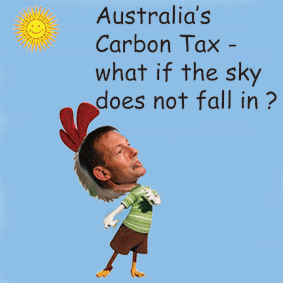 Big fall in electricity sector emissions since carbon tax Peter Hannam, 5 Feb 14 ENVIRONMENT EDITOR, THE SYDNEY MORNING HERALD “……..The premise of the debate about changes in emissions from last year is wrong, said Frank Jotzo, an associate professor at Australian National University’s Crawford School of Public Policy and deputy director, ANU Climate Change Institute.
“What matters is not the comparison with last years’ emissions levels, but with what emissions would be if it was not for the carbon price,” Professor Jotzo said. “Australia’s emissions have been on an increasing trajectory, projections without carbon pricing were for strong increases.”
“Now we’re seeing only very slight increases which is progress,” he said.
While the electricity sector is seeing the largest impact of the carbon prices, the impact is not as big as it would be if businesses believed that the carbon price was here to stay, Professor Jotzo said.
“To stop increasing emissions in transport and extractive industries like LNG would require a carbon price much, much higher than what is currently in place,” he said…….http://www.smh.com.au/environment/climate-change/big-fall-in-electricity-sector-emissions-since-carbon-tax-20140205-320a6.html
Aboriginals wait to see if Cape York Peninsula can be protected from mining
Lateral Love, 6 Feb 14 Traditional Owners in the Cape York Peninsula are still waiting on the State Government to submit information that would see parts of the Cape listed as UNESCO World Heritage.
Desmond Tayley is speaking for his traditional land in the Laura area, a cultural site with world-renowned rock art that is also a major tourist attraction.
Mr. Tayley says there has been no feedback by the Government and world heritage status would not just protect the site from mining……http://lateralloveaustralia.com/2014/02/05/aboriginal-news-aboriginal-way-national-indigenous-radio-service-nirs-19/
Australia’s carbon tax has successfully reduced electricity greenhouse gases
 Christine Milne – ‘‘Reducing free permits and ending fossil fuel subsidies to coal and gas would help to drive down emissions but the Abbott government is keen to maintain the culture of entitlement in those industries,’’
Big fall in electricity sector emissions since carbon tax Peter Hannam, 5 Feb 14 ENVIRONMENT EDITOR, THE SYDNEY MORNING HERALD Australia’s greenhouse gas emissions from the electricity sector are down about 7.6 per cent since the carbon tax was introduced in July 2012, or the equivalent of about14.8 million tonnes. Continue reading
Solar air conditioning, solar power the clean way to keep cool
 Over one million Australian homes now have solar and our power pricing doesn’t handle them well either
under the status quo, those without air conditioning and with solar are being slugged unfairly.
Matthew Warren: The way we pay for electricity is out of date and urgently needs reform MATTHEW WARREN THE ADVERTISER FEBRUARY 03, 2014 THE recent intense heatwave across south-eastern Australia stretched many things to breaking point.Heatwaves provide a rare, but important examination of the power system.On a normal summer’s day in South Australia the peak load is around 1890 megawatts. In the heatwave it topped 3000 megawatts for almost three days straight. That put the network right at the edge of its capacity.
There is one key reason for these spikes in demand: increased deployment of airconditioners. On the hottest of days they are all turned on at once and this sends demand skyrocketing……
A large part of your household power bill is to pay for these infrequent events. It would make sense if those households with large air conditioners paid more than those who have only a small unit or none at all.
But they don’t. Continue reading
Australia’s outdoor workers most at risk of skin cancer
 Tradies and farmers most at risk from sun 7 News 5 Feb14 Farmers, tradies and professional drivers are the workers most at risk from skin cancer, research has confirmed.
A major study by the Harry Perkins Institute of Medical Research, affiliated with the University of Western Australia, looked at the extent of sun exposure among workers in a cross-section of industries.
The research found that overall, more than one-third of male workers but just eight per cent of female workers – two million people in Australia – were exposed to solar radiation at work.
The workers at particular risk of skin cancer were farmers, trades and construction workers and drivers…..https://mail.google.com/mail/u/0/?tab=wm#inbox?compose=143ff06c388d6238
Tony Abbott’s double standards as he supports fossil fuel subsidies
 Why does Australian PM Tony Abbott support fossil fuel subsidies? Guardian, Alex White 4 Feb 14 Why does Tony Abbott support $10 billion per year in fossil fuel subsidies but oppose an aid package for food manufacturer SPC-Ardmona?……. the prime minister seems very happy to continue to give taxpayer’s money to fossil fuel companies to the tune of $10 billion per year in subsidies.
the prime minister seems very happy to continue to give taxpayer’s money to fossil fuel companies to the tune of $10 billion per year in subsidies.
The fossil fuel subsidy decision is particularly inconsistent with his stance on industry support for SPC-Ardmona and the car industry. This is a prime minister who in December declared an end to corporate welfare.
But he said “we don’t want to see corporate welfare … we don’t believe in corporate welfare”.
“This government will be very loth to consider requests for subsidies, we will be very loth to do for businesses in trouble the sorts of things they should be doing for themselves,” he warned.
Fossil fuels subsidies are the most pernicious and distorting of subsidies. The biggest in Australia is the fuel tax credit scheme, which is worth $2 billion per year to mining companies, the equivalent of each taxpayer in Australia handing over $182 to the mining companies.
The national president of the Mining Union, Tony Maher called out this squandering of public funds in an article for The Drum:……
Despite global warming posing an imminent threat to Australia, and its predominate cause being the burning of fossil fuels, the Australian government is using your tax dollars to literally pay these fossil fuel companies to pollute.
As I’ve noted in the past, Tony Abbott and his government seem intent on turning Australia into a reckless “charco-state” (the coal equivalent of a petro-state).
These fossil fuel subsidies don’t just pay companies to pollute our air, water and atmosphere. They also distort our markets by making fossil fuels, like diesel and gas, artificially cheap. Special tax treatment for big oil, gas and coal projects allows fossil fuel companies to rapidly depreciate their assets, like drilling rigs. This means they get away with paying taxes that other companies are forced to……. http://www.theguardian.com/environment/southern-crossroads/2014/feb/02/fossil-fuel-subsidies-tony-abbott-spc-ardmona-corporate-welfare
Griffith bye election: only the Greens care about climate change
Senator Milne said major parties were ignoring the preliminary warning signs of climate change and the implications that had for rural and tourism jobs.
“You cannot deal with droughts in Australia without acknowledging global warming”
The Griffith byelection is being held on February 8

 Greens use Griffith to push for climate change action , SMH, 4 Feb 14 Tony Moore brisbanetimes.com.au senior reporter In 2007, climate change was deemed the most important issue of a generation. The bigger issue of climate change subsequently got lost in a complex argument, over two elections, about the merits of a carbon tax.
Seven years on, as Australia faces up to record summer temperatures and more intense cyclones, it has again been bought into focus by the Greens.
On Monday in Brisbane, Greens leader Senator Christine Milne chided the major parties for decisions which she said appeared to ignore the impact of climate change. She was in the city to support the Greens campaign to win the seat of Griffith, left vacant by Kevin Rudd’s retirement……. Continue reading
How vested interests exploit rural communities about “wind turbine syndrome”
a community that is well-informed, consulted and empowered is much more likely to welcome the development of clean technology, and reject the offerings of anti-wind groups selling a narrative of fear and danger..
The theory of wind turbine syndrome was not sourced from empirical scientific investigation – it was borne of a heady mix of human nature and vested interests,
 stew of sentiment and pseudoscience bubbles below the surface, and the link need only be completed by motivated and well-funded lobby groups with no desire to adhere to the bounds of scientific inquiry
Consultation is the key to curing wind turbine syndrome KETAN JOSHI ABC Environment3 FEB 2014 Joshi 7 MAY 2013 Wind turbine syndrome is a symptom of a community that feels it has lost control. It has very little to do with wind farms and ‘infrasound’. PRIME MINISTER TONY ABBOTT’S intention to open a fresh investigation into the vexed issue of ‘wind turbine syndrome’ hasn’t impressed many.
Mick Vagg, SeniorLecturer at Deakin University wrote that ‘there is no scientific justification for any further investigation of ‘wind turbine syndrome'”.
Meanwhile the anti-wind Waubra Foundationsupports the plan……. Continue reading
History of Aboriginal Land Rights in Australia
The story of Mabo, SMH January 31, 2014 Colleen Keane Before 1967, Aboriginal people in Australia – the first Australians – were not included in the national census. The referendum altered their status in the constitution, but afterwards it no longer contained any reference to indigenous people. The doctrine of terra nullius also meant that Aboriginal people were not recognised as traditional owners of their land. Continue reading
Community ownership of wind farms in Australia
Consultation is the key to curing wind turbine syndrome, KETAN JOSHI ABC Environment 3 Feb 14 “…….In Australia, community ownership is gaining traction. My employer, InfigenEnergy, is looking to enable community ownership of one of the wind turbines at the Flyer’s Creek development in NSW, through theCentral NSW Renewable Energy Cooperative (CENREC).
The Hepburn Wind Farm, a two-turbine community-owned wind farm in Victoria, has generated 27,809 megawatt-hours since commencement — enough to power an average Australian home for 4,209 years, and the proposed Fremantle Co-operative wind farm project in WA recently hit a $10,000 crowd-funding target to produce myth-busting videos on wind energy. The Coonooer Bridge Wind Farm development utilises a community benefit model that is the first of its kind, and has been welcomed by locals.
These initiatives are, simply, the circuit-breakers needed to lessen the influence of lobby groups working against the integration of renewable technology into our energy system, and empower communities. Abbott’s research will likely be ineffective in lessening the spread of wind energy health fears in communities.
The deployment of clean technology across Australia as a means of reducing our reliance on fossil fuels will be stewarded by tight-knit Australian communities. The companies that develop, operate and maintain large-scale generation assets fuelled by renewable resources can only benefit from community ownership and engagement.
It seems the only ones who will lose out from this shift will be those who professionally stoke anger and feed fear. The demand for their resource will run swiftly dry.http://www.abc.net.au/environment/articles/2014/02/03/3935067.htm
Toro’s Wiluna uranium project’s costs blow out: not a good omen
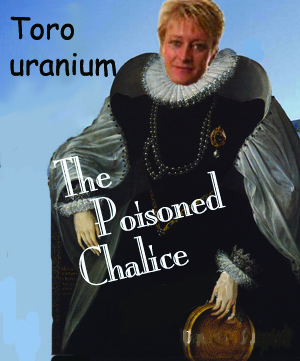 Just a quick update on Toro – they released their quarterly report yesterday – revealling the estimated start up costs of the Wiluna project has jumped $47 million. With a slump in the uranium price, lack of new investments in mining, and a $47 million cost blow out before they’ve even got final approval does not bode well… http://www.businessnews.com.au/article/Toro-reveals-Wiluna-cost-increase?utm_source=Business+News+Mailing+List&utm_campaign=75e9eadd22-dba&utm_medium=email&utm_term=0_e5391356e5-75e9ead
ERA uranium company’s losses, and closed operations due to radioactive spill
 ERA narrows loss to A$136m, says toxic spill probe continuing Mining Weekly By: Esmarie Swanepoel 31st January 2014 “…..During the year, revenue from sales decreased 10%, to A$355.8-million, while revenue from continuing operations was down 12% on the previous financial year to A$370-million…..
ERA produced some 2 960 t of uranium oxide in the year under review, which was 20% less than that produced in 2012, as lower mill rates affected output. The suspension of processing operations following the failure of a leach tank in December also negatively affected operations, ERA said.
Processing operations at the Ranger mine, in the Northern Territory, remain suspended pending the completion of a full investigation and regulatory approvals to restart.
ERA was conducting an independent investigation that would run in parallel with the government investigation.http://www.miningweekly.com/article/era-narrows-loss-to-a136m-says-toxic-spill-probe-continuing-2014-01-31
Tony Abbott’s pathetic performance at Davos, on climate change
there is a growing view among business leaders and mainstream economists who see global warming as a force that contributes to lower gross domestic products, higher food and commodity costs, broken supply chains and increased financial risk.
 Shipping Oars,The Australian Independent Media Network BY KAYE LEE on JANUARY 26, 2014 Tony Abbott’s brief sojourn in Davos left most of us cringing and somewhat bemused as to the purpose of his journey. He met with some Australian big business leaders and delivered a speech that had nothing to do with the stated priorities of the forum – the problem of increasing income inequality and the economics of climate change. Le Figaro noted Abbott’s address as a footnote, quoting him as calling for more free trade, an idea that was a long way from the agenda – très loin de la thématique – of earlier gatherings. In fact, Tony left before any of these meetings took place.
But he did fit in a few personal meetings.
Apparently the Dutch Prime Minister also requested a meeting. Tony suggested it was a meet-and-greet but I suspect there was a bit more to it than that. Continue reading
1 This month
17 October, Free Public Talk on Nuclear Issues in South Australia
David Noonan will speak on public interest concerns over the new Roxby Downs Indenture Act 2026 on BHP copper-uranium mining and ore processing in SA, and on how AUKUS may face SA with a High-Level nuclear waste agenda.
Dr Jim Green will discuss international developments in the field of nuclear power including ‘small modular reactors’ and Generation 4 ‘advanced’ nuclear reactor concepts.


Help Aunty Sue Protect Her Land and Sacred Sites From Destructive Rocket Testing.
.

Australians deserve the truth
about
AUKUS – https://aukuspublicinquiry.com/

PETITION – To: Prime Minister Anthony Albanese and the Australian Labor Government

of the week – Australians for War Powers Reform (AWPR)
To see nuclear-related stories in greater depth and intensity

