Will Abbott carry his war on renewables to attack rooftop solar power
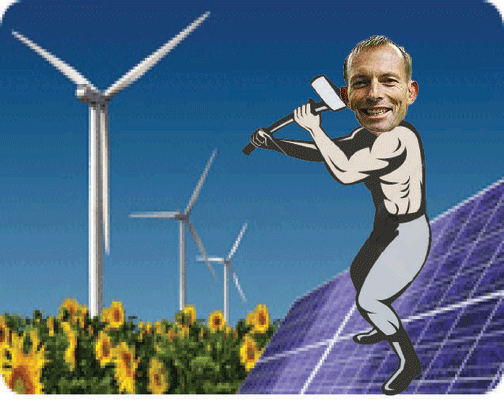 Abbott urged to cut rooftop solar in national renewables revamp http://reneweconomy.com.au/2014/abbott-may-cut-rooftop-solar-national-renewables-revamp-83883 By Giles Parkinson on 23 January 2014 The Australian rooftop solar PV industry may have to prepare for a future with no federal government incentives. There is growing speculation that the small scale renewable certificate may be cut in a revamp of the national renewable energy target.
RenewEconomy understands that there is a renewed push by utilities and generators – particularly but not exclusively the state-owned ones – to close the small scale renewable energy scheme (SRES) and cease issuing renewable energy certificates for rooftop solar. Others suggest cutting the price cap on the certificates.
The renewable energy target is already under threat from utilities and generators, state governments, and sympathizers within the Abbott ministry to either remove, or severely dilute, the 20 per cent target. Continue reading
Australian government spied on Aboriginal activists: photographic exhibition

THROUGH THE LOOKING GLASS Exhibition dates: Wed 22 January to Sat 1 February 2014 View the artworks http://damienmintongallery.com.au/artists/asio-through-the-looking-glass
Australia spy photos: Australia stalked Aboriginal activists ‘Persons of Interest’ Australia stalked Aboriginals By Brenda Norrel Censored News, 23 Jan 14, Australian Aboriginals were secretly photographed under surveillance by the government of Australia. Now, the spy photos of Aboriginal land rights activists, authors, playrights and artists are the subject of a photo exhibit.
“The 70 photos of people such as author Frank Hardy, Aboriginal activists Eddie Mabo and Gary Foley, film critic David Stratton and actor Bob Maza, among a range of Australians who went on to become prominent in public life,” Business Insider reports.
The director of the documentary series, Haydn Keenan, said the photos are “… images with no author, created by the State, of those who threatened it. They are secret political images, stolen to gain power over the subject. Here is a machine aesthetic. No artful frame or composition proposed, but uncannily appears.”
The gallery said the photographs were created as documents and records of surveillance by secret ASIO operatives going about their work monitoring the activities and meetings of people who the state considered to be ‘a person of interest’……(PHOTOS below in the original article) http://bsnorrell.blogspot.com.au/2014/01/australia-spy-photos-australia-stalked.html
Aboriginal religions and the land
‘Dreamtime’ and ‘The Dreaming’ – an introduction The Conversation, Christine Nicholls Senior Lecturer at Flinders University 23 January 2014, In 2002, Jeannie Herbert Nungarrayi, formerly a Warlpiri teacher at the Lajamanu School in the Tanami Desert of the Northern Territory, where I worked for many years first as a linguist and then as school principal, explained the central Warlpiri concept of the Jukurrpa in the following terms:
To get an insight into us – [the Warlpiri people of the Tanami Desert] – it is necessary to understand something about our major religious belief, the Jukurrpa. The Jukurrpa is an all-embracing concept that provides rules for living, a moral code, as well as rules for interacting with the natural environment.
The philosophy behind it is holistic – the Jukurrpa provides for a total, integrated way of life. It is important to understand that, for Warlpiri and other Aboriginal people living in remote Aboriginal settlements, The Dreaming isn’t something that has been consigned to the past but is a lived daily reality. We, the Warlpiri people, believe in the Jukurrpa to this day.
In this succinct statement Nungarrayi touched on the subtlety, complexity and all-encompassing, non-finite nature of the Jukurrpa.
The concept is mostly known in grossly inadequate English translation as “The Dreamtime” or “The Dreaming”. The Jukurrpa can be mapped onto micro-environments in specific tracts of land that Aboriginal people call “country”.
As a religion grounded in the land itself, it incorporates creation and other land-based narratives, social processes including kinship regulations, morality and ethics. This complex concept informs people’s economic, cognitive, affective and spiritual lives…….. Continue reading
Community microgrids the renewable energy opportunity for rural Australia
“The stand-alone approach would give electricity network companies the opportunity to sell assets that they can no longer afford to maintain, and creates the potential to unwind cross-subsidies from urban to regional consumers,”
Unplugging Australia From The Mains Grid http://www.energymatters.com.au/index.php?main_page=news_article&article_id=4136 Regional towns and new housing estates in Australia have the potential to dump mains grid electricity supply quite soon according to a new report.
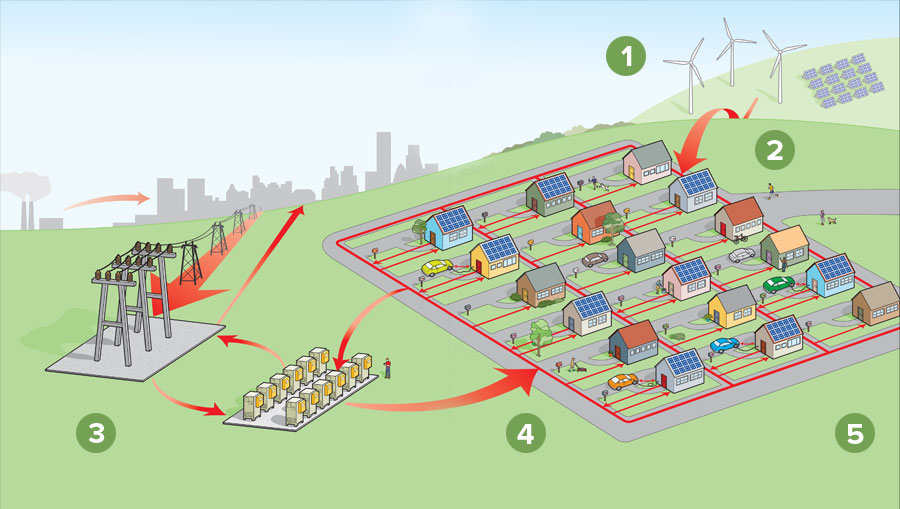
The document, prepared by Energy for the People and the ATA might initially send shivers down the spine of Big Energy; one that is already quivering from the impact of the home solar revolution in Australia.
This doesn’t necessarily mean households would be reliant on whatever panels they could fit on the roof. It could also involve “micro-grids” where communities buy back their local energy grid and invest in local energy generation and storage says Tosh Szatow, director of Energy for the People. Continue reading
Lucas Heights Nuclear Reactor gets MORE money,for its cover of medical research
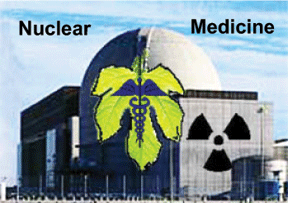
Nuclear medicine is the nuclear lobby’s “fig leaf” – to make nuclear look good. Medical isotopes can be obtained without needing a nuclear reactor
Watpac wins $83m contract for nuclear facility http://www.theaustralian.com.au/business/companies/watpac-wins-83m-contract-for-nuclear-facility/story-fn91v9q3-1226807150273# GINA RUSHTON THE AUSTRALIAN JANUARY 22, 2014
QUEENSLAND-BASED builder Watpac has won an $83 million contract from the Australian Nuclear Science and Technology Organisation to design and construct the Nuclear Molybdenum-99 facility at Lucas Heights, in Sydney’s south. Continue reading
Australia is letting down Pacific Islanders on Climate Change
 But he and Pacific nations like Palau have won no favours from their big neighbour, Australia. Palau has publicly expressed disappointment with Australia’s and Canada’s climate change position.
He recently told Radio Australia the Pacific is disappointed about the Australian government’s moves to abolish the Climate Change Council and the Climate Change Authority, as well as the carbon tax.
Marshall Islands’ President Christopher Loeak says it’s not too late for climate action to save the Pacific http://www.abc.net.au/news/2014-01-21/an-climate-change/5210462 Is it too late to save low-lying Pacific nations from being lost forever because of rising sea levels?
The President of Marshall Islands, Christopher Loeak, doesn’t think so and he’s been on a relentless campaign to get the world to listen to his message.
He does concede time is running out, but has been encouraged by news that a number of nations recently announced they’d signed up to the Majuro Declarationto cut emissions. “We were really happy that the United States agreed to join and also European Union and in the United States, Hawaii also has agreed to join,” he told Radio Australia. Continue reading
Solar energy microgrid viable for rural towns in Victoria
Australia’s micro-grid opportunity, Business Spectator, Tristan Edis, 21 Jan 14 A new report released today suggests that the improving economics of solar and battery technology mean that by 2020 it would be cost-effective for greenfield housing
What’s highly surprising is that the authors of the report suggest that it could be economically viable for some Victorian regional towns to move to self-contained solar micro-grids today.

The study was prepared by the Alternative Technology Association and the organisation Energy for the People, which is focused on developing community clean-energy power projects. It looked at three alternative Victorian locations for assessing the viability of stand-alone power solutions: the regional town of Bendigo; Werribee – a fringe suburb of Melbourne experiencing rapid greenfield housing estate growth; and inner urban Melbourne. Continue reading
Aboriginal Land Rights activists targeted by ASIO and NT cops
ASIO and NT cops spied on, meddled with careers of Territorians BY ALISON BEVEGE NT NEWS JANUARY 21, 2014 AUSTRALIA’S secret service spied on Territorians – including the NT News editor – files released under the Archives Act show……
Those targeted had spoken out against the Vietnam War, campaigned for Aboriginal land rights or opposed Indonesia’s brutal invasion and occupation of East Timor.
Their partners, friends and colleagues were followed, their phones tapped and mail was intercepted…….http://www.dailytelegraph.com.au/news/asio-and-nt-cops-spied-on-meddled-with-careers-of-territorians/story-fnk1w5xx-1226806880023
Uranium enrichment plant for Australia? A really bad idea
 In such a negative climate, it is not particularly accurate to suggest that the region is a ‘nuclear growth area’.
Reader riposte: N enrichment in Australia and beyond http://www.lowyinterpreter.org/post/2014/01/20/Reader-riposte-N-enrichment-in-Australia-and-beyond.aspx 20 January 2014 Richard Broinowski writes:In his speculative piece on a regional uranium enrichment plant in Australia, John Carlson gets a few things wrong.
First, it is inaccurate to suggest that but for Labor’s opposition, Australia might now be well on the way to establishing a uranium enrichment facility. Whitlam’s Minister for Minerals and Energy, RFX Connor, very much wanted to establish such a plant. Only Whitlam’s untimely fall from grace following the Khemlani affair brought Connor’s plans to a halt.
Nor can opposition to such a scheme only be laid at the feet of Labor. McMahon scotched Gorton’s plans for a nuclear reactor at Jervis Bay in 1971-72. Mindful of deep and pervasive suspicion of nuclear technology in the Australian community, many Liberal politicians continue to be extremely coy about giving any support for an Australian nuclear industry.
Second, on what grounds does John assert that the Asia Pacific is a major growth area in nuclear power? Continue reading
Radiation contaminated sailors ignored by Australian government
Compensation plea over nuclear test MIKE DUFFY, 7NEWS SYDNEY 21 Jan 14 A veterans’ support group says it is disgusted by the treatment of sailors left sick with cancer after taking part in nuclear tests in the 1950s.
The conscripts claim they’ve been abandoned despite other servicemen receiving healthcare assistance.Over 60 years ago, back in October 1952, an Australian atomic test gave Britain membership to the nuclear club.
‘What no officer wants to face’ The cloud that appeared over the islands of Monte Bello, off Western Australia’s north coast, was proof Britain had the bomb.
Operation Hurricane was a major operation for the Australian Navy, but not everyone involved knew what they were in for.
Michael Rowe was a teenager, a conscripted national serviceman on HMAS Murchison.“When we got there we didn’t know why we were there,” he said.
“Then one morning we were told to assemble on deck we were going to witness the first British atomic bomb explosion. So we did as we were told and assembled on deck in fully protective outfits of sandals and shorts. “Knowing what we know now, they wouldn’t have had us there exposed as we were.”
Since speaking to 7News, Michael has sadly passed away, claimed by a cancer he believed was caused by radiation.
He lobbied for the same healthcare assistance afforded to those veterans judged to be closer to the blast.
Veterans activist Sandy Godfrey said:” These are the forgotten veterans of Australia who have just been ignored by the government.”……..http://aunews.yahoo.com/nsw/a/20893335/veterans-plea/news.yahoo.com/nsw/a/20893335/veterans-plea/
John Howard rises up again, to tell furphies about climate change
In Australia, the figures are very clear. A majority of Australians accept that humans are causing global warming. John Howard is simply wrong with regard to Australia

Are most Australians really climate ‘agnostics’? Guardian, Alex White, 20 Jan 14, Former Prime Minister John Howard claimed Australians had “settled into a state of sustained agnosticism” on climate change. Is this true? Last year, former conservative Australian prime minister John Howard gave a speech at the climate-change denying Global Warming Policy Foundation in London.
In his speech, he derided climate change mitigation advocates as “alarmists” and “zealots” for whom “the cause has become a substitute religion”. He also said that politicians should not heed the advice of scientists when making policy, and repeated the denialist line that climate change was natural: “Of course the climate is changing. It always has,” he said. Continue reading
Nuclear power has no future for reducing Australia’s carbon emissions
even on the most optimistic projections of the world’s leading nuclear agency, nuclear power won’t play any significant role in decarbonising the electricity sector, let alone the economy as a whole.
 A few more observations on nuclear power January 18th, 2014 John QuigginL I thought I should respond to the latest suggestions from Department of Industry and others that nuclear power is an option worth considering for Australia. While I’m at it, I’ll add some updates on global developments.
The most striking feature of recent Australian discussion, beginning with the Australian Energy Technology Assessment from 2011 is the claim that “small modular reactors” represent an appealing option for Australia. AETA listed these as being one of the cheapest options for 2020. with an estimated levelised cost of between $75 and $125/MWh.
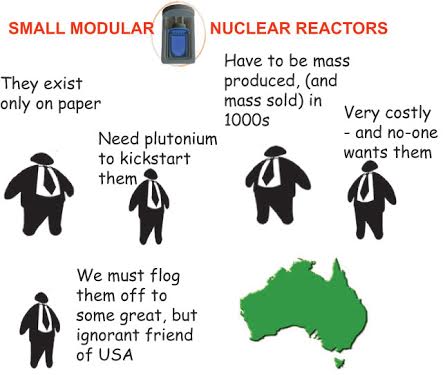
That’s both ambitious and remarkably precise for a technology that does not yet exist, even in prototype form. Continue reading
Renewable Energy Target enabled Musselroe Wind Farm
the jobs and investment in Tasmania would not have been possible without the Renewable Energy Target, which is supporting the development of new clean energy projects right across Australia.
This year sees yet another review of the RET, with initial signals from Prime Minister Abbott being less than encouraging – a situation that is negatively affecting investment in new major renewable energy projects in Australia.
 Tasmania’s Musselroe Wind Farm Opens, Renewable Energy News, 20 Jan 14 Tasmania’s largest wind farm was officially opened on Wednesday by Premier Lara Giddings. The 168-megawatt Musselroe Wind Farm consists of 56 Vestas wind turbines and is joint venture operated by Shenhua Clean Energy and Hydro Tasmania.
According to Hydro Tasmania, the wind farm is generating enough energy to supply the needs of up to 50,000 homes; equivalent to the residential power needs of Burnie and Devonport combined…..Clean Energy Council Chief Executive David Green –
“The $394 million Musselroe Wind Farm has employed Tasmanians in construction jobs since 2011, and the steel towers for the project were manufactured locally in Launceston,” he said. Continue reading
Solar panels – literally our best investment
 Home Solar: Australia’s Best-Performing Investment http://www.energymatters.com.au/index.php?main_page=news_article&article_id=4131 20 January 2013 – National solar provider Energy Matters has released consumer insights that rank each town for solar viability and also reveal the true investment potential of solar power in comparison to shares, property, gold, global fixed interest or even fine art.
The figures will startle many; with it outperforming all other investment options using current ASX figures and other key organisations that rate investment opportunities.
The consumer insights also revealed Townsville in Queensland was Australia’s top address for solar, giving its residents a healthy return of investment of 21.8% per year. Other mainland capital cities included Brisbane (annual return of investment of 20.2%), Adelaide (19.1%), Sydney (18.9%), Perth 17.8%) and Melbourne (13.2%). Continue reading
Award to Australian university team for cost-cutting solar technology
 Bright sparks scoop top award for cutting cost of solar power, The Age, 20 Jan 14 Peter Hannam ENVIRONMENT EDITOR, THE SYDNEY MORNING HERALD AUSTRALIA’S WORLD-LEADING EFFORTS TO DRIVE DOWN THE COST OF SOLAR ENERGY HAVE BEEN RECOGNISED WITH AN AUSTRALIA-BASED RESEARCHER TAKING OUT THE ENGINEERING EQUIVALENT OF THE OSCARS.
Professor Stuart Wenham and his team at the University of NSW won this year’s A. F. Harvey Engineering Research Prize from the Institution of Engineering and Technology, and plan to plough the $560,000 award – one of the world’s richest – back into their work. “The prizemoney is going to be very valuable for us,” Professor Wenham said. “We’re going to use that to expand one of the research areas that actually contributed to winning us the prize.”
As Fairfax Media reported in May, Professor Wenham’s team discovered methods to control hydrogen atoms to correct deficiencies in silicon, the most costly material in solar photovoltaic (PV) cells.
As a result of the new hydrogenation process, lower-quality low-cost silicon can achieve the same performance as typical commercial cells using the expensive high-purity silicon, which now convert about 17-20 per cent of the sun’s energy into electricity.”
1 This month
17 October, Free Public Talk on Nuclear Issues in South Australia
David Noonan will speak on public interest concerns over the new Roxby Downs Indenture Act 2026 on BHP copper-uranium mining and ore processing in SA, and on how AUKUS may face SA with a High-Level nuclear waste agenda.
Dr Jim Green will discuss international developments in the field of nuclear power including ‘small modular reactors’ and Generation 4 ‘advanced’ nuclear reactor concepts.


Help Aunty Sue Protect Her Land and Sacred Sites From Destructive Rocket Testing.
.

Australians deserve the truth
about
AUKUS – https://aukuspublicinquiry.com/

PETITION – To: Prime Minister Anthony Albanese and the Australian Labor Government

of the week – Australians for War Powers Reform (AWPR)
To see nuclear-related stories in greater depth and intensity

