Reducing carbon emissions by Zero Carbon building
Beyond Zero Emissions has estimated that implementing its Zero Carbon Australia Buildings Plan could reduce Australia’s emissions by more than 15 per cent, or 90 megatons of CO2-equivalent.
Casting away carbon, street by street Stephen Bygrave 14 Jan, Climate Spectator, Australia’s homes are among the largest and most inefficient in the developed world. Then we wonder why our household energy bills and carbon emissions are so high.
There are, also, few ways we get feedback regarding our household energy consumption meaning we are mostly ‘driving blind’ when it comes to energy use and emissions from our homes – we get a bill at the end of the month or end of the quarter, far past the time the energy was actually consumed. The lack of instantaneous feedback makes it difficult to correlate our energy consumption to a particular event.
An inefficient home is also uncomfortable, it is draughty, damp, too hot in summer and too cold in winter. Live in North America or Europe and you will know what an energy efficient and low emissions home is like, and the opportunities that exist for energy efficient homes in Australia.
Our homes are a ripe area for direct action, with real benefits for the climate, our comfort levels and for our hip pockets. Continue reading
Geo-engineering for climate action – not popularidea
Climate engineering faces PR problem Anna Salleh ABC 14 Jan 14 The general public have an overall negative image of climate engineering, which includes proposals to use mirrors in space to reduce global warming, a new study has found.
Although some were viewed more positively than others, the study published this week in the journal Nature Climate Change, suggests the public is nervous and unsure about implementing them.
Climate engineering uses technologies to reduce the amount of solar radiation reaching the Earth or directly remove carbon from the atmosphere.
Some of the more ambitious proposals are to reflect sunlight using orbiting mirrors in space, or inject tiny particles known as aerosols into the stratosphere.
Climate engineering also includes carbon dioxide removal technologies such as biochar, a very stable form of charcoal that could be locked away in farmlands.
“It’s quite an extraordinary idea,” says lead author, Professor Malcolm Wright, from Massey University‘s School of Communication, Journalism and Marketing.
In an online survey, Wright and colleagues asked more than 2000 Australians and New Zealanders what they thought about different climate engineering technologies……
Unknown effects
Survey respondents had to associate positive and negative attributes to each of the technologies.
Wright says the associations were overwhelmingly negative, with people concerned primarily with “unknown effects” of climate engineering.
“Around two thirds of associations were negative,” says Wright.
“There was an incredibly striking pattern. While the reaction was negative overall for all techniques, it was much more positive for carbon dioxide removal than it was for solar radiation management.”…….http://www.abc.net.au/science/articles/2014/01/14/3925334.htm
Abbott removing words “climate”, “clean energy”, “cleantech” from the political dialogue

it’s about time the PM accepts that Australia has a “super-abundance” of wind and solar, just as it has of coal and gas. The only difference being is that wind and solar generation will be cheaper – as the government’s own economic advisor suggests – and cause a lot less pollution.
Abbott won’t let facts derail his anti-renewables campaign REneweconomy. By Giles Parkinson on 13 January 2014 Last week it was quietly announced that the Australian Cleantech Competition would hitherto be known as the Australian Technologies Competititon. It was another subtle reminder of how the new Australian conservative government is going about the re-phrasing of Australia’s energy future. Anything that involves the words climate, clean energy, or cleantech are considered projects or institutions -non-grata.
In the public arena, it’s not just a rephrasing that’s taking place, but a concerted attack on renewables. Continue reading
Australia’s Liberal government suppresses information and discussion of ideas
 despite the song and their promise to be a more accountable government, with more honesty and common sense than their Labor predecessors, the Liberals are doing everything they can to suppress discussion of ideas.
Abbott promised a more accountable government for Australians yet his has also become the most inaccessible  and shadowed from scrutiny. Cabinet ministers have to get approval from the Prime Minister’s office before they can speak publicly on ideas and issues. And why is it that Tony Abbott has been one of the most reluctant to publicly debate his ideas in either interviews or formal press conferences?.
Libs stifle debate while touting ‘battle of ideas’, The Age, January 12, 2014 –Amy Gray “…..It is tempting to sideline Bernardi as a “freelancing” backbencher whose “views do not represent the position of the government”, as described in a statement issued by Prime Minister Tony Abbott’s office last week.
But for all his flamboyant vilification of the millions of Australians who apparently bear the scarlet letters of ethnicity, sexual preference, medical autonomy and marital/family status, Bernardi is hardly freelancing when it comes to this strategy.
Seen from such an angle, it would appear Bernardi does represent the position of the government, not only due to his status as an elected senator who received top billing, but also because of the similar views and strategies used by his party teammates. Any disavowal from Abbott’s office appears disingenuous to say the least. The calls for “common sense” and “battle of ideas” and the cries against “the tyranny of political correctness” appear straight out of the Liberal Party hymn book and right now Bernardi is singing up a vulgar storm. Continue reading
“Direct Action” – Greg Hunt’s slush fund for the big polluters
Australian environment minister is totally, shamefully negligent with “direct action” policy Guardian Alexander White 12 Jan 14 The Australian government’s “direct action” policy is like giving money to an illegal drug dealer to stop dealing drugs, then having no penalty if he keeps selling them.

Moderate conservative that he is, Australian environment minister Greg Hunt ran on a platform of “lean” government, where private businesses “are the true creators of wealth”, individuals need to take personal responsibility for their actions, and the former Labor government’s carbon price was a “non-delivery of an invisible substance“. It was a surprise then, to learn last week, that Greg Hunt wants to give $3 billion to big polluting companies to reduce their emissions, but have no sanctions for those businesses if they fail to meet the reduction targets.
This is like giving money to an illegal drug dealer to develop innovative ways for him to stop dealing drugs, then having no penalty if he keeps selling them. Worse, the drug dealer could claim government funding for drugs that he supposedly didn’t sell over his “baseline” of sales, but carry on pushing drugs regardless.
You’d expect that a believer in lean government wouldn’t use billions in tax-payer’s money to create an expensive, totally ineffectual regulatory bureaucracy to auction permits to not emit carbon pollution.
The Australian government’s “direct action” policy will allow companies to bid for grants to implement the most efficient carbon reduction programs. Companies will have a “business as usual” baseline from which they agree to reduce their pollution. Several options are canvassed by Greg Hunt, including having multi-year compliance periods, or the ability for companies to “make good” by buying reduction credits from elsewhere.
In reality, the Emissions Reduction Fund is little more than a slush-fund for the big polluters.
What is surprising is that Greg Hunt seems unaffected by the cognitive dissonance of paying someone to not do something — to not emit a tonne of carbon dioxide — when his principle criticism of the carbon price was that it was a “non-delivery of an invisible substance”.
This policy is shamefully negligent.
Not just because it won’t actually reduce Australia’s carbon emissions and will fall vastly short of the inadequate 5% reduction target.But because you can’t measure what you don’t emit. Instead, you just assume how much you would have emitted and compare it to what you did emit. This is, needless to say, utterly subjective, and open to manipulation. Private companies will be given public funds to magically reduce their carbon pollution emissions, with no consequences if they fail to deliver.
As is so often the case with this government, Greg Hunt and prime minister Tony Abbott have a very flimsy moral case to implement their direct action policy, and the federal election does not qualify as a mandate to abolish the carbon price. Abbott may claim that the 2013 election was a “referendum” on the carbon price, but if so, only around 45.5% of voters supported the abolition by voting for the LNP. This falls to a miserable 37.7% in the Senate.
Implicit in their “direct action” policy is that it is a more effective way to reduce carbon emissions than the carbon price. This is a view that could only be held by someone if they didn’t accept the scientific basis forclimate change.
Considering Tony Abbott’s past statements that climate change is “crap” and that the carbon price was “socialism masquerading as environmentalism”, a common sense reading of the policy is that exists solely because of the climate change denialists in the ranks of the Liberal-National party……… This Liberal-National government is shamefully attempting to fleece everyday Australians out of $3 billion, handed out in grants to big polluters for magical, unmeasurable carbon emission reductions. http://www.theguardian.com/environment/southern-crossroads/2014/jan/12/greg-hunt-negligent-direct-action-climate-change-denialist
Following tank rupture, outlook dim for ERA’s Ranger uranium project
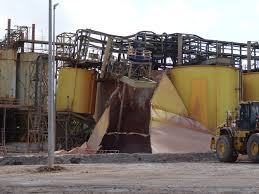 Leach tank failure impacts ERA’s uranium production results, Mining Australia,10 January, 2014 Vicky Validakis Production at ERA’s uranium mine took a 60 per cent hit in the December quarter after a leach tank rupture forced operations to close at the site.
While a slight fall in production was expected after the completion of mining in the high-grade open-cut Ranger pit, matters worsened for the miner when a leach tank at the site’s processing plant ruptured and collapsed, causing an acidic radioactive slurry spill.
The incident forced the shutdown of operations and a massive clean-up at the site, with the Federal Government announcing the mine will not be able to restart production operations without regulatory approval and the go ahead from a joint operation taskforce.
Processing operations remain suspended while clean-up and recovery operations at the Ranger processing plant are ongoing.
In an ASX announcement the Rio Tinto-owned ERA revealed uranium production for the December quarter was 503 tonnes, down 17 per cent on the preceding September quarter and 59 per cent down on the previous corresponding period.
The fall cut annual output by 20 per cent to 2960 tonnes……..approval may be difficult to come by with the Mirrar people previously stating that a number of safety incidents at the site had caused distrust.
In early November a mine left the site’s controlled areas sparking fears of contamination, while later that month four uranium storage barrels were discovered in bushland near Darwin.
“Day by day, litre by litre, incident by incident, they’re losing whatever trust traditional owners have in them,” Mirrar spokesperson Justin O’Brien said. http://www.miningaustralia.com.au/news/leach-tank-failure-impacts-era-s-uranium-productio
Practical problems in Tony Abbott’s climate change policy
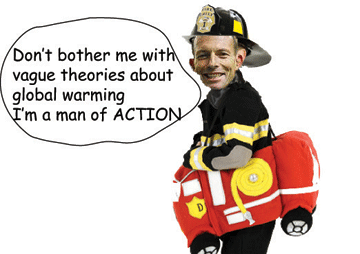
Labor and the Greens are preparing to exploit the confusion with a Senate inquiry into direct action taking submissions until January 20 before it starts public hearings.
Tony Abbott’s climate change policy problematic January 11, 2014 SMH, Tom Arup, Peter Hannam The federal government’s new green paper reveals many practical problems with its policy to combat climate change.
When Australia’s new senators take their place in July they are likely to deliver Prime Minister Tony Abbott what he has promised for four years – the scrapping of the carbon tax.
But despite that looming victory the government is now finding out its other big climate promise – the development of a ”lasting and stable” alternative – may not be as simple as it had first suggested.
That alternative, called direct action, has had a long gestation period with then-opposition environment spokesman Greg Hunt devising its initial outline during the summer of 2009-10…….
Hunt emerged touting a scheme that has since been panned by many economists and environmentalists. Despite the doubters, Hunt is now preparing to implement it.
Direct action has two main elements. Continue reading
In Australia renewable energy now cheaper than fossil fuel
 Renewables cheaper than fossil fuels in Australia BY DAVID TWOMEY · JANUARY 10, 2014 IT MAY COME AS A SHOCK TO SOME BUT EVEN WITHOUT A SUBSIDY THE COST OF RENEWABLE ENERGY IN AUSTRALIA HAS FALLEN TO THE EXTENT THAT IT IS NOW CHEAPER TO PRODUCE THAN CONVENTIONAL FOSSIL FUEL POWER SOURCES.
This has emerged from a study produced by Bloomberg New Energy Finance (BNEF), and shows that even without a carbon price, wind energy is 14 per cent cheaper than new coal and 18 per cent cheaper than new gas.
The BNEF study should certainly provoke a rethink by Australia’s conservative Liberal-National government as it sets about trying to repeal the country’s carbon price laws and possibly change the Renewable Energy Target (RET).
Prices for both renewable energy and fossil fuel-based energy have been changing rapidly in Australia Continue reading
Government divided on whether to kill Renewable Energy Target or just mortally weaken it
The renewable energy industry has said preservation of the RET was crucial for the future of billions of dollars’ worth of investment in large-scale renewable energy projects.
The Clean Energy Council said the RET was encouraging households to invest in renewable and efficient energy.
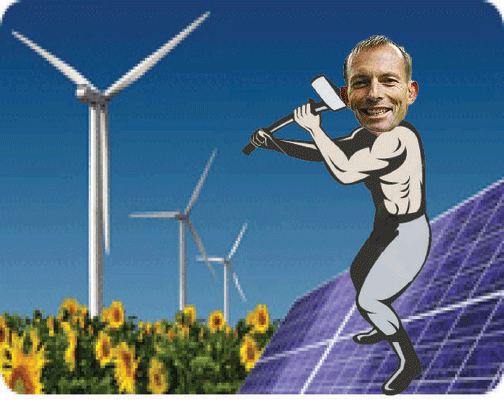 Cabinet rift on RET: Hunt firm amid scrapping calls GRAHAM LLOYD THE AUSTRALIAN JANUARY 11, 2014 THE federal government is badly split on what to do about the mandatory renewable energy target, which has been blamed for rising electricity prices and making manufacturing Australian uncompetitive.
The terms of reference are being finalised for a review, which was expected to look at whether the RET should be reduced in line with falling demand for power……..
Mr Hunt said the review would be completed well before the end of the year.
The RET forces large power users and retailers to source a fixed amount of their energy demand from renewable sources.
Nationals senator Ron Boswell is pushing to have it scrapped…….. Continue reading
Uranium company ERA’s “horror year” continues
 Production slump caps a horror year for ERA BARRY FITZGERALD THE AUSTRALIAN JANUARY 10, 2014 RIO Tinto’s listed uranium subsidiary Energy Resources of Australia (ERA) has finished off a horror year by reporting a near 60 per cent slump in December quarter production from its Ranger mine in the Northern Territory.
A severe production fall was expected because of the absence of high-grade material following the cessation of mining operations in the open-cut at Ranger. But things got worse on December 7 when a leach tank at the processing operations collapsed, forcing a shutdown for clean-up and a wait for regulatory approval to restart processing operations. … (registered readers only) HTTP://WWW.THEAUSTRALIAN.COM.AU/BUSINESS/MINING-ENERGY/PRODUCTION-SLUMP-CAPS-A-HORROR-YEAR-FOR-ERA/STORY-E6FRG9DF-1226798542510#
Australian renewable energy technology: sales to Japan?
 Renewable energy in Japan: opportunities for Australian businesses Ecogeneration , 10 January 2014 In an exclusive excerpt from the February 2014 edition ofEcoGeneration, Austrade Trade Commissioner in Sapporo Ian Brazier explains how the Japan’s feed-in tariff scheme has made solar PV their fastest growing energy sector, creating new opportunities for Australian technology, equipment and service providers.
……To diversify its energy mix, the Japanese government is moving towards bolstering renewable energy usage. In order to increase supply, a generous feed-in tariff (FiT) regime for renewable energy was introduced in July 2012.
To date, most announced projects that have come as a result of the FiT rely on solar photovoltaic (PV) generation and are based in northern Japan…..
What has been the big impact from feed-in tariffs?
The FiT regime has triggered a 4,086 megawatt (MW) increase in total deployed renewable energy project capacity from July 2012 to July 2013 (latest available figures). Of this total capacity, 3,916 MW comes from solar PV power generation.
The dominance of solar PV generation is likely to continue. Japanese government policy is that FiT will remain in place for at least three years and this will ensure continued solid growth…….
Residential solar is the second biggest growth area in renewables and is an area where Australia has commercial advantage that is of interest to Japan. Under the current FiT regime, each owner may sell only surplus electricity, with the duration of purchase agreements limited to ten years. 646375.png…….
Some large Japanese firms with expertise in large lenses and mirrors and speciality construction are looking to expand into CSP projects overseas, including in Australia. This presents possible inward investment opportunities for Australia in attracting Japanese direct investment.
New trends are also emerging in wind
There are a number of wind projects being progressed due to introduction of the FiT….. http://ecogeneration.com.au/news/renewable_energy_in_japanopportunities_for_australian_businesses/084932/
It is time for a TREATY with Aboriginal people
 It is time for a Treaty.
Aborigines have never ceded sovereignty to the colonial invaders. There must be a treaty recognising prior ownership and all the legal, social and financial responsibilities that flow from that.
None of this will be won by petitions, or electing Aboriginal people to Parliament, or relying on Labor.
En Passant. John Passant 10 Jan 14 If Wikileaks and Edward Snowden teach us anything it is that our leaders lie. And lie. And lie.
Australia Day is no different. It is Invasion Day but we will never hear that truth. Bourgeois clichés about the lucky country (what irony!) and our great nation compete with bullshit about our brave soldiers overseas and how we all in this together.
It’s time for some truth about our genocidal and racist history. As George Orwell said telling the truth is a revolutionary act.
Australia has a black history.
For 65000 years Aboriginal people lived here in harmony with themselves and the environment. Australia Day does not recognise that proud history and prior stewardship. It whitewashes this history by celebrating the arrival of a bunch of neocolonialists and their convicts and guards a mere 225 years ago. Continue reading
Abbott commissions unnecessary research on wind energy and health
 Abbott’s fear mongering on wind farms is dangerous and reckless: Greens http://richard-di-natale.greensmps.org.au/content/media-releases/abbott%E2%80%99s-fear-mongering-wind-farms-dangerous-and-reckless-greens 08 Jan 2014 | Richard Di Natale
“This is another cynical attack on renewable energy that will create more fear and anxiety in the community” said Senator Di Natale.
“After trying to dismantle the carbon price, axe the Clean Energy Finance Corporation and attacking the Renewable Energy Target, it’s no surprise that the anti-science Abbott Government has latched onto the discredited anti-wind campaign.
“It is the Prime Ministers actions, not the wind industry’s that will put people’s health at risk. His fear mongering is reckless, dangerous and irresponsible. The truth is that there has already been extensive research into this issue and no credible health body or medical journal in the world supports the idea of wind turbine syndrome.
“There is significant research to indicate that misinformation about wind farms can make people sick. Much like a placebo can lead to genuine health benefits, false claims that something is harmful can lead to real harms.
“By commissioning further unnecessary research, the Abbott Government is simply sending a signal that there could be something to worry about. Every dollar the NHMRC spends on politically-motivated research is a dollar not spent on cancer or diabetes research.
“If the Abbott Government is truly concerned with the health impacts of power generation, a Senate Inquiry found earlier this year that the mining, transportation and combustion of coal contributes to poor air quality which has a greater impact than the road toll. It’s time the Prime Minister got on with implementing those recommendations rather than pursuing his reckless and dangerous campaign against clean energy.”
Australia has 2 million small scale renewable energy systems
Australia reaches nearly two million small scale solar systems http://reneweconomy.com.au/2014/australia-reaches-nearly-two-million-small-scale-solar-systems-66389 By Giles Parkinson on 9 January 2014 Clean Energy Regulator says Australia now has 2 million small scale renewable energy systems – enough to power Perth, Hobart, Darwin and Canberra.
Australia has now installed more than 2 million small scale renewable energy systems – reaching the target just eight months after the country achieved its first one million rooftop solar systems.
The announcement came from the Clean Energy Regulator, which manages Australia’s renewable energy target. The total is made up of 1.83 million small scale solar systems (both rooftop PV and solar hot water, and 173,000 air source heat pumps – see graph below).
The CER said the data underlines the fact that investment in small-scale renewable energy continues to flourish in Australia. Nearly all subsidies have been removed for small scale installations, although rooftop solar and other systems still benefit from renewable energy certificates. Continue reading
Treaty with Aborigines needed – Pilger’s new film “Utopia”
 John Pilger’s damning new film about indigenous Australia SMH, Julian Drape, December 31, 2013 “……London-based Pilger returns to outback Australia for this documentary film to find little has changed since his 1985 work The Secret Country.The Utopia of the title refers to the Northern Territory region north of Alice Springs…….
Pilger, 74, sees a treaty and genuine land rights as the key to improving the position of the original owners of Australia. Anything less, including the current talk of constitutional recognition, is simply a “distraction”, he says.
The film opened in the United Kingdom in mid-November and screens in Sydney on January 17. Subsequent limited dates include Melbourne, Brisbane, Perth and Alice Springs. Pilger would have been delighted to show Utopia in Australia first but no local distributor offered a cinema run.
“One Australian distributor refused to take the film because he said it was ‘too dark’ and ‘it might upset people with its myth-busting’,” the veteran journalist says.The film was commissioned by ITV in Britain and funded entirely in the UK…..
Pilger doesn’t apologise for taking such an uncompromising view.”Unlike the US, Canada and New Zealand, no treaty was ever negotiated between the lawful owners of Australia and those who took their land,” he says. “International law is clear – there has to be a treaty.
“If the Australian political establishment believes it can continue to look the other way and deny the first Australians their basic rights they are seriously mistaken.”……
Pilger reminds the viewer that Bob Hawke in the 1980s walked away from genuine land rights in the face of a racist scare campaign from the mining industry. He draws parallels with Julia Gillard’s decision to fold on Labor’s mining tax in 2010.
“The revenue lost is estimated at $60 billion,” the director says in the film. “Enough to fund land rights and to end Aboriginal poverty.”……
Child abuse is one of the rationales for taking children away, yet the NT has one of the lowest rates of reported child abuse in Australia, Pilger says. He argues Australians shouldn’t still need educating about the plight of indigenous Australia, but if they do he hopes Utopia helps.
“Utopia tells them the truth,” he says. “If people choose to ignore the research and evidence in this film then their prejudice is unshakeable.”….. Utopia is on limited released in Australia from January 17. Details at utopiajohnpilger.co.uk http://www.smh.com.au/entertainment/movies/john-pilgers-damning-new-film-about-indigenous-australia-20131231-303tf.html#ixzz2povi3A9Z
1 This month
17 October, Free Public Talk on Nuclear Issues in South Australia
David Noonan will speak on public interest concerns over the new Roxby Downs Indenture Act 2026 on BHP copper-uranium mining and ore processing in SA, and on how AUKUS may face SA with a High-Level nuclear waste agenda.
Dr Jim Green will discuss international developments in the field of nuclear power including ‘small modular reactors’ and Generation 4 ‘advanced’ nuclear reactor concepts.


Help Aunty Sue Protect Her Land and Sacred Sites From Destructive Rocket Testing.
.

Australians deserve the truth
about
AUKUS – https://aukuspublicinquiry.com/

PETITION – To: Prime Minister Anthony Albanese and the Australian Labor Government

of the week – Australians for War Powers Reform (AWPR)
To see nuclear-related stories in greater depth and intensity

