Australia’s coal and gas profit at the cost of climate change

Fossil-fuel demand is being stoked by massive subsidies, particularly in the Middle East, with the global total rising $US20 billion ($21.4 billion) in 2012 to $US544 billion. That total will rise to about $US600 billion a year by 2020, Dr Birol said.
By contrast, subsidies for renewable energy rose about $US10 billion in 2012 to $US101 billion, and will reach about $US220 billion by 2035, the agency forecasts. Despite continuing to lag in support at roughly a five-to-one ratio with fossil fuels, renewable energy will account for almost half the increase in power generation to 2035, Dr Birol said.
Climate change: Golden energy age for Australia will cost the world dearly , November 13, 2013 Peter Hannam Environment Editor, The Sydney Morning Herald Surging energy demand in Asia will deliver ”a golden age” for the Australian economy but also set the world on a path of dangerous climate change as fossil fuel-sourced emissions soar, according to the International Energy Agency. Continue reading
Australia’s racial discrimination against Aborigines
 Aboriginal affairs: why Australia is allowing racial discrimination, Scan, 12 Nov 12, Annie Underwood asks why we are simply standing by while Australia enforces discriminatory policies against their native people. In a country where the majority will not accept any form of racial discrimination, how can we justify simply standing by and doing nothing whilst one of our greatest allies, Australia, enforces hugely discriminatory policies against their native people – Aboriginal and Torres Strait Islanders?……..
the Native Title Act of 1993, which facilitates the granting of native title (i.e. right to historically held land) to indigenous communities, is seen as a step towards equality. However, the Native Title Act clearly states that when the native title rights and rights of a non-indigenous person conflict, the rights of the non-indigenous person always prevail, despite indigenous people being the ‘First Peoples’. Such a ruling breaches international human rights, as the “promotion of the interests of the many can never justify violating the human rights of the few”.
Again and again the same thing can be seen within Australian politics. Self determination is a UN defined basic human right for people to be able to freely define who they are “without external compulsion or interference”. Yet the Liberal Australian government under John Howard in 2005 abolished ATSIC (the Aboriginal and Torres Strait Islander Commission) – a purpose-built democratic institution for indigenous self-determination – on the grounds that it was causing racial segregation. ATSIC was the primary means by which indigenous Australians participated in the political and decision-making system, and the subsequent mainstreaming of indigenous services into the government were seen by many as an attempt to inhibit indigenous self-determination, and limit indigenous people’s freedom to govern themselves. As noted Aboriginal anthropologist Jon Altman stated: “It is ironic that at a time when Australia engages in high risk projects to install democracy abroad, its national government is seeking to eliminate a purpose-designed democratic institution at home.”………http://scan.lusu.co.uk/comment/aboriginal-affairs-why-australia-is-allowing-racial-discrimination/
As USA’s nuclear plants bite the dust, so do Australian uranium mines?
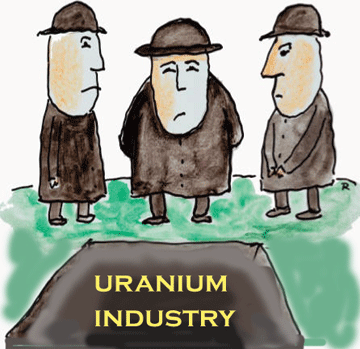 South Australian uranium Honeymoon mine to stop production, jobs in doubt NEWS.COM.AU NOVEMBER 11, 2013 THE Honeymoon uranium mine in South Australia’s far northeast is expected to be mothballed. Low uranium prices and production difficulties at the plant have put pressure on the mine. The future of about 70 employees was not immediately known but far fewer employees would be needed when the mine is put under “care and maintenance”.
Honeymoon, which began producing uranium in 2011 , became wholly owned by Russian state company JSC Atomredmetzoloto in mid-October.
Previously it had been 49 per cent owned-and-operated by Canada’s Uranium One……..
Honeymoon is about 500km north by road from Adelaide, 80kms northwest of Broken Hill.It uses an in-situ leach method – where liquids are pumped underground to dissolve the uranium with the mineral extracted from the pregnant solution at the surface. SA is Australia’s leading uranium producer with Olympic Dam and Beverley in operation. Ranger in the NT is the only other mine. The Four Mile mine – near Beverley – has been approved but is yet to be built….. http://www.news.com.au/national/south-australia/south-australian-uranium-honeymoon-mine-to-stop-production-jobs-in-doubt/story-fnii5yv4-1226757697638
Exploration company Thundelarra reduces costs, sell uranium assets
 Thundelarra sells non-core Hayes Creek uranium asset November 11, 2013 byProactive Investors Thundelarra (ASX:THX) will sell its Hayes Creek uranium assets for a total value of $1.5 million, while neatly retaining an exposure to any future exploration success from the Northern Territory project…….The sale is part of a new “look” Thundelarra that has rationalised non core projects, taken costs from the system and is focusing on core copper, base metal and gold exploration..
…the deal removes the rent, rates and exploration commitment overheads that accompany the Hayes Creek interests…..Today’s deal further illustrates the new broom through Thundelarra, disposing of non-core assets, while focusing on core projects. http://www.proactiveinvestors.com.au/companies/news/50073/thundelarra-sells-non-core-hayes-creek-uranium-asset-50073.html
Uranium industry wants special royalty discounts from Queensland government, despite its existing burdens on taxpayerite
 Royalty discounts for uranium disputed http://www.northweststar.com.au/story/1901524/royalty-discounts-for-uranium-disputed/?cs=191 Nov. 11, 2013, URANIUM projects should receive royalty discounts, according to Queensland Resources Council chief executive Michael Roche. `Royalty relief should be something that’s offered not just in the Galilee Basin but around Queensland, and I mean it for coal and I mean it for minerals,” Mr Roche told ABC radio. “The concept has already been raised in relation to proposed uranium projects, for example.”
“The QRC are irresponsibly pitching to reap in larger uranium profits by paying less royalties at the expense of Queensland taxpayers if they are responsible economic managers.”
Mr Bailey called on the Newman government to reinstate the ban on uranium mining, saying it was an ongoing liability on the public purse. `The Newman government has no mandate from the people of Queensland to allow uranium mining as they explicitly ruled it out before the election,” he said.
Australian Conservation Foundation nuclear-free campaigner Dave Sweeney said the uranium sector was a minor contributor to employment and the economy, was a major source of domestic and international risks and was overdue for an independent inquiry into its effects on the environment, health, safety and security.
“Instead of backroom deals to facilitate an underperforming and contested industry, the LNP government should honour its responsibilities to the community and the environment by commissioning an independent public inquiry into the full costs and consequences of any uranium mining in Queensland,” Mr Sweeney said.
Australia’s Prime Minister Tony Abbott repeats misconceptions about renewable energy
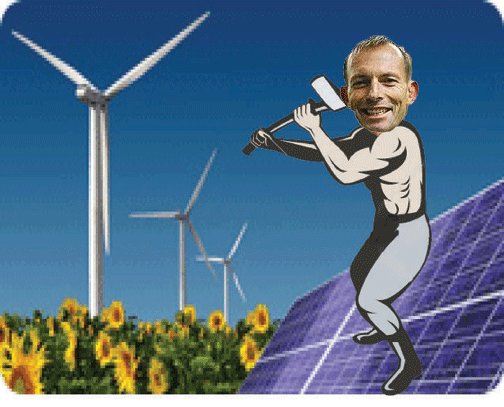 Pollie Watch: PM Abbott’s first comments on wind farms, Yes 2 Renewables November 12, 2013 by Leigh Ewbank Renewable Energy Target Tony Abbott has made his first comments on wind energy and the Renewable Energy Target as Prime Minister…….The Prime Minister cites two common misperceptions about renewables energy: Firstly, that renewables aren’t up for the job of powering the Australian economy because they’re intermittent. And secondly, that the Renewable Energy Target makes up a significant portion of electricity bills.
Let’s break down these misconceptions for the Prime Minister to assist his government’s energy policy making.
Misconception #1: Australia needs backup for when the wind doesn’t blow and the sun doesn’t shine.
Reality: It is technically feasible for Australia to meet it’s electricity needs from renewable energy alone.
According to the energy experts, shifting to 100 percent renewable energy is both technically viable and affordable. Studies by the think tank Beyond Zero Emissions (PDF), and follow up studies from the Australian Energy Market Operator (PDF) and University of New South Wales (PDF) confirm the technical feasibility of renewable energy. In terms of cost, the 100 percent renewable energy system is cheaper the fossil fuel based business-as-usual approach.
Modelling is one thing, what about real world applications?
South Australia is leading the nation with it’s renewable energy rollout. The state now meets 31 percent of it’s electricity demand from renewable energy sources. Wind farms are doing the heavy lifting, providing 27 percent, while the rapidly growing rooftop solar contributes 4 percent. South Australia is expected to reach 50 percent renewables in a decade.
Misconception #2: Renewable energy is a significant part of power bills, driving up costs.
Reality: John Howard’s Renewable Energy Target makes up a small portion of Australian power bills. The rollout of renewable energy is making power bills cheaper.
Data from the Australian Energy Market Commission (PDF) shows the RET accounts for less than one percent of the average household electricity bill – or a mere $35 from a $2000 bill. That’s around $0.70 each week over a year. It is transmission, distribution, and wholesale electricity prices which are the largest contributors to power bills.
Renewable energy is putting downward pressure on power bills. Energy analysts agree wind farms are causing South Australia’s wholesale electricity prices to drop. This trend resulted in the SA Essential Services Commission directing energy companies to cut retail prices cut by 8.1 percent. The move will lower the average power bill by $160 a year.
So, what are Australians getting for their $35 investment in renewable energy? Cheaper bills, less pollution, and action on climate change. Most Australians would agree that’s a win, win…….
Retired Liberal Senator for Tasmania, Peter Rae shows you can be a proud Liberal and a strong supporter of renewable energy. Mr Rae believes the Liberal party has a tradition to uphold when it comes to supporting renewable energy.
Mr Rae was vice president of the World Wind Energy Association (now honorary VP) and is Vice Chairman of the International Renewable Energy Alliance, REN21. With impeccable renewable energy credentials, Mr Rae knows what he’s talking about. Perhaps the PM will draw on the expertise of Peter Rae when undertaking a review of the Renewable Energy Target next year.http://yes2renewables.org/2013/11/12/pollie-watch-pm-abbotts-first-comments-on-wind-farms-renewable-energy-target/
By 2015 Australia’s gas prices to triple
 Gas Prices Could Triple (Or More) In 2015 http://www.energymatters.com.au/index.php?main_page=news_article&article_id=4018 11 Nov 13, According to AGL’s CEO, east coast gas prices could skyrocket soon. The situation will occur as a result of the effects of LNG plants being constructed at Gladstone. An article on The Australian says when these plants start up in 2015; spot gas price spikes are likely to be exacerbated by demand for Australian gas from Asia.
“For industrial and commercial gas users, I have no doubt there will be demand destruction,” said Mr. Fraser.
“You start with baseload gas power generation, that is the first load that will get knocked off because it doesn’t work without a price on carbon, those gas prices.”
The situation will also impact households; but Mr. Fraser claims average per-household annual increases are likely to be less than $100.
However, with households being pummelled by energy price rises in recent years and the much vaunted carbon tax repeal perhaps unlikely to deliver the savingspromised; any further increases in energy bills could be the proverbial straw.
Earlier this year, Matthew Wright, Executive Director of Zero Emissions said common major gas appliances already have an electric competitor that beats them on price and performance; including induction cooktops, heat pump hot water units and reverse cycle heat pump air-conditioners. In July, Mr. Wright also forewarned the push to develop more gas fields in Australia had little to do with securing domestic supplies and lowering prices and more to do with export profits.
“Do not be fooled by the fossil gas miners – they’re not here to give Australia a competitive advantage, only renewable electricity generators can do that as there is no way to export renewable electricity,” he said.
Financial costs aside, the other impact of Asia’s thirst for Australia’s gas reserves is the cost to the environment from the rush to dot the landscape with coal seam gas wells.
British takeover, and their goal of genocide – true history of Aboriginal Australia
Thus there were no treaties concluded with Aboriginal group and no arrangements were made with them to acquire their land, or to regulate dealings between them and the colonists.
Some notable colonial legislation that targeted Aboriginal peoples included:
· 1816 Martial Law (NSW). This proclamation declared Martial Law against Indigenous Australians who could then be shot on sight if armed with spears, or even unarmed, if they were within a certain distance of houses or settlements
· 1824 (Tasmania). Settlers are authorised to shoot Aboriginal peoples
· 1840 (NSW). Indigenous Australians forbidden to use firearms without the permission of a Justice of the Peace
· 1869 (Victoria). The Board for the Protection of Aborigines is established. The Governor can order the removal of any child to a reformatory or industrial school
· 1890 (NSW). In a denial of human rights the Aborigines Protection Board could forcibly take children off reserves and “resocialise” them………
Despite the veil of FIRST WORLD superiority we need to remind all First World nations that they are what they are because of the stolen riches of the countries they have turned into THIRD WORLD and continue to keep them as Third World nations by controlling world trade, the international laws, international rights and justice mechanism and the international media
 Britain’s Mass Murder of Indigenous Australians (Aborigines), Lanka Web November 9th, 2013 Shenali D Waduge To those that do not know of Britain’s colonial crimes in their eyes Britain is the epitome of justice, equality, the nation that rears gentlemen of breed and holds the seat of democracy. To those that are aware of British mass murder as ordered by British Governments, the scale of cataloguing these crimes becomes a task in itself and should nullify all claims of any gentlemanly behavior.
The invasion and decimation of Aboriginal Australia was and is entirely a British affair. When Britain devastates a 65,000 year old culture in just 200 years and carries out unthinkable crimes to take over land and exterminate the indigenous population how do we term Britain other than a mass murderer? The Aboriginal experience is depressingly similar to that of Native Americans in the United States. European settlers viciously drove the Aborigines from their land, massacring thousands with impunity. Why does the world remain silent and ignorant of these crimes against humanity?
When the British arrived in Australia in 1788, Australia was NEVER a white country. It was occupied for over 65,000 years by indigenous black Australians later called ‘Aborigines’ by the British. How did these black Aborigines suddenly disappear? British colonial terrorism is the answer. How would the English, such respectable and gentlemanly people get rid of possibly close to 1million indigenous people and take over their lands after their arrival in 1788? How did the Aborigines become less than 100,000 by 1901? The very respectable English settlers cut their food resources and began genocidal massacres and David Cameron speaks to the world on HUMAN RIGHTS! Aborigines did not invade nations or take over lands – the British did and moreover these Aborigines were not warlike people – their culture and livelihood never left room for dissent of the kind that warranted defense. Continue reading
Australia snubs United Nations on climate change
 Abbott puts Australia out of the Hunt on climate change Independent Australia, 8 November 2013, Coalition has signalled its commitment to climate change action by deciding not to send a minister to high level UN talks on the issue for the first time since 1997. Matt McDonald from The Conversation comments.
THIS WEEK, the Australian Government announced that it would not send a minister to the UN Framework Convention on Climate Change (UNFCCC) negotiations in Poland for the first time since 1997. This announcement came on the back of a cancelled stakeholder meeting on Wednesday, traditionally held in advance of UNFCCC Conference of the Parties (CoP) meetings……..
the climate conference snub is one with troubling implications for climate politics and Australian foreign policy generally. Post-election we’ve seen an assault on climate policy, and lingering suspicion over whether Abbott has genuinely put his denialist tendencies behind him. These negotiations provide an opportunity for the government to signal a commitment to action on climate change, both domestically and internationally.
Australia should be sending the message that it is an engaged and proactive member of the international community, concerned with helping to forge global solutions to global problems. Continue reading
International disappointment at Australia not sending Minister to climate change talks
The UK’s former top climate diplomat at the foreign office, John Ashton, told the Guardian that the decision by Australia was puzzling.
If people draw the conclusion that that this is a country that would rather stick to a business a usual approach rather than building a low-carbon growth model compatible with [temperature rises of] 2C, no one should be surprised.”
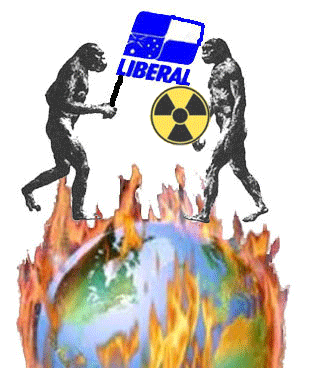 Former UN climate chief: ‘Australia should send minister to Warsaw talks’ Adam Vaughan theguardian.com, Friday 8 November 2013 Yvo de Boer stresses importance of COP19 climate change talks as it emerges Australia’s environment minister will not attend Australia should be sending a minister to international climate negotiations starting next week, the UN’s former climate chief has told the Guardian following the revelation that the Abbott administration will not be sending its environment minister to the talks.
The remarks by Yvo de Boer, who stood down as executive secretary of the UN Framework Convention on Climate Change standing down in 2010 to take up a position at KPMG, come as the UK’s former top climate diplomat called the move by Australia “puzzling.”
Justin Lee, a diplomat and Australia’s ambassador for climate change, will instead represent Australia, marking the first time the country has not sent a government minister in 16 years. The UK is sending energy and climate secretary, Ed Davey, and more than 50 officials from government. Continue reading
Doubts raised on the safety of Ranger uranium mine
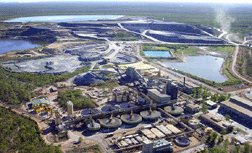 ACF questions Ranger uranium mine safety http://news.ninemsn.com.au/national/2013/11/08/16/49/acf-questions-ranger-uranium-mine-safety 8 Nov 13 It would be a case of good luck rather than good management, if it turns out there is no radiation contamination due to an an unauthorised vehicle leaving the Ranger uranium site in Kakadu, an environment group says. At about midnight on Sunday, a controlled vehicle used in the most contaminated parts of the Rio Tinto-owned Ranger mine left the site without permission. Continue reading
Hotter weather could turn people against Abbott’s climate change policies
The polling suggest that from a carbon tax-inspired nadir last year, concern about climate change is creeping up……..two separate studies of polling show that people are more likely to be concerned about climate change if they have directly experienced hot, dry weather.
Abbott’s climate change Achilles heel: the weather November 9, 2013 The Age, Tom Allard National Affairs Editor Hotter days could bring with them a potent political wildcard.”……….Neither Foreign Affairs Minister Julie Bishop nor Environment Minister Greg Hunt will now be attending global talks in Warsaw on how to reduce global greenhouse emissions. Not even a parliamentary secretary will represent.
Off grid solar energy an economic benefit to mining companies
Of the 400 operating mine sites in Australia, 170 are either off-grid or connected to a smaller distribution network and needing to supply their own electricity. Natural gas and diesel dominate as fuel supplies for electricity generation and other energy uses. Rising prices of both of these fuels are leading mining companies to consider alternatives.
In South Africa, reliability of electricity supply has been a major issue for the mining sector, with electricity shortages in 2008 severely impacting operations and financial performance at a number of mine sites. The South African Government is addressing electricity supply issues through a renewable energy procurement programme….
Renewable energy, and in particular solar photovoltaic (PV), can offer significant benefits to mining companies. The unit cost of energy from solar PV is now below $US200/MWh in many locations compared to typical diesel generation costs of around $US300/MWh. This provides an opportunity for mining companies to reduce energy costs by reducing diesel consumption and maintenance costs with solar generation, particularly at sites with high day-time loads. The diesel engines are retained for night-time generation and as backup to the solar panels. Their operating life is also extended through lower annual operating hours.
Mining operations are strongly influenced by international commodity prices and operational focus can change rapidly in response to market signals. Diesel generators support this flexibility through their modularity and ability to be relocated to other sites if required. Solar modules also offer a degree of flexibility. With simple foundation systems and electrical reticulation, solar installations can theoretically be redeployed to other sites if mining operations need to close down. Recent trends in lease financing of solar modules provide further alignment with mining operations.
As panel prices continue to decrease and panel efficiency continues to increase, expect to see greater focus on renewable energy as a strategic consideration for mining operations. http://sourceable.net/grid-renewables-mining-energy-price-certainty/
Western Australia’s biggest national park faces uranium threat
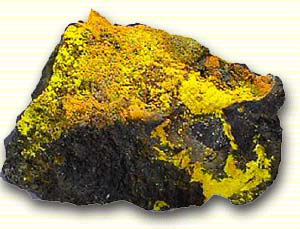 WA’s biggest national park faces uranium threat National and state environment groups have vowed to fight plans for a uranium mine that would directly threaten Western Australia’s largest national park. The Australian Conservation Foundation and the Conservation Council of WA will join groups across the nation to challenge plans by the Canadian multinational Cameco, which today lodged an Environmental Review Management Plan for the Kintyre uranium mine at Karlamilyi National Park (Rudall River) with the WA Environment Protection Agency.
“Kintyre is in one of the most unique and diverse ecosystems in the country and is directly connected to WA’s largest national park,” said ACF campaigner Dave Sweeney. “The proposal to mine at Kintyre has been actively contested since the 1980s and will continue to be a priority issue for the environment movement given the high conservation values of the area and the unique risks of uranium mining.
“Many things have changed since the first proposal to mine Kintyre, including a severe and sustained slump in the uranium price and increased pressure on nuclear power from the growth in renewable energy and concerns fuelled by the continuing Fukushima crisis.“This is not the time – and certainly not the place – to give a green light to yellowcake.”
The Kintyre uranium deposit is nestled between two branches of Yanadagodge Creek which feeds springs and lake systems throughout the Karlamilyi National Park and the communities of Punmu and Parngurr. Radioactive contamination of water sources is already an issue in the area with elevated uranium levels found in Parngurr’s (Cotton Creek) drinking water.
“We will use every available avenue to challenge this dangerous proposal,” said CCWA campaigner Mia Pepper. “Cameco’s plan for a 1km wide, 1.5km long open pit only 500 metres from the Yanadagodge Creek could have devastating impacts on this fragile desert ecosystem.”
“Uranium poses unacceptable and unnecessary risks to the environment and public health. Cameco’s plan is a long way from being economically viable or environmentally approved.”
Cameco’s plan will be open for public comment for fourteen weeks.
Contact: Dave Sweeney 0408 317 812 or Mia Pepper 0415 380 808
Safety slip up at ERA’s Ranger uranium mine disturbs Aboriginal landowners
Uranium contamination fears: police investigate Rio Tinto Ranger mine SMH, November 8, 2013 Peter Ker Resources reporter Rio Tinto’s relationship with an indigenous group in Kakadu National Park has taken ”two steps backward” after a safety breach at the Ranger uranium mine.
The Rio subsidiary that operates Ranger, Energy Resources of Australia, has confirmed that a vehicle used within the mine was taken out of controlled areas, sparking contamination fears among the nearby Mirrar people. Police are investigating the incident, which took place without the consent of ERA management in the early hours of Sunday morning, and which some believe may be a breach of the company’s authorisation to mine.
Like all uranium mines, Ranger operates under strict conditions to ensure dangerous levels of uranium do not contaminate the nearby area. ERA said the car – which was supposed to remain inside the mine at all times – had been checked and was ”free of contamination”.
But Justin O’Brien, who represents the Mirrar people, said it had caused great concern among the local community.
”We think it is very serious that you could take potentially contaminated material from an operational mine site, avoid all scrutiny, leave the mine site with it and then be found down the highway,” he said. ”There needs to be a broader inquiry into how on earth this could happen in the first place.”
ERA’s relationship with the Mirrar people is crucial to its survival, given the company has agreed not to restart mining at Ranger without approval from the group. Ranger ceased operating as an open-cut mine last year, and its only future lies in winning approval to become an underground mine in coming years.
The nearby Jabiluka uranium deposit will also not be mined until the Mirrar people give their full support, something that appears unlikely any time soon………Australian Conservation Foundation spokesman Dave Sweeney said it was not the first breach at Ranger, and it was time for Rio Tinto to ”reconsider the project”. http://www.smh.com.au/business/uranium-contamination-fears-police-investigate-rio-tinto-ranger-mine-20131107-2x46w.html#ixzz2k5tWwFN7
1 This month
17 October, Free Public Talk on Nuclear Issues in South Australia
David Noonan will speak on public interest concerns over the new Roxby Downs Indenture Act 2026 on BHP copper-uranium mining and ore processing in SA, and on how AUKUS may face SA with a High-Level nuclear waste agenda.
Dr Jim Green will discuss international developments in the field of nuclear power including ‘small modular reactors’ and Generation 4 ‘advanced’ nuclear reactor concepts.


Help Aunty Sue Protect Her Land and Sacred Sites From Destructive Rocket Testing.
.

Australians deserve the truth
about
AUKUS – https://aukuspublicinquiry.com/

PETITION – To: Prime Minister Anthony Albanese and the Australian Labor Government

of the week – Australians for War Powers Reform (AWPR)
To see nuclear-related stories in greater depth and intensity

