Queensland University gets a second, and even larger, solar array
 Queensland’s Largest Solar Panel Array Announced http://www.energymatters.com.au/index.php?main_page=news_article&article_id=3998 27 Oct 13, Queensland University will soon be home to the largest solar power system in the state.
Announced last week, the 3.275 megawatt pilot plant will incorporate more than 34,000 ground mounted solar panels. The solar farm will be constructed on a 12.6 hectare former airstrip site at the University’s Gatton campus, which is situated 90km west of Brisbane.
Doubling as a research facility, the Gatton plant will augment the University’s existing St Lucia campus 1.22 megawatt photovoltaic array; which is currently Australia’s largest rooftop solar installation. Continue reading
Australia’s Prime Minister Abbott says climate-bushfire link is ‘complete hogwash’
 Climate and fires link ‘hogwash’: PM HERALD SUN AAP OCTOBER 25, 2013 PRIME Minister Tony Abbott has described attempts to link the NSW bushfires with climate change as “complete hogwash”, as Australian scientists warn there is a clear connection between global warming and the probability of extreme fire days……
Mr Abbott ramped up the rhetoric on Friday, dismissing suggestions that climate change was behind the bushfire crisis.
“That is complete hogwash,” he told News Limited.
“I suppose, you might say, that they are desperate to find anything that they think might pass as ammunition for their cause.”
He said it was “bizarre” people were drawing parallels between the two, given there had been worse fires in Australian history, stretching back to the earliest days of European settlement. Mr Abbott said the longer the period of time, the greater the likelihood of extreme weather events, and broken records didn’t prove anything about climate change.
The prime minister earlier this week accused UN climate chief Christiana Figueres of “talking through her hat” by suggesting the fires were the result of global warming….
Greens leader Christine Milne said Mr Abbott was continuing to make a laughing stock of Australia on the world stage by ignoring the climate science. “It would be laughable if it were not so serious,” she said in a statement. Opposition leader Bill Shorten said he believed climate change was fundamentally linked to human activity, but didn’t want to speculate on the fires while people’s homes were still on the line. http://www.heraldsun.com.au/news/breaking-news/climate-and-fires-link-hogwash-pm/story-fni0xqi4-1226746632119
VIDEO: Prime Minister Abbott sitting on a barbed wire fence, about climate change
PM a climate fence sitter? (11:06) http://media.theage.com.au/news/national-times/pm-a-climate-fence-sitter-4855111.html
Climate Institute chief John Connor sees Prime Minister Abbott as straddling a global warming ‘barbed wire fence’, after the PM dismissed claims of a link between bushfires and climate change.
AUDIO: Marshall Islands angry at Tony Abbott’s dismissal of climate change-bushfire link
 AUDIO: Marshall Islands angered by Australian PM Tony Abbott’s dismissal of climate change link to bushfires http://www.abc.net.au/news/2013-10-25/an-marshalls-bushfires/5044714 The Marshall Islands Government is unhappy at Australian Prime Minister Tony Abbott’s dismissal of
  a link between the bushfires in New South Wales, and climate change……Senator Tony de Brum, the Minister in Assistance to the Marshall Islands President, said while it is difficult to tie any one event to climate change, his country is concerned at Mr Abbott’s dismissal of the issue…….”We’ve been watching the fires in Australia over the past few years and can say that we’ve been impressed with their ferocity and the threat that they project to our friends in that part of the world,” he told Pacific Beat.
“But I don’t think that we should just wave this thing off as something that is natural to Australia and is part of life in Australia and therefore not connected in any way to climate change.”
Senator de Brum said Australia should first be looking inward to what it is doing to fight against the impact of climate change.
“Just last month with the blessing of the new Environment Minister Greg Hunt, the Australian Government committed to being a climate leader by supporting the Majuro Declaration for climate leadership – this was the key outcome of the Pacific Island Forum,” he said.
“Australia should step up and be a leader in climate change and not be a laggard.”
AUDIO: Australia’s Prime Minister and Environment Minister talking through their hats on climate change?
Hunt disputes fire link to climate change http://www.sbs.com.au/news/article/2013/10/24/hunt-disputes-fire-link-climate-change
The federal government is continuing to play down claims of links between bushfires in Australia and climate change. By Santilla Chingaipe World News Australia Radio The federal government is continuing to play down claims of links between bushfires in Australia and climate change.
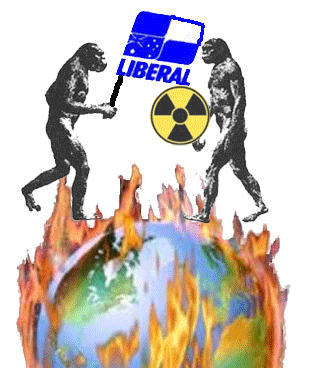 It comes amid international claims of such a link. But questions are also being asked whether the debate should be held amid the current New South Wales bushfire crisis.
Earlier this week, the United Nations climate chief, Christiana Figueres said it was clear bushfires were absolutely linked to climate change.
She told CNN, after watching footage of the New South Wales fires, it showed the need for action to combat climate change.
“The WMO, the World Meteorological Organisation, has not established the direct link between this wildfire and climate change yet. But what is absolutely clear is the science is telling us that there are increasing heat waves in Asia, Europe, and in Australia – that these will continue, that they will continue in their intensity, and in their frequency. So what we have just seen on the screen is an example of what we may be looking at unless we take actually vigorous action.”
Speaking to Melbourne’s 3AW, Prime Minister Tony Abbott accused Ms Figueres of talking through her hat.
Greg Hunt and what Wikipedia actually does say about climate change and bushfires
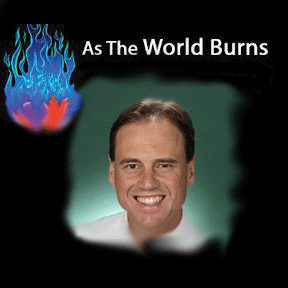 Greg Hunt uses Wikipedia research to dismiss links between climate change and bushfires October 23, 2013 Esther Han, Judith IrelandEnvironment Minister Greg Hunt has hosed down suggestions of a link between climate change and increased bushfire intensity, saying he had ”looked up what Wikipedia” said and it was clear that bushfires in Australia were frequent events that had occurred during hotter months since before European settlement.
Wildfires become more pervasive and dangerous
His comments come as scientists, environment groups and politicians have raised concerns, in the wake of massive bushfires in New South Wales, that the increasing extreme weather events are linked to climate change…..
The head of the UN’s climate change negotiations, Christiana Figueres, and former US vice-president and climate change activist Al Gore have this week both weighed into the debate, criticising the Abbott government over its moves to scrap the carbon price. They also said the evidence was clear that extreme weather would be more frequent as the planet warmed.
She noted that the World Meteorological Organisation had not yet established a direct link between the NSW fires and climate change. Mr Hunt and Ms Figueres spoke by telephone overnight after Prime Minister Tony Abbott on Wednesday rejected Ms Figueres’ assessment that a clear link existed between bushfires and climate change, saying she was ”talking through her hat”.
On Monday, Ms Figueres had told CNN that the Coalition government would pay a high political and financial price for its decision to scrap carbon pricing. Read more: http://www.smh.com.au/federal-politics/political-news/greg-hunt-uses-wikipedia-research-to-dismiss-links-between-climate-change-and-bushfires-20131023-2w1w5.html#ixzz2ilagdbdT
AND WHAT WIKIPEDIA ACTUALLY DOES SAY
Climate change Australia’s climate has been trending toward more bushfire weather over the last 30 years.[18] The Climate Commission found that “The intensity and seasonality of large bushfires in south-east Australia appears to be changing, with climate change a possible contributing factor.”[19]
A 2006 report by the Bushfire CRC identified South Eastern Australia as one of the 3 most fire-prone areas in the world,[20] and concluded that an increase in fire-weather risk is likely at most sites over the next several decades, including the average number of days when the Forest Fire Danger Index rating is very high or extreme. It also found that the combined frequencies of days with very high and extreme FFDI ratings are likely to increase 4-25% by 2020 and 15-70% by 2050, and that the increase in fire-weather risk is generally largest inland.[21]
The IPCC Fifth Assessment Report due to be released in 2014 warns that Australia’s very high and extreme fire danger days will increase by up to 30% by 2020, and up to 100% by 2050.[22] http://en.wikipedia.org/wiki/Bushfires_in_Australia
How Origin Energy is strangling renewables
Energy giant ‘actively blocking renewables‘ http://www.businessspectator.com.au/news/2013/10/23/renewable-energy/energy-giant-actively-blocking-renewables Origin Energy is actively blocking renewable energy, a report has found.Co-produced by Greenpeace Australia Pacific and 100% Renewable, a community campaign for clean energy, the report – titled Strangling Renewables: Origin Energy’s campaign against renewable energy – accuses the energy giant of strangling renewables as part of a strategy to prolong the dominance of gas and fossil fuels.
“As this report shows, Origin is strangling renewable energy in a number of ways, including running a smear campaign against the renewable energy target, which sets Australia’s goal for the amount of our energy produced by renewables, and using misleading public statements to manipulate the general public and politicians alike,” said Lindsay Soutar, the national director of 100% Renewable.
“Origin’s Managing Director, Grant King, has repeatedly said the renewable energy target is a primary driver of increased energy costs. But, that is inaccurate, with the main cause of price rises – at over 70 per cent – due to over investment in poles and wires.”
Greenpeace Australia head of program Ben Pearson said Origin has used its market power to sideline clean energy sources by underinvesting in its own renewables portfolio. “Origin has also underinvested in its own renewable energy portfolio and is blocking other clean energy developers projects from going forward – using its market power to keep renewables on sidelines,” Ben Pearson, Head of Program at Greenpeace Australia, says.
The report shows that Origin has invested heavily in gas projects, including developing new LNG projects and gas generating plants, and also generates 75 per cent of its profit through its retail arm – but increasingly these are threatened by the emergence of cheaper, cleaner wind and solar.“In truth, renewables are working. As this report shows, renewables are reducing energy bills and producing clean energy in an efficient way. Not only that, but wind power is lowering wholesale power prices. And other countries are surpassing us with more ambitious renewable energy goals,” Ms Soutar says.
A review of Australia’s Renewable Energy Target, which is 20 per cent renewables by 2020, is scheduled to occur early next year. Origin boss Grant King has said he would prefer a higher RET target later – such as 30 per cent by 2030.
Tricks and strong passions in the corporate drive against renewable energy

The trick for these people is to ignore the benefits of renewables – increased investment, more jobs, lowering emissions, delivering a faster transition to low carbon economy, solar delivering cheaper alternative to homes and businesses – and instead paint a doomsday scenario.
As Wilson (rightly) pointed out, there is a vast reserve of anti-renewables passion in the rump of the National Party and the Liberal party backbench open to such rhetoric– which insiders say is being whipped up by new Liberal MP Angus Taylor.
Wilson insisted that renewables “are producing a product that no one wants to buy.” This ignores the fact that Australian households and businesses are still spending more than $1 billion a year installing their own rooftop solar systems – even with most subsidies removed. (
The dark forces lined up against renewables in Australia http://reneweconomy.com.au/2013/the-dark-forces-lined-up-against-renewables-in-australia-20629 By Giles Parkinson on 24 October 2013 The Australian renewables industry is under no illusion about the extent of the forces lined up against it following the election of a highly conservative Coalition government in Canberra.
The antipathy to renewables in large sections of the Coalition is deep set, as it is among some of the highly influential and ultra-conservative think tanks such as the Institute of Public Affairs, and various industry lobby groups.
But even battle-weary supporters of solar and wind energy – and those firmly in the middle of the road – were taken aback by an extraordinary tirade against renewable energy delivered in Sydney on Wednesday by Burchell Wilson, a senior economist at the Australian Chamber of Commerce and Industry.
ACCI is one of the most visible and influential lobby groups in Canberra, and its opposition to climate policy, carbon pricing, and renewables incentives, is well known. Still, no-one was quite ready for the “venomous rant” – as one observor described it – against the renewable energy target that Wilson delivered to the Eastern Australian Energy Outlook Conference.
Wilson’s approach was not atypical of the sort of rhetoric we have come used to hearing from conservative energy ministers – be they state of federal – and the incumbent utilities, who are threatened by the rise of renewables, and their cheerleaders in the conservative think tanks. Continue reading
Australia’s timely action to prevent skin cancer from tanning beds
Australia’s Tanning Bed Ban Could Save Thousands Of Lives Taken Each Year By Skin Cancer http://www.medicaldaily.com/australias-tanning-bed-ban-could-save-thousands-lives-taken-each-year-skin-cancer-260693 By Justin Caba | Oct 23, 2013 In light of various studies that link UV exposure produced by indoor tanning beds to skin cancer, Australia is close to implementing a nationwide ban on tanning beds. Australia will join Brazil as the only countries to outlaw sun beds on a federal level once the state of Western Australia passes the ban.
“There’s not lots of them, there’s no big downside for them to stop because most of them have other businesses,” Health Minister Kim Hames told ABC Online.“And, I think given every other state and territory has done it, it’s probably right we follow suit.”
The Australian government successfully outlawed the use of indoor tanning beds by people under the age of 18 back in 2008, theWall Street Journal reports. California, Illinois, Nevada, Oregon, Texas, Vermont, the United Kingdom, Germany, Scotland, France, and some Canadian provinces have also banned minors from using tanning beds. Continue reading
Australian utilities’ determined fight to stop solar energy development
 The solar industry in response is feeling outraged because of the way in which the sector has been singled out when the greatest cross subsidy in the industry is given to users of air-conditioners. This is something that the Australian government itself concedes in a white paper revealing that each $1,500 air con system imposes five times that amount in network costs on other users.
Australian utilities are therefore deciding to fight back, rather than adapting their business model to the new renewable economy. They hope to rely on regulatory protection in order to knock back the take-up in solar PV installation.
Australian utilities raise the barricades against solar http://www.renewableenergymagazine.com/article/australian-utilities-raise-the-barricades-against-solar-20131023 Robin WhitlockTuesday, 22 October 2013 Utilities in Australia are now pushing for higher network charges, refusing connections, removing discounts, forcing tariff changes on solar consumers and downsizing rooftop proposals in their bid to resist the growth of solar PV
Hostility to renewable energy in Australia has been notched up a little again as the country’s major utilities prepare to brake or even halt the rapid uptake of solar PV in the country. They are currently pushing for higher network charges, refusing connections, removing discounts, forcing tariff changes on solar consumers and downsizing rooftop proposals. This activity comes even after most of the subsidies for solar have been removed and represents a tacit admission among major generators, network operators and electricity retailers that renewable energy, particular solar PV, is hurting their business model.
The latest move has come from the Australian Energy Market Commission (AEMC) which has released a “strategic priorities” document that as described the growth in solar PV as one of the most pressing issues for the electricity industry, suggesting that network tariffs do not reflect the reductions in the use of the grid caused by solar installation. Continue reading
Call for inquiry into proposed uranium mining in Queensland
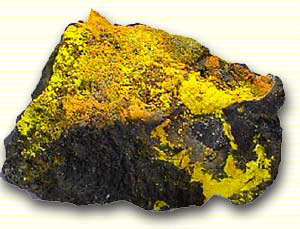 The Newman government must hold a fully independent and open inquiry into the real risks of uranium mining before Queensland starts down a risky pathway for existing industries, workers and our environment.
If it’s as safe as they claim, then they have nothing to fear from any inquiry.
Independent inquiry needed into uranium mining Brisbane Times, Mark Bailey, October 23, 2013 This week marks one year since the Newman government breaking its pre-election promise by overturning Queensland’s ban on uranium mining – without any mandate to do so.
Queenslanders across the state should be deeply worried about the dangers of mining and transporting uranium yellow cake due to the many radioactive risks involved. It was no surprise to hear Premier Campbell Newman admitting no research or modelling had been done before overturning the ban.
Given the extensive history of over 150 recorded mishaps at the Ranger uranium mine in the Northern Territory, why would our state allow a uranium mine located in our tropical climate prone to heavy summer rainfall and cyclones from the Coral Sea and the Gulf?
Given the vast amounts of radioactive sludge (or ‘tailings’) involved in uranium mining, the impact of inevitable extreme weather events slamming into mine sites with many hectares of tailings risks radioactive sludge spreading over vast distances in our state. That’s not a risk worth taking for existing industries in north and north-west Queensland let alone residents.
Uranium mines use vast amounts of water that are likely to come from the Great Artesian Basin for most of the year. While rainfall is often torrential in the wet season in north Queensland, much of the north west is dry most of the time.
The cumulative impact on the Great Artesian Basin of anywhere between one to five uranium mines may have a significant impact on water resources for other existing agricultural and cattle industries. Once one uranium mine is approved then other mines will likely be approved……
Shamefully, the Newman government has not ruled out exporting uranium across the Great Barrier Reef which should be a source of great national and international concern. Continue reading
Tony Abbott rubbishes top United Nations secretary on Climate Change
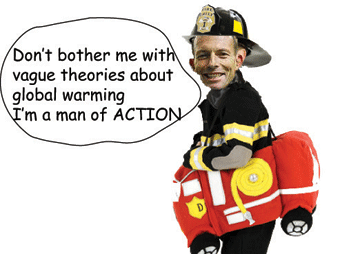 Tony Abbott accuses UN official of ‘talking through her hat’ on climate change (VIDEO) ABC News By chief political editor Emma Griffiths 23 Oct 2013, Prime Minister Tony Abbott has dismissed a UN assessment that the New South Wales fires are linked to climate change, accusing a senior UN official of “talking through her hat”.
Earlier this week, the executive secretary of the UN Framework Convention on Climate Change,Christiana Figueres, said the fires proved the world is “already paying the price of carbon”.
She also criticised the Abbott Government’s direct action plan to tackle climate change as being potentially “much more expensive” than the carbon pricing scheme that it is moving to dump……http://www.abc.net.au/news/2013-10-23/tony-abbott-fires-climate-change-rfs-un/5039932

Christiana Figueres, executive secretary of the UN Framework Convention on Climate Change, has an outstanding record of contribution to protection of the environment, and in particular, climate action.
She is one of the world’s most highly respected negotiators, having represented Costa Rica and the Americas before taking up her global role. I met her at the UNFCCC talks in Durban in 2011, and was impressed not only by her obvious knowledge and professionalism, but by the warmth she brought in her engagement with NGOs and government representatives alike.
For Tony Abbott to not even know who she is in the global climate change negotiation context, and to dismiss her role and expertise in such a cavalier manner, shames Australia and does not auger well for Australia’s engagement in the lead-up to the 2015 global treaty discussions.
Al Gore on the link between climate change and bushfires
Al Gore weighs into debate over links between bushfires and climate change http://www.abc.net.au/news/2013-10-23/al-gore-weighs-into-debate-over-bushfire-climate-change/5041776 Former US vice-president and environmentalist Al Gore says there is a proven link between climate change and bushfires.
This week, a United Nations official said the devastating fires in New South Wales proved the world is “already paying the price of carbon”.
Prime Minister Tony Abbott dismissed the comment on Wednesday, accusing the official of “talking through her hat”.
He argued that “fire is a part of the Australian experience” and not linked to climate change. …
Mr Gore, a Nobel laureate for his work to fight climate change, has told the ABC’s 7.30 that climate change will bring about more extreme weather.
“Bushfires can occur naturally, and do, but the science shows clearly that when the temperature goes up, and when the vegetation and soils dry out, then wildfires become more pervasive and more dangerous.
“That’s not me saying it, that’s what the scientific community says.” Continue reading
Labor’s right wing pushes the nuclear power barrow: we’d better watch Shorten
Labor MPs urge rethink on nuclear power Financial Review, JAMES MASSOLA Political correspondent, 22 Oct 13
Opposition Leader Bill Shorten has quashed a call by Labor MPs for the party to reopen debate about its support for nuclear power, just a day after the shadow ministry agreed to a post-election policy review.
Resources spokesman Gary Gray and Right faction senators Mark Bishop and Alex Gallacher called for the party’s approach to nuclear power and uranium exports to be discussed in a move that could provoke a damaging split with the party’s Left faction. Mr Gray said there was “absolutely no solution to global base load power generation that does not feature a strong role for nuclear power”……
Senator Gallacher said as a developed economy, Australia had a responsibility to examine how to implement “as clean an energy system as possible”.
“The nuclear option is exactly that, politically, there are so many emotional positions but there should be a scientific debate. …..
a spokeswoman for Mr Shorten said Labor had no plans to shift its position and “the prohibitive cost alone of creating a nuclear industry in this country makes it untenable”.
The ALP’s 2011 policy platform expressly forbids “the establishment of nuclear power plants and all other stages of the nuclear fuel cycle in Australia”.
The opposition has will review all of its policies, except the disability insurance scheme and the better schools plan, but it reaffirmed its support for putting a price on carbon emissions. Australian Conservation Foundation anti-nuclear campaigner Dave Sweeney said nuclear power was “high cost and high risk with its global market share falling”. http://www.afr.com/p/national/labor_mps_urge_rethink_on_nuclear_QO9FaVus9ZpZhJJjSVfJ8I
Australia’s great underused energy resource – sunlight
Australia – where the Sun hits the hardest The Starlight Walker,
Mathieu Isidro October 8, 2013 Today, I’d like to talk about solar radiation and its consequences in Australia (it is, after all, linked to astronomy and heliophysics).
Look at the bright red spots in the Pacific, mid-Atlantic and Australia where irradiance (the power of solar radiation) is highest.
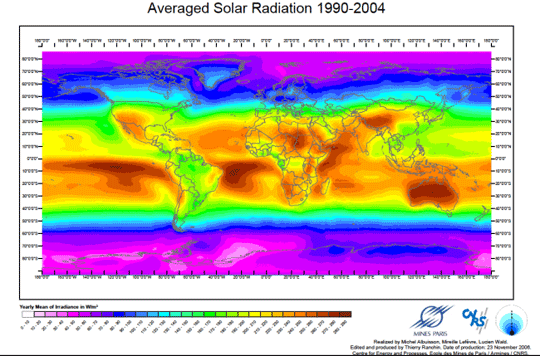
Australia receives much more solar radiation than California or even the Mediterranean famed for its sunny summers and beautiful beaches. And while it does not necessarily mean blue skies and sunny days (solar radiation can be pretty high on a cloudy day), there is a correlation between strong solar radiation, heat, the climate, and health. Solar radiation includes visible light, but also infrared radiation responsible for the “heat” sensation you feel and ultraviolet radiation responsible for sunburns.
So, what is irradiance? Irradiance is the power of electromagnetic radiation on a unit of area, and is measured in watts par square metre (W/m2). In Australia, it reaches the scale’s 2nd maximum of 270-280 W/m2 on a large portion of the country. The sunlight that hits Australia is really strong, and there’s lots of it.
In fact, the map shows there are only three important continental areas to reach such highs: Australia, eastern China (Tibet) and central Africa at the intersection of Sudan, Chad, southern Libya and southern Egypt. Australia is the largest, making it, some claim,the world’s sunniest country.
Last week, a friend sent me this incredible map……..So much irradiance tells me Australia is a great if not the best place on Earth to produce solar energy. The map also made me realise Australia is probably the safest, most politically stable and most accessible place on Earth among the areas where solar radiation is highest. The sun is shining strong throughout the year, and we have large flat uninhabited areas ready to host giant solar farms. And yet, the largest solar farms are located in California, Spain, and…Germany!
In August, The country’s top expert body on climate change, the ex- government-funded Climate Commission (scrapped by the new government and now reborn as the crowd-funded Climate Council) recognised this, writing:
Germany receives less sunlight than Victoria but has more installed capacity than any other country (…)
Australia is the world’s sunniest continent with enormous, but largely underutilised, potential for solar power generation.
In fact, Australia doesn’t even make it into the long list of the largest photovoltaic plants in the world. You have to wonder about that….. http://thestarlightwalker.wordpress.com/2013/10/08/australia-where-the-sun-hits-the-hardest/
1 This month
17 October, Free Public Talk on Nuclear Issues in South Australia
David Noonan will speak on public interest concerns over the new Roxby Downs Indenture Act 2026 on BHP copper-uranium mining and ore processing in SA, and on how AUKUS may face SA with a High-Level nuclear waste agenda.
Dr Jim Green will discuss international developments in the field of nuclear power including ‘small modular reactors’ and Generation 4 ‘advanced’ nuclear reactor concepts.


Help Aunty Sue Protect Her Land and Sacred Sites From Destructive Rocket Testing.
.

Australians deserve the truth
about
AUKUS – https://aukuspublicinquiry.com/

PETITION – To: Prime Minister Anthony Albanese and the Australian Labor Government

of the week – Australians for War Powers Reform (AWPR)
To see nuclear-related stories in greater depth and intensity

