What would it mean to abolish the carbon price
 Why Tony Abbott wants to abolish the carbon price, The Guardian, byAlexander White Wednesday 18 September 2013 “…… In the twelve months since the carbon price was introduced in Australia, our nation has enjoyed nearly unparalleled economic prosperity: low inflation of 2.4 percent, strong growth in the stock market of 23 percent, record low unemployment of 5.8 percent, low interest rates of 2.5 percent (cash rate), strong terms of trade and most importantly a decrease in carbon emissions.
Carbon emissions from the highly polluting energy sector National Electricity Network fell by 7.4 percent in 2012-13. Renewable energy grew by around 30 percent in the same period. A great deal of the reductions in various sectors of the economy in carbon emissions are due to the price signals from the carbon price.
More importantly, from 2015 the Clean Energy Future Act would introduce a cap on carbon emissions, a policy tool of greater significance than the price alone.
If the carbon price were abolished, the cap on emissions would also be removed. Australia is already one of the world’s largest polluters and per capita there is almost no greater carbon emitter than Australia. The removal of the carbon price would give a signal to fossil fuel companies to continue expansions of dangerous coal projects and unconventional gas projects.
Numerous other environmental policies under Tony Abbott would contribute to a likely expansion of carbon emissions, including the abolition of the Clean Energy Finance Corporation, the devolving of environmental regulation to state governments, and the overturning of the world heritage listing for Tasmanian forests.
Australia would also be sending a very dangerous signal to the rest of the world, that as a major polluter Tony Abbott does not plan to contribute to a global solution to climate change. Australia is about to take the chair of the G20, a very influential role. The G20 potentially has an important role to play in providing leadership in reducing global carbon emissions. As a climate denier, it would be difficult for Tony Abbott or his foreign minister Julie Bishop to credibly contribute to multilateral climate discussions………http://www.theguardian.com/environment/southern-crossroads/2013/sep/18/tony-abbott-abolish-carbon-price
ERA, Rio Tinto, Paladin desperately hope that Fukushima is just a “bump in the road”
Japan goes nuclear-free The Motley Fool, By Justin Loiseau – September 16, 2013 Japan is closing down its last operating nuclear reactor for scheduled maintenance, putting the country in “nuclear-free” territory for the first time since the Fukushima crisis necessitated nationwide inspections two years ago. Japan has 50 commercial reactors nationwide, and the March 2011 Fukushima disaster marked the first time in over 40 years that the country pulled power exclusively from non-nuclear sources.
Japan is split on the future of this fuel. While Prime Minister Shinzo Abe and utilities point to the need for nuclear to meet Japan’s growing energy demands, the general public and environmental activist groups remain apprehensive about the safety of local reactors.
Japan and Australia may be oceans apart, but the two countries are closely linked. Energy Resources of Australia (ASX: ERA) is one of the largest uranium producers in the world, the secret sauce of nuclear reactors. Rio Tinto (ASX: RIO) has a 64% stake in the company as well, and Japan’s exit from nuclear could push prices down drastically if it bids adieu indefinitely. Paladin Energy (ASX: PDN) and its 82%-owned Summit Resources(ASX: SMM) subsidiary tell a similar story. Spot prices have already dropped from $65 highs in 2011 and are currently hovering around $35, similar to 2006 markets.
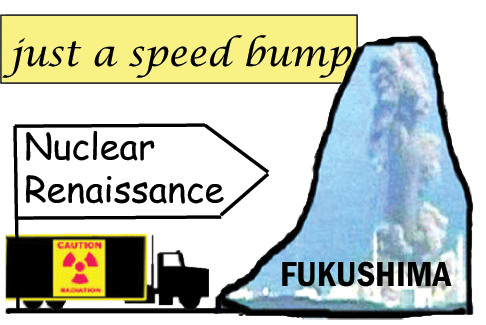
Japan’s nuclear notions are unclear, and proponents of the energy have warned of blackouts if the country doesn’t jump back on the nuclear track. Opponents, including Greenpeace Japan, are instead pushing Japan to seize the opportunity to become a leader in renewable energy.
Regardless of the ultimate outcome, this latest nuclear shutdown is another bump in the road (read “increased risk”) for nuclear energy and its uranium producers……http://www.fool.com.au/2013/09/16/japan-goes-nuclear-free/
Indigenous Affairs to be run by Prime Minister’s Office, and the unelected Indigenous Advisory Council
Senator hails change NT News, STAFF WRITERS | September 17th, 2013 TERRITORY Senator Nigel Scullion is the country’s new Indigenous Affairs Minister………The administration of the portfolio will now rest within the Prime Minister’s office – not the Indigenous Affairs Department.
“Having the support of the Department of Prime Minister and Cabinet ensures that I will have influence across all portfolios,” he said.
Senator Scullion has already met with Indigenous Advisory Council chair Warren Mundine and said they shared “common ground on most issues”……http://www.ntnews.com.au/article/2013/09/17/325000_ntnews.html
Wind farmers find the industry profitable and benign – no “wind farm syndrome”
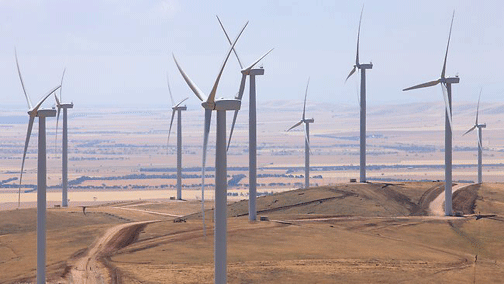 Wind turbine syndrome: farm hosts tell very different story The Conversation, Simon Chapman Professor of Public Health at University of Sydney 18 Sept 13 People who host wind turbines on their properties and derive rental income from wind energy companies have important stories to tell about living alongside turbines, but they’ve largely been absent from the debate on wind farms and health. Australian filmmaker and researcher Neil Barrett is finally giving this critical group a voice in his new short film, The way the wind blows, released today.
Turbine hosts at Waubra earn A$8,000 a year for each turbine on their land. In the bush, the expression that wind farms can “drought-proof a farm” is common: a land owner with ten turbines can wake up each morning comfortable in the thought that a tough year with poor rain or bad frosts can be ridden out, thanks to income from wind generation.
All of Barrett’s interviewees say they can hear the turbines but none say they are bothered by them or suffer from any health problems they attribute to the turbines. Continue reading
Ambitious community wind farm project for Fremantle?
 Fremantle Community Wind Farm , Pozible, By Claire Vanderplank, Raoul Abrutat, Louis Kent, Rowan Gallagher, Michael Fuller and Jamie Ally The Fremantle Community Wind Farm is an ambitious project to build 8 to 12 community-owned wind turbines along the breakwaters at Fremantle Port. With 8 turbines sized to fit within the port landscape, the project would produce enough electricity for 3300 average Australian homes.
We are so passionate about this project. It will produce clean energy and distribute profits locally. With Fremantle’s connection to the wind and water and its identity as a progressive city, the project has great potential to produce cultural and social capital. It also has educational and awareness-raising potential due to the prominent location. Check out our website and Facebook page for all the details.
The project is at a critical point in time; ready to go ahead however facing one key barrier, land access. The community’s voice is required to make it happen. There are too many myths and misperceptions blowing around regarding wind farms that are holding this, and other projects, back. We are on a mission to set things straight.
Exposing the garbage propaganda from the anti wind farm lobby
More than two-thirds of Australian wind farms including more than half of those with large turbines have never received a single complaint. Two whole states – Western Australia and Tasmania – have seen no complaints.
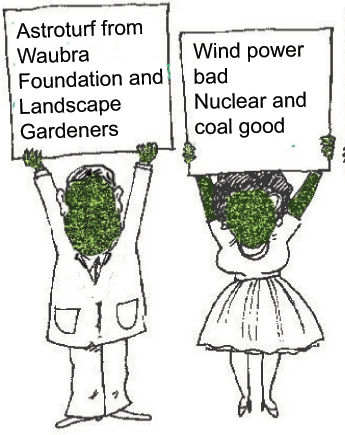 Wind turbine syndrome: farm hosts tell very different story The Conversation, Simon Chapman Professor of Public Health at University of Sydney 18 Sept 13 “………Laurie and the Waubra Foundation have done all they can to spread concern about the harms they allege are caused by living near wind farms. One former Waubra resident has been particularly prominent, speaking emotionally at anti-wind farm meetings about how wind farms have ruined his health and caused his family to move to Ballarat, at great personal expense.
In a statement that would be of immense interest to Apple, Samsung and Nokia, he recently told a meeting in Barringhup that electricity generated by wind turbines started charging his cell phone without it being plugged in:
I’ve had my … mobile phone go into charge mode in the middle of the paddock, away from everywhere.
In 2012, he wrote a public submission to a parliamentary inquiry where he revealed he had suffered a serious head injury some eight years before the wind farm opened in 2010:
I have been in brain training care and rehabilitation for about ten years because of an unfortunate, unrelated accident.
Indeed, the most common health complaints voiced by complainants are problems such as disturbed sleep, anxiety, hypertension and normal problems of ageing that are very prevalent in all communities, regardless of whether they have wind farms. Continue reading
Aboriginal and Torres Strait Islander Commission (ATSIC) – what it meant for Aboriginal Australia
History of government and Aboriginal Affairs prior to 1967 and after The Stringer, by Delephene Fraser September 17th, 2013…..…….History of Aboriginal and Torres Strait Islander Commission (ATSIC)
ATSIC became part of the Australian legislation in 1989 and the government appointed Lois (Lowitija) O Donoghue as ATSIC first Chairperson, ATSIC flung open it doors in March 1990. section 3 of the Aboriginal and Torres Strait Islander Commission Act 1989 sets out ATSIC objectives as follows:
- To ensure maximum participation of Aboriginal and Torres Strait Islander people in government policy
- To promote Indigenous self-management and self-sufficiency
- To further Indigenous economic, social and cultural development, and
- To ensure co-ordination of Commonwealth, state and territory and local government policy affecting Indigenous people.
In order to achieve these objectives, ASTIC was to:
· Advise governments at all levels on Indigenous issues
· Advocate the recognition of Indigenous rights on behalf of Indigenous peoples regionally and nationally and internationally
· Deliver and monitor some of the Commonwealth government Indigenous programs and services. Continue reading
Making coal seam gas seem clean – by changing its name
 More CSG Greenwashing? http://www.energymatters.com.au/index.php?main_page=news_article&article_id=3948 18 Sept 13, What’s been a good way in the past to distance a nasty product from its bad reputation? Simply change its name. However, the strategy isn’t so effective these days in an increasingly online world where news travels fast.
According to a report on the ABC, a briefing note from the office of Resources Minister Chris Hartcher suggests changes be made to the way the coal seam gas (CSG) industry and fuel is described within Government communications and texts. Instead of the crisp ‘CSG’ term or ‘coal seam gas’, it seems Mr. Hartcher would like to see it referred to as ‘natural gas from coal seams’ and that references to coal seam gas or CSG be removed from sentences.
‘Natural’ may work as an effective greenwashing term for some products; but the recommended change won’t fool many – it will (and has already) just further incited those dedicated to exposing the many serious issues involved with extracting the fossil fuel. In addition to the interruptions to agriculture and potential contamination of water supplies; according to Zero Emissions and other sources, coal seam gas is even more emissions intensive than coal when total lifecycle emissions are taken into account.
Research recently carried out by scientists at the University of Queensland determined that not only would a shift from coal-fired to gas-fired electricity generation in Australia fail to deliver significantly lower carbon dioxide emissions;wholesale electricity prices would be higher than with a renewable energy option.
According to Aidan Ricketts from CSG Free Northern Rivers, quoted by theNorthern Star; the attempt to relabel coal seam gas is “.. just another example of the government falling in line with industry. They’re trying to get away from the words which have become poison.”
It would seem changing how CSG is referred to is just a case of putting lipstick on a particularly filthy and greedy pig.
New equipment: old problems – ERA’s Kakadu uranium plans in focus
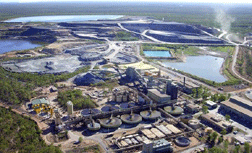 Environment Centre NT, 17 Sept 13, Uranium miner Energy Resources of Australia will unveil its new brine concentrator – a long overdue piece of infrastructure that seeks to address both chronic water management problems and contaminated process water – at its aging Ranger uranium mine in Kakadu on Thursday.
The Ranger mine has been plagued with water and waste management problems that have caused extended shutdowns and deep concerns about impact on the World Heritage Kakadu National Park. “The new infrastructure is a long overdue and welcome initiative,” said Lauren Mellor, Nuclear Free NT Campaigner with the Environment Centre NT.
“The delay in commissioning this key piece of equipment is a poor reflection on ERA’s commitment to rehabilitation, given the company’s long history of water mismanagement. That ERA has been allowed to continue mining and expanding its waste water inventory, now estimated at eleven gigalitres, without having an effective waste water management plan or the ability to treat process water shows a disturbing lack of regulatory rigour.” Continue reading
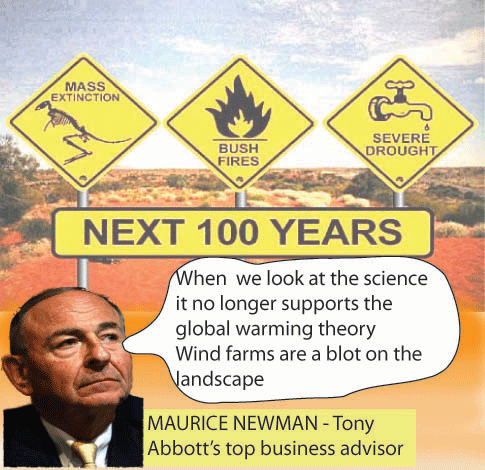
Maurice Newman, Tony Abbott, John Howard, get behind climate denialist campaign
 Tony Abbott’s business advisor attacks “myth” of climate change http://reneweconomy.com.au/2013/tony-abbotts-business-advisor-attacks-myth-climate-change-53017 By Giles Parkinson on 17 September 2013 Maurice Newman, the former chairman of the ABC and the ASX who will be the chair of Tony Abbott’s Business Advisory Council, has launched an attack against the CSIRO, the weather bureau and the “myth” of anthropological climate change.
In an opinion piece written for the Australian Financial Review, Newman said much of the public service infrastructure would be resistant to change because of their “vested interests” in the status quo.
“The CSIRO, for example, has 27 scientists dedicated to climate change,” Newman wrote. “It and the weather bureau continue to propagate the myth of anthropological climate change and are likely to be background critics of the Coalition’s Direct Action policies.”
Given Newman’s dismissal of climate science, one wonders why he sees the need for Direct Action of any type. The answer possibly lies in the government’s updated policy position: Abbott has conceded that the government will no longer seek to reach even the minimum 5 per cent emission reduction target if its reduced budget of $3 billion falls short of requirements.
Newman’s comments came a day after it was revealed that Abbott’s mentor John Howard would address one of the world’s most prominent climate skeptics think tanks, and the portfolios of science and climate change had been subsumed into other ministries. Continue reading
Climate denial themes pushed by Murdoch media, in 5 stages
 In Murdoch’s The Australian, Andrew Montford took a different approach to deny that we’re the cause of the problem, attacking the expert consensus on human-caused global warming. Specifically he attacked the Cook et al. (2013) study finding 97 percent consensus on this question in the peer-reviewed scientific literature.
The 5 stages of climate denial are on display ahead of the IPCC report, The Guardian, by Dana Nuccitelli Monday 16 September Climate contrarians appear to be running damage control in the media before the next IPCC report is published The fifth Intergovernmental Panel on Climate Change (IPCC) report is due out on September 27th, and is expected to reaffirm with growing confidence that humans are driving global warming and climate change. In anticipation of the widespread news coverage of this esteemed report, climate contrarians appear to be in damage control mode, trying to build up skeptical spin in media climate stories. Just in the past week we’ve seen:
- The David Rose Mail on Sunday piece that treated scientific evidence in much the way bakers treat pretzel dough.
- Dr. John Christy interviewed by the Daily Mail;
- Christy’s colleague Dr. Roy Spencer in The Christian Post;
- Andrew Montford in Rupert Murdoch’s The Australian;
- Matt Ridley in Rupert Murdoch’s Wall Street Journal; and
- Bjorn Lomborg in The Washington Post.
Interestingly, these pieces spanned nearly the full spectrum of the 5 stages of global warming denial. Continue reading
Community solar energy kicks off in a New South Wales pub at Boggabri
 Boggabri pub leads the way in community solar “revolution”http://reneweconomy.com.au/2013/boggabri-pub-leads-the-way-in-community-solar-revolution-33313 By Emma Fitzpatrick on 16 September 2013 A new community-based solar investment company has completed its first community-funded solar installation – at a pub in the heart of a NSW coal-mining region – and says it is revolutionising small scale solar power generation in Australian communities.
ClearSky Solar Investment works off trust-based investor model, planning to link local investors with high quality solar projects. The company is one of many eyeing up to several hundred community solar projects around the country. The company has completed its first project, a 15kW system at the Royal Hotel in Boggabri, NSW. The project, which comprises 60 250W Trina solar panels and a 15Kw SMA inverter, and was completed on June 10. It had about 10 investors, an agreed investor term of 7 years, and a planned total term yield of 171 per cent.
Under the model, investors own the modules and sell the output of the system to a local consumer – usually the landowner. Each project has a maximum of 20 investors and a minimum investment of around $2500 or $5000, depending on the size of the project and the number of investors. Continue reading
Adelaide’s 100% solar powered bus – a world first!
The World’s First 100% Solar Powered Bus http://www.energymatters.com.au/index.php?main_page=news_article&article_id=3945 17 Sept 13, The world’s first solar powered bus is located in Adelaide, South Australia – which makes it especially heaps good*.
Tindo – the name of Adelaide City Council’s electric solar bus – is the first in the world to be recharged using 100% solar power. Continue reading
Distnguished Aboriginal Elder, Yami Lester, explains the dismantling of Anangu Pitjantjatjara Yankunytjatjara (APY) lands
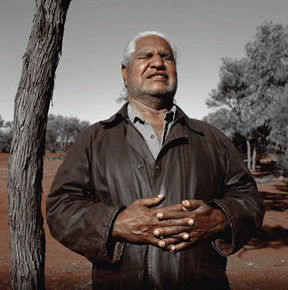 “As an elder of the Yankunytjatjara and the APY Lands I state my absolute disappointment and disgust with the governments of South Australia and the Commonwealth. I say “NO” to mining in APY Lands and I say “NO” to homeless centres being built for our people away from their traditional homelands.”
Elder believes the APY Land is being dismantled http://cooberpedyregionaltimes.files.wordpress.com/2008/11/coober-pedy-regional-times-12-09-2013.pdf, by Yami Lester, (OAM) Order of Australia Medal)
Yankunytjatjara Elder Yami Lester is deeply disturbed by the exodus of Anangu from the APY Lands over the past several years. Big mining has been approved for the area but there are no jobs.. He says many families are not returning, causing a decline in the population of the lands. Lester who was awarded the Order of Australia medal in 1981 for service in the field of Aboriginal Welfare says,“The governments are now impatient to mix Anangu into the mainstream, hundreds of kilometres from their homelands.
 interests is a cruel and racist act,” said Yami Lester.
Nuclear puppet Mundine helps Abbot clear the way for mining industry
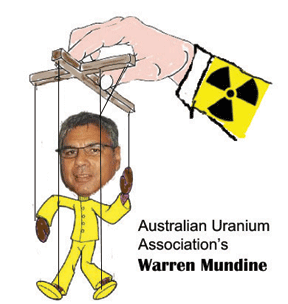 Abbott & Mundine want to get rid of aboriginal land councils http://fredleftwich.com/2013/09/10/abbott-mundine-
 want-to-get-rid-of-aboriginal-land-councils/ September 10, 2013 by Fred Leftwich
http://www.abc.net.au/news/2013-09-10/iac-chairman-mundine-keen-to-meet-clc/4948744/?site=indigenous&topic=latest Tony Abbott’s chairman of his indigenous advisory council, Warren Mundine, is seeking to meet with the Central Land Council soon to “get the ball rolling”, what ever that means.
Given the new federal government withdrawing of funding for aboriginal legal services, and it’s attack on the native title act to make it easier for mining companies to access aboriginal people’s traditional land, is it any wonder the government’s main point of attack is aboriginal land councils?
Once Tony Abbott gets rid of any form of aboriginal organisation or representation then it will be much easier for him and mining companies to make billions of dollars off aboriginal land. And what is Mundine’s payment for his role in all this? I think the going rate is 30 pieces of silver.
1 This month
17 October, Free Public Talk on Nuclear Issues in South Australia
David Noonan will speak on public interest concerns over the new Roxby Downs Indenture Act 2026 on BHP copper-uranium mining and ore processing in SA, and on how AUKUS may face SA with a High-Level nuclear waste agenda.
Dr Jim Green will discuss international developments in the field of nuclear power including ‘small modular reactors’ and Generation 4 ‘advanced’ nuclear reactor concepts.


Help Aunty Sue Protect Her Land and Sacred Sites From Destructive Rocket Testing.
.

Australians deserve the truth
about
AUKUS – https://aukuspublicinquiry.com/

PETITION – To: Prime Minister Anthony Albanese and the Australian Labor Government

of the week – Australians for War Powers Reform (AWPR)
To see nuclear-related stories in greater depth and intensity

