Clean Energy Future helping New South Wales’ farmers
A $1 million energy boost for NSW Farmers The Rural, July 15, 2013, NSW Farmers has received funding of $1 million from the Australian Government to deliver an energy innovation program to farmers across the state. Fiona Simson, President of NSW Farmers, said farmers urgently needed support in reducing their energy costs and in making decisions around their investment in energy related equipment.
“Over the past five years energy costs in NSW have risen approximately 60 percent for small to medium sized farming enterprises. Our own surveys and work by our partners in the program showed that farmers can readily achieve savings, but they also need the right advice and technical support,” she said.
Our farm energy innovation program will provide practical tools and advice to help farmers analyse their energy use and identify solutions. In addition, it will conduct pilots across 20 representative farms, involving the development of detailed strategies for intensive and broad acre operations. Continue reading
Australia must adopt an independent policy on Iran

 Will Australia erode or build trust with Iran? Guardian UK, NAJ Taylor, 15 July 13 The way forward is clear: Australia must adopt an independent foreign policy towards Iran on the nuclear question, as well as commit to dialogue Iranians now comprise the largest cohort of those seeking asylum in Australia each year. The tendency to dehumanise and securitise them is not only deeply disturbing, it is also beset, in part, by a paradox of our parliament’s own making: Australia has imposed sanctions on Iran since 2008. Continue reading
Aborigines’ 8 year battle against nuclear waste dumping
“We’ve been arguing for a long time that the Northern Territory was targeted because it was a politically weaker jurisdiction.
“Obviously it was easier for the Commonwealth to override any local opposition to the plan, which is what they’ve done.
“We want the Territorian Senators to actually stand up for the interests of the community, and not just roll over and say that we’ll accept Canberra’s waste dump plan.”
Dust-up over nuclear waste dump hits eight years http://www.abc.net.au/news/2013-07-15/opposition-grinds-on-over-muckaty-nuclear-waste-dump-plans/4820806 Jul 15, 2013 A Northern Territory traditional owner has vowed to keep fighting federal government plans for a radioactive waste dump on her land.
Dianne Stokes is in Melbourne today for a scheduled Federal Court directions hearing on the Muckaty waste dump.
Today also marks eight years since the Federal Government announced a plan to dump nuclear waste in the Territory. Continue reading
Australian science adds to knowledge on radiation risks of CT scans
Another recent study from Australia by John Matthews and colleagues, published in BMJ, helps give us a bit more perspective….The peril was greater for children exposed at younger ages and was linked to many different types of malignancies — including cancers of the brain, skin, blood and gut…….
Dr. Dustin Ballard: Examining the trade-offs with CT scans marinij.com By Dr. Dustin Ballard 07/15/2013 IN MEDICINE, like in life, there are almost always trade-offs. Most treatments, even unassuming ones like oxygen, have side effects. And most medical tests hold the potential of unintended consequences.
Consider the recent evidence about the long-term effects of CAT Scan (CT) radiation in children. But, before we get there — please don’t flip out — CTs can be valuable tools, so please don’t decide that you will boycott them entirely.
That said, it’s undeniable that there’s been an explosion in the use of CTs, and that this is a concerning trend. Mounting evidence shows that CT exposure in childhood results in a small but real increased risk of cancer later in life……. Continue reading
Sunshine Council – an Australian first – to have council solar farm
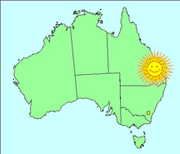 Sunshine Coast Council To Go Solar http://www.energymatters.com.au/index.php?main_page=news_article&article_id=3837 14 July 13, Queensland’s Sunshine Coast Council is planning to build a solar farm that would supply half of its electricity needs. Mayor Mark Jamieson says it would be the first council in Australia to have a utility scale solar farm constructed.
“The $24-30m solar farm proposed to be built at Valdora near Coolum would meet half of council’s electricity needs for at least the next 30 years,” he said. “Over the next three decades council is expected to pay in excess of $110m for electricity, and the solar farm would have the potential to reduce that by many millions of dollars.”
Council believes it will save around $10 million over the expected life of the project.
The solar farm project would inject $10 million into the local economy over the next 10 years and create 40 jobs during construction.
One of the reasons Sunshine Coast Council believes now is the right time to invest is energy contract re-negotiation with current retailers is due in 2014. It also recognises solar panel prices are currently very low; something that could change given fluctuations in the Australian dollar and other factors.
The solar farm would help develop the Sunshine Coast’s cleantech industry hub and skills developed during construction could be deployed to similar projects within Queensland and elsewhere in Australia; helping to further diversify the local economy.
“This project has the potential to transform the Sunshine Coast. It would become the embodiment of everything we stand for; a region which is economically, environmentally and socially sustainable,” said Councillor Mark Jamieson. “It would save money, reduce our carbon footprint and take us another step closer to becoming the most sustainable region in Australia”
Council will call for Expressions of Interest to design and build the solar farm in the next few weeks and hopes construction will commence in 2014.
Doom and gloom in Australia’s uranium investment sector
 Uranium, rare earths miners in doldrums BY:ROBIN BROMBY The Australian July 15, 2013 A FEW years ago, talking up a well-balanced portfolio of uranium and rare earth elements assets would have been a mouth-watering come-on for investors. Not now, of course.
You’ve got Toro Energy (TOE) with most of its ducks in a row including finance and government approvals to develop Western Australia’s first uranium mine.
All except the rather important duck of a spot uranium price somewhere in the vicinity of $US70 a pound that would make the mine viable; it’s stuck with $US39.50/lb.
A few years ago, the average resources punter would have sold their children to raise money for buying such a share, but Toro languishes at just 9c.
And there was disappointment on Friday for Aura Energy (AEE), French nuclear giant Areva pulling the plug on plans to partner up with the Australian junior in its Haggan uranium project in Sweden, one of the largest undeveloped uranium projects in the world (389,000 tonnes)…..
Greens’ Christine Milne strikes a positive note for Australia’s clean energy revolution
 Greens urge creation of clean energy map for the community http://www.theaustralian.com.au/national-affairs/election-2013/greens-urge-creation-of-clean-energy-map-for-the-community/story-fn9qr68y-1226678708055 BY:SID MAHER The Australian July 13, 2013
THE Greens will today propose the creation of new economic zones to speed the development of renewable energy as part of an election campaign roadmap to cut the nation’s reliance on fossil fuels.
Greens leader Christine Milne will unveil a policy allocating $2 billion to a task group within the Department of Energy to map Australia’s clean energy resources, involve local communities in planning energy projects and run a competitive tender to link clean energy hotspots to the national energy grid.
The policy argues “where our world-beating clean energy resources and genuine community support align”, renewable energy development zones should be established with quicker approval processes for clean energy projects. Continue reading
Australian Renewable Energy Agency sharing knowledge on industry development
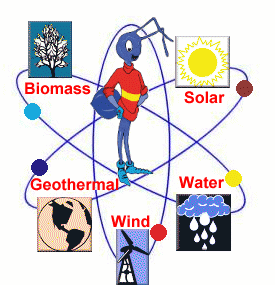 Supporting renewable energy knowledge EcoGeneration — July/August 2013 As the Australian Renewable Energy Agency approaches its one-year anniversary, it is consulting with Australia’s clean energy industry to devise best practices for sharing project knowledge, in order to assist with the overall expansion of the industry.
In November 2012, the Australian Renewable Energy Agency (ARENA) released a consultation paper on its Supporting High-Value Australian Renewable Energy (SHARE) Knowledge Initiative in order to seek input from the clean energy industry in designing and implementing the initiative.
In particular, ARENA sought views on the extent to which project-specific information should be shared for the growth of the sector; the key issues the program should aim to address; and the questions the initiative should aim to answer.
Sharing industry information
SHARE is intended to disseminate knowledge from ARENA projects, and offer funding for strategic knowledge development that addresses key knowledge gaps and increases awareness and acceptance of renewable energy technologies. ARENA hosted one-on-one meetings with companies involved in developing utility- and large-scale projects as part of its consultation on designing and implementing SHARE. The Agency also sought input from stakeholders involved in smaller-scale projects, such as research projects, and noted the importance of information, data and knowledge from these smaller projects.
Its aim is to maximise the value of supporting individual projects, for both industry participants and the general community.
“Given ‘learning by doing’ is a key aspect of many ARENA-funded projects, this additional value can come in the form of information, data and knowledge that can lead to a cascade of new projects,” the Agency said in its SHARE consultation paper
The industry responds…… http://ecogeneration.com.au/news/supporting_renewable_energy_knowledge/082503/
Renewable energy is revolutionising Australia’s power generation sector
 Renewable Energy Making Its Presence Felt In Australia http://www.energymatters.com.au/index.php?main_page=news_article&article_id=3836, 12 July 13 Once disregarded as being any sort of threat to the energy status quo; renewable energy is rapidly changing the power generation sector in Australia.
According to a new report from the Energy Supply Association of Australia (ESAA), new renewable and gas power stations now account for more than 90 per cent of planned energy investment in the country.
Wind farms made up half of all new large-scale generation investment in 2012-13, compared to just 11 per cent in 2002-03.
The ESAA has acknowledged renewable energy has reined in the average wholesale price of electricity; but believes this isn’t necessarily a good thing. Others might argue the energy gravy train losing a little of its bloat is a very good thing indeed. The number of instances where the wholesale cost of electricity jumped above $300 per megawatt hour have greatly decreased in recent times. The consumer is yet to see any benefit as any savings have been overshadowed by network cost increases.
The ESAA raises the spectre of reliability issues possibly resulting from a sustained lower wholesale electricity price, but it has noted reliability in Australia’s electricity supply improved in 2011/12 according to the Australian Financial Review. The ESAA also says the value of the National Electricity Market has shrunk by more than $4 billion, or 40 per cent, in the last four years.
In its public statement regarding the report, the ESAA has avoided directlydemonising home solar. A previous discussion paper on energy in Australia released by the organisation was criticised as being riddled with myths in this regard.
ESAA’s membership includes AGL, Origin, Energy Australia and other Big Energy participants.
The marked increase in renewable energy in Australia has also played a role in reducing power generation related carbon emissions. The pitt&sherry Carbon Emissions Index indicates electricity generation in the National Electricity Market (NEM) 2011-12 to 2012-13 decreased by 2.2 percent while emissions were down by 12.2 million tonnes carbon dioxide equivalent -equivalent to just under seven percent for the first full year under the carbon tax.
Planning report recommends go ahead for Western Australian wind farm
 Report gives conditional nod to wind farm http://www.abc.net.au/news/2013-07-11/report-gives-conditional-nod-to-wind-farm/4814128 Jul 11, 2013 A planning report, compiled for a panel that will decide whether a Great Southern wind farm proceeds, has recommended it go ahead with strict conditions.
Moonies Hill Energy’s Flat Rock Wind Farms project would create a 150-megawatt facility in the shires of Kojonup and Broomehill-Tambellup.
The company says the project could power 90,000 homes and inject $130 million into the local economy.
However, it hit a snag earlier this year when the Great Southern Joint Development Assessment Panel refused to give planning approval to the part of the development in Broomehill-Tambellup.
The company appealed against that decision and another hearing is scheduled for next Friday, when the panel will decide whether to accept the Broomehill-Tambellup Shire planner’s recommendation to approve it.
That recommendation includes strict conditions, including noise regulations and that the development begins within four years of the issuing of a building permit.
The primary documents in Australian Aboriginals’ fight to keep their land
 50 YEARS ON, YIRRKALA CELEBRATES BARK PETITIONS THAT SPARKED INDIGENOUS LAND RIGHTS MOVEMENT Yahoo 7 News, 11 July 13, The remote community of Yirrkala in East Arnhem Land is celebrating 50 years since the signing of the historic bark
petitions that paved the way for the Indigenous land rights movement……… Local NAIDOC week coordinator Rosealee Pearson says what
the leaders achieved at a time before Indigenous Australians were even counted on the national census cannot be overstated.
“It’s pretty astounding that a group of people who weren’t even counted as human beings decided to do that,” she said.
“It’s because of them and the fight they fought that I exist as a person.”
The ochre-framed bark petitions were adorned with the clan designs of all that was threatened by mining – from the snakes to the sand dunes. They were first traditional documents to be recognised by the Australian Parliament.
Ms Pearson says the combination of traditional and modern forms of communication helped bridge a gap between the two cultures at the time. The petitions were created in 1963 to protest against the Federal Government’s removal of 300 square kilometres of land from the Arnhem Land reserve so that bauxite found there could be mined…… Despite not achieving the constitutional change sought, the petitions were the spark which lit the flame for the eventual recognition of Indigenous rights in Commonwealth law.
Less than five years later, a referendum was held and the Australian
Constitution amended to count Indigenous Australians in the national census.
Less than a decade after that, the Northern Territory Aboriginal Land Rights
Act was passed…….
http://au.news.yahoo.com/latest/a/-/article/17938240/50-years-on-yirrkala-celebrates-bark-petitions-that-sparked-indigenous-land-rights-movement/
Australia helping China to organise its emissions trading cheme
 China seeks Australia’s help building emissions trading scheme The Age, July 11, 2013 Heath Aston Political reporter Australia has been drafted in to help design an emissions trading scheme for China, the world’s biggest polluter.
A deal announced in Canberra on Thursday will see the Australian National University take leadership of a program that will analyse pollution data provided by China and allow Chinese university researchers to examine Australia’s experience of the carbon tax and transition to an emissions trading scheme.
China is aiming for a full national emissions trading scheme by 2015.
The program, known as the “Australia-China research program on market mechanisms for climate change policy”, will team Australian researchers with those from three provincial universities in China and the Beijing Institute of Technology. The University of New South Wales and Melbourne University will also take part……. Climate expert and economist Ross Garnaut, a professor at ANU, said the most recent climate science showed a two degree warming of the planet was now a minimum and Chinese leaders understand there is a huge potential impact from climate for that nation. http://www.theage.com.au/federal-politics/political-news/china-seeks-australias-help-building-emissions-trading-scheme-20130711-2prjh.html#ixzz2Ys4PY1At
ERA’s new uranium plan for Ranger mine sheds doubt on proper future cleanup
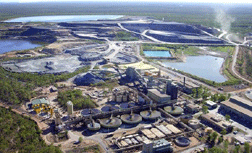 Ranger uranium mine expansion plan faces scrutinyhttp://www.abc.net.au/news/2013-07-09/environment-centre-nt-on-ranger-uranium-mine-eis-undergounding/4808406 By Kristy O’Brien Jul 9, 2013 The Northern Territory Environment Centre says it is assessing draft environmental guidelines for the expansion of the Ranger uranium mine.
The draft EIS guidelines from the Northern Territory Environment Protection Authority aim to minimise the effects on the surrounding Kakadu National Park of a move from open-cut to underground mining.
The Environment Centre’s Lauren Mellor says the group is opposed to the expansion but is happy to see increased scrutiny of the project.
“What has been proposed here is underground mining, which is something that has never been done before at the Ranger site,” she said. “This is being proposed at a time when the company should be ramping down operations in preparation for rehabilitation, not ramping them up.”
Mine operator Energy Resources of Australia (ERA) says underground mining would extend the life of the operation. Ms Mellor says her group will assess the EIS guidelines to ensure they are appropriate.
“They [ERA] have got a legal obligation to cease mining and mineral processing by 2021 on the site,” she said. “What they are proposing here is to increase contamination, increase tailings and waste at the site, which means rehabilitation is more than likely to be delayed,” she said.
Uranium prices just keep on – going down, down
 Spot uranium prices about $39.50/lb with ‘downward’ bias: sources Washington (Platts)- Jim Ostroff -9 Jul2013 The spot price of uranium is around $39.50 a pound, unchanged from last Tuesday, but the ongoing weak demand for U3O8 indicates that prices are more likely to soften further than rise in coming weeks, according to price publisher Ux Consulting and market sources.
Ux, in its weekly report Monday, said the spot U3O8 price was $39.50/lb, unchanged from Friday, but that the market “could see further erosion as the month wears on.” It added, “The overall demand situation may not improve anytime soon,” noting it is unlikely “that Japanese reactors will see a surge in restarts in the near future.”
Ux on Monday reduced its daily Broker Average Price — based on information from Evolution Markets and Armajaro Securities — by 6 cents to $39.38/lb. The BAP bid-offer spread Monday was $39.00-$39.75/lb, with the bid down 13 cents and the offer unchanged from Friday…..”The bias still is to the downside a bit” in the uranium spot market, one market source said in an interview Tuesday. “There remains more supply than demand and nobody seems to be motivated on either side,” to conclude deals, he said. http://www.platts.com/latest-news/electric-power/washington/spot-uranium-prices-about-3950lb-with-downward-21262350
Mining companies in control of Aboriginal land; the battle for land rights continues
“This time it is [for the] economic side of the land rights, [for] the money that comes into the hands of the Aboriginal people through their own country and not to the mining company or contractors,” he said. “We want to develop our country and we want to develop our own soil.”….
Land rights are empty, Yolngu elder tells Rudd on bark petition anniversary Oliver Laughland, guardian.co.uk, 10 July 2013 Galarrwuy Yunupingu throws down gauntlet to PM over ‘economic side of land rights’ at Yirrkala commemoration Fifty years ago the Yolngu people of Yirrkala in remote east Arnhem Land changed history, but to this day respected leaders of the community say not enough is being done for Indigenous land rights.
The Yirrkala bark petitions, signed in 1963 to protest against the federal government’s approval of a bauxite mine on their reserve, were the spark for a land rights movement that engaged much of Indigenous Australiaand resulted in the first formal acknowledgement of Aboriginal and Torres Strait Islander people in law. Continue reading
1 This month
17 October, Free Public Talk on Nuclear Issues in South Australia
David Noonan will speak on public interest concerns over the new Roxby Downs Indenture Act 2026 on BHP copper-uranium mining and ore processing in SA, and on how AUKUS may face SA with a High-Level nuclear waste agenda.
Dr Jim Green will discuss international developments in the field of nuclear power including ‘small modular reactors’ and Generation 4 ‘advanced’ nuclear reactor concepts.


Help Aunty Sue Protect Her Land and Sacred Sites From Destructive Rocket Testing.
.

Australians deserve the truth
about
AUKUS – https://aukuspublicinquiry.com/

PETITION – To: Prime Minister Anthony Albanese and the Australian Labor Government

of the week – Australians for War Powers Reform (AWPR)
To see nuclear-related stories in greater depth and intensity

