Australian government and Labor opposition ignore the suffering of Julian Assange. Can they afford to, as election looms?
If he dies, his death will have been caused by, among others, politicians in Australia who have the diplomatic power to bring him home,” Pilger said.“Scott Morrison, in particular, will have Julian’s life and suffering on his hands, along with those in the Labor opposition who have kept a cowardly silence.
Independent MP Andrew Wilkie, among others, has said that Scott Morrison must urge the US and Britain to release Assange and let him return to Australia.
the “noise” in parliament combined with more public awareness of Assange’s dire state may present a headache for the government as polls loom.
Saving Julian Assange, Last week, the British High Court ruled that Julian Assange can be extradited to face charges in the United States. His fiancée, Stella Moris, vows to continue the fight alongside his network of supporters. By Amy Fallon. https://www.thesaturdaypaper.com.au/news/politics/2021/12/18/saving-julian-assange/163974600013099?fbclid=IwAR2dLaNxKG0FTyBvywjYpL_HpxPb8RWA6rF0mQwIE-X8Pnd8TMbAzkWed2Y#mt This week, Stella Moris said she and Julian Assange still intended to marry in the new year, although they have not set a date. She is currently speaking to the prison about arrangements. Moris hopes it will be a ceremony attended by close family and friends, with their children, Gabriel, 4, and Max, 2, taking part.
“The High Court ruling has made things even more precarious than before,” she tells The Saturday Paper.
“But that has only strengthened our determination to celebrate what is constant and certain in our lives – our love and support for each other.”
Moris is a South-African born lawyer and an activist in her own right. Her family were involved in the anti-apartheid battle. After the British High Court ruled that her fiancé could be extradited to the United States, her response was simple: “We will fight.”
“History will not spare them if we lose a man who is not only innocent of any crime but a genuine hero in the extraordinary public service he has performed for millions of people.”
She sees the case in these terms: “Every generation has an epic fight to fight, and this is ours, because Julian represents the fundamentals of what it means to live in a free society.”Last week’s decision was made after two of Britain’s most senior judges ruled Assange, earlier deemed a suicide risk, had received assurances from the US that he would not face the strictest measures before a trial or once convicted. They found a lower court had erred in offering him protection.
“That risk is in our judgement excluded by the assurances which are offered,” one of the judges, Lord Burnett, said. “It follows that we are satisfied that, if the assurances had been before the judge, she would have answered the relevant question differently.”
British Home Secretary Priti Patel must now approve Assange’s extradition. Lawyers for the 50-year-old are appealing the decision. Subsequent hearings are likely to raise the issue of free speech, which campaigners say is at the heart of the case involving the Walkley Award-winning journalist.Many around the world are now calling on the Australian government to intervene and save Assange’s life before it’s too late.
“There seem to be no limits to the savagery of the Anglosphere – US, UK, Australia – in exacting revenge for the crime of informing the population of what the powerful want to conceal,” the intellectual and activist Noam Chomsky later told The Saturday Paper.
He urged followers of Julian Assange, wanted by the US for breaking espionage laws after publishing hundreds of thousands of Afghanistan and Iraq war logs and diplomatic cables, to “get organised”.
“And act,” added Chomsky, because there was “not much time”.
Another two to three years may drag on before the extradition is resolved. Australian journalist John Pilger, who described Assange as “frail and skeletal” the last time he hugged his friend in 2020, said the fact he was still alive was remarkable.
Last weekend’s revelation, that Assange had suffered a stroke in October, didn’t shock the veteran reporter. A month earlier, a Yahoo News report revealed that the CIA allegedly planned to assassinate Assange.
“If he dies, his death will have been caused by, among others, politicians in Australia who have the diplomatic power to bring him home,” Pilger said.“Scott Morrison, in particular, will have Julian’s life and suffering on his hands, along with those in the Labor opposition who have kept a cowardly silence. History will not spare them if we lose a man who is not only innocent of any crime but a genuine hero in the extraordinary public service he has performed for millions of people.”
To Gabriel Shipton, Assange’s brother, Julian, is a “bad dancer” with a “dorky sense of humour”. But, he says, “he is very sweet with his children, very good with kids, and a very principled man”.
Shipton produced the recent documentary Ithaka, which tells the story of Gabriel and Julian’s father’s struggle to have Assange freed.“Often people lose sight that these are actual real people involved, not just a head on a screen, or a headline, that this is a person’s father, brother, partner,” Shipton says. “Once people find out about how tragic the actual injustice that Julian suffered [is], and through no fault of their own his family are suffering, they’re quite confronted that they’ve allowed it to carry on for as long as it has.”
Shipton concedes the fight is just as much or even more political than legal, and others echo this. “There is no doubt that [this] aggressive and relentless pursuit is driven by the US security and defence state,” said Greg Barns, a barrister and adviser to the Australian Assange campaign.
A bipartisan Australian Parliamentary Friends of the Bring Julian Assange Home group comprises 25 senators and MPs, but was adding “about one member or so monthly”, says Shipton. In the past week, Deputy Prime Minister Barnaby Joyce has spoken out against Assange being sent to the US. Independent MP Andrew Wilkie, among others, has said that Scott Morrison must urge the US and Britain to release Assange and let him return to Australia. The opposition has urged the government to encourage the US to close the matter, although it has not elaborated on what it means by this.According to Kellie Tranter, a Maitland-based lawyer, human rights activist, researcher and former WikiLeaks Party candidate, the “noise” in parliament combined with more public awareness of Assange’s dire state may present a headache for the government as polls loom.
“If the level of interest keeps increasing, the government may feel obliged to act as the Howard government did in the case of David Hicks,” she says, referring to the former Guantánamo Bay detainee. “The last thing the government wants is this case soaking up oxygen in place of its policies. It’s public criticism, which is exactly what they wanted to avoid in the case of Hicks.”Tranter points out that progressive campaign group GetUp! played a critical role in Hicks’s repatriation by making his detention by the US an election issue, mobilising public opinion against his mistreatment. They may be the only organisation capable of doing the same in this case, she said. GetUp! said they had no comment on Assange.
In Britain, Assange has admirers from all walks of life. Sadia Kokni, 40, is British-born with African, Indian and Middle Eastern heritage and the managing director of a cosmetics company. Despite having a disability, she attends twice-weekly protest vigils at the Australian high commission with “Team Assange”, comprising about 50 people, including bus drivers, graphic designers, nurses and artists.
“I campaign for nothing, I only campaign for Julian,” Kokni says. “Unlike when people campaign against a war – it’s a nation against a nation – when it comes to Julian it’s the most powerful nation in the world against one man and he’s exposing the atrocities of global governance and things that every living person should be aware of.”
Although Kokni acknowledges Assange’s predicament could be treated with greater urgency by the British parliament, she also feels disbelief over Australia’s inaction.“They could be doing a lot more, Australia. I find it ridiculous,” she said, singling out the high commissioner, George Brandis. “Brandis – what is he actually doing? Has he written any letters?”
The Australian high commission in Britain did not respond to requests for comment.
Traditional owners lodge legal challenge to planned Kimba nuclear waste dump
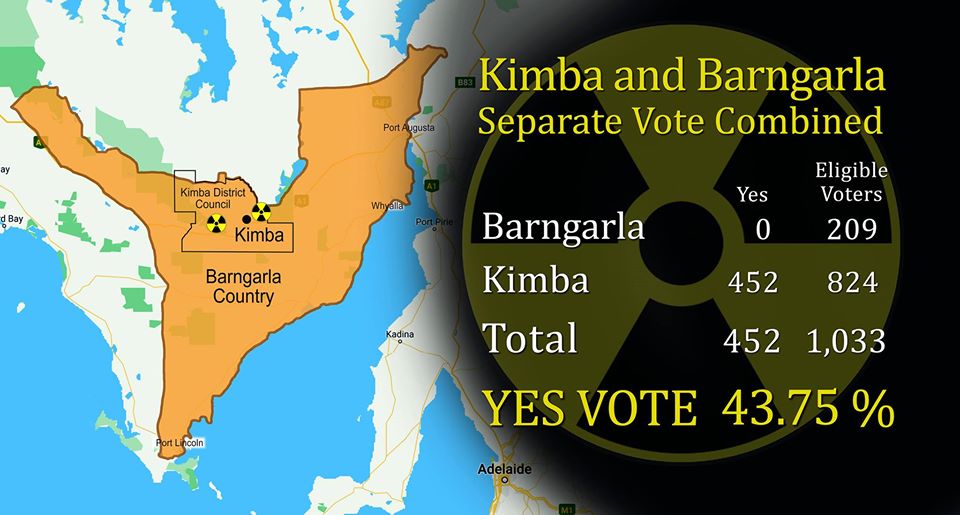
Traditional owners lodge legal challenge to planned Kimba nuclear waste dump, https://www.abc.net.au/news/2021-12-21/barngarla-challenge-kimba-radioactive-waste-facility-napandee/100717404?fbclid=IwAR3QiztQ5454cuTfmjLaBaCb_nK4usDM43TObZV5R
ABC North and West SA / By Declan Gooch, Patrick Martin, and Gillian Aeria Tue 21 Dec 2021 raditional owners on South Australia’s Eyre Peninsula have formally lodged a legal challenge to the federal government’s plan to build a nuclear waste dump in the region.
Key points:
- The Barngarla people have begun legal action against a planned radioactive waste dump
- The federal government wants to build the facility near Kimba
- Traditional owners have complained they were not consulted properly
The government wants to store low and intermediate-level waste at a property called Napandee, near the town of Kimba.
The Barngarla people say they were not included in the consultation process, which included a ballot of ratepayers.
“We don’t want it to be at Kimba because we were excluded from the vote under white man’s law,” Barngarla Determination Aboriginal Corporation chairman Jason Bilney said.
The group filed for a judicial review of the site selection process in the Federal Court on Tuesday.
The ballot of Kimba ratepayers, which the government has repeatedly cited as evidence of community support, showed about 60 per cent of voters were in favour of the plan.
“The government says broad community support — well what broad community support did you have, let alone with the native title holders of Kimba or on the Eyre Peninsula?” Mr Bilney said.
The ballot of Kimba ratepayers, which the government has repeatedly cited as evidence of community support, showed about 60 per cent of voters were in favour of the plan.
“The government says broad community support — well what broad community support did you have, let alone with the native title holders of Kimba or on the Eyre Peninsula?” Mr Bilney said.
He said South Australian law required a parliamentary inquiry if nuclear waste was to be brought in and stored.
“We are going to see continual opposition emerge over the next five to 10 years, and this has got a long way to run.”
He expected the court to decide in the Barngarla group’s favour.
“They have a clear and strong case. They were excluded from the community ballot, and they do have native title rights, and it’s essential the Federal Court stands up and protects those rights.”
The government had initially tried to legislate the location of the facility in a way that would have eliminated the possibility of a judicial review.
It later amended the legislation in response to pressure from Labor so it received the support needed to pass both houses of parliament.
In a statement, resources minister Keith Pitt said the declaration of Kimba as the site for the facility was a “significant step”.
He said his facility was a crucial piece of national infrastructure for Australia’s nuclear medicine industry and nuclear research capabilities.
We froze’: What was this 1.3-metre missile doing at an Aboriginal heritage site?
We froze’: What was this 1.3-metre missile doing at an Aboriginal heritage site?
EXCLUSIVE: An unexploded high-tech missile was discovered at a culturally significant Aboriginal heritage site in remote South Australia. Neither the company that is believed to have made it – nor the Department of Defence – have explained how it got there.
SBS, Tuesday 21 December 2021By Steven Trask, Sarah Collard A group of Aboriginal Traditional Owners was inspecting a culturally significant site in remote South Australia when they discovered a high-tech anti-aircraft missile, a joint investigation by SBS News and NITV can reveal.
The 1.32-metre missile is believed to have been built by a subsidiary of Swedish weapons maker Saab and was found at a registered heritage site called Lake Hart West, about 40 kilometres from the small town of Woomera, in January this year.
Woomera is home to one of the largest weapons ranges in the world and the missile appears to be a similar model to those tested by Australia’s Department of Defence near the town in 2019.
Lake Hart West is important to the Kokatha people of the Western Desert region of South Australia; it is scattered with artefacts, historic shelters and tool-making sites.
“It startled us. There were four of us and we froze about five metres away from it,” says Kokatha man Andrew Starkey, who registered Lake Hart West as a heritage site with the South Australian government in the early 2000s.
“We were worried that there could be other missiles covered by the sand and in the bushes.
“There are over 20 heritage features all within a one-kilometre radius. There are rock engravings only a couple of kilometres away – it’s only through luck that that was not destroyed.”
The conservation of Aboriginal heritage sites has been under intense scrutiny since mining company Rio Tinto blew up the 46,000-year-old Juukan Gorge caves in Western Australia in May 2020.
An inquiry into the disaster found that existing state and Commonwealth laws were failing to protect Aboriginal heritage areas.
The Defence Department maintains it does not test weapons at culturally significant Aboriginal sites. But neither the department nor Saab have addressed questions over why the missile was found at Lake Hart West………………………………………
Human rights lawyer John Podgorelec has been representing the Starkeys as they pursue a complaint under OECD guidelines that govern “responsible business conduct” by foreign companies operating in Australia.
The Australian National Contact Point, which runs the process, said a complaint had been received against an “Australian-based enterprise” in the “defence sector”.
SBS News and NITV have confirmed the complaint relates to Saab.
An entry on the OECD complaint database reads: “Specifically, the issues relate to the discovery of an unexploded ordinance in South Australia by the Starkey Traditional Owners, resulting in risk to personal safety and artefacts of cultural significance.”………… https://www.sbs.com.au/news/we-froze-what-was-this-1-3-metre-missile-doing-at-an-aboriginal-heritage-site/3c67ce10-15ed-442c-b735-cea3673e5caa
Growing opposition to radioactive waste dump

Federal plans for a radioactive waste facility near Kimba on South Australia’s Eyre Peninsula face growing opposition with Barngarla Traditional Owners today launching a Federal Court challenge to Minister Keith Pitt’s decision to site the facility on their lands.
The UN Declaration on the Rights of Indigenous People requires that ‘States shall take effective measures to ensure that no storage or disposal of hazardous materials shall take place in the lands or territories of indigenous peoples without their free, prior and informed consent.’
“The federal plan has many flaws, one of which is poor consultation with the Aboriginal and wider community,” said Australian Conservation Foundation campaigner Dave Sweeney.
“Barngarla have never given consent. Instead, they have been denied a vote in a federal community ballot. This approach is simply not acceptable in the third decade of the 2000s.
“Fewer than a thousand South Australians have had a say in a plan that has profound inter-generational implications.
“The proposed facility is unnecessary given federal parliament’s recent support for a $60 million waste storage upgrade to secure the most problematic intermediate level waste at the federal Lucas Heights nuclear site for the next three to five decades.
“Extended interim storage at Lucas Heights is prudent and possible. Moving intermediate level waste from Lucas Heights – a site with security, radiation monitoring, emergency response and local expertise – to a site near Kimba with far fewer assets and resources is irresponsible and inconsistent with best industry practice.
Sites that store and manage nuclear medicine waste around Australia will still need to do so, irrespective of the status of any national facility, so the Minister’s repeated reference to nuclear waste being spread across 100 sites is disingenuous and inaccurate.
“The planned federal action is contrary to SA state law and does not enjoy bi-partisan political support. The waste plan needs formal environmental and regulatory assessment and approval and is occurring in the context of both state and federal elections in 2022. This issue has a long way to run and will be actively contested.”
For context or comment contact Dave Sweeney on 0408 317 812
ACF’s 3-page background brief on federal radioactive waste plans
Measure twice, cut once: Advancing responsible radioactive waste management in Australia
Massive cask of nuclear waste to arrive in Sydney
Monolithic cask of nuclear waste to arrive, https://www.mandurahmail.com.au/story/7559502/monolithic-cask-of-nuclear-waste-to-arrive/
- Tracey Ferrier 21 Dec 21,
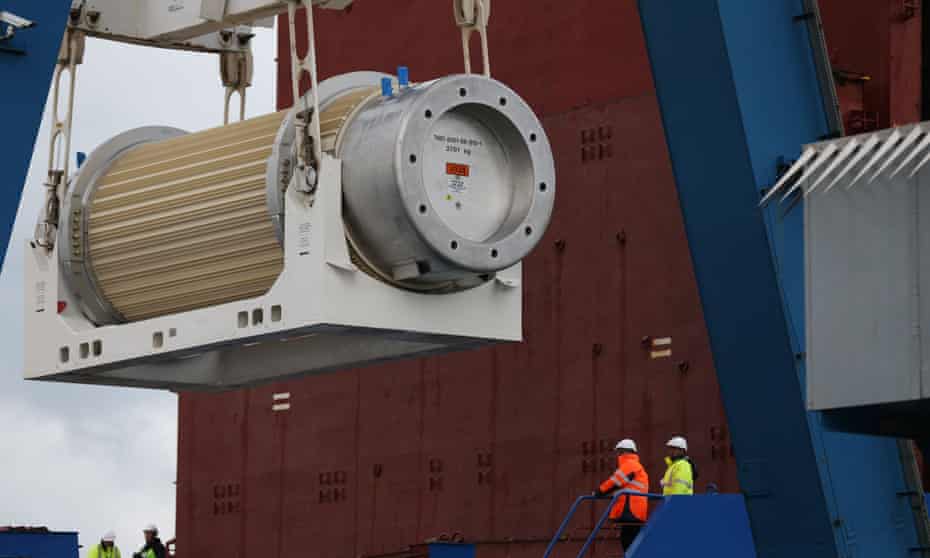
Monolithic cask of nuclear waste to arrive, https://www.mandurahmail.com.au/story/7559502/monolithic-cask-of-nuclear-waste-to-arrive/Tracey Ferrier
A monolithic steel cask designed to withstand an earthquake and a jet strike will arrive in Sydney next year, carrying two tonnes of radioactive waste.
For security reasons authorities won’t say when the hulking capsule – containing four 500kg canisters of ‘intermediate-level material’ – will arrive from the UK.
But it will hardly be an inconspicuous affair: the cask itself weighs 100 tonnes and resembles something from NASA’s space program.
Its forged steel walls are 20cm thick, it’s 6.5m long and three metres wide.
Back in 2015, when the first cask of its type arrived, it was carrying 20 tonnes of Australian nuclear waste that had been reprocessed in France.
About 600 police and security officers were involved in the mission to truck it from Port Kembla, near Wollongong, to Lucas Heights, the southern Sydney suburb that serves as the country’s nuclear technology hub.
It is safe to assume that next year’s arrival will involve an equally elaborate, high-security operation.
The Australian Nuclear Science and Technology Organisation operates the Lucas Heights compound.
It was home to the High Flux Australian Reactor (HIFAR), which supported nuclear medicine and science before it was closed in 2007 and superseded by the Open Pool Australian Lightwater reactor, also at Lucas Heights.
The waste that’s due to arrive in 2022 is from HIFAR’s operations and ANSTO says the material is being “repatriated” under the international principle that countries must be responsible for their nuclear leftovers.
However what’s coming won’t actually be what is left of the 114 spent fuel rods HIFAR sent to the UK for reprocessing in 1996.
The Australian Nuclear Science and Technology Organisation operates the Lucas Heights compound.
It was home to the High Flux Australian Reactor (HIFAR), which supported nuclear medicine and science before it was closed in 2007 and superseded by the Open Pool Australian Lightwater reactor, also at Lucas Heights.
The waste that’s due to arrive in 2022 is from HIFAR’s operations and ANSTO says the material is being “repatriated” under the international principle that countries must be responsible for their nuclear leftovers.
However what’s coming won’t actually be what is left of the 114 spent fuel rods HIFAR sent to the UK for reprocessing in 1996.
“Specifically it’s not the material we sent, it’s an equivalent, almost swapping the material that came from reprocessing our waste, for equivalent material that was produced at another UK site.”
Mr Griffiths says the UK had to demonstrate that what will be sent to Australia is “within the measurement boundaries” of the accepted definition of intermediate level waste, which can remain radioactive for thousands of years.
ANSTO also had to satisfy the national regulator on that point.
While saving money wasn’t the objective, Mr Griffiths says the waste exchange agreement means taxpayer-funded ANSTO will save $12 to $13 million in shipping costs.
ANSTO’s Pamela Naidoo-Ameglio has promised the cask’s arrival will be a “routine and safe operation”
“This will be the second repatriation project and 12th successful transport of spent fuel or reprocessed waste which ANSTO has carried out since 1963,” she said in a statement on Monday.
“For all of the obvious and standard security reasons, we can’t comment on the specific route or timing of this transport.”
The new cask will sit alongside the original one at Lucas Heights until Australia’s new national nuclear waste storage facility is constructed at Napandee, near Kimba, on South Australia’s Eyre Peninsula.
The facility is up to the design phase and is being contested by Indigenous owners, so the casks are likely to remain at Lucas Heights for a number of years.
Once Napandee is operational, the casks will be moved there and stored, pending a final solution that will involve deep burial.
Australia’s radioactive waste results from nuclear medicine, research endeavours and industrial applications. Australia does not produce nuclear power.
A free press, a free Julian Assange – would be the best gift for the world

Proposed National Radioactive Waste Facility: Implications and Options for South Australia

Proposed National Radioactive Waste Facility: Implications and Options for SA, https://www.conservationsa.org.au/kimba_report, After a controversial process that has torn apart the previously close-knit Kimba community, Federal Resources Minister Keith Pitt (Liberal National Party – Qld) has formally declared the Napandee area near Kimba in the Eyre Peninsula grain belt as the proposed site for Australia’s first dedicated national radioactive waste facility – the National Radioactive Waste Management Facility (NRWMF).
The planned facility is not consistent with international best practice, and waste will be placed in temporary storage without a plan for what happens next.
The government says this will take decades while the federal nuclear regulator says it could take a century. Yet, there is a safer and cheaper alternative: keep the waste where most is currently stored at the Australian Nuclear Science and Technology Organisation’s (ANSTO) Lucas Heights facility south of Sydney, and only move it once a long-term site to house Australia’s long-lived intermediate-level waste is identified.
It simply does not make sense for the waste to be sent on a temporary basis to SA. Especially as it is fiercely opposed by the Aboriginal Traditional Owners – the Barngarla people and many regional grain producers. Further, the federal plan is illegal under SA law.
Defence scrambles to train nuclear scientists for ‘exciting roles’ on AUKUS programme.

Defence scrambles to train nuclear scientists for ‘exciting roles’ on AUKUS program
ABC, by defence correspondent Andrew Greene 19 Dec 21, Students and public servants are being enticed with generous scholarships to study nuclear science and engineering so they can begin “exciting roles” on the massive AUKUS submarine program.
Key points:
- Defence expects to offer more than 300 scholarships
- The program will train graduates to work in the nuclear-powered submarine program
- The scholarships are worth approximately $20,000 per student yearly
Defence is scrambling to find hundreds of properly qualified staff for the mammoth task of acquiring a nuclear-powered submarine fleet with the help of the UK and US.
| The ABC can reveal Defence is establishing a nuclear scholarship program from next year, offering scholarships worth approximately $20,000 per student per year. Over the next five years Defence expects to offer over 300 scholarships and has launched a separate initiative to sponsor existing staff to undertake nuclear-related Masters courses. ………………….An existing Defence STEM (science, technology, engineering and mathematics) Cadetship Program is also being expanded to target nuclear-related studies, with cadets entering trainee positions in the department…………….. https://www.abc.net.au/news/2021-12-19/defence-staff-studying-nuclear-science-aukus-program/100710264 |
Traditional Owners and environment groups vow to fight Mulga Rock uranium decision

Traditional Owners and national and state environment groups say a decision
by the Department of Water and Environmental Regulation to allow a
controversial uranium mine in WA’s Goldfields to proceed is unjustified and
inconsistent with the evidence.
The Mulga Rock uranium project has been declared to have met an important
‘substantial commencement’ condition that is required to maintain crucial
environmental approvals.
A condition of the Mulga Rock approvals – issued by the former Barnett government
– was that the proponent, Vimy Resources, must “substantially commence” mining
by 16 December 2021. Failure to meet that condition would have prevented the
company from pursuing the mine.
The company has failed to meet with the Upurli Upurli Nguratja registered Native
Title claim group, which is entitled to negotiate on an Area Use Agreement.
The company has continually failed to engage with and respect Traditional Owners
or understand processes and protocols on meeting with the claimant group.
Campaigners say to advance the project without consulting with the group is
disrespectful and out of step with community expectation and best industry practice.
“It’s very clear that as a native title group we don’t want uranium mining on our
country,” said Upurli Upurli Nguratja claimant Debbie Carmody. “This decision has
sidelined our voice and undermined the Native Title process”.
“Any progress to continue to develop this mine is done without consent and without
even having met with our claim group. We have been let down by the company and
now by the Government.
“We will continue to fight this project and stand up for our country and culture.”
Conservation Council of WA (CCWA) Nuclear Free campaigner Mia Pepper said it
was fanciful to say the project has substantially commenced.
“We will continue to fight this project and stand up for our country and culture.”
Conservation Council of WA (CCWA) Nuclear Free campaigner Mia Pepper said it
was fanciful to say the project has substantially commenced.
The Australian Conservation Foundation’s Nuclear Free campaigner Dave Sweeney
said while the company had done some premature and destructive clearing at the
site, it was not substantial
“If this mine proceeds it would cause unacceptable harm to the environment,
including damage to vital habitat for the endangered sandhill dunnart, which is found
in only a handful of locations across Australia.
“Vimy does not have the necessary finance and has not made a Board level decision
to pursue this mine. It still needs a range of approvals, permits, licences and
agreements.”
The Conservation Council of WA and the Australian Conservation Foundation, which
have opposed uranium mining in WA for several decades, are reviewing today’s
decision and exploring all available avenues to stop this mine from proceeding.
Environmentalists and Traditional Owners very dissatisfied with Western Australia’s Environment Department ‘s ruling supporting uranium project.
Green groups angry over uranium project milestone, Stuart McKinnonThe West Australian, 16 Dec 21,
Environmentalists are livid after Vimy Resources was deemed to have met a key milestone in its approvals process that allows it to pursue the development of its Mulga Rock uranium project.
The Department of Water and Environmental Regulation has ruled that the company has begun “substantial commencement” of the project 290km east of Kalgoorlie, an essential component of its approval five years ago.
The former Barnett Government approved the controversial project on December 16, 2016, but ordered that Vimy must have substantially commenced work within five years.
The company had submitted to the DWER that substantial works had begun last month based on the recent clearing of about 143ha, expenditure of more than $20 million over the past five years and a further $8m to be spent on early works before the end of January.
But green groups and Traditional Owners say the decision to allow the project to proceed is unjustified and inconsistent with the evidence.
A statement released jointly by the Upurli Upurli Nguratja claimants and the WA Conservation Council argued the company had failed to meet with the registered Native Title claim group, which is entitled to negotiate a land use agreement.
They say to advance the project without consulting with the group is disrespectful and out of step with community expectation and best industry practice.
Vimy’s works to date have been a clumsy last-minute attempt to hold on to controversial environmental approvals for a toxic commodity that has no social licence.
Upurli Upurli Nguratja claimant Debbie Carmody said the decision had sidelined the group’s voice and undermined the Native Title process.
“We will continue to fight this project and stand up for our country and culture,” she said.
CCWA Nuclear Free campaigner Mia Pepper said it was fanciful to say the project had substantially commenced.
“Vimy’s works to date have been a clumsy last-minute attempt to hold on to controversial environmental approvals for a toxic commodity that has no social licence,” she said.
Ms Pepper said the clearance work completed to date represented just 4.27 per cent of the intended clearing and the company’s expenditure represented just 2.2 per cent of the total estimated capital costs.
The Australian Conservation Foundation’s Nuclear Free campaigner Dave Sweeney said the mine would cause unacceptable harm to the environment, including damage to vital habitat for the endangered sandhill dunnart, which is found in only a handful of locations across Australia.
The CCWA and the ACF, which have opposed uranium mining in WA for decades, said they were reviewing today’s decision and exploring all avenues to stop the mine from proceeding.
Vimy executive director Steven Michael said the confirmation of substantial commencement was testament to careful planning and executive by the company and was consistent with the Mulga Rock Project Implementation Plan.
“Vimy can now advance Mulga Rock to the next stage of development and will continue to work closely with State and Federal departments to secure the remaining approvals required to bring the project into production by 2025,” he said.
However Vimy is yet to make a final investment decision or nail down a funding solution for the $US255m ($355m) project.
Its shares closed up 1.5c, or 8 per cent, at 20.5c on Thursday.
The disgraceful case mounted against Assange by a corrupt U.S. Department of Justice and their hired guns in Britain.

It is this institutional lying and duplicity that Julian Assange brought into the open and in so doing performed perhaps the greatest public service of any journalist in modern times.
JOHN PILGER: U.S. wins extradition appeal against Julian Assange, Independent Australia, By John Pilger | 11 December 2021, ”…….. Miscarriage of justice is an inadequate term in these circumstances. It took the bewigged courtiers of Britain’s ancien regime just nine minutes on Friday to uphold an American appeal against a District Court judge’s acceptance in January of a cataract of evidence that hell on Earth awaited Assange across the Atlantic: a hell in which, it was expertly predicted, he would find a way to take his own life.
Volumes of witness by people of distinction, who examined and studied Julian and diagnosed his autism and his Asperger’s Syndrome and revealed that he had already come within an ace of killing himself at Belmarsh Prison, Britain’s very own hell, were ignored.
The recent confession of a crucial FBI informant and prosecution stooge, a fraudster and serial liar, that he had fabricated his evidence against Julian was ignored. The revelation that the Spanish-run security firm at the Ecuadorean embassy in London, where Julian had been granted political refuge, was a CIA front that spied on Julian’s lawyers and doctors and confidants (myself included) — that, too, was ignored.
The recent journalistic disclosure, repeated graphically by defence counsel before the High Court in October, that the CIA had planned to murder Julian in London — even that was ignored.
Each of these “matters”, as lawyers like to say, was enough on its own for a judge upholding the law to throw out the disgraceful case mounted against Assange by a corrupt U.S. Department of Justice and their hired guns in Britain. Julian’s state of mind, bellowed James Lewis, QC, America’s man at the Old Bailey last year, was no more than “malingering” — an archaic Victorian term used to deny the very existence of mental illness.
To Lewis, almost every defence witness, including those who described from the depth of their experience and knowledge the barbaric American prison system, was to be interrupted, abused, discredited. Sitting behind him, passing him notes, was his American conductor: young, short-haired, clearly an Ivy League man on the rise.
In their nine minutes of dismissal of the fate of journalist Assange, two of the most senior judges in Britain, including the Lord Chief Justice, Lord Burnett (a lifelong buddy of Sir Alan Duncan, Boris Johnson’s former Foreign Minister who arranged the brutal police kidnapping of Assange from the Ecuadorean embassy) referred to not one of a litany of truths aired at previous hearings in the District Court.
These were truths that had struggled to be heard in a lower court presided over by a weirdly hostile judge, Vanessa Baraitser. Her insulting behaviour towards a clearly stricken Assange, struggling through a fog of prison-dispensed medication to remember his name, is unforgettable.
What was truly shocking on Friday was that the High Court Judges – Lord Burnett and Lord Justice Timothy Holroyde, who read out their words – showed no hesitation in sending Julian to his death, living or otherwise. They offered no mitigation, no suggestion that they had agonised over legalities or even basic morality.
Their ruling in favour, if not on behalf of the United States, is based squarely on transparently fraudulent “assurances” scrabbled together by the Biden Administration when it looked in January like justice might prevail.
These “assurances” are that once in American custody, Assange will not be subject to the Orwellian SAMs – Special Administrative Measures – which would make him an un-person; that he will not be imprisoned at ADX Florence, a prison in Colorado long condemned by jurists and human rights groups as illegal: “a pit of punishment and disappearance”; that he can be transferred to an Australian prison to finish his sentence there.
The absurdity lies in what the Judges omitted to say. In offering its “assurances”, the U.S. reserves the right not to guarantee anything should Assange do something that displeases his gaolers. In other words, as Amnesty International has pointed out, it reserves the right to break any promise.
There are abundant examples of the U.S. doing just that. As investigative journalist Richard Medhurst revealed last month, David Mendoza Herrarte was extradited from Spain to the U.S. on the “promise” that he would serve his sentence in Spain. The Spanish courts regarded this as a binding condition.
Medhurst wrote:
‘Classified documents reveal the diplomatic assurances given by the U.S. Embassy in Madrid and how the U.S. violated the conditions of the extradition. Mendoza spent over six years in the U.S. trying to return to Spain. Court documents show the United States denied his transfer application multiple times.’
The High Court Judges – who were aware of the Mendoza case and of Washington’s habitual duplicity – describe the “assurances” not to be beastly to Julian Assange as a “solemn undertaking offered by one government to another”. This article would stretch into infinity if I listed the times the rapacious United States has broken “solemn undertakings” to governments, such as treaties that are summarily torn up and civil wars that are fuelled. It is the way Washington has ruled the world, and before it Britain — the way of imperial power, as history teaches us.
It is this institutional lying and duplicity that Julian Assange brought into the open and in so doing performed perhaps the greatest public service of any journalist in modern times.
Julian himself has been a prisoner of lying governments for more than a decade now. During these long years, I have sat in many courts as the United States has sought to manipulate the law to silence him and WikiLeaks………….. https://independentaustralia.net/life/life-display/john-pilger-us-wins-extradition-appeal-against-julian-assange,15842
Protesters say no to AUKUS nuclear submarine deal
- Protesters say no to AUKUS nuclear submarine deal, Mandurah Mail, Claire Sadler 15 Dec 21,
Canning MP Andrew Hastie has hit back at the Greens party, calling members “nuts” following protests outside his Mandurah office this week.
The Greens, along with other community groups, say they are lobbying to stop the Liberal’s AUKUS deal – which would see Australia’s first nuclear-powered submarines in WA waters under a partnership with the United States and United Kingdom…………
On Friday, Greens MP Jordon Steele-John, former MP Jo Vallentine, and Conservation Council nuclear free campaigner KA Garlick presented a dossier of statements to Mr Hastie – who is also Assistant Defence Minister.
The dossier outlined anti-AUKUS statements from groups such as the Australian Conservation Foundation, the Medical Association for the Prevention of War, the International Campaign against Nuclear Weapons, and Amnesty International.
Mr Steele-John said the Liberal government was trying to implement the AUKUS deal for two reasons alone.
To be able to escalate tensions so they can use the threat of war to win an election and because their party takes money from the very weapons manufacturers that will profit from these projects,” he said.
“The Morrison government is engaged in war mongering with China and the Assistant Defence minister and the Defence minister are complicit in that war mongering.
“They’re using a faux threat of war for political purposes and it is a shameful thing to do.”
Mr Steele-John said the Liberals had proposed to base the nuclear submarines in WA with no community consultation, without mediating the danger, and without detailing how much money it would cost………..
An 18-month consultation period for the nuclear submarine deal would determine workforce and training requirements, production timelines and safeguards on nuclear non-proliferation agreements.
During this time, The Greens say they will continue to protest the AUKUS nuclear-powered submarine deal. https://www.mandurahmail.com.au/story/7547141/andrew-hastie-hits-back-at-greens-anti-nuclear-submarines-stance/
Classified Documents Invalidate United States’ Appeal Against Assange — Richard Medhurst
‘‘I’m scared that will be Assange. They will make him go nuts.”
“I’m a nobody. If they’re capable of doing this to me, just imagine what they can do to Assange.”
The United States Broke Diplomatic Assurances for David Mendoza, It Will Do the Same with Julian Assange Richard Medhurst’s Newsletter
| Richard MedhurstNov 29 |
| Richard Medhurst Nov 29 In 2009, David Mendoza Herrarte was extradited from Spain to the United States, on condition he be allowed to serve his sentence in SpainClassified documents reveal the diplomatic assurances given by the U.S. Embassy in Madrid and how the U.S. violated the conditions of his extraditionMendoza spent over 6 years in the United States trying to return to Spain. Court documents show how the United States denied his transfer application multiple timesWhile in prison, Mendoza sued the United States, and Spain for failing to uphold the conditions of his extradition and violating his human rights. His case was recently taken up by the United Nations |
- Mendoza’s case was raised last month in the English High Court, where the United States is attempting to extradite Julian Assange to the U.S.
- The United States has offered similar diplomatic assurances that Assange could serve a sentence in Australia
- Assange’s lawyers cite Mendoza’s case as evidence that these assurances cannot be trusted
- James Lewis, the lead U.S. prosecutor, said that these assurances are bulletproof. He told the High Court that, “The United States have never broken a diplomatic assurance, ever”. Court documents and diplomatic assurances obtained by Richard Medhurst show this to be untrue
- David Mendoza Herrarte was born and raised in the United States. His mother being from Spain, he would go there every summer, describing it to me as his second home. He is both an American and Spanish national.
Mendoza was wanted by the United States for drug trafficking. In the early 2000s, he used helicopters to transport marijuana, known commonly as BC Bud, from Canada across the U.S. border into Seattle. Today, marijuana is legal in Seattle……………………………………………… - The diplomatic assurance did not specifically state that Mendoza would be sent to Spain to serve his sentence. It only said that the United States “does not object to Mendoza making an application to serve his sentence in Spain”– something the United States cannot object to anyway, as it is every prisoner’s right to apply for a treaty transfer.
Mendoza tells me, “This shows the deviance of these people. They use this ambiguous language on purpose. There’s precedent in federal court that if they don’t specifically agree to the transfer, it’s not valid”.
Recently, the United States offered similar diplomatic assurances to the United Kingdom, namely that Assange could could serve a sentence in his home country of Australia.
Mendoza says for this to be valid, the diplomatic assurances from the U.S. must explicitly state in advance that the U.S. Department of Justice and Australia accept Assange’s transfer— otherwise it’s meaningless.
“With the Assange thing, I can see it black and white. They [Australia] are not going to do a thing. Under the treaty, all three parties must agree: Julian, Australia, and the United States. But the U.S. can tell Australia behind the scenes: ‘screw this guy, don’t do anything’.”
- The Convention on the Transfer of Sentenced Persons specifically states under Article 3 (f) that a sentenced person may be transferred “if the sentencing and administering States agree to the transfer.” (The administering state meaning Australia)Being one of the few journalists to cover Assange’s extradition, I can confirm that as of now Australia has not given any indication that it would accept Julian Assange’s request to serve a sentence there, should he apply……….
- April 2009: David Mendoza Herrarte is extradited to the United States
After signing the Acta de Entrega, Mendoza was officially under U.S. jurisdiction. He recalls being handed over to U.S. authorities: “The first thing they do when they get you, is they strip you naked. The marshals look in your mouth, your ass, your ears, every orifice. They attempt to humiliate you in every fashion: ‘Squat! Now do this…’. They tell you: you’re under US jurisdiction now, and our law is what is going to apply to you.”
June 2009: Once in the United States, Mendoza took part in what is known as an arbitration hearing or settlement conference. This is where plea bargains are hashed out in the presence of the judge, between prosecutors and defendant……………………………………………
- It now became clear that the United States never intended to send Mendoza back to Spain. They had squeezed him for every last penny, then violated the diplomatic assurances given to Spain………….
- Mendoza expects the United States government will play the same trick on Assange if they refuse to send him to Australia and he contests it in court.“Within that note, it must specifically state that Julian has a right to contest non-compliance of the United States, even as a non-signatory to the treaty. Because the US will start playing games.”…………….
- Instead of being sent to Spain immediately to carry out his sentence, Mendoza was told to apply for a treaty transfer. He applied, and the answer from the United States was ‘no’……………
In total, Mendoza applied three times for treaty transfer to Spain. All three applications were denied, violating the conditions of his extradition. Each time he applied, he had to wait 8 months for a decision, and even longer to apply again. The denial states: “There is no administrative appeal from this decision. Unless otherwise noted above, the prisoner may reapply two years after this denial.”
Mendoza told me: “That’s when I realized I’m in the wrong court. I’m going to get nothing here. ……………………..
The other assurance offered by the United States appears to state that Assange would not be jailed at ADX Florence or placed under oppressive prison conditions known as Special Administrative Measures (SAMs).
Similiar to those offered for Mendoza, the assurances for Assange are ambiguous and vaguely-worded. The United States says he will not be subject to SAMs or imprisoned at ADX unless “in the event that, after entry of this assurance, he was to commit any future act that met the test for the imposition of a SAM pursuant to 28 C.F.R. § 501.2 or § 501.3”
Once in U.S. custody, the United States could simply allege that Assange did something that “met the test for the imposition of a SAM”, place him in isolation, and then claim that it never violated its assurances, because it already gave itself a backdoor to do so.
This is why Mendoza told me that assurances must be explicitly spelled out, with no room for derogation.
Assange’s extradition was blocked by a UK judge in January 2021, on grounds that U.S. prison conditions would be too oppressive, leading him to commit suicide.
While in the U.S., Mendoza was imprisoned at a medium-high security facility in Englewood, Colorado. This is near ADX Florence, where Assange is likely to be sent.
“Believe me, European prisons aren’t nice. But U.S. prisons are much worse. I was in Colorado, one of the biggest s–tholes I’ve ever been to. It was dirty; they let you out of your cell one hour a day– when they decided, not when I wanted.”…….. It’s 3am, for example, they would buzz you and say: do you want your hour of recreation?”. Prisoners who declined would not be able to leave their cell until the next day.
Mendoza explained to me the process of dehumanization and sleep deprivation in prison: “You don’t have a name; you have a number, and you have to repeat it during every count. Counts are every three hours in higher security federal prisons. Another thing guards would do is instead of pointing their flashlight up to the ceiling, they would flash it right in your face.”
“I’m scared that will be Assange. They will make him go nuts. The only thing that kept me sane is this legal work; writing to the judges and the press, going after the United States in civil court.”
What Mendoza went through is a step down from what Assange would be in. Not only is ADX Florence a federal super-maximum prison, but Assange would also be placed under Special Administrative Measures (SAMs), in extreme isolation.
Mendoza tells me that visitation had to be approved by specific people. ……………………
Mendoza’s case is an incredible story on its own merits.
Nevertheless, it must be examined in the context of Assange’s extradition. When James Lewis told High Court judges that “the United States have never broken a diplomatic assurance, ever”— this is simply untrue.
The above documents [on original] make it clear that the United States violated its agreement and broke diplomatic assurances to Spain. Mendoza was to be returned to Spain to carry out his sentence, instead he spent six years and nine months in various U.S. prisons. Only after suing both the United States and Spain— his own countries— for failing to enforce the conditions of his extradition, was he allowed to return. Only after the Spanish Supreme Court ruled in his favor, threatening the U.S.-Spain Extradition Treaty itself, could he compel the United States to enforce the conditions of his extradition and return him to Spain.
Mendoza was fortunate enough to have the Spanish Supreme Court, senior judges and public on his side. Were the United States to violate the assurances of Assange’s extradition, it is extremely unlikely given the “Special Relationship” between the U.K. and U.S., that Assange would be able to successfully lobby the British government into compelling the U.S. to uphold the conditions of his extradition.
James Lewis told the English High Court that diplomatic assurances are “solemn undertakings, given out at the highest order; they are not dished out like smarties”. He is correct. It is therefore incumbent on the Court to consider what happened to Mendoza, for whom the United States did offer diplomatic assurances, and assess whether those offered for Assange are adequate, but more importantly, whether they can be enforced once he is no longer under British jurisdiction.
Mendoza’s experience shows that for Assange, any diplomatic assurances or agreements must be written in explicit language and signed by all parties, including Assange, so that in the eventuality of non-compliance, he may be afforded the opportunity to contest this in court, despite his status as a non-signatory of the United Kingdom-United States Extradition Treaty.
Mendoza’s case offers the Court extraordinary insight into the innerworkings of American diplomacy, legal proceedings, and extradition to the United States. It is a serious warning which High Court Justices should heed, who at their discretion, have the power to prevent gross miscarriages of justice which gravely imperil the respondent, before they arise.
“I’m a nobody. If they’re capable of doing this to me, just imagine what they can do to Assange.” https://richardmedhurst.substack.com/p/mendoza
Australian taxpayers up for $170Billion, for American nuclear submarines. No problem?
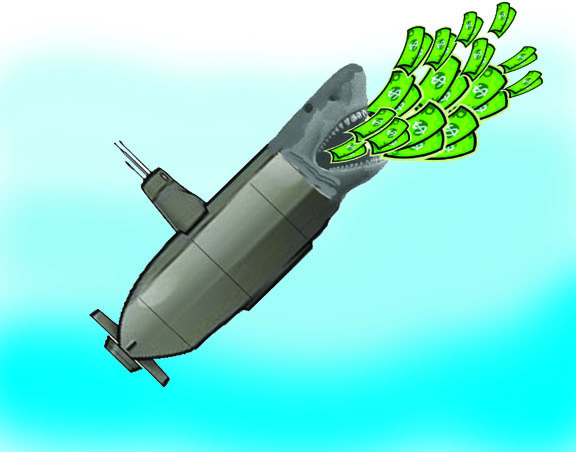
Australia’s Aukus nuclear submarines could cost as much as $171bn, report finds
Australian Strategic Policy Institute report calls project ‘most complex endeavour Australia has embarked upon’ Guardian, Tory Shepherd, Tue 14 Dec 2021
Australia’s eight planned nuclear submarines will cost $70bn at an “absolute minimum” and it’s “highly likely” to be more than that, defence analysts say.
With inflation, the cost could be as high as $171bn, according to a new report from the Australian Strategic Policy Institute.
The thinktank’s report contained a series of estimates ranging from low to high and conceded that estimating the final cost of the project is necessarily an “extremely assumption-rich activity”…………
The prime minister, Scott Morrison, has said the planned nuclear-powered submarines, part of the Aukus deal with the United States and the United Kingdom, would likely cost more than the scrapped plan for conventional submarines, which would have cost $90bn……..
Australia will partner with either the US or the UK to buy their boat designs, and a nuclear-powered submarine taskforce is working through the details
“We haven’t determined the specific vessel that we will be building, but that will be done through the rather significant and comprehensive program assessment that will be done with our partners over the next 12 to 18 months,” Morrison said in September.
“Now, that will also inform the costs that relate to this, and they are yet to be determined.”
The authors of the Aspi report, Implementing Australia’s Nuclear Submarine Program, wrote that while the Aukus deal has seemed to move fast, the enterprise would still be “a massive undertaking and probably the largest and most complex endeavour Australia has embarked upon”.
“The challenges, costs and risks will be enormous. It’s likely to be at least two decades and tens of billions of dollars in sunk costs before Australia has a useful nuclear-powered military capability…….
The Aspi report co-author Dr Marcus Hellyer told Guardian Australia the government needed to work out its priorities and would need to balance capability needs, scheduling and the Australian industry content. He emphasised that picking which submarine to build was “secondary” to picking a strategic partner.
The US is building submarines at a rate 10 times higher than the UK, he said……….
The report canvasses other issues that will need to be resolved.
There are likely to be legislative changes needed to allow nuclear reactors in Australia. The government should consider appointing an internal nuclear regulator, an inspector general of nuclear safety, and how it will responsibly dispose of radioactive waste once the reactors that power the submarines reach the end of their useful lives…….. https://www.theguardian.com/world/2021/dec/14/australias-aukus-nuclear-submarines-estimated-to-cost-at-least-70bn
 | ReplyForward |
1 This month
7 April – WEBINAR – Australia and the Doomsday Clock – Preventing nuclear war through NoFirstUse and other policies
Online | Tuesday April 7, 4:00-5:30pm, Australian Eastern Time / 8:00-9:30am Central Europe Time
– Access the registration link
15 April – Zoom –Nuclear Power is Not the Solution
Apr 15, 2026 01:00 AM in Canberra, Melbourne, Sydney

Join the International Physicians for the Prevention of Nuclear War (IPPNW) on Tuesday, April 14th for a timely webinar exploring the risks associated with nuclear power and challenging the myth that it offers a simple, safe, carbon-free solution to the climate crisis

21 April Webinar: No Nuclear Weapons in Australia
Start: 2026-04-21 18:00:00 UTC Canberra, Melbourne, Sydney (GMT+10:00)
End: 2026-04-21 19:30:00 UTC Canberra, Melbourne, Sydney (GMT+10:00)
Event Type: Virtual
A virtual link will be communicated before the event.
Host Contact Info: australia@icanw.org

of the week – Australians for War Powers Reform (AWPR)
To see nuclear-related stories in greater depth and intensity
 Antinuclear