The Australian government is complicit with USA and UK imperilling the health of Julian Assange, may well cause his death.
AUKUS alliance driving Assange to his death, https://independentaustralia.net/life/life-display/aukus-alliance-driving-assange-to-his-death,15904, By John Jiggens | 6 January 2022, The actions of the U.S., UK and Australia are imperiling the health of Julian Assange and could result in the tragic death of the publisher, writes John Jiggens.
THE NEWS THAT Julian Assange has suffered a stroke while detained in London’s Belmarsh Prison has strengthened the fears of Assange supporters that the AUKUS alliance is comfortable with the WikiLeaks’ founder’s death at their hands.
But would an Australian Government be complicit in a plot against one of its own citizens?
Consider these recent stories.
In September 2021, Yahoo! News revealed that Mike Pompeo, who was the CIA Director in 2017, became party to a scheme to kidnap Assange from the Ecuadorean Embassy or to assassinate him.
The Yahoo! investigation was based on conversations with 30 former U.S. officials. Among those interviewed, eight provided details on plans to kidnap Assange.
Greg Barns SC, a barrister and advisor to Julian Assange, told Bay FM:
“It was like something out of a James Bond film, except sadly, it was very true. There was a clear plan to take Assange out. We now have the Australian Government on notice that one of its citizens was the subject of a conspiracy to murder plot by the CIA.”
Further, he remarked:
The conduct of the CIA was outrageous, unlawful and represents a complete breach of the so-called alliance or friendship between Australia and the United States.
The CIA acts essentially as a criminal enterprise. It is state-sanctioned criminality. To be overtly planning to murder someone in any circumstances would amount to a conspiracy to murder for anyone else and the persons would face very serious criminal charges.
The Yahoo! report prompted prominent Assange supporters to write to Prime Minister Scott Morrison, asking if the Australian Government accepted the behaviour of an ally plotting to murder an Australian citizen and questioning whether Australian intelligence agencies participated in the plot or were notified about it.
Five weeks passed while Morrison’s office composed a 100-word reply.
It acceped no responsibility or accountability whatsoever. Indeed, Morrison’s reply did not deny Australian involvement or knowledge of the plot.
Instead it passed the buck, advising:
Concerns about the legality or propriety of the activities of Australian intelligence agency are best directed to the IGIS, the Inspector General of Intelligence and Security.’
During the UK High Court extradition appeal in October, the Courier Mail ran another story, titled ‘Assange snubbed Aussie help 29 times, says Payne’.
Why, in the middle of Assange’s High Court hearing, was Foreign Minister Marise Payne using her friends in the Murdoch media to portray Assange as un-Australian, snubbing her patriotic ‘’Aussie help’’?
Assange’s father John Shipton commented:
“I get no help from Marise Payne in any way whatsoever. Saying I have been snubbed 29 times by Julian is to defend her. It’s only to defend her. It’s nothing to do with Julian.”
The family have continually asked for Payne and Morrison to actively engage with Australia’s UK and U.S. allies. They see extradition as an outrageous surrender of Australian sovereignty and they expect that Morrison and Payne should tell UK Prime Minister Boris Johnson and U.S. President Joe Biden so.
Shipton, who has travelled to 50 countries to garner support for Julian, said:
“Everywhere I go, people ask where is the Australian Government in this? What is the substance of Australia in its relationship with the UK that it allows this show trial to go on without comment?”
Australia’s ambitious weapons plan -Joint Air Battle Management System (JABMS) AIR-6500

Move Over Nuclear Subs & F-35 Stealth Fighters, This Weapon System Is The ‘Most Ambitious’ Military Project In Australia, The Eurasian By Sakshi Tiwari– January 4, 2022 Australia, a key player in the Indo-Pacific region, has been making concerted efforts to increase its military capability. From hosting the first Marine Rotational force in 2011 to signing the AUKUS pact for a nuclear submarine, Australia has come a long way.
So far, the big projects the Australian Defence Force (ADF) has undertaken are for submarines, combat reconnaissance vehicles, F-35 fifth-generation stealth fighters, infantry fighting vehicles among others.
Now, the country is pursuing its most ambitious military project — the indigenous Joint Air Battle Management System (JABMS), which could be a game-changer in the near future. The JABMS, also called AIR-6500, forms the core of the future Integrated Air and Missile Defense capabilities, according to the Australian Defence Magazine.
The AIR 6500 is the cornerstone of the Royal Australian Air Force’s fifth-generation archway. Its goal is to bring all platforms and sensors from all warfighting domains together in a single interface that can track threats, organize a combined response, and guide that response toward the target. It’s emblazoned with the phrase “all sensor, best shooter.”

In August of last year, the Australian Department of Defense (DoD) chose Lockheed Martin and Northrop Grumman for the AIR6500 Phase I project, as previously reported by Airforce Technology.
(Ed. note: They have the nerve to call this ”indigenous technology)
Australia currently relies on Space-Based Infrared System (SBIRS) for surveillance, and one possibility for the next-generation OPIR satellites which are in the works would be to maintain this reliance. Both these systems are US-made………………..
The technology being provided to Australia comes from the US Army’s Integrated Air Missile Defense Battle Command System, which is at the heart of the US Army’s next-generation air and missile defense capacity, according to Zeitz. To put it another way, this model is an ‘all sensor, greatest shooter’ model.
“There are a large number of people who are actively working on AIR 6500 today and the majority of them are in Australia,” Steve Froelich, Lockheed Martin Australia (LMA) program executive for AIR 6500, said………………
The relationship between Australia and China remains strained due to the former’s participation in Quad [US, Japan, Australia and India], which China has termed as the Asian NATO. Canberra becoming a part of AUKUS for the acquisition of nuclear submarines has made matters worse.
https://eurasiantimes.com/move-over-f-35-nuclear-subs-this-weapon-most-ambitious-australia/—
The Australian government’s Kimba nuclear waste decision rides roughshod over Australia’s obligations under international law

United Nations Declaration on the Rights of Indigenous Peoples
The Australian Human Rights Commission advised that Article 29(2) of the United Nations Declaration on the Rights of Indigenous Peoples states that ‘no storage of hazardous materials shall take place on Indigenous lands without their free, prior and informed consent.’ 265
1.255 The Commission submitted that in order for Indigenous people to make informed consent, adequate resourcing to representative groups needs to be provided to ensure appropriate and informed consultation. 267
EXTRACT FROM REPORT BY FORMER SPECIAL RAPPORTEUR VICTORIA TAULI-CORPUZ IN SEPTEMBER 2017 FOLLOWING HER VISIT TO AUSTRALIA IN MARCH 2017
Self-determination and participation
When Australia officially endorsed the United Nations Declaration on the Rights of Indigenous Peoples in 2009, the Government stated its intent was to reset relations between Indigenous and non-Indigenous Australians and to build trust in order to work together to overcome the legacy of the past and shape the future together. Furthermore, in Australia’s pledge as a candidate to the United Nations Human Rights Council 2018-2010, it committed to give practical effect to the United Nations Declaration on the Rights of Indigenous Peoples and the World Conference on Indigenous Peoples’ Outcome Document.
Self-determination is a fundamental element of the Declaration whereby indigenous peoples have the right to freely determine their political status and freely pursue their economic, social and cultural development (Art. 3 of UNDRIP) and have the right to autonomy or self-government in matters relating to their internal and local affairs, as well as ways and means for financing their autonomous functions (Art. 4). The Declaration also sets out that indigenous peoples have the right to participate in decision-making in matters which affect their rights (Art. 18).
While Australia has adopted numerous policies aiming to address Aboriginal and Torres Strait socio-economic disadvantage, the failure to respect the right to selfdetermination and the right to full and effective participation in these is alarming. The compounded effect of these policies has contributed to the failure to deliver on the targets in the areas of health, education and employment in the Closing the Gap strategy and has contributed to aggravating the escalating incarceration and child removal rates of Aboriginal and Torres Strait Islanders
LETTERS PATENT
The Letters Patent, long title “Letters Patent under the Great Seal of the United Kingdom erecting and establishing the Province of South Australia and fixing the boundaries thereof”, defined the boundaries
of the Province of South Australia:
Provided Always that nothing in those our Letters Patent contained shall affect or be construed to affect the rights of any Aboriginal Natives of the said Province to the actual occupation or enjoyment in their own Persons or in the Persons of their Descendants of any Lands therein now actually occupied or enjoyed by such Natives
Australia’s nuclear-free collective efforts and achievements in 2021.

Dave Sweeney, 31 Dec 21,
- Nuclear weapons made illegal: Climate change and nuclear weapons are the two existential threats facing our planet – one reduces our chances every day while the other could end our chances in a day. ICAN – the International Campaign to Abolish Nuclear Weapons – was recognised with the 2017 Nobel Peace Prize and the Treaty on the Prohibition of Nuclear Weapons entered into force and became part on international humanitarian law in January 2021. Our planets worst weapons are now illegal.
- International support is growing for the Treaty and the first meeting of state parties is planned to be held in Vienna in March – https://icanw.org.au/
- Superannuation and pension funds are among those divesting from companies involved in nuclear weapons – https://quitnukes.org/
- Pushing for the Treaty is an important counterpoint to the AUKUS driven lurch to ever greater militarisation
- Resistance, rehab and repair: our efforts to stop further, and clean up former, uranium mines saw important results.
- All mining and mineral processing at the Ranger mine in Kakadu ceased in January 2021. Nuclear free advocates are now working closely with the Mirarr Traditional Owners to ensure that primary mine owner Rio Tinto does a credible and comprehensive rehabilitation and in supporting an Aboriginal centred post mining regional economy in Kakadu.
- A federal commitment to ‘full’ funding of a new clean up of the former Rum Jungle site in the NT was confirmed in the 2021 budget
- Despite extensive efforts there was a disappointing outcome in WA with the recent further approval of the Mulga Rock project east of Kalgoorlie. It is a long journey from a signed paper to a commercial mine and the project faces strong contest – https://www.ccwa.org.au/nuclearfreewa
- International collaboration continued with efforts to track the impacts of Australian uranium miners in Africa, Spain and Greenland. Opposition to the planned Kvanefjeld uranium project, driven by Perth based Greenland Minerals, was a dominant issue in the 2021 Greenland election which was won by nuclear-free politicians who have since introduced a national ban on uranium mining.
- Responsible radioactive waste management: the federal government push for a national radioactive waste facility in regional South Australia is not responsible or necessary.
2021 saw deeper co-operation with Barngarla Traditional Owners and Kimba region farmers along with media and political advocacy to highlight and delay the heavy handed federal legislation. Movement advocates welcomed the federal budget allocating $60 million to advance extended interim waste storage at the Australian Nuclear Science and Technology Organisation’s Lucas Heights nuclear site. This means Australia’s worst waste can effectively stay in place until a longer term approach is developed and that Kimba is a political choice, not a nuclear necessity.
Unsurprisingly, the federal government has to date ignored the potential this move offers for a constructive circuit breaker in this debate.
2022 will see elevated attention to radioactive waste issues with a Barngarla legal challenge – kick in if you can at –https://www.gofundme.com/f/nbp8f8-barngarla-help-us-have-a-say-on-radioactive-waste – the SA state election in March and growing community awareness and engagement – https://nodumpalliance.org.au/
- Renewable, not radioactive: in the year that saw the 10th anniversary of Fukushima lots of work went into keeping the door closed to domestic nuclear power and contesting nuclear industry promotion of SMR’s – so called small modular reactors – and other distractions to effective climate action. Efforts have focussed attention on the urgent need for proven and renewable energy solutions – renewable, not radioactive. Australian advocates played a key role in a new dedicated website and co-ordinated the development of a global civil society non-nuclear statement released at CoP 26 in Glasgow that was endorsed by 480 organisations across multiple nations
- – https://dont-nuke-the-climate.org/ There was increased collaboration with regional partners in Japan, the Pacific, the Philippines and Taiwan – including around next steps in the Fukushima waste water story and the recent positive referendum that has ended plans for a new reactor in Taiwan. 2022 is sure to see more chatter and challenge on the domestic nuclear front ahead of the federal election.
Nuclear waste returning from UK to Australia
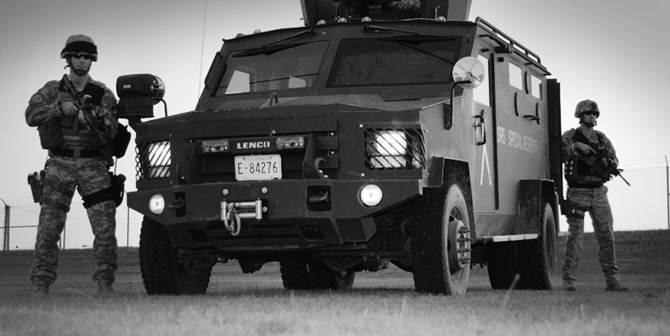
Dealing safely with nuclear waste, THE AUSTRALIAN, DECEMBER 30, 2021,Australia’s lack of a long-term storage plan for nuclear waste is a serious gap the Morrison government needs to address. The issue has been highlighted by the return from Britain in coming months of a two-tonne shipment of nuclear waste generated in Australia. The nation is committed to receiving the waste after 114 spent fuel rods from the Australian Nuclear Science and Technology Organisation were sent to Scotland to be reprocessed in 1996. It will be the second shipment of intermediate-level nuclear waste returned to the country in recent years under tight security. In the absence of a permanent secure storage facility, the waste will be stored temporarily at ANSTO facilities at Lucas Heights in Sydney’s south.
Preparations for the shipment have been in train for years, with all safeguards to be implemented. The waste is being returned in a more condensed form than what was originally sent to Scotland. It has been vitrified in four glass containers, then encased in an outer container made of specialised steel. Details of its movement, and the timing, will be kept secret. ANSTO previously received intermediate-level nuclear waste in 2015 when 25 tonnes of similar-level nuclear waste were returned from France. Australia can expect to have to receive further shipments of returned waste every six or seven years……..
As an alternative to Lucas Heights, a temporary storage facility for intermediate waste is being considered for a site near the town of Kimba in South Australia. But the proposal is being contested, with a judicial review requested by the traditional landowners. https://www.theaustralian.com.au/commentary/editorials/dealing-safely-with-nuclear-waste/news-story/5bbe6898c49206c64fe987e9949d88b4
The murky world of financing Small Nuclear Reactors (SMRs)
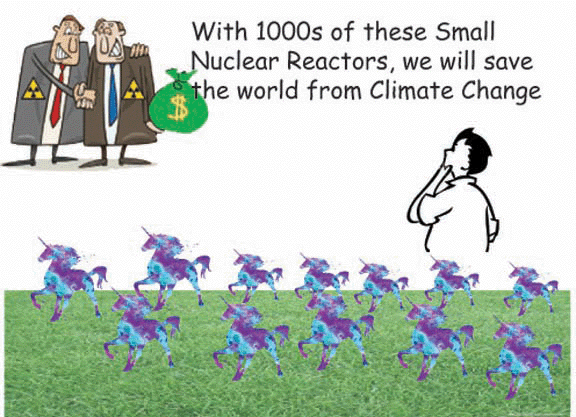
IKEA it ain’t: don’t go looking for friendly nuclear option, no matter the spin
MICHAEL WEST MEDIA, By Noel Wauchope|December 30, 2021 Despite the Murdoch media hype over small nuclear reactors as a solution for Australia’s “clean energy” future, this is costly technology which barely exists in a commercial sense. Noel Wauchope explores the murky world of funding for Small Nuclear Reactors (SMRs).
Small nuclear reactors are being proposed as the solution for Australia’s ‘clean energy’ future. Australians should be aware of the financial gymnastics going on in the USA, with NuScale, and in the UK, with Rolls-Royce. That’s just to single out the two most advanced of the many dubious SMR projects still at the starting gate.
The Murdoch media is enthusiastic about SMRs. Missing from the hype are a lot of unanswered questions. For a start — the ”M” stands for ”modular” — meaning that these reactors will be built in pieces, sort of, and transferred to a site, where they will be assembled, like a piece of IKEA furniture. But in fact there are at least 50 designs being promoted, and not all are modular.
The critical question comes down to – the money
The enthusiasm of the SMR lobby for the economic viability of SMRs is not matched by the facts.
For one thing to consider – there’s the price of the electricity to be eventually delivered by these small nuclear reactors. The Minerals Council of Australia estimates that by 2030 and beyond, SMRs could offer power to grids from $64-$77MWh, depending on size and type.
An analysis by WSP / Parsons Brinckerhoff, prepared for the 2015-16 South Australian Nuclear Fuel Cycle Royal Commission, estimated a cost of A$225 / MWh for a reactor based on the NuScale design, about three times higher than the MCA’s target range. CSIRO estimatesSMR power costs at A$258-338 / MWh in 2020 and A$129-336 / MWh in 2030.
Then there are the costs of actually getting SMRs in the first place.
In Russia, China, France, and Argentina, the construction is done entirely or largely at taxpayers’ expense, and there is little or no transparency about the costs. But generally in the Western world, electricity production is supposed to be a commercially viable operation. In the context of promoting low -carbon technologies, SMRs are promoted as being cheaper than large ones. It is generally acceptable for the government to kick-start the process, with some funding, but with the understanding that the industry will become successful, profitable.
NuScale financing contortions………………….
Now NuScale is to go public by merging with what’s known as a special purpose acquisition company, or SPAC……..
US Securities and Exchange Commission Chair Gary Gensler wants to tighten regulations on SPACs:
Glitzy corporate presentation decks, hyped press releases and celebrity endorsements can balloon a SPAC’s equity well beyond a reasonable value long before proper disclosures are filed, Gensler said.
SPACs have had a chequered history — they enable the sponsors to avoid financial loss, even if the business fails, as many did, in the 1990s. Sixty-five per cent of deals completed in 2021 at a valuation above $1bn are trading below $10 — the price at which they were floated. All of the companies are trading below their stock market highs with some of them down by as much as 70%. Senator Elizabeth Warren and three other Democrats are investigating the imbalance between the financial results for the sponsors and banks versus the early investors.
Rolls-Royce still looking for money
The process of getting funding for the UK’s SMRs is equally tortuous. ……………….
Rolls-Royce will be seeking more investment for the project to help fund the building of actual SMRs.
The government is currently passing legislation that will allow investors to back projects like SMRs using a regulated asset base (RAB) model, which allows them to recoup upfront costs from the consumers, over the construction period, long before those consumers actually get any electricity from the project.
Mythical beasts
So — what it all boils down to is an agreement to spend about £400 million over the next three years — to perhaps produce a design for a reactor, which might get approved by the regulators, and might find investors who might be willing to pay what will be at least £2 billion to build each one.
Where does all this leave Australia? Confused, probably like everyone else? It’s not at all clear who is going to end up paying the most for small nuclear reactors, or indeed, if that fleet of SMRs will ever become a reality. It will probably be the taxpayers. I haven’t mentioned all those ancillary costs — of winning community approval, of security, waste disposal. In all the hype about solving the climate crisis, it’s not likely that Australia will have the necessary thousands of small nuclear reactors operating in time to have any effect on the climate.
In the meantime, it’s worth being wary about the financial aspects, given the obscure manipulations going on in the US and UK, and remembering that not yet does one of these mythical beasts, Small Modular Nuclear Reactors actually exist.
Renewables remain the cheapest “new-build” source of energy generation. They exist. They work. https://www.michaelwest.com.au/ikea-it-aint-small-modular-nuclear-reactors/
.
Nuclear waste from Britain heading to Lucas Heights – first load of many.

Nuclear waste from Britain heading to Lucas Heights, THE AUSTRALIAN, JACQUELIN MAGNAY 30 DECEMBER 21, LONDON@jacquelinmagnay,
Australia is to receive a two-tonne shipment of nuclear waste from Britain that will arrive under tight security and amid high secrecy in the coming months.
The shipment of intermediate-level nuclear waste has been prepared for delivery to the Australian Nuclear Science and Technology Organisation facilities at Lucas Heights, in Sydney’s south.
It will be just the second tranche of intermediate-level nuclear waste returned to the country, and its arrival shines a spotlight on Australia’s lack of a long-term storage plan for nuclear waste classified above low-level material.
The radioactive uranium and plutonium waste has been vitrified in four glass containers and then encased in an outer container made of specialised steel, known as a TN81 cask.
ANSTO says its previous experience in receiving intermediate-level nuclear waste – which occurred in 2015 when a larger shipment was returned from France – will mitigate any risks.
In that shipment, all local roads along the route were shut for more than five hours, and the operation involved the NSW Riot Squad and other police units to contain antinuclear protesters.
In the coming weeks, the nuclear waste will be moved by rail from the decommissioned nuclear plant at Sellafield in Cumbria to the British coast before being loaded onto a ship operated by Nuclear Transport Solutions.
It is expected to travel through Australian waters, including some maritime parks, before berthing.
The cargo is likely to be unloaded at Port Kembla in Wollongong under heavy guard, arriving sometime before the middle of next year.
Wherever the ship berths, the container will be loaded onto a truck for transport through residential and industrial areas, as well as along the Princes Highway through the Royal National Park south of Sydney and on to the Lucas Heights facility.
ANSTO says the final route will be a closely guarded secret and will be decided in consultation with NSW authorities.
NTS confirmed that the return of the intermediate-level waste in the form of vitrified residue to Australia had first been expected to take place last year.
Preparations for the shipment have been carried out since 2014……..
The Australian Radiation Protection and Nuclear Safety Agency has recently certified “the transport package”, and it will allow ANSTO to “temporarily” store the nuclear waste in the Interim Waste Store at Lucas Heights before another temporary storage facility for intermediate waste – currently being considered for Napandee, near the town of Kimba in South Australia – is ready to receive it.
This planned alternative storage solution, which is known as the National Radioactive Waste Management Facility, would bring together all the low-level radioactive waste from 100 different sites around the country and allow temporary storage of intermediate-level waste.
However, the proposed site in Kimba is being contested, with a judicial review requested earlier this month by traditional landowners the Barngarla Determination Aboriginal Corporation.
Longer-term storage plans for the intermediate waste are yet to be considered.
Despite this uncertainty, Australia is committed to receiving the waste after 114 ANSTO spent fuel rods were sent to Dounreay, Scotland, to be reprocessed of plutonium and uranium in 1996.
The processed waste being returned is of an equivalent radioactive level, but in a more condensed form than was originally exported to Scotland, and it has now been transported to the old Sellafield power station.
This means that instead of 52 500-litre drums of cemented waste, the British shipment will comprise four canisters of glass waste of an equivalent level.
It is classified by British authorities as having radioactivity levels greater than four GBq/tonne for alpha emitters and Beta/gamma emitters greater than 12 GBq/tonne – which puts it in the intermediate category.
ANSTO says it has experience in handling and storing such waste, citing the 2015 arrival of 25 tonnes of similar-level nuclear waste from France.
The new shipment will be stored next to that waste……………..
It is unclear if local councils positioned along the expected transport route will be notified when the shipment lands.
Previously, some export transportation of spent nuclear fuel rods from ANSTO to France for reprocessing has been carried out in the middle of the night with tight secrecy and no prior notice. Several councils, including Wollongong through which the nuclear waste will be carried, have called for Australia to sign and ratify the Treaty on the Prohibition of Nuclear Weapons.
Australia can expect to have to receive further shipments of returned waste every six or seven years, including spent fuel elements from the Opal reactor sent to La Hague in France for reprocessing before being returned. https://www.theaustralian.com.au/world/nuclear-waste-from-britain-heading-to-lucas-heights/news-story/e5e8511403cd24de66c79be3d1d96fe6
Despite war-mongering Peter Dutton, a Defence review finds it not necessary to overturn Darwin port agreement with Chinese company

No security issues over Darwin port lease, A Defence review has found no national security grounds to recommend the federal government overturn the 99-year lease of the Port of Darwin to Chinese company Landbridge. https://www.canberratimes.com.au/story/7565412/no-security-issues-over-darwin-port-lease/ DECEMBER 29 2021 The national security committee of cabinet has considered the review it commissioned to re-examine the 2015 agreement under which Landbridge won the bid to operate the port in a deal worth $506 million, The Australian reports. Defence Minister Peter Dutton had pushed the review amid deepening tensions between Beijing and Canberra. The government is still reviewing the matter but the Defence review recommendation makes it more difficult for it step in and overturn the port lease. Scott Morrison has said the port lease was “undertaken by the former Territory government and it was not a lease that was approved by the federal government – it was not”.He also said the government would only act in relation to the port lease “if there is advice from the Defence Department or our security agencies that change their view about the national security implications of any piece of critical infrastructure”. The defence department also undertook a review of a Chinese company acquiring 50 per cent of shares in the Port of Newcastle back in March 2018 and found no concerns with the transaction. |
Dave Sweeney – Australia needs a genuine discussion about nuclear waste

(This is an extract from a basically pro-nuclear article on AAP , 28 Dec 21, )”………..Australian Conservation Foundation campaigner Dave Sweeney accepts there is a need for final solution for all the radioactive waste the nation produces, but he has grave concerns about the current approach.
He says the federal government recently handed ANSTO tens of millions of dollars to expand storage options at Lucas Heights and there’s no imperative to relocate waste from there any time soon.
He particularly objects to what he calls the unnecessary double handling of the worst nuclear waste Australia has.
“The plan is that a future federal government, sometime in the next 100 years, would relocate this material for deep burial at another currently undecided location via an undisclosed and unfunded process,” he says.
He points to evidence given to a parliamentary committee last year by Carl-Magnus Larsson, CEO of Australia’s nuclear regulator.
When asked why the majority of Australia’s waste stored at Lucas Heights could not simply stay there, Dr Larsson replied: “There is no such thing as indefinite storage. That equals disposal.”
“Waste can be safely stored at Lucas Heights for decades to come, but we need to talk long-term and even beyond the existence of ANSTO and the current facilities at ANSTO.”
Mr Sweeney says there’s never been a discussion in Australia that starts by asking “what’s the best way to manage this material, or what is the full scope of ways that we could mange this material and which do we think is the least worst”.
“We’ve heard that it can stay at Lucas Heights for decades to come. How about we use one of those decades to do what we’ve never done.”
Earlier this week, traditional owners of the Napandee site launched Federal Court action to try to stop the waste facility from proceeding.
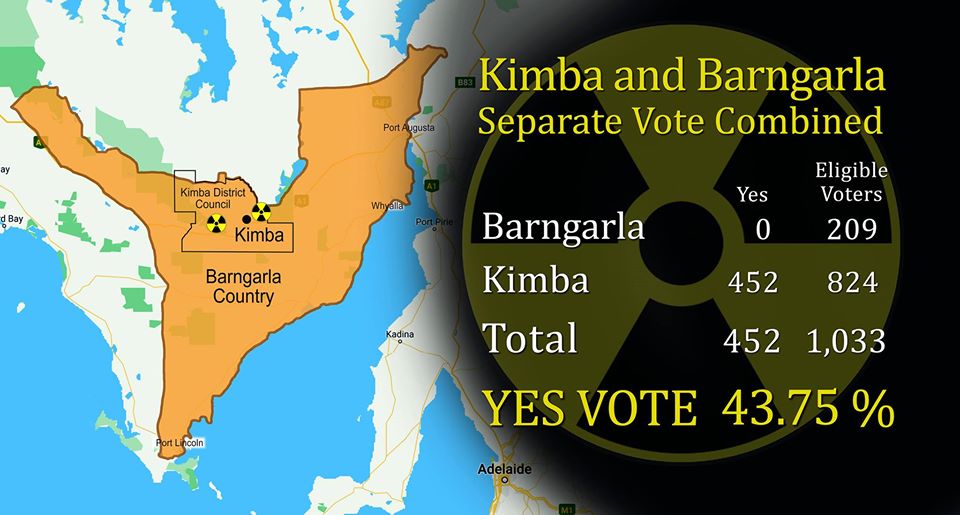
The Barngarla Determination Aboriginal Corporation has accused the government of excluding traditional owners from a community ballot that ultimately supported the facility.
Australians, like other nationalities, need to put pressure on their government to join the UN Treaty on the Prohibition of Nuclear Weapons (TPNW)
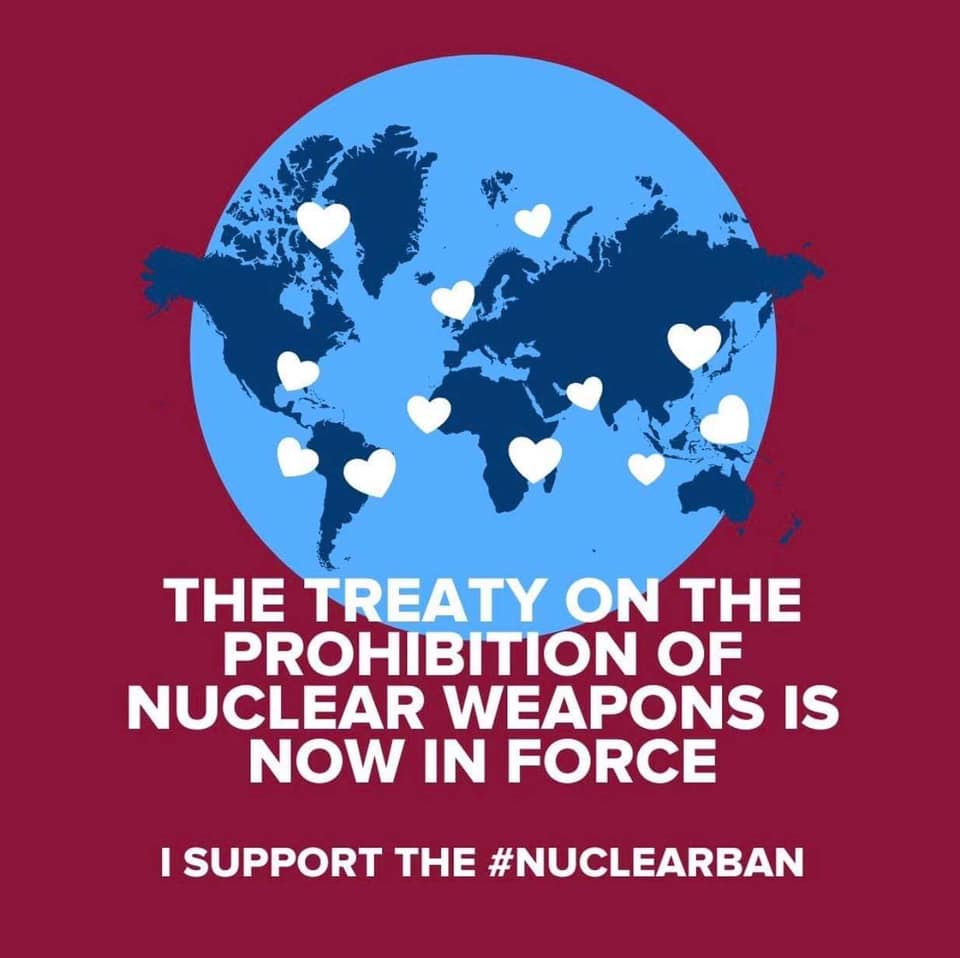
Nuclear weapons free future https://www.echo.net.au/2021/12/nuclear-weapons-free-future/ ByThe Echo Mick & Deborah Stacey, Ballina , December 26, 2021 Whilst the federal government is ‘rattling sabres’, and spending more on so-called defence, the movement to abolish nuclear weapons is gathering momentum.
There are now 58 countries who have ratified the UN Treaty. Boston, New York City and Minneapolis have joined the ICAN Cities Appeal, along with Ballina, Byron Bay and Lismore.
New York City have begun divesting public pension funds from nuclear weapons companies, as have a major Australian superannuation fund and the first Finnish pension fund. The Financial Times wrote a story about how weapons companies are starting to be impacted by this growing pressure from investors.
The first meeting of State Parties to the UN Treaty on the Prohibition of Nuclear Weapons (TPNW) will take place at the United Nations in Vienna, 22–24 March, 2022.
Sweden, Finland, Switzerland, Germany and Norway are not yet ready to join the TPNW, but they have already announced they will attend the meeting as observers. So, it is up to us to put pressure on our government (whoever they may be) to do likewise.
Check out: www.ICANW.org. Here’s to a safe nuclear weapons free future.
The Australian government has breached the rights of both black and white people of Kimba in depriving them of access to independent information on nuclear wastes.

Nuclear waste is considered a highly toxic and dangerous material which it is acknowledged requires geological burial for long term storage and disposal which is not the case at Kimba
I wonder how our government so highly regarded overseas as a beacon for justice and democratic principles has not just allowed but actively participated in depriving the Barngarla as well as the general community of their rights to properly ventilate their concerns
It is quite clear from the settled overseas requirements that the federal government as the proponent of the nuclear waste facility at Kimba must enable the Kimba community including the Barngarla to seek their own independent assessment and advice as to the government’s proposals with the government providing all the necessary funding and access to all information for that purpose
It should be relatively straightforward for the community generally which includes the Barngarla to establish that the government has failed to assist them in getting the independent assessment and refusing the funds for that purpose when requested on several previous occasions
In addition to obviously being a major ground for the judicial review the government’s conduct is tantamount to a seemingly serious deprivation of the human rights of the Barngarla and the Kimba community .
While this breach of human rights applies to the whole community the Barngarla can additionally claim that their human rights were breached and that the mandate created to overcome the discriminatory conduct towards them covering
- implementing international standards concerning the rights of indigenous peoples;
- making recommendations and proposals on appropriate measures to prevent and remedy violations of the rights of indigenous peoples;
- reporting on the human rights situations of indigenous peoples around the world; and
- addressing specific cases of alleged violations of indigenous peoples’ rights.
Francisco Cali Tzay is the current mandate holder as Special Rapporteur on the rights of indigenous peoples
The mandate on hazardous substances and wastes
relates to the exposure of people to a myriad of harmful substances without their prior informed consent which is a human right that can be satisfactorily solved if identified in its early stages
Dr Marcos A. Orellana is the current mandate holder as Special Rapporteur on toxics and wastes as human rights
Nuclear waste is considered a highly toxic and dangerous material which it is acknowledged requires geological burial for long term storage and disposal which is not the case at Kimba
Australian government and Labor opposition ignore the suffering of Julian Assange. Can they afford to, as election looms?
If he dies, his death will have been caused by, among others, politicians in Australia who have the diplomatic power to bring him home,” Pilger said.“Scott Morrison, in particular, will have Julian’s life and suffering on his hands, along with those in the Labor opposition who have kept a cowardly silence.
Independent MP Andrew Wilkie, among others, has said that Scott Morrison must urge the US and Britain to release Assange and let him return to Australia.
the “noise” in parliament combined with more public awareness of Assange’s dire state may present a headache for the government as polls loom.
Saving Julian Assange, Last week, the British High Court ruled that Julian Assange can be extradited to face charges in the United States. His fiancée, Stella Moris, vows to continue the fight alongside his network of supporters. By Amy Fallon. https://www.thesaturdaypaper.com.au/news/politics/2021/12/18/saving-julian-assange/163974600013099?fbclid=IwAR2dLaNxKG0FTyBvywjYpL_HpxPb8RWA6rF0mQwIE-X8Pnd8TMbAzkWed2Y#mt This week, Stella Moris said she and Julian Assange still intended to marry in the new year, although they have not set a date. She is currently speaking to the prison about arrangements. Moris hopes it will be a ceremony attended by close family and friends, with their children, Gabriel, 4, and Max, 2, taking part.
“The High Court ruling has made things even more precarious than before,” she tells The Saturday Paper.
“But that has only strengthened our determination to celebrate what is constant and certain in our lives – our love and support for each other.”
Moris is a South-African born lawyer and an activist in her own right. Her family were involved in the anti-apartheid battle. After the British High Court ruled that her fiancé could be extradited to the United States, her response was simple: “We will fight.”
“History will not spare them if we lose a man who is not only innocent of any crime but a genuine hero in the extraordinary public service he has performed for millions of people.”
She sees the case in these terms: “Every generation has an epic fight to fight, and this is ours, because Julian represents the fundamentals of what it means to live in a free society.”Last week’s decision was made after two of Britain’s most senior judges ruled Assange, earlier deemed a suicide risk, had received assurances from the US that he would not face the strictest measures before a trial or once convicted. They found a lower court had erred in offering him protection.
“That risk is in our judgement excluded by the assurances which are offered,” one of the judges, Lord Burnett, said. “It follows that we are satisfied that, if the assurances had been before the judge, she would have answered the relevant question differently.”
British Home Secretary Priti Patel must now approve Assange’s extradition. Lawyers for the 50-year-old are appealing the decision. Subsequent hearings are likely to raise the issue of free speech, which campaigners say is at the heart of the case involving the Walkley Award-winning journalist.Many around the world are now calling on the Australian government to intervene and save Assange’s life before it’s too late.
“There seem to be no limits to the savagery of the Anglosphere – US, UK, Australia – in exacting revenge for the crime of informing the population of what the powerful want to conceal,” the intellectual and activist Noam Chomsky later told The Saturday Paper.
He urged followers of Julian Assange, wanted by the US for breaking espionage laws after publishing hundreds of thousands of Afghanistan and Iraq war logs and diplomatic cables, to “get organised”.
“And act,” added Chomsky, because there was “not much time”.
Another two to three years may drag on before the extradition is resolved. Australian journalist John Pilger, who described Assange as “frail and skeletal” the last time he hugged his friend in 2020, said the fact he was still alive was remarkable.
Last weekend’s revelation, that Assange had suffered a stroke in October, didn’t shock the veteran reporter. A month earlier, a Yahoo News report revealed that the CIA allegedly planned to assassinate Assange.
“If he dies, his death will have been caused by, among others, politicians in Australia who have the diplomatic power to bring him home,” Pilger said.“Scott Morrison, in particular, will have Julian’s life and suffering on his hands, along with those in the Labor opposition who have kept a cowardly silence. History will not spare them if we lose a man who is not only innocent of any crime but a genuine hero in the extraordinary public service he has performed for millions of people.”
To Gabriel Shipton, Assange’s brother, Julian, is a “bad dancer” with a “dorky sense of humour”. But, he says, “he is very sweet with his children, very good with kids, and a very principled man”.
Shipton produced the recent documentary Ithaka, which tells the story of Gabriel and Julian’s father’s struggle to have Assange freed.“Often people lose sight that these are actual real people involved, not just a head on a screen, or a headline, that this is a person’s father, brother, partner,” Shipton says. “Once people find out about how tragic the actual injustice that Julian suffered [is], and through no fault of their own his family are suffering, they’re quite confronted that they’ve allowed it to carry on for as long as it has.”
Shipton concedes the fight is just as much or even more political than legal, and others echo this. “There is no doubt that [this] aggressive and relentless pursuit is driven by the US security and defence state,” said Greg Barns, a barrister and adviser to the Australian Assange campaign.
A bipartisan Australian Parliamentary Friends of the Bring Julian Assange Home group comprises 25 senators and MPs, but was adding “about one member or so monthly”, says Shipton. In the past week, Deputy Prime Minister Barnaby Joyce has spoken out against Assange being sent to the US. Independent MP Andrew Wilkie, among others, has said that Scott Morrison must urge the US and Britain to release Assange and let him return to Australia. The opposition has urged the government to encourage the US to close the matter, although it has not elaborated on what it means by this.According to Kellie Tranter, a Maitland-based lawyer, human rights activist, researcher and former WikiLeaks Party candidate, the “noise” in parliament combined with more public awareness of Assange’s dire state may present a headache for the government as polls loom.
“If the level of interest keeps increasing, the government may feel obliged to act as the Howard government did in the case of David Hicks,” she says, referring to the former Guantánamo Bay detainee. “The last thing the government wants is this case soaking up oxygen in place of its policies. It’s public criticism, which is exactly what they wanted to avoid in the case of Hicks.”Tranter points out that progressive campaign group GetUp! played a critical role in Hicks’s repatriation by making his detention by the US an election issue, mobilising public opinion against his mistreatment. They may be the only organisation capable of doing the same in this case, she said. GetUp! said they had no comment on Assange.
In Britain, Assange has admirers from all walks of life. Sadia Kokni, 40, is British-born with African, Indian and Middle Eastern heritage and the managing director of a cosmetics company. Despite having a disability, she attends twice-weekly protest vigils at the Australian high commission with “Team Assange”, comprising about 50 people, including bus drivers, graphic designers, nurses and artists.
“I campaign for nothing, I only campaign for Julian,” Kokni says. “Unlike when people campaign against a war – it’s a nation against a nation – when it comes to Julian it’s the most powerful nation in the world against one man and he’s exposing the atrocities of global governance and things that every living person should be aware of.”
Although Kokni acknowledges Assange’s predicament could be treated with greater urgency by the British parliament, she also feels disbelief over Australia’s inaction.“They could be doing a lot more, Australia. I find it ridiculous,” she said, singling out the high commissioner, George Brandis. “Brandis – what is he actually doing? Has he written any letters?”
The Australian high commission in Britain did not respond to requests for comment.
Traditional owners lodge legal challenge to planned Kimba nuclear waste dump
Traditional owners lodge legal challenge to planned Kimba nuclear waste dump, https://www.abc.net.au/news/2021-12-21/barngarla-challenge-kimba-radioactive-waste-facility-napandee/100717404?fbclid=IwAR3QiztQ5454cuTfmjLaBaCb_nK4usDM43TObZV5R
ABC North and West SA / By Declan Gooch, Patrick Martin, and Gillian Aeria Tue 21 Dec 2021 raditional owners on South Australia’s Eyre Peninsula have formally lodged a legal challenge to the federal government’s plan to build a nuclear waste dump in the region.
Key points:
- The Barngarla people have begun legal action against a planned radioactive waste dump
- The federal government wants to build the facility near Kimba
- Traditional owners have complained they were not consulted properly
The government wants to store low and intermediate-level waste at a property called Napandee, near the town of Kimba.
The Barngarla people say they were not included in the consultation process, which included a ballot of ratepayers.
“We don’t want it to be at Kimba because we were excluded from the vote under white man’s law,” Barngarla Determination Aboriginal Corporation chairman Jason Bilney said.
The group filed for a judicial review of the site selection process in the Federal Court on Tuesday.
The ballot of Kimba ratepayers, which the government has repeatedly cited as evidence of community support, showed about 60 per cent of voters were in favour of the plan.
“The government says broad community support — well what broad community support did you have, let alone with the native title holders of Kimba or on the Eyre Peninsula?” Mr Bilney said.
The ballot of Kimba ratepayers, which the government has repeatedly cited as evidence of community support, showed about 60 per cent of voters were in favour of the plan.
“The government says broad community support — well what broad community support did you have, let alone with the native title holders of Kimba or on the Eyre Peninsula?” Mr Bilney said.
He said South Australian law required a parliamentary inquiry if nuclear waste was to be brought in and stored.
“We are going to see continual opposition emerge over the next five to 10 years, and this has got a long way to run.”
He expected the court to decide in the Barngarla group’s favour.
“They have a clear and strong case. They were excluded from the community ballot, and they do have native title rights, and it’s essential the Federal Court stands up and protects those rights.”
The government had initially tried to legislate the location of the facility in a way that would have eliminated the possibility of a judicial review.
It later amended the legislation in response to pressure from Labor so it received the support needed to pass both houses of parliament.
In a statement, resources minister Keith Pitt said the declaration of Kimba as the site for the facility was a “significant step”.
He said his facility was a crucial piece of national infrastructure for Australia’s nuclear medicine industry and nuclear research capabilities.
We froze’: What was this 1.3-metre missile doing at an Aboriginal heritage site?
We froze’: What was this 1.3-metre missile doing at an Aboriginal heritage site?
EXCLUSIVE: An unexploded high-tech missile was discovered at a culturally significant Aboriginal heritage site in remote South Australia. Neither the company that is believed to have made it – nor the Department of Defence – have explained how it got there.
SBS, Tuesday 21 December 2021By Steven Trask, Sarah Collard A group of Aboriginal Traditional Owners was inspecting a culturally significant site in remote South Australia when they discovered a high-tech anti-aircraft missile, a joint investigation by SBS News and NITV can reveal.
The 1.32-metre missile is believed to have been built by a subsidiary of Swedish weapons maker Saab and was found at a registered heritage site called Lake Hart West, about 40 kilometres from the small town of Woomera, in January this year.
Woomera is home to one of the largest weapons ranges in the world and the missile appears to be a similar model to those tested by Australia’s Department of Defence near the town in 2019.
Lake Hart West is important to the Kokatha people of the Western Desert region of South Australia; it is scattered with artefacts, historic shelters and tool-making sites.
“It startled us. There were four of us and we froze about five metres away from it,” says Kokatha man Andrew Starkey, who registered Lake Hart West as a heritage site with the South Australian government in the early 2000s.
“We were worried that there could be other missiles covered by the sand and in the bushes.
“There are over 20 heritage features all within a one-kilometre radius. There are rock engravings only a couple of kilometres away – it’s only through luck that that was not destroyed.”
The conservation of Aboriginal heritage sites has been under intense scrutiny since mining company Rio Tinto blew up the 46,000-year-old Juukan Gorge caves in Western Australia in May 2020.
An inquiry into the disaster found that existing state and Commonwealth laws were failing to protect Aboriginal heritage areas.
The Defence Department maintains it does not test weapons at culturally significant Aboriginal sites. But neither the department nor Saab have addressed questions over why the missile was found at Lake Hart West………………………………………
Human rights lawyer John Podgorelec has been representing the Starkeys as they pursue a complaint under OECD guidelines that govern “responsible business conduct” by foreign companies operating in Australia.
The Australian National Contact Point, which runs the process, said a complaint had been received against an “Australian-based enterprise” in the “defence sector”.
SBS News and NITV have confirmed the complaint relates to Saab.
An entry on the OECD complaint database reads: “Specifically, the issues relate to the discovery of an unexploded ordinance in South Australia by the Starkey Traditional Owners, resulting in risk to personal safety and artefacts of cultural significance.”………… https://www.sbs.com.au/news/we-froze-what-was-this-1-3-metre-missile-doing-at-an-aboriginal-heritage-site/3c67ce10-15ed-442c-b735-cea3673e5caa
Growing opposition to radioactive waste dump

Federal plans for a radioactive waste facility near Kimba on South Australia’s Eyre Peninsula face growing opposition with Barngarla Traditional Owners today launching a Federal Court challenge to Minister Keith Pitt’s decision to site the facility on their lands.
The UN Declaration on the Rights of Indigenous People requires that ‘States shall take effective measures to ensure that no storage or disposal of hazardous materials shall take place in the lands or territories of indigenous peoples without their free, prior and informed consent.’
“The federal plan has many flaws, one of which is poor consultation with the Aboriginal and wider community,” said Australian Conservation Foundation campaigner Dave Sweeney.
“Barngarla have never given consent. Instead, they have been denied a vote in a federal community ballot. This approach is simply not acceptable in the third decade of the 2000s.
“Fewer than a thousand South Australians have had a say in a plan that has profound inter-generational implications.
“The proposed facility is unnecessary given federal parliament’s recent support for a $60 million waste storage upgrade to secure the most problematic intermediate level waste at the federal Lucas Heights nuclear site for the next three to five decades.
“Extended interim storage at Lucas Heights is prudent and possible. Moving intermediate level waste from Lucas Heights – a site with security, radiation monitoring, emergency response and local expertise – to a site near Kimba with far fewer assets and resources is irresponsible and inconsistent with best industry practice.
Sites that store and manage nuclear medicine waste around Australia will still need to do so, irrespective of the status of any national facility, so the Minister’s repeated reference to nuclear waste being spread across 100 sites is disingenuous and inaccurate.
“The planned federal action is contrary to SA state law and does not enjoy bi-partisan political support. The waste plan needs formal environmental and regulatory assessment and approval and is occurring in the context of both state and federal elections in 2022. This issue has a long way to run and will be actively contested.”
For context or comment contact Dave Sweeney on 0408 317 812
ACF’s 3-page background brief on federal radioactive waste plans
Measure twice, cut once: Advancing responsible radioactive waste management in Australia
1 This month
17 October, Free Public Talk on Nuclear Issues in South Australia
David Noonan will speak on public interest concerns over the new Roxby Downs Indenture Act 2026 on BHP copper-uranium mining and ore processing in SA, and on how AUKUS may face SA with a High-Level nuclear waste agenda.
Dr Jim Green will discuss international developments in the field of nuclear power including ‘small modular reactors’ and Generation 4 ‘advanced’ nuclear reactor concepts.


Help Aunty Sue Protect Her Land and Sacred Sites From Destructive Rocket Testing.
.

Australians deserve the truth
about
AUKUS – https://aukuspublicinquiry.com/

PETITION – To: Prime Minister Anthony Albanese and the Australian Labor Government

of the week – Australians for War Powers Reform (AWPR)
To see nuclear-related stories in greater depth and intensity

