Negotiations focus on historical Kakadu uranium injustice
 In response to recent media reports on the renegotiation of the Ranger Uranium Mine agreement, the Gundjeihmi Aboriginal Corporation (GAC), which represents the Mirarr Traditional Owners of the Ranger mining area, confirms that talks are continuing. These talks aim to mitigate some of the historical political and financial injustices associated with the 1978 Ranger Uranium Mine arrangements put in place by the Australian government.
The current renegotiation – recently referred to by mining company Energy Resources of Australia (ERA) – addresses historical matters only. It does not consider the future of mining beyond the existing Ranger authorisation. Mining at Ranger must cease by 2021 with rehabilitation completed by 2026. Any mining beyond 2021 would require Federal legislation and cannot be agreed to under present arrangements. The Mirarr remain unequivocal in their opposition to any mining operations at the adjacent Jabiluka site.
The Mirarr await detailed information from the current Ranger 3 Deeps exploration. Mirarr insist on the highest level of scrutiny of the potential environmental and social impact of any proposal to mine uranium at Ranger beyond 2021.
Rio Tinto and ERA as well as the Australian government must genuinely respect and adhere to the internationally recognised right of Indigenous people for free, prior and informed consent regarding development on their traditional lands before any further arrangements are made for extension of the Ranger operations into the future.
Rio Tinto and ERA have gone some way to demonstrating a collaborative approach in their current dealings but the future of the operations remains a matter for the Australian government which has yet to engage with the Mirarr about future authorisations.
We look forward to a positive and speedy resolution to this long-standing injustice.
—
______________________________________
Kirsten Blair
Community and International Liaison
Gundjeihmi Aboriginal Corporation
0412 853 641
skype: kirsten-blair
www.mirarr.net
www.facebook.com/mirarrcountry
Many a slip twixt Toro’s plan and uranium mining at Wiluna in Western Australia
 The Anti Nuclear Alliance of WA said it would fight in court the approval granted by WA Environment Minister Bill Marmion yesterday.
the mine cannot make money at current low uranium prices and the company, valued at only $86.5 million, did not have the financial capacity to clean up the mine if it was unprofitable
“If Toro falls over at Wiluna, who cleans it up? It either doesn’t get cleaned up, which is unacceptable, or it gets cleaned up at public expense,” Mr Sweeney said
Green protests at Toro HQ over mine approval Rhianna King, Nick Evans and AAP, The West Australian
October 11, 2012, A group of about 25 protesters marched outside the West Perth offices of Toro Energy this morning to express their anger over the approval of WA’s first uranium mine.
Environmentalists and trade unionists walked from Toro’s headquarters to Parliament House, chanting ‘Toxic Toro, you’ve got to go.’ Conservation Council of WA Nuclear Free campaigner Mia Pepper said green groups would not give up until the State Government’s decision was overturned.
“This proposal has no complete mine closure plan or costings, it will run out of water in seven years and no alternatives have been evaluated, scientists are still naming a new plant species found near the mine site, and Toro are yet to finalise their transport management plan,” she said.
“This is not a credible plan. It is a half-baked, half-assessed shambles driven by a political agenda and is not based on good science or evidence. Continue reading
In the long run, for Australia, 100% renewable energy will be cheaper than the present energy system
 100% renewables in Australia will be cheaper than Business As Usual REneweconomy, By Sophie Vorrath on 11 October 2012 Iain MacGill is the first to admit that there’s a good deal more research and modelling work that could be done before Australia might confidently launch itself on the path to 100 per cent renewable electricity generation.
But the main, and very positive, message from the UNSW Associate Professor, and joint director of its Centre for Energy and Environmental Markets (CEEM), is that on the basis of current research and modelling, the viability of a shift to a 100% renewable energy network looks “very promising” – in fact, when you factor in the costs of business-as-usual, it’s likely to be cheaper than continuing on the current path.
Speaking at the All-Energy Australia conference in Melbourne today, MacGill outlined some of the preliminary findings of the current UNSW project on the technical feasibility, underlying economics and possible commercial implications of 100 per cent renewable energy generation for the Australian National Electricity Market.
It’s a hugely complex task, that has had to factor in such technicalities as the NEM’s 0.002 per cent unserved energy standard, moderate energy spill, moderate total biomass, no extra hydro capacity, the need for new NEM regions, and the perennial question of whether a 100 renewables mix using highly variable and somewhat unpredictable solar and wind can reliably meet demand at all times and locations.
And then, of course, there is the all-important question of whether 100% renewables is economically worth doing, not to mention commercially feasible: can we establish commercial frameworks that drive appropriate deployment at the speed and scale required?
The final estimates for the UNSW work are not ready for release, but when they are they will form a crucial reference point for the clean energy industry. One of the criticisms of the detailed work that the Australian Energy Market Operator is being asked to undertake into 100 per cent renewable scenarios is that it will not reference its cost estimates to business-as-usual, or to the potential savings….. http://reneweconomy.com.au/2012/100-renewables-in-australia-will-be-cheaper-than-bau-51873
Solar energy farm up and running in Western Australia
Hip hip array! First solar farm opens in WA SMH, October 10, 2012 Australia switched on its first utility-scale solar farm today, a small step on the way to achieving ambitious renewable energy use targets that traditional coal and gas power producers are now fighting to soften.
The Greenough River Solar project, just outside the small town of Walkaway in Western Australia is a joint-venture between WA state-owned Verve Energy and US conglomerate General Electric. It is expected to generate 10 megawatts, enough to power 3000 homes. Continue reading
South Australian innovation in battery storage for solar and wind power
Energy firm claims battery storage breakthrough SMH, October 10, 2012 – Peter Hannam
Carbon economy editor A South Australian energy firm is claiming an international breakthrough in battery technology that will help generators of solar and wind power store their energy more cheaply.
ZEN Energy Systems today unveiled a computer-controlled storage system – with one model about the size of a bar fridge – which almost doubles the effectiveness of batteries.
“This technology is a game changer for the renewable energy industry and has the potential to change the way individuals and communities use electricity in the future,” ZEN’s chief executive officer, Richard Turner, said.
Mr Turner said as many as 10 Australian utilities are interested in trialling the system and the company has already begun shipping large-scale container-sized units to US clients…….. Continue reading
USA-Australia defence trade treaty would censor Australia’s researchers
 Defence treaty to ‘censor’ research http://www.theage.com.au/opinion/political-news/defence-treaty-to-censor-research-20121009-27bao.html#ixzz28xGXeEc9 October 10, 2012 Bianca Hall UP TO 90 per cent of academic research could be affected by an Australian-US trade agreement that would make it an offence for academics to communicate findings on research, the University of Sydney has warned. Continue reading
Nuclear spin doctor the keynote speaker at Energy Conference in Melbourne: WHY?

Why is this pro nuke spinner the keynote speaker at All Energy Australia International, the conference for  the Asia Pacific, tomorrow in Melbourne?
Energy alternatives ABC Radio 10 Oct 12, Ticky is joined by Professor Chris Llewellyn Smith, Oxford
University’s Director of Energy and former head of CERN.
“…….TICKY FULLERTON we know you’re a big fan of nuclear playing a big part in our energy future. Has the global industry moved on from Fukushima or is it still in damage control in your view?
 CHRIS LLEWELLYN SMITH: I think it’s in damage control as far as public relations are concerned, but we have to put Fukushima in perspective, as one of a British journalist wrote. You take a crappy old 1960s power station, you hit it with the biggest tsunami and earthquake you can think of – actually bigger than anyone thought of, that’s one of
the problems – make every possible mistake and nobody was killed.
( Christina Macpherson’s note : Just by the way – about that mention of the crappy old 1960s power station, well – in the USA, 23 reactors operate with same flawed GE design that failed in the triple meltdown at the Fukushima plant and released over four times the amount of cesium-137 than was released in the 1986 Chernobyl disaster. )
So we shouldn’t forget that. Nobody’s been killed and probably … maybe there will be one or two radiation deaths. …. we have to treat it with great respect, but all forms of power production are dangerous and nuclear has a very, very good safety record compared to the others.
TICKY FULLERTON: It’s got a big bill behind it though. I see a report just on Europe reactors is a $30 billion repair job?
CHRIS LLEWELLYN SMITH: Yes, I think the weak spot of nuclear at the moment may be that the new generation of nuclear power stations – which were cracked up to be as cheap as coal – they’re coming out way over budget. We don’t know if that’s just because the first ones or the costs will come down….”
Victorian Wind Alliance to express Victoria’s majority view and promote wind energy
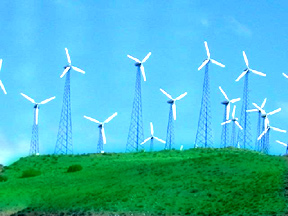 Victorian Wind Alliance to promote industry http://www.weeklytimesnow.com.au/article/2012/10/09/544954_latest-news.html Samantha Landy | October 9, 2012 A NEW organisation aimed at building support for wind energy in Victoria is set to launch tomorrow.
The Victorian Wind Alliance, made up of wind workers, landowners, environmental and community groups and anyone else who supports wind energy, hopes to promote the wind energy sector in the face of a halt in wind farm developments.”The premise is that the majority of Victorians and the majority of Australians support the development of
renewable energy,” Friends of the Earth campaigns co-ordinator Cam Walker said.
“Here in Victoria, the government has largely stalled action on renewable energy. Continue reading
22 storeys up, Adelaide’s roof garden brings an ecosystem, and cools the building
Adelaide is leading the way in water-sensitive urban design and green roof technology.
Roof gardens proven to cool buildings ABC Radio The World Today Nicola Gage reported this story on Tuesday, October 9, 2012 ELEANOR HALL: Roof gardens are becoming more prevalent in the world’s major cities.
Now a study has found that not only are they building mini-ecosystems, they’re also cooling buildings significantly and reducing carbon emissions, as Nicola Gage reports.
NICOLA GAGE: Major cities have inherently been linked to pollution and rising carbon emissions, but 22 stories up on the roof of a building in Adelaide, there’s a micro-climate that’s returning wildlife to the city.
GRAEME HOPKINS: It’s had bees up here collecting honey, it’s got birds and we’ve identified two moth varieties and no doubt the birds have been chasing the moths. So there’s a whole ecosystem and this has
happened spontaneously on the 22nd floor, so it’s quite amazing. Continue reading
Woomera, the size of England, to open for uranium mining
Woomera Prohibited Area Open to Resources Development 04 October 2012 Stephen Smith MP
Minister for Defence Martin Ferguson MP Minister for Resources & Energy Minister for Defence Stephen Smith and Minister for Resources and Energy Minister Martin Ferguson today announced the next step in opening up the Woomera Prohibited Area (WPA) in South Australia to minerals exploration and resources development.
“The Woomera Prohibited Area has great economic potential, with estimates that more than $35 billion of developments, including iron ore, gold and uranium projects would be possible over the next decade, ” Mr Ferguson said.
“We can now consider new applications for access to the area from companies wishing to explore for minerals,” Mr Smith said…..
Minister Ferguson said that implementing the recommendations of the Hawke Review will help secure the longevity of our minerals resources sector….. The Review is being implemented in three phases – the moratorium on the granting of new non-Defence entrants access to the WPA, a transitional phase involving the development and implementation
of enabling legislation, and a final phase where transitional arrangements are implemented and where permanent arrangements are put in place.Further information is available at www.defence.gov.au/woomera/
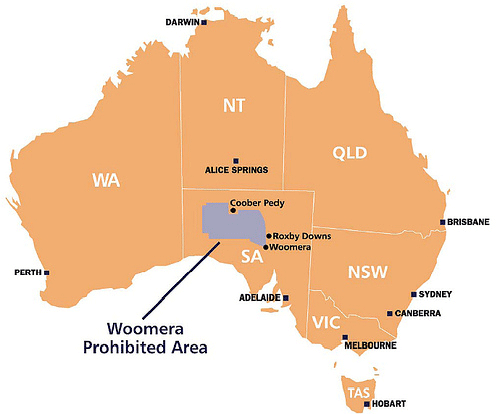
Woomera Prohibited Area, Australian Department of Defence The Woomera Prohibited Area (WPA) is a globally unique military testing range. It covers 127,000 square kilometres in north-west South Australia, approximately 450 kilometres NNW of Adelaide. It is the largest land range in the world, with a centre line of over 600 kilometres, comparable in size to England….The WPA comprises extensive lands north of the Indian Pacific railway, from Maralinga in the south-west up to its north-west corner in the Great Victoria Desert (that stretches across the SA-WA border), across to Coober Pedy, and west of Roxby Downs down to Woomera in the south-east.. http://www.defence.gov.au/woomera/about.htm
South Australian Native Title Services (SANTS) legal case against govt’s discriminatory law
 Aboriginal groups to challenge SA Govt’s legislation on oil, gas licences on constitutional, racial discrimination grounds, Adelaide Now, Valerina Changarathil October 08, 2012
THE State Government’s retrospective amendments to the Petroleum and Geothermal Energy Act affecting exploration and production licenses in the Cooper Basin area will be challenged in Federal Court on constitutional and racial discrimination grounds.
Aboriginal groups representative, the South Australian Native Title Services (SANTS), will file an appeal to this effect in an ongoing matter set for hearing early next year. Continue reading
South Australian government’s contempt for Aboriginal rights
Native title ‘reforms’ slammed http://www.theaustralian.com.au/national-affairs/indigenous/native-title-reforms-slammed/story-fn9hm1pm-1226490977811 BY:MICHAEL OWEN The Australian October 09, 2012 THE government-funded native title service provider in South Australia has lashed state Labor for cosying up to miners with moves to streamline approvals in indigenous areas and strip away Aboriginal rights.
Native Title Services chief executive Keith Thomas accused Mining Minister Tom Koutsantonis of adopting an inaccurate and inflammatory position on reforming the state’s Aboriginal Heritage Act, and said the Labor government had revealed its true colours.
“This government has clearly demonstrated its attitude to Aboriginal people with recent moves to remove native title rights in relation to petroleum exploration and production in the Cooper Basin and traditional fishing rights on the Yorke Peninsula,” Mr Thomas said. Continue reading
Free energy fuel- sun and wind- brings down cost of electricity for South Australians
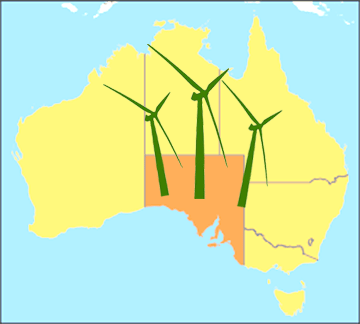 Renewables typically have no fuel costs (free sun and wind), and thus have the lowest short run marginal cost of production.
Renewables ‘lowering SA electricity bills’ SBS WORLD NEWS, 8 OCT 2012, Renewable energy sources such as wind and solar power appear to be the impetus behind a South Australian proposal to substantially drop electricity prices, By Dylan McConnell , University of Melbourne
Renewable energy sources such as wind and solar power appear to be the impetus behind a South Australian proposal to substantially drop electricity prices, just as other states are hiking theirs.
The Essential Service Commission of South Australian (ESCOSA), which regulates retail electricity prices, has released a draft price determination that proposes an 8.1% reduction in the electricity standing offer, (that is, the default retail price that must be offered to South Australians, at a minimum).
The proposal, which follows an ESCOSA investigation into the wholesale energy costs, translates to a reduction of $27.19/MWh, potentially lowering South Australian electricity bills by an average of $160 per household.
And while it is not specifically acknowledged in the determination, this may be the first time the “merit order effect ” of renewable energy sources can conclusively be seen flowing through to consumers in Australia. The Merit Order Effect
There is nothing special about the “merit order effect”. Quite simply, if you introduce more of a product into a market (that is, increase supply) then prices fall. Continue reading
Solar panels best for town home energy: wind turbines better for farms
average wind speed needs to be above 5m/s (18km per hour) to make installing a wind turbine really worthwhile. Ideal locations for wind turbines are in the country, on farms, or on the coast: basically anywhere away from built-up areas. The more buildings around the wind turbine, the less wind there is and the more turbulent any wind present becomes.
While wind power can be ideal on farms, for most suburban settings Energy Matters strongly recommends solar panels.
Backyard Wind Turbines – In Adelaide You Can (For Now) http://www.energymatters.com.au/index.php?main_page=news_article&article_id=3413 by Energy Matters 9 Oct 12, If you live in Adelaide and want to install a wind turbine atop a 10 metre tower in your back yard, it seems to you can do so without the need for council approval. But you may need to be quick. Continue reading
Uranium mining for Queensland – NOT a job provider, and NOT needed
As for respecting the wishes of Aboriginal Queenslanders, neither our State nor Federal legal frameworks give traditional owners the right to refuse mining on their lands, so it is difficult to see how their wishes will be respected should they not wish to host a uranium mine. And given the findings of a 2006 study that found a 90% higher incidence of cancer amongst indigenous peoples living in close proximity to uranium mines in Kakadu, one can well understand how that might be their preference.
Queenslanders have thus far decided we don’t want to be part of an industry that generates toxic waste with no functioning long-term storage solution, fuels weapons of mass destruction, and has no future in electricity generation because it grows ever more expensive while clean energy alternatives grow ever cheaper.
The jobs aren’t in uranium: Stone Opinion: Adam Stone | 6th October 2012 “……..The LNP obviously decided to insulate their campaign from public concern about uranium mining by committing that they would not change Queensland’s anti uranium mining policy, but their underlying conviction on the subject is completely at odds with this position. After all, they openly campaigned in favour of repealing the policy in the 2009 State election …..
The Queensland Resources Council (QRC) and Australian Uranium Association (AUA) have opened by arguing that uranium mining in Queensland will: provide jobs, respect the wishes of indigenous Queenslanders, cut greenhouse gas emissions, only supply uranium for peaceful purposes, and is necessary for baseload power generation as only nuclear, hydro and fossil fuels can meet this need. Continue reading
1 This month


Help Aunty Sue Protect Her Land and Sacred Sites From Destructive Rocket Testing.
.

Australians deserve the truth
about
AUKUS – https://aukuspublicinquiry.com/

PETITION – To: Prime Minister Anthony Albanese and the Australian Labor Government

of the week – Australians for War Powers Reform (AWPR)
To see nuclear-related stories in greater depth and intensity
 Antinuclear