Olympic Dam copper/uranium mine’s future more doubtful, with rise of RECYCLING of metals
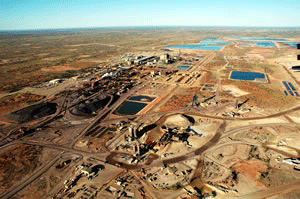 Olympic Dam is surely under review,” said UBS mining analyst Glyn Lawcock. “It’s not an issue of
 finding the cash,” he
said, but rather ensuring a good return on the investment……
Further curbing the appetite for refined copper, BHP now sees recycled scrap meeting up to 50 percent of China’s overall demand in the coming year for the metal, up from 35 percent now.
there is a much bigger question mark over it [Olympic Dam new mine] now
BHP Olympic Dam delay would tighten copper supply Reuters, By James Regan SYDNEY | Fri Jul 6, 2012 “….. A 25 percent drop in benchmark international copper prices since early 2011 has eroded potential returns from the project, and the economic slowdown in top base metal consumer China has dampened the demand outlook.
BHP’s scheme to quadruple output from Olympic Dam – the fourth-largest known copper deposit and largest uranium source in the world – is one a growing number analysts believe likely to be shelved until markets stabilize…. London copper prices have fallen to around $7,650 a metric ton (1.1023 tons) from a peak over $10,000 in early 2011 as big copper buyers such as car and computer manufacturers slow consumption… Continue reading
Poor market outlook for copper/uranium will make BHP delay Olympic Dam plans
BHP May Reduce Copper Supply Reduced Demand in China Hurts Production, Wealth Daily, By Swagato Chakravorty , July 9th, 2012 After a 25 percent decline in international copper prices since 2011, BHP Billiton (NYSE: BHP) may need to reduce the global supply of copper from late 2013 onward should the $30 billion Olympic Dam mine
project in Australia be delayed.
The sustained drop in copper prices has affected the potential for returns on the project, and China’s cooling economy has added on to demand woes. BHP intended to expand the mine in order to increase output fourfold from what is the world’s fourth-largest known copper deposit and biggest source of uranium.
40 percent of the world’s copper demand comes from China, which also cut its interest rates last Thursday for the second time as it increasingly focuses on shoring up its economy.
BHP is working on turning the Olympic Dam, which is currently a mine, into an open pit operation.
The board will make a decision by year-end on whether or not to continue the process, which would produce 750,000 metric tons of copper and 19,000 metric tons of uranium a year.
Right now the biggest problem is figuring out whether the current levels of copper will mean an oversupply as demand slows down everywhere…. for now, the analysts advise against the sort of mining expansion BHP is planning.
Reuters reports: “Now is not exactly the right time to be thinking of bringing more copper into the market and BHP knows this,” said Gavin Wendt, a mining analyst with MineLife in Sydney.
Peaceful anti-nuclear protest in South Australia might be met with police violence, as in the past
Still fresh for many campaigners are the memories and scars of an anti-nuclear protest at the Beverley Uranium Mine in  May 2000…. a nasty example of police violence
we should also try to engage genuinely with the important moral issues that the protestors are highlighting.
Their agenda is quite public , which is more than could be said for the private sector interests they are protesting. We might also question why the police are deploying over 200 personnel to “manage” a peaceful protest and what violence police have instigated during similar events in the recent past.
Peaceful dissent and a lizard’s revenge http://www.abc.net.au/environment/articles/2012/07/10/3541989.htm PETER D. BURDON ABC 10 JUL 2012 Protesters at the Beverley uranium mine were treated in a “degrading, humiliating and frightening” manner in 2000, according to a later judgement.
THE ANTI-NUCLEAR MOVEMENT in Australia can be characterised by several key themes – colour, lentils, solidarity and a commitment to nonviolent acts of resistance. Another pervasive theme that characterises the past forty years of activism is power imbalance. On one side of the struggle you have poor and sometimes dislocated indigenous people, students and concerned community members (greenies). On the other side there are billion dollar companies, the Government, State police and the media.

Such is this power imbalance that many campaigners will spend decades resisting without reward. Those who are fortunate to be involved in a campaign victory (or even a slight concession) have also seen promises betrayed and decisions reversed.
Yet, despite many crushing defeats, antinuclear activists continue to resist. They do so, not because they have nothing better to do, or because they are violent delinquents (the images commonly portrayed in the media), but because they are acting in accordance with their conscience. Continue reading
Above Australia’s State and Federal laws – BHP and Olympic Damn uranium mine
Jim Green: Project a rule unto itself Adelaide Now, Jim Green July 10, 2012 OLYMPIC Dam is like a state with no environment, water, Aboriginal and FoI laws, says Jim Green. HUNDREDS of Australians will converge on BHP Billiton’s Olympic Dam uranium/copper mine – and a camp up the Oodnadatta Track – from Saturday for five days of protest, education and entertainment.
The concerns leading people to participate are many and varied. The overarching concern might be expressed as a failure of governance – corporate and political.
Olympic Dam is a state within a state. It operates under a unique set of laws enshrined in the amended Roxby Downs Indenture Act.
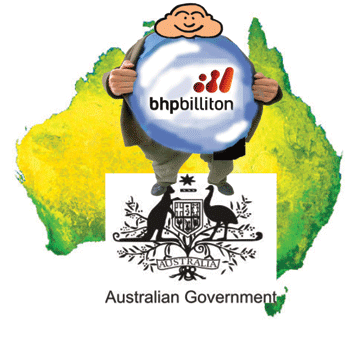
That would be unobjectionable except that the Indenture Act allows Olympic Dam wide-ranging exemptions from environmental, water management and Aboriginal Heritage laws and, for good measure, it curtails the application of the Freedom of Information Act.
SA Liberal Party industry spokesman Martin Hamilton-Smith said “every word of the (Indenture) agreement favours BHP, not South Australians”. It beggars belief the SA Labor Government would agree to such one-sided terms and that Mr Hamilton-Smith and his Liberal colleagues waved it through Parliament with no amendments. Continue reading
BHP Billiton’s open cut Olympic Dam copper/uranium project to be shelved indefinitely?
BHP (NYSE:BHP) Reports It Will Make Tighter Worldwide Copper Supply- USA Election News, 9 July 12 By: Jessica Honsinger BHP Billiton Limited (NYSE:BHP) reported on Friday that it will make tighter worldwide copper supply from late 2013 onward if it delays work on its single-biggest project, the $30 billion growth of the Olympic Dam mine in Australia.
A 25% decrease in benchmark international copper prices since early on 2011 has eroded possible returns from the project, and the economic delay in top base metal consumer China has dampened the demand
viewpoint. BHP’s system to quadruple output from Olympic Dam the fourth-biggest known copper deposit and biggest uranium source in the world is one a growing number experts consider probable to be shelved until markets
stabilize….. http://uselectionnews.org/bhp-nysebhp-reports-it-will-make-tighter-worldwide-copper-supply-bhp-pcx-vale-anr-aci/
South Australia: police ready in force for anti uranium protest at Olympic Damn
“We’d like as many people as possible to show that Australian community does feel marginalised by the decision to build the largest uranium mine in the world and show they care,”
Protesters vow to shut down Olympic Dam, Police reporter Doug Robertson The Advertiser July 07, 2012 HUNDREDS of police will be sent to Roxby Downs as thousands of protesters from around the country attempt to shut down the Olympic Dam uranium mine.
The Desert Liberation Front website has issued an open invitation to more than 10,000 people to attend the six-day protest, music and art festival to be held on the outskirts of the town from next Saturday. It says it will take their protest to “Roxby Downs – gates of hell” to help “shut down the mine”….. More than 1200 protesters have already indicated they will attend while 723 others are seeking transport.
Police sources have told The Advertiser “a couple of hundred officers” will head to Roxby Downs, including STAR Group, mounted police and others on dirt bikes….The protest and festival is named after the Aboriginal Dream Time story of Kalta, a lizard which belongs to the land around Olympic Dam. Desert Liberation Front’s Adelaide-based spokeswoman Nectaria Calan said busloads of supporters were coming from Melbourne, Sydney and Adelaide. Continue reading
Olympic Damn Uranium Mine: BHP’s disgraceful record, and contempt for Australian Aboriginal rights
BHP has shown similar contempt for taking responsibility for the impacts of its actions in Australia. The recently amended Indenture Act which will apply to the new mine continues to exempt BHP from the Aboriginal Heritage Act 1988, which applies elsewhere in the state.
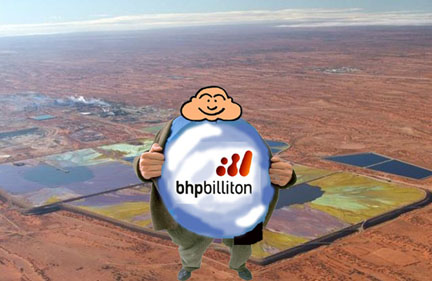
It is clearly a conflict of interest to have a corporation with a commercial interest in a piece of land also making decisions as to whether this same piece of land has competing non-commercial values.
Uncle Kevin Buzzacott is an Arabunna elder. Arabunna land lies North of the mine site. The borefields which extract water for the mine from the Great Artesian Basin are located on Arabunna land. The recent recognition of the Arabunna peoples long standing Native Title claim does not give the Arabunna people any rights to contest the location of the borefields. The GAB feeds the mound springs scattered throughout the Lake Eyre region. The springs are integral to the desert ecosystem and sacred to the Arabunna people. They have already been impacted by the water usage of the current mine.
by Nectaria Calan, 9 July 12, The Lizards Revenge was first announced on the 10th October 2011, coinciding with the State and Federal approvals of the Olympic Dam expansion. Since then, Rio + 20 in June this year has highlighted the failure of the concept of sustainable development and the failure of individual governments and the international community to genuinely address the ongoing environmental destruction that has become a feature of our age. Continue reading
Sydney hospitals’ dangerous dumping of radioactive materials

Toxic health dumping scandal, SMH, July 8, 2012 Natalie O’Brien The dangerous disposal of hazardous substances including liquid uranium and contaminated objects, the dumping of the confidential records of patients and the mishandling of asbestos have exposed a culture of mismanagement in Sydney hospitals. : http://www.smh.com.au/national/health/toxic-health-dumping-scandal-20120707-21nqp.html#ixzz204LVGURR
Australia’s Solar PV threatening profits of big energy companies
 How big utilities propose to kill solar PV, REneweconomy By Giles Parkinson 9 July 2012 A couple of nasty figures have been produced in recent weeks that will give energy companies – retailers, generators and distributors – cause to reflect on how they will manage to satisfy their shareholders’ insatiable appetite for increased profits in coming years.
The figures were inter-related. The first lot were the updated demand forecasts issues by the Australian Energy Market Operators. Demand for 2012/13 is now likely to be nearly 10 per cent below where it was predicted just a year ago, and demand out to 2020 might be 30 per cent below the most optimistic predictions. For an industry that has relied on an unremitting correlation of electricity demand to GDP growth, this has been a shock to the system.
Part of this reduction has been partly blamed on reduced manufacturing, and partly on reduced demand from households and business in response to surging electricity costs, and on the massive investment in infrastructure to cope with peak demand. But the most enduring, and growing factor, at least on the demand side, is the penetration of solar PV. And AEMO forecasts give little consolation to the established industry – the amount of solar PV in the Australian market is tipped to grow 10-fold over the next two decades, and its impact on revenue and profits for the incumbent generators, retailers and network operators will increase accordingly.
Private forecasts suggest that the growth of solar PV could be much greater than that recognised by AEMO. Yingli, the world’s largest solar PV manufacturer in 2012, has said that Australia could, in fact, become the first “mass market” for solar PV in the world – thanks to a combination of declining costs, rising grid prices, lots of sun and innovative financing models…….
Here are some tactics that are being suggested to deal with what AGL Energy managing director Michael Fraser described on the Radio National Breakfast program 10 days ago as the “infiltration” of solar PV and distributed energy. “It’s been a good thing,” Fraser said. “But we will have to watch that.”…. http://reneweconomy.com.au/2012/how-big-utilities-propose-to-kill-solar-pv-81496
Aborigines boo Australia’s Aboriginal Affairs Minister Jenny Macklin
 Macklin booed at NAIDOC night 9 July 2012 Federal Aboriginal Affairs Minister Jenny Macklin has been booed at an official function in Hobart because of her support for the Northern Territory intervention…..
http://www.radioaustralia.net.au/international/2012-07-07/macklin-booed-at-naidoc-night/975600
Aboriginals and supporters march for human rights, land rights
 Indigenous march marks long quest for rights, ABC News, By Myles Morgan, July 06, 2012 Hundreds of Indigenous people and their supporters have marched through the streets of Darwin as part of NAIDOC week celebrations.
Waving Aboriginal flags and banners, they chanted and walked to the accompaniment of clapping sticks.
Many were asking for the same thing: “Rights, land rights, equality, the same rights that other Australians take for granted.”… NAIDOC week is also marking 40 years since the Aboriginal tent embassy was set up at Old Parliament House in Canberra. NAIDOC week is also marking 40 years since the Aboriginal tent embassy was set up at Old Parliament House in Canberra…. http://www.abc.net.au/news/2012-07-06/naidoc-week-march-darwin-city-streets/4114680?section=nt
Which one REALLY is the liar – the Prime Minister or Tony Abbott?
 Abbott is reported as saying during the post-election negotiations that he would ”do anything” to be prime minister. This implies that he, too, would have accepted a carbon tax as part of a minority government compromise.
Taxing the truth: why we must not let Abbott’s dogmas lie, The Age, July 7, 2012 Ian Robinson Opposition Leader Tony Abbott constantly accuses the Prime Minister of ‘lying’ when she made a commitment before the last election not to introduce a tax on carbon. But who’s the liar here? Continue reading
Australian businesses don’t want repeal of carbon tax
 The opposition climate spokesman, Greg Hunt, (left) repeated his prediction that if the Coalition won the next election, there would be no carbon price in Australia for the next 20 years.
Keith Orchison, a former head of the Australian Petroleum Production & Exploration Association, said Mr Hunt’s 20-year prediction was out of step with business. Investors in mining, power infrastructure and large manufacturing – which look 20 years or more ahead – were assuming a carbon price, he said.
Businesses reject Abbott’s vow to repeal carbon tax, SMH, July 7, 2012, David Wroe with Adam Morton and Paddy Doulman FEWER than a quarter of the biggest heavy greenhouse gas-emitting companies that will directly pay the carbon tax support Tony Abbott’s ”pledge in blood” to repeal the scheme, a survey by the Herald has found…
.The Herald asked 40 of the biggest emitters on the government’s list of 294 companies that will pay the carbon tax whether it was in their interests to repeal or change the scheme. Nine indicated they supported a repeal, Continue reading
When El Nino strikes, Australians will believe in global warming again, and in carbon tax?
 This week, the weather bureau warned another El Nino event was looming for the coming year.
The last time Australia went through El Nino, the country had its worst drought in more than a century. Not surprisingly, many Australians drew a connection between the drought and climate change and the need for action.
 El Nino may be good for Labor The West, Andrew Probyn July 6, 2012, Shhhh! Don’t mention the war. As the great heatwave struck the US, knocking off thousands of temperature records, Bob Henson, a meteorologist at the National Centre for Atmospheric Research in Colorado, was asked this week whether any of this could be down to climate change.
“Climate change is a political question,” he told Fairfax’s US correspondent Nick O’Malley. “I thought it was a scientific question,” O’Malley responded. “Well, it’s both.”
This was a fascinating exchange. Especially in a week where scientists could confidently announce they had confirmed the existence of the Higgs boson, the so-called God particle. Comparatively speaking, there’s less evidence of the Higgs boson than there is of climate change, but we believed the scientists when they told us they had found the elusive subatomic particle that explained mass.
The fact that Mr Henson went straight to the politics of climate change, rather than going to the cause of climate change
(anthropomorphic or otherwise) speaks volumes for the success of the campaign against the so-called “warmists”….. Continue reading
Military leaders concerned about USA yanking Australia into war
 Former lieutenant-general Peter Leahy, who headed the Australian army for six years to 2008, is watching it all with increasing alarm, urging Canberra to be wary about falling in with US ambitions to maintain ”primacy” in China’s maritime backyard……
”My concern is that we are so embedded in the US planning process, we are so interoperable with them, that there’s this expectation we will be involved in whatever [the US] does …
Hugh White, a former senior defence official and author of the earlier 2000 white paper, also fears Australia being drawn too tightly into US brinkmanship with China…….White points out that almost everywhere but inside Australia, the arrival of US marines in Darwin for six-month ”training rotations” is being viewed as the effective establishment of an American land base here – for direct deployment to conflicts …. And this, too, is being largely driven by Washington’s ”strategic pivot” towards China……..
Defence ready to muscle up, THE AUSTRALIAN, July 7, 2012 Australia has a choice: spend big preparing for war or focus on smaller regional skirmishes. Deborah Snow and Hamish McDonald report. It takes the skills of a diplomat as well as those of a soldier to head the Australian Defence Force. So it was startling to hear unusually plain talk from the present chief, General David Hurley, at a low-key event at the Lowy Institute in Sydney one evening last month.
Touching on the delicate subject of growing Chinese-US rivalry in the region, Hurley revealed: ”When I am asked by my US counterpart what’s my major concern about the relationship between Australia and the US, I say the relationship between your military and the Chinese.” Continue reading
1 This month


Help Aunty Sue Protect Her Land and Sacred Sites From Destructive Rocket Testing.
.

Australians deserve the truth
about
AUKUS – https://aukuspublicinquiry.com/

PETITION – To: Prime Minister Anthony Albanese and the Australian Labor Government

of the week – Australians for War Powers Reform (AWPR)
To see nuclear-related stories in greater depth and intensity
 Antinuclear