South Australian government backing miners, bankrupting Aboriginals with legal costs
 State seeks day in High Court over land rights, BY:SARAH MARTIN, SA POLITICAL REPORTER The Australian May 11, TRADITIONAL owners have warned that a government High Court challenge over land rights in South Australia’s mid-north could send them bankrupt.
In the High Court today, the South Australian Labor government will appeal to have a finding against it overturned. Lawyers will seek costs of up to $300,000 from the Adnyamathantha Traditional Lands Association.
The South Australian Supreme Court ruled in December that former Aboriginal affairs minister Grace Portolesi had “deprived the traditional owners of the opportunity to protect and preserve their heritage” by failing to respond to a request for authority over their land at Lake Torrens, about 345km north of Adelaide.
The court found the government ignored the request from traditional owners for control over the land for about seven months.
However, on the same day Ms Portolesi responded to their request expressing “concerns” over the application, she approved the destruction of significant cultural sites on the land by a mining company, Straits Exploration.
Lands association chairman Vince Coulthard said he was surprised the government was attempting to overturn the ruling and impose costs on the group.
“It could potentially bankrupt us, but maybe that is what the state government wants,” he said.
“I feel it is a mean attack on us, given this whole thing could have been avoided.”
The court found Ms Portolesi had denied traditional owners “procedural fairness” by authorising drilling at the Lake Torrens site while failing to respond to a request for a delegation of ministerial powers to the traditional owners.
Under the Aboriginal Heritage Act – which the government is now reviewing – the minister must transfer authority to traditional owners if requested……..
The High Court will consider today whether it will accept the state’s application for a hearing. http://www.theaustralian.com.au/national-affairs/indigenous/state-seeks-day-in-high-court-over-land-rights/story-fn9hm1pm-1226352471154
BHP Billiton putting Olympic Dam expansion on the back burner
Australia’s Copper and Mining Hopes Expected to be Staggered, Resource Investing News, By Shihoko Goto, 11 May 12 “…..Earlier this month, both Rio Tinto and BHP Billiton suggested that they are reconsidering investment plans in an effort to lower risks amid rising costs and uncertain demand. Greater pressure from governments, particularly in developing countries, to tax mining companies as resource nationalism rises worldwide is also a concern……..
BHP’s head of aluminum, nickel, and corporate development, Alberto Calderon, said that the company will be staggering its expenditure in order to match its cash flows – which could slow down the development of mega-projects, including its Olympic Dam copper-uranium project – so as to maximize value, reduce risk, and balance short- as well as longer-term returns.
The Olympic Dam project has been slated to be taken to the board for approval this year, but BHP has stated that is will “live within its means.” Still, it is unlikely that the Olympic Dam project will remain a priority for BHP Billiton…. : http://resourceinvestingnews.com/36093-australias-copper-and-mining-hopes-expected-to-be-staggered.html#ixzz1ubSgvacP
Australia’s budget : handouts to mining companies far exceed carbon price
Reaction to Federal Budget 2012 SMH,May 8, 2012 http://www.smh.com.au/business/federal-budget/reaction-to-federal-budget-2012-20120508-1yba0.html#ixzz1uPdyOZDc
“……..DON HENRY, Australian Conservation Foundation chief executive Score: 6.5/10 “The federal budget’s failure to tackle wasteful, inefficient tax breaks that promote fossil fuel use and pollution is a blow to Australia’s environment.
Continuing the senseless diesel fuel handout to mining companies is a much bigger slug to Australian households
than any carbon price, with the handouts to mining companies projected to increase to $182 per taxpayer, per year, costing $9.4 billion over the forward estimates.
The budget includes full funding for the climate package, including assistance for households, a boost for
renewable energy through the Clean Energy Finance Corporation and the Biodiversity Fund – we warmly welcome this. But Australia should not be axing tax breaks for green buildings and slashing the aid budget, while leaving untouched billions of dollars of tax breaks for mining and resource industries to pollute our environment. The budget contains $14 of new spending on roads for every $1 spent on rail – this is the wrong priority.”
Draconian Aboriginal Intervention laws meeting with powerful community opposition
 From the bush to Bankstown, communities prepare to fight ‘Stronger Futures’ welfare laws Green Left, May 10, 2012 The Stop the Intervention Collective Sydney released the statement below on May 9.
Remote NT communities are joining with the south-western Sydney suburb of Bankstown in a pledge to challenge the implementation of ‘Stronger Futures’ legislation which is set to be debated in the Senate.
“Stronger Futures” will extend draconian NT intervention powers for a further 10 years. The laws also facilitate the national expansion of income management, pioneered under the NT intervention, beginning with Bankstown and four other “trial sites” across Australia.
“Stronger Futures” has faced fierce opposition from Aboriginal communities, churches and peak organisations. More than 36,000 people have signed the online “Stand for Freedom” campaign calling for withdrawal of the legislation.
In a historic statement from Arnhem Land last week, Yolŋu Elders pledged to refuse to negotiate any leases, including mining exploration leases, while the government pushed ahead with “Stronger Futures”.
In Bankstown, the Say No to Government Income Management Campaign Coalition, with strong roots in the community sector, Aboriginal and migrant communities, is organising a major seminar on May 26 to discuss strategies for stopping the implementation of income management…… Paddy Gibson from the Stop the Intervention Collective Sydney has just returned from a research trip to the Northern Territory.
He said: “The NT intervention was designed to deny any control or opportunity to Aboriginal people in remote communities and force a migration into town and larger settlements. Every time I visit these communities the situation has deteriorated further. People are completely disenfranchised, there is next to no employment and in places even basic amenities like sewage are collapsing.
“Scratch the surface of the government’s ‘Stronger Futures’ budget announcements for the NT and you find even less funding for homeland services than the current levels which keep people living in third world conditions.
“The decision not to fund a waged employment program to replace CDEP, once 7500 strong in the NT, is a death sentence for many communities. Meanwhile funding for bureaucracies to punish and control Aboriginal people through the income management and prison systems are spiraling out of control.”…. http://www.greenleft.org.au/node/50971
Australian rare earths company Lynas held back by public opposition in Malaysia
the expanding protest movement …… has already delayed the project by eight months and cast a shadow over its future.
The resistance – fed by social networks and Malaysia’s increasingly lively independent online media – also raises broader questions over the global expansion of an industry that has created huge environmental problems in China
Opponents say the Lynas plant doesn’t meet with best practice standards for the industry as it is too close to heavily populated areas and in a place where the ground water level is high. Molycorp’s plant in California, by comparison, is situated far from residential areas in an arid climate.
Citizen backlash keeps Malaysia rare earth plant on hold, The West, Siva Sithraputhran, Reuters May 9, 2012 GEBENG, Malaysia – The expensive machinery lies silent, idling as Malaysia’s government weighs a delicate decision to allow shipments of raw material to arrive from Australia and finally start operations at the world’s largest rare earths plant outside China. Continue reading
Honeymoon uranium mine ‘not economic’ says Mitsui trading company
 Mitsui pulls out of Honeymoon mine, BY: BARRY FITZGERALD The Australian May 10, 2012 JAPANESE
trading house Mitsui is pulling out of Australia’s newest uranium mine, the 340 tonnes a year Honeymoon operation in South Australia’s outback….. Mitsui took up its stake in Honeymoon in 2008. It was a first for the trading house, adding uranium to its better known portfolio of oil, coal and global liquefied natural gas interests.
Honeymoon started production in 2010 after expenditure of $138 million, with Mitsui’s entry cost being a $104m contribution to the capital cost. Its annual production makes it the smallest of Australia’s uranium mines behind ERA’s Ranger mine in Kakadu, BHP Billiton’s Olympic Dam in South Australia and Heathgate’s Beverley
mine in South Australia.
Mitsui’s exit follows the one-year anniversary of the earthquake and tsunami, which led to meltdowns at the Fukushima nuclear power plant in Japan. But a Mitsui spokesman said the decision to exit Honeymoon was not directly related to the Fukushima tragedy.
Mitsui “could not foresee sufficient economic return from the project”, he said.
Stop Northern Territory aboriginal Intervention laws – Australia’s Catholic bishops tell Senate
Bishops slam NT intervention extension Big Pond News, May 07, 2012 Australia’s Catholic bishops have urged the Senate to block draft legislation to extend the Northern Territory intervention in Aboriginal communities.
Labor’s Stronger Futures draft laws are likely to clear the upper house with bipartisan support when federal parliament resumes this week. Continue reading
Australian government and scientists refute climate denial propaganda to kids
The document appeared on the department’s website last Wednesday — along with a list of other trusted sources on climate science, including the CSIRO, the Bureau of Meteorology, the latest Australian Academy of Science report and the latest review from the Climate Commission.
Dept of Climate Change rebuts Plimer’s book for sceptic kids Crikey, by Amber Jamieson, 8 May 12 The Department of Climate Change and Energy Efficiency have confirmed that the decision to commission and publish a document called Accurate Answers to Professor Plimer’s 101 Climate Change Science Questions was made in reaction to outrage from teachers and scientists about Ian Plimer’s climate sceptic book aimed at children. Continue reading
Olympic Dam uranium uneconomic? might not proceed, but they will try to blame Australian government

the talk in the market is how big a write-down the company will have to make on these two acquisitions in the next 12 months, how much longer Kloppers will remain CEO, and what will happen to BHP’s pipeline of mega-growth projects.
Miners review plans as tax bites, The Age, Adele Ferguson, May 7, 2012 IN THE countdown to the federal budget miners have made a lot of noise about cost blowouts threatening tens of billions of dollars of projects due for final investment approval this year……..the budget may try and save itself billions of dollars a year by removing the diesel fuel excise rebate…..
The problem facing the government is a two-speed economy in which manufacturing, retail and tourism are being battered, while the mining sector and associated industries continue to do well but at a slowing pace.
This means if the government goes too far taxing the miners, it may give the miners the excuse they are looking for to pull the pin on some projects that are on the borderline of being uneconomic. Continue reading
Member for Northern Victoria Donna Petrovich called to account on her claims against wind power
 there is an onus on Ms Petrovich to come clean on her research if she is to stand by her claim that communities right across the Macedon and McHarg Ranges and big chunks of Central Victoria are “not appreciative” of this form of green and sustainable energy.
 Yes to renewables
http://yes2renewables.org/2012/05/07/where-did-the-no-go-zones-come-from/Where did the ‘No Go’ zones come from? May 7, 2012 by Cam Walker The following is a letter from last weeks Macedon Ranges Weekly. Where did the ‘No Go’ zones come from? Last year, the state government created a series of ‘No Go’ zones, which block wind energy developments across much of Victoria, including the Macedon – McHarg Ranges. The government seems to think these ranges extend almost as far north as Bendigo.
Member for Northern Victoria Donna Petrovich has said in state parliament that the No Go zones were “carefully” selected where communities “on the whole have told us that they are not appreciative of wind farms”.
Given the controversial nature of the No Go zones, and the widespread support for the Macedon and Castlemaine community wind proposals, it would be useful to understand how Ms Petrovich consulted the community
to reach her conclusion that wind power is unpopular. Continue reading
Mass media and State govt policies damaging Australia’s wind farm industry
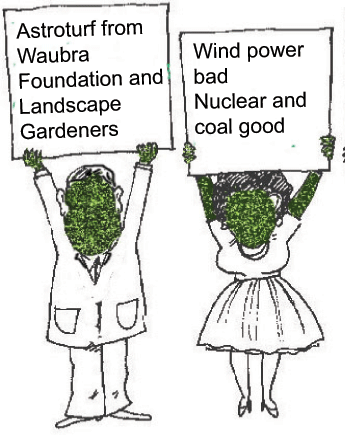 Economics taking the wind out of farm’s sails, Canberra Times, Graham Downie.May 7, 2012 “……. Infigen Energy, the largest wind farm owner in Australia, owns Capital Wind Farm, between Bungendore and Tarago, east of Canberra, which has 67 turbines.
The company has approval to almost double this. Only the present economics prevent the extension going ahead.
Mr Upson said about 20 new wind farms had been approved in Victoria and about six in NSW. These projects had been delayed by the ”small-scale screw up”. That had now been fixed by separating the small-scale and large-scale schemes but the glut of certificates remained.
Mr Upson said some elements of the media spread a lot of misinformation about wind energy. Certainly, turbines killed a small number of birds, but this was infinitesimal compared to the number of birds killed by power lines, motor vehicles, cats and pesticides.
He also dismissed concerns that wind farms caused illness. ”There is no independent, regulatory, scientific or medical body in the world that thinks wind turbines make people sick.”
With wind energy worldwide doubling every three years, there would be an epidemic of biblical proportions if wind turbines made people sick. ”There are wind turbines everywhere in Europe and no one is getting sick.”
Mr Upson said the wind industry worldwide had grown by more than 25 per cent each year for the past 15 years. ”I challenge you to think of another industry that has had this sustained and long-term growth.”
Wind produced less than 2 per cent of the total electricity demand in NSW and the ACT, but in South Australia, with a greater wind resource and less demand for electricity, wind produced about 25 per cent of that state’s total demand. At times, it reached about 70 per cent.
Though generation from wind turbines was variable, the Australian Energy Market Operator could now forecast wind energy throughout the grid with 98 per cent accuracy an hour ahead. This meant other generators were turned on or off as required.
Wind farms were expensive to build but were very cheap to run. So they could under bid coal and gas generators given suitable wind.
Infigen had plans to develop solar generation and would be pleased to be selected in the Solar Flagships program, he said. ”In which case we would build three large-scale solar facilities.” One would be at the Capital Wind Farm, one at Nyngan and one at Manildra. At present, generating electricity from even large-scale solar plants was about twice as expensive as from wind.
”May be by the middle of the decade it might be more competitive … to build a large-scale solar facility we need some sort of grant or subsidy.” http://www.canberratimes.com.au/act-news/economics-taking-the-wind-out-of-farms-sails-SMH 20120506-1y7bt.html#ixzz1uDQDJkG
Australian company selling award-winning solar panels to Bulgaria
 REC Inks 20MW Bulgarian Solar Panel Deals, by Energy Matters, 7 May 12, http://www.energymatters.com.au/index.php?main_page=news_article&article_id=3193 Renewable Energy Corporation (REC) has signed agreements to supply 20 MW of its award-winning solar panels for facilities throughout Bulgaria.
The company says it signed a deal for 10 MW with ALMA-D Ltd. to provide its 240 watt Peak Energy series modules to a 6 MW solar farm in Kamenar and a 4 MW plant in Kameno – both near the Black Sea in Bulgaria.
REC also signed three separate contracts with local Bulgarian partner Elektro-Solar Systems Ltd. for 2, 3 and 5 MW solar electric generation plants; all of which will be constructed this year.
The company says the latest deals bring the total amount of REC modules installed in Bulgaria to 50 MW; boosting REC’s share in Bulgaria’s solar market to 15%.
Among the other accolades for REC – a nomination for 2010’s prestigious Intersolar Photovoltaics Award and a Solar Industry Award for Module Innovation, also in 2010.
REC’s Peak Energy solar modules have become a common sight on the rooftops of Australian homes after Melbourne-based Energy Matters introduced the panels to the local home solar power market in June 2010.
Energy Matters is a REC Platinum Partner – the only company in the Asia-Pacific region to achieve that standing. The company was also Australia’s first accredited REC Solar Professional and is able to offer an extra 2 years product warranty on REC solar panels the firm installs.
Who is lying about uranium ? New South Wales Resources Minister, or Queensland Premier
 Who is telling the truth? New South Wales Minister for Resources, Mr Hartcher? or the Queensland government?
In fact, both States prohibit uranium mining. New South Wales has recently allowed uranium exploration only.
THE HINDU 4 May 2012, reports that New South Wales Minister for Resources and Energy and Central Coast Christopher Peter Hartcher announced on Friday that both New South Wales and Queensland State governments in Australia had changed their laws which prohibited mining and sale of uranium.
Also Mr Hartcher is quoted “We also respect India’s decision on not signing the Nuclear Proliferation Treaty (NPT)” http://www.thehindu.com/news/national/article3384772.ece
See this article – No plans for uranium mining ban rethink http://www.abc.net.au/news/2012-05-02/no-plans-for-uranium-mining-ban-rethink/3984350?section=business By Stephen Smiley ABC News May 02, 2012 “The State Government says it has no plans to revisit Queensland’s ban on uranium mining.”
Queensland Premier Newman has recently reiterated the position that uranium mining is banned in Queensland.
And as for Mr Hartcher “respecting” India’s decision on the NPT, he is in the minority. Most Australians are appalled at the idea of selling uranium to a country that won’t sign the NPT.
Australian government has been intelligent about free trade agreements
 virtually every free trade agreement we’ve [ USA] negotiated since the 1994 North American Free Trade Agreement (NAFTA) has contained language that lets foreign corporations sue governments directly — in private and non-transparent tribunals — for unlimited cash compensation over almost any domestic law (environmental or otherwise) that the corporation argues might hurt its profitability.
The sole exception is our free trade agreement with Australia — because the Australian government refused to allow its laws to be attacked by foreign corporations.
That was smart, because corporations have been quick to take advantage of this ability to attack a country’s laws and protections.
What Are They Trying to Hide? HUFFINGTON POST, Michael Brune , 4 May 12, Odds are that you haven’t heard of the Trans-Pacific Partnership (TPP) agreement. And even if you’ve heard of it, I’m willing to bet you don’t know what might be in it. That’s because, although this massive new trade agreement could have profound implications for our environment, our health, and the rights of workers, it is being negotiated in almost complete secrecy. Continue reading
Musicians, church leaders and 36,000 Australians oppose the “Stronger Futures” laws
Former Liberal prime minister Malcolm Fraser, the Catholic Church and Uniting Church have backed the elder’s stance.
More than 36,000 people have signed the Stand for Freedom campaign petition against the Stronger Future laws.
Musicians rally against ‘Stronger Futures’, THE AUSTRALIAN AAP May 04, 2012 AUSTRALIAN musicians Paul Kelly, Neil Murray and Archie Roach have joined Northern Territory Aboriginal leaders in rallying against the federal government’s Stronger Futures Laws. Continue reading
1 This month


Help Aunty Sue Protect Her Land and Sacred Sites From Destructive Rocket Testing.
.

Australians deserve the truth
about
AUKUS – https://aukuspublicinquiry.com/

PETITION – To: Prime Minister Anthony Albanese and the Australian Labor Government

of the week – Australians for War Powers Reform (AWPR)
To see nuclear-related stories in greater depth and intensity
 Antinuclear